Langston Hughes’ “Cabaret”

Before we close the book on National Poetry Month and International Jazz Day, here’s a musical performance of a poem by Langston Hughes. I didn’t think I’d be able to complete it today — but the opportunity arose, and it’s more than appropriate for both observations.

Langston Hughes was one of the founders of Jazz poetry, and that style of reading poetry that interacts with a musical accompaniment (even if it’s not sung) is an influence for some of the performances you’ve heard here in this Project. I can’t say what year Hughes first performed his poetry that way, but there’s another meaning to Jazz poetry without a band: poetry that writes about the experience of Jazz music itself. And Hughes was repeatedly doing that in the early 1920s.

Decades later, a 1950s Hughes reads his 1920s poem “The Weary Blues” in front of a Jazz combo

.

This, a combination that appreciated Jazz, was not a sure thing in the early 1920s. Afro-American intellectuals and cultural critics were not universally fond of Jazz and Blues music, these great Afro-American Modernist musical forms arising right under their noses. There were reasons: it was associated with drugs, drink, criminality, and sexual promiscuity — and none of that promoted Black achievement and excellence in their minds. And some young white folks were taking an interest in Jazz for those very reasons. Tut-tut voices from both racial camps were observing their young people and thinking it was all about mindless, hedonistic partying. Let me repeat myself: when the last decade to be called “The Twenties” was called “The Jazz Age,” it wasn’t meant as a compliment.

I’d suspect this isn’t widely known to many readers. Jazz, to our 21st century Twenties, might be felt as supposed-to-be-good-for-you-but-boring-art music made up of too many weird chords and snobbish old men with a fetish for instruments you blow into. If we take it too seriously, too often now, the problem in the 1920s was they didn’t think it had a serious bone in its body.

Maybe it helped that Langston Hughes was a young man, a teenager when the 1920s began. He appreciated things in Jazz and Blues that even his Afro-American elders didn’t see. He knew it could be a balm to pain and disappointment, its expression and expiation — and he could see the art in it, an art to wrap into his poetry. This small poem of his, published in 1923 in the W.E.B Du Bois/NAACP The Crisis magazine, hears something others couldn’t: he hears a Jazz band cry — or rather his poem reports a woman heard this. Here’s a link to the full text of the poem.

Even in the shortness of his poem, note the dialectic here. The band, earlier in the night, had dancers, “vulgar dancers” it says. The older cultural gatekeepers at the Crisis would agree as they accepted this poem, “I see the young poet is aware of the dangerous moral unseriousness of the Jazz hounds.”

Why could Hughes hear what others didn’t? Well, he’s a great poet, and a poet that wrote often and empathetically of other people’s experiences. There’s another possible element. Do modern ears hear the poem’s second line differently than his readers in the last Twenties? “They say a jazz-band’s gay” he wrote. “Gay” in the 1920s would have clearly meant “happy.” As far as scholarship understands this, gay=homosexual seems to have come into use a bit later, perhaps in the 1930s, and to general readers, that meaning emerged in an even later era.

Hughes’ own sexuality is not something we know a lot about. Some say he was gay, some say he was asexual. One thing I get from reading Hughes’ early poetry is that he’s hearing and telling his stories not just from a stereotypical straight masculine viewpoint. Is it his anima that’s the she who “heard the jazz-band sob” in the poem? Or is he just listening to a woman?

Well, my performance of Langston Hughes’ “Cabaret”  is ready to be heard. Unlike the last piece, I made no pretense of Jazz music as it’s classically understood this time, but I do throw in some weird chord extensions. You can hear it with the audio player below. No player to be seen? The dancers have left, and some ways of reading this blog suppress the display of the audio player. If so, use this alternative, a link that will open a new tab with its own player.

.
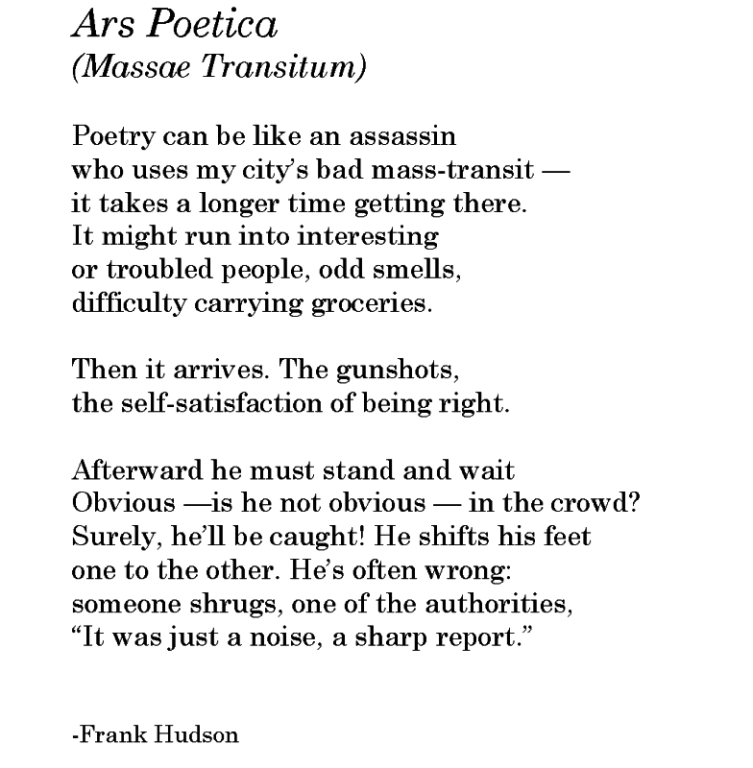
Ars Poetica

Today I take on one of those poetic expressions a great many poets have engaged with: the poem about the state of poetry. The title gets written in Latin to puzzle readers, and because Horace wrote in Latin back when the world had to worry about the whims of tyrannical kings and poets got their words carved in marble. We’re much more culturally advanced now. You can hear this poem anywhere in the world using the Internet. Dozens will listen with you during National Poetry Month. Dozens!  Imagine the value of that if that dozens was of eggs.

I briefly hesitated to share this poem of mine publicly. Not only is this project largely about other people’s words, but my Ars Poetica poem starts off comparing some poets to assassins. That’s a metaphor, a conceit, a simile.  I’ve shared other civic poems about the fate of nations this month, but I’m not a big fan of political assassination — but then I’m also not a big fan of making fun of poets, and I’m going to do that today. And it is  a civic poem. On my way to comparing poets to assassins I make note of the state of mass transit in my fair-sized midwestern American city, which is: pretty bad. Not assassination bad. No! Rather my point is that it would be bad for an assassin. Or for poets trying to get to and from poetry readings.

Ars Poetica

32 bar AABA tune. Chords are F C Am G and then Cm Gm Cm Dm in the bridge, though there are some substitutions.

.

Well, you don’t have to go anywhere to listen to the performance. And it’ll be doubly good to do so because the last day of National Poetry Month in April is also International Jazz Day, and I’m going to make some fake Jazz.* Poets, we get a month! Jazz — like a whole world of it — gets only a day. Well, it’s an international day, sliding across the globe’s time zones, but still…

You can hear me reading my Ars Poetica poem with a Jazz combo using the audio player below. No player? The Jazz Police haven’t come for it, it’s just that some ways of reading this blog suppress it. There’s an alternative: this highlighted link will open its own browser tab with an audio player.

.

*Way back in the 20th century, when we had to carry the dead weight of a constitution around all the time with laws, and due process, and so forth, a group of local improvisational comic performers used to get together and the agenda was to play bad Jazz. No, not to parody or put down Jazz, more at an honest admission that their musical skills weren’t up to that level, but the desire to have a go at it was still there. That’s me making up this Jazz quartet today. I’ve cut a corrupt deal with the composer to only write things I can play on bass and guitar, and I give the computer the chords to tickle on the piano.

John Sinclair writes two poems of Thelonious Monk

John Sinclair lived an eventful life. He’s likely still most well-known for his “10 years for two joints” marijuana sentence, and secondarily for his connection with Midwestern 1960s high-energy rock music as a manager and promoter. Maybe you know too of his founding of a White Panther Party, the quixotic attempt to translate the charismatic radicalism of the Black Panthers to young white hippies.

He was a provocative guy, and he seems to have had a promotional streak to go with that. As I often say about folks like Sinclair: no sane person can likely agree with everything he said and did. Feel free to feel about him however you did before you read this, but there’s a particular reason for a piece using his words today.

This is the last day of (U.S.) National Poetry Month, but it’s also International Jazz Day. The connection of poetry with Jazz seems to have gone back to the very beginnings of Jazz. While Jazz is a predominantly instrumental music, it grew out of a sung Afro-American music that got called Blues. Besides accompanying Blues singers, Jazz musicians often used instruments to evoke the vocal parts of Blues even when the singers weren’t present. And just as Jazz music can use abstract sounds to stand for speech, a lot of Jazz musicians infuse music into the way they talk about their life or their art. The formula of music + words is the formula of poetry.

Long time readers here may recall that I’ve made a point that lyrics in the Blues tradition are Afro-American Modernist verse, and that we can choose to frame them as such — but it’s not so novel for cultural historians to note Afro-American Jazz as an important part of Modernism in music.

Given these connections, it should be no surprise that Jazz Poetry is a long-standing flavor of American verse. Carl Sandburg and Langston Hughes wrote it early in their careers. Sandburg even sang Blues-adjacent songs. Beats adored Jazz, often thought it a literary model, and the mid-century commonplace of bohemians intoning poetry beside a Jazz combo is a influence on this Project that shouldn’t be hard to see. The Black Arts movement welded itself to Jazz too, its poetry often spoke of that music’s artists while Jazz music played.

It turns out that alongside the other things John Sinclair was, he was also a Jazz fan particularly intrigued by Jazz’s rebels. He wrote Jazz criticism, and Jazz poetry before doing anything else he was remembered for, and he kept writing that Jazz poetry throughout his life. When I read that Sinclair had died during the first week of this April’s National Poetry Month, I sought out some of that poetry of his.

The examples you can hear today may surprise you. They did me. For all Sinclair’s association with high-energy music and radical politics I expected some rantings of a passionate sort, strong declamations. He may have written some of that, but these two you can hear me perform were the ones that intrigued me the most. They might seem too casual to be poetry or even public speech, save for his intent to frame them so. They don’t even contain his own words for the most part. Instead, they are statements attributed to Jazz pianist/composer/bandleader Thelonious Monk.

Monk’s a unique creature, even in the highly individualized world of creative Jazz musicians. He was present at the creation of Bebop in NYC in the 1940s, but unlike many of that style’s pioneers there was puzzlement at his skills. To not put too fine a point on it, many connoisseurs weren’t sure he was a good musician. His piano technique was unorthodox, his note choices seemed odd-to-wrong even within the extension of harmonic language that Bebop was proposing. Was that a misunderstanding by (largely white) outside authorities? There’s more: Monk confounded other skilled Jazz musicians who thought he was erratic, not always a steadfast partner in their musical combos that could give the other soloists a predictable foundation to solo over. And on stage he would sometimes extend his eccentricities by leaving the keyboard to sort of dance and wander about the stage.

A remarkable thing happened over a decade or so of this limbo. His compositions became more and more accepted by other musicians, and with wider repetition what once seemed peculiar now seemed irresistibly catchy. Eventually they were deemed masterpieces. Other players started to understand Monk’s unique off-kilter phrasing and rhythm sense. And those odd stage antics became lovable, even if they also could have been worrying. As they would say today, Monk wasn’t neurotypical — and there’s been posthumous talk of schizophrenia-like psychosis. For a Black man working on the fringes of an increasingly marginalized art form in a mid-century America, that Monk eventually achieved so much is a monumental achievement.

Sinclair knew all this. I suspect he trusted you might know this too, and that’s why I’m taking your time to give you this capsule history of Monk. What Sinclair does collect and write down of what Monk says about his art and being an artist seems so modest — both for the poet and the musician. In the first poem, “recollections for allen ginsberg”  Monk claims in effect that he’s discovered the pluperfect American music as just being in this America, ready to be gathered and heard. And the lack of esteem and appreciation he’d received by fans, esteemed critics, and other musicians? The second poem Sinclair gathers (gathers like the Jazz that’s everywhere) and titles “worry later – san francisco holiday – for my mother”  says he intends to persevere trusting himself, eschewing worry about the lack of understanding. Why does he think that, how does he go on making art? The making itself: “my playing seems to work!” he says. Is he saying that he himself understands the achievement of his own work based on his goals, and so is glad he made it — or is he saying that the concreteness of making something that integrates into a something that didn’t exist before is the best therapy for a life that could otherwise be consumed with worry and doubt? My understanding is that he’s saying both.

A lyric video of today’s piece

.

The Valerie Wilmer that Sinclair credits for the Monk quote in the second poem made a series of invaluable photographs of Afro-American Jazz musicians toiling on in the creative fringes of music after their music became even more marginalized than it was in Monk’s time. Her book As Serious as Your Life  is a document of making that work and the musical artists it depicts.

My performance of Sinclair’s two poems features my best attempt at realizing a Monk-ish composition to accompany it. There are two unfinished drafts of this post where I tried to come to confessional terms with my feelings about that process of realizing the piece and my audacity to present myself in the context of real musicians with lives devoted to their craft. I decided to spare you all the breast-beating since I came to see that as boring. As a composer, I guess I could conclude with a variation of that Monk quote “I’ll tell you one thing: my composition seems to work.” You likely saw the video link above, but if you prefer just the audio, there’s a graphical audio player below, and this backup highlighted link for those who don’t see the player.

.

Jazzonia: May Music Find a Way on International Jazz Day

The end of U. S. National Poetry Month is approaching and there are things I meant to get done (and didn’t) this year, but the last day of April is also International Jazz Day, and I can’t let that go by without a piece to celebrate. Poetry Month and Jazz Day — shouldn’t that be a piece of Jazz Poetry read in front of a Jazz combo?

I looked around the house and didn’t find one. Not the Jazz poem, it was easy for me to think of Langston Hughes, one of the originators of the form, and find a poem of his, “Jazzonia”  that I didn’t perform when I celebrated his book The Weary Blues  a couple of years ago.

No, it’s the Jazz combo that’s missing. Not in the garage, not in my studio space, not under the table in my office amidst that messy pile of stuff. Not in my phone’s contacts list. None marching down the street in my city too northern and cold for Mardi Gras.*  Oh sure, there are a couple of Jazz clubs in town, and local musicians who can play Jazz, but I don’t know them. I’ve handed out Parlando demos to a couple over the past few years, and heard nothing, which may indicate politeness around my audacious use of my limited skill-set — and that would be right. I can sort-of hang with a Jazz feel on a good day with guitar as long as I’m under control of the context,** but Jazz isn’t about tightly controlling the context. It’s about surprise, about flexible chops that fit with a multitude of things.

So, I went about doing my best with what I had at home. I have a little device I use to practice instead of a metronome. It lets one play-in a set of chords in rhythm, and then generating from the form you play a drum and bass track following the harmonic material in tempo you’ve given it. It’s a fine quick practice tool, but I’ve only used it a couple of times here for public Parlando Project pieces.

I prefer to put in work on the digital drum tracks, adding hand percussion, even playing a real ride cymbal I collected from a neighbor a few years ago, editing the hits and beats on drum patterns — but I let that go this time. The machine had supplied a serviceable walking bass part, I let that stand as well. I played the guitar part in a single pass after warming up. I had to duck out a couple of egregious clams, but it represents one of my good guitar days.

Jazzonia 2

In the whirling cabaret, guided robots and human jazzers play for Poetry Month and Jazz’s Day.

.

Looking at Hughes’ poem (full text here)  I see that he specifies there’s six Jazz players in his poem’s combo. If I count my reading at the mic as a player, that got me up to four, including the two robots on bass and drums. So, I next checked out my naïve piano skills. I was pleased with a couple of little motifs I came up with. My repetition with under-elaboration of those motifs marks this piece as more of the simplified “Soul Jazz” emanation*** than a hardcore blowing session. That’s OK with me, I liked those records. For the sixth and final musician, I played some vibraphone over MIDI from my little plastic keyboard.

The above account may have convinced too many readers to not listen to the result, but for a one-day-wonder I think it came out pretty well. It’s a little longer than most pieces I present, but that lets its relaxed celebration grow on you if you’re receptive. The audio player gadget to hear it is below for many, and this backup highlighted link is for those that don’t see that.

.

*One thing my town once had, and I now miss, was the May Day parade that happened each year in my neighborhood. Elaborate giant puppets, kids on decorated bicycles, dancing troops, folks on stilts or riding on fantastic creations, and usually more than one amateur shambling marching band with a touch of second -line New Orleans flavor. Alas, lack of funds and what seems to be a case of sectarian infighting has stopped this annual event. I did some videos of this while it was still a going thing. You can see some here, here, and here.

**Jazz guitar is much about chord chops, something I’m embarrassingly bad at. Similarly, advanced Jazz harmony will confuse me quickly if I try to understand it in real time. Luckily, with this Project I usually get to be the composer and bandleader, so I work with myself the player to do what I can accomplish.

***You’re still here reading the footnotes? Good, this probably should have been the main thing in this post. Langston Hughes’ long life and immediate and lasting appreciation for Jazz meant that he could write about and be influenced by early Jazz when Dixieland was fresh, and then he continued to dig it, incorporate it, and perform his poetry with Jazz musicians in the post-WWII years. So even though Hughes wrote “Jazzonia” about 1920’s Jazz, he lived long enough that he could have performed it more in the mid-century bag I experienced then and sought to manifest today.

What’s extra cool about how Hughes presented the still emerging Jazz of the 1920s in “Jazzonia”  is that he sees it already as part of a continuum from the African Garden of Eden, and then via Cleopatra, and through Harlem Renaissance — so it’s no surprise his Jazz, and Jazz itself, can keep on reformatting itself into new ways of expression. The honesty I shared regarding this audio piece above? It’s part of living the Musician’s and Composer’s Prayer: “May music find a way.”

Completing my National Poetry Month daily posting with two beautiful pieces

It’s been quite the job of work to do daily posts with new lyric videos here this April in celebration of National Poetry Month, and I haven’t taken the time yet to see what impact those extra efforts have had. Though I was re-releasing already recorded audio pieces from the earliest years of this six-year Project this month, even the fairly simple lyric videos took more time than you might think — and then there was the selection of which pieces to present, as well as writing a few hundred words on what I currently thought of each of them.

Well, not only is today the last day of National Poetry Month, it’s International Jazz Day, and I felt I needed to make a nod to that today. So, let’s play two!

The first piece is, I think, one of the prettiest of the more than 600 performances we’ve presented: Carl Sandburg’s “Autumn Movement.”   Sandburg gets tagged as an urban poet, and of course he broke into the scene with Chicago Poems in 1914. But he grew up in a more downstate Illinois town, and traveled around the less urban areas of the country before spending the majority of his “now you’re famous” years on a small goat farm. “Autumn Movement”  is from his 1918 Cornhuskers collection, which as you might expect from its title is not all city living.*

Here’s Sandburg with farmland not skyscrapers

.

While “Autumn Movement”  is short in word-count, I did get to playing a bit as I tried my best to approximate in this piece the stylings of Bill Frisell with my Telecaster and fretless bass. Frisell, who can play more contexts more better than I can properly imagine, is usually labeled a Jazz guitarist. I’m not, labels or otherwise. I just have a lot of guts — but the result is  pretty.

As per our April thing, you have three ways to hear “Autumn Movement.”  You can use the player gadget just below. No gadget?  This highlighted hyperlink will do it too. And the lyric video is above.


.

And the bonus second piece? “Sonny Rollins, The Bridge, 1959”  is not an early performance (I performed and presented it earlier this year) but for International Jazz Day I thought it’d be good to have another piece that not only uses Jazz musical flavorings but actually deals with being a Jazz artist — or by easy extension, an American artist in any medium. If I’m not a proper Jazz composer or musician, I take great strength just from considering their achievements, their dedication, their originality. Given that most of the giants are Afro-Americans who’ve had a whole ‘nother level of obstacles and expectations to get over as serious artists — well, the mind boggles and the heart swells considering them.

And one more chorus: three ways to hear it: the graphical player just below this, the backup highlighted hyperlink, and the lyric video just a bit lower down on the page.

.

I hope this experiment has been enjoyable for the regulars here who may have joined the Parlando Project already in progress and who perhaps haven’t heard the earlier pieces — and it was my hope that it would also bring some new readers and listeners into the fold. If you’re one of those: welcome! I’m not predictable in what kind of poetry or music I’ll use, but I do consistently try to keep it interesting and varied, and I’d sure like to have you come along with me as I do that.

And here’s my ode to the inspiring Sonny Rollins in lyric video form

.

*I’ve always enjoyed the story of Bob Dylan seeking out Sandburg as the younger singer was just starting to reach a level of national fame in 1964. While trying to locate Sandburg, Dylan was unable to get the locals to recognize a “Sandburg the poet” he was seeking, but then they asked back if he was looking instead for “Sandburg the goat farmer.”

Robert Frost wrote a lot of poems about rural life, including many of his best and best remembered, but his contemporary Sandburg, Mr. City of the Big Shoulders, probably spent more time around actual farms and farming.