Dolphins (Heroes)

I live in a city where 12-string guitars are over-represented. Since I’ve only lived in Minneapolis for 50 years, I can’t say for sure why that’s so. Folk-revival pioneers Leadbelly and Pete Seeger, likely the ur-source for the instruments post WWII use, have no direct connection, but by The Sixties™ this powerful but awkward branch of the guitar family had a nexus of players here. The guitar playing other two sides of the Pythagorean Koerner, Ray, and Glover trio played 12-string. Leo Kottke made the beast a virtuoso instrument while working the small clubs and coffeehouses of the Twin Cities. John Denver had fallen in love with a Minnesota girl and played a lot of 12-string (and who can say what is the cause and effect there). By the time I arrived in the Seventies, Ann Reed, Peter Lang, and Papa John Kolstad also played 12-string in small venues. The year my ten-year-old Pontiac rolled into town, a local college student, Steve Tibbetts, was self-recording his first LP featuring 12-string landscapes pebbled with percussion over which roamed howling electric guitar wolves.

At that point I owned my J C Penny’s nylon string guitar and a weird amorphously shaped Japanese electric guitar I’d bought at a flea market and for which I couldn’t yet afford an amp.  Accommodating my new hometown, I soon felt I should get a 12-string guitar. A year or so after arriving I managed to afford a Cortez 12-string acoustic which was sold as a sideline item at the local Musicland record store. My memory was it cost $79. Designed to outwardly look like a “professional” instrument at the lowest cost, it could have been the music equivalent of costume jewelry or a stage prop. As these sorts of things go it wasn’t as bad sounding as modern forum-dwelling guitar aficionados would suspect, and mine had pretty good “action,” reasonable string height to allow easier fretting.

Later in the Seventies I added a DeArmond sound-hole pickup and I played this guitar with the LYL Band, and for the rest of the 20th century. With their double sets of strings, 12-strings sometimes warp and self-destruct under the increased string tension – but cheap and cheerful as the Cortez was, it’s held up, though the top has bellied-up over the years.

I eventually got a better 12-string, but I kept the Cortez around. A few years back I set it up to use Steve Tibbetts stringing variation where most of the octave strings are replaced with unison strings.*

Now let’s jump the month just ending, January 2026. As a writer I can’t paper over the immense mood shift this entails: from oddities about the types of guitars, to lives being mangled by intended government action.

I still feel unable to write fully about my reactions to the many injustices and atrocities that are incurring at the hands of thousands of federal agents that are roaming my city and the rest of Minnesota this winter. The first of the murders this month, the shooting of Renee Good in front of her wife happened on the street just across the alley of my home office and “Studio B.” If I hadn’t been wearing headphones and working on music for this Project I would have heard the gunshots – instead, it was my wife who rushed in to tell me. As of the end of the month, we’ve had a non-fatal shooting and one more murder by the federal agents, and a daily grind of sufferings. I won’t be the one to try to catalog all the careless to cruel things that are happening day after day. It sorrows me, and perhaps you, and at least for now, this information is available elsewhere. Nor will I offer enough praise for the ordinary people in this city who are trying to mitigate that suffering and plead for its ending. I will call out one thing many of them are doing: they’re seeking to be “Observers,” the term that has come to be used for folks who feel called to witness and record with their phones what our own government agents are doing to the people living around us. Think about this for a moment as you read this: these Observers are intending to go to where cruel things are being done by armed bullies who will use their weapons – issued along with pledges from their leadership that they will face no consequences – to rough up, to detain with and without charges, to attack with chemical and “less-lethal” munitions, to in two infamous cases, to kill them. Folks were doing this before Renee Good was killed – and after she was shot, more signed up. After the next murder of Alex Pretti pushed to the ground holding his cell phone camera: more again signed up.

I think of the incredible bravery of the American Civil Rights movement of the mid-20th century, and this is like unto that. But here’s something else I think concerning that role, something I don’t recall being written much about yet. There’s a chance that these observers are going to see armed agents of our government kill someone in front of them, and they’ll be tasked with recording that. The infamous murders of the Sixties’ Civil Rights movement happened in darkness and rural separation, though the corporal brutality of clubs, dogs, and firehoses was done in public and was sometimes filmed.

Along with bravery, that’s an additional heavy burden to take on. And some are now carrying that specific burden. We have memorials to Alex Pretti and Renee Good, but I want to stop and think of those that witnessed their killings, and what they must be carrying in their minds. My mind is once removed, however close to me these things happened, and yet it’s filled with conflicting and intense reactions – but they were there, in that instant as this happened. Dozens of people in my city, some intentional observers, some protesters, some just bystanders, are carrying that as I write this.

So, the name that most often arises in my heart this month after the many insults to justice and mercy isn’t one of the detained or murdered, but is instead, Rebecca Good, Renee Good’s spouse, who was apparently observing ICE action on the broad avenue near her house and mine. When the federal agents came up to their car and began to hassle Renee, Rebecca tries to draw their attention away from her partner. In that moment, I read her actions as saying: detain me, let Renee get away, throw me down onto the ice and snow and get a few punches or sprays of mace into the eyes while you strap cuffs on me. Rebecca can’t get in as Renee puts the car in drive, the doors are locked. On one of the videos you can hear her say “Drive babe,” allowing herself to be left behind with the agents. And then the shots.

You hear her voice in another video, moments later, sitting on the side of that broad road just behind my house, saying that they’ve killed her spouse, and moaning that she was the one that suggested they move to Minneapolis. I should transcribe her exact words, but I can’t bear to watch that video again just for journalist precision tonight.

Another jarring transition I can’t engineer now. In between Renee Good’s murder and Alex Pretti’s, and thinking of Rebecca and other survivors, and of the witnesses, observers, I somehow fell to thinking of a song written by another 12-string guitar player of The Sixties,™ Fred Neil, “The Dolphins.”   Neil’s songwriting was a mixture of earnest and off-hand, an unusual combination. “The Dolphins”  is a somber wail about the cruelty of the world compared to the swimming pods of the famously playful aquatic mammals, and it’s just a handful of words.** Neil’s career was one of those “better known to other musicians” ones, and his song was covered by others back then, particularly those who played the 12-string guitar. Now if we move onto the Seventies – that off-brand extension of The Sixties™ – I’ve always thought that when another songwriter who played a lot of 12-string guitar in The Sixties, David Bowie, had to have been thinking of Neil’s song when, in the midst of his Cold-War-Berlin masterpiece “Heroes,”  he has one of the lovers kissing next to the armed guards around that inland city’s border wall think of dolphins again.

Fred Neil had a rich baritone voice, and David Bowie was a talented singer. I, alas, am mostly singing things here myself, yet I wanted to make a realization of those two songs while thinking of Rebecca Good, and others I didn’t (and still don’t) know how to number and name in this time. That would mean no first-rate vocalist, and I also decided to go primitive on the 12-string guitar, using that old Cortez 12-string. As the song progresses I strummed that 50-year-old box loudly, and I didn’t necessarily want a pretty 12-string with a rich sound.

.


*One of the features of the Cortez is a “zero-fret,” a still unusual feature that brings two benefits: it insures optimum string height in the “cowboy chord” first position area for easy playing and allows greater freedom in using different gauge strings at the player’s whim. Conventional 12-strings use a thinner string tuned an octave above the regular string for the low E, A, D, and G strings. Steve Tibbetts (like Leadbelly) instead uses two regular gauge, unison not octave tuned, strings for some of the courses. My Cortez 12-string has unison D and G strings.

**Neil’s choice of the dolphins, however casual it seems in his song, was a serious one. He drifted out of the music business in the Seventies and spent the rest of his life working on a dolphin support/conservation project.

I repeat myself when I’m under stress. I repeat myself when I’m under stress.

It’s been tough to plan and work around poetry or music this month in Minneapolis.

Every time I write a sentence like that one, I start to compose what I think will be a concise account of why that is – and I find I can’t do that well enough, partly because there so much to say. To try to put down all the things I’m feeling and thinking in this time of daily governmental offenses and stalwart self-less resistance? Impossible – I go the whole gamut, and these instances and reactions don’t wait their turn, queue up to go one at a time: all the emotional and thought-mode flavor combinations rush to be present.

I’m going to assume some of you already have some sense of the constant lying, the retributive violence, the self-congratulatory joy in inflicting pain, and even the sloppy indifference to a lack of competence or good administration.* This operation is like someone took one of our mad and mentally diminished king’s speeches and sought to make them a battle plan: and so the incursion goes on and on, jumping from half-truth to 100, no 200, no 500 percent less truth, never really making a point or achieving an objective, becoming instead an example of how one can, without any checks or accountability, say or do anything (however stupid, cruel, or shameful).

“I must be powerful,” thinks our mad despot and his dukes and vassals – “for I can do something so badly, with so little care, crowing with pride about hurting my own countrymen!”

Those who don’t know this? You’ll need to find out more elsewhere. I urge you to do so. Those that are sure I’m the deluded one? Why are you still reading today? I will be getting back to literary poetry soon if you come here for that.

Yes, I’m tentatively trying to get back into finishing new musical pieces, though events may continue to make that difficult. I do have this for today: another version of the definitely not a topical song “I’m on Fire (and I’ve got mountains of ice to melt)” composed by Parlando alternative voice Dave Moore using some words borrowed from speeches by 19th century American abolitionist Wendell Phillips – but this time instead of Dave’s own voice and piano it’s a solo performance recorded on a cell phone back in 2014, accompanying myself on acoustic guitar. Between these two versions, I gave preference to Dave’s, not just for the justice of having him sing it, but because back when both versions were new, most listeners thought that my performance repeated the chorus too often. Thinking of that now, I’ll adapt William Blake: maybe the only way to know when we’ve said that line about melting mountains of ice enough is to say it too much.

.

*What a lousy sentence that is! People being shot, even killed, families separated, reverse Raptured cars with vacated driver’s seats. Doors busted down with battering rams without a warrant. Supreme Court nod-and-a-wink approved detainments where folks are grabbed, thrown down in the snow, handcuffed, taken to a makeshift jail for a day or so, only to be released with no charges or immigration regulations violations. Tear gas, pepper spray, and “less-lethal” weapons used more likely for sport and revenge than necessity – and I still have the officiousness to end my sentence by objecting to these agents poor organization and the incapacity of their leadership to make a detailed, defensible, consistent case for the necessity of their actions.

Mountains of Ice

When you listen to the song you can hear below you might doubt me – but it is not a topical song written about recent events. It was written by Parlando alternative voice Dave Moore in 2014. Dave’s the keyboard player and the better singer in the LYL Band, and that same year I recorded us playing it with him singing and pounding the piano, and me squawking in with some backing vocals and skidding guitar. Dave tells me today he was writing the song while caring for his father in the times surrounding his dad’s final illness, and he was thinking of the work of someone that goes even farther back than 2014: the 19th century American Abolitionist and speaker Wendell Phillips. Dave’s father was a preacher and a man of strong principles, but Phillips would take a backseat to no one on standing and speaking for his convictions.

As to Phillips’ convictions (as I’ll do once more before this post is done) I’ll try to be brief – but in considering the refrain in “I’m On Fire”  it’s important to note that people, even ones who somewhat agreed with Phillips, noted he was a little off the scale in his fervency whenever talking about injustice. And Phillips’ stand on slavery was not the popular, acceptable opinion when he began to express it. Phillips started his Abolitionist calling knowing full well that another prominent Abolitionist speaker had just escaped being lynched by a mob. Dave’s energy with the piano in today’s piece rightfully reflects how Phillips expressed himself.

The Boston Public Garden memorial to Wendell Phillips. Ice or ICE not visible in this picture.

.

And so it was that Phillips was once asked, “Why are you so fiery all the time Wendell?” Phillips replied “Yes, I’m on fire – because I have mountains of ice before me to melt!” More than a hundred years later, a man who became a U S Senator from Minnesota, Paul Wellstone, liked to remember that Wendell Phillips quote. And Dave Moore, our singer and songwriter remembers Phillips too – he has a long-running cartoon in a neighborhood paper where he often brings out Wendell Phillips quotes to assay our analysis and actions regarding current injustice.

Phillips’ ice metaphor, that cry against intransigent injustice will make it seem like Dave was freshly writing about Immigration and Customs Enforcement (ICE) in Minneapolis today. Once more I’ll be brief, but I have foreign readers here, and they might not know what’s been keeping me from working on this Project much in this new year. The following section has been written and rewritten a half-a-dozen times in the past week, and I’m largely going to surrender to highlights, because those that know and see what I’ve seen this past week are already saturated with the things I might try to describe, and those that have certain other judgements that benefit, comfort, or blind them, likely require more vision correction than I can prescribe.

Our home state of Minnesota is currently suffering an intentionally vindictive armed incursion by secretive forces sent by our mad and ill-tempered ruler, who says, right out, this is his retribution. Yes, this is also ostensibly about immigration regulation enforcement, but this is largely a pretext, as the rules for immigrants are being changed week to week, and the enforcement seems capricious and sloppy. If this was some laudable reform targeting people they tag with rote-repeated epithets of being murders, rapists, and gangsters, you’d expect constant published detail of accomplishment, with hundreds of chapter and verse rap sheets to show their work – yet to a significant degree, no one knows completely who is being taken out of their homes, cars, schools, or workplaces. The point, or the result, is to make a great many feel they could be next, particularly if they object to this, since that’s being a “violent agitator.” These so-called agitators are often standing on sidewalks and street corners in their own neighborhoods, on their own blocks, even on their own doorsteps – or they are at their own shopping sites, schools, or workplaces, armed with but cell phone cameras and whistles to call others similarly “armed” to protect them (somewhat) from the masked squads. Some step forward to try to get the names of those who are being detained (since the secretive authorities do not reliably release those names) and getting near enough to hear that risks their own detention. Their cameras minimize, but do not eliminate the street beat-downs and such that would otherwise occur. “Less lethal” bullets, chemical sprays and grenades also get used. They call some of these actions “targeted,” but the targets seem out of focus. US citizens with accents or too much skin color get grabbed, and if you squint a First Nations citizen can look like one of those foreigners. Gotta be hard to deport a Lakota – where’s the plane to fly too? Maybe they put them on a plane, draw all the window shades, make zoom-zoom engine noises, and then let them off?

Given the poorly trained, ineptly led, error-prone outside troops, and all their quick with the ordinance reflexes, these encounters with cruelty-is-the-point apprehensions aren’t prayer circles. Many locals observing this in their neighborhoods are angry and disgusted and they are shouting out shames and curses.

If you’ve seen reports this past week you’re horribly aware that one of these neighborhood observers was shot at close range in the face and killed in front of their spouse, or you might have seen another raid during which a woman driving on one of the busiest avenues in Minneapolis comes upon a half dozen ICE vehicles blocking the street. Some of the agents wave her to turn off to a side street, then others decide she must be a protestor and break a couple of her car windows and drag her out the vehicle still caught in her seat belt as she wails “I was just trying to get to my doctor’s appointment.”

Well, I live between those two avenues. When urbanists talk of walkable neighborhoods they’re likely not thinking of walk-up atrocities, but this is where I, and my little family, live. I’ may have written too much or too little of these things, and just as with other attempts to write about this experience this week I’m not sure I did an adequate job of it – but no gentle poetry sung today though I have this old song that sounds right. Click the audio player below and let poet/cartoonist/pianist Dave sing his song. No player? It hasn’t been detained, it’s just that some ways of viewing this blog don’t show the player, and this highlighted link will open a new tab so you can hear it.

.

.

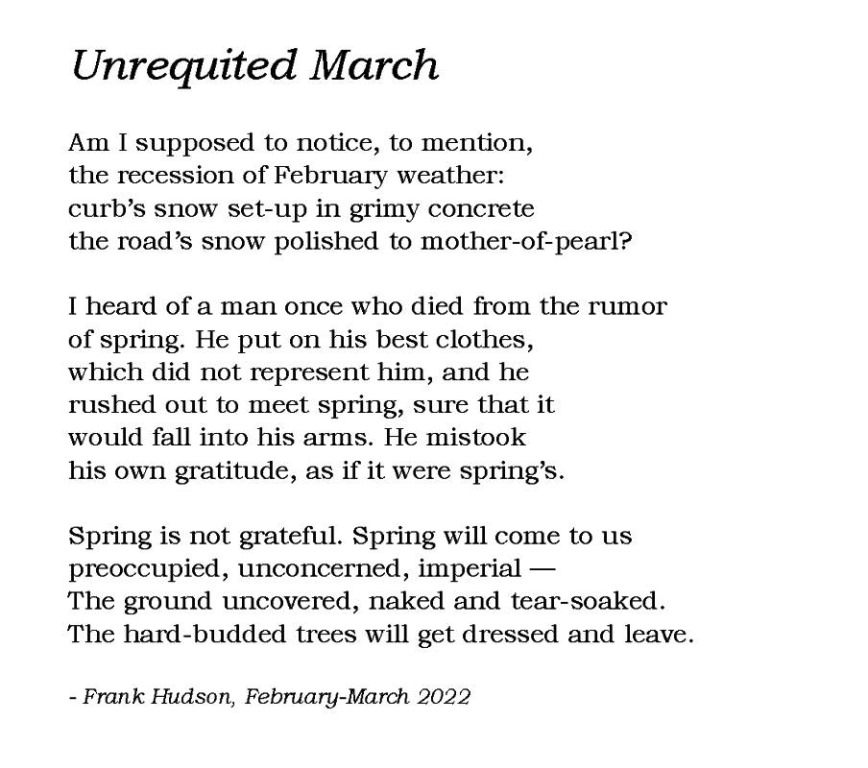
Unrequited March

Here’s a sonnet of my own about the oncoming spring. I live in Minnesota, and here that season’s arrival is something of a lottery ticket. Oh, it’s likely that by sometime in February a Minnesotan is tired of winter, and we know that somewhere around May Day we’ll not have snow or cold to deal with for a few months, but when today’s high got to 40 F, we know no more than that. When I moved here, I was told that on days like today we might see folks wearing T-shirts outside — and yes that’s so. We are so in a hurry for spring that what would be a 5-degree Celsius winter day in more temperate regions seems time to ditch the jacket. Yet we are still likely to have more cold, and even more likely to get substantial snowfall, particularly in March.

So it is, from late February to late April is a two-month season of “what d’ya got” in our state. That’s what my poem performed today deals with.

Things are still snow-covered around here, but it’s not fluffy, Christmas-card snow— more at rugged crusts. I still ride a bicycle nearly every day year-round, and so winter means that I pay special attention to the surface conditions of the side-streets that I most often ride. You know the old factoid that Inuit peoples have a multitude of words for snow in their vocabulary? A day or two after a snow what’s often found is compressed and polished snow with some patches of white glaze where tires’ friction has buffed a gloss.*  A few days later there will be areas where that surface further abrades and patches of dull-brown porridge-like snow aggregates are scattered on the roadway. I call the later “brown-sugar,” and the earlier hard white surface looks to me like the smooth inside of a shell.

Spring-time bike rides in Minnesota aren’t necessarily what you think.

.

Low-pressure studded bike tires work pretty well on the hard shiny stuff, and large knobby treads are the thing for the loose brown sugar. My deep-winter bike’s tires are a pair of Venn diagram hoops circling both.

That’s a poet’s bike ride for you: metaphors per hour.

Unrequited March

The meter’s a bit loose, yet not loose enough to cry “Kings X — Free Verse!” either.

.

Does any of this help “translate” my poem for those without my climate? That’s my hope anyway. Though the title of my poem is “Unrequited March,”  my wish for you, curious or stalwart reader/listener, is that spring will love you back this year. The player gadget to hear about the uncertainty of that is below for many readers, and for those whose way of reading this blog won’t show that graphical player, this highlighted hyperlink will open a new tab to play the performance just as well.

.

*The large, knobby, low-pressure tires are also capable of riding on fresh snow before cars get to it. Un-rutted light and granular cold-weather snow is kind of fun to ride in. The wetter and clumpy snow that will likely come in any heavy storms for the rest of the season is much less joyful. That stuff is like riding in deep mud. The tires’ knobs will get traction — it’s not the tires, it’s an old out-of-shape guy like myself who’ll get tired quick riding through that.