Credo (The Will To Love)

A friend of the blog noticed today I used a particular phrase when I wrote about late-night work on the musical piece you can hear below. I’ll try not to take too much of your time, but I thought I’d expand on my explanation to him, and at the bottom you’ll be able to hear a 2-minute song made from a poem by Alfred Kreymborg.

The early years of the Parlando Project benefited from several things that are not in as great a supply now: I had multiple days in each week when I could work on finding and making these musical pieces. I worked regular workday hours on this, beginning after my morning bicycle ride for breakfast. I was eight years younger then, and those days were filled with rewarding creative work as I learned more about musical composition and recording technology. Shortly after the public launch of the Parlando Project, we had a consequential election in America,*  but that (if anything) increased the energy I found most weeks.

Those who happen upon early posts here might notice a tone that isn’t as common in recent years. Without announcement, I was writing back then with my child in mind as an audience. They were going to be entering the 6th grade, and I vividly recall from my own youth how a great vista of complex, connective, and evaluative thought opens up around that age. I wasn’t going to make it a point to them to read this — adolescents aren’t looking for that sort of thing from parents — but rather more, I thought others in their peer group might come upon this Project and find some interest in my promotion of discovery and enjoyment. Working from that aim, as my child grew, I gradually changed the age group I was aiming the blog writing here at — though I don’t know if I ever achieved an adolescent audience.

Then a few years ago my family went through a series of crises, and it was only after a period of distress that the wise and resourceful members of my little family met those issues and managed them. I tried to be supportive — I probably was, to my imperfect degree — but that work was largely their doing. I’ll say that in that year or so of the greatest distress, my time spent here was a tonic for me from the stress and worry. How much of that was (in the modern terminology) “self-care,” and how much was temporary flight from responsibility? I can’t say, my perspective is too close-in.

But now in the past year or so, the time I can devote to this Parlando Project is constrained by external and internal factors. By choices outside my control, days go by when I’m restricted from recording, and even the blocks of assured time to compose or research are harder to come by. At the same time my energy endurance is lower as I age. As grateful as I remain to have the opportunity to do this Project, I guilt and grumble as an old codger when an opportunity comes — time when I can play or record — and at that moment my body is saying: take a nap instead. If I could schedule creative time, if I was to ask for concessions to schedule it, I’d probably face complex outcomes and reactions when my old body can’t be assured the energy levels and ready fingers like my 70-something self could.

Let me be complexly-clear about that though: that frustration doesn’t outweigh the gratitude. To have the opportunity and resources to do this Project remains a blessing! I just have to work with this, that’s all.

Here’s one “how” of that: after everyone in the house has gone to sleep early, or is at work on an evening shift outside our home — I can do my work, as long as it’s in silence. Knowing this, I often get a “second-wind” after 8 or 9 PM or so. I might spend this time researching or writing early or final drafts of these posts. There’s even limited music-making that can be done without making noise. I can go over the things I have been able to record, evaluate if they are worth using, perhaps adding additional parts silently using my little plastic keyboard, and mix the results into something suitable for releasing to the public. So: the hours between 9 PM and 1 AM have increasingly become working hours for the Parlando Project.

I’ve come to call that time “burning the midnight lamp.” As I told my online friend this morning, that phrase is taken from two particular sources — ones you might not guess could be combined.

“Burning the Midnight Lamp”  is a song, a lesser-known “deep cut,” by Jimi Hendrix. The song had a long gestation, Hendrix struggled to complete it. It was written early in his Jimi Hendrix Experience career, while living in London. Hendrix was a young man who previously had been in the care of a succession of childhood relatives, foster homes, and then a short Army barracks stint followed by couch-surfing until this point. For the first time he had his own place, shared with a woman in what sounds like an equality of love.**  That Hendrix London flat has been restored to appear as it did then, and when I visited it some years back I thought of what a special place it must have seemed to him. I imagine his thoughts: my own place, paid for with my own money, living on my own recognition, work done under my own name. In anyone’s life (not just a “rock star”) the time when one has achieved that — that’s something.

Here’s an odd connection: when you visit the site it’s a joint institution. Hendrix’s apartment is upstairs, but the main floor is laid out to reflect another emigrant musician of another era: this address was also George Frideric Handel’s London home.

When Hendrix was searching for the extra sound needed to complete his “Burning the Midnight Lamp,”   he found the recording studio he was in had an odd instrument present: a harpsichord. Comparing Hendrix’s guitarist skills to my own would be laughable, but things even out in naivete when at the musical keyboard. Today’s song uses piano, but I had to play separate right and left hand tracks to realize the simple part. Likewise, Hendrix hacked out a little harpsichord part for his song. Was Hendrix tipping his hat to his downstairs ghost with that harpsichord?

Why did Hendrix write his tune about working late within the endemic uncertainty of creatives using the image of a lamp? No guess. But another lamp, elsewhere, in another visit: something I recall when visiting Emily Dickinson’s bedroom was the little table that was her writing desk. On the small top of the table was a whale oil lamp. Dickinson, living with her family in a household, with household tasks and human needs that would take the daylight hours, had this little mid-19th Century, middle-class luxury of a warm effective light to work by after the busier-with-others’ hours.
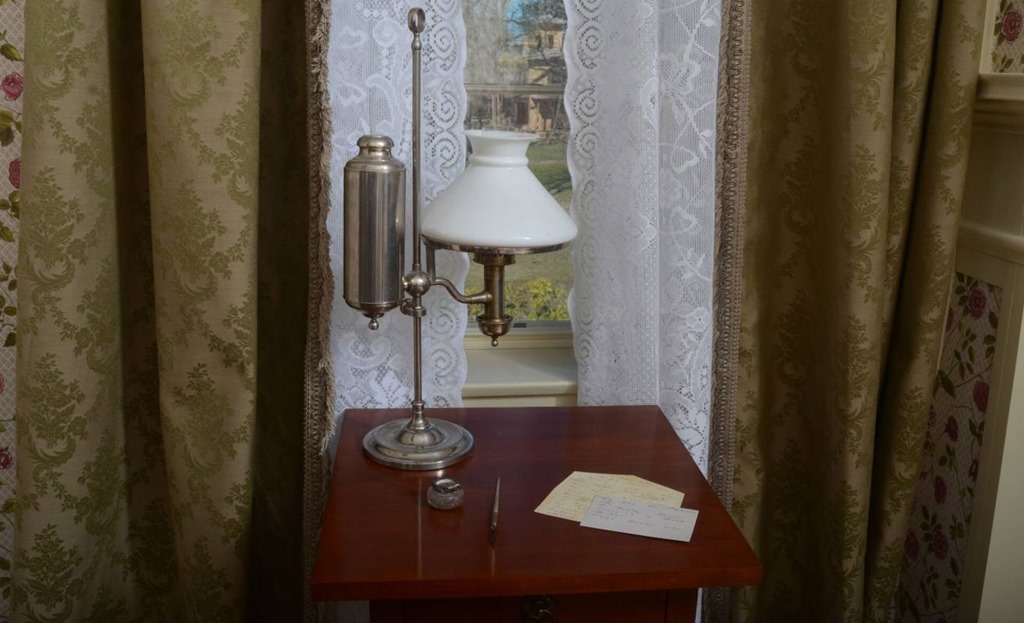
dickinson's desk and lamp

“Ready for the same old explosion/Going through my mind…” A small writing table and lamp in Emily Dickinson’s bedroom (photo from the Emily Dickinson museum)

.

Looking at Dickinson’s lamp, I thought of the whole system that represented: the swimming mammals of the dark, cold sea, the diverse Moby Dick industry which captured, killed and deconstructed those massive bodies — and so, extra hours glowing with North Atlantic juice opened for a woman to scribble and sew little booklets. If I’d try to tell these thoughts and feelings when looking at the lamp to the average person, they’d sense a disproportion. Someone might even harrumph to me “It’s just a lamp — an unexceptional, domestic thing.” Readers here? You’re not that sort of person — and on her part, Dickinson too, she had further thoughts.

And so I continue, to burn the midnight lamp. Alone.

Today’s results came after a week of disappointing myself as I looked for some words to express what I was feeling, words that would ask me to sing them out even with my inexact and unprofessional voice. I was seeking words that would add something hopeful in a time of extraordinarily slipshod callousness carried out with motives of punishment as a virtue. It was this short poem by early American Modernist poet, editor, and publisher Alfred Kreymborg that captured me.
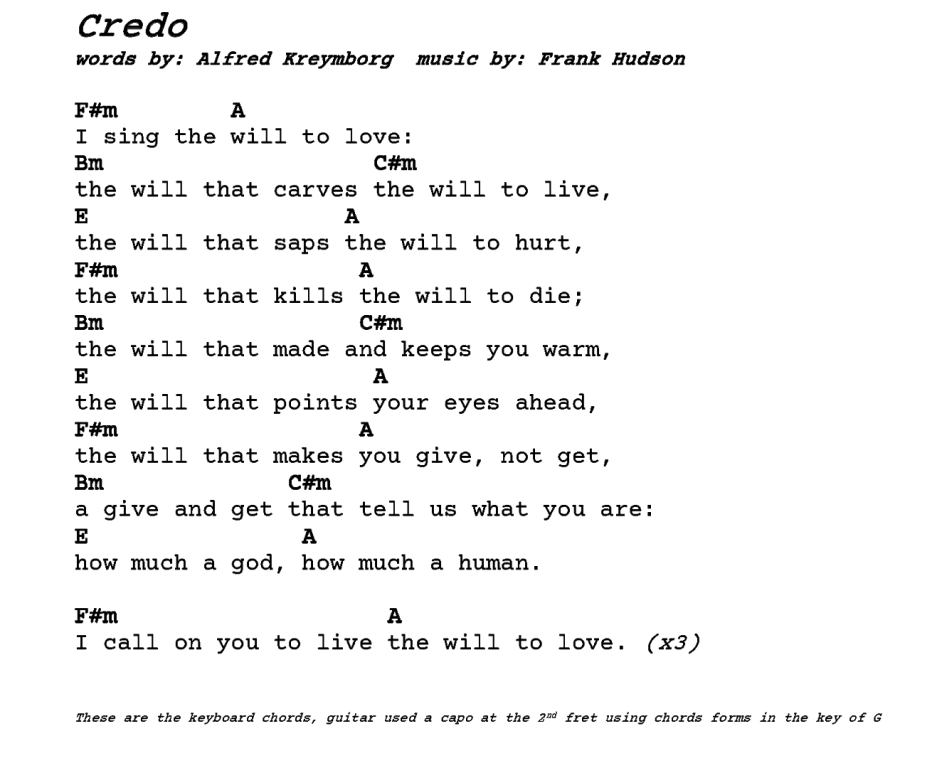
Credo keyboard chords

As I often say here under these chord sheets: someone out there can likely sing this song better than I can.

.

Last post here was a series of inspirational maxims carried by a Jazz musician. Maybe Kreymborg’s “Credo” seems a little too hopeful, too earnest for some of you. It’s probably not the sort of poem you’d first think of as an early text of American Modernist poetry from a colleague of William Carlos Williams, Man Ray, and Mina Loy. Little matter, I felt I needed to sing it. That’s enough for now.

You can hear my performance of “Credo”  with the graphical audio player gadget below. No gadget? It’s not that you didn’t keep your lamplight trimmed and burning, it’s just that some ways of reading this suppress showing the player gadget.  This highlighted link will open a new tab with its own audio player.

.

*Decades before, longtime Parlando contributor Dave Moore and I started the LYL Band just before Ronald Reagan’s election. Then too something that wasn’t very good for the country paradoxically encouraged creativity as contrast.

**This short video shows the flat decorated to look just as it was in the mid-Sixties, and features Hendrix’s then-partner, Kathy Etchingham, speaking briefly about their time together. Hendrix, like other struggling musicians, lived before largely at the behest of his hosts. From accounts, the two lovers seemed to be in a somewhat equitable partnership (within the expectations of the time). Etchingham worked as a DJ in London clubs and had a resident’s knowledge and straight-white-British appearance to bring to the arrangement. Hendrix’s fame was still somewhat localized, and his uprising career had offered him a semblance of a regular income.

Libertad! Igualdad! Fraternidad!

We’re going to have some William Carlos Williams poetry turned into a song below. If you’ve missed that sort of thing from me, I’ve returned with time to focus on what we do here.*

I think I’ve already mentioned that I’m disappointed in my country and its follies this past year after the national election. I could take your time and patience with some personal punditry on where to apportion blame for this. The electorate? The winning vassal party and it’s red duchies? The oligarchs and emperors ever-richer and more protective of prerogatives? And then too, the losing party, who gets apportioned blame for everything else on the list as well as bearing the sting of defeat?

I’m not going to do that. A complete list opens up the vulnerability of adding one’s own self to the blame. While many personalities have strong defenses against that self-indictment, I’m not sure if that’s a good or bad thing. By now, if you wanted any variety of that, you’ve already had your fill. Rather, if you’re on the side that lost, you might feel left alone. As we approach the new regency in a matter of hours, let me repeat something I said after the election: we can, we should, forgive ourselves for hope. It is a right-sure prediction that we’re going to need more not less hope in the next few years.

As we approach the new regency in a matter of hours, let me also repeat something I said after the election: we can, we should, forgive ourselves for hope. It is a right-sure prediction that we’re going to need more not less hope in the next few years.

Further in that feeling alone — except for the exchange of blame and shame — I’m not thinking this group are presently at risk of being visited by reporters seeking to understand their sorrow, fear, disappointment, despair. They’ve had over 60 days to file those “I must understand them” stories, but there’s a general silence on that front. Perhaps there will be some stories of the manifestations to come of what some of us fear — though if the worst fears come, those could be harder to find, and stories after injury may be less efficacious than the now-impossible to file stories that could have come beforehand.

Libertad!

I urge folks to sing these Parlando songs themselves, so here’s a chord sheet for today’s piece. Some will likely do a better job than I do, and additional voices strengthen a song.

.

So, I was happy to find, write music for, and sing this short William Carlos Williams poem this winter, even though it was written back in the last decade called The Twenties. I too feel forced into the mud, and so much now depends on the stink of the ash-cart rolling toward us. You can hear it with the graphical audio player gadget that should appear below. No player? No editor looking over his shoulder at their owner-baron has spiked it. No algorithm has ruled against it in court. The audio gadget has always been impartially suppressed by some ways to view this blog — but you can use this highlighted link to open a new tab with its own audio player.

.

*This isn’t the first holiday season that has caused a drop in new pieces or posts, but I’ve spent a good deal of time in this cold bilaterally looking January shopping for a replacement for my 20-year-old car. I had previously figured I’d wait until that car had reached its full majority this upcoming fall to shop for a replacement, but like some others I played the odds that new tariff taxes and repercussions would raise prices.

Millay’s Thanksgiving

There’s a long tradition in poetry of civic poetry — poems not meant for an audience interested solely in the interior intimate experience of the poet, but speaking to larger, more public themes. I suspect modern poetry doesn’t do this mode directly much, even though some individualist poetry infers that purpose. American poetic Modernism began with an emphasis on the concrete, the thing specific: red wheelbarrow, ripples in a pool, a certain Chicago cat-fog, an exit on the Metro on a rainy day. Yet, a focused subject can still be an example that stands for more.

If the subject is small though, perhaps we poets expect our audience most often to be small too, compared to a variety of other, popular arts. But this was not always so. Longfellow and Whitman expected the nation to listen to their poems of democratic virtues. If the literary set eschew the mode, song-lyricists and non-literary poets will still assay it.

Just under four years ago, a poet Amanda Gorman who has written civic poetry, delivered a poem at the last U.S. Presidential inauguration, speaking of the nation’s fears, hopes, promises. The mode of the next Inauguration has changed. I’m not expecting poetry. Some will think, more-the-better — who wants a poet spouting off what I should think.

Why not, are they not citizens? What are the occupations that are allowed to speak?

Nearly 75 years ago. American poet Edna St. Vincent Millay wrote a long poem for the American holiday of Thanksgiving. She expected a good-sized audience: it was published in the Saturday Evening Post, a weekly general interest magazine, the one that often featured Norman Rockwell paintings on the cover, that claimed Ben Franklin as its founder.

Millay NFTG

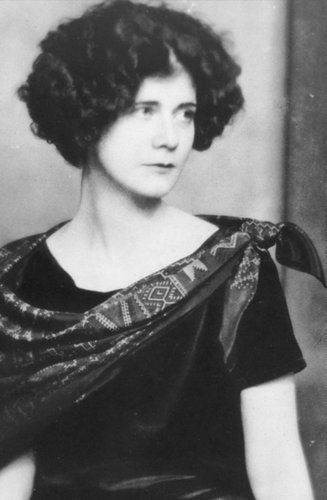
The most often used pictures of Millay show the young romantic adventurer. I’m also fond of this one that seems less all that. The poem which I perform excerpts from today was the last one she published before she died at age 58.

.

I’m sure there were specific things on Millay’s mind, geo-political, American issues. She writes five years after a war ended with two A-bombs. How long would be the peace? In 1950 there was another war going on overseas in Korea, there was a “Red Scare,” and to a large degree some deficiencies in American equality of opportunity were so far off to the side that too few even thought of them as political issues to address then. Millay didn’t cite any of that directly.

Instead, she wrote about how she thinks we, the citizenry, were feeling, assuming a general agreement that might be hard to gather today. Thanksgiving is a dual holiday occasion: it’s our harvest festival, a time to give thanks to what our work brought us, and it’s also a holiday to give thanks for what we’ve come through: it originated in a time of Civil War, and it commemorates the hardy survival of some early 17th century boat-people who landed without papers and survived on American shores. Millay’s Thanksgiving thoughts were more toward the latter than the former.

What will ring true in some American hearts this year will be her words of hopes dashed or at least deferred. Can one give thanks for having hopes that were unfulfilled? Can we at least forgive ourselves for hope? Her poem exists in that question. In the excerpts I performed today for this musically accompanied piece you can hear below, I focused on that sense, felt in my bones. “Cunning and guile persist; ferocity empowers” Millay writes. The lines that stand out for me as a Thanksgiving prayer this year are “Let us give thanks for the courage that was always ours; and pray for the wisdom which we never had.”

As civic prayer goes, that’s humble, but it has some bite in it.

You can hear my performance of portions from Millay’s “Thanksgiving…1950”  with the audio player below. The full poem’s text is at this link. No audio player gadget to be seen?  This highlighted link will open a new tab with its own audio player.

.

.

Let No Charitable Hope

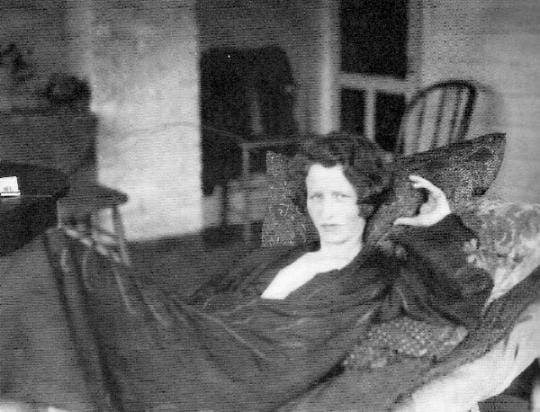
Elinor Wylie once was a reasonably successful poet, back in the last decade that was called The Twenties. I informally group her with some other American women poets of that time: Sara Teasdale, Edna St. Vincent Millay, Dorothy Parker, each of whom wrote often about the complexities of love and relationships. Though none of this group had careers of extended success,* Wylie’s poetry career arc was exceptionally short, contained entirely within the 1920s — though it was preceded by a few years of being a gossip item for a series of romantic elopements and divorces. I wrote a bit about that element of her life a few years back, but it seems that Wylie was playing at the Kardashian-family level of tempestuous celebritydom in her time. Read my link if you want a summary of the tea.

Young Elinor Wylie

Elinor Wylie. Runaway socialite and 1920s poet.

.

So how good was her poetry? Clearly better than the usual celebrity with a book of poetry. She’s highly musical and concise, an irresistible draw to my Project, and while ranking art is a foolish game, her best work stands up well against the trio I associated her with. Today’s piece uses a poem that was called one of her best works when I first read it as poets.org’s Poem-a-Day a year ago. Here’s a link to the poem’s text if you’d like to read along. I myself wouldn’t rank it that high if I somehow needed to rank her poems, though the musicality alone compelled me to set it with music this week. Why do I prefer, for example, her “Velvet Shoes?”  “Let No Charitable Hope”  is a bit abstract, despite the eagle and antelope that are cited in passing and the woman trying to get substance from a stone,** while “Velvet Shoes”  is as sensuous an experience in imagery as in sound. But as a complaint, “Let No Charitable Hope”  probably still connects. Many of us, maybe more for those women reading, are familiar with being misapprehended, of having a hard enough time maintaining one’s own hopes, and to then be asked to try to match the hopes of others. What does Wylie mean by her ending smile in the poem? Is she smiling at how mistaken the apprehension was, or is she allowing herself to smile at her own small lofting of her own hopes?

You can hear my musical performance of Wylie’s poem with the audio player below. I went all-out on the weird chords for this one, so it may not be to all tastes. Is your screen so woozy from fear of odd voicings that it’s obscured any such audio player? No, some ways of reading this blog suppress that player gadget, so I provide this highlighted link that will open a new tab with its own audio player.

.

*Like Wylie, Teasdale died young. Parker and Millay’s political commitment damaged their later careers. The New Morning of the The New Woman of the 1920s had its backlash as well — but this isn’t simple. It’s hard to maintain an artistic career in general, Parker suffered from writerly alcoholism, and some who shared Milay’s politics didn’t think her later work was as good as literature.

**One more concrete image occurs in the poem: masks. The line “Masks outrageous and austere” was sonorous enough for Tennessee Williams to cop it later on. As if sometimes does for me, I thought of masking as in autism, though the syntax of the poem’s last stanza seems to have masking being applied to the years, not the poem’s speaker’s smiling face. Still, I’d expect some ASD readers would see the disconnect of the “charitable hopes” of others viewing them verses their own internal reservoirs of hope and intent.

“Hope” is the thing with feathers

We don’t usually associate Emily Dickinson with metapoetry or with the widespread sampling and recontextualizing such as found in T. S. Eliot’s “The Waste Land.”  But this poem from Dickinson, one of her best-known, could be engaging in something we could call that.

The poem starts off with a clear indication of reference, by putting its first word in quotes. Based on Emily’s unusual but internally consistent style, I don’t believe that she’s using quotes to indicate hope as concept, as an ideal (she capitalized words to indicate that sort of thing). If it’s a quote, she’s referencing someone else. Who said this “Hope?”

My chief candidate would be the poet and poem from our last post, Emily Bronte and Bronte’s poem “Hope.”  If you read and listened to “Hope”  in our last post you’ll know that “Hope”  isn’t a hopeful poem at all. Dickinson’s poem, on the other hand, is often viewed as praising hope, but if you read/listen to them together, Bronte’s poem sheds a different light on the much better-known “thing with feathers” poem.*

Dickinson seems to start where Bronte ended. Bronte’s hope has feathered wings, and it uses them to soar to heaven to never return. Dickinson starts with “hope” only specifically given the potential for flying away, but Dickinson has “hope” sticking around. Some read the feathered aspect of Dickinson’s image as cute, like a pet songbird, a friendly image, but I don’t think Dickinson does cute much, and I’m not sure she’s doing it here.

Punk Monk Emily

My wife sent me this and I believe the illustration is by Wendy MacNaughton.

.

What Dickinson says about hope in the rest of the poem has been read as outright praise, but if we take that fly-away-and-feathers link between Bronte and Dickinson, we should be alerted that there may be more shading the situation.

Hope and Hope is a thing with feathers

For those who’d like to read along, here’s today’s text and the Bronte poem it may be referencing

.

Dickinson’s hope sings without words, which is a statement of great ambiguity from a poet. Abstract sound that goes beyond meaning is part of poetry’s power, yes, but “without words” may also say that, for good or ill, hope is generalized and not realized by the specifics of the situation. A song without words could be like advice that things will always get better, always turn out fine. A friend or advisor that always tells you that; whose non-specific hope is constant and never relenting can be a “not today please!” thing after all.

The second stanza is an extended metaphor of the hope-birds sweet song in a storm. “Plucky little bird! Good for it!” Is one reading. But there’s an odd line in there that must be weighed too. If the storm is bad enough the bird might be abashed, embarrassed, Dickinson says. Why would that be? Is the hope-bird, shy, timid? Bronte’s hope is said to be in her poem’s first line, and that turns out to be a very severe flaw as Bronte develops it. Could it be even darker? Did the hope-bird say listen to my hope-song in the storm and not fear—oh, how embarrassing—category 5, your town is wiped out by the tornado or hurricane?

Am I being Debbie-downer here? Could be. But how else does one explain the “abash” in that line?**

The last stanza begins still carrying over that metaphor: hey New Englanders (and Minnesotans!) if it’s cold, the frozen center of winter, you can still hear the magical hope-bird. Out way beyond land on the strangest sea? You can hear it. The hope-bird is operational in any and all conditions!

More won’t-shut-up testimony about the hope-bird there. Is this fulsome praise? Recall Dickinson’s famous definition of poetry: “If I read a book and it makes my whole body so cold no fire can warm me I know that is poetry.” And in Wild Nights Wild Nights  she speaks about adventuring on chartless wild oceans. Not to paint Dickinson as an inner stone-cold Goth here, but cold and strange are not what she seeks to avoid. Dickinson says the hope-bird keeps “so many warm.” She doesn’t say everybody or herself.

What do I make of Dickinson’s concluding couplet? Many readings see it as a comment that hope isn’t self-serving, the crumb being reward for a pet or a tamed or otherwise human-habituated bird. Dickinson (unlike Bronte, whose hope is portrayed as fickle and even cruel) has just made much of hope’s seeming ubiquity. If we take it that she’s commenting ambiguously on someone else’s hope or Bronte’s portrayal of a fickle hope, she could have undercurrents in those last two lines. She may be saying “My hope is wild and unpredictable, maybe not as specifically feral and cruel as Bronte’s, but my hope is not my pet, not at my beck and call.”

Of course, a great deal of this reading depends on thinking that when Dickinson put hope in quotes she meant to refer to the title of Bronte’s poem whose protagonist is highly skeptical about hope. There’s another thing she might be quoting, a special use of the word. When Dickinson entered Mount Holyoke the students there were highly encouraged to make a sincere profession of religious faith. At the end of her single year there, Emily Dickinson was still in a small group that refused to make that profession. The school had a classification for those hard-cases. They were put down as “Without hope.”

Here’s my performance of Dickinson’s “Hope’ is a thing with feathers.”  Use the player below to hear it if you see that, or if you don’t, this highlighted hyperlink can play it.

.

*Somewhere in my reading this spring someone tipped me off to consider Bronte’s “Hope”  as an influence on this poem of Dickinson’s. I did, and this is what I found following that tip. However, I can’t find any note I made about where I first read that there might be a connection. I owe someone.

UPDATE: Thanks to another blog’s discussion of this poem, I think I’ve rediscovered where I may have read of this connection between poetic Emilys and “hope.” It could have been this post by Nuala O’Connor.

**I’m truly hesitant in this regard. I do believe in the intractable nature of the human condition, and I think Dickinson does too, but I don’t want to discount hope or “the peace that passeth all understanding” as a necessary part of dealing with those things.

Emily Bronte’s Hope

If Emily Dickinson had no real models for the revolutionary poetry she developed, she did have other poets she could look to. We know from her letters that one of them was Emily Bronte.

English author Emily Bronte and her two sisters Charlotte and Anne all wrote poetry and then novels, but Emily seems to have been the most avid poet of the trio. Starting in childhood Emily Bronte created along with her sister Anne a fantasy world they named Gondal in which they spun tales of adventure. At least some of Emily’s poetry was connected to that world, and so it’s possible that today’s hopeless piece titled “Hope”  is part of some fully imagined plot and isn’t autobiographical.

Emily Bronte

Emily Bronte. Plotting what to do to that useless hope when she’s uncaged?

One of America’s great contributions, an Afro-American contribution in large part, is The Blues. The Blues reaction to misfortune is almost inevitably to battle that misfortune in some way: to mock it, to hip others to it, to talk back to it and tell it that the speaker knows the score and may even settle that score with it some day. Most American Blues aren’t “woe is me, I’ve got it bad, and I’d rather be dead” it’s “I can tell you how much trouble I’ve encountered, but I’m still here.”

Emily Bronte is mocking too, but she’s mocking hope itself, not the unspecified troubles that have figuratively imprisoned the poem’s speaker. Hope is portrayed throughout as an external character, and that character is a pious creep, totally uninterested in easing the pain of the imprisoned speaker.

Still you have to hand it to Emily Bronte here. This is a rather impious poem from a preacher’s kid, even if it’s a character from her imagined world and this is only a momentary lament. Perhaps that’s part of what attracted Emily Dickinson to this fellow Emily. Dickinson is also a great mocker.

Does today’s Emily Bronte poem remind you of a well-known Emily Dickinson poem? Check back later this week and we’ll try to follow up on that—but until then, here’s today’s audio piece Emily Bronte’s “Hope.”  The player gadget is below for some of you, but if your blog reading software doesn’t show it, this highlighted hyperlink will also workFull text of Bronte’s poem for those who would like to read along is here.

.

The Darkling Thrush

My teenaged son is proud of his mastery of modern youth slang and enjoys the idea that his parents and their generations will have no idea what such terms mean. This is of course part of the utility of language: it not only binds people together, it keeps them apart.*

No matter, new times and new experiences enjoy making fresh and untarnished words to describe them. Words must have their pleasures, even when we don’t quite understand everything someone is saying. Take Thomas Hardy, a man who wrote what may be one of the last poems written in the 19th Century, after he had spent 61 years in it. Published on or around New Year’s Eve in 1900, today’s piece is “The Darkling Thrush.”  In Hardy’s poem, as an old man looks at the changing of a year and century, we have the reverse of my son’s joy: old words from an old man.

Thomas Hardy Moustache wax abuser
Careful with the moustache wax Tom, you’ll put someone’s eye out!


“Darkling”, “coppice”, “spectre”, “bine-stems”, “lyres”, “outleant”, “illimited”—we meet the first one in the title, the second five words in, the third at ten words. Even if I was to quiz educated Americans, I doubt most could define the majority of these words, and I’m unsure how much better modern British residents would do.**

Coppicing is a European method of managing tree growth, in which mature trees are cut off to allow fresh shoots to continually propagate. Spectre is more known now as a trademark applied to laptops and James Bond bad-guys, but is an English word for a spirit or ghost. Bines are not vines to the knowledgeable horticulturist (bines twist their main stem around things to tangle and climb, vines use special parts of branches to hitch themselves up). Lyres are not supporters of disreputable political movements, but a stringed harp. Illimited is just another, rarer, form of the word unlimited, and I think Hardy may have chosen it because it starts with a sick word, ill, but also puns on illuminated. The titled adjective, darkling is a handy way to say it’s occurring in the dark. Although it’s a little-used word, like illimited, the sound of it brings to mind something else, the smallness of the title bird, as in duckling,  and darkling’s sound also lets us see dusk rather than deep night, when we can still see the winter thicket Hardy sets his poem in.

But outleant is the real mystery word. A short web search finds no online dictionary definitions, no examples of its use other than in Hardy’s poem. A simple deconstruction of the word’s parts would make it, inverted, saying “leaning out.” And that’s what it probably means. There’s textural evidence as it ties back to the poem’s second word, “leant upon the gate” to the coppice. Yet, did Hardy intend to infer two other close words in this word’s sound? Out-lent, a sense that the haunted and dreary winter scene of the poem is owned by the old, dying century and is lent out only to the present? Depending on pronunciation of the printed word’s “ea,” it could conceivably be pronounced out-lent (and Hardy does rhyme it with “lament.”) Does he also want us to hear a closeness to outlearnt, and that the old century’s corpus of belief has been superseded (by newer scientific discoveries?) That would be consistent with Hardy’s beliefs.

Perhaps this is my weakness as a reader, translator, performer and poet myself. If I sense an image is possible, I want to see it, hear it, perform it. Bare winter bines twisted around a copse of brush wood as a corpse leaning out of a coffin may be grisly, but it’s not to me a strong image.*** Even if it’s abstract, the second sense, that of this bare and haunted landscape being the cemetery plot owned by the old century of which we are only visiting seems stronger. For others, the sense that new knowledge has killed off the old beliefs (outlearnt) could be a choice. I can’t know that Hardy intended this ambiguity by choosing this unusual word outleant, but I, the reader, put it there.

The title calls attention to the central image, yet another messenger bird in British poetry, to go with the nightingales and skylarks of Keats and Shelley, poets of Hardy’s now dying century. I like that Hardy lets us see the bird, and it’s frail, gaunt, and -ling tiny, and that we can see feathers fluffed to best insulate its frame, which the wind is disputing.

So, there was Hardy, around New Year’s Eve, using his old and odd words at the end of an old century. For us, Hardy’s oncoming one (the 20th century) has now closed itself. Will things get better or worse in our new year? Something in us wants to foretell at every ending—yet even looking backwards, we have trouble making a simple better or worse judgement. Here, the battered bird, the darkling thrush, says better. Hardy says he knows he doesn’t know.

He knows he doesn’t know is the realist’s version of hope.

Anyway, one of the joys of combining poetry with music is that you don’t have to take a test on the words to enjoy the piece. My pompatus of a performance of Thomas Hardy’s “The Darkling Thrush”  is available with the player below.


*Right now he’s very generous in this however. He wants me to know these words so I won’t be left out.

**Before looking them up, I knew spectre and lyres for sure and I was fairly sure about darkling as an adverb, then taken to adjective. I had ideas (some from context) on the others—and in the case of coppice, my ideas were wrong. My son knew spectre and lyres and defined darkling as “a creature of the night” for which I’ll give half-credit. In the case of bines, I told him I learned how bines were different from vines, and he told me “Sure they are! Vines are 7 second videos.” (That last was a joke on his part.) My wife, a fine word-smith, also got 2.5 (“Bines, it that like a wood-bine?” got half-credit as understanding was there, even if a good dictionary definition it wasn’t.)

***Saplings and bines and “sharp landscape” would indicate a skeletal image is intended, but bare bones are not particularly scary or intense compared to rot and decomposition, much less animated brains-hungry undead. Hardy doesn’t mean scary so much as long-dead I guess. Interestingly, Hardy had a direct graveyard experience to draw on here.

I Heard the Bells on Christmas Day (Christmas Bells)

Here’s a hopeful song written by a worried man during the great trauma of the American Civil War.

Those who’ve followed along on this blog in 2018 will know that I’ve performed several pieces with words written by that man, poet Henry Wadsworth Longfellow. I’ve written about his once great fame and his steep fall from poetic fashion, but I’ve written little about his eventful personal life.

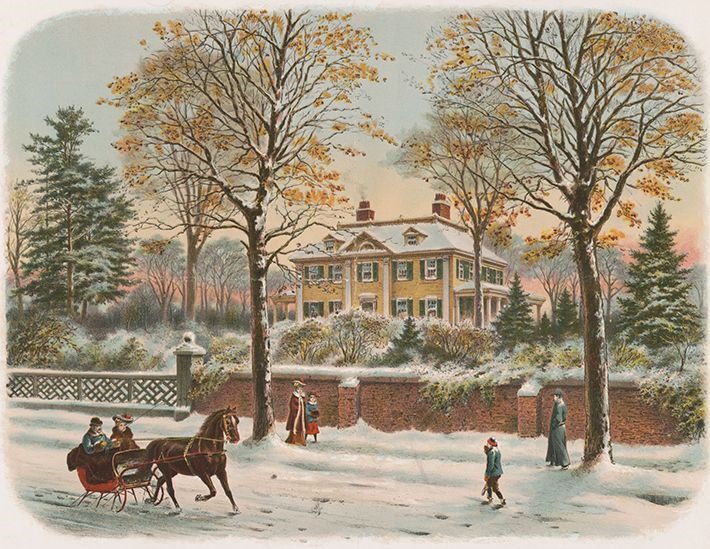
longfellows house in winter

Not all of what it seems: a picture postcard scene of Longfellow’s home during the Civil War.


When the American Civil War broke out in 1861, there could be no doubt on which side Longfellow would be on. To the extent that Longfellow was political as a writer, he was resolutely against the institution of slavery. Longfellow was also philosophically a pacifist, but even before the war he was aware of the cost Abolitionist convictions could bring. His closest friend, Charles Sumner, a U. S. Senator and another Abolitionist, was sitting at his desk on the Senate floor in 1856 when three southern congressmen launched a planned assault on him. The leader of the crew beat Sumner into unconsciousness with a walking stick, while the other two held off any who rose to try to stop the assault, one brandishing a pistol to keep help at bay. Sumner was so badly injured from the attack he was unable to resume his Senate duties for three years after the attack.

By the spring of 1863, the Civil War over the maintenance of slavery was now two years old. No one knew how long it would continue or what the outcome would be, and once more someone close to Longfellow would feel its blows. Longfellow’s 17-year-old son Charley, who had firmly resolved his own feelings about the war, snuck out of the family home and made his way to Washington to join the Union army. In November of that year, his unit was reconnoitering around a Virginia location called New Hope Church. They found what they were looking for. A southern bullet ripped through Charley Longfellow’s torso sideways, just nicking his spine. Luck that, and luck that he was able to endure and survive a painful evacuation on a wagon and the woeful state of battlefield trauma care in his time. Over half-a-million fellow soldiers didn’t.

So, a month before Christmas, Henry Wadsworth Longfellow was searching the maze of makeshift hospitals and camps in Washington until he found his wounded son. Son found, by Christmas the Longfellows could return home for further recuperation.

Today “I Heard the Bells on Christmas Day”*  if listened to casually may pass as just another carol, an obligatory musical evocation of some cheerful pealing on a winter’s holiday. But to the poet who wrote these words that Christmas, and to the nation torn apart, that he and his audience were part of, this was not merely another generalized Christmas card.

I wrote a couple of hundred words, meaning to put them here next, starting to say, preaching about, what Longfellow said in his poem—but Longfellow says what he needed to say pretty well and clear for an unfashionable poet. Maybe that “clear” thing is part of what is unfashionable, but despair shared and hope earnestly put forward is  a gift.

The player gadget below will let you hear “I Heard the Bells on Christmas Day (Christmas Bells)”  as I performed it. To sharpen Longfellow’s point, I trimmed back the number of stanzas in his original poem and then again from the shorter number of verses usually sung in the hymn that was made from it. I also reharmonized the chord changes a little. Guitarists wanting to play this themselves can use this shared link to see the details of the open tuning and chord voicings I used for this. The modified tuning, with the two lowest strings on the guitar tuned down even lower, makes this very easy to play.


*When Longfellow’s poem was published the next year it was titled “Christmas Bells,”  but it’s now best known through the hymn/Christmas carol set to music by John Baptiste Calkin.

Dream Big

There’s an old joke that goes like this:

Alarmed Customer: What’s a fly doing in my soup?

Waiter: I believe that’s the backstroke sir.

Part of the humor here derives from the order brought to the chaotic event of an insect in the diner’s food. The waiter is able to observe the fly and classify its actions from an altogether different perspective. And the rest of the humor comes from the waiter willfully, or otherwise, misunderstanding the customer’s complaint as a mooted question.

Rhythm, a primary component of music and poetry, shares that ability to reshape chaos. The day after I saw the Emily Dickinson film biography “A Quiet Passion”  I returned to the same theater complex to see Chasing the Trane,” a documentary about musician John Coltrane, a man whose work and life story has carried me across many a low place. You could predict most of the talking heads (what director Warren Beatty once called, perceptively, “witnesses” in his John Reed biopic “Reds”)  that appeared in the Coltrane film. Coltrane’s children talk about their parents. Winton Marsalis and Cornell West are obligatory we suppose. A pair of Coltrane biographers chip in their perspective. The surviving members of Coltrane’s great combos, Reggie Workman and McCoy Tyner, talk briefly. Sonny Rollins, Coltrane’s great contemporary, and Benny Golson, a musician who first knew John Coltrane as a fellow teenager in Philadelphia, are especially insightful.

And then John Densmore, the drummer from the 60’s rock group The Doors speaks. OK, I can hear a few saying “What’s he doing in a John Coltrane biography?”

The answer is: swimming in the rhythm of Elvin Jones (the great drummer of Coltrane’s greatest band). Like the original Homer who wrote our fly in the soup joke, Elvin Jones could converse with whatever new melody, whatever mistaken-for-mere-chaos invention, that John Coltrane or Eric Dolphy could invoke. Densmore watched him do that on the bandstand closely, and then applied what he learned when he later was called to add order to the Dionysian deconstructions of The Doors’ lead singer, Jim Morrison, a man who had the touch of a poet quickly smothered by drink, drugs, and uncharted celebrity.

Densmore’s part in the film is to add to the thought that John Coltrane lived as if  he could converse with the universe and approach its Creator with what he had heard from it. Densmore’s addition: but it’s the drummer that is the witness that this is happening now, in the time we are all beating. Coltrane may swim out in the tide of the cosmos, but Elvin Jones knows what stroke he’s swimming.

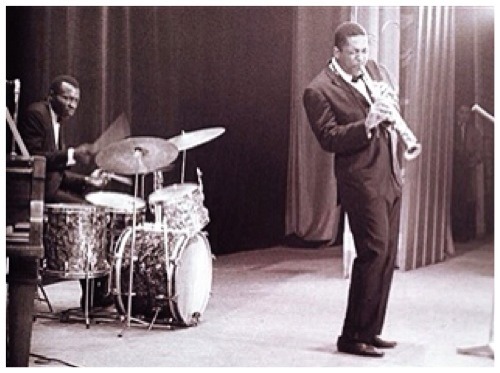
John Coltrane and Elvin Jones

Elvin Jones and John Coltrane: a conversation with infinity and time


I call today’s audio piece “Dream Big!”  June is the month of graduations and their obligatory talking heads delivering commencement addresses, most of them deputizing themselves as present-day Ralph Waldo Emersons with mature advice for the audience. However, “Dream Big!”  doesn’t present the tale from some sundry gray eminence—instead it has some words from a young man, the British musician Kiran Leonard, who asks us to look at the dream of Herman Sörgel.

Kiran Leonard

Kiran Leonard: quiet is the opposite of thoughtful

Kiran Leonard’s music takes several forms and may still be forming, but his words that I adapted for use with my music in “Dream Big” were taken not from a song, but from a short statement broadcast by the BBC. In it, Leonard uses Sörgel to encourage us to take on creative projects we think are beyond us. Good advice for young people—but I also took it as good advice for this old man as I started the Parlando Project in 2016, and needed to contact some hopeful audacity. And now, this week, as I am readying this post, I need John Coltrane and Herman Sörgel, Emerson and Kiran Leonard levels of such hope as I mourn the needless death of a young man and our pretentions that we can do nothing about it.

To hear more of Kiran Leonard’s music you can see this live set from last year here, or view the promotional videos for songs from recent albums here and here, or read this interview/introduction/review. To hear my performance of “Dream Big!”  use the player below.