Jade Flower Palace

National news and household events continually waylay my attention. Dejected gutters, palace intrigues throwing glances on complicated and duplicitous political alliances, and a middle-schooler with the sniffles—how can one weigh these things against this small but welcomed audience here for music combined with (mostly) poetry?

And so, I found myself short of material as I got ready to record with the LYL Band this week, a problem that the domestic, the national, and the poetic world combined to answer.

My wife had sent me a poem from the Confucian Odes  recently, a loving gesture gratefully received, and as beautiful as it was, I wondered about the poem and its English translation because of my work here. As the news sticks its tongue out at me with screen-edge notifications (mutterings about the Emperor and his possible private derangement issuing from the far-off capitol) I read again some of those Confucian Odes,  an ancient anthology designed to instruct not just scholars or poets, but politicians and bureaucrats.

What an odd idea. I suppose distributive requirements in American colleges still require some exposure to literature for those who will eventually serve in those roles, but this anthology was considered core material in Imperial China. And the Confucian Odes  are not grand works of moral or civic uplift, rather they are compressed, tiny reports of humble activities, decisions, and situations. They sometimes imply or depict correct behavior, but they don’t explicitly end with a moral. Their lesson may be, in the largest part, that the reader must study them and find the lesson in the everyday.

How different would our emperor or his retainers be if this was their schooling?

One collection I read mixed in later classical Chinese poems with some of the Odes.  It was here that once more I was pulled in by Du Fu, one of those aspiring bureaucrats who was steeped in those odes, but who lived centuries later at a time his country was in rebellion and upheaval. The Confucian ethos elevates faithful service, but who was to be served was shifting with the tide of rebellion. Reading Du Fu’s poems from the 8th Century as a small-part-citizen witnessing an empire disrupted in folly can have eerie resonances.

Late Thursday night, worried about material to record the next day, I began to translate Du Fu’s “Jade Flower Palace.”
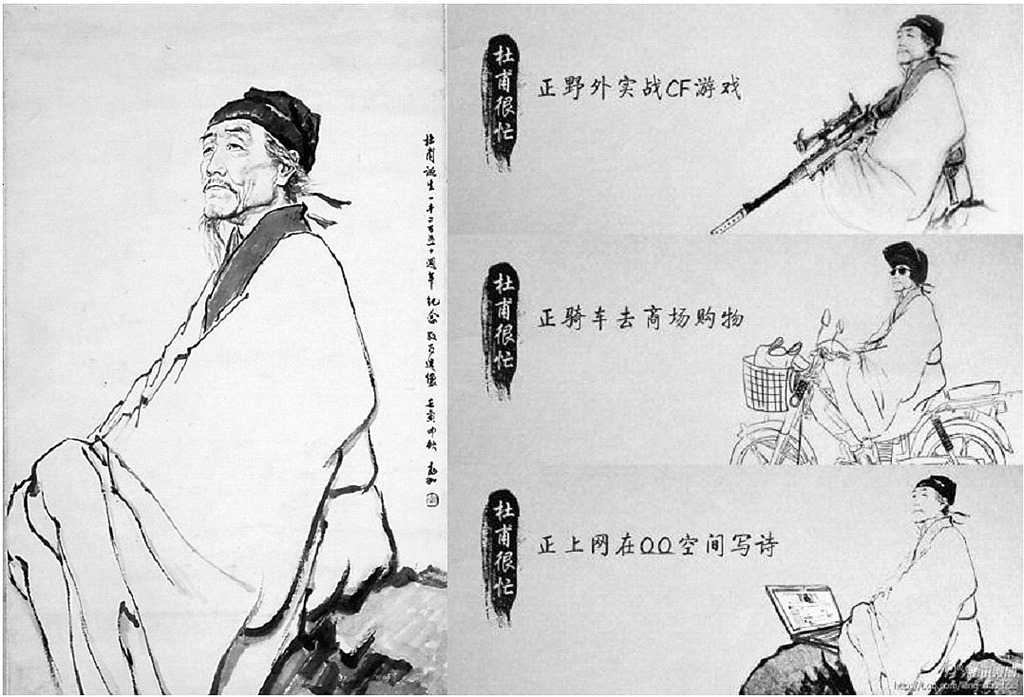
Du Fu and his Memes

If time is boustrophedon, wrapping back next to itself, then Du Fu may still be with us.


I could not find a clean literal translation of the original ideograms for the entire poem, only for about half the lines. I was able to find three previous English translations, which I could at least triangulate for the parts I didn’t have the raw stuff for.

Looking at what I had, I noticed that Du Fu was making constant juxtapositions, comparisons of contrast. Even the opening lines had water pushing and wind sighing and reflecting. That seems conventional, even a commonplace like “oh no, the wind and rain” in an English folk ballad, but it’s followed by a jump to rodents running through a roof, so close to a translation of the English idiom “bats in the belfry.” I decided to take Du Fu as intentional here. Events may seem to push you, or you may sigh and accept them, but “Rats are running in the rafters.” The ruin is real, and for that matter, your mind may reflect that too.

What follows is partOzymandias  without Shelly’s political radicalism, and part ghost story. A ruined palace, once as lush as Mar-a-Lago, haunted by ghosts. I was puzzled by the “green ghost fires” referred to in this section, what with my limited knowledge of Chinese culture. Those three words are wonderous, but I still don’t know exactly what Du Fu is describing. Are there actual fires, lit as protection from ghosts (akin to the tradition of ghost lights in theaters)? Why green? Is it brightly colored moss or overgrowth in the ruins? Is Du Fu seeing luminous ghosts (instead of hearing them as he does later in the poem)? I can’t tell. Looking at some online material on Chinese ghosts, I see that this end of August/beginning of September period is sometimes celebrated as “ghost month” in China, and various things are done both to connect with or protect oneself from various spirits. Offerings, such as burning a pile of currency may be left out. I have no idea if that goes back to Du Fu’s time, but in our current world, the thought of a burning pile of greenbacks to keep one safe from long dead rich people sure seems like a vivid image. And water is running over the palace’s roadways. Just what is the sea level of Mar-a-Lago if global warming isn’t only a political question?

Green Ghost Fires

“Green ghost fires” The “ghost light” on the dark Fitzgerald Theater stage and money being burned as part of the Chinese Ghost Festival


As you listen to “Jade Flower Palace”  perhaps you’ll want to pay notice to Du Fu’s subtle use of juxtapositions. More so than the other translations I read, I sought to bring those forward in mine. Translators seem to differ on Du Fu’s final lines, and that was a part where I didn’t have a literal translation to draw from. As midnight approached, I left two alternatives for my decision of what the final line should be to follow “There are many paths away from here.” It could be “How long are any of them?” or “None of them go on forever.” In the morning I decided that I would keep both, another juxtaposition.

In the performance on Friday I used this as our band warm up, where we loosen up our old and demented fingers, a cold first take. I repeated the first two lines once more at the end both to emphasize that they should be heard as more than commonplaces, and as a reminder (to invert a proverb of mysterious origin) that history isn’t necessarily instructed by rhyme, but repeats.

To hear the LYL Band perform Du Fu’s “Jade Flower Palace,”  use the player below.
I Have Fallen in Love with American Names

Anyone remember those sentry questions that would be used in to determine if some straggler in the soldier’s darkness was an American or foreign foe? “Who plays first base for the New York Yankees?” they’d ask.

Native Iowans have a similar method to catch those from out of state. They might start right off with asking about the state capital. “Dezz Moynens.” Wrong! Not an Iowan. “Day Moyne.” Native. Poweshiek, that fine county with a Brooklyn no one knows. “Poe’s He Eck.” Nope. “Powa Sheek.” How about that nice small town founded by lost Swedes in Boone County, Madrid. “Ma Drid?” Outsider, it’s “Mad Rid!”

While overseas in France in the early 1920’s Stephen Vincent Benet wrote his own catalog of place names that I have adapted for today’s piece “I Have Fallen in Love with American Names.”  In it, Benet contrasts American place names with European ones, perhaps to staunch a little homesickness on his part, but also as part of his claim to something he and Carl Sandburg helped to define in the first half of the 20th Century, something that’s now used to label a musical genre: “Americana.”
 
To briefly define Americana, it’s the featuring of things that are distinctive to our country, most often things that are in the past tense, things that we are asked to pay attention to as our heritage. If these things seem a little odd, old-fashioned or provincial to us, that’s the tang the artist wants us to taste.

I came upon Benet’s poem after reading a Phillip Roth memoir in the New Yorker last month, where Roth takes off from Benet’s poem to discuss how a literary sense of a greater America he did not yet know expanded his horizons westward from his childhood neighborhood in Newark New Jersey. Roth remembered how, in the 1940s, even though one of the most cosmopolitan cities in the world was a river and a marsh away from his town, New York City was a world away, perhaps as far away as America seemed to Benet in Paris.
 
Roth doesn’t mention it, but as I read Roth’s piece, I thought of Benet’s story “By the Rivers of Babylon,”  were a future neo-indigenous youth ventures across that same river into the ruins of New York on a vision quest.

The original title

This was “By the Waters of Babylon’s” original title

In the nearly 100 years since it was written, Benet’s “I Have Fallen in Love with American Names”  has not fallen to ruins, but it has gained some tarnish or patina. I’ve cut a stanza because the notables referenced are now obscure, and I modified another line in it, not out gentility, but because it frankly stuck in my craw. By chance, one of the obscure and colorfully named towns in Benet’s catalog, French Lick, now is slightly better known as the hometown of basketball great Larry Bird—but that’s the not the greatest resonance the poem has picked up over the years.

As the poem builds to its ending, Benet uses something like the thought used by Rupert Brooke in his famous war poem “The Soldier”,  the idea where even if Brooke was to die and his body was buried overseas, that his Englishness would remain. Benet sets up a series of places he might be interred in England or Europe, and ends with a line that later became the title of a landmark book about the cruel and unjust treatment of indigenous Americans. Did Benet choose to end his poem with the evocative place name of Wounded Knee because of the massacre that occurred there a bit more than 30 years before he wrote his poem, or because of legends that Crazy Horse was secretly buried there, or was it only something that caught his eye on the page of an atlas? I don’t know enough about Benet to say. His litany of American places does include “a Salem tree” which sounds to me like a reference to the Massachusetts witch trials and executions. If we are to remind ourselves of the greatness in our heritage, we are likewise obligated to remind ourselves of the sins there too.

I Married A Witch Poster

Fall in love with a Salem tree? I have a tenuous connection to the story made into this film.

In my performance, I made the choice that, author’s intention or not, modern audiences will hear it as intentional, so I should perform it that way.  The American name of my home state, Iowa, comes somehow from it’s indigenous people, but over 400 years passing, we no longer know what it’s meaning is. How strange to say that I come from a place of no meaning, knowing the pass-word to tell the magic ghosts of native sentries, but knowing not what I’m saying.

To hear “I Have Fallen in Love with American Names” use the player below.

Potential Graveyard

Our last episode featured words by Phillis Wheatley, whose story I first heard about in a graveyard.

I was taking a walking tour in Boston, and there was a lot for the guide to talk about as we strolled through the Granary Burying Ground near one end of Boston Common, the cemetery where many of the instigators of the American revolution are buried. That’s where I heard Phillis Wheatley’s story.

Granary Tombstone Boston

the Granary Burying Ground, Boston Massachusetts


There’s no tombstone for Phillis Wheatley there, and no record of where she was buried, though it could have been there. So, we don’t even know her graveyard, but we know her story.

Only a few days after wrapping up the work on the Phillis Wheatley episode, I happened to catch Viola Davis’ Oscar acceptance speech. Like David Harbour’s speech earlier this year, it compressed an artist’s calling into a few well-chosen words, and so, I set about creating today’s audio piece.

I trimmed and recast Davis’ words a little, turning it from her own pledge and testimony, to an artist’s pledge than we all can take:

There’s one place that all the people with the greatest potential are gathered – that’s the graveyard.

People ask me, what kind of stories do you want to tell?

I say exhume those bodies, exhume those stories,

the stories of the people that dream big and never saw those dreams to fruition,

people who fell

in love

and lost.
Become an artist

They are the only profession that celebrates what it is to live a life.
Here’s to August Wilson, who exhumed, and exalted, the ordinary people.

There are only a few words here, but the opening sentence announces itself strongly, while going—to my take on it—in two directions. “There’s one place that all the people with the greatest potential are gathered—and that’s the graveyard.” In that magnificent sentence, we may think of all the potential that’s totaled up short in every graveyard: potential lost due to life’s duration, lost due to injustice, lost to just bad luck, potential never reached for the many human failings. One of the most common of those human failings is to just not try, and when we fail to try, the graveyard is where that potential will end up.

This direction, where the sentence could go, is not where Davis takes us however. She reminds us: there, in those graveyard lives is that precious struggle, the part-ways reach, all the somedays that someday may see victories. We should “exhume those stories,” she says.

And then Davis’ makes a daring statement. Art “is the only profession that celebrates what it is to live a life.”

Can that be so? Certainly, historians and social scientists collect and analyze information about lives too—but perhaps they must step beyond that role to light the footlights that art does. Art is the transference of the emotions and the perceiving inner being between people.  Only at that level of communication can the celebration of what it means to live a life be reached. That’s what we do when we create art, or when we consume it actively.

Davis repeats her specific charge to artists, as she praises the creative acts of August Wilson, the writer and playwright: art’s radical empathy empowers and obligates artists to tell other people’s stories.

Writers listen to her here, listen to her evoke August Wilson: even your story is not your story. It’s your great-grandparent’s story, perhaps it will be your great-grandchild’s story. The graveyard, the grocery store and the stars are full of stories. Allow them to ask you to tell them.


Viola Davis delivered her words much better than I could, but today’s Parlando Project piece “Potential/Graveyards” adds the music I composed and played to go with my recasting of them., To hear this short piece, use the player below.


2ebruary

I decided on my own that Yeats’ piece in the last post was about February, but I have some other pieces that say, right out, in their own words, that they are about our current month. Here is one, “2ebruary.”

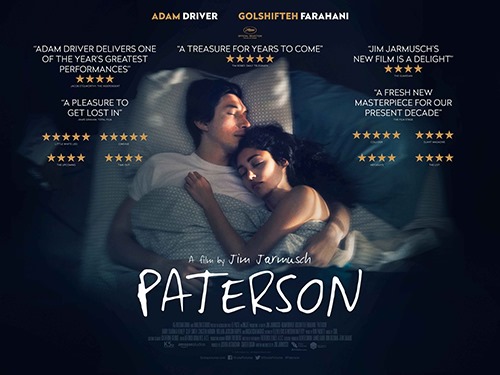
Earlier this month I saw Jim Jarmusch’s film, Paterson.”  This movie succeeds, in its modest and appropriate way, to do something impossible: to film poetry, or more exactly, the composition of literary work. It does this two ways: by having a writer, its central character, portrayed as a regimented, routinized person, grounded in a particularized working-class city and job; and then by having him compose “aloud in his head” his work against this background.

Paterson Poster

this movie has no light-sabers

This is a wonderful choice. The city, the routine clock of the days, the job, become the metrical, musical background for the flowerment of the writer’s consciousness that becomes the poems.

Though the movie is set in the New Jersey city of it’s title, the filmmaker refers often to the “New York School” of poetry, using the poems of Ron Padgett to stand-in for the work of the film’s main character.

The New York School uses a lot mid-20th Century Modern ideas, combining them into various combinations, depending on the individual writer associated with the movement. Some of it can be obscure and abstract, taking off from the same ideas that launched abstract expressionism in painting around the same time. But some also find a tenderness and wonder in the abstract patterns of urban existence, a Pop Art with a depth beneath its surface able to hold a beating heart.  At a point in the film, the main character opens his noon lunchbox to eat, and to write down the intermediate state of his morning’s writing aloud in his head, and there like a Thermos, nestled above an orange and a sandwich, is Frank O’Hara’s “Lunch Poems.” It has to be there.

Lunch Poems Cover

Don’t loose your Lunch Poems

O’Hara wrote in a great many styles, but this slim chapbook features several poems that someone once called his “I do this, I do that” poems. where O’Hara walks about, seemingly composing aloud in his head amidst daily tasks. These are my favorites, because, like “Paterson,” these poems seem to be about their own grounded creation in a city of routines, reflected inside the moist, encased, flowing mind of their writer.

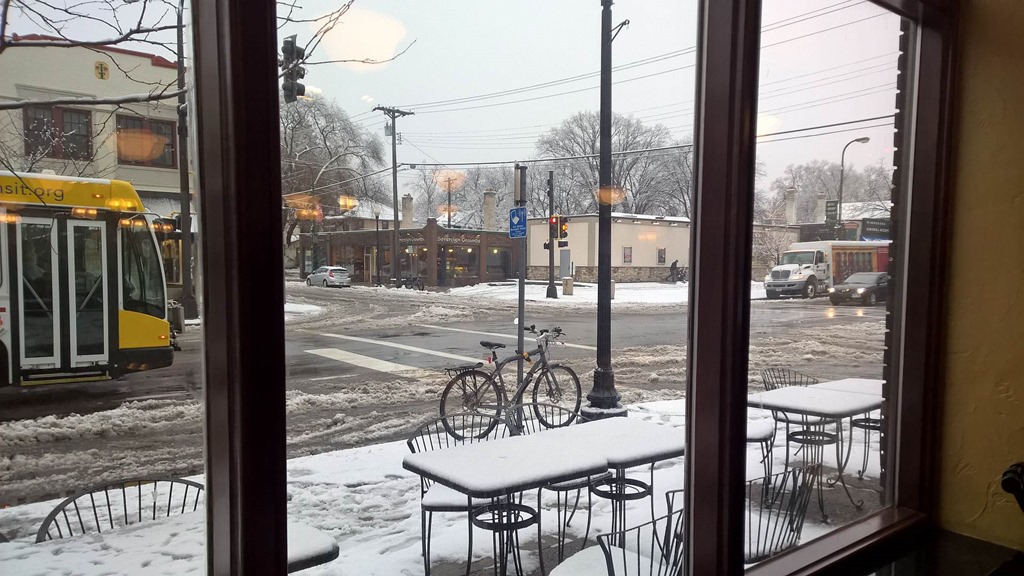
Today’s piece “2ebruary” takes off from that Frank O’Hara mode, as I often like to do, though I’m an old man, writing in another century, in the Midwest, not New York City, and my old joints creak best on a bicycle.

Schwinn IG5 outside Turtle Bread in Winter slush smaller

a scene from today’s piece, breakfast not included


“2ebruary” is a short bicycle journey thinking of history, and past the events that are turning into history that we can still change. I take a pause, as every American should, to note that American culture is made from those who came here carrying something from elsewhere. And Midwestern culture? For many, those packing trunks are hardly great-grandparent’s-age-old, at the eldest.

At one point in the journey, I note those that had no trunks when they came to America, they had only their chattel bodies and souls—and even of those two things, the former had been appropriated by others for handy profit. What could they unpack? Well for one thing: the largest and grandest part of our American music. Our history is short compared to many nations, but it contains mighty things like this. We who are joining that history, already in progress, can turn it one way or another. Which way do you choose to turn?

To hear the LYL Band perform “2ebruary” use the gadget below.