A great deal of what you hear me play here is made possible by a 1983 invention, MIDI (Musical Instrument Digital Interface), a standard for communicating musical commands. MIDI lets me create piano parts I can’t play with my non-pianist fingers. I tell MIDI what to play, and MIDI then instantly responds by playing those notes on an instrument so I can see if they fit.
Given MIDI, I as the composer can have the equivalent of a pair or more of pianists willing to play as simply or complexly as I want them to, and not only are my MIDI pianists totally compliant, they can be preternaturally skilled as well, willing to play odd rhythmic displacements or impossible fingerings.
In the years between WWI and WWII, a young musician of no great wealth or social background was studying composition in Boston. He was said to have crossed paths with some of the giants of 20th Century music there, including Walter Piston, whose Harmony book I once started many decades ago, and Nicolas Slonimsky whose book on scales later became a huge influence on John Coltrane and Frank Zappa.
However, the titanic forces of world events would soon sweep him away from all this. In the 1930s he joined the Abraham Lincoln Brigade, Americans who volunteered to fight the Fascist forces seeking to overthrow a republic in Spain during a war that served as a beta-test for World War II. This was a complex event, but all we need to know for our young man is that the anti-Fascist coalition was defeated, and the survivors who had fought for the Spanish Republic ended up as men without a country.
Earlier this year I was reading some 1939 writing by Herbert Read where he was appealing for support for a plan to transport these Spanish war survivors from French refugee camps to Latin America. Our young man, who’d hobnobbed with key musical theorists before becoming a “premature anti-Fascist,” soon found himself in Mexico City, perhaps as a result of this plan.
It was there our exiled young man took a technological step as a composer. He chose to write his music using “player pianos.” Player pianos, also called “reproducing pianos,” were a home entertainment fad from the era before better quality electronic recordings. An elaborate clockwork rolled a scroll of punched paper across mechanical sensors inside the piano which then drove the hammers to strike the piano strings. Scrolls of piano music, some recorded and played by the famous performers of the early 20th Century could be purchased, and when inserted into the home player piano, and played back with musical fidelity.
Our young man’s name was Conlon Nancarrow. Over the next few decades he exploited the player piano, not for parlor entertainment, but to create striking Modernist music of otherwise unplayable complexity. He was hip to new varieties of rhythm and harmony not only from other 20th Century “serious composers,” but from Jazz too—and the mathematical structures of Bach-like cannons were well suited to the looping scrolls he would punch himself. He wasn’t reproducing music someone played, he was producing music he conceived and punched into the controlling scrolls.
In the first few decades of his work Nancarrow had no funds, no grants, no copyist/assistants, no local orchestral resources to realize his musical ideas; but this one artist, a player piano, and his own score-roll punching could produce work needing only himself and his ideas to sound inside his small Mexican apartment.
Except for it’s painstaking, mechanical, cuckoo-clock handwork, what Nancarrow did is schematically like how one can use MIDI today. In a tip to this heritage, MIDI scores are still shown on the lit-up computer screen like player piano scrolls.
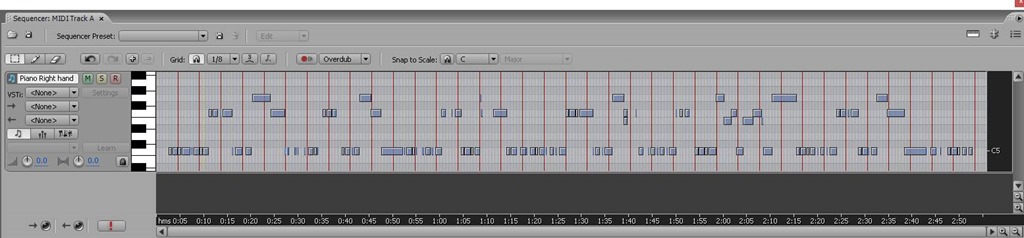
“Stuck in holes which once were dots”
One of the piano parts for today’s piece shown in MIDI “piano roll” notation
In 1969, using the high-fidelity home entertainment media of its age, an LP record of Nancarrow’s works was issued on a major, well-distributed record label (Columbia, the record company of Miles Davis, Bob Dylan, and Gary Puckett and the Union Gap). That’s when I first heard him. Acclaim in avant-garde music circles, and some grants and touring followed until his death in 1997.
In some ways the typical Nancarrow piece sounds like an artist who when finding out the vast capabilities of his new technology decides to use all of them. At once. A lot. Typical tempos sound like someone playing a recording at the wrong speed—and backwards. The number of simultaneous notes can be overwhelming, the intervals jarring, the rhythms insane. It’s challenging you to understand it, and it’s not a matter if you want to, you likely cannot. As with some avant-garde music, repeated listening (if one allows it) can increase comprehension of the ideas, but Nancarrow is never going to be shoving Billy Joel off the piano bench in popularity.
“Punched polyphony in a row” A Nancarrow scroll plays.
No, the reason I wrote this to celebrate Nancarrow isn’t because I think you’ll like his music, or even because he’d figure in any Desert Island Discs episode in my future (though through castaway days one might find the time to try to untie all the knotted ideas in a Nancarrow piece). No, it’s because I admire that kind of audacity and perseverance.
I originally wrote music of an acoustic guitar “folk song” sort, even though the poem sought to make use of eccentric meters and a tricky rhyme scheme to reference some of Nancarrow’s ideas. Today’s version has new music I wrote which fits the words better. Using MIDI-controlled pianos, it’s sort of “Nancarrow-lite” musically. To hear my audio piece for “Conlon Nancarrow,” use the player below.
 Frank Hudson