Reynardine

Are you familiar with the song “Reynardine?”  You might be. It’s been performed by many of the best performers in the modern folk revival: Anne Briggs, Fairport Convention, John Renbourn, June Tabor, Bert Jansch and others.*  Today as I extend our Halloween series, I’m going to introduce you to a version of the song you haven’t heard, a version that I’ll maintain uses more efficient and effective methods to convey an air of mystery. There’s supposition that this version may have been an indirect catalyst in the way the song you may know was presented, but this little-known version’s lyrics are so good that singers should consider using them in contemporary performances.

Where did I find this new version of “Reynardine?”   In the 1909 book of collected poetry by Irish poet Seosamh MacCathmhaoil (AKA Joseph Campbell) titled The Mountainy Singer.

I’ve spent a day or so in hurried research on this, even though long-time readers (or readers of our last post for that matter) will know that Joseph Campbell** has been of interest to me for a couple of years now. Here’s the shortest version of what I know that I can make.

Songs related to “Reynardine”  go back to the early 19th century in the British Isles and the U.S. Wikipedia gives us a representative early (1814) example, and this helpful page gives us a catalog of later 20th century versions. The older versions sometimes vary the name of the title character and contain no supernatural elements. The typical plot is a broadside ballad variation of what is still a staple romance-story trope: a woman meets an erotic stranger who she thinks may be disreputable and possibly stranger/dangerous — but who also may be wealthy or noble (Reynardine claims to have a castle in most versions.)  Over several verses there may be Victorian code-words like “kisses” and “fainting,” and the title man may leave the lady wondering where he’s run off to.

Skip forward to the early 20th century: in 1909 (the same year that Campbell as MacCathmhaoil publishes “The Mountainy Singer”)  a musicologist Herbert Hughes publishes the first volume in a series of successful song collections titled Irish Country Songs.  A great many songs that will be featured in Celtic and general folk-revival recordings, performances, and song anthologies are included in Hughes series of books.*** Hughes’ printed version of “Reynardine”  is shorter than most extant versions, a verse and a once-repeated refrain, and it’s even called a “Fragment of Ulster Ballad.” In a footnote at the bottom there is this note, unsupported by any of this song’s lyrics:

In the locality where I obtained this fragment Reynardine is known as the name of a faery that changes into the shape of a fox. -Ed.”

A century-old song, with many collected versions, and this is the first time that “Reynardine”  is said to have supernatural elements. Where did Hughes get this? I don’t have a direct link, but there is our version of “Reynardine,”  published in the same year by the Ulster-native Campbell who is not credited on Hughes’ score, though Campbell/ MacCathmhaoil is  credited in at least two other songs in Hughes’ Irish Country Songs.  The supposition is that Campbell is either “the locality” — or that Hughes and Campbell shared a traditional source which has left no extant song version that indicated to both of them that Reynardine is a supernatural creature.

Hughes' Irish Country Songs version of Reynardine

Footnotes! Pretty scary boys and girls! Herbert Hughes’ songbook presentation of Reynardine that likely changed how the song was viewed.

.

Did some of the later 20th century folk revival singers know of this footnote? Possibly. One highly influential revivalist A. L. Lloyd sang a version that included at times a remark that Reynardine had notable teeth which shined. In pre-dental-care England this detail may have been enough supernatural evidence. Furthermore, he wrote of the were-fox context in liner notes more than once 50-70 years ago which led other performers to explain the song that way, either as their own subtext or to audiences.

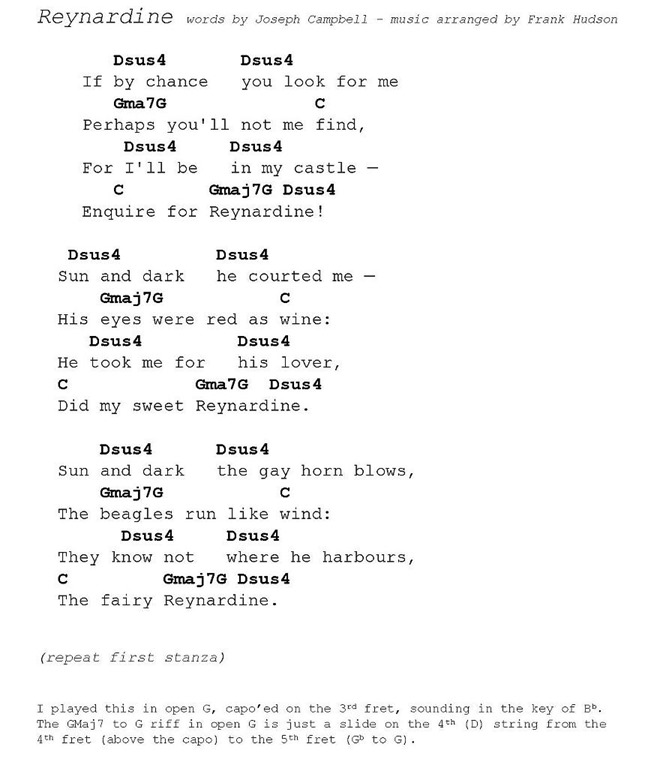
But here’s another mystery — and I’m saying, a useful one — why isn’t Campbell’s version of “Reynardine”  known and sung? Let’s look at it. The chords here are the ones I fingered, though I used Open G tuning and I formed the chords while capoing at the 3rd fret, so it sounds in the key of Bb. But the music “Reynardine” is sung to isn’t harmonically complicated (you could simplify the chords), and a better singer than I could better line out the attractive tune used by myself and most performers. ****
Reynardine Song

I made one change to Campbell’s masterfully compressed 1909 lyric. I use the more instantly recognizable, less antique word “lover” where Campbell had the easy to mishear “leman.”

.

Poets and lyricists: this is a marvel. No need of footnotes or spoken “this song is about…” intros. The supernatural element is subtly but clearly introduced. The refrained first stanza was as published by Hughes, and is commonly sung in modern versions. The second makes the bold move of changing a folk-song readymade where some damsel’s lips are found to be “red as wine” with an animalistic short-sharp-shock of Reynardine’s “eyes were red as wine.” The third stanza lets us know he can be a fox in form, subject to fox hunters with the brief but specific statements of the horn and hounds. Another subtle thing: Campbell repeats the “sun and dark” all-day-and-all-of-the-night lyrical motif to tell us this isn’t an ordinary fox hunt scheduled for seasonable days befitting rich people’s leisure, but a 24-hour emergency. The hunters know this fox isn’t normal. The refrained first verse reminds us that the lover may know that the were-fox can also take a human form, and make use of human defenses, such as castles, which the assiduous hunters do not.

As a page poem this has the vivid compression that Imagism preached. Compare the efficiency of this story-telling to “La Belle Dame sans Merci”  which has its sensuous pleasures, yes, but takes it’s time getting to the point. The two poems convey essentially the same tale, but Campbell can leave us with an equally mysterious effect using so few and aptly chosen words.

There’s a player below for some of you to hear my example of a performance of Joseph Campbell/ Seosamh MacCathmhaoil’s “Reynardine.”   Those who don’t see it can use this highlighted hyperlink instead.

Hopefully, I haven’t put any of you off with my own footnotes about this song’s unusual history and transformation. If you skipped to the end, here once more is my message today:

If you perform this sort of material, consider using Campbell’s lyrics instead of those you may have heard from other singers. They’re that good.”

.

*And more recently in a softly lovely version by Isobel Campbell, formerly of Belle and Sebastian.

**Obligatory statement: no, not the Power of Myth  guy. I suppose it could be worse, Campbell could have been named James Joyce or Sinead O’Connor, and confused us too.

***Besides “Reynardine,”  Vol. 1 includes another popular folk-revival song, erroneously considered to have wholly traditional lyrics: “She Moved Through the Fair”  which Hughes’ correctly credits lyrically to Irish poet Padraic Colum.

****I was somewhat working from a very rough memory of Bert Jansch’s version on his Rosemary Lane  LP. It’s a good thing I was rushing this and didn’t stop to listen to Jansch — his version is an acoustic guitar tour de force. If you’d like one performance to demonstrate why I, and many acoustic guitarists, revere his playing, that would be a good choice.

our Halloween Series starts with: The Good People

In the past month I’ve presented poetry by Robert Frost and Emily Dickinson, two of the most famous and best-loved American poets, and William Butler Yeats, the great Irish poet — but I also like to go beyond Poetry’s Greatest Hits and hunt for overlooked writers to combine with our original music. That’s how I found the work of Joseph Campbell who also wrote under the Gaelic version of his name as Seosamh MacCathmhaoil.

Ireland takes great pride in their poets, rightfully so, but Campbell seems to have slipped out of memory for the most part. I’m not yet sure why. Something about his personality? Political scores? The wealth of other poets to read? The lack of some widely acknowledged great poem that anthologies can’t ignore? It may just be that his limited level of fame and esteem in his most-active years before WWI didn’t reach a high enough point for his glide path to carry him into the 21st century.

When I found Campbell’s work, two things immediately attracted me: it’s lyrical and easily fits into the Parlando Project, and that he is likely the first Irish national to write in the Modernist short free-verse form that became known as Imagism. I don’t know how he came to write excellent examples in this style, but as the 20th century progressed that highly compressed and unpresupposing poetry was compartmentalized into a “you’ve proved your point” passing corrective to 19th century verse, and so Campbell’s fine examples in this style that were not widely anthologized and commented on when fresh carried little weight later.

But there’s another reason that his work fits with our “The Place Where Words and Music Meet” motto. Campbell seems to have collected and worked with traditional British Isles folk music. A few years back, author Greil Marcus came up with a fine phrase for America’s mashed-up folk musics and their contexts: “The Old Weird America” — but the British Isles traditions love ghosts, mysteries, and general strangeness too. In Campbell’s early 20th century books, right next to the free-verse Irish landscape Imagism, we may find poems that look a lot like folk song and which contain elements from traditional sources; but Campbell also shows a talent for vivid condensation (no 30 verse slowly iterating ballads for him) and luckily for our Halloween Series, he retains an emphasis on spooky and occult motifs.

So, let’s kick off a short Halloween series here with one of those poems which I’ve set to music: “The Good People.”

The Good People

What good’s a folk song if folks can’t sing and play it? Here are the accompaniment chords to my setting of “The Good People.”

.

The poem’s opening four lines set the scene, a mill path near a stream at night. Mist is rising off the mill stream, and it’s clear though dark. I was puzzled a bit by the black “lock,” but best as I can figure it may be a waterway-controlling lock. I don’t think it’s a spelling variant of the Scotch Gaelic “loch,” but it’s easy to think so just hearing it sung.

Ducks on a misty pond 1024

One misty morning early… Heidi Randen’s picture of autumn pond mist

.

In this quick-to-the mystery telling, the poem’s narrator lets us know there’s another group in this nighttime in the next quatrain. There’s a somber procession “along the grass.” I visualized small creatures, at least tall-grass short. One of them is apparently a queen of the creatures, and by now we should sense we’re in a fairy story. Two things, one obvious to any reader, and the other obscure to me until I read the poem are disclosed before this stanza ends: the queen is Aoibheall who is a prominent Irish supernatural creature. Besides noble prominence, she’s known for having a magic harp, and any human who hears this harp will soon die. Knowing that detail will set one up for the final two stanza’s concluding lines: the first of those lines we encounter tells us the little people are conveying a corpse.

This is not a victory march, the supernatural creatures are apparently The Good People in the title and they are sad and solemn. As the poem finishes, our narrator brings us to the final stanza-ending line, telling us that the corpse is possibly human.

Many, probably most, versions of traditional folk songs do not work like this, despite the rich folkloric flavor. Instead, British Isles folk songs often work like soap operas or podcast serials with a slow accretion of detail separated by many repeating refrains. At 12 lines and 72 words, Campbell’s lyric is very condensed.

To some who read or hear this, at least an air of strangeness should be conveyed efficiently. It’s also plausible, knowing the tales of Aoibheall and her harp, that a short sharp bolt of terror could occur to the narrator standing in this scene for us to imagine ourselves. The narrator surmises the corpse the fairies are bearing may be human. They (and now you) may know about Aiodheall’s harp. Did Aiodheall’s harp’s music kill the human they’re carrying? Will their dirge, already in progress, come to a harp part?

So, listen to today’s audio piece, if you dare. The player gadget will materialize below for some, but other ways to read this blog are under a powerful spell which forbids displaying it. Therefore, I’ve cast a highlighted hyperlink here to give you another chance to risk your life.

.

The Listeners

I have one more audio piece for our Halloween celebration, this one using a mysterious poem by Walter de la Mare. The way it goes about being scary is unusual—weird even.

After you read or hear it today, how would you describe what’s frightening about it to someone else who doesn’t know this poem, “The Listeners?”   Would you find that a hard task? Our previous two Halloween pieces have easy anchors to something describably frightening. Even though those two are short poems, you could point out their fright potential just as one could blurb a Stephen King novel or a horror genre film. Bronte’s “Spellbound”  has its character held unable to move as cold night approaches. While it’s not “spelled out” (and there’s a jump scare for you: boo! language play!) it is implied that this immobile state has the character suspended in the air. And Housman’s “Her Strong Enchantments Failing”  has poisons and weapons drawn and multiple deaths assured.

OK, now watch a movie in your mind of de la Mare’s “The Listeners”  with the sound off. A man rides up to a somewhat elaborate house in a woods at night. Close up: you see his hand knocks on the door. And he knocks again. And one more time—oh the heavy suspense—he knocks a third time. No one comes to the door. Back to wide shot: he rides off. Gripping! I was on the edge of my seat! Goosebumps!

Now of course suspense, fright, that sense of out-of-joint weirdness are all subjective feelings inside an audience. Nothing is assured to be delivered by any artist or writer’s work, no more than all readers will find something sexy, delicious, or beautiful. But almost nothing happens here, and that little is not unusual, at least in the days when the horse was unremarkable transportation, back before we Zoomed or IM’ed our associates instead of riding over to them.

But if you listen to “The Listeners”  (hey, is that title a clue?) you may get that ghost story jolt that de la Mare intended. After enjoying this as a poem (full text here) or in my song version, let’s look at some details of how de la Mare casts his spell.

First off, the poem is full of assertions of silence. For something that’s not a there, there—it won’t shut up about it. Helping us endure the author pointing and asking us to notice that, some of the descriptions of silence are quite nice I think, particularly the last one: “The silence surged softly backward.” And oddly, to enforce our sense of the silence, sound effects are used in a couple of places to richen the silence. We can hear the mouth of the horse grazing early in the poem as his rider goes to the door. And as the rider mounts up to leave, we can hear the sound of the leather stirrup strap stretching as his sole meets the stirrup and then the differing sound of the horse’s shoed hooves when they strike a rock in the forest trail away from the house. What we hear enforces the feeling of silence.

Dialog (strictly speaking, monologue) is used sparingly, but it finally tells with the rider’s final utterance. This is no chance encounter, though the rider is called “The Traveller” he’s not a curious passerby or a man looking for a cup of oats for his empty-tank horse. That this is an unexplained appointment is a wonderful choice! Like the silence it can let us fill it with detail.

I just got done exchanging new work this month with a small group of poets that have been doing this for decades. I’m sure many of my responses were suggestions to clear something up or to expand something the poem seems to start but doesn’t finish. And the same was likely said about my work. I thought my advice was valid when I gave it, if only from an example reader, but “The Listeners”  points out there’s no law that a poem needs to answer every expectation—maybe instead there’s a statute that says that at least in a small yet significant way it needs to surprise or even confound expectation.

And yes, that title: “The Listeners”  really helps here. The rider knows they’re there somehow, just not in the state or mood to answer. Like the silence, their nonappearance is silhouetted with outlines of absence.

The Listeners Turn2

She Don’t Care About Time. Walter de la Mare’s writing had an affinity for the weird, so David Crosby’s anachronistic cape seems fitting.

.

I went with one of my favorite rock music sounds today, the 12-string electric guitar, an instrument made indispensable for a short time in my youth by The Byrds’ Roger McGuinn. The 12-string electric is an unusual instrument today, as rare to see in a guitar store as a horseman is on the road now. I bought mine a couple of decades ago because I love the sound McGuinn and his engineers developed for it, which I exploit today. The player to hear my presentation of Walter de la Mare’s “The Listeners”  is below. if you don’t see the player, this highlighted hyperlink will also play it. Thanks for being one of the Parlando Project’s listeners.

.

Her Strong Enchantments Failing

Here’s another Halloween short poem with a supernatural spell and struggle in it, this time by British poet A. E. Housman. I found it spookily similar to Emily Bronte’s short poem from last time—but while Bronte’s poem wrung its fear from being frozen, this one is more hot-blooded.

Housman retains a degree of non-academic popularity in England but is less well known here in the United States. Academics on both sides of the Atlantic soured on his poetry during the 20th century as it didn’t hew to the Modernist ways of expression, because they viewed much of his verse as sentimental, not complex and allusive, and he often dealt with humble English characters. He’s not alone in that fate, but it’s somewhat ironic in that Housman was himself a formidable scholar, specializing in classical Latin poetry.

I found Housman’s language in “Her Strong Enchantments Failing”  as brisk and unemotional as an epigraph, despite its fantastic element. It would be easy to present as a pulp tale that starts with a statement about a failing spellcaster that by the fourth line has a knife at her neck. It moves as fast as any hardboiled fiction. Here’s a link to the text if you’d like to check it out.

The final two stanzas give us the summary, the box score, of a battle between the spellcaster and the knife-wielder. There’s no rigmarole of dice throws, just the final inning laid out as the poem ends with each character left a mystery.

All we know of the spellcaster, she with the weakened spell, is that she’s viewed as some kind of evil principal portrayed as at ease with killing. We’re told less about the other character, only that he’s young and a man, and that he’s got the upper hand holding the blade.

…this poem and Emily Bronte’s ‘Spellbound’  from last time have strange correspondences…”

Housman seems to be taking the young man’s side in the tale. His opponent is called the “Queen of air and darkness” here. I said this poem and Emily Bronte’s “Spellbound”  from last time have strange correspondences, perhaps only coincidental—but in Bronte’s “Spellbound”  the subject is held, apparently suspended, frozen in the darkening air. If we jam the poems together, our knife holding young man is a spellcaster too, and as today’s episode opens with a “previously on the Parlando Project…” connection, he was able to freeze our Queen, destroy her fearful towers and vials of poison. Bronte’s “Spellbound”  character isn’t described, but perhaps she shares Emily Bronte’s gender, and we sympathize and shiver with her for the length of Bronte’s poem. Bronte says the spell that binds her character is from a tyrant.

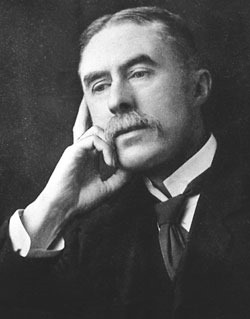
A E Housman

A. E. Housman, humble classics scholar, thinking how he could beat Emily Bronte in a fantasy boss fight

.

There’s nothing that says the young man who is ready to kill an evil spellcasting Queen in Housman’s poem is not themselves a spellcaster and maybe not a humble freedom fighter either. After all, to slightly alter the old saw, who wants to bring a knife to a spellcasting fight? In my performance I couldn’t help but start to sympathize with this doomed formerly formidable Queen, even it she’s evil, or said to be so.

Well, that’s two good weird-tales poems now in our celebration of Halloween. The player to hear A. E. Housman’s “Her Strong Enchantments Failing”  may be below. Don’t see it? Not an enchantment failure, it’s just that some blog readers won’t show that. Here’s a highlighted hyperlink that will also play it.  There may be time to do a third Halloween tale yet this month. Check back to see.

.

.


Emily Bronte’s Spellbound

Let’s begin our celebration of Halloween here at the Parlando Project with a setting of a short poem by Emily Bronte that starts “The night is darkening round me.” What a marvelous short poem it is too.

Halloween here in the northland of Minnesota is in some years an early winter holiday, and this late year’s late October seems one of those. I’ve awakened to temperatures in the teens Fahrenheit already this month, snow and ice are on the ground, and of course it’s already twilight at 6 pm. So, given that the speaker in Bronte’s poem is enchanted by a spell, it’s easy to see this from my landscape as a Halloween poem, but if you are farther south you can consider it a Winter Solstice one. And if you live in the tropics? Well, I do promise “Other People’s Stories” here.

My wife and I live by the Norwegian proverb about there being no bad weather, only bad clothes. Our love gifts tend not to be lingerie or sharp dress duds, but things like merino wool and handlebar pogies*.  We each try to keep up outdoor activities in the winter, and as long as you are active, such clothing works well.

But Bronte opens up in a different situation. It’s night. It’s cold. It’s windy. And our poem’s speaker has been spellbound out in it. They can’t leave. The poem, short as it is, tolls a refrain over and over, the speaker “cannot go.”

spellbound

I played this with the eerie, hook-like appendage guitarists call “a capo,” so it sounds in Bb in the recording.

.

And the second stanza says the weather is getting, what? Worse! There’s already heavy snow on the tree branches. Where is the speaker bound in this spell in the foreboding night with a further storm coming on?

Not even hunkered down in a sheltered area or behind a windbreak. They are frozen (not soon to be a metaphoric word!) somewhere between the sky’s clouds and the winter, snow-covered wastes below. When I read this poem, I pictured the spellbound speaker held supernaturally some distance in the air (makes it easier to view the snow-load on those tree branches), but if you are less fantastic you could view them on a ridge or hillside and able to view lowland areas below, but still more than minimally exposed to the weather. I’ve even read a reading where the writer thought that Bronte had placed the speaker in Purgatory, and the clouds are heaven and the lower wastes hell. Well, Emily Bronte was a PK** and all, so that’s not impossible, but I’ll still take the picture with what Bronte gives us, stark as it is—and in its moment, without any route to salvation.***

Other close readers note the subtle change in the last “cannot go” refrain. The speaker says “I will not…go” the last time, not “I cannot…go.” Do they want to be in this predicament? Is there a kinky love bond with the tyrant who has them trapped in the spell? Plausible reading. My sensibility hears this “will” as a final realization that there’s no way out from the spell, that the speaker is not just temporarily trapped and cannot go, but they will be so in any future they can see.

So, a Halloween-scary poem. Back in the “real world” that we hope is safe enough to tell each other scary stories, we can reflect how this trope of being in a situation of oncoming dread and not being able to move is a common bad dream. Or if you, or someone you know, suffers from S.A.D. (Seasonal Affective Disorder) you may find the winter darkness brings on a torpor that’s hard to break out of.

A simple setting for today’s piece: guitar, bass, and piano. The weather’s too cold and dark to drag an orchestra outside I guess. I plan to be back with more Halloween spells this week, time allowing, so check follow, or check back. The player gadget to hear my performance of Emily Bronte’s “Spellbound”  also known as “The Night is Darkening Around Me”  is below. No player? This highlighted link will also play it.

.

*Pogies are neoprene hoods that allow one to operate bicycle controls inside their wind and warm shelter while wearing only normal gloves rather than bulky insulated mittens. They are the only solution that really works for subzero F. cold on bikes.

**PK means “Preachers Kid.” A class that Parlando Project alternate voices Dave Moore and my wife share with me. One thing this experience usually leads to is a youthful exposure to a lot of sermons. “Heaven and Hell” may not just be someone’s favorite Black Sabbath LP—or it may be, but one has yet another context for that.

***In its short, stark, three stanza format that could repeat in any order, and it’s no way out of here situation, this poem is sort of Emily Bronte’s “All Along the Watchtower.”  Except, Emily’s speaker has no one to talk this doom over with. A like-named Emily, Emily Dickinson, would appreciate the solitary nature of this kind of Bronte poetry. Earlier in this blog we discussed that Dickinson’s “Hope” in her famous “Hope’ is a thing with feathers”  poem may have been quoting Emily Bronte.

Theme in Yellow

Carl Sandburg. I get the impression that he’s been filed away as a folksy peculiarity, a 20th century and less-original echo of Walt Whitman, an artist not worth considering these days. Readers of this blog will know I find him otherwise: a first-generation English language Modernist, just as concerned with making it new as anyone else in that movement.

Carl Sandburg guitar kids goats

The young Josh Homme and Kim Deal get lessons from some old flannel-clad grunge guitarist.


Here’s a piece using words by Sandburg for Halloween. I’ll note that almost alone among the first-generation Modernists he sometimes writes poems about, perhaps even for, children. “Theme in Yellow”  can serve as both. Of course, since we’re all “obsolete children” the audience isn’t limited to them.

Anyway, it’s a good piece for the holiday that’s about the whimsy of fear and how far from reach we can hold death. Oh, and in our modern America, it’s also about candy, for which the Jack O’ Lantern’s teeth were meant to warn us.

David S Pumpkins

David S. Pumpkins. Any questions?


Sandburg’s poem is just slightly old fashioned—the harvest festival aspects of Halloween are now abstracted from most of us, though it was in Sandburg’s personal experience. But we might still dress our stages with straw, and with cobwebs and lanterns, setting our fears as old.

May all your fears be old.

Today’s music has lots of electric guitars (seven tracks, four different guitars) mostly because I’ve been missing their sound. Lots of coordination to get all that traffic running—and I don’t know if I did right by it—but it was fun while I had time to make some noise this afternoon. You can hear the results with the player gadget below, and if you’d like to read Sandburg’s poem while you listen, it can be found here.


Witch Hunt

I’ve spent a lot of words this month talking about the history of poet and songwriter Dave Moore, who’s been the alternate voice here since we kicked things off more than two years ago. Today I’m going to end the history and get back to the present, shut up a bit, and let Dave’s words and performance tell its own story. Here’s a recent Dave Moore piece performed with the LYL Band this fall.

Let me tell you another thing about witches

Little to do with Dave’s song, but I can’t resist including a still from René Clair’s “I Married a Witch”

Is this a Halloween song? A political commentary? An investigation of something that precedes and supersedes civilized politics? An excuse for me to fire up my Mellotron virtual instrument again? I could talk. You could listen. Today let’s choose the later. The player gadget is below.

October November

By title this would be the perfect piece for today, though it does not describe the axis of these months this year in the upper Midwest, which is cold, gray, blustery, and threatening sleet or snow. So, this is not the day or night for sitting on arbor-seats in some garden, and the blazon leaves have already succumbed to a snow storm last week.

But never mind the weather, it’s an early enough poem from Hart Crane to have fallen into public domain, so that I can use it here. “October-November”  shows only a little of Crane’s eventual poetic style, but that means it might be a good way to introduce him.

Hart Crane and the Bridge

Would you like to buy a poem about this bridge? Crane in Brooklyn.

Crane’s just a bit younger than the other early 20th Century modernists, but you can see similarities to some of the branches of modernism we’ve already climbed out on. Like Tzara or the Surrealists he loves extravagant images; but though he is utterly romantic, there’s a certain classicism to many of the images he uses, just as H.D. or Eliot would. On the other hand, like the Futurists, he loves to touch on what was then modern technology. Like Edna St. Vincent Millay or Yeats his music can sound older than his subjects. Crane is a master of Elizabethan-style iambic meter and he doesn’t avoid the old habits of poetic diction. You can even see links in Crane to the original American Modernists: the ecstatic pronouncement of a new world and a new version of humanity like unto Walt Whitman and the concisely packed and puzzling lines of conclusion that Emily Dickinson could use.

But what you see most in Hart Crane, although it’s only hinted at in this early poem written when he was a teenager, is extraordinary, stunning, eloquence at the phrase level, lines with heart-stopping lyricism. Like Shakespeare, Dickinson or the writer of Ecclesiastes, a Crane poem may hold gnomic and gorgeous sounding lines, even if they are as inexplicable as what they sum up. One could write dozens of books or poems with titles taken from lines in Crane poems, though few have done so.

There’s more to say about Hart Crane, perhaps another post that tells about how the Modernists he lived and worked among never fully accepted him, but let me leave that for another day.

“October-November”  is simpler than later Crane, just a pair of images of sun dappling a garden as if it’s still summer followed by a fully delirious autumn night. I sense a growing intensity as this short poem proceeds, and tried to reflect that in the music I composed and played for this one, extending that ecstatic line in the instrumental section at the end.

One last ironic Halloween tie-in: Crane’s father invented Life-Savers, a candy that are now available in a rainbow diversity of sugared flavors that one might find in a ghost’s or skeleton’s bag at the end of tonight; but when invented, Life Savers was more of a breath mint line, successfully sold to cover up the vices of drink and tobacco on the breath. The thing that remains its essence? The round shape, the hole in the center, like the floating ring made to be tossed to a drowning person.

1917_Life_Savers_ad

Like a kid in a candy store. The Crane family business.

In 1932, a 32 year-old Hart Crane vaulted over the railing of the ocean liner carrying him back to New York City. One witness says they looked after, and “saw Crane, swimming strongly, but never again.” Perhaps his leap was too far and his swimming direction away from them, but there is no account of a round, perforated life preserver being tossed in after him before he disappeared and died.

To hear my performance of “October-November,”  use the player below.

Did You Miss It?

Let’s get one more Halloween appropriate piece in before the holiday.

We’ve featured a lot of words from Dave Moore this month, but not enough of his voice, so let’s get to that with a performance by Dave backed by the LYL Band. Dave’s a founding member of the LYL Band, singing and playing various keyboards with it. Beside his own band, Moore wrote lyrics for other bands back in the beginnings of the Twin Cities punk/new wave/indie rock scene. Around the same time, Dave worked with Kevin FitzPatrick on a well-loved literary magazine “The Lake Street Review.”  Besides poetry and songs, Dave Moore has produced the comic “The Spirit of Phillips”  for many years.

Besides Dave’s words, voice and keyboards that are often present here, you’ve also read me talking about Dave’s father, Les Moore (he of the Bauhaus name). That should be enough background from me.

Alan and Dave Moore

Alan Moore didn’t share any birthday cake with Dave. “Isn’t the book enough?”


I found Moore’s “Did You Miss It” mysterious, in a good way, so let’s let him tell us how it came to be:

“I could have called this ‘3 Moores Stew,’ where the ‘philosophies’ of Dave, Alan and Les collided in my head around the issue of predestination. It’s also an attempt to celebrate first-and-only-take songs.

For my birthday last year (#67), I got (my hero) Alan Moore’s 1200-pg. novel Jerusalem.  Wonderful, literally. Took a while to read such an intricate structure, and parts of it started to show up in my dreams.

Concurrently, I was editing my dad Les Moore’s sermons, typing over 50 transcripts. I’d class him as liberal Methodist, the admirable socially involved 60s Christian. I heard him speak every week till I went off to college & expected that many of his words would bang something up from my subconscious.

The lyric starts in Alan-psychogeography-zone, where one of his characters is choking to death for hundreds of pages as reality is explicated.

The joke of the chorus is also from Jerusalem, shared by Sir Thomas More with another shade. How could you miss the free will you didn’t have?

2nd verse (‘more hairy’) extrapolates Alan’s simultaneous beauty & death across time.

3rd verse (‘Belief’) is Les’s gift of Heavenly beauty despite death.

4th verse (‘Lights go on’) Dave points out you make your own beauty & might as well enjoy it. If it’s yours, you can get the joke.

Unlike most of my mistakes, those in the concluding instrumental are intentional. If everything’s pre-destined, who would bother pre-scripting this? Or could they?”

Dinty Moore Beef Stew Can

“Beef stew, I tell you there’s no beef stew…”


Dave points out the contrast we get from having LYL Band performances mixed with the more composed stuff here, where I play all the parts. “Did You Miss It”  is one of those “first and only takes songs” that we’ve done, were the arrangement and parts are happening just as the recording light is lit. Trick or treat? Mostly treat here I think.

Use the player below to hear Dave’s song.


Wrapping up Maila Nurmi and Vampira

Yesterday, the songs I made from Dave Moore’s cycle of poems about Vampira had taken us up to her short run as the first “horror host” in the early days of television. As recounted in that post, by the time her little more than a year of  broadcasting fame had wrapped up, the idea of a sardonic costumed character hosting late night showings of horror and SciFi films went nationwide, with dozens of local reflections of that concept. None of them were exactly like Vampira though, and oddly, all of them were male.

Vampira’s creator, Finish-American Maila Nurmi kept at a show business career following her TV host stint, including some Los Vegas work with Liberace, but as the 1950s started to conclude, she was getting farther and farther from the brass ring. Should there be any wonder that this would have been so? No, there were few models of self-defined female performers in the Fifties, and it was her character, Vampira, not herself, that held what fame remained. And that character, combining as it did fears of death with fears of female sexuality, both attracted and repelled where it was remembered.

It was in this context that Nurmi took a role in a micro-budgeted movie with an incoherent script and famously eccentric director: Plan 9 From Outer Space.”  When the movie was completed, if such a disaster could say to have completion, it hung around in obscurity even lower than Nurmi’s for more than a decade.

Plan 9

Like 80s video game packages, Plan 9’s poster has higher production values than the movie.
Vampira gestures, Tor Johnson arises from the grave, and Ed Wood’s chiropractor fakes it as Bela Lugosi

Nurmi pressed on with living, less and less known. There were a couple more bit parts, and her day gig sometimes was “handyman” work in the homes of the more affluent. Poet Kevin Fitzpatrick remarked after reading Dave Moore’s pieces on Nurmi’s resilience that she was showing “Sisu,” that untranslatable Finnish characteristic that says that determination will get you through any challenge.

And then something odd happened. The same generation of film scholars and fans that helped recognize the value in genre fare like pre-war horror movies, low-budget serials, or the foreign oddness of Japanese monster movies began to look around all the blind corners of obscure film. What made a film that met few of the criteria of good cinema still interesting? Could it be that watching a film fail to fulfill it’s duties had a fascination in itself? What would the worst possible movie be like?

In 1978 a couple of movie critics put together a book called “The Fifty Worst Films Of All Time.”  Like many lists of superlatives, it generated plenty of response, but one response was to claim that they’d overlooked this now 20 year old film that was seen mostly on TV, late at night, when viewers just couldn’t believe the bad dream they were seeing. The authors, Michael and Harry Medved, figured there was another, better book about worser movies, and in 1980 they redid their lowerarchy with a follow up book that named “Plan 9 from Outer Space”  the worst movie of all time, and it’s director, Ed Wood, the worst director of all time. And since then, nothing has challenged that assessment, it’s become the “Citizen Kane”  of bad cinema, a movie seen by millions who are astounded by its, ah, quality.

Thus Vampira’s few minutes of (gratefully, given the script) silent footage in “Plan 9”  communicated Nurmi’s visual concept to a new generation looking to stand back from their times. The Misfits recorded a tribute song around this time, and now this year, The Haxans illuminate that song with an excellent cover. But of course, you want to hear how Dave Moore and I conveyed this part of Maila Nurmi’s story in the song-cycle. In case you’re in a hurry to get to your Halloween party, here are the three preceding songs from the Vampira song-cycle, along with the LYL Band telling the story of how Vampira would have been forgotten “If Not For Ed.”

Maila Nurmi arrives in L.A., and as she considers what persona to take on she considers celebrity evangelist Amiee Semple.


Why might someone like Nurmi choose a gothic character
in the midst of the supposedly peaceful and satisfied Fifties?


Maila Nurmi performs on TV as the first “Horror Host.”


The last part of the tale, how “Plan 9”  allowed Vampira to be seen by a new generation.