Wild Peaches, an Eden with undercurrents

There’s an undercurrent of grief beneath life. I don’t say this as a sentimentalist, it’s just there. This doesn’t preclude joy – it may in fact demand it.

I awoke at dawn today, August drizzle falling. I connected briefly with a livestream of the candlelight anniversary memorial service in Hiroshima,* and then shared a few tears with my living wife. Tears from each of us mixed on my face, shed for my late wife now dead for 24 years this morning. After she left for work, I took to my daily joy and hopped on a bike and rode to breakfast under gray skies without remaining rain.

I usually read the news with breakfast, a long habit – and I still do, though there’s little joy and much sense of loss in it these days. I took an old pocket music player with me (which no longer works except for the radio)** so that I could listen on air to the children of a recently assassinated state legislator memorialize her and her husband killed alongside her. They played their parent’s favorite songs mixed with sharing stories of hearing those songs in the back seat of a minivan while all sang along in flagrant voices. See what I mean: grief demands joy.

Perhaps you don’t. I express myself awkwardly, some will wonder what I’m on about. Let me look at it from the perspective of absent connection: the man who has gained some wealth by bamboozling someone or by force of power, often has the briefest of joys. The one who seeks joy in the suppression of others, has a meagre joy constructed out of a comparison to other’s pain inflicted. Grief for them might be a weakness, a sure sign of submission. I, a nobody in this world of power, can laugh at myself writing this and tell myself I should stop trying to be mistaken for Kahlil Gibran.

Today’s musical piece came about when someone shared a poem by Elinor Wylie called “Wild Peaches.”  Wylie, a contemporary of Edna St. Vincent Millay, gained an audience during the last decade to be called The Twenties. She was born into a successful family steeped in political rectitude, but her love life became a national scandal. She eloped with the son of an admiral at age 20, but soon left him for a married, older lawyer by the name of Wylie.***  The abandoned husband committed suicide after she left him, and the lawyer Wylie and Elinor fled to England and lived undercover under an assumed name. Eventually the couple married and were able to return to the U.S. in time to have that relationship too fall apart.

Hanging out with the East Coast Modernists, the now Elinor Wylie launched her poetry career. The scandals likely helped and hurt that career, but Millay and some other women poets were writing with complexity in melodic verse about eros (and what surrounds it) – and for a while they found readers hoping to understand “the New Woman” of the 1920s. As it turned out their careers were helped and hurt by many of them writing rhyming verse in metrical forms. Even before Modernism, rhyming verse was already becoming associated with less serious poetry, and women writing about eros were judged less substantial than men writing about the supposed important things. The oncoming middle of the 20th century was to be very concerned with important things – many deadly through new bombs or other means.

“Wild Peaches”  was published as a series of four sonnets, and I’ll link the full text here. My performance is only of the first one, which I think can stand alone and is representative. Rewardingly musical, the first impression one might have is of a poem that’s kin to the famous Yeats’ poem “The Lake Isle of Innisfree.”  Instead of an Irish bee-loud glade and house of wattles made, the poem’s voice is describing an Eden, a locus solus, a blessed arcadia, in the south-eastern coast of the U.S.**** But wait, there’s an undercurrent.

This is the poem of a woman who had twice eloped – the second time was subject to an international “womanhunt” – and neither partner stuck. The voice of the poem knows full well flee and exile may the entry and exit point of such an Eden. I love the ironic turn the sonnet takes even within its octet when it goes all Frank O’Hara – though written before that poet or Disney’s Davey Crocket had come into existence – with the man taking to wearing a coonskin cap and the fleeing couture-debutante clad in homespun. The exultation of “We’ll swim in milk and honey till we drown” is delicious, moving from Exodus past the parted sea to drowning.

Wylie in elaborate dress

Elinor Wylie, not wearing homespun fabric


The sextet seems to offer more Eden – but wait, the best season is Autumn, the season of The Fall, and we are left with the abrupt movement from wild fruity abundance to a subsistence bringing death, and a hunter whose shot will not miss.

Oh mercy, I’m going to go all Gibran again: death will surely win one battle, though love can win many battles. That’s what I’ve found – and though she died young, Elinor Wylie later seems to have found her most successful marriage the third time around.

After our last piece where I accompanied my speaking ghost with lots of electric guitar, today’s piece is full of bowed strings: cello, violin, and viola da gamba. In secret I’ll tell you I played most of the string parts for my Carolina Eve in Exile with my MIDI guitar. I’ve taken to calling pieces such as this “Punk Orchestral,” in that I’m not getting overly fancy with the rank and order of calling these instruments up. You can hear my song made from the first sonnet in Elinor Wylie’s “Wild Peaches”  with the audio player below. No player? You’ve not been driven out of the garden, it’s just that some ways of viewing this blog will suppress it, and so I’ll supply this highlighted link that will open a new tab with its own audio player.

.

*For several years after my late wife’s death, I didn’t notice that it happened on Hiroshima Day, but I’ve found that linking a single death with the death of thousands underlines my point about humanity’s shared undercurrent of grief and loss.

**I could have Internet-streamed the children’s memorial radio program of course, but I decided to use the old device because it reminded me of the era I shared with my late wife.

***The imp of the perverse in me can’t help but think of the lawyer’s family name with the animated coyote and his well-funded Amazon Prime account who is none-the-less doomed. We find that funny.

****We can locate this poem’s Eden from its fruits. The wild peaches indicate it’s southeastern as that non-native fruit is only cultivated below the Mason-Dixon line. Wild peaches are the remains of abandoned orchards or animal-carried/buried/excreted seed-pit refugees of cultivated fruit. The poem’s other fruit, scuppernong, is a wild white grape native to the Carolinas.

The Unquiet Grave

August brings me this triple obligation: it’s the anniversary of the public launch of the Parlando Project, of my late wife’s death, and of the atomic bombings — three things varying in nearness, scope, and heart-weight. Two of them plainly have to do with grief — and poetry’s connection to matters of death and survival is there to be examined too.

Today’s musical piece isn’t exactly literary poetry, as its survival can largely be laid to singing, not printing and the murmuring eye.*  “The Unquiet Grave”  is one of those works from that prolific author Anonymous. Their publisher? The memories of people who wanted something to sing. The version of “The Unquiet Grave”  that you can hear below was collected by Cecil Sharpe in Great Britain from the singing of a “Mrs. Lucy White at Hambridge, Somerset, 6 August 1904.” This is a portentous coincidence: I just went to the book where I saw that version to gather the note on its collection, and that date of the year is the very day my late wife died; the year of collection, the same that the house my late wife and I bought and I still live in was first occupied; and the place it was sung “Somerset,” says August in its sound.

The Unquiet Grave

With all the words flowing through the Internet, you still might want to pause and listen when the ghost begins to speak.

.

The story in the ballad is compressed, but it opens with a lover’s mourning. The next event, the dead partner becoming present and speaking is not just supernatural, it’s also an empirical report of what many of those in grief experience.

Just last week I was listening to Fresh Air’s Terry Gross interviewing podcaster/comic Marc Maron.  As they talked, ostensibly about Maron’s career, the two bonded over their own recent partner’s deaths — Maron’s a couple of years ago, Gross’ earlier this year. They each shared that their dead spouse’s presence and voice had vividly returned to them, and each averred that this experience was not horror-show scary — rather it was, while remaining strange, comforting. I can remember one of my own experiences around a year after my wife’s death. I was becoming involved with my present wife around this time, and I felt it awkward that here was the presence of my dead wife returning. I don’t know if I spoke to my dead wife’s presence out loud, but then in such a spirit world our conversations likely needed no sound or syntax, only the sense, and that sense was a common realization between us that it was  awkward, but that this new complexity was fine. More than speaking — do ghosts laugh? Do we laugh in their presence? I think we both might have that night.

I’ve always felt that “The Unquiet Grave”  has a practical, darkly humorous, intent. If ghosts have additional knowledge, extra-existential wisdom, what the ghost in the song shares is that one can cherish the dead, even hear them speak, but that they are changed forever — and the living can, should, change too. When the ghost says that you wouldn’t want to kiss the corpse’s lips, the gothic joke on deadly “mourning breath” almost writes itself.

The words in Lucy White’s version, which I remained faithful to, somewhat fumble the lyric’s closing statement. What the final exchange the lovers share means to say is “When the autumn leaves fall from the trees/and (then) spring up green again.” I just sang what was on the page, but that fumble is, I now think, also exemplary of grief, it’s misdirection. Grief’s disruption, like a slight-of-hand magician: something is here (like what you meant to say), and then it’s, poof, gone.

Today’s musical performance of “The Unquiet Grave”  is a tribute to Fairport Convention, the pioneering British folk-rock group — a choice of mine inspired by recently listening to Andrew Hickey’s 500songs.com history on how that group formed its own Cecil Sharpe revival-with-Stratocasters after their own encounter with death and grief. You can hear my performance with the audio player below. Has any such player failed to materialize? If so — mourn but organize — and click this highlighted link which will open a new tab with its own audio player.

.

*It’s hard to date the ur-versions of folk songs, though many were printed in the 18th and 19th centuries, first by commercial broadsheet publishers and then by collectors and song-catchers like Cecil Sharpe and Francis James Child. Child collected “The Unquiet Grave”  in America in the late 19th century and numbered it 78 in his ballad collection. It’s always seemed to me that “The Unquiet Grave”  (also known in versions as “Cold Blows the Wind”)  is an extended variation of one of the oldest fragments of English language poetry “Westron Wynde,” which has been dated to the Middle Ages, plausibly to quite early in that era.

Dirge Without Music

I’ve worried a bit lately that I’ve been doing too many Parlando pieces presenting sad poems. It’s likely that mood is part of my nature despite living a life I’m grateful for — perhaps even more so because I live a life I’m grateful for, and I’m therefore aware of its temporary nature that I cannot keep. Because of this, I’ve kept a quote, a suggestion, from Kurt Vonnegut close to me:

I urge you to please notice when you are happy, and exclaim or murmur or think at some point, ‘If this isn’t nice, I don’t know what is.’”

Vonnegut wrote this in one of his last books, one that might again speak to my mood in this state of my nation and its ideals, A Man Without a Country.

At my age, it’s no longer morbid to think about death. This past weekend my wife and I went on a goth date, and visited one of the fancier local cemeteries. We mostly went for the 1910 main chapel building full of early 20th century William Morris/Pre-Raphaelite derivations which echo back to the start of the era I mine for a lot of the poetry here.*  The cemetery was taking part in a special open-house event held around the Twin Cities offering more access for the public to “behind the scenes” parts of the facilities.

We walked by famous early citizen’s gravesites, some elaborate with statues and such, and then too the many small vaults with names and dates on their file-cabinet sized faces. One room’s space was maximized with rows floor to ceiling across the room — so much like a library, even up to having a rolling metal staircase that would facilitate viewing the topmost. Instead of spines one views in those tall rows names, and partner’s names, and those bookend years. Every one of them, like every book I suppose, expects that there’s someone left to see and remember them, and I paused to consider that that wasn’t always so.

In another part of our tour, another portion of my nature was stoked. Walking by the cemetery’s crematorium, I noticed this homely implement hanging on the wall. As the old prayer book has it: ashes to ashes, dust to dust — and that passage now had a corollary: and dust to pan.

Dome and Dust Pan

Part of the main chapel: tiled mosaics, stained class, intricate motifs, capitol mottos. Crematorium: clean, professional, and an inexpensive hanging broom and plain white plastic dustpan, the same model as hangs in our home pantry.

.

Oh, it was a beautiful Spring day, full of decoration, full of evidence of grief, inscriptions of loss — and to the puritan, evidence of vanity. Life is so big, or so small, we must laugh at it.

Which brings us to today’s poem I’ve performed with music: Edna St. Vincent Millay’s “Dirge Without Music.”   I had finished this piece earlier this Spring, but at first held it back because I feared it was too much like some other musical pieces I was working on — and then after those coincident issues expired, I started to worry that it was too much-more sadness. Revisiting it this week, I now think no, it’s not just bleak — it’s a bald-faced statement of honest feelings about death and loss. Here’s a link to the full text of the poem.

In writing music and preforming this poem, am I disrespecting the author who titled her poem “…Without Music?”   I think Millay’s intent here was to speak against sentimentally decorating loss. Loss has patterns, resolutions, codas, and rests — and music too, even if it has repeat marks, has an ending measure — but music’s part of the equivalence is so often beautiful. In such ways fine poetic word-music, as well as that with express melodies, may speak over loss, interrupt it. Perhaps my rough-hewn voice with its limits and plainness, its lack of precise or elaborate lyricism, is apt for Millay’s mood here?

You can hear that musical performance of Millay’s poem with the audio player below. What if you see no player? That’s likely because some ways of reading this blog suppress showing it, but this alternative highlighted link will open a new tab with its own audio player.

.

*A few years back here I did a series on “before they were Modernists” with early poems by some Modernist figures. More than a few had roots in those retro-hipster movements of the late 19th century, and many a free-versifier had carried around a Swinburne volume in their youth.

I Dream I Am Falling

This August 6th is the 8th anniversary of the Parlando Project — but it’s also the 23rd anniversary of my late wife’s death and Hiroshima Day. This isn’t the first time I’ve linked these three observations with a single post and musical piece.

Given two-thirds of this anniversary, it’s not surprising that “I Dream I Am Falling”  is about grief and remembrance. It is a departure from the Parlando Project’s focus in that this freshly completed song uses a poem I wrote rather than our regular use of others’ words.

I continue to write poetry, though less often as I’ve aged. I think sometimes about prize-winning poet Donald Hall revealing in old age that he’d given up writing poetry. I don’t recall if he knew why he stopped writing poetry, or if he revealed the reasons for stopping if he knew them. For myself, there are elements of regular life interfering, but throughout my life the writing of poetry was the easiest art to interleave with other busyness. I would compose stanzas in my head, trusting memory retention as a good test of their value until they could be transcribed. Or like William Carlos Williams, I might jot down first drafts on prescription pads in slow worknight moments in the Emergency Department of a hospital.

Remembering that, I think writing poetry is unlike musical composition and recording, which for me is constrained by my life’s current contexts. Looking back I recall that as a younger person I was eager to write down observations from life which seemed to me to be important and unique. Now, in my older age, when I see similar things they seem less unique, and my expression of them less apt, for I sense that life I was once observing has all along been watching me too — watching me as the hunter does.

Still, the reason I set the official launch of this Project on my late wife’s death anniversary was to counter that. Life, the actuary, knows something, but I can sing in the meantime. The reason I sing others’ words in my unkempt voice is that the writers here are already dead, and I can stick my thumb in death’s eye by making their words current. Given that death’s eye socket is empty, that there’s no sensitive eyeball there, this does not stop Death — but it feels good to do it anyway.

Partway into this Project’s course I started to include Hiroshima Day, the anniversary of the first use of atomic weapons, in my August 6th observances. Death of one’s specific partner has an intimacy that sears because it’s so personal, but it’s not unique nor fully shareable. The death of thousands in a way that still threatens us by the millions or more — well, shouldn’t we share that?

Let me take then a tiny digression to this presentation of today’s musical piece. This summer I’ve been watching a 10-hour multi-episode documentary on Netflix titled Turning Point: The Bomb and the Cold War. I’m only about ¾ done with it, and maybe there’s something at the end that I should have waited to observe before writing about it, but I’ve found it so good I want to mention it today. For something of this length, its storytelling is compelling, and it often takes the sophisticated choice of leaping out of time’s lockstep to connect things. OK, it is 10 hours, but also roughly equivalent to a graduate-level course on the Cold War and atomic weapons strategy in the breadth of its concerns and detail.

I Dream I Am Falling

This is an American Sonnet, following my longstanding practice of breaking up the 14 lines in different ways.

.

Now, returning to the new song. I hope it speaks for itself. Many of you, my treasured audience, will have their own experience of grief to resonate with what it sings. I was able to compose and realize it without access to a studio space where I could use acoustic instruments and sensitive microphones. Only the vocal, through a less-sensitive microphone* recorded sounds vibrating in the air as I played the block chords appearing in the left-channel that established the song’s harmonic structure on my little plastic MIDI keyboard. You can hear “I Dream I Am Falling”  with the graphical audio player below. No player seen? This highlighted link is an alternative.

.

*ElectroVoice RE-20. Worth considering for anyone needing to record vocals in a space that is not acoustically proper for recording, where low-level unwanted sounds would otherwise end up on the recording. For my budget level, expensive, but it’s been an important tool for me. No, it’s not magic — louder sounds will still intrude — but the sensitive condenser microphones I use to record with acoustic guitar in my studio-space hear everything: HVAC sounds, louder computer fans, outside traffic, even sometimes footsteps on another floor of the building. In my converted bedroom home office where this was recorded, the studio-space condensers would be highly problematic.

If all the griefs…. Emily Dickinson and also music

We’ll get to a remarkable short Emily Dickinson poem today, but first a few words about the music.

One of the things I like about this Project is not caring about what style of music I make to combine with the poetry. You see, I don’t like “silos” — those ways of viewing music as having borders, types, genres, labels. Some days I want to make acoustic music, some days I go inside computers to see what I can score and program to happen, other days I want to take an electric guitar and lean into the amp so that I can hear that guitar respond to its own screaming. Then I’ll be so audacious as to fake music that I have no right nor sufficient understanding to make. Jazz and orchestral music are fields where extraordinary musical knowledge is required — or it would be if I paid attention to the rules. When delving into those kinds of ensembles and approaches I make do with quite simple ideas.

In the music for this Project I’ve become dependent on acting as the musicians that work with my composing self, and the composer knows the musician’s limitations intimately. At least the musicians in me can depend on the composer to keep them from being bored with the same challenges all the time.

Does this variety succeed or fail? I don’t know. Perhaps I am steeled in this effort by writing poetry for years before composing music. Poets in our age generally don’t know if they’ve succeeded. Poetry’s audiences are small and what audiences poetry has may be too cowed by the pretentions of the art to allow us mere listeners footing to talk about it.

Today’s audio piece combines unlike things even before it gets to combining with Emily Dickinson’s striking short poem. I took some very old things: A Telecaster (a 1950 design, meant for bar-room and dancehall cowboy music*) and a small Fender Princeton electric guitar amp I’ve had for more than 40 years. But instead of playing birth-spanking music for dancing and carousing, I played slow, spare music, exactly stumbling though while still keeping itself upright. That part of the piece’s musical approach has a label within the catch-all of indie rock: the sub-genre is called slowcore. To this I decided to add (or perhaps preserve is a better word) some artifacts of its making that you, I, or the next recordist might think defects. The mic was picking up a lot of the pick strikes on the guitar’s strings —well sobeit, they are the crickets or the tapping implements of this soundscape. And to this I decided to mic the floor beneath me as I performed this to capture my foot stomping time as I played.**

I believe this combining pairs well with the difference of Emily Dickinson. I’m not entirely sure what Dickinson meant to achieve in the short poem we title with it’s first line “If all the griefs I am to have.”   What was her internal intent in writing this, what did it mean to its author? Was she writing something to herself? Or was it expected to be a little greeting card epigram to thank someone else for the gift of joy? The first line we use out of need for a title leads us to think it’s about grief, and a recipient of this might think it awfully strange to think this a thankyou message — yet one through-line of the poem’s two stanzas is that the poet’s present mood is so joyful that a lifetime’s accumulation of grief wouldn’t phase her at the poem’s moment, and that any imagined accumulation of a lifetime’s joys would only measure the same as what she says “happens to me now.” We might assume the poem’s occasion is some joy then, yet this poem doesn’t say that outright.

Emily often enclosed poems in letters or gifts to others. I don’t know if this was one, but can one imagine being an acquaintance or family member of Emily and receiving these 8 lines? Others might be jotting down “I thoroughly enjoyed your visit/garden party/whatnot” in bread & butter notes. You open Emily’s and it’s “If all the griefs I am to have would only come today…”  Awkward. But to her mind the thought of all that grief, all the sadness, all that pain, all taken at once — it’s something to envision and grapple with. And your cherries jubilee was scrumptious.

thank you from Emily D

A goth who loves dessert? Emily was a dessert maker of some note to her friends and family.

.

If you follow the logic, that’s what the poem could be saying. But the way of saying it, the framing of saying it*** causes one to see grief in an equivalent measure to joy. I see this poem as a Taoist statement, that there is one unified, effortless, way in things.

Is that Taoist reading an accident, an illusion I’m imposing? I’m frankly not sure. One thing I’ve learned as I’ve leaned into Dickinson this century is that her mind had within it a mode of trying to express vast philosophical points in tiny poems, and that the central thoughts that are embedded in just a few words in these poems can be difficult. She was reading Emerson and the Transcendentalists, and they were among the first Americans to try to come to grips with East Asian philosophy. Her poem does  explicitly say grief may seem an illusion to joy, which can flow around it; and that nothing (including joy) is so large that something else cannot be larger.

Well, that’s my awkwardness for today — but you can hear it with music if you use the audio player below. And if the audio player isn’t giving you a RSVP, this highlighted link is supplied for those ways of reading this that suppress showing the player, as it will open a new tab with its own audio player.

.

*A great many musicians discovered that it was good for things well beyond what it was designed for. One side-effect of Leo Fender’s guitar design was that its bridge pickup was to deliver bright, clear notes which meant that no matter how much you smeared it with reverb and ambient effects or applied fuzztones and distorted murk, it still let its intent cut through. For today’s guitar part the Telecaster had things that went against this bright, clear nature: I tuned it down a full step (D to D instead of the conventional E to E) and the motifs tend to be played on the lower strings here. And the guitar was strung with flat-wound strings. Almost all modern guitarists use round-wound strings, which let the lowest pitched 2 or 3 strings have a brighter sound and bring out more of the harmonic series above the root frequency of a note. Flat-wound strings are wrapped with a tight flat layer of wire that suppresses that, which makes them contrast with the ringing plain, un-wound top 2 strings all the more. This timbral contrast can make the single guitar sound almost like two differing instruments.

**I had intent there, even though the sound and rhythms of today’s piece were unlike its model: John Lee Hooker’s early records were often just Hooker’s voice and electric guitar, and his work-boot stomps were clearly audible as percussion on some of them. When I listen to exemplary slowcore band Low’s spare drumming I  sometimes think it has the same effect as Hooker’s sole-music.

*** In poetry, unlike say the essay or expository writing, the way of saying is brought forward to be as important as the message of what is said.

Free to Fall

Allow me to be more internal than I usually am when presenting these pieces. Today’s piece uses my own words (we do that rarely here) and it’s here today for a peculiar reason — and peculiar is something I enjoy indulging in.

Early this autumn I was looking for a musical piece that represented the season, and I recalled this poem of mine that I had written music for. When? I probably wrote the poem early this century, and from a file I found, I was able to determine I wrote the music in 2007. Sometime after writing the music, I recorded what I recall was a pretty good version of it, likely with Dave Moore playing keys.

“Maybe I made this one of the early Parlando Project pieces” I thought. At the beginning of this Project as I was figuring out how to compose and record our combinations of original music with literary poetry, I had used several recordings of that vintage. Having some already completed pieces gave me time to get a handle on other tasks while getting this thing going.

But, what, I didn’t know? Well, I’ve put up over 700 publicly accessible pieces in this Project’s lifetime since 2016 — and that doesn’t count the ones that just didn’t work or didn’t fit the concept. One might like to think I keep my eye on every sparrow — but with that amount of catalog, it’s not fully accessible in my head. So, I looked. Here. For my own work.

Nope. I hadn’t presented it. It might not have made the cut because I wrote the words, and the Parlando Project is about other people’s words. Where else might it be? I looked in my somewhat disorganized collection of sessions and finished non-public pieces. Nope, not found there either.

My solution then was to re-record it. Recording time has been hard to come by lately, but I remembered this poem-which-became-song as being effective, so I tried to have it ready when I could open my microphone and record.

The piece is called “Free To Fall.”  As I wrote at the start of this inward story, I said I remembered it as being an interesting variation on the poetic perennial of autumn. In the first verse I already hit the falling leaves motif (can that one be escaped?) and I think the “every tree grows tall” was me referencing the British folk song “The Trees They Do Grow High.”   I continued to try to bring some longstanding tropes into this brief song: my own restatement of François Villon’s “Mais où sont les neiges d’antan*” starts off the second verse. I think the lines “Old men carry winters/in which the children play” are my own, but like my memory of where I put this song’s older recording, who knows if I just don’t recall some inspiration or reference.

The third verse’s reversion to summer memories and grief may be influenced by what I consider to be one of the great autumn songs, one found in every fakebook: Joseph Kosma/Jacques Prévert/Johnny Mercer’s “Autumn Leaves.**”  That song too begins with falling leaves, but references a summer lover now gone. Having lost my late wife in August might have made sure I made that step back in memory in the song.

Free to Fall Illustration 800

“Everything is free to fall”

.

The originality of this compressed catalog of autumn thought comes in the refrained pair of lines “I grew up believing/everything was free to fall.” What was my intent there? I’m not sure if I’m articulate enough to do as brief a job as the poet me did in writing the poem. Yes, I knew many readers/listeners would think of things like free will and predestination, shibboleths of theology — but in the lines’ first statement I wanted the connotation that autumn’s falling leaves are freed from their work in photosynthesis and now can flutter and drift. The fourth verse refrain may (or may not) put this in a different context. Is this a compressed statement of “free will,” the doctrine that humankind has the choice of choosing good or evil, which also carries a connected thought that this is what makes good, good, not just an inherent trait? I was likely aware of that when I wrote it, but in performing it this fall I took another plausible memory: that there are those who believe in an afterlife, or a rising or rebirth of the souls of the dead, but that the song’s singer believes that however temporary or final autumn’s dying off is, that there’s a freeing element in it, like that leaf that has been loosed at the start. That’s a bittersweet freedom I wanted to convey.

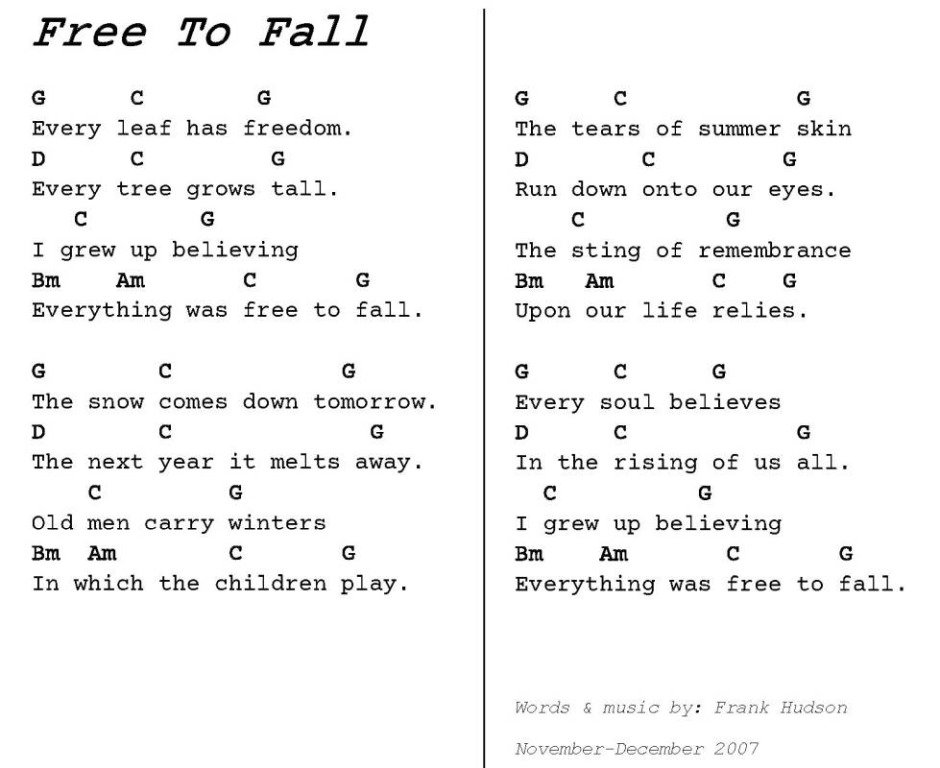
Free to Fall

Here’s a chord sheet so that other singers can extend or improve my performance

.

This poem/song works for me. Maybe it has some worth to you. In summary, the way I think it works is from the ability of compressed verse and song to collect things in a small memorable chunk of words, a portable experience. I’m glad I remembered this 16-year-old song and that I was able to record a new version to share with you. You can hear it with the audio player gadget below if you see that. No gadget? Some ways of viewing this blog won’t show them, but this highlighted link will open a new tab with its own audio player.

.

*“Where are the snows of yesteryear” is the concluding line of his “Ballade des dames du temps jadis”  published in 1533. Yup, those snows are definitely gone.

**One of the abandoned Parlando Project songs you won’t hear came from my idea to do a fresh translation of Surrealist-associated poet/lyricist Prévert’s French “Autumn Leaves” lyrics. I got a hold of those lyrics in French, and found that Johnny Mercer’s English lyrics are a freer, looser sort of translation. Prévert’s lyric is longer and more miserable, while Mercer’s cuts right to the nub of the situation without wasted elaboration. I found there was nothing I could do with Prévert’s French that would even approach the recasting that Mercer had already done.

Palingenesis — three anniversaries noted

Today’s post is part of observing three anniversaries this week: this blog’s launch six years ago, Atomic Bomb Day (noting the anniversaries of the bombing of Hiroshima and Nagasaki), and my late wife’s death in 2001. An odd combination? Well, yes, but they coincide.

Odd? Personal loss has an odd size. If one holds one’s hand in front of one’s eyes it can block out the entire sun. How close grief is to one, has a similar effect. When the 9/11 plane crash attacks occurred a month after my wife’s death, it was objectively a sad, horrible, thing. To some small and nearby degree it impacted the place I worked. There were employees traveling, in the air as the attacks became known. We had at that time a floor of offices in a tall local building in St. Paul, over a thousand miles away from the attacks, but a tower named at that moment ominously “The World Trade Center.” And the radio network I worked for had a large news component. Everyone and I did what we needed to do in the wake of the attacks. It was not that I did not care or have consideration then — but the sharp pain of that public grief could not be felt to the same degree in my self still encased in loss.

So too the atomic bomb attacks on the two Japanese cities must have been in 1945 to many Americans. Some had lost loved ones in that war, some feared for losses to come. Some were waiting for what, how many, conventional deaths before the war’s end, and wondering if one of them would be their own.

Those nearby close things can blot out an atomic bomb. Ethical philosophers try to make true weights and perspectives, poets on the other hand talk instead of how it feels to think of these things.

Henry Wadsworth Longfellow, an American poet whose importance is now obscured by judgements of excessive conventionality against the bright lights of Dickinson and Whitman’s new approaches, wrote the poem which I’ll perform in part today. Written and published in 1864 during the American Civil War, it’s author certainly knew of the generalized grief and loss of that war and the human slavery it was fought over* — but he also had closer griefs. His wife had not only died in 1861, she died in his arms, her body on fire from a household accident as he himself was burn-scarred trying to extinguish the blaze. And then his teenaged son was serving in the Civil War and was grievously wounded in 1863.

Longfellow-bomb-Renee

Three anniversaries remembered. There’s no way to picture this blog in a single picture, so we’ll show Longfellow.

.

The opening section** of “Palingenesis”  considers memories and grief, considers the imperfection of the rebirth that the obscure word used as the poem’s title offers. If the eternal noises of the sea and ghostly apparitions in the mist may strike us as all-too-tired poetic tropes to our 21st century judgement, the image at the end of the segment I perform, the ashes from which some fabled alchemist might be able to reconstruct a burnt rose still has power for me. This “rebirth” without scent, and without the ability to change and bloom, is not a true rebirth, it does not repair the loss.

My life path after my wife’s death is a complicated story including joy and gratitude. Are those considerable things big enough to obscure the loss — in reverse, a planet bigger than a hand? I cannot honestly weigh that, other than to live in the scent of life and to bloom. Starting this project, even if over a decade after my wife’s death, was one way to return to poetry what my young poet-wife would have given.

I have at least one other planned part to this anniversary post, one other musical performance that doesn’t yet exist. I don’t know if I’ll be able to find time to do that, but this part that I did complete is available below. You can play the performance with the graphical gadget below where you see it — and where you don’t, you can use this highlighted link.

.

*A close friend, a U. S. Senator, was beaten unconscious and seriously injured on the floor of the Capitol over an anti-slavery speech which was deemed insulting for inferring the same crimes of sexual slavery Longfellow wrote about in a poem.

**The rest of Longfellow’s “Palingenesis”  concludes with the realization that a forward-looking new birth, not an attempt at exact repair and reincarnation, is the better answer. Not only would the entire poem produce a piece longer than I prefer to present here, I think the poem’s older poetic language might wear down many current listener’s interest. Here’s a link to the complete version.

It’s been hard to complete new work recently, so “Anglers” for Minnesota’s Sport Fishing Opener day.

The world of this poem is scribed with the understanding that when you’re on a lake’s surface you are at the boundary level of two worlds. Like unto angels in Medieval drawings, those fishing are pulling the fish from the aqueous world into the sky world, and I often felt I could sense the hooked fish’s wonder and distress. “Who are these scale-less giants unconcerned by gaseous air?” This poem is called “Anglers.”

Meanwhile, back in Chicago, the Yip Abides blog and rmichaelroman caught this wall painting in 2009. Whimsey aside, the very fish the anglers are seeking to catch in Minnesota today are spending their day trying to catch other fish.

.

It’s unsaid in the poem, but I was in the boat described. I didn’t put myself there because I wanted to focus the reader’s attention on the two brothers and yes, on the fish. There are other undercurrents that I think I kept out of the poem, and someday should make at least one other fishing boat poem. If any in this blogs’ diverse readership reads this before or after getting in a boat and wetting a line, net, or spear, the poem asks you to consider this if you like to think on the water and not just chum with talk: you are frighteningly miraculous.*  Don’t let it give you a big head or anything. There are angler forces without skin on another level above our surface.

My grandfather’s actual Johnson Seahorse outboard motor mentioned in the poem

.

I recall that the more published and noticed members of my little writer’s group Kevin FitzPatrick and Ethna McKiernan were not particularly satisfied as readers/listeners of this poem in an earlier version, and I may have made a couple of changes based on that in the version you can hear today. I think they may have been puzzled or unimpressed** by the pun at the heart of the title: that on the flat surface of the lake, the “anglers” are the highest upward length of a right-angle to the water surface, the sharpest break vertical the fish would ever experience. And then there’s the even more obscure eye-rhyme-ish pun of anglers and angels. Neither of them cared much for puns, while Dave Moore and I indulged generously, enough to wrinkle the other half of the group’s noses.

Now Kevin and Ethna have been, like the fish, also pulled through the surface, and today there’s a church-based memorial service for Ethna which I don’t think I will be attending, though I’m glad to have attended a poetry-centered one for her earlier this year, and I’m planning to attend the poet-focused one for Kevin later this May.  In lieu of today’s service attendance, and out of guilt from my absence, I’ll say that if their skin-less existence is in wonder and distress, that my thoughts go with them, and in my dim watery existence here I ask us on all our levels to turn our circle-eyes toward wonder.

And I know too there are practical voices in the fishing opener today. “That’s what I get for getting into a fishing boat with a poet. Such high-flown thoughts! Damnit. I’m trying to get a worm on this rig’s hook. We feed worms to fish, and then well, we feed worms.”

If you’d like to hear my performance of my own poem “Anglers”  there’s an audio player gadget below this for many of you, and for those who can’t see that, this highlighted link  will open an audio player  for it in a new tab. My music for this uses what I often call my “punk rock orchestration.” I use very simple orchestral instrument colors both because I lack the knowledge/skill to do more complex ones and because I think there’s a direct charm remaining and being featured by stripping that sound down.

.

*Ah, footnotes, the sinker-weighed lures bobbling along near the bottom! No, I’m not out fishing today, or most any days in this part of my life, though I think about my hours of fishing as a young person. I always considered the fish though, a little to a lot. One thing’s simple though: every poet wants to be miraculous.

**When a poem or poet doesn’t “hook” us, these two feelings can be cause and effect in either order.

Winter Solstice Consolations

I ran long the last time, let me be short today. Last week after Ethna McKiernan died, Dave Moore and I talked briefly, and I said that I was going to try to write something for Winter Solstice.

“Make it a happy one” Dave requested. I’ve written at length about the losses Dave and I have had with poetic colleagues in recent posts, so for those who want more details, I’ll refer you to the last couple of posts here instead.

How far did I get to that “happy?” Not all the way. The piece I wrote and you can hear my performance of today is more at bittersweet. I’ve talked to Dave about how I’m hearing Kevin FitzPatrick’s and Ethna’s voices, very distinctly at times when I’m quiet. And since I knew them largely as poets, I’m hearing them reading their poetry. I tell you honestly I don’t find this eerie at all. I find it comforting. I expect that those voices will fade with time, but right now to hear them keeps them with me.

I suspect grieving people have heard similar departed voices since we first began to speak, and that those voices would be more sure to come on a long dark winter night. But here’s my modern variation: due to the pandemic the last few meetings of the Lake Street Writer’s group happened over Zoom Internet videoconferencing. I became accustomed to seeing Ethna’s face after she began her cancer treatment on the same home screen I’m typing this on, and so now when I’m on a Zoom conference I sometimes expect to see her face again as one of the squares on my grid — and I will allow myself to visualize my expectation. You can read all 2916 lines of “In Memoriam,”  and you won’t find Alfred Tennyson having that exact image to deal with.

Winter Solstice Consolations

Here’s my own text I performed from. Due to short recording opportunities, I worked out the drums and percussion, and then rapidly laid down a bass, piano, and then an arpeggiated 12-string guitar part to further establish a harmonic flavor. I had time to quickly improvise three passes of a lead electric 12-string part, and this was the best of them.

.

Then the last time I saw Ethna McKiernan, it was her book launch reading at Celtic Junction on August 6th. I recall she wore a brightly colored headwrap on those last Zoom conferences, and for the public reading she was all in bright red. I melded those two visual memories with our seasonal gift-wrapped packages in the poem.

Ethna McKeirnan reading August 6th 2021 2

Ethna with bright red shinning over frailty, on stage for the book launch of “Light Rolling Slowly Backwards” this August.

.

So those are some of the consolations the poem’s title refers to. And too, one of the fine things in winter and on winter solstice is to be inside, in our lights, at home with our partners, family, house-pets, and welcome ghosts.

Here’s what I speak of in the final line: our lakes and ponds and the still parts of rivers have ice surfaces now. Whichever side of the ice you are on: under it and in the underwaters, or over precarious ice not thick enough to securely separate yourself from those cold underwaters — laugh with more than happiness, laugh with that knowledge that that ice is a fragile and temporary division.

A player gadget to hear my performance of “Winter Solstice Consolations”  will appear where possible below. If you don’t see it, you can use this highlighted hyperlink to play it.

Ethna’s Dream

Long time readers here will know that one of this Project’s ideas is “Other People’s Stories.” I’ve chosen to make that one of its principles for a couple of reasons. First, the Internet is full of folks telling their own stories, and this is fine (after all, to me those would all be “Other People’s Stories”). I wanted to do something different, to focus on how you and I experience a variety of words from a variety of writers with a variety of outlooks. The second is that I’m rather uncomfortable with promoting myself. That one’s complex.*  Like most writers or composers or artists I think my own work has value at some percentage over half the time. Which then, mathematically, allows that I doubt its value, or my handling of its value, or the costs of declaiming its value to the universe a bunch of the time too.

No one creates without the first thought. It would be impossible. And no one who cares about what they create, about their audiences, or about how much craft and care can be devoted to any art; without seeing the faults, the missed communication, the needs for just one more revision or tomorrow for any work.

Many of us create instinctively, because we have to — but sharing that work is a choice. I’m nearing 600 Parlando Project audio pieces presented here. I could have presented at least half or two-thirds of that easily with things Dave or I wrote, but I made a different choice. It’s less conflicted for me to publicly look at, to be honestly surprised and delighted at Emily Dickinson, William Butler Yeats, Carl Sandburg, Langston Hughes, Sara Teasdale, or Du Fu; and then to share that with you.

But there’s a problem with “Other People’s Stories.” I’m likely not understanding everything those authors intended.** And they’re their  stories, their  visions. I’ve talked recently here about how when I translate a poet who wrote in another language how I want to honor their work and transfer accurately their particular powers, and yet then become tempted to break off into something their work makes me see through my own eyes.

A long prolog to presenting today’s piece, one I wrote and titled “Ethna’s Dream.”  Ethna is Ethna McKiernan, a poet who I used to meet and talk about work with once a month or so, along with two to four others. Ethna cared and crafted her work over decades, and in her life did other useful work: running an Irish heritage book and art shop, working with the homeless. She’s currently in hospice, comforted by family, and the reports are that she’s now mostly in an out of what appears as sleep.

I couldn’t call Ethna a close friend. I always sensed a distance there. I think often of her none the less these days, and of every rudeness, awkwardness, or self-dealing on my part around her; and those or any number of things could have caused that. The very fact of writing a poem about her death, her dying, that mostest personal thing, seems problematic.

So, when you listen to my piece “Ethna’s Dream”  you now know all that. This is not a poem about those things I’ve discussed in prolog, or at least I hope so. Instead, my intent is that it’s a poem about what we should treasure of that sharing of the unconscious that we have with artists (including those whose main art is just living). What I present in “Ethna’s Dream”  is not a romantic, imaginary, sentimental metaphor in my own mind — though it may attract or repel you if you see it as such — it’s more at the essences of what we do, share, and take with art.

Ethna's Dream

There’s references to Bottom’s speech in Shakespeare’s A Midsummer Night’s Dream. Am I prettifying  myself up with pretentiousness, or comparing myself to the foolish play character? I wrote it, and yet I can’t tell.

.

There’s a player gadget to hear it below for many of you, but some ways of reading this blog won’t show it, so there’s this highlighted hyperlink to play it as well.

Thanks for reading and listening.

.

*One problem, leading to one fear, is that when offered the chance to promote myself I see myself as overdoing it, and coming off as a self-absorbed narcissist that runs on too long about the arts I work in, prattling about the obvious and the obscure in equally embarrassing ways. If you’re still reading at the footnote stage, you may have forgiven me for that.

**Beside just plain embarrassment of ignorance, we now more often talk about cultural appropriation in regards to this. The travesties of cultural appropriation are real, but my belief is that they should, must, be risked.