The great American poet Emily Dickinson writes about death a lot, so maybe I should pause for a moment to mention how inescapable the living’s experience of death was in her time and place, what with disease, injury, a deadly Civil War, graveyards within the city limits, and approaching death happening often at home.
Because I lived across the street from death? When a child, Emily Dickinson’s family did not live in the Dickinson Homestead (now the Dickinson Museum), but at another house, located across the road from the town cemetery where she would later be buried. A child is born, plays, grows up, and crosses the fence.
.
The poem I’ll sing below today speaks to that. If you’d like to follow along, here’s a link to the text of “As far from pity, as complaint.” This poem is more than its message —most good poems are — but let me write down here a sentence to summarize what I read this poem as saying: rather than pity, dread, or anger toward death, a result we cannot change, we should emulate the dead themselves who demonstrate that life is not everlasting — but the predicament of dying, and the predicament of living, are everlasting.
That’s a worthwhile thought, and poems in Dickinson’s time and place were often expected to deliver a lesson. But why is this a poem, why is this an Emily Dickinson poem? An essay, a sermon, a sympathy card, a letter, a conversation all could deliver this message as well or better as 12 lines not even pentameter-long and broken with the skeleton spaces of the pervasive Dickinson dashes (as if her “trade was bone.”)
Because it sings this situation, even silently on the page. There’s a dancer’s force, a singer’s force, an instrument’s augmented force in this way of telling. If death is inevitable — as is also meter, repetition, rhyme, the flow of sound into shapes — might we be comforted by these shapes? We live. We die. The shape of life continues. Quod Erat Demonstrandum, thus it is demonstrated.
When encountering this poem earlier this summer I sensed an intra-poem image-rhyme in this poems 7th and 8th lines. A better-known Dickinson poem which attracts us with what seems like mundane charm, “I’ll tell you how the Sun rose,*” has summer children playing from dawn — and at the end, disappearing over the horizon’s fence-line at sunset. That’s the continuing shape of our lives.
You can hear my musical performance of “As far from pity, as complaint” with the audio player below. If your way of reading this blog is numb to that revelation, don’t complain, I offer this highlighted link as a way to open a new tab that will have its own audio player so you can hear it.
Here’s another example of a short Emily Dickinson poem that seems in some facets simple, and yet when examined more closely still shows her uniqueness. On first reading it reminded me of a saying attributed to Benjamin Franklin* “Nothing concentrates the mind like the prospect of being hanged at dawn.”
One might read this poem from the start as a restatement of that Franklin quote — except, Dickinson may be saying this isn’t someone’s last day, she wants to set down the situation someone’s next-to-last day. In the first stanza, it is sunrise, and the poem says that the doomed person has delight. Why? Because there is one more day before their death at the dawn.
Chord sheet in case you’d like to sing this one yourself.
.
This idea is clearer in the second stanza, where again, death is clearly due — but tomorrow. There the doomed man is listening for the bird that will likely sing at the next dawn. Perhaps he’s listening to the Meadow bird in the day-before dawn more intently, knowing the next time he hears that song it will be his execution, and this is his last day to hear it in the more generally hopeful context of introducing a day, not an execution. He might choose this — after all, if he knows he’s to die tomorrow, he can be somewhat assured he will not die in that present day as the bird sings the day to begin.
The final stanza may be the oddest, but indicates that this is so. It twice tells us the mood is joyful, which would indicate that the condemned does feel assured of, and is in love with, this day — the full day before. There’s a somewhat ambiguous word-choice in the last line: “ought.” The word can be a stand-in for zero, for nothing, but it’s primary meaning is more at obligated. If we take the zero/ought meaning, or the obligated meaning, Dickinson’s poem is saying the poems doomed subject is joyful though the next-to-last morning Meadow bird has a duty to sing nothing but elegy, because the poem’s subject will accept the day with joy.
So, this is goth-mode Emily with death certain, but this is also certainly the day before the last day.
Musically I had to throw this one together quickly, but it came out OK. Though in a minor key it’s somewhat jaunty. You can hear it with the graphical player below, or if the Meadow bird’s audio player isn’t visible, you can use this highlighted link that will open a new tab with its own audio player.
.
*There’s a similar quote attributed to Samuel Johnson, and there’s this later extension authored by Terry Pratchett “They say that the prospect of being hanged in the morning concentrates a man’s mind wonderfully; unfortunately, what the mind inevitably concentrates on is that, in the morning, it will be in a body that is going to be hanged.”
For a cluster of reasons, it’s been increasingly difficult to create new audio pieces for this Project. For one thing, having done over 750 of these pieces during the past 8 years, a lot of musical ideas, poets, and poems have been explored already. For another, my increasing age and high-mileage body have decreased my stores of reliable energy and dexterity. But one other reason is that I no longer have a predictable and luxurious access to times when I can record something that involves a microphone. Oh, I still get such time — but I don’t always know when it’s coming — and so an opportunity may arise, and I’m committed to something else, or it comes about and I’m weary and spend it napping or resting my aching old frame, or it opens up, and I have nothing prepared to record.
This frustrates me even as I realize that what I do have to bring to the Parlando Project in terms of resources and time is something to be grateful for.
Yesterday I had foreknowledge of one of those recording times coming. I collected two things I wanted to do something with: a well-known poem by Emily Dickinson and another musical piece that I wanted to record just for my own personal enjoyment. As I sat down in my studio space to record my musical performance of the better-known Dickinson poem, I noticed on my music stand a chord sheet for a lesser-known Dickinson poem I had done the music for early this spring: “Sexton! My Master’s sleeping here. ” “Sexton!” hadn’t been recorded, even though it was ready — I didn’t have the time in early Spring as I rushed to do all the pieces on the children’s verse theme I had chosen for National Poetry Month.
Dickinson’s “Sexton!” is an early Spring poem, a season that arrives at different times in different climes, but I figured that I needed to record it right away if I was going to keep it at all timely. I grabbed a dreadnaught guitar (a larger, more powerful sounding guitar than my usual instrument) and quickly refreshed myself on how I had intended to perform “Sexton!”
I was so eager to record on this occasion when the restrictions to making a sound had fallen away that I ripped into the piece at a reckless tempo. A choice or a mood? Moot point, I had to get on with it. Thinking about that tempo today I also wondered if my teenager’s hardcore punk listening had seeped into my mental metronome. But then “Sexton!” does start with an exclamation point, and the whole poem is that: an exclamation of Spring.
Of course this is Goth Emily — so even if her poem and performance are as short as a cut by the so-rapid punk bards of San Pedro The Minutemen, there’s context crammed into 90 seconds. Here’s a link to Dickinson’s poem if you want to follow along. What do we find in those words?
This is what you come to the Parlando Project for: stuff that’s stuck on each other like cockleburs.
.
A sexton* takes care of church grounds, typically including a graveyard. The sleeping Master’s bed chamber is therefore likely a grave. Spring has come with flowers and birds expecting new life.**
Spring isn’t stopping to reflect on this, like the tempo of the song it’s got work to do. Dickinson is in a churchyard, but it’s full of death departed and life arriving, not dogma. What replaces that dogma, sermon, homily? Bird-troubadours, secular Spring-song: its shortness, its insistence. You can hear my performance of Emily Dickinson’s “Sexton!” with the graphical audio gadget you should see below. No gadget? This highlighted link is a backup that will open a new tab with its own audio player.
.
*By anachronistic coincidence, the poem’s sexton made me think of Anne Sexton, a 20th century American poet. Poetry is like a cocklebur: its tropes and metaphors will stick to anything.
**More coincidental connections: in considering Dickinson’s poem in the context of a song I thought of this Earl Sykes song, best-known from a Ralph Stanley bluegrass version, called “A Robin Built a Nest on Daddy’s Grave.” I wonder if Sykes knew Dickinson’s poem, or if there’s some third source that both the poet and the songwriter tapped for this springtime combination. My Dickinson poem-now-song would make a good medley with Sykes’ song —and good bluegrass high vocals and harmony would certainly spruce up my rough-hewn singing performance.
Here’s another piece that has been in process for nearly a month. It’s also another that I’ve held back because I feared it would be either disturbing or unattractive. It should be apparent by now that this Project doesn’t exactly pander to an audience — what with its inconsistency and stubborn variety — but I do sincerely appreciate those who take some of their time to read or listen to it. So let me explain.
Sara Teasdale’s “Since There Is No Escape” is a piece of gothic romanticism. Since my tastes are wide-ranging, it’s not the first time I’ve touched on that strain of expression — “The Dark Cavalier” from earlier this month would be another example. These are pieces with a kind of dark beauty to them, and therein is the danger. For, at least to some, there’s a simplifying morbid pull to that kind of thing.
Do gothic pieces impel that kind of response? They have a defense. I wrote that “The Dark Cavalier” implies skeptical elements while expressing the dank promises of death. “Since There Is No Escape” might be said to go further, presenting itself as a memento mori exercise, a way of praising life by starkly expressing the inevitability of death. As an old person I’ll frankly acknowledge that the ending of any expectation of unlimited numbers of years ahead of me motivates me in getting on with what I do. At my age, my cohort of fellow art-workers near and far from me are dying off. Yes, that’s inevitable, but I’m not going to put on a big black-crepe production about it either. Let it get me off my butt and onto my work — but beyond that, those concerns could just get in the way and constrict my vision.
Teasdale means to say nearly the same thing, but with poetry it isn’t so much about what is said (unlike a book or essay) but more about what it feels like to say it. The emotional moment in this poem is stuck a bit — and it’s a short poem which contains only a moment — in the contemplation of death and the romanticism of life and song against it. If “The Dark Cavalier” sees death as a lover who promises to be faithful, a quality many lovers promise with crossed finger bones, the “Since There Is No Escape’s” singer sees death as a chief magnifier of the author’s art.
Maybe that’s so. Maybe there’s no escape from that: that we value the transience of life, love, and art because it’s transient. Memento mori is a motivator, as I acknowledge, but it can get in the way of living, which has a right to the flavor of the inconsequential and the illusionary non-obsolescence of the present.
An oft used picture of Sara Teasdale. I’m struck by the enigmatic expression.
.
All this sounds like I’m dragging on Teasdale, whose word-music pulls me in, and whose poetry is worthy of greater attention. It’s not that simple. The poète maudit stance can be overvalued as the only true outlook — it’s not the only way to frame life and living — but poetry and song that expresses those emotions allows us to examine those feelings in ourselves, in others. That then is my explanation: those who believe life is richer and stranger can find value in examining and acknowledging that gothic outlook.
A few words on the music for today’s audio piece. I’d like to give a romantic explanation for the elaborate ensemble you’ll hear when you listen to it: three (count’em) three pianos, two Mellotron parts, organ, upright bass, drums, and a large mixed chorus of voices. I could write about the music trying to express the richness of life that Teasdale says she’ll miss, or that those are the choral voices of sweet and solemn death angels singing above us temporary earth dwellers.
Don’t let anyone else know, but that fair field full of folk set of sounds is due to my setting up a new more powerful audio production computer because I’ve finally started to run into issues with larger numbers of more demanding virtual instruments in some of my arrangements. This music was motivated by me layering in a bunch of those VIs to see that I’d successfully reauthorized them, and to test that the upgraded computer was able to run them at low latency settings without glitching. Perhaps this is a parable: that you can find substance while you are only concerned with the mundane, since it was freeing to play the various lines on these instruments on my plastic piano keyboard unconcerned with their lasting success.
To hear my performance of Sara Teasdale’s “Since There Is No Escape” you can use a graphical player you should see below. No player? There’s still a way, this highlighted link will open a new tab with its own audio player. Those wanting to follow along with the text of the poem can find it at this link.
Long time readers here will know I’ve referred several times to an observation by former US Poet Laureate Donald Hall that I’ve called Donald Hall’s Law. Here’s how I’ve recorded what Hall wrote:
The majority of poets who receive prizes, notice and ample publication in their time, will be unread 20 years after their death.
If they are unread at 20 years post-mortem, their fate beyond that rarely changes, save by scattered efforts like this weird Project and its versatile readers and listeners. So, today’s piece is by one such awarded and forgotten poet, Margaret Widdemer. I can’t really claim that Widdemer is a great talent awaiting rediscovery. I fear some antiquated elements in her poetry make reading her in large doses more of an academic exercise. As an indifferent scholar with many other tasks in this project, I can only say I’ve skimmed her work. Yet, per Hall’s Law, she was a prolific oft-published prize winner. Widdemer was first published as a novelist in 1915, and in the silent film era several of her novels were adapted into movies. Her poetry has several modes and subjects, and she wrote selections dealing with social issues, including child labor and women’s suffrage. Perhaps the height of her prize-winning resume came fairly early, when she tied Carl Sandburg in the voting for the 1919 Pulitzer Prize for poetry, becoming the co-winner that year. Anyone who knows me knows I maintain that Sandburg is due for a reappraisal — but if Sandburg’s undervalued, he at least has a current value. If Widdemer was his peer in 1919, her stock has long ago dropped off the literary stock exchange.
Widdemer’s Pulitzer Prize winning poetry collection was The Old Road to Paradise, and it contained a representative mix of what I’ve seen while skimming her poetry. She writes rhymed verse, and her poems often seem to have music implied in their structure and prosody — you could class many of them as literary ballads or songs. Despite this structure, I’m unaware that she’s been commonly set to music by composers.*
At least to me, the most interesting of Widdemer’s work combines that “just asking for a musical setting” structure with strong fantasy elements.** Given that fantasy literature retains cultural interest in the present day, these Widdemer poems are the ones that might have revival interest. Today’s selection “The Dark Cavalier,” included in her Pulitzer book, is one such poem. Furthermore, if it was written more recently and set to music, we’d easily see it genre-wise as Goth. It certainly risks being disturbing, the poem being spoken by a seductive Death who wishes to lure the weary or troubled listener to settle for his stable and grave-set romance. The poem’s outlook is such that one could feel that reprints should have footnotes about the 988 number established for those dealing with suicidal thoughts. Yet it seems to be one of the relatively-known of her nearly-unknown works, and it was selected in 1958 as the title for a late selected poems collection.
I didn’t know Widdemer married a cellist when I composed this, but this setting is acoustic guitar with a simple string quartet accompaniment.
.
In musical performance I tried to undercut the poem’s speaker’s luring spiel, to bring out a little of the subsumed caddishness in a suitor who offers an everlasting relationship, when we know, that even for prize-winning poets, their attention will quickly fade.
You can hear my performance of the musical setting I did for Margaret Widdemer’s “The Dark Cavalier” with the audio player gadget you may see below. No player to be seen? Some ways of reading this blog will suppress that player, so I offer this highlighted link that will open a new tab with its own audio player.
.
*Widdemer married the year she received the Pulitzer. Her husband was also a prolific author, but it’s also said he was a proficient cellist who wrote book-length biographies of composers.
**One recent reader noted that she wrote a poem about a “Gray Magician” in “Middle Earth” before Tolkien, which indicates that Widdemer may have had some knowledge like JRRT did of Old English. I also suspect that she must have been aware of the revival of interest in older British Isles folk-music by Cecil Sharp, Francis James Child, et al.
I’m nearly over the bout of upper-respiratory crud that has laid me low this month, so I felt it time to see if I could test the dulcet tones of my voice again with a new audio piece. Today’s is one by Emily Dickinson: “I died for Beauty — but was scarce.”
This poem is characteristically short, and “I died for Beauty” has long been one of Dickinson’s “better known” poems. Let’s do what I often like to do with one of Poetry’s Greatest Hits here and see what we may have missed, and why I might archly put that “better known” in quotes. Here’s a link to a blog post that starts with the full text of the poem in case you’d like to refer to that as I discuss it.
Let me get this out first: to certain sensibilities this is a poem that’s easy to find infused with a kind of corny gothic pretension. It’s got all the counters, common already in Dickinson’s mid-19th century, only more so now: graves, decomposing tragic corpses, sad death, and the world’s disinterest in earnest souls. And on top of this: it’s got capital letter Truth and Beauty. Even a school child who’s read and adored some Keats* will see Dickinson as dropping a shout-out to the doomed garageman’s son.
What can we infer about what Dickinson intended here? I’m no Dickinson scholar, but what I’ve gleaned from reading some of her letters as well as her poems is that while she had those gothic urges, she fiercely wielded a skeptical eye and a satirist’s pen. My guess is that she believed in capital letter Truth and Beauty, and Poetry for that matter, but she also knew the comic limits of humans dealing with them. I could be wrong, or projecting, but that’s the Dickinson I “read.”
The poem’s opening line, with its concluding start of a broken phrase “I died for Beauty — but was scarce” lets one suspect that the tomb is not exactly overflowing with heavenly beauty. So, our dead-in-the-tomb “died for beauty” narrator here finds death (like life) is asking for our narrator to become “adjusted.”
But wait there’s another voice! One equally devoted to capital letters! One who died for Truth! In case one thinks those capital letters are shouty, his voice is soft, somewhat defeated, and is asking about failure. Note that the died for Truth voice is male —we’ll have more to say regarding gendering in the poem soon.
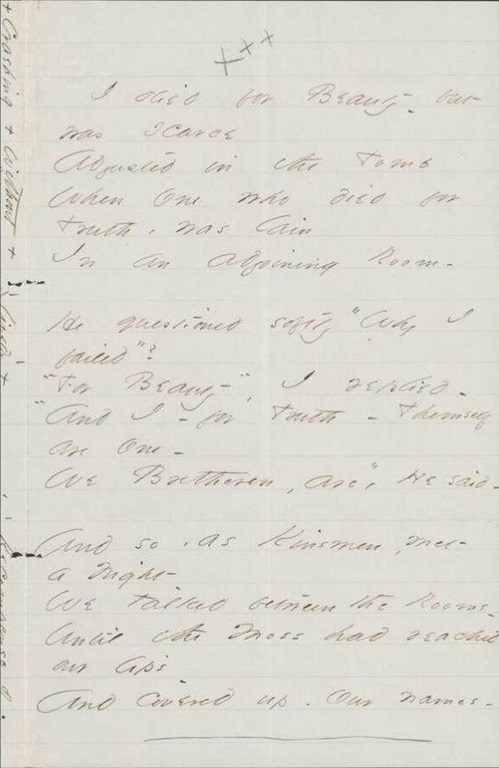
Here’s how Dickinson wrote down this poem of hers in one of her sewn-up fascicles.
.
Dickinson either makes an odd choice or is just awkward in the Truth guy’s opening question.** She writes it as he’s asking “Why I failed?” in quotes. In ordinary writing this would indicate that the voice is asking: “Why did I, the Truth Guy, fail.”*** However in the context of the poem the Beauty voice, our narrator, answers back as if they were asked why they died. It’s hard to convey in a single-voice performance, but if Dickinson intended this awkwardness, it’d be a demonstration of Beauty being consumed by their own state and so thinking the question was to them.
The conclusion of the 2nd stanza, Truth Guy’s reply to our Beauty narrator is stilted, even by mid-19th century formal speech standards. I don’t know if this is intended or simply a failure in Dickinson’s prosody. If intended, Truth Guy’s speech is demonstrably meaningful (truthful) while not being beautiful. I think of my thought about Dickinson growing up in a household consumed with lawyering and contracts and being genetically related to lawyers.
I’m indebted to Oliver Tearle in pointing out something else in Truth’s little speech: he calls our narrator “Brethren” which is continued in the summary of the next and final stanza as “Kinsmen.” Now if we are to assume that our narrator is Emily Dickinson, a woman, then she’s just changed gender or has been miss-gendered by Truth Guy. Now of course even though the poem begins with “I” we can’t be sure that Dickinson — even if consumed by the beauty of poetry and multiple times in her poems apt to cast herself as writing of herself after death — intends that I who died for Beauty to be herself.
This may be leading to the final two lines, where truthfully and beautifully the omnivorous (even consuming mineral!) moss consumes their bodies and eventually their grave’s marker stones, leaving nothing gendered, nothing specific, only their essences returning to our shared essence: the truth and beauty available to us all if we seek it, to borrow and use it, to find comfort with, and to comfort by.
I’ll pause here to note that poet Ethna McKiernan died this past Sunday. I worked on this Sunday and Monday before I heard the news.
A Player gadget is below for many of you to hear my performance of Emily Dickinson’s “I died for Beauty — but was scarce.” And if you don’t see that, this highlighted hyperlink will also play it.
I’ll offer my own tentative and inconclusive possible inspiration: It’s thought this poem was composed in 1862, and while we don’t know the particulars of Dickinson’s intent, there’d be this possible even more contemporary influence: the folk hymn adaption “John Brown’s body (lies a moldering in his grave/but his soul is marching on)” which was transmuted into a more grand literary composition with the chorus of “His truth is marching on.” As “The Battle Hymn of the Republic” Julia Ward Howe’s poem was published in the February 1862 number of the Atlantic Monthly where Dickinson surely would have seen it. Literally, the antecedent to “His” in Howe’s poem is the godhead, but folk-music-process wise, the antecedent is John Brown.
Posthumous editor and sought-out living “preceptor” (in her words) of Dickinson, Thomas Wentworth Higginson, was a backer of John Brown’s raid.
**Original Dickinson editors Mabel Loomis Todd and Thomas Wentworth Higginson removed the quotes Dickinson put around Truth Guy’s question, making it clearly a question to our died for Beauty narrator in their version. So “He questioned softly ‘Why I failed’?” in Dickinson’s hand then became “He questioned softly why I failed?” on first printing.
***”Failed” here is meant also to have a double meaning as in dying, but the fail in failed is too prominent. As this voice was first introduced, “One who died for Truth” is more noble sounding, as in martyrdom, than failed in truth.
As a person educated in the mid-20th century this is what I knew about Fredrich Nietzsche: he was a philosopher who was all the rage in the late 19th and first half of the 20th century and he had this thing about achieving a more perfected human condition. Oh, I knew one more thing about him, something that discouraged all other curiosity: the Nazis liked him, saw him as an intellectual forerunner of their decidedly non-intellectual movement.
I know only a little more than that now. In the past few years it’s become accepted knowledge that the Nazi connection was to a large degree accidental. Nietzsche’s sister was his literary executor,* and she was a Nazi fan-girl who did a great deal to forge that linkage; and since the Nazis were nationalists, the available idea that there was a notable German cultural figure whose contradictory writings could dab some intellectual cologne onto their bully-boy stink was useful.
But this fall, while reading a blog I follow,** I learned another thing: that Nietzsche was also a poet. Which shouldn’t be news to me I guess, but it had never occurred to me, even though as a philosopher Nietzsche seemed to be something of a human quote machine who could turn out memorable phrases. And today’s text, “In German November,” was the example that introduced me to that fact.
Ah sunflower! Weary of cold and $%*@! snow.
.
I know only a little about German literary Romanticism, but what I know makes Nietzsche’s poem part of that tradition: worship of nature, doomed love—Damn! There’s even a prominent talking flower for Odin’s-sake! This can seem very twee in summary, but Nietzsche redeems it with his gift for language and characterization. Unlike other translations I’ve done here, this one’s poetic images and plot moved rather easily into English.
This is autumn: it — it just breaks your heart.”
After the poem establishes its “This is Autumn…” refrain by opening with it, the first full stanza has a graceful post-equinox image of a now lower sun against a mountain that would please Wang Wei. The poem’s second scene, set in a orchard with post-frost fruit starting to rot mixes sex and death tropes effectively. And then there’s that talking flower.
It takes some nerve to carry that scene off both as a writer and as a performer. I felt I had to push myself as a singer to portray the sunflower, and part of the reason I’ve started to put chord sheets up for some of my compositions here is to encourage better singers to improve on my attempts.
Simple chords, but this one has opportunities for a singer.
.
Because Nietzsche’s German moves fairly easily to English my translation doesn’t differ that much from the one in this link, which also provides you with the original German. One choice/change I made: I wanted to emphasize the existential angst of the sunflower and to strengthen an image—and so the original German: “in ihrem Auge glänzet dann/Erinnerung auf” gains a repeated word “memorial” reflected in the dying flower/eye. I also thought the implied pause in Nietzsche’s refrain: “This is autumn: it—just breaks your heart.” could be emphasized further by repeating the “it” for a stutter effect.
As I mentioned above, I went for it in this performance, and given my limits as a singer it may not be to everyone’s taste, but it was the best I could do given the more limited recording opportunities I have these days. The player gadget to hear it is below. Thanks for reading and listening in whatever November wherever you are.
.
*Nietzsche died in 1900, late enough to give his ideas access to the early 20th century’s cultural ferment, but with the benefit that the proponent of those ideas wasn’t around to contradict the uses interpreters put them to.
**Byron’s Muse. I like to think I’ve outgrown youthful goth romanticism, which fits badly with my aged frame and less virginal connections to death, but Byron’s Muse sometimes reminds me that artistically there is still some attraction there.
I don’t plan ahead with this project much, which has it’s benefits and costs. Often one piece sort of kicks off the idea for the next one and so on. That was the case with doing my roll up of last year’s section of “The Waste Land” for National Poetry Month, and then following it up with a very short poem by Sara Teasdale, T. S. Eliot’s contemporary in growing up in St. Louis Missouri.
But I had looked at doing another Sara Teasdale poem other than her “Morning.” I even went so far as to write a sketch of the music I would use. I liked what I had there, but “Morning’s” striking compression made it more of a contrast to Eliot.
This project has a lot of inefficiencies like that, poet’s collections I read or skim and then find nothing that inspires me to go further. Ideas for musical combinations that don’t quite bear fruit. Poems that jump out at me as compelling, only to find that they aren’t in the public domain and therefore free to use. Ideas that seem sound but get pushed aside by other ideas that step in front of them.
Given the extraordinary work that I put into this project: selecting my own texts, researching what to say about them, and then composing, playing and recording multiple musical parts, these inefficiencies could trouble me. I certainly don’t want to increase them, but I’m somewhat comfortable in them. Like a meditative walking maze, there’s something in the time and indirectness that lets other thoughts in.
The Official Moon of Shelter in Place. None of you stand so tall. Pink Moon is going to get you all.
I’m continuing this project in a time of a global pandemic, which doesn’t aid efficiency either. Luckily so far, I haven’t had to deal with any family members or friends suffering from the Covid-19 virus. In their place, there’s the toll of artists who have succumbed to it. It’s been a tough week for that. Bill Withers, who in his too brief time singing through the music industry, produced songs and performances of them that could carry this troubled workman through his clocked-in days. Adam Schlesinger, a songwriter after my own heart who liked to jump and mix genres. Hal Willner, that most underappreciated functionary in the arts, the impresario, who melded other artists into projects many and wide, projects often aimed (as this one does) to celebrate other artists. And then John Prine, the singing mailman from the outskirts of Chicago, who came from nowhere quickly into the Seventies age of the singer-songwriter, and then stayed like a little public park that you knew was always there, visited by yourself, some others, some pigeons, but nothing elaborate and scenic enough to celebrate.
“Become an artist. They are the only profession that celebrates what it is to live a life.” – Viola Davis
When something, someone, goes away it’s a good time to notice what a sum total of things are. Some people are heroes for one thing they once did. Some have career highlights, a dozen or half-dozen models of importance. Others do things for decades, just doing what they do. Prine’s like that. Here’s a guy that in the decade that got called “The Me Decade” wrote songs that had other people in them. He kept writing, forging his trademark take on the human condition into song after song. No big thing. That’s what he does. Or did, because now he’s dead and you notice something: there aren’t a lot who did that, and we have songwriters and songwriters still who will do something other than that.
Anyway, these thoughts in a pandemic brought me back to this other Teasdale poem, the one I didn’t use, “I Have Loved Hours at Sea.”
It’s a premature, self-elegy. That’s a hard form to pull off, but I think Teasdale does. It’s bitter-sweet, but that’s what we should expect from Teasdale, poem after poem. It can be read as a poem with a moral, a lesson, that we should live our lives fully so that our container of time is fulfilled—but also as Teasdale often does, there’s a gothic undertone to it all: many the blessing she recounts is qualified or undercut and stated by this young poet in a past tense. Here’s the full text of her poem.
So, as you can see with the player gadget below, I decided to go through with performing this second Teasdale poem in a row. I even decided to write and perform a short piece for strings as an introductory lament. In the delay of inefficiencies and skimpy planning, “I Have Loved Hours at Sea” now seems to have a reason to be performed, and perhaps for you to listen to.
We don’t usually associate Emily Dickinson with metapoetry or with the widespread sampling and recontextualizing such as found in T. S. Eliot’s “The Waste Land.” But this poem from Dickinson, one of her best-known, could be engaging in something we could call that.
The poem starts off with a clear indication of reference, by putting its first word in quotes. Based on Emily’s unusual but internally consistent style, I don’t believe that she’s using quotes to indicate hope as concept, as an ideal (she capitalized words to indicate that sort of thing). If it’s a quote, she’s referencing someone else. Who said this “Hope?”
My chief candidate would be the poet and poem from our last post, Emily Bronte and Bronte’s poem “Hope.” If you read and listened to “Hope” in our last post you’ll know that “Hope” isn’t a hopeful poem at all. Dickinson’s poem, on the other hand, is often viewed as praising hope, but if you read/listen to them together, Bronte’s poem sheds a different light on the much better-known “thing with feathers” poem.*
Dickinson seems to start where Bronte ended. Bronte’s hope has feathered wings, and it uses them to soar to heaven to never return. Dickinson starts with “hope” only specifically given the potential for flying away, but Dickinson has “hope” sticking around. Some read the feathered aspect of Dickinson’s image as cute, like a pet songbird, a friendly image, but I don’t think Dickinson does cute much, and I’m not sure she’s doing it here.
What Dickinson says about hope in the rest of the poem has been read as outright praise, but if we take that fly-away-and-feathers link between Bronte and Dickinson, we should be alerted that there may be more shading the situation.
For those who’d like to read along, here’s today’s text and the Bronte poem it may be referencing
.
Dickinson’s hope sings without words, which is a statement of great ambiguity from a poet. Abstract sound that goes beyond meaning is part of poetry’s power, yes, but “without words” may also say that, for good or ill, hope is generalized and not realized by the specifics of the situation. A song without words could be like advice that things will always get better, always turn out fine. A friend or advisor that always tells you that; whose non-specific hope is constant and never relenting can be a “not today please!” thing after all.
The second stanza is an extended metaphor of the hope-birds sweet song in a storm. “Plucky little bird! Good for it!” Is one reading. But there’s an odd line in there that must be weighed too. If the storm is bad enough the bird might be abashed, embarrassed, Dickinson says. Why would that be? Is the hope-bird, shy, timid? Bronte’s hope is said to be in her poem’s first line, and that turns out to be a very severe flaw as Bronte develops it. Could it be even darker? Did the hope-bird say listen to my hope-song in the storm and not fear—oh, how embarrassing—category 5, your town is wiped out by the tornado or hurricane?
Am I being Debbie-downer here? Could be. But how else does one explain the “abash” in that line?**
The last stanza begins still carrying over that metaphor: hey New Englanders (and Minnesotans!) if it’s cold, the frozen center of winter, you can still hear the magical hope-bird. Out way beyond land on the strangest sea? You can hear it. The hope-bird is operational in any and all conditions!
More won’t-shut-up testimony about the hope-bird there. Is this fulsome praise? Recall Dickinson’s famous definition of poetry: “If I read a book and it makes my whole body so cold no fire can warm me I know that is poetry.” And in “Wild Nights Wild Nights” she speaks about adventuring on chartless wild oceans. Not to paint Dickinson as an inner stone-cold Goth here, but cold and strange are not what she seeks to avoid. Dickinson says the hope-bird keeps “so many warm.” She doesn’t say everybody or herself.
What do I make of Dickinson’s concluding couplet? Many readings see it as a comment that hope isn’t self-serving, the crumb being reward for a pet or a tamed or otherwise human-habituated bird. Dickinson (unlike Bronte, whose hope is portrayed as fickle and even cruel) has just made much of hope’s seeming ubiquity. If we take it that she’s commenting ambiguously on someone else’s hope or Bronte’s portrayal of a fickle hope, she could have undercurrents in those last two lines. She may be saying “My hope is wild and unpredictable, maybe not as specifically feral and cruel as Bronte’s, but my hope is not my pet, not at my beck and call.”
Of course, a great deal of this reading depends on thinking that when Dickinson put hope in quotes she meant to refer to the title of Bronte’s poem whose protagonist is highly skeptical about hope. There’s another thing she might be quoting, a special use of the word. When Dickinson entered Mount Holyoke the students there were highly encouraged to make a sincere profession of religious faith. At the end of her single year there, Emily Dickinson was still in a small group that refused to make that profession. The school had a classification for those hard-cases. They were put down as “Without hope.”
Here’s my performance of Dickinson’s “Hope’ is a thing with feathers.” Use the player below to hear it if you see that, or if you don’t, this highlighted hyperlink can play it.
.
*Somewhere in my reading this spring someone tipped me off to consider Bronte’s “Hope” as an influence on this poem of Dickinson’s. I did, and this is what I found following that tip. However, I can’t find any note I made about where I first read that there might be a connection. I owe someone.
**I’m truly hesitant in this regard. I do believe in the intractable nature of the human condition, and I think Dickinson does too, but I don’t want to discount hope or “the peace that passeth all understanding” as a necessary part of dealing with those things.
Once more we visit a song from the Dave Moore-written song-cycle looking at the innovative goth/horror persona created by Maila Nurmi in 1953-54. Today’s piece “Hollywood TV” continues Nurmi’s story as commerce finds a place for her Vampira character as it seeks to fill out the expanding television time slots.
In the 50s, the moving picture industry faced an existential crisis of its own: television was going to deliver its kind of entertainment right to people’s homes, no need to go to the theater, no need to pay admission, make your own popcorn, Philco Playhouse and chill.
One way the old entertainment empire sought to use the new TV medium was to sell rights to rebroadcast movies that had completed—sometimes, long-ago completed–their theatrical runs. One studio, Universal Pictures, wanted to monetize their classic horror pictures it had released back in the ‘20s, ‘30s, and ‘40s and so put together a package of these films for TV stations to buy and rebroadcast in 1956.
It’s hard to believe now, in an era when SciFi, Horror, and Fantasy are the dominant commercial film genres, that in the mid-50s these films were considered shoddy goods. They reflected back to 19th Century characters and tropes, even when they were made before WWII, and so they were not thought to be the stuff that a forward-looking post-war world was looking for.
But wait, we’re in 1953-54. Even this is still in the future.
Nurmi had created the Vampira costume for a Hollywood Halloween costume party in 1953, and the story goes this novel combination of sex and death was noticed there by an entertainment figure, through which she was eventually connected with a TV station looking to broadcast old movies. The TV execs thought such old-fashioned low-value fare needed something else to make it viable, a host to contextualize the old movies to be shown at night when such niche material could fill otherwise uncommercial air time.
So, in 1954, two years before the Universal “Shock Theater” package was offered, Vampira began hosting a show made up of old movies whose rights could be obtained on the cheap, with her character leavening the proceedings with quips and intentional perversity. This is an old show-business tactic, as even in vaudeville theater, a master of ceremonies might be called on to hype or explain the acts, or to fill time when a performer had dragged down the audience’s interest. And intentional perversity was decades old too, what with the Dada cabaret of the WWI years.
Even if this is recent history, in the lifetime of people still living, it’s hard to know how big the Vampira character’s impact was in her time. Her late-night show lasted about a year ending in 1955. A follow-up show with the character on another local station didn’t stick. During the years 1954-56, there was a substantial publicity push, a local Emmy nomination, a Life magazine profile, guest appearances in the Vampira persona on other TV shows; but there was the short run of the show, and a general tailing off of Nurmi’s celebrity and performance career afterward. How big were the waves in that ripple?
If we can’t see how big the first ripples are, we can see the waves that built off it, as they are substantial, and still rolling.
In 1956 came that Universal Pictures “Shock Theater” package, eventually followed by “Creature Features” and others. Over the next decade, most major local TV markets gained a horror/SciFi host. The pattern was unmistakable. Costume. Macabre humor. Campy name. Maybe a little dry-ice fog, screeches and screams, and a haunted house décor. All parts of the Vampira scheme. What wasn’t copied? The Thanatos remained, however distanced by humor, but the Eros was toned way, way down, and the follow-on horror hosts were invariably male.
It’s a boys club. Some of the horror hosts for “Shock Theater” around the USA
In pop music, the erotic and self-possessed element of Vampira saw a revival by the late ‘70s with Poison Ivy and the Cramps, and in the UK, bands like Siouxsie and the Banshees. Eventually a goth subculture and “look” developed often borrowing from first or second level influences of the Vampira character with various continental European influences.
Poison Ivy of the Cramps substituted midriff & pychobilly riffs for Vampira’s décolletage and goth ennui
It took a generation from the ‘50s before the female TV horror host was revived in 1981, back again in Los Angeles, with a character, Elvira, largely based on an updated Vampira. Nurmi had helped with the creation of the show, but had a falling out with the producers.
By the end of the 20th Century, the Vampira character was still being kept alive by a wordless cameo in a widely viewed “Worst Movie of All Time” “Plan 9 from Outer Space.” Irony wasn’t just a pose for the character, it was the way the character survived.
More irony: the mostly male ‘50s children who watched Vampira, Shock Theater, Creature Feature, and the other black and white movies rerun on TV at night past their bedtimes, had grown up and became the new Hollywood elite, making tens, and then hundreds of millions for a revived Hollywood, revising the tropes of the shoddy goods whose TV rights had been sold on the cheap.
If you take pre-Comics Code EC Comics attitude, the TV horror hosts, their old movies and modern descendants, add some bite-sized marketing from the candy merchants, and there you have modern American Halloween. If you walk by the rack of tacky vinyl and polyester costumes at the store, past the Star Wars characters in kid’s sizes, over to the adult-sized costumes, and there you see a “Sexy Vampire” hanging, black and low-cut, long, dark-haired wig included. A colored sheet suggests it worn by a thin young woman with red lipstick, white makeup and weaponized eyebrows. Think, then, of Maila Nurmi for Dave and me, won’t you.
Oh, there’s a song. Dave Moore wrote the words, I wrote the music and performed it. You can hear “Hollywood TV” using the player below. Click it. If You Dare!






 Frank Hudson