The spider holds a Silver Ball

Welcome back to our regular fare after a spate of summer diversions. And what is it that you’d expect to see here? We take various words, mostly literary poetry, and combine them with original music in differing styles. I’ve done this Project for over nine years, and within the archives here you can wander through nearly 850 of these combinations. Since poetry can be described as words that want to burst into song, such combinations might seem an obvious task – sometimes they are – but I enjoy looking for unusual connections, conversations between tendrils and mycelium deeper in the soil, not just the majestic and visible branches everyone sees.

One frequent supplier of words to be recast in sound here is the seminal American 19th century poet Emily Dickinson. Dickinson’s mind is Shakespearean in its scope, and while her modes of expression vary to meet those needs, much of her poetry sits in a rich intersection between short epigramic verse that superficially seems like it could be stitched as some crewel homily, and unconventional, rebellious, independence of thought.

For example, this lesser-known Dickinson poem: “The spider holds a Silver Ball.”   I’ll link the full text of it here. The opening four lines are praise to a spider’s industriousness, with the arachnid – unusually for this poet – standing in here for the highly common Dickinson totem, the bee. Dickinson, the avid gardener with a science-focused education, knows well the necessity of pollinating and honey-keeping bees. In this rarer appearance in her work, the spider is no such creature, for their work is occult or predatory. She praises its web-work none-the-less, that work’s imperial provisioning for prey goes unmentioned. This praise continues in the next stanza. The web is anchored or arises from “Nought” she says. The spider makes its spider silk from a secreted process, its attachment points may be a dimly lit corner unespied, its constructions do not exist until the spider’s efforts create them. But “Nought to Nought” is an omen too for all this effort as the final stanza will tell. Note too, Dickinson genders the spider: “His.” Spiders of either sex spin webs, but this action is male.

spider and mushroom by Heidi Randen 1080

A mélange of moss and mushroom. Can you spot the spider’s unperceived hands in the picture? (click to enlarge)

.

I’ll make a leap here: Dickinson, the prolific weaver of 1,789 poems, identifies with this spider. One accounting has this as poem 513, so there are hundreds of poems behind her as she makes this one, and more than a thousand yet to go. The bees in Dickinson’s poems are usually cast as joyfully playing, the spider here is more obsessive. Even the dourest Puritan in her era would know the worth of the bee’s work: flowers, food, unspoiled sweetness. In the final stanza, the spider’s work is destroyed by what Dickinson genders as woman’s work, by housework – as endless as this spider’s spinning. Another leap: I wondered if Dickinson might have composed this poem while busy with housework, secretly engaged in the (gendered by her) masculine work of inessential gossamer creation – no matter if “Nought to Nought” is that work’s fate.

As I read this poem I thought of another poet working in this mode, the William Blake of Songs of Innocence and Experience,  who wrote of “The Fly”  and likened his own intellectual and creative drive to the bothersome insect.

I combined Dickinson’s words with music that partakes of the sound of the 1960s psychedelic genre.*  The joy of that kind of expression is the freedom granted to instruments to take novel roles and reconstituted timbres. To a loping 6/8 time, the bass is allowed to rise to sing, the electric piano has been having an episode, the guitars wander onto new paths, an organ breathes, the drums fibrillate. Over this I sing wildly, unconcerned to be overheard. You can hear this performance with the audio player gadget below. What, has that audio player seemingly come to nought? Some ways of viewing this post will suppress the gadget, so I offer this highlighted link which will spin a new tab that has its own audio player so you can listen.

.

*I don’t find this a strained pairing at all. The 19th century American New Thought and Transcendentalist strain was still alive in the Beat and later counter-culture outlooks that arose a century later. Dickinson’s recasting of language and syntax in many of her poems is like to the sonic experiments of psychedelic music, which I’m attracted to for their adventuresomeness rather than their drugs. What is novel about my application of this to Dickinson is that this element of her poetry is under-observed, while it’s more common to view William Blake as “A ‘head’ before his time.”


The Fairies Have Never a Penny to Spend

We’re coming to the end of my month-long look at a pair of poetry anthologies for children: 1922’s The Girls Book of Verse  and the follow-up 1923 Boys Book of Verse.   I’ve had a little fun with the decision to make two volumes, asking you to guess which poems the editors chose for each gender. So, before we get to a poem from them and its corresponding musical piece, let me do a quick final summary of how they divvied poetry up by gender audience.

The boys book has four sections: Outdoor Poems, Poems of Peace and War, Story Poems, Songs of Life. The first three are self-explanatory, the fourth consists of poems meant to teach stalwart virtues and honorable life. I’d hoped to include at least one poem from this section to demonstrate that flavor — a leading candidate was William Henley’s “Invictus” — but I maxed out my capacity to produce increased posts this National Poetry Month and it didn’t make the cut.

The girls book has four sections too: Melody, The Pipes of Pan, Enchantment, and Stories. Melody is more-or-less a poetic catchall, with a slight preference for poems explicitly invoking song or music. The Pipes of Pan is the girls version of the boys Outdoor Poems. Stories obviously corresponds to the narrative Story Poems in the other volume. Enchantment? It’s fairy poetry.

So, here’s our divergence: boys get war and stern life-coaching. Girls get fairies.*  Most of these are fairy whimsey, only a few touch on anything truly mysterious or an outland** where humans have no dominion.

Today’s piece is made from one of the whimsical fairy poems, written by Rose Fyleman. Fyleman was making book on fairies in the run up to these American children’s verse anthologies. During WWI she submitted a fairy poem to England’s Punch  magazine and it was so well liked that a number of books of fairy poems for children authored by Fyleman followed. I know no further details, but two things stand out from this career story: Fyleman was 40, a somewhat late start for a writer, and she was the daughter of an immigrant from Germany, a nation that England was at war with as she was submitting her poetry of the “Oh, nothing — just fairies pretending not to be imaginary” kind. Given the war losses in Britain then, the market for light fantasy might have been a desirable diversion.

The child next door has a wreath on her hat

A frontpiece from the book-length collection that included today’s poem, Fairies and Chimneys. The illustration is for another poem in Fyleman’s book that starts “The child next door has a wreath on her hat./Her afternoon frock sticks out like that,/ All soft and frilly;/She doesn’t believe in fairies at all /(She told me over the garden wall)—/She thinks they’re silly.”

.

“The Fairies Have Never a Penny to Spend”  isn’t “La Belle Dame Sans Merci”  or “Tam Lin,”  but it is  fun, and after the sober Arnold, a darkly satiric Browning, and a month of much work to bring these pieces to you, we can enjoy a little of that. The music is a rock’n’roll trio, so go to the graphical audio player below and bop to the fairy beat. What? The fairies have stolen your graphical audio player?  This highlighted link is a backup that will open a new tab with its own player.

.

*Consider this gendered choice in the context of later years when Tolkien and all the extensions of his imagined worlds and demi-humans became a considerable sub-culture among boys and young men. While Fyleman was writing her fairy poetry, Tolkien was stuck in the battle of the Somme.

**There is another Walter De La Mare fairy poem that I planned to perform — and it might still sneak in some following day because it’s too good not to present. And this girls book section included Yeats’  “Faries Song,”  a similar case to “Pippa Passes”  from a couple of days ago. Both seem innocuous as stand-alone poems, but each was part of a play which provides dread context. You can read about Yeats’ play and hear my performance of the song from it here.

Two Children’s Poetry Anthologies in the 1920s: Still a Colony

I keep meaning to write some things in general about the two anthologies aimed at children I’m featuring during this U.S. National Poetry Month: “A Girls Book of Verse”  (1922) and “A Boys Book of Verse”  (1923). NPM implies an American focus in its name — and these 1920s anthologies were published by an American publisher (Frederick A Stokes) with American editors (Mary Gould Davis & Helen Dean Fish) and they remained in print until at least the WWII years.

Long-time readers here will know that I have an affinity for the first quarter of the 20th century as a literary era. It’s the time of Modernism’s emergence and triumph in the arts, and English language literary poetry was transformed largely by a group of Americans: Ezra Pound, Carl Sandburg, Langston Hughes, T. S. Eliot, Robert Frost, H. D., William Carlos Williams, Amy Lowell et al.

How much of this is reflected in our two 1920’s anthologies?

Close to zero, zilch, nada, nothing,

There’s a single poem by Amy Lowell, “A Little Garden,”  a metered and rhymed poem that barely reflects her influence on a branch of Imagism, that indispensable early Modernist poetic movement. There is one Modernist with several poems included in the two anthologies — an American not in the above list, one that I’ll reveal later this month — but most of you won’t know that poet’s name.

This is not because the anthologists wanted to include only older poems from before America was in the game. Most of those published postdate America’s Whitman/Dickinson/Longfellow and the “Fireside poets” poetic emergence. Many of the poems are from the young 20th century or the final years of the old century. OK, let’s quantify how many poems by U. S. poets are in this set of English language poetry from just about a century ago.*

I did a quick and dirty count of American’s poems in these two anthologies’ tables of contents. Remember, Americans are making these two books, and while they might have been sold overseas, I suspect American parents, libraries, and children were the intended audience. Are they going to be flying the red, white and blue from the library ramparts? Cheering the home team?

Apologies for the cursory numbers to follow. Even if I’m reasonably knowledgeable about poets of this era, there are a lot of unknown authors in these two books 237 poems. Stopping to search Pamela Tennant, Jean Ingelow, Cecil Roberts, Alice Meynell, and Young E. Allison, and the like would have delayed this post.**

Here’s the rough count: 42 poems with known U.S. authors. 150 written by known non-U. S. authors (almost all British Isles residents). The poems by unknowns (which still included those in the footnote below when I did the tally) counted as 42. Given the over 3-1 breakdown in the knowns, and the revealed makeup of the short sample of the unknowns, I expect the unknowns would break similar to the knowns.

So, there you have it: about a hundred years ago — within our parents’ and grandparents’ childhoods for many readers of this post — they easily could have gotten the idea that poetry was still largely a British thing. I was surprised at this lopsidedness. I’d also say that before reading through the anthologies this year I expected at least a smattering of the Modernists, though I’m not surprised by the overwhelming rhymed/syllabic metric poetry .

And then I remembered how poetry was taught to me as an American student. Modernism was acknowledged, though things seemed to stop at Frost and Yeats. The art started with Chaucer and Beowulf, quickly moved to the Tudor poets, and spend a fair amount of time on the 19th century worthies that were included in these 1920s books.

However de-emphasized poetry may be in today’s America, I doubt we’d see such a disproportionate mix now. But before I end off today, I’ll reiterate what I wrote last time: I’m not that much of a literary nationalist, and so I’ll leave you with two non-American authors from this gendered pair of books of verse for children, two poems that speak of longing for their home nations. Both were written when the poets were no longer living in their birth countries, intensifying their poetic expressions. As I’m doing throughout this series, I’m asking you to guess if the poems appeared in the girls or boys book of verse.

The first is one of the most famous and best-loved poems to appear in the pair of books: William Butler Yeats “The Lake Isle of Innisfree.”   I was at a poetry reading here in America this past Thursday night, and not just one, but two of the reading poets said that one of their own poems was inspired by this poem of Yeats. It’s such an Irish poem that it’s printed on the Irish passport. Yet the poem was written in London, by a man whose father had moved his family to England when the poet was only two. I performed this as part of this Project in 2019, and you can hear it here with this audio player — or if you don’t see the player, with this link.

Can you guess if it’s in the girls or boys book?

The second one, is by Robert Browning, who’d eloped off to Italy with his poetic life-partner Elizabeth Barrett Browning. He called his poem “Home Thoughts from Abroad”  and I recast it for singing and call my version “In England Now.”  My aim in my recasting was to make the dislocation from an ideal England seem less a matter of geography and more a matter of time and change. You can hear that version with the next audio player gadget, or with this link.

Was this floral longing poem in the girls or boys book?***

.

It ain't cricket 600

Here at NPM2024 Field the British side has shown up to face the Modernist American 9. The Brits advantages: fine woolens, bats that could also be used in a pizza oven. Americans? Plenty of sharp Latin-American players, closer, more aerodynamic beard trims. Read the post for the score.

.

*In case you’re wondering, I think the only translations from a non-English poet are a pair of William Cullen Bryant translations of Homer, and a KJV Song of Songs  excerpt.

**Anyone who knows me, knows that just typing this excuse makes me want to indeed do a web search for at least this quintet. I did. Results: only Allison is an American.

***Yeats’ poem of his bee-loud Mojo Dojo Casa Dream House was the leadoff poem in the “Girls Book of Verse.”  Browning’s poem of an April unaware for those who simply live in it was in both the boys and the girls volumes. So, if you’re keeping score, you guessed this second one correctly.

Rimbaud’s Dawn

The last time I created and performed a fresh translation of a Rimbaud poem here, I broke from my usual practice with translation and produced a rhyming poem. I don’t usually do that. There’s too much else to try to bring over from one language to another to add that extra degree of difficulty. But in the case of Rimbaud’s “Eternity”  I felt the incantatory power of the poem was too essential to discard.

Today’s new translation from Rimbaud’s French relieved me of that decision, as “Dawn”  is from his collection of prose poems Illuminations.  I’m still left with the usual problems of translation though. My primary goal when I translate is to make the poem vivid in the destination language, and that leads me to take care with two tasks: to transfer the sense of the poem’s images to the contemporary reader in the new language; and when a poem makes use of scenes or an overall plot, to do the same with portraying that. The translated poem’s sound word-music will almost certainly be diminished (per Frost’s “poetry is what’s lost in translation” declaration) but I try to respect the poem’s music of thought, that sense of harmonic relationships between things, the melodic undulation of its series of images. These primary tasks become fraught when the images and scenes are difficult, or by intent irrational or obscure; and in those cases determining the author’s intent and how understandable they would likely be to the intended reader they wrote them for adds another level of difficulty.

Lately I fear I may go too far in how I handle this, reducing to something determined that which the author wanted to remain mysterious or only an enticing sound or novel juxtaposition — yet still I risk it. Most other translations of today’s Rimbaud piece are less clear than the one I produced. My hope is that the sense of wonder in the poem is enhanced rather than reduced by portraying more exactly what I sensed Rimbaud was showing us. Here’s a link to the poem in French, and then here is the fresh translation I made and used for today’s performance:

dawn

Issues start with the poems opening sentence: “embrassé” has been translated as “embraced” (retaining some of the sound from French) and as “kissed.” From the whole of the poem, this non-native French speaker thinks there’s more of a context of grabbed or taken in here. Unlike others I then chose to make a compound English expression for Rimbaud’s single word: “caught and kissed.” My hope is that this sets up the story that Rimbaud seems to me to be telling, of the poem’s speaker and the dawn of the title being caught up in something between a passionate tryst and an abduction.*

Truckloads of dawn are being shipped while you sleep!

.

The second paragraph shows us an urban early morning as the sun is just rising. Grand public buildings, symbols of power and order, have no crowds or guards. The trees are still shadowing the streets. Warmth is only gradually emerging from the overnight chill.** The last phrase there remains somewhat mysterious to me, so I left it so for the reader. I believe the wings may be the pigeons or other early morning birds in front of the grand buildings, but “pierreries” (gemstones) is harder to grasp. I tried the thought that it might be iridescent feathers on the birds, but little else in this poem looks at such a close level and I suspect more at glints of early morning light breaking in, which helps inform how I handle the next section.

That next paragraph is mysterious too — and left somewhat at that in my translation. But I couldn’t resist making “blêmes éclats” into “gilded splinters.” It was just too good a connection from Rimbaud’s French to Afro-American creole French, known to me from the Voodoo folk-chant once appropriated effectively by Dr. John into a slow-burning musical ritual.

I think the next paragraph is dawn’s light coming in through tree branches, blonde on blonde.

In the next paragraph I once more choose a compound English expression rather than making a singular choice from the French. “Voiles” can be either a veil or a sail,*** an I think the sense of the poem wants it to be both. Dawn (feminine) is lifting veils, and the poem’s speaker (masculine) is setting sail on a voyage. Ecstatically Rimbaud is sailing down the streets in the poem’s mind and camera-eye out to the very borders of the city in a magical instant while dawn is still breaking and unveiling, to reach where in the penultimate paragraph dawn and Rimbaud fall onto a forest floor in what I read as a sexual embrace.****

Some readings of the poem have the final sentence as one of those “It was all a dream” trick endings. Yes, the poem intends to portray a visionary experience, but I think we’re still in the vision at the poem’s end, perhaps with the lovers only about to depart in a mid-day aubade — after all, the speaker has exercised the aubade trope of denouncing the time-announcing rooster. In their union, dawn and Rimbaud have stopped time, if only for an interval.

So, here’s the player gadget and alternative highlighted hyperlink for those who don’t get the player gadget in your reader to hear my performance of my new translation of Arthur Rimbaud’s “Dawn.”


.

*This poem is a vision, a fantasy. Yes, within the fantasy there’s no explicit consent, and we might read Rimbaud as male and the long-haired and veiled dawn as female (see the footnote on linguistic gender below) but that may be us putting our own casting on the fantasy roles here. But again, it’s a fantasy, and the loving and respectful rules of reality may contain it.

Alternatively, in kinky fantasy footnotes, my best-guess that the child (l’enfant) in that concluding embrace is a persona of the young Rimbaud, and that opens up age of consent issues regarding an encounter between the ancient cosmic event of solar dawn and a teenager. Beyond glib jokes, given Rimbaud’s biography, I wonder if that has been more seriously addressed by modern scholars?

**Personal aside: in my early-morning bike rides this May, I’m growing increasingly tired of the WWII-Fahrenheit temperatures of between 39-45 degrees so far. I want to ride with bare legs and arms and make vitamin D with human skin!

***The former noun is feminine in French and the later is masculine. My teenager strongly dislikes gendered languages with a personal dislike, and I’ve never cared for this common language feature for efficiency’s sake. Still, I searched the section to see if I could determine the gender intended and decided it wasn’t certain.

****Discrete Rimbaud leaves out (did I intend that pun?): forest floor matter in nether crevices, bugs more interested in their own desires, and pointy things extrinsic to the coupling. This is why Rimbaud is a poet!

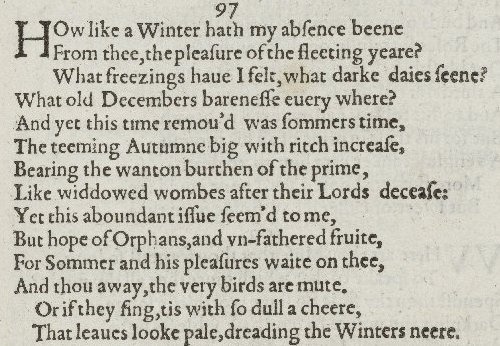
Shakespeare’s Sonnet 97 “How like a Winter hath my absence been”

What with Longfellow last time and Shakespeare this time, I’m thinking I’ll return soon to some of the more surreal and avant garde 20th century authors whose work has entered the public domain. That would be the New Year’s thing to do — but then once one penetrates the archaic language of this old sonnet, it gets plenty weird.

Sonnet_97_1609

How this poem looked in 1609. I note that most versions of this poem I find online replace the question marks in the opening sentences with exclamation points. I wonder why?

.

How many come here, perhaps via a web search for help in figuring out what some hard-to-understand poem might be on about? Well, here’s the usual “homework helper” summary of Sonnet 97:

The clever bi-amorous poet character* in the sonnet starts out bewailing that it’s winter and he’s away from his beloved. But wait, a few lines in, it’s summer, or maybe autumn harvest time, but the poet started out talking as if it’s wintertime because he misses the beloved so much and that makes it seem as bad as winter.

There you go, a greeting-card worthy poem when reduced to that meaning: “Miss you so much, summer’s like winter because of that.”

But all that ignores the strangeness of it. Don’t put this in your school work if you have a conventional teacher only looking to see that you’ve taken the effort to decode Elizabethan English,**  but is it just possible that the poem is really written in wintertime, or that the portrayed states of winter and summer in this poem are not actual, look-at-the-calendar fact? ***

That supposition that this poem is actually set in summer (or maybe autumn) has to be vague, because the statements about seasons in the poem are spread between four seasons: winter, summer, harvest-time and then near-winter fall — but the actual imagery Shakespeare goes with is much more at pregnancy**** and birth, and he’s not subtle about it at all, working a number of angles on that idea, and with a specifically  patriarchal slant on pregnancy.

Here’s what he says about what his state and season is in this poem: “teeming” (breeding with no concern of to excess), “increase,” “bearing” (and wanton at that), “burthen” (an archaic term that puns on birth, and was used for cargo in a ship’s hold, which the poem notes is owned by the principle, the prime, of the shipping company who has in that way impregnated the cargo), and outright “wombs,” “issue” (a legal term for children), and “orphans” (children again, though patriarchally, orphans from loss of just the father) and “un-fathered fruit” (from what little I know of horticulture and pollination, possible — but in this context, more orphan or bastard status being inferred). Shakespeare doesn’t really care to nail down if it’s summer or harvest because it’s not a calendar season he’s depicting. He’s been impregnated, and magically given birth perhaps more than once from this impregnation.

Now in terms of gender fluidity (no snickering in the back row — and Ms. Rowling, no passing notes you can’t share with the rest of the class) this is outrageous imagery, and something that I’ve seen no other reading of the poem address, though it seems to me overt enough that someone must have noticed it.

What is his point? What’s he getting at? I think the “issue,” the “orphans,” are the poet’s poems, even including this sonnet itself. His beloved is absent, so he shouldn’t be productive (maybe even an undercurrent here of infidelity or artistic parthenogenesis) and at least for the purposes of this poem he is exaggerating the patriarchal attitude that the father (not our fecund womb-bearing poet) owns the children, or if there be “issue” that isn’t his, they aren’t worthy.

There’s also a potential class layer here too, isn’t there. If the “Fair Youth” addressed in this and other sonnets is indeed a titled patron, that purported “only begetter” may be a fancy whose sexual politics shouldn’t be overlooked.

In that reading, it may really be winter outside, as on this late December day in my state it certainly is. And there may be a longing for an absent beloved, but the poet is writing the winter, writing the separation, teeming. I think Shakespeare may be playing with that claim that poetry without a patriarchal father is a dull song and illegitimate. As for us, we should write down our dark verse on the pale leaves of winter, and may you find pleasure in your own ever-fleeting year!

To hear my musical performance of Shakespeare’s Sonnet 97, “How like a Winter hath my absence been,”   you can use the player gadget below or this highlighted hyperlink that will also play it.

.

*Modern scholarship has generally come down on the side of thinking that Shakespeare’s sonnets are an invented work, using and playing changes on conventions of Renaissance sonnet topics and plot lines. But the desire to know “the real Shakespeare” still leads a great many to comment on what these poems, seemingly intimate and confessional, say about the person who wrote them. I’m going to write as if the poem is Shakespeare speaking as himself for simplicities sake, as writing “the character of the poet who is writing this poem” is too awkward to keep repeating.

**I wonder how many immigrant and Afro-American students realize that they have a possible advantage in appreciating and interpreting the archaic English of Shakespeare’s time in that they already have a contemporarily developed and working code-switch skill regarding language.

***When I first read this poem I thought of the Twilight Zone episode “The Midnight Sun”  in which (spoiler alert) two women are approaching death on an Earth that is growing ever hotter, only to have the twist ending be that it’s a near-death fantasy of our heroine on a planet that is instead growing ever colder.

****Human pregnancy having a 9 month term could account for some of the seasonal ambiguity and the poem not being clear about it being winter, summer, harvest mid-autumn or near winter/late fall.

Tiresias

Each April, as part of National Poetry Month I’ve been recording a performance of T. S. Eliot’s “The Waste Land”  and presenting it here in serial fashion. This year we’re performing the third section of the poem, “The Fire Sermon.”

When we last left “The Fire Sermon”  we were by the not-so-sweet Thames river where (as elsewhere in the poem) voices and diction were constantly changing. We don’t know who, or how many “whos,” were speaking in that segment, but the narrator in today’s section identifies himself as Tiresias. As we’ll soon see, Tiresias is as shape-shifting in body as the poem has been in voices.

Tiresias’ has many characteristics in the various mythological tales told of him. He’s able to predict the future, and he does this by studying birds (augury) and in particular by studying birdsong.*  He’s blind but is able to perceive things anyway through second sight and acute hearing. He’s said to have been given the gift (or curse) of an extra-long life. He also has the ability to talk to the dead, and in some stories talk to the living after his death. But perhaps the most remarkable part of the Tiresias story is that he was transformed from a man to a woman, and back again.

Tiresias_striking_the_snakes

Tiresias as he is transformed into a woman by Hera because he killed a female snake.


We open not with Tiresias introducing himself, but with his encounter with a merchant, who seeks some kind of meetup with the narrator. There are some who tell us the meetup locations suggested indicate that the narrator is being propositioned for a homosexual tryst. If so, this would be consistent with the closing song in the “Sweet Thames”  section, referring to heterosexual prostitutes and that section’s opening in some kind of any-affiliation “after the party” ennui by the river. And so the theme is set: “The Fire Sermon”  is going to talk about sex and what passes for love.

Now Tiresias introduces himself, and his sexual fluidity, as he begins to tell what seems at first a straightforward story: a typist has come home to her small  apartment. Hers is a low-paid job in the early 20th century business/bureaucracy, one often filled by the new “working woman.” She’s taking care of after-work household necessities, including collecting her drying laundry scattered across the room’s couch (which also serves as her bed), and fixing a meal.

Tiresias tells us he already knows what’s going to happen, and since mythologically he’s told the fortunes of kings and heroes, he’s sort-of over-qualified to tell this story.

And sure enough, Tiresias tells us a young man (carbuncular, i.e. covered with zits) arrives. He’s another wage slave, a clerk, who affects a silk hat that he thinks makes him look like a wealthier man. The typist and the clerk have a meal the typist has cooked and then he, hurriedly, unromantically, and with no real consent, jumps her bones.

And here Tiresias tells us he’s not just seen this all before (in both senses of the phrase, as someone who can predict the future, but also as a demi-immortal for whom this story only changes costumes and scenery as it repeats) but that he’s experienced it as both genders.

And then it gets weirder. That back-story of Tiresias’ own history with sexual exploitation is told in a long compound sentence in parenthesis. Today’s section then ends with an unstated someone who “bestows one final patronizing kiss, and gropes his way, finding the stairs unlit” out of the apartment. Is that the young man carbuncular, or Tiresias, or are they one in the same? And for that matter what of the woman, the typist?

As they used to say in serials, tune in tomorrow, as our story continues. To listen to my performance of this segment of “The Waste Land”  use the player below.


*And birdsong acts as a bridge between our first segment of “The Fire Sermon”  and this one.

**There are a great many interpretations of “The Waste Land”  and its sections. Mine is far from the most learned. I could use footnotes to try to explain every reference and connection in the poem—at least until my learning and research ran out—but I’m choosing to resist cataloging all the connections and references, so that we can appreciate the poem as an impressionistic, imagistic, musical suite of scenes, voices, and songs. If you’d like to read along, here the whole poem.

Twelfth Night

As we near 170 audio pieces posted here, we now get our second set of Shakespeare’s words, but instead of one of his sonnets, here’s a short scene from one of his plays (Twelfth Night)  which, by his design, includes a song.

The play’s title indicates it was an occasional piece for an English holiday that takes place on the 12th day after Christmas. I read that the traditional English Twelfth Night partakes of various “floating” winter/winter solstice traditions, some dating back to Roman Saturnalia, with much party-play acting of role-reversals, selections of short-term random royalty, eating, drinking, and song.

Here in modern commercial America, the extending of Christmas is via a prelude, with ever extended shopping days before the holiday; but in the past, Christmas was instead broadened after the December 25th date, with the “Twelfth Night” being the end of the “12 Days of Christmas”—yes, those same 12 days the famous listing song counts off. Given the dreary length of winter in northern climes, the holiday season was sometimes extended even further to February 2nd, Candlemas.

And it was on Candlemas, 416 years ago that Shakespeare’s Twelfth Night  was first performed. The play has a complex series of plots, but the one central to today’s audio piece is that of a young woman, Viola, who’s been shipwrecked in a foreign land, has taken to dressing as a man, Cesario; and while still disguised and cross-dressing, she has fallen in love with Orsino, an older Duke of the foreign land. Orsino is sad because he’s in love with Olivia, a local lady, who refuses his attentions. Only one thing keeps Orsino going in his melancholy: music.

As we enter into the play with today’s audio piece, the “meta” gets laid on thick. Orsino, though unlucky in love himself, seeks to give the “young man” Cesario advice in love. And Cesario (infatuated Viola in disguise as a young man) tolerates this mansplaining in hope that Orsino might someday see something in her/him. And in Shakespeare’s time the young woman passing as a young man would have been played by—well, a young man passing for a woman. To simplify things, I read both actors’ parts myself in the audio piece.

As the scene ends, Orsino asks for an “old song” to cheer him up.

The song Orsino requests “Come, Come Away Death”  is so dour I wonder if Shakespeare is making more comedy against the excess of melancholy and the foolish suffering of unrequited love. It’s a cheery little ditty about refused love causing or requiring death, and the spurned lover wishing only that his grave be unknown so that there’s no chance his unresponsive sweetie will ever hypocritically mourn there.

Representative lyrics: “On my black coffin, let there be strown./Not a friend, not a friend greet/My poor corpse, where my bones shall be thrown.” If Judas Priest had recorded this, it certainly would have been brought up in the 1990’s trial where the heavy metal band was accused of driving listeners to suicide.

But, after all, Twelfth Night  is a comedy. No spoilers here, but despite multiple love triangles and more disguises and misunderstandings, fate is kind to multiple sets of lovers, something we can all wish for lovers this upcoming year.

twelfth night by Walter Howell Deverell

Melancholy Duke Orsino bids Feste to Kick Out the Jams while Viola/Cesario ponders gender roles

Since Orsino in the play’s text asks for “Come, Come Away Death”  to be sung, we know it was indeed sung with music in Shakespeare’s time, and there are several extant settings of it. The ones I’ve heard are in the Elizabethan style, usually for a high, plaintive tenor—and even when Elvis Costello sang it, it was in that manner. I went counter to this, taking a more rock stance, allowing the singer to mix some anger into his self-pity. To hear that, use the player below.

Love Song for a Woman I Do Not Love

One joy of this project’s exploration has been coming upon poets I know nothing about and acquiring their words in my bloodless version of that conqueror on the “peak in Darien.” Writing about Frost, Pound, HD and Eliot in England early in the 20th Century lead me to T. E. Hulme, an Englishman of pugnacious artistic pronouncements and surprisingly modest and moving poetry. And T. E. Hulme led me to F. S. Flint, another British writer and literary theorist in this circle in the years just before WWI.

Last month I introduced readers here to Flint’s amazing rise from Victorian poverty. In the interim I’ve been reading more of his work, including his 1920 collection of poems (he called them “cadences”) titled “Otherworld.”  Since Flint is not commonly studied or anthologized, each poem as I encountered in the collection was a fresh experience, no different than reading a new poet’s chapbook published this year. I could start a poem of his in “Otherworld”  about a confused midnight awakening, and come to find it’s a first-hand account of a deadly London air-raid by a German Zeppelin.

Today’s piece, in the same collection, held another surprise. It tells you it’s a Love Song, but contradicts that before the end of the title. What it is instead is an unstinting examination of the corrosion class and gender inflict on the grail of love. The singer of this song lays bare a combination of disgust at how he’s judged as a poor man, with an undisguised desire to own the things he does not have, including this other human being, the woman of the title.

Bright Coloured Cretonnes!

“Bright-coloured cretonnes…” What is the erotic despair of draperies and upholstery?

I can think of dozens of popular songs that deal in some variation of this, but it’s harder to come up with 100-year-old poems, much less ones as good as this one, that talk of this. Ignore a handful of references to the interior decorating trends of Flint’s time, and this poem could have been written yesterday, except few writers of any time would be as acute as Flint is in observing this.

What new poets of the Modernist movement do I get to discover and share with you in the upcoming year? I can’t be sure, but I noted that Flint’s “Otherworld”  is dedicated to Herbert Read, and from what few poems of his I can find online, Read seems just as fresh and fascinating.

But let’s not get ahead of ourselves. Musically I’ve been telling myself I want to utilize some of the methods of hip-hop records, and yet each time I set out to do this, I get side-tracked by my own idiosyncratic musical muse. The melodic top line is my appreciation of early 1960s hard-bop organ playing. The bass part is a combination of a left-hand organ part with electric bass. Two bass lines shouldn’t work, but I think it does here. That’s not the only duality in this: the drum machine beat is augmented by some percussion which keeps the drum machine from ruling the groove “correctly.” The hip-hop rhythm flow eludes me again, though maybe I recall some predecessors like Dr. John the Night Tripper?

To hear my performance of F. S. Flint’s “Love Song to a Woman I Do Not Love,”  use the player below.