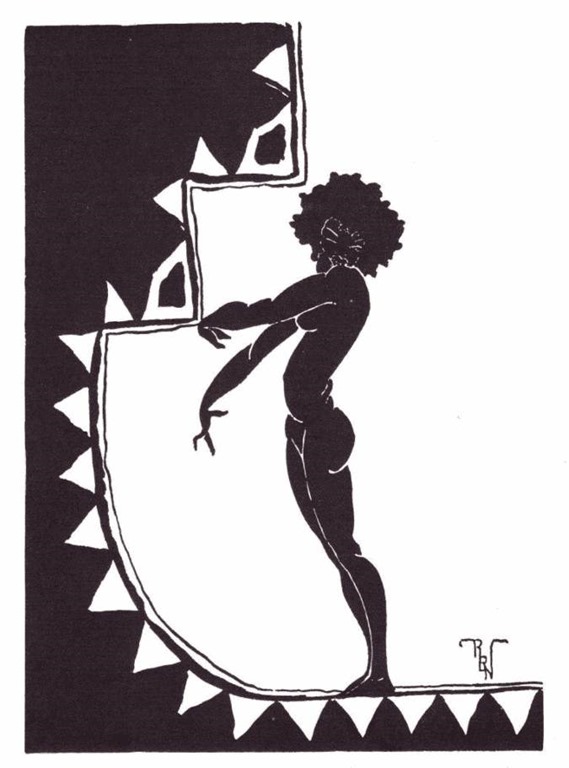
When the Year Grows Old

Here in Minnesota, the weather is turning, as it does at a time of its choosing in the Fall. Tomorrow morning the Fahrenheit temperature will be in the teens when I get up, and the forecast says single digits will greet me by Friday.

I began work on setting this poem by Edna St. Vincent Millay last week after seeing it at the Byron’s Muse blog. Two things grabbed me when I saw it: sitting there as silent words it begs to be sung, and it’s tantalizingly ambiguous.

This poem was from Millay’s first collection, published (1917) as Modernism was starting to find an audience in America. Americans in the last decade to be called The Twenties saw Millay as a Modern, though her prosody wasn’t like the free-versifiers, and her lyric’s narratives weren’t fragmented word-Cubism. So, a more comfortable Modernist to those whose expectations of poetry still flowed from the 19th century? Somewhat. Still, though not so much in her first book, but soon, Millay began to stand for The New Woman, a character that took up the prerogatives of independent thought, act, and agency in love and desire. A William Carlos Williams might have absorbed radical Modernist visions in Modern Art into prosody. A Carl Sandburg may have taken his Imagist eye and cast it toward workers and immigrants in his poems. But soon after this poem, Millay was using somewhat traditional verse to speak about female independence in life and desire. Cubism and Socialism were controversial, sure, but the kind of change Millay was covering in her poems was large in scope. Man Ray or Monet, Debs or Debussy, Pound or Reverdy — change was in the air — but as far as art such as poetry was concerned, the charge for change from women (and Afro-American artists) in the Last Twenties is a big deal, not something to shelve off as some sideline.

OK, so what does this early poem have to do with that? I’m not entirely certain. Yes, the overall scene of the poem is clear to any Northerner — but even as the poem starts the seemingly simple language has faceted surfaces. The poem is titled “When the Year Grows Old,”  but I’d suspect you might mistakenly remember it as “When the Year Grows Cold.”  It’s not just the rhyme, the poem is clearly about the weather getting colder, all the images intensify that. Intensities of anything old are not there directly at all. And then, I can’t say how idiomatic the opening statement (refrained at the end,) “I cannot but remember,” would be in 1917 — but it’s easy to read it (out loud, or in understanding) more than one way: “I will reflexively remember,” “I have only memory of this,” or even “I can’t do this, but I am forced to remember.”

And who’s the “she” in this poem? I had a thought in early-days with the poem it might be a pet, likely a housecat. Beside a generalized factor of love for warmth, cat owners might recognize the bird watching vocalizations — that, and a reference to “the warmth of fur” led me to that consideration. One reader’s reaction I read online this week thought “she” was a mother. I’m not sure of Millay’s mother’s (if that would be the mother here) characteristic feelings for tending a fire or even the specific kitchen task of making tea. My cursory non-scholarly thoughts are: not likely her happy place.*  Still, I could imagine that a general poetry reader in 1917 (like the Internet contemporary I came upon this week) could think that, or that the “she” is a friend of the poem’s speaker (which we might expect to be Millay), and so find this poem Millay’s predecessor to something like the young old Bob Dylan writing “Bob Dylan’s Dream”  about his remembering lost friends who’d once gather around a wood stove.
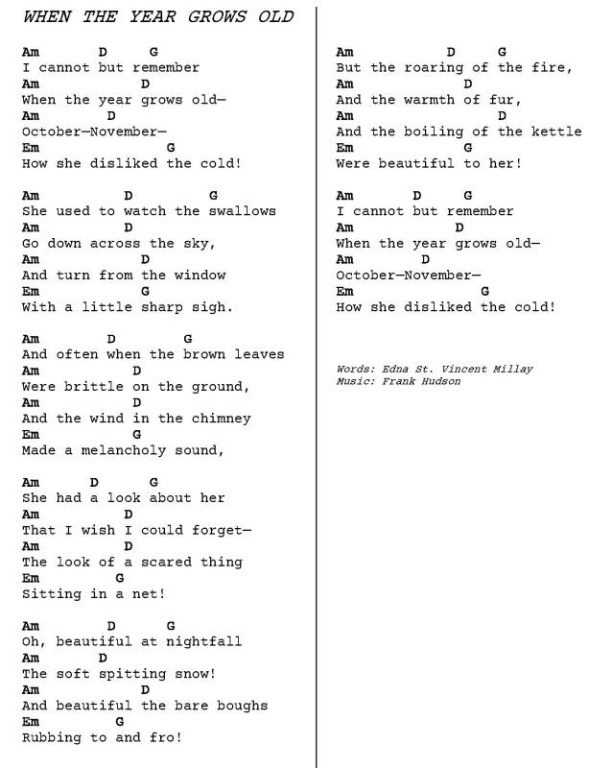
When the Year Grows Old

Simple chords for today’s piece, presented here as chord sheet  in case you’d like to sing it too.

.

Living with this poem as I set it to music and performed it, I came to think of it more at “Girl from the North Country” — a song about a lover who is longingly thought of lovingly, but who is now separated. By the time of the performance that you can hear below, that was how I was singing it. Why did I think that?

Partly from reading later Millay poetry, partly in biographic clues of Millay’s sexuality. There’s a definite undercurrent in the poem of the “she” feeling ambivalent: the sighing look at the flying birds, the melancholy chimney wind, and most directly in the abrupt “look of a scared thing/sitting in a net!” And what follows that line feels lustily sensual to me: those rubbing “bare boughs,” that fur by the fire verse.

That reading also answers the why the year being “old” is the title, not “cold,” other than just seeking variety. A once passionate attachment has been reconsidered by the other party, has grown old/cold.

Millay could have made other meanings (“cat lady,” “dear old mom.” etc,) clear with no commercial readership risks, but following my understanding, this presentation is coded so those who know will see that, and others will see a vaguer poem while recognizing late autumn weather. If I’ve misread it, or if Millay ever explained what she was intending — well, it wouldn’t be the first time — but it worked for me to find an experiential place to inhabit the poem.

You can hear my performance of Edna St. Vincent Millay’s “When the Year Grows Old”  with the audio player gadget below. No gadget? It’s nothing personal, just that some ways of viewing this blog suppress that. This highlighted link will open a new tab with its own audio player.

.

*As poetic testimony: tender as Robert Hayden’s well-loved poem “Those Winter Sundays”  is, it’s not a story of a parent finding happy beauty in loading up a household’s fire box.

Shadwell Stair

Halloween is a chance for us to note our fears.

I first wrote “celebrate” in that sentence, but revised it to ”note,” with musical pun intended.* I don’t think we actually celebrate fear on Halloween, but rather we play with it: pretend we don’t have it, pretend we can sport with it — though perhaps some connoisseurs roll the sense of it around on their tongue to absorb fear’s full body and taste. But in any of those ways, however obliquely, we are acknowledging it.

How close are we to our fears the rest of the year? I suppose that varies. Can we name them? Do we bother? Do our friends, our intimates, know them? Do we even speak of them to ourselves?

Today’s piece is based on a hard to explain poem by one of the most loved British “War Poets” who wrote of their experience of WWI, Wilfred Owen. Certainly that war’s trench warfare, mixing squalid contemplation and carnage, would offer enough horror to write about, and Owen’s WWI poetry is loved while not flinching from that horror or buffering it in patriotic bunting.

But then there’s this poem. It is not set on the front lines. If it mentions the war at all, it must be implied from knowing his biography.

Shadwell Stair is on the banks of the Thames River in urban London. In Owen’s early 20th century it was apparently a noisy, smelly industrial area. This blog post has numerous pictures, some history of the Stair, and the delicious trivia that it’s next to “Labour in Vain Street.”

As treasured as Owen’s bleak poetry is, Shadwell Stair  isn’t one of his best-known “Greatest Hits.” Its effective condensed portrait of the locale isn’t the most-read poem of that time and place in metaphor, being eclipsed by “The Waste Land’s”  bankside sections written by an American, T. S. Eliot. Those portions of Eliot’s poem are alienated, partly by the recent Great War, and partly by his own sense of an educated visitor weighing England’s and Europe’s history and culture against the grimy realities of the London he had settled in. Eliot’s “The Waste Land”  doesn’t actually name the fears in the center of it, but it conveys them in vivid and varied silhouettes. Arguably, Owen’s poem is more coy — if only by being brief — but let me make a case for it. Here’s a link to the text of Owen’s poem.

The first stanza introduces lovely word-music that the poem carries on throughout. It claims to be in the voice of a ghost. We may (I did) anticipate a classic Halloween poem. If we know Owen’s biography, we might think the slaughter-house there is a reference to the war. It may be, but I think the second stanza gives us a different context.

It’s a fleshy context. I can almost feel the goosebumps on the skin, and the speaker’s eyes are lit up in what? Fear? Anticipation? Heightened vigilance? If this be a ghost, it’s an embodied one.

The third stanza is almost all scene-setting, lit by snapping arc lamps evoked between interrupting night noises — those streetlights had a sensual, buzzing, almost reptilian sound that younger readers now may not have had the experience to hear. Of our mysterious speaker, it only says of themselves here that they are watching. OK, watching for what?

Later readers have given an understanding to the mystery here: Owen’s sexuality had a homoerotic element. In this reading, the speaker (presumably Owen) is cruising for a hookup, and it’s said that the disreputable docks and titular Stair were known sites to London’s homosexual demimonde. As with the harsh arc-lights, this context illuminates the poem. I see vividness in this reading, and no reason not to give it credence. Let’s consider then the situation evoked: here is a man, likely on leave from the immense horror of a war that was grinding men up with ineffective tactics in the face of modern lethality. Many Halloween readers here with holiday ease to play with fears would likely have no gauge to measure that — but what has his flesh firming, his skin puckered with cold plucked-chicken skin, his pupils dilated out round as the gems of Rilke’s absorbing cat from last time? Answer: the anticipation of sensual, carnal, sexual contact — intensified by a fear of police trolling for arrests, complicated in the doubts of attraction or rejection with disgust that strangers meeting in the night would encounter.

If so, the enigma of this poem has a specific — if unspoken — core, and the last stanza is an aubade of something even more transitory than the average parting of lovers at dawn. We started being told this is a ghost poem, and the ghost here meets another ghost. The ghosts here are metaphor for spirits that could barely speak of the eros of their lives. A silencing louder than bombs.

shadwell stair MS1

Here’s Owen’s poem in work-in-progress form, He seems struggling most with the 3rd stanza yet at this point.

.

Today’s music had two challenges for me. The setting I devised might benefit from a “real singer,” someone who could carry a melody with confidence and a beautiful timbre. I’m not that. I decided I could do no better than I can do. And then too, while I was pleased at what I could come up with feeding parts into my orchestra instrument arranger, and particularly with the high trumpet part that comes in near the end, I was never satisfied that I could get the best trumpet Virtual Instrument I own to have the correct envelope I wanted. There I just surrendered. No one with a “no-revenue” independent musical enterprise could expect to be able to present the full richness of the actual instrument. Those who can, will know I fell short — but the rest will, I hope, accept my approximation. You can hear my musical setting of Wilfred Owen’s “Shadwell Stair” with the audio player gadget below. Not even a ghost of such a player visible?  This highlighted link is an alternate way which will open a new tab with its own audio player.

.

*”Note…fears?” See that final paragraph today.

Wrapping up the 1926 Fire!! magazine story

I hope some of you enjoyed this Black History Month look at the premier 1926 issue of Fire!! Devoted to Younger Negro Artists. This landmark of the Harlem Renaissance announced a new generation of young Black writers, many just out their teens — artists who not only filled its pages, but organized and edited the publication. Today I’m going to tie up some loose ends and tuck in the laces on the Fire!!  story and give you a few links in case you want to do your own exploring.

Here’s a fine website done recently by a group of young people who present the entire magazine itself and some of their own encounters with the meaning of the work inside.

It was there I found a link to this completely scientific and accurate Buzzfeed quiz from 2018 “Which Fire!! Magazine Author Are You Most Similar To?”

The quiz says I’m Gwendolyn Bennett. My wife’s results: Richard Bruce (Nugent). Richard Bruce too for longtime keyboard playing and alternate voice contributor to this Project Dave Moore. Dave’s artist partner joined me in the Gwendolyn Bennett result.

So, we looked at the first issue of Fire!!  this month. What about the next issue, other issues? There wasn’t one. The magazine, founded by young artists, was not well funded, and selling and distributing didn’t go well. The gatekeepers were at least privately aghast at some of the content, so their advice and word of mouth was to disparage and discourage this effort. I’ve already mentioned when presenting two of the four poets I selected for musical performance that publication in Fire!!  did not guarantee lasting readership or note for these young people. So, Fire!!  folded, and in a lead-eared note of irony, the mostly unsold print run was destroyed in a storeroom fire. John Keats epitaph says his name was writ in water. Fire!!  and some of its writer’s names were writ in fire, and it all died down.

I often suspect many folks who find these blog posts are looking for homework help or teaching resources. To what I (an old person) can understand, being a teacher or a student covers wider territories than in my days, but there are still skirmishes at the borders and difficult areas under the control of different warlords. Fire!!  magazine sought to cross those borders then — and if one is to study it and its contributors in any depth, it still does. Not only did Fire!!  bring forward new young writers — many committed to Modernist art and radical politics — it purposefully sought to express elements of life that the older generation of gatekeepers wanted to suppress or keep only within the tribe. One of those things was sexuality. So teachers and students, here we have a group of young creators in 1926 writing on race, injustice, and sexual expression that isn’t in committed relationships or straight. On what authority did these audacious writers take to break through those barriers? Not only were the instigators and contributors of Fire!!  young, gifted and Black, they also were often somewhere on the spectrum we could label today as queer.*

Drawing by Richard Bruce Nugent

A drawing by Richard Bruce Nugent from Fire!!

.

So, to teach or discuss Fire!!  and its creators beyond a surface is to go to places where teaching and learning is still constrained. I’d say to learners (a class that includes nearly all teachers) you may choose to go there even if traveling alone. Literature, music, the arts are the forged identity papers that let you cross borders. Though the writers of Fire!!  are all dead, they won’t mind speaking with you.

In the spirit of gratitude to Afro-Americans and their vital contribution to American culture let me repost my Buzzfeed Fire!! contributor-like Gwendolyn Bennett’s summary in poetic “Song.”   Graphical player below, or a backup player will open in a new tab link here.

.

*Here’s one web post by someone who taught school, doing a better job than I can today of discussing the queer aspects woven into the Harlem Renaissance. There is also this low-budget indie movie Brother to Brother  made nearly a decade ago centering on Richard Bruce Nugent, Wallace Thurman, and the non-straight circle that organized Fire!!   The film has some PG13 level sex scenes and self-violence. I found it available for rental from the usual online sources like Apple TV or Amazon Prime.

When I Peruse the Conquer’d Fame

Modernist American poetry has two parents, Emily Dickinson and Walt Whitman, but it’s been awhile since we’ve presented any Whitman here. Dickinson is a subversive Modernist, ironically skewing the expected tropes. Whitman on the other hand is the provocateur, the poet who is proud to say right out front everything he wishes to change.

As Whitman prepared his 1860 edition of his evolving Leaves of Grass,  he was about to cross a Rubicon of a sort. He had decided that erotic material needed to be added to his great collection. Since he wished to be all-inclusive and unabashed, starting with himself, that material would vary, but it would include expressions of male homosexual longing and relationships.

Whitman in 1860 - caricature from Harpers Monthly

Walt Whitman as caricatured in 1860 in Harper’s Weekly


Once again, my knowledge of the historical context here is not extensive, but some brief reading this weekend indicates that to the mid-19th century American audience, the homosexual elements of what Whitman was to publish was little or no more disturbing than the erotic element generally. For a man who was already wishing to revolutionize English poetry with his free-verse and universalist message including what would surely be considered shockingly fleshy writing about desire, longing, and connection was certain to complicate his goals for a wide audience. His leading ally within American High Culture, the Transcendentalist Ralph Waldo Emerson, counselled him to not include, or to greatly tone down that material.

Whitman didn’t take that council. The 1860 edition of Leaves of Grass  included a section, Calamus, that was full of love and desire between men. Emerson was right, that would complicate Whitman’s task of revolutionizing American poetry.

When Transcendentalist Thomas Wentworth Higginson* asked Emily Dickinson if she had read Whitman shortly thereafter, Dickinson replied: “You speak of Mr. Whitman. I never read his book but was told that he was disgraceful.” If one is of a speculative mind, one can imagine Emily Dickinson getting a plain brown wrapper delivery of Leaves of Grass  that she would never acknowledge.

This Monday is Veteran’s Day/Remembrance Day, and as he prepared the Calamus  poems Whitman was not a veteran or a survivor with war memories, as the American Civil War that would add another tremendous shaping force on his poetry was still more than a year off. Still he would write this moving comparison that I present today.

When I Peruse the Conquer'd Fame as published

Today’s poem as it appeared in the 1860 edition of “Leaves of Grass.”


“When I Peruse the Conquer’d Fame”  is a comparison of two things: fame and envy. Perhaps the fame part will strike you first, along with the implications of worth and value. The fame in the title most often comes to prominent men: victorious generals, Presidents who bask in their election and men who put their names on large buildings. The U.S. Presidents that Whitman would have had in mind then were bumbling ineffectual men, totally incapable of coming to grips with the immense and deadly crisis they were careening toward, but famous none the less.**  What generals would he have in mind? Napoleon or his adversaries perhaps, men who could shuffle the borders and crowned heads back and forth in tides.

And for comparison, Whitman sets out “the brotherhood of lovers.” Does he mean men who love men? As this is part of the homoerotic Calamus  poems section I think we need to accept that is significantly so. He goes on to praise the lovers who are steadfast in their love as aging and fate and even the numbing of time is arrayed against them.

This task of enduring love is not something unique to same-sex lovers, and I suspect that Whitman, the universalist, recognizes that too. But in his particular, he’s saying that unfaltering love which would not then be socially acknowledged is all the more extraordinary, though unknown compared to the war-heroes and political potentates.

Did Whitman, and I suppose myself in my choice to present this poem at this time, just dis veterans? That objection would assume that the two groups are mutually exclusive, at odds. That isn’t so. And if Whitman was here to answer he’d point out he spoke of Generals, Presidents, and rich men, not the soldiers he later comforted and whose wounds he dressed in the upcoming war.

And of course, in the U. S. today it’s Veterans Day, set aside for those who after their service may well have continued as or became those ardent lovers whatever their sexual orientation. We honor them for their service in the one regard, Whitman asks that we consider the second as well.

What of the other comparison, the one you may not have noticed, the one concerning envy? Whitman has chosen not to weigh his comparison between the two sets of roles only by their levels of objective fame, but specifically in the example of his own state of envy. He says he doesn’t envy those powerful and rich men—but of the “long and long” lovers, there he says he is bitterly envious.

Let me suppose Whitman was sincerely speaking here (he has almost no other mode in his poetry than sincerity). But there is an element in Leaves of Grass  where the poet speaking—“Walt Whitman” as the character in his great collection of poems—is meant to be an example, as his verse is an example, of an imperfect thing striving to find a different, better path to something new and not fully known. Whitman, like the best of Modernist art, like various America, like many veterans, ardent as a lover is running faithfully and with a heart open toward an affectionate and unknown future.

Once more I marshal the ranks of my marcato orchestral instruments for “When I Peruse the Conquer’d Fame”  into another “punk orchestral” piece. Harmonically, I’m working a three-chord trick here, just as if the composer/conductor’s podium was stocked with Ramones. Other than the use of a rock’n’roll drum set, the other unusual textures are mixed subtly into the low-end where there’s a contrabassoon line and Fender electric piano bass (ala Ray Manzarek). You can hear it with the player below.


*It’s possible that a canny Dickinson might have been telling Higginson what Higginson would want to hear, since Higginson, though au fait with political and social radicalism, was also of the opinion that Whitman was disgusting.

**Coincidentally, the U. S. President when the Calamus  poems including edition of Leaves of Grass  was published was James Buchanan, who may have been gay himself. Though Donald Trump has already selected Andrew Jackson as his favorite President, Buchanan may also prove to be indispensable to his legacy in that Buchanan has long been the consensus choice among historians as the worst-ever President of the United States.

Memory of June

As promised, here’s a love poem, one written by Claude McKay the Jamaican-born poet and writer who worked for many years in the United States. McKay sort of bridges the gap between Paul Laurence Dunbar and the Harlem Renaissance for Afro-American poets.

Like Dunbar, Fenton Johnson and Anne Spencer, his poetry was written early enough to be included in James Weldon Johnson’s pioneering 1922 The Book of American Negro Poetry.  Like Dunbar, McKay could write a smooth metrical/rhymed poem in the 19th century style, but like Fenton Johnson he often set his poems in distinctly urban settings: the northern U. S. cities that were the terminus of the Great Migration of southern Afro-Americans during the 20th century. Alas, also like Fenton Johnson and Anne Spencer, his published poetic work seems to have fallen off by the late 20s, though McKay’s prose career continued throughout the 30s.

Claude McKay

Claude McKay

One of the poems James Weldon Johnson included in his anthology continues to be one of McKay’s best known, his sonnet “If We Must Die,”   a passionate ode to desperate self-defense that doesn’t once specifically mention the white race-riots, lynching and other terrorism that was a cardinal problem for the civil rights movement between the abandonment of Reconstruction and the middle of the 20th century. I find this an interesting choice on McKay’s part. I’m certain many readers of “If We Must Die”  understood in McKay’s time exactly what he was writing about, even to the specifics of it down to names, places and horrific details. But that’s not in the poem itself, unless you count the “O kinsman” address in the 9th line and the external knowledge of who that might be defined via McKay’s skin color. Is McKay’s choice intentional? By omitting his race and context, which his readership largely knew anyway, he’s saying self-defense isn’t a thing to be granted to or earned for Afro-Americans somehow, but a fundamental human right to be self-asserted. McKay had many other poems in which race is mentioned after all—makes it seem all the more to be a choice.

By choosing to state this universally, “If We Must Die”  has even engendered an unverified factoid that Winston Churchill quoted this poem in a speech during the most desperate days of WWII—but all that is in war and ugly violence, and I promised you a love poem, and “Memory of June”  is that—though it has one somewhat ambiguous phrase that might make it part of a struggle.

Here’s the text of McKay’s “Memory of June:”

Memory of June

Did you spot it? You should know I’m not about testing you; you are to only score yourself here. I didn’t see it the first time I read it either. Do you think it’s the phrase “your brown burning body” celebrating mutual Afro-American love and desire? Well this is poetry, a pleasure, not bomb-defusal, feel free to hold for that. It is a pretty poem, a romantic one, isn’t it?

The subtle, ambiguous line I eventually noticed is earlier: “For one night only we were wed.” McKay is now widely assumed to have been gay, though he never “came out” and nothing I’ve read so far tells me why this is now assumed as known.*

Let’s assume this is so. It is also safe to assume that few readers of the poem when it was first published in 1920 knew this, other than those in McKay’s intimate circle. Now the course of love is complex. Many nights of love are singular for many reasons. And Afro-American couples accrue special challenges. But McKay chose “wed,” the thing that gay couples were officially denied until late in my lifetime.

McKay might well be using the same tactical move as he used in “If We Must Die”  in a different context, one where a then more secretive circle would read this poem differently from the common reader.

So here we are in June, a traditional month for weddings and also gay Pride month, and I present Claude McKay’s “Memory of June,”  a love poem, not another poem about war or violence. Except love isn’t simple, and good love poems aren’t.

The player to hear my performance is below for many. Don’t see it? This highlighted hyperlink is an alternative way to play it.

*This sort of ex-post-facto outing without a diary, journal or other unpublished manuscript that would be easily cited if it existed often comes from gossip or oral history—two names for what is largely the same thing, but gay history has fewer paper records to rely on. So, evaluating that isn’t simple, and McKay isn’t notable enough for this to be something I can find quickly.