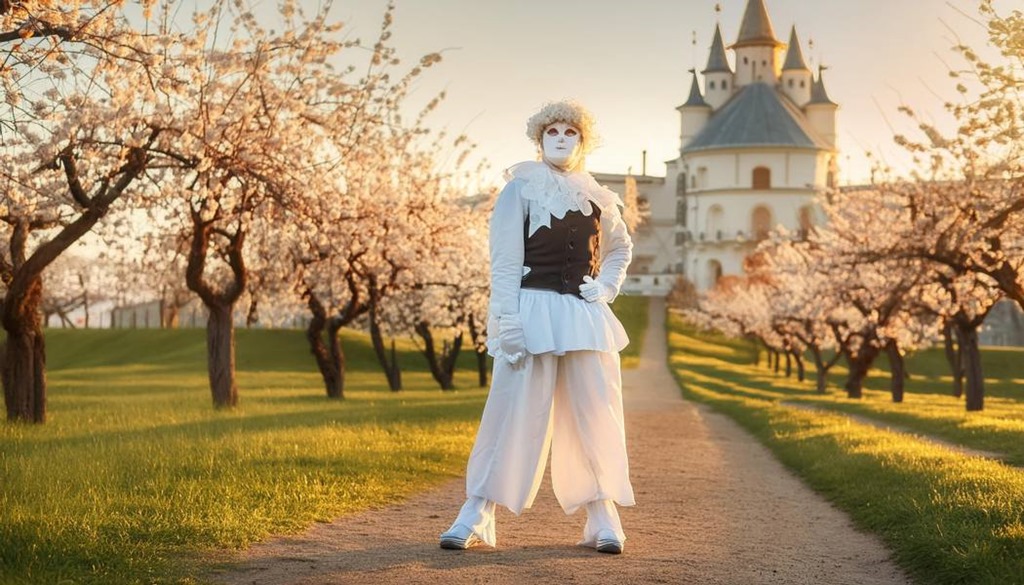
Halloween is a multi-valent holiday. There’s the cluster of religious and spiritual holidays of prayer and remembrance for the dead, the holiday of horror and monsters, the children’s festival of costumes and small candy-bars, and so on. I went looking for some supernatural poems that might be fun to present this week, and I came upon this short poem by British Romantic-era figure Leigh Hunt that was begging to be sung – after all, the full title of his poem was written down as “Song of the Fairies Robbing an Orchard.” It’s light fantasy, but then the news has stolen all the horrors.
Was I thinking of a particular orchard as I worked on this piece? There were two apple trees just to the side of the house I grew up in, but they were past their prime by my time. I remember they bore small and not very appetizing fruit, and sometime around when I left home they were cut down. I recall my sisters and I climbing in the low and scraggly branches when barely more than toddlers – but it wasn’t exactly that pair of trees. I was probably thinking more of an orchard I have never seen: the apple trees that are part of the homestead “kitchen garden” that blogger Paul Deaton often writes about. I also probably visualized Deaton’s apple trees and his stories of work with them when I performed Robert Frost’s great harvest-time poem “After Apple Picking” a few years back. Deaton’s a regular reader of this Project’s blog – so Paul, if you read this, and when you next check you are missing some of your apples, you’ll know who tipped off the fay. Well, the more they take, the fewer you need to harvest and put up.

An engraved drawing of Leigh Hunt by J. Hayter
.
Leigh Hunt is one of those Zelig or Forrest Gump like characters of the 19th century British Romantic-era. He knew and worked with all the big three Romantics: Byron, Shelley, and Keats. Hunt was key in launching Keats poetic career, was there for Shelley’s death by drowning, and had a tempestuous relationship (I suspect the most common kind) with Byron. As a poet himself, he’s decidedly minor, but this opus’ mischievous whimsy charmed me. I love the characterization tidbits in it: the fairies peeping in at pious humans worshiping in chapels, and their admission that they don’t even care that much for apples, but are in it more for the challenge of stealing them.

Come to think of it, Julius Lester probably has as least as high a Zelig/Forest Gump score as Leigh Hunt
.
For music to sing Hunt’s poem, I used a 12-string acoustic guitar. Last week while commenting on a poem I’d read online, its author asked if I’d read Julius Lester. An old man, my steel-trap memory has corrosion problems, but the name rang a rusty bell. I remember seeing Lester’s byline in the Village Voice back in the Seventies, and I had some vague recall of him working on radio. But poetry? No, I had no idea he wrote any poetry. I hit a quick web search, and Julius Lester as it turns out was a multi-hyphenate: author of many books in several fields, social activist, college professor, photographer, critic, broadcasting host, and folk-scare-era folk singer. Reading about him I realized that I had owned one of his books: the early Sixties instruction manual “The 12-String Guitar as played by Leadbelly.” I’ve long been interested in this 12-string variation of the great folk instrument of my country: the steel-string, flattop acoustic guitar. Leadbelly was a pioneering performer on that instrument.* I can’t say that today’s piece is fully in his style, but it’s the work of someone who’s heard Leadbelly and some of his more apt descendants. You can hear the short song I call “Robbing an Orchard” with the audio player gadget below. What, have the fairies run off with the audio player too? Naughty fairies! I give you this alternative enchantment then: a highlighted link that will open a new tab with its own audio player.
.
*I heard a counselor at a kids summer camp play a 12-string in the early part of The Sixties around the time that the 12-string-featuring song “Walk Right In” made it to #1 on the Billboard Hot 100. I note in the linked wiki article on that song, that in 1962 12-string guitars were so scarce that when they decided to use two 12-strings playing together for an even more powerful sound, they had to wait for a second one to be made by the Gibson guitar company. Lester’s book, co-authored with no-less-than Pete Seeger, was a rare publication on how to play this instrument.
Minnesota’s Twin Cities was something of a hotbed of 12-string players in the 20th century, and shortly after I moved there, I bought my first 12-string, a cheap one sold as a sideline in a Musicland record store.






 Frank Hudson