The Minstrel Boy

The Parlando Project’s thing: taking a literary poem and combining it with a piece of music isn’t a new thing. If poetry exists in every language, poetry combined with music exists in every language too, and such casual melding typically pre-dates the culture’s written poetry. We have just kept on doing it as a practical and immediate art.

This is National Poetry Month here in the U. S., but I don’t think I’m overly nationalist in the words I use here. Still, just as poetry and music go together, national and ethnic pride often takes poetry and song onto itself. W. H. Auden notably stated that “poetry makes nothing happen” but if we examine it the other way around, it’s unlikely that any great movement for change or nationhood ever has had no poetry and song associated with it.

As a poem “The Minstrel Boy”  was first published in 1813 as part of the author’s collection titled Irish Melodies, and its central image is a harp carried by a “warrior bard.” It’s therefore apt that Moore combined it with music forthwith, using what he named as a traditional Irish tune.*  Harps and lyres etc. are an extraordinarily large family of instruments, but Moore seems clearly to be writing of Ireland, where the Celtic harp has become a national symbol. At the time of its writing, Ireland was still under the long-standing, often cruel and exploitative, rule of England. Classmates of Moore had recently died in one of the periodic Irish rebellions.

Minstrel Boy

I asked alternate voice and keyboard player connected to this Project Dave Moore if his family has any connection to the liked named poet. None known, he tells me. Dave’s father preached for decades, and he wrote at least one literary short story that I read after he — one of the generation this month’s poetry anthologies were marketed for — had returned from WWII.  I told Dave’s dad his story reminded me of Hemingway. He replied “I don’t think I knew anything about Hemingway then, he was kind of avant-garde stuff at the time.”

.

The song also became popular in America, though I’m not certain how rapidly it took root here — but in the year of its publication America was at war with Britain for the second time after its revolution. And by later in the 19th century, the song had currency among Irish-American immigrants.

Ironically, Moore received a British diplomatic post to Bermuda, and in 1803 he not only visited the United States but met President Thomas Jefferson. The tale I read online says the two did not hit it off, and that Moore was not impressed with American chattel slavery. **

Since those times the song (or sometimes just the tune associated with it) has been closely associated with the armed forces, police, and firefighters — folks whose sense of professional duty includes risk of death. I find that ironic too, for the song’s minstrel boy is the definition of an untrained irregular, possibly underage, untrained (he has to borrow a weapon), and more of a singer-songwriter than a SEAL Team professional. *** This is one of those cases where tradition overwhelms close reading.

I’m performing this song as part of my NPM series looking at poems from a pair of 1920’s anthologies of verse for children: The Girls Book of Verse  andThe Boys Book of Verse, and “The Minstrel Boy”  appears in one of this gendered pair of books. In each instance this month I’ve asked you to guess which one: Boys or Girls.  Today’s poem is a free square in that game, as one would easily guess this military service theme would be in the boy’s book — as it is. Indeed, The Boys Book of Verse  has an entire section, Songs of Peace and War dealing with poems about battles and military service. The editors, both women, would have had recent experience of WWI, and whatever their feeling about warfare, they must have felt that subject was something their readers or purchasers would want included for the boys.

I stop to think here — as I do as I consider the entirety of this pair of “the last Twenties” books — that the first audience for these books would go on to experience a much greater and deadlier world war.

I’m likely not one of the best singers to have sung this well-loved song, but I performed it with a full rough’n’ready rock-band arrangement as best as I could peel off in this month’s accelerated schedule. My inspiration for singing this song? A similarly not-ready-for-the-most skilled-singer-contest one, Joe Strummer, who also recorded this song. You can hear me tear through those chords asunder with the audio player you should see below. If no audio player sullies your screen, it’s because some ways of reading this blog won’t show it. This highlighted link is your alternative — it will open a new tab with an audio player.

.

*The tune Moore selected, named as “The Moreen,”  was said to be a traditional tune. Wikipedia says that no one has independently found a source of this tune from before its pairing with “The Minstrel Boy’’ —  so it could be that it would have disappeared forever if Moore hadn’t tapped it for his poem about a doomed harper. That adds an air of mystery to the song, doesn’t it.

**The stirring final line stating the harpers fight was against slavery does and doesn’t require an explanation. Servitude in general, even government duties and tributes required from monarchs or tyrants, was often rhetorically called out as slavery, while American chattel slavery was totalitarian: humans — and with added cruelty, any families of those enslaved — owned in perpetuity like animals without rights of any kind. I read that this song was sung by both sides of the American Civil War — the “slavery” on one side rhetorical, the slavery on the other total and abject. When I started this post talking about the widespread tradition of nationalist poetry and song, take note: a corollary from Auden’s dictum may be that poetry and song prove nothing.

***This might be a fair poetic description of the Irish rebels that the teenage Moore knew, those who died in an ineffective rebellion. The long fight for Irish independence seems to have had an outsized portion of “warrior bards,” folks with less military experience and tactical acumen than literary and musical bona fides.
Free to Fall

Allow me to be more internal than I usually am when presenting these pieces. Today’s piece uses my own words (we do that rarely here) and it’s here today for a peculiar reason — and peculiar is something I enjoy indulging in.

Early this autumn I was looking for a musical piece that represented the season, and I recalled this poem of mine that I had written music for. When? I probably wrote the poem early this century, and from a file I found, I was able to determine I wrote the music in 2007. Sometime after writing the music, I recorded what I recall was a pretty good version of it, likely with Dave Moore playing keys.

“Maybe I made this one of the early Parlando Project pieces” I thought. At the beginning of this Project as I was figuring out how to compose and record our combinations of original music with literary poetry, I had used several recordings of that vintage. Having some already completed pieces gave me time to get a handle on other tasks while getting this thing going.

But, what, I didn’t know? Well, I’ve put up over 700 publicly accessible pieces in this Project’s lifetime since 2016 — and that doesn’t count the ones that just didn’t work or didn’t fit the concept. One might like to think I keep my eye on every sparrow — but with that amount of catalog, it’s not fully accessible in my head. So, I looked. Here. For my own work.

Nope. I hadn’t presented it. It might not have made the cut because I wrote the words, and the Parlando Project is about other people’s words. Where else might it be? I looked in my somewhat disorganized collection of sessions and finished non-public pieces. Nope, not found there either.

My solution then was to re-record it. Recording time has been hard to come by lately, but I remembered this poem-which-became-song as being effective, so I tried to have it ready when I could open my microphone and record.

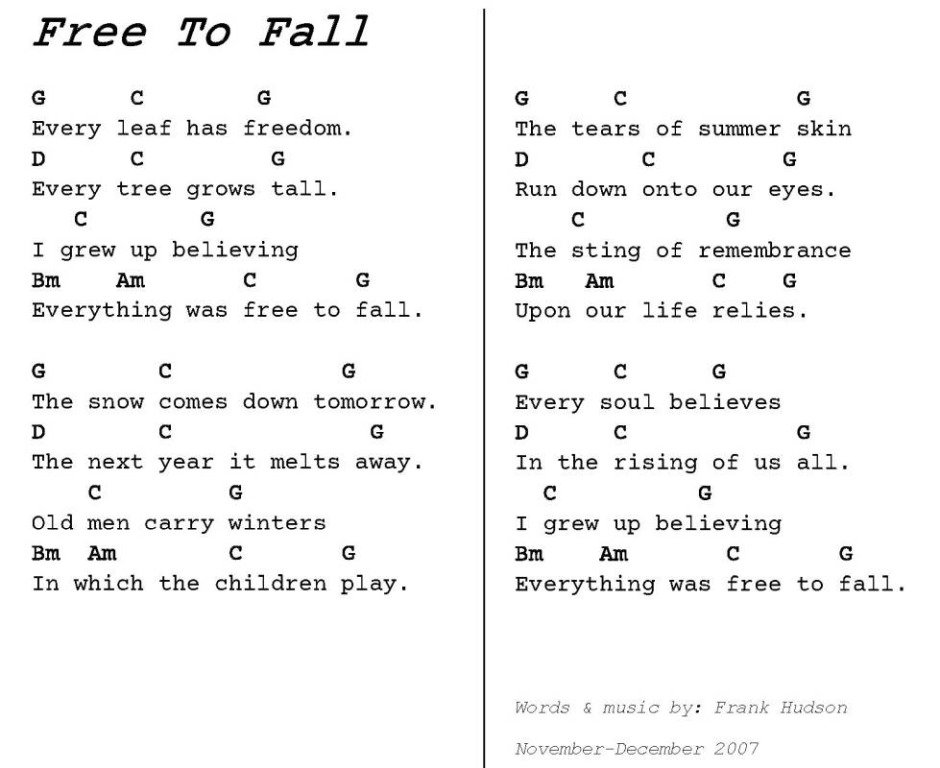
The piece is called “Free To Fall.”  As I wrote at the start of this inward story, I said I remembered it as being an interesting variation on the poetic perennial of autumn. In the first verse I already hit the falling leaves motif (can that one be escaped?) and I think the “every tree grows tall” was me referencing the British folk song “The Trees They Do Grow High.”   I continued to try to bring some longstanding tropes into this brief song: my own restatement of François Villon’s “Mais où sont les neiges d’antan*” starts off the second verse. I think the lines “Old men carry winters/in which the children play” are my own, but like my memory of where I put this song’s older recording, who knows if I just don’t recall some inspiration or reference.

The third verse’s reversion to summer memories and grief may be influenced by what I consider to be one of the great autumn songs, one found in every fakebook: Joseph Kosma/Jacques Prévert/Johnny Mercer’s “Autumn Leaves.**”  That song too begins with falling leaves, but references a summer lover now gone. Having lost my late wife in August might have made sure I made that step back in memory in the song.

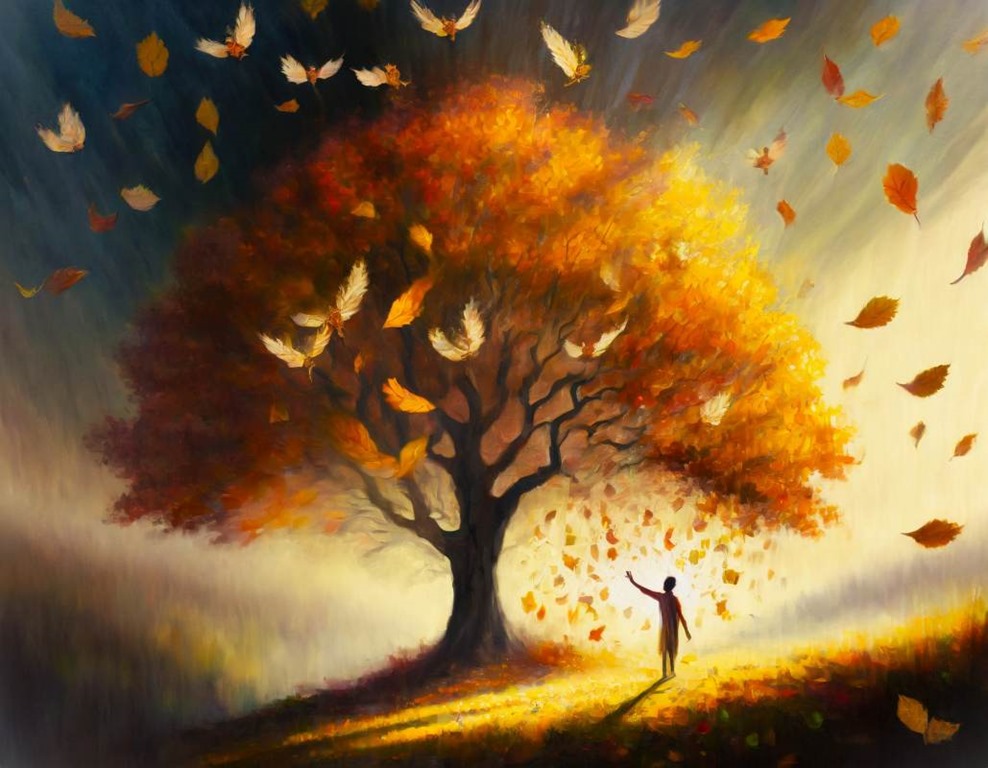
Free to Fall Illustration 800

“Everything is free to fall”

.

The originality of this compressed catalog of autumn thought comes in the refrained pair of lines “I grew up believing/everything was free to fall.” What was my intent there? I’m not sure if I’m articulate enough to do as brief a job as the poet me did in writing the poem. Yes, I knew many readers/listeners would think of things like free will and predestination, shibboleths of theology — but in the lines’ first statement I wanted the connotation that autumn’s falling leaves are freed from their work in photosynthesis and now can flutter and drift. The fourth verse refrain may (or may not) put this in a different context. Is this a compressed statement of “free will,” the doctrine that humankind has the choice of choosing good or evil, which also carries a connected thought that this is what makes good, good, not just an inherent trait? I was likely aware of that when I wrote it, but in performing it this fall I took another plausible memory: that there are those who believe in an afterlife, or a rising or rebirth of the souls of the dead, but that the song’s singer believes that however temporary or final autumn’s dying off is, that there’s a freeing element in it, like that leaf that has been loosed at the start. That’s a bittersweet freedom I wanted to convey.

Free to Fall

Here’s a chord sheet so that other singers can extend or improve my performance

.

This poem/song works for me. Maybe it has some worth to you. In summary, the way I think it works is from the ability of compressed verse and song to collect things in a small memorable chunk of words, a portable experience. I’m glad I remembered this 16-year-old song and that I was able to record a new version to share with you. You can hear it with the audio player gadget below if you see that. No gadget? Some ways of viewing this blog won’t show them, but this highlighted link will open a new tab with its own audio player.

.

*“Where are the snows of yesteryear” is the concluding line of his “Ballade des dames du temps jadis”  published in 1533. Yup, those snows are definitely gone.

**One of the abandoned Parlando Project songs you won’t hear came from my idea to do a fresh translation of Surrealist-associated poet/lyricist Prévert’s French “Autumn Leaves” lyrics. I got a hold of those lyrics in French, and found that Johnny Mercer’s English lyrics are a freer, looser sort of translation. Prévert’s lyric is longer and more miserable, while Mercer’s cuts right to the nub of the situation without wasted elaboration. I found there was nothing I could do with Prévert’s French that would even approach the recasting that Mercer had already done.

Thoughts on Juneteenth: Jazz was born free, and everywhere is exchanged

I have no new musical piece for today’s American celebration of freedom’s restoration, Juneteenth. I made moves toward one, but things didn’t move fast enough. In my wayward search I’ve been spending more time thinking about the Mid-20th century period 1940-65 that I wrote about a few posts back. During that period the Afro-American art form Jazz moved from being a predominant popular music style (though often performed by non-Afro-American musicians) to a multi-valent art music that intelligently reflected young Black artists, their concerns, and their adaptations.

That transformation is a complex thing, and this’ll be a short post. Early this century Ken Burns’ Jazz  made the simplified case that this was a tragic arc.  Art-music is something a smaller portion of people listen to, live with, care about. I don’t buy that singular tragic summary any more than I buy the companion theory held by others that the audience’s advancing stupidity is to be blamed instead. I suspect these theories are subject to the downhill-to-hell-in-a-handbasket generational syndrome that is ever repeated throughout time. Not that there aren’t things worth observing, worth reviving attention to, worth taking back out of the toolbox for reuse in these sorts of reverence for the past! After all, I’ve spent a good deal of time in this project drawing attention to and finding worth in early 20th century Modernist poetry. So, moldy figs, check.

I’ve spent a good deal of time this month listening to mid-century Black American Jazz, some of it from the end of that mid-century quarter when “free jazz” was the new thing. It’s not everyone’s cup of expresso-in-a-small-club. In Burns’ Jazz,  several of the talking critics had it that these were the vandals that sacked Rome. Last night at dinner I tried to explain Albert Ayler to my spouse, who loves me enough to forgive that.*  Want a simple blurb from me now on Ayler? Most people will be unable to listen to many of Ayler’s recordings with pleasure without significantly understanding something of its intent and context. There’s an argument to be made that art should never resort to that. My belief: sometimes one needs to be baffled, needs to ask questions on the parade from ear to heart. In the Jazz  documentary, Stanley Crouch (the initial G is silent) would say of a player like Ayler “the emperor has no clothes.”  I’d say he’s stripped naked.

quote clip

Mid-Century was also an era when LP liner notes could be saying something. Here’s a bit written by Steve Young on 1965’s Black Arts/Free Jazz live album “The New Wave In Jazz.” I’m unable to find anything about what happened to this Steve Young.

.

So, it was Free Jazz in my ear as I approach this month’s American’s celebration of the restoration of freedom. Soon it’ll be American Independence Day. We Americans abundantly like the word freedom. Conceptually freedom is inherently a broad thing. People tore into the Capital crying freedom from votes they wished to disenfranchise. People were beaten on the Pettus bridge crying freedom to cast votes.

So, Freedom’s a broad thing. Freedom is like the meaning of life, self-evident and elusive. I think it’s to find your joy and to help others.

Here is today’s returning meeting of my original music and someone’s poetry, from one of the too-overlooked Afro-American artists of the last decade that was called The Twenties: Gwendolyn Bennett. She just called it “Song,”  as broad a title as freedom for a complex thing that is Black American music. You can play it with the player below if you see that, or with this highlighted link.

.

*I told her I’d just spent the day reading LeRoi Jones/Amiri Baraka and listening to free jazz from 1965. Poetry and 50-plus-years-ago free-jazz combined will interest a few people, less perhaps than even the small crowd for either of those things by themselves — that’s you folks reading this far — and she’d just spent her day helping sick people. Sing heavenly muses: that I clearly have a higher calling.

Sympathy (I Know Why the Caged Bird Sings)

The last two times I presented poems by Paul Laurence Dunbar here I went out on a limb on subtexts that might be present in those poems. “October”  is on the surface a harvest “Happy Autumn” poem, but there’s an element in it of the personified rich harvest’s carefree possession of wealth. Just a handy poetic metaphor? Perhaps. And then there was his valentine of a poem “Kidnapped”  which could plausibly be connected to the Cupid and Psyche myth, but specifically deals with the narrator being captured and taken from its home. Just another recasting of a widely utilized myth? Could be.

But you see Paul Laurence Dunbar is the first successful Afro-American poet. A man whose parents had both been slaves, whose ancestors would have been very non-metaphorically kidnapped, and a man whose race in his 19th century were the harvesters who retained none of the wealth that accrued to the owners.

Today’s piece by Dunbar carries its subtext clearly—it’s hardly subtext at all! One cannot read or hear it and not see it as a statement about freedom denied. Partly because it can be applied so directly to Afro-American history, it’s become one of Dunbar’s best-known poems.

Dunbar Live!

Dunbar with violinist. Seems like an idea….


I don’t need to add to Dunbar’s words today. But since my ego claims I should say something, I’ll note this: Dunbar chose to write his poem as a universalized statement. There’s no lack of Afro-American experiences of freedom limited, other-defined, and outright denied—but the poem he wrote speaks universally of that issue.*  The specifics of racism and economic deprivation would be self-evident to his Afro-American readers anyway.

Was writing about denied freedom in metaphor a commercial choice, in accordance to the poetic style of his time, or an example of a largeness of his soul? Well, now his poem exists, and it speaks to freedom denied to anyone who encounters it.

Levys Ad and Malcom X

I started thinking of wry captions for this. Nope, the picture doesn’t need’em.


Another setting from me using violin, cello, and acoustic guitar today. I went out last night after working much of the day on this audio piece and saw songwriters playing acoustic guitar at a local venue. I enjoyed the concert, but also in the background I was thinking: alas, I can’t really play guitar or write songs like they do. I watched them changing chords rapidly compared to what I could do earlier in the day. That’s so useful I thought, recalling that I had had trouble rendering my leisurely cadence earlier.

I’m not sure why I thought that. I’ve been doing both of those “I can’t” things for over 40 years, despite limitations on my part that change over time. When I returned to the piece today my guitar part didn’t sound as wanting as I remembered, and the uncommon “i, III, VI, v, i” hopscotch chord progression of my composition seemed worthwhile to the morning’s ear. My violin line (played on guitar via MIDI) seemed better than I remembered too. I still wish I was a better singer, but I can express my own way with melody on an instrument even if my singing limits me. The piece seemed valid to me again.

What lesson to draw from that? Comparing your art to others can be fraught. Sometimes when you need to improve, observing others can show you the way. Sometimes when you’re different, it’s still good, and not a falling away.

To hear Dunbar’s “Sympathy”  as I performed it, use the player below. The full text of the poem is here if you’d like to follow along.


*A good argument could be made that there is a specific to the Afro-American experience in Dunbar’s metaphor though: the caged bird’s song. American music, that stuff that we (and a great deal of the rest of the world) have come to hear as the strongest part of our American culture is disproportionally Afro-American music.

Chains At Her Feet

Here’s a piece that I wrote* which is appropriate for July 4th, American Independence Day, since it talks about freedom and independence—but also because of its compositional back-story.

A few years back I got to travel to New York City with my wife and young son. An advantage of this trip is that I could see New York as a tourist. We stayed in Brooklyn, on the same block as a now unused building that was a waystation on the Underground Railroad, and we’d walk by it every day going to and from the subway station, that different underground railway. We visited the Tenement Museum (highly recommended) and my accompanying book for this trip was Rebels: Into Anarchy and Out Again, “Sweet Marie” Ganz’s** memoir of her life as a tenement-dwelling radical a hundred years before. We visited Ellis Island and my wife and son got to sit on one of the benches that immigrants sat on in the great hall awaiting decisions. We did what resident New Yorkers rarely do, we visited the Statue of Liberty, the giant statue that on Independence Day becomes the representational symbol for the American spirit.

Every American knows that statue as an image. For our large and diverse country, it’s the equivalent of ancient Athens’ civic sculpture of Athena. Still, here are two things that are lesser-known.

Two Civic Statues

“Not like the brazen giant of Greek fame..” The reconstruction of the Parthenon’s Athena sculpture is in Nashville Tennessee. Athena has a carving of Steve Earle in her right hand as stone-Earle proclaims Townes Van Zandt the greatest songwriter ever.

The pedestal of the monument rests on the repurposed ruins of an early 19th century fort which once guarded New York harbor. Visitors to Liberty Island can see a section of the fort’s lower structures left uncovered and accessible down a stairway: bricked-in doorways of a room that was once used as a military prison cell according to the placard. The author of the placard was likely not a poet, but the Statue of Liberty rests on top of the doors of a prison.

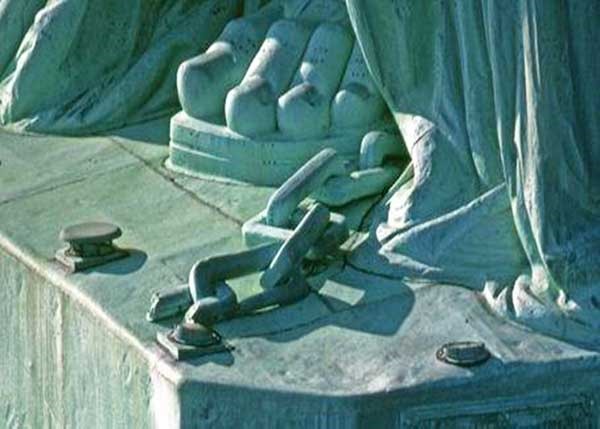
One part of the statue, otherwise so well known, is nearly impossible to see for visitors, but was intended as part of the work’s imagery by its creator: beneath the torch of “imprisoned lightning,” the halo of spiked rays,  the serene face, the tablet bearing the date July 4th 1776, and the copper-clad folds of its robe, the sandaled feet of this Lady Liberty stand on top of a broken shackle and chains.***  That would become the title image of “Chains At Her Feet.”

Statue of Liberty chains at her feet

“Flashing for the refugees on the unarmed road of flight”  some of the broken chains at her feet

It was sometime after that visit that I watched a young woman move out of a rooming house on my block. I could not discern all her story, but the small number of belongings, and the unable-to-tell relationship with a man who was assisting her with the move, but who left after helping with a couple of larger pieces of furniture, supplied the second set of images.

Why did I combine those two sets of images? Because it seemed emotionally right, though it may not be. A Dada principle, one beloved by composer/musician Frank Zappa, was “Anything, anytime, anyplace for no reason at all.” My understanding of Zappa’s artistic tactic is that combining things that don’t seem to go together, even things that seem outrageously incongruous, can create new and strong impressions. Chance, randomness, coincidence can be entryways to this.

I agree with that, though I’d caution you that my experience has been that most results of chance, incongruity and randomness will suffer from incomprehensibility and boredom, near and far misses. In practice, selection must occur, whether it happens before or after. Who selects? The artist and their audience. Zappa certainly chose, he was just happier choosing widely, and in some cases choosing things many people (and even I) will not like.

So, this combination in today’s piece “Chains At Her Feet,”  the Statue of Liberty and a young woman, leaving or going somewhere, sketched in clear lines, yet missing parts of the story, may not impress on readers/listeners what I intuited and felt in combining them. Would it be better if I filled in the missing parts, even with invented details? Some readers of it have thought so. The title/refrain “Chains at her feet,” a detail taken from our giant July 4th icon, puzzled people. Was that my intent? Yes and no. I wanted people to ask what that odd line meant. In singing it, I repeat it enough to make sure people know it’s not a mistake. Do I want listeners to think “Aha, that must be the Statue of Liberty?” No, but I wanted the effect Liberty’s sculptor wanted when he put those chains under his statue’s feet, the same sort of conjunction as the remains of the military fort and the jail doors under the pedestal on Liberty island.

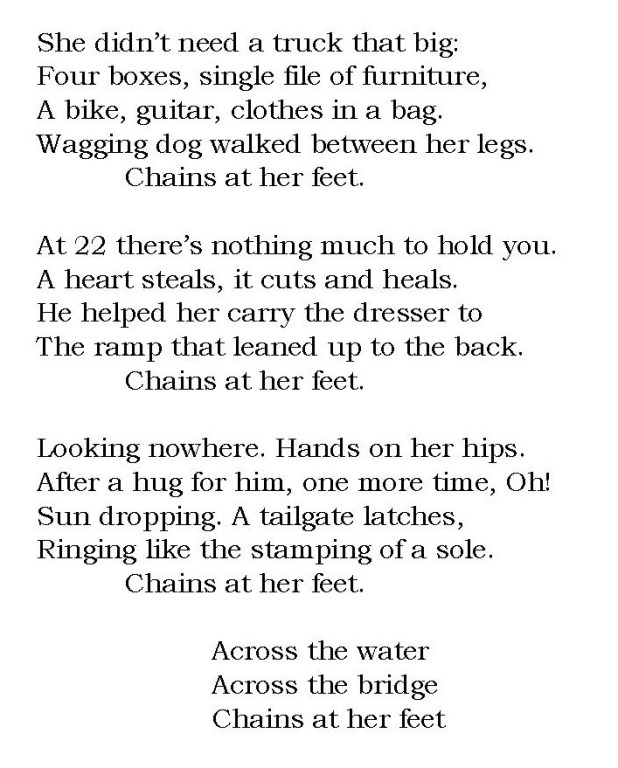
Chains At Her Feet lyrics

When singing this, I add more refrains. When reading it you see words I want as punned/double-meaning: “steals” and “sole.” Even “chains at her feet” sounds a bit like “change…” when drawn out.

So, who’s right? The answer is I don’t know. Long-time readers here know one of my dictums: “All artists fail.” Even the canonical greats bore and puzzle and meet with disinterest of most people most of the time—so unestablished artists like me certainly don’t know if what we do is any good.

No artist does. We do it anyway.

I like it when something connects with readers/listeners, I’m often sad when it doesn’t. My stance on what disconnect I find with what audience I find is to interrogate it and myself. I haven’t let it stop me making. Indeed, it sometimes leads me to additional making, seeking ways to make something work some of the time.

As important as it is that we artists respect, are even grateful, for genuine audiences, it is also important that we choose widely, even fail widely.

To hear “Chains At Her Feet”  performed, use the player below. No player visible? This highlighted hyperlink will also play the song.

*Regulars here know that presenting pieces with my own words is an intentional rarity here. I often fall into doing it when I’m running behind in developing pieces with other writer’s words or researching around that goal.

**Ganz’s story was fascinating to me, an immigrant sweat-shop garment worker from age 13, who through chutzpah and conviction toward justice became a street agitator for reforms in early 20th century NYC. Speaking of a conjunction that may be accidental or designed, I’ve wondered if the Sweet Marie in Bob Dylan’s “Absolutely Sweet Marie”  could have intentionally referenced her. Some of Dylan’s Greenwich Village cohort might have known of “Sweet Marie,” and her actions were less than 50 years old when Dylan hit town.

***Though Liberty’s tablet references the 4th of July, the proximal motivation for its creation was the ending of the American Civil War and American slavery. In statuary, having something beneath the feet of the figure or trodden on is not uncommon imagery, but chains and shackles aren’t just mythological images. In another juxtaposition, Juneteenth and July 4th sit close together on the calendar, if four score and seven years apart.

America, A Prophecy

July 4th is celebrated in the U. S. as Independence Day, the day that our congress signed a declaration of independence from the British Empire. I know this project has an international audience. So, why celebrate a provincial event here?

Because the American Revolution was not simply a patriotic event. Ralph Waldo Emerson said that its initial battle was “the shot heard round the world.” What was so singular about it? It was not merely an anti-colonialist act—after all empires have had rebellious provinces forever, and empires always fall—but it was also an act that founded the modern democratic republic. Overthrowing a colonial government, as the American patriots did, is not in itself a remarkable event. I don’t mean to denigrate the sacrifices, the risks, they took. I don’t mean to overlook the evils inherent in armed struggle. I won’t today seek to re-litigate the proximate issues of the Revolutionary War, with its details of commercial interests (including, yes, commercial interests in human properties) and debate the best tactics for redress of grievances. No, those are all important, but they are not what makes the American Revolution worth our unique attention today.

signing the declaration

Silent thoughts in the room: What a fine statement of the Rights of Man we sign today! I hope they wrap this up before traffic on the turnpike gets crazy. None of my slaves have learned to read, right? Why am I the only one wearing a hat? I can’t get tickets to Hamilton? I am Hamilton!  All middle-age white guys, when does the prog-rock concert start?


Americans did not replace a king with a president for life. They didn’t exchange one dictator for another. They were not, in the end, interested in only replacing a bad man with what seemed to be a good man, and job-done. They instead instituted an imperfect, constantly challenged and constantly changing structure based on human rights and rule by reason and popular consent. The struggles, the risks of the Revolutionary generation were indeed great, but they pale in contrast to the struggles and risks born by the successor generations who sought to maintain and improve those structures. So, this is not a holiday honoring a person, a generation, or a concluding event, but instead, it is one marking a beginning.

Today’s piece was not written by an American, but by an Englishman who followed those revolutionary 18th Century events, but dealt with them on a spiritual plane: William Blake. The words come from his self-created 1793 book America, A Prophecy,  which he wrote, lettered, illustrated, and printed himself. It’s not an account of the actual battles, and its characters are largely his own imaginary beings, but he never lets his visionary eye fall away from what he sees as the core struggle in the events. It’s spiritual—not in sense of its fantastic stage—but in the sense of its divining the essence of the battle: human beings being held back from their potential and dignity by corrupt structures.

America_a_Prophecy_copy_a_plate_08

A plate from William Blake presenting part of today’s song


In our worldly plane, the men who signed that declaration were all men, all white men, mostly men of property, and yes, we should remember that some of those men of property’s properties were indeed other men, women, and children. Blake explicitly understood that. In his prophecy, the essence that they are declaring for, the angelic forces that cry for freedom and dignity are for all nations, for all genders. If the American structure had to struggle for generations to refuse slavery and give full citizenship to women, Blake says that, in essence, and in the philosophy of their republican structures and statements, they have already declared those evils as tyranny, even if they don’t perceive that yet.

It’s almost a reverse Faustian bargain, isn’t it? Instead of the devil tricking them to eternal slavery, freedom’s angels have them agreeing to dissolve their allegiance to a bad king—but the codicils they have signed declare for more than that! They’ve put their lives on the line to declare that humans have inalienable rights and that governments must work with the consent of the governed. How entirely can they understand what that entails? July 4th 1776 is a Thursday. Some are no doubt thinking of Friday; the men of foresight, to the possible course of the rest of the war; the wisest, perhaps, are thinking, of what, a generation ahead?

The sections I use from William Blake’s America, A Prophecy  are spoken by an angelic character he calls Orc, who personifies the overturning of the old tyrannies. With the limits of our short-piece format I’ve tried to give some flavor of what Blake understood was being overturned by the American Revolution. Musically, it’s a simple structure, though not the most common of chord progressions.  I tried to chant Blake’s words with as much passion as I could in this one-take performance by the LYL Band. If you are in the U. S., enjoy your cylindrical explosives and tubular sausages, but do not mix the two things up. Their shapes are similar, but keep your mind on their essences. The performance of an excerpt from William Blake’s America, A Prophecy  can be played with the gadget below.


Frederick Douglass

Today’s piece uses words by Robert Hayden, who was a 20th Century American poet who often wrote about that essential American subject, Afro-American history. He was born just before WWI, and was writing poetry both before and after WWII, during the rise of the New Criticism, which held that the poem exists as a thing created as a conscious work by an author but is best judged irrespective of who that author is.

Douglass and Hayden

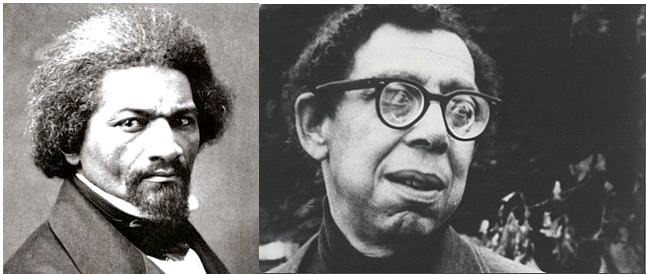
Frederick Douglass used the power of the charismatic portrait as well as his  powerful words
Robert Hayden had to rely more on the words alone, but what words they are!

To the degree that this theory was actually practiced, it solves a number of problems. One of them are the issues of discrimination, old-boy networks, and literary log-rolling where who you know or where you are in the social and academic order pre-emptively decree the worth of writing. It helps deal with thorny problems, like having poetic Modernism’s great progenitor Ezra Pound becoming a Fascist propagandist during wartime. If it was still in vogue, it might assist in considering issues around artists in our time who’ve committed heinous acts or supported political opinions we judge to be beyond the pale.

There’s a saying: in theory, there is no difference between theory and practice; but in practice, there is. Historically, the New Criticism as a critical movement didn’t consistently break down cultural barriers, though things like the post WWII GI Bill certainly did. Extra-academic movements like the Beats and their successors, and the Black Arts Movement did so as well. Great cultural shifts such as the civil rights movement have literary impact. In the end, the New Criticism seemed to restrict itself to giving students and academics a framework to discuss literature without the need to refer to the problems in their authors lives.

Perhaps too, it’s just easier to judge works based on friendship, affinity groups, or cultural and political stances. Even for an artist, how much can we live in an artistic world separated from the daily, inescapable effects of the political and economic world?

But let’s not be too unfair to the New Critics. They cared about the work as it exists, treating art not as inessential decoration for something else. They offered open structures, criteria that were open to any to master. When Robert Hayden, born in the crowded Detroit ghetto swelling with southern migrants looking for industrial work, mastered those structures, he (eventually) earned a place in the culture of his time. How did this play out as my generation, born after WWII, came of age? Let’s look at the tape.

15 minutes from a Robert Hayden interview in 1975.

This is a time capsule from over 40 years ago, yet it could be longer for all the patina of time. The monochrome of the film makes the impassive white interviewer, the smoke from his constant cigarette, and the later-life Hayden all look gray. You see the coke-bottle glasses on Hayden’s face, but not the tint of his skin that would have born him instant misjudgments throughout his life, misjudgments that he would have to have dealt with along with his art. You will hear him make the claim I made to describe him at the beginning of this: that he’s an American poet who will write about Afro-American subjects, and hear him begin to make the case as to why this distinction is important. I can clearly hear how important he believes this is.

Around 10 minutes in, he’s asked to engage with the separatist strain in Afro-American culture, and he offers his full-throated disagreement with what he thinks are their goals. That’s too big a subject to deal with here, but apparently at the point at which he was finally achieving some recognition for his poetry, some aligned with the Black Arts Movement saw him as an assimilationist. Some might view this part as a “damn kids, get off my lawn” generational moment.

Also, in the film Hayden reads two poems. One is probably his most well-known work “Those Winter Sundays,” and the other is today’s piece, “Frederick Douglass.”   In the later, using only the eloquent words in his sonnet, Hayden makes that argument that he could write a political statement timeless and yet incisive, and in the former, he writes a poem of gratitude to his foster father, an unpoetic man who made it possible for him to be a poet.

“Those Winter Sundays”  will be featured this month on Poetry In America on PBS. It’s a fine poem, and I’ll be interested in seeing what they do with that poem’s details, things that one needs to linger a bit to see. I, on the other hand, had already chosen to present “Frederick Douglass”  for my first Robert Hayden poem here. If you take the poems together, you’ll see two arguments for paying attention to Hayden. One the universalist for liberation (a political theory Hayden shared with Frederick Douglass) and the other the argument for gratitude to those, however imperfect, that helped us.

When I first read Hayden’s “Frederick Douglass”  this year I was immediately struck by the poem’s uncanny details, laid in-between the eloquent flow. It was written over 50 years ago, but it’s more current than that B&W film from 1975. Perhaps you’ll hear them too if you attend to them: freedom that can be beautiful and terrible, hunted aliens, metal statues more valued than lives made possible.

Here’s my performance of Hayden’s words about Douglass. Use the player to hear it.

Thanks to the publisher for permission to perform this. “Frederick Douglass”  is Copyright © 1966 by Robert Hayden. From COLLECTED POEMS OF ROBERT HAYDEN by Robert Hayden edited by Frederick Glaysher. Used by permission of Liveright Publishing Company