I’ve told some folks that I’m working on Emily Dickinson’s “No Kings” piece this week. Now, that’s hardly true. There is a king in this poem and he doesn’t come off so well in its telling; but there’s a naïve maiden too, and Emily’s going to paint her as much a fool as the pompous potentate.
If much has been made about the use of hymn meter in Dickinson’s verse and connections there to her skeptical view of conventional religion, plot-wise this poem takes its tale from an extremely common folk and folk-broadside trope: the foolish maiden. In countless variations some man of high-degree dallies with a young woman of the common folk, and it usually doesn’t turn out well for the girl.* In the best of it, he’s a cad and leaves her; in the worst, there’s murder most foul in the offing. Many folk songs, including those in this grouping, open with it being a Spring morning. Springtime promises, it seems, aren’t to be trusted the voice of folk music says.
I’m not scholar enough to tell how many such songs Emily Dickinson knew, but they were highly common in her time, and I suspect she was using that folk-music plot here to make her point about what life promises us, and about trusting kings.
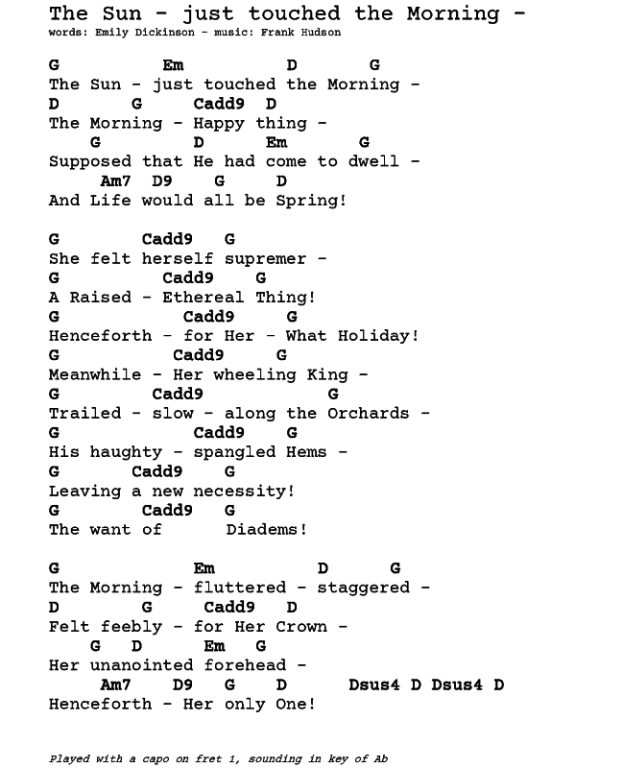
Here’s a chord sheet to assist if you’d like to sing this in your parlor. I like the sound of 9th chords, but they were chosen here to ease my fingering on guitar and can likely be simplified if that suits other players.
.
In “The Sun – just touched the Morning” we have the morning herself playing the foolish maiden and the sun is the sun king who likely believes that when you’re a king they just let you grab it. The sun, as we might guess, soon has to be moving on doing important stuff like making dew into a passing mock-up of glittering jewels, but Morning thinks she is to be his queen. Dickinson reports Morning trying to act like the imperial Sun, crowned with a dew-drop diadem: “She felt herself supremer – A Raised – Ethereal Thing!”
Dickinson knows how this comes out: there’s no crown on offer, no coronation. Some divine right will not tell us who is right, honorable, reciprocal, or trustworthy – that will be up to our “unanointed foreheads.”
So it is: hymns generally tell us how to live right, how to praise a beyond-human perspective, while folk songs take on the task of telling us not to be a fool.
As I composed this, I tried to use a 19th century popular song kind of feel, but ended up being enticed by rock quartet instrumentation with a chiming electric guitar element. If I was to do another version, I might lean more into parlor instruments – but this’ll have to do for now, for we have present business with kings we refuse to allow.
You can hear this song version of Emily Dickinson’s “The Sun – just touched the Morning” with the audio player below. What? Has the king refused to fund any such audio player? No, it’s just that some ways of reading this blog won’t show the player, and I offer this highlighted link which will open a new tab with its own audio player so you can hear it.
Today’s piece was created from a poem written by the Irish poet Padraic Colum. Colum was born in the 19th century, then traveled through the world of 20th Century Modernism, and lived on long enough to overlap my lifetime. Looking at the outlines of his life I am pleased to report that Colum connects a favorite of this Project, the undercelebrated Irish poet Joseph Campbell* and the American mythological theorist of the “Heroes’ Journey” also named Joseph Campbell. With the American Campbell, Colum connected because he was a folklorist as well as a poet, and he wrote several young adult and children’s collections of folk tales and retold myths which I’ve not yet read. With the former Campbell, besides being Irish literary revival contemporaries, he collected folk-songs.** Like that Irish Campbell, Colum’s best-known work today is arguably a folk song.
Long-time readers here may recall that the poet Campbell is likely responsible for the song “Reynardine” being sung in a version featuring a supernatural, shape-shifting lover. At around the same time, and for the same publisher of Irish folk songs, Colum collected/wrote the lyrics to the song “She Moved Through the Fair.” Why the slash notation on the authorship? There’s some controversy if Colum closely adapted a traditional set of lyrics, or largely wrote original lyrics to an existing tune. Colum claimed he wrote the lyrics, making use of only a few floating lines that are folk song ready-mades. The challenge to Colum’s authorship strikes me as highly suspect: it’s based on another collector writing in 1970 that he came across an old man who told him he’d learned it as a traditional song before Colum’s version was published in 1909.
I suspect there’s someone out there who can do a better job singing this song I created from Colum’s poem.
.
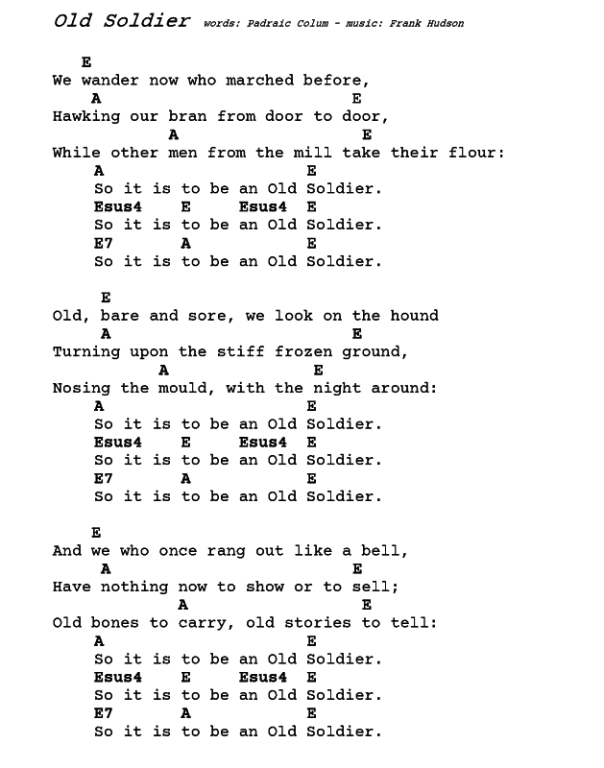
“She Moved Through the Fair” was included as a poem in Colum’s first poetry collection “The Wild Earth”*** which also includes today’s poem. I note that “Old Soldier” has some similarities with the lyrical methods of SMTtF: both use spare details and leave out a great deal. Some of what is implied in the two lyrics may have become more obscure to modern listeners. SMTtF very early on speaks of the singer’s “lack of kind” which uses a now archaic meaning of “kind,” meaning family. “Old Soldier” opens with the titular old soldier going door to door. Since “hawking” (a hawker is a street-seller) is used as a verb in the second line I thought at first he was peddling, but from what I can find, no one sold flour that way. I think he’s begging for bran, which was then the discarded part of the milling of flour. That waste part after the wheat was milled or boulted, was thrown out or used as animal feed, though apparently the poor sometimes made use of it for human consumption.**** In the second stanza we meet the old soldier’s only companion, a dog, and the bran the soldier has garnered may have gathered mold.
I don’t know if “Old Soldier” has been set to music before this, but it seems every bit as singable as “She Moved Through the Fair,” and as soon as I read it, I wanted to sing it. I decided to use an arrangement soaked in South Asian musical influences, perhaps due to the wonderous extended version of the SMTtF tune played by Davy Graham. That link above includes one of Graham’s recordings of it, as well as Anne Briggs wonderous acapella version. Oh, hell, here’s that link again, click it indeed if you haven’t heard the song Colum made. Last week I recorded the basic tracks singing and playing a tune I created for Colum’s poem using my guitar in an alternate tuning driving a sitar virtual instrument though a MIDI pickup. To this first pass, I added harmonium, tanpura, tabla drums, acoustic guitar, and a final vocal.
Every one of those overdubbed passes felt good as I played them (save for my vocals, I’m never happy with my vocals) but the result was a whole bunch of tracks that would require careful mixing so that the instruments blended well. I set about doing that, working until midnight when I figured I might have a piece to present and saved a complete mix down. Awaking the next morning, I listened again, and the result wasn’t just flawed, it was a mess. A useful question for one mixing a piece of music with various instruments in an ensemble like this is “What track is the focus of the piece?” My putative mix had no good answer for that. The voicings of the chords on the sitar and the guitar didn’t mesh well. The harmonium and the tanpura were fighting over the same part of the sonic spectrum despite my efforts to give them their own sonic space. The tablas didn’t mesh with the acoustic guitar’s rhythm.
The wise solution would be to just re-track the piece. Maybe I should have more particularly considered that Davy Graham had made his impressive version of a Colum poem/song with only a solo acoustic guitar. But I would not have another opportunity to record with a sensitive open mic until this week, too late for Veteran’s Day. So last night I went to work stripping back the crud of my failed mix, leaving mostly the acoustic guitar and the vocal, with the tanpura and then the harmonium coming in for later parts of the song in turn. It’s not an ideal recording, but it’s my hope it lets one consider “Old Soldier” as song today.
The more palatable version can be heard with the audio player below. The song itself is simple, and the remixed arrangement that builds a bit as the song continues serves it better. You don’t see any audio player gadget? No, I didn’t remove that, it’s a side-effect of some ways of viewing this blog. I have a plan B for that too: this highlighted link that will open a new tab with its own audio player.
.
*Joseph Campbell, who also wrote under the name Seosamh MacCathmhaoil, was acquainted with the original London Imagist circle, and wrote what I think is some excellent short verse in the form. His life and literary career were brought low by siding with the losing side in the Irish Civil War.
**Given that I’ve been doing this project for a decade, the folklorest/singer/collector and poet is a combination near to my heart. Besides Colum and Campbell, two American poets from the same era, Carl Sandburg and Edwin Ford Piper did both things, and I’ve tried to briefly make the case that Sandburg should be more often cited as instrumental in connecting folk song with progressive politics and literary poetry in the United States, which eventually leads to the case of a Nobel laureate in Bob Dylan. Around the same time as all these others, elements of the “Harlem Renaissance” in Afro-American literature were open to melding folk song with high literature too (Fenton Johnson, Langston Hughes, Jean Toomer, Waring Cuney, Zora Neale Hurston).
I’m going to jump far afield before leaving this footnote: I’m writing this on the 50th anniversary of the release of the Patti Smith Group’s glorious debut LP Horses. The Patti Smith Group started because Smith, a poet personally immersed in colloquial music, a paramour of Fugs-adjacent musician/actor/playwright Sam Shepard, joined up with a guitarist/rock critic/crucial anthologist of garage bands Lenny Kaye, wanting to make unexpected poetry combined with electric guitar.
***Just when Colum’s The Wild Earth was published is unclear to me. My copy has a 1927 American printing of a 1922 edition. Wikipedia says “She Moved Through the Fair” was in a 1916 edition of the book, and then in their entry for Padraic Colum gives a 1907 date for the book.
****What, that’s the healthy part! Whole wheat! At the time the milled pure white flower was prized from making lighter baked goods and for a longer shelf life. The city I live in was growing rapidly at the time of this poem by finely milling the “Best” and the “Gold Medal” flour that had absolutely no bran or wheat germ at all.
As Halloween approaches, here’s a song that focuses on the playfully frightful aspects of the holiday. Wait a minute – I debated typing “playfully” there with “frightful.” I went with that combination as it’s my best guess at the intent of the Vachel Lindsay poem that I converted into a song, though I can’t be sure.
Playing with fear and horror is clearly a part of Halloween. We expect children to celebrate the holiday, and the adults participating in Halloween celebrations plan them to be happy occasions, even though the decorations will be full of spiders and their webs, and monsters, and skeletons, and those dream-flickering pumpkin skulls.
But if you take the poem (now a song) at face value, this is about a woman who is personified as a predator, the femme fatale trope and her victim fly. Had poet Lindsay felt himself wronged by some lover to come up with this piece? I don’t have biographical evidence to point to with an emphatic gesture,* and the internal evidence within the poem speaks to me of a playful mode to the condensed tale of horror it tells. There seems to be a paradoxical agreement on the part of the singer: they’ve been done wrong, but they’re going to speak lightly about this, and while the song’s fly doesn’t say it out-loud, they might be open to just a little more peril.**
A poem that literally describes tearing the wings off flies, yet I’m still holding it as playful.
.
Earlier this month I wrote about the mid-20th century “folk scare” in passing, and as someone who has some grasp of the songs revived by that movement, I couldn’t help but think that Lindsay referenced a floating verse that appears in some American folk songs. Did anyone else catch it from listening or reading the text above?
The spider takes her prey with the line: “She drove me to her parlor/above the winding stair.” Reading this, I immediately heard a specific tune – cementing the idea that this poem would get the Parlando Project treatment. What tune? One widely sung song that features the verse about a woman taking a lover to her parlor goes by the title “Cindy, Cindy.” Besides the parlor destination – sometimes sung in the folk song as “She took me to her parlor and she cooled me with her fan” – most “Cindy, Cindy” versions have devouring women in them too, with verses like “I wish I was an apple a-hanging on a tree and every time my Cindy passed she’d take a bite out of me”*** or even “My Cindy is a pretty girl. My Cindy is a peach; she throws her arms around my neck and hangs on like a leech.”
Quick research says that “Cindy, Cindy” was sung in America in the early 20th century when Vachel Lindsay wrote his poem. I’m going to suspect Lindsay knew one of the variations of it – and he might have thought some of his audience would too.
So, I’m calling it: playful. Likely erotically playful.
I also suspect my music for today’s performance of “The Spider and the Ghost of the Fly” had “Cindy, Cindy’s” tune in its ear a little bit too. You might be able to hear that performance with the audio gadget below – but like the devouring and dangerous love between the spider and the fly, some of you may find the audio gadget hidden and suppressed. Aha! I have this highlighted link, a veritable grail-shaped beacon, that will open a new tab with its own audio player so you can hear the song.
While researching my questions about Edwin Ford Piper in his archives at the University of Iowa Special Collections Library, did other things occur to me? Yes, a few things did. I’ve warned you, I never seem to be able to tell stories simply.
I tapped this thought on my laptop computer during the first day with the yellowing paper newspaper clippings, cursive correspondence, and paperclipped notes on scraps of paper surrounding me: “Paper or Song?”
I hoped that would be enough to remind me of what occurred off to the side as I worked my way through this somewhat random archive containing the folk songs Piper had collected around the American Midwest early in the 20th century, often from rural settings.
Given the high cost of the more or less instant communication in my rural youth, I easily recognized Piper’s world of correspondence, little journals, and newspapers of the region. If my mid-20th Century had long-distance phone calls, or I suppose telegrams (I never sent the latter, but a couple appear in Piper’s files), long-distance calls were an expensive thing, something you saved for emergencies or life events for the most part. As in Piper’s days, tasks like exchanging folk songs or literary networking was something you might engage in with pen in hand like some medieval monk or courtier.
That information’s travel was slow: what one found in one small town might appear days later in the mailbox of another town, but it had persistence. It opened the possibility of staying around longer than the electronic instants we exchange now on little glowing rectangles. This document I’m entering into a computer gets saved to a solid-state device, and backed up to another — but who would care after I’m gone or know how to access if they did? This blog, widely public as it is today, exists more or less at the mercy of my monthly payment from my no-profit enterprise.
In summary: slow communication in Piper’s time, but a chance it’s kept long. Fast, facile communication now wizzes past in a flying timeline and disappears.
How much did Piper save? I can’t tell, we only have what we have, not what we don’t. In my last day at the Special Collections I read an in-passing comment from his wife written decades after Piper’s sudden death, telling which professor took over his position and classes and of the two of them going to Edwin Piper’s office and cleaning out the stuff there for his successor. Piper was not Robert Frost or Carl Sandburg then or now, but someone saved some things that could be held in hand so I could go on my time travel trip into the boxes in the library Special Collections.
Still, there’s nothing about paper that assures eternal. Beyond paper, Piper seems to have done good work, good things for others. As a professor there’s the legacy of his students and perhaps their students, and so on outward. The unarchived of us will have that too, with no library boxes, indexes, or perhaps even attribution.
But then this occurred to me, there’s something else, an archival format with a potential longer shelf life: songs. It was partly a folk song archive I had come to look at, and I’ve had an interest in folk song since I was a teenager. Therefore, I already knew many of the songs I came upon in Piper’s archive, at least in a version I could recognize were related to his. I’ve heard them sung, sung them myself. Some of them are old, some of them had Child folk song collection numbers since they were British Isles songs that had emigrated to North America and remained to be passed from one singer to another through time. Ford wanted to write them down, but at least at first it was said he just wanted to learn of them to sing them. Singing — that’s an instant, ephemeral communication — but at least for some songs, sometimes, there’s a lasting component that persists.
A folk song for this post? Here’s a song better known from the 1960s folk revival where its haunting supernatural elements started attracting singers in the British Isles, “Reynardine.” While there are older songs with a like-named character, the version we know today descends from a song collected or recast in the first decade of the 20th century in northern Ireland around the time Piper was collecting his songs in the American Midwest. You can read more about this at this earlier post, but here it is simply as a song to pass through your ears via the audio player below, or this backup link.
Very often I find myself unable to tell a story simply. While I find internal joy in expanding complexity there is a painful element too. Even when under the spell of things I’ve experienced and learned, I retain enough self-awareness to see what effect my expression has on others, the burden of strangeness. Then the reach between the teller and the listener becomes haphazard, unstable — pile it too high and it tiresomely topples — and so in some break for breath partway in, I realize I’ve dumped a cluttered mass of thought debris on a listener, long past any interest.
Perhaps this is why I’m attracted to lyric poetry, constrained as it is to moments, often held tight within the stiff glass bottles of forms.
Here’s a personal story that’ll go many places coming from the place I find myself in this June. It starts, I’ll guess, earlier this year when I came upon a poem, “The Last Antelope,” a striking, empathetic account of the end of an animal’s life and wildness after settlers captured it. Edwin Ford Piper was the author, and there were only scattered bits of information to be found about him. Scattered and bits do not constrain my curiosity — if the bits were great distances apart, the space between them could hold a lot of things: born 1871 in rural Nebraska, parents part of early European-origin settlement there. Largely self-educated in a land of necessary child-farmhand-so-never-more-than-half-year schools, still goes on to university in Omaha studying literature with a specialization in Chaucer, and then to the University of Iowa where as a professor he helped establish the idea of teaching and granting degrees in creative writing.
The modern convention of a university as patronage for artists, and the rise of the credentialed MFA-holding poet is not without controversy — but isn’t it odd, this man who taught himself in a small town on the fluid boundary between the 19th Century Wild West and the 20th Century staid Midwest took that journey.
In the middle of this, the same man had a compulsion to collect songs ordinary people brought with them while journeying, the words and music carried in the light baggage of memory. He wrote down songs his relatives and townsfolk knew by heart. He asked others to send him more by mail. He paid particular attention to the songs of those on the move: hobos, cowboys, and other traveling workers. Did this connect with his literary poetry? There are no recordings of Piper reading his poetry, but accounts say he declaimed it with a musical lilt — perhaps like the surviving recordings of Yeats, or maybe like the more bombastic Vachel Lindsay — and at times he would break into full song. His students took to calling him “The Singing Professor.”
Since this Project is “Where Music and Words Meet” you can see why I’d be attracted. And I’m a small-Midwestern-town boy, though without degrees. But did that seem strange then, to mesh high culture and the songs remembered by old women and rude mechanicals?
Piper was born just west of the Missouri River in Nebraska — and in Illinois, just to the east of the Mississippi River and less than a decade later, Carl Sandburg was born to an immigrant railway blacksmith who signed his name with an X. Iowa, the state where I was born in the middle of the next century, and Minnesota, the state where I’ve lived the longest, sit in a delta between those two tremendous rivers. Sandburg too mixed the latest in Modernist poetry with folk songs he collected and sang. Did Piper influence Sandburg? Did Sandburg influence Piper? Or are they the same genus of plant, raised in the same climate, but in separate plots? Questions.
Answers fork like river systems. Even with little information being readily available on Piper, I was already in flood stage. And here’s how much my wife loves me: for our 20th anniversary she agreed to go on a road trip with me to Iowa City and Sandburg’s home-town of Galesburg. My scenery in Iowa City? An archive of Piper’s papers* held in the university library there. Our grand museum of the arts of poetry and song to visit on the trip: a railway worker’s shack in a small rust-belt city, a town worn-out but still running like a paint-shedding Oldsmobile.
Two considerations worried me as I thought about this trip, one for my wife and one for myself. For my wife, I worried if there’d be something rewarding for her to do while I enthused at the library. She was able to solve that one easily, locating nature reserves, parks, and trails within an hour’s drive. I often tell her that she’s a nymph, and I complement her on how seriously she takes her job to supervise the plants and animals when she returns with soggy hiking boots from her hikes with pictures of landscapes, mushrooms, wildflowers, birds, and other critters. I love her pictures and stories on return (her stories briefer and better organized) — but my old joints ache just thinking about hiking for hours.
For myself I worried about my old-ager endurance. The library was two-thirds of a mile from where we’d stay. I’d need to hoof it with my laptop bag back and forth, which would have been a trifle in my youth, but nowadays longer term standing and walking is troublesome. I considered taking a bicycle with me, which would have made the library to-and-from easy, but a lot of hotel/AirBnB places don’t have any good places to lock up overnight, and on further consideration I thought that a bike would just be one more thing to worry about, taking my focus away from the trip’s main goals. And then I worried too about spending full days at the library’s special collections reading room. Because my time was limited, and to minimize the walking, I planned no break for lunch. I’d need to keep my focus and energy up, something that I have not been consistently able to do this year even with all the comforts of home.
On average I bike at least once every day in my normal routine, often in the morning. In the past two years I’ve not been a longer distance bicyclist, but 30-50 miles a week easily exceeds those 150 minutes exercise recommendations, and it lets me get to a café for morning breakfast and handle a lot of routine shopping and other trips. I ride year-round. In 2016 I bought my first 21st Century winter bike with studded tires; and in 2019 I upgraded the winter season bicycle to a Fat Bike with monstrous 4.5-inch-wide tires that handled ice and snow with the challenging ice ruts and potholes that my city’s current “We’ll get to all the streets in 3 days after the snow stops” plowing regime supplies. My overall stamina for the walk wasn’t my worry so much as how well my joints and stiff back would take the more load-bearing walk.** And to make it through the day I’d planned, there’d be no old-man’s afternoon nap either.
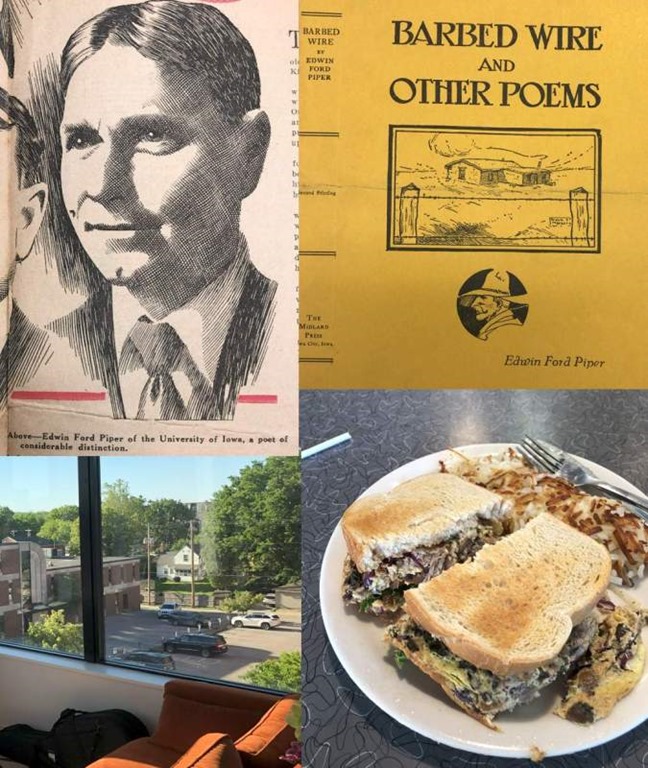
Piper, once a “poet of considerable distinction.” A later version of his collection Barb Wire. My Iowa City view, and yes the guitar got some use. Example breakfast.***
.
The first day we arrived at Iowa city was hot and very humid, so I put on my best hot weather clothing. Spouse-nymph headed off at dawn for her day’s supervisory encounter with nature, and I planned a big breakfast fuel-up. I’m a “eat little meat” kind of guy, but for good or ill I take the lacto-ovo part of my lesser meat diet seriously, so I’m a big frittata, omelet, hash, scrambler kind of guy most mornings. I note that I eat like an old-time farmer, despite never farming, but the good thing about this higher fat/protein kind of meal is that it can hold me until supper, and that was my plan.
I put on my best hot weather clothes, slung my bag over my shoulder, and headed for the university’s main library building for my encounter with poet-professor Piper’s papers.
Thus ends Chapter One.
Here’s a musical performance I put together in March of Piper’s “The Last Antelope.” You can play it with the audio player you should see below. No player? This highlighted link is another way to hear it.
.
*When I arrived at the library archives will-call desk, I asked them to pick Piper’s Papers. The librarian suggested puckishly that I was nearly reconstructing the old tongue-twister folk-rhyme, Roud Folk Song index 19745.
**Local papers/forums are full of folks who bemoan bike lanes in my city, often remarking that “not everyone is young and fit.” Despite that, most bicyclists I meet and see on my city’s streets aren’t of the MAMIL (Middle-Aged Man in Lycra) variety — and I’m maybe 1.5 letters of that acronym. I joke with my wife that as my joints get older, a bicycle is becoming a “fore-and-aft wheelchair” for me, allowing me increased mobility and beneficial low-impact movement for the old joints.
***That’s a St. Paul Sandwich: egg foo young on sourdough with lettuce, tomato slices and mayo. Near as anyone knows, my Twin City of St. Paul has no tradition regarding it, and no restaurant there serves it now. Its origin is something of mystery.
Did T. S. Eliot for Halloween* suffocate our audience with too much of the musty air of the classroom? I hoped those loud synth fanfares would set such terrors to run. Maybe not. Well, I’m ready to tempt you back with a bit of love and seduction, a song set away from graveyards and into castles. Our Halloween series continues, and this time with 100% wooden music I played on an acoustic guitar.
So, ladies in nightclothes flaunting impossibly flowing but still in good array hair, running through the forest under a moon over the branches kind of stuff? Maybe. First some literary history. Don’t worry, I won’t take long with that, and there’s a good creature-feature song at the end.
We started our Halloween series with Frost and Eliot, poets that many will know even if poetry isn’t an interest. Today’s piece uses words from a well-known name that when applied to a poet isn’t well-known: Belfast writer Joseph Campbell is that name. Yes, every cursèd time I mention his name here I’m required to say “No, not the Power of Myth guy.” Poet Campbell was a contemporary of Yeats. And like Yeats he visited London when F. S. Flint, T. E. Hulme, and the “What’s with the initials guys?” Yank-transplant Ezra Pound were taking up their make-it-new idea to be called Imagism. Several years before Pound and Flint published their famous essay on the tenants of Imagism, Campbell published some of the earliest Imagist poems.
Campbell’s relationship with Yeats is complex. They both were heavily into valorizing Irish culture. Campbell was even more so into Ireland throwing off its exploitative English colonial status. Both seemed to have an interest in the faerie and spirit realms, though Yeats had an interest in practicing wizardry, while Campbell, AFAIK, didn’t. Both had interest in music, but Yeats was specifically resistant to having his poems sung conventionally, while what of Campbell’s work survives (underrecognized) is as a lyricist** for songs better-known than he is.
As a song, today’s piece, “Reynardine,” became oft-performed in the British 20th century folk revival. When those performers would present it, they would introduce it as an old song — which is true in part. Its melody is largely based on an old air. The name of its main character, and something in the general trope of “I’m in love with a mysterious bad boy” did have old ballad antecedents. But those revivalist performers would usually want their audiences to know that the main character, the haunting love interest the singer knows but society doesn’t, is a shape-shifter, a were-fox.
Campbell’s words as printed in “The Mountainy Singer” are better, more direct, than the lyrics usually used for performing this song. I made one change: Campbell has “took me for his leman” in his, and I translated this to “lover” for clarity.
.
As I discussed briefly when I first presented this one a couple of years ago: that doesn’t seem to be so in the extant pre-20th century versions of this song. In 1909, our “Reynardine,” now a were-fox eluding the patriarchy and foxhound driving hunters, was published in two books: as a collected Irish folk song from Belfast, and as a page poem in Campbell’s poetry collection The Mountainy Singer. This idea of the song’s dark hero emerged that recently, and I have every reason to believe it was the little remembered Joseph Campbell who cast him that way.
I did my best with my performance of this one, thinking I was emulating those folk revivalists whose work I greatly admire. The one special thing I did was use Campbell’s set of words as printed in his poetry collection. With one small alteration, I think they work well to sing to modern audiences, and his version has the compression and specific mystery that can make Imagist poems and short lyrical songs compelling when contrasted with lengthy poems and discursive sung ballads. Audio player to hear the performance below. No player? This highlighted link will open a tab with a player.
.
*Unlike the other pieces I’ll present in this series, my settings of Eliot are not listener favorites. I watch the stats here while not spending much time trying to maximize them. Eliot draws some interest outside the U.S., and very, very little from here in the States.
I also want to say that I want to celebrate Halloween this year (more about why later in this series) and I want to do it as Emily Dickinson once wrote she did in approaching some topics in her poetry “I sing, as the Boy does by the Burying Ground — because I am afraid.” But writing as Eliot did of his unreal city of corpses that can’t be hidden, and casting it as a song of fantasy, vision, or delusion, can be offensive in a time where real corpses are piling up not from natural death, but from human intention.
If I offend you, you likely aren’t reading this far. I assure you I offend myself in doing so. “You! hypocrite lecteur! — mon semblable, — mon frère!” “You! Hypocrite reader! — my fellow, — my brother!” quoted Eliot, quoting Baudelaire, quote I.
**Even as the composer part of most of the Parlando Project, I want to say that a pet peeve of mine is folks crediting a song solely to the music composer. I hear this all the time with contemporary songs, particularly when the melodist has sung the piece: Brian Wilson, Carole King, Elton John, and so on. Besides his unacknowledged work in recasting “Reynardine,” Campbell is the lyricist for “The Garten Mother’s Lullaby” and “My Lagan Love.”
While looking for material to combine with music and perform for the Project this week I came upon a specific but little-known connection between two great early 20th century poets. I’ll go into the details of that in a bit, but before I write about that, let me set the scene by mentioning something about one of those poets, Robert Frost.
In the past mid-century, when I was growing up, Robert Frost was a poetic institution. He’d won four Pulitzer prizes, his work was as well known as any living American poet, ordinary readers might have familiarity with some of his best-known poems, and a few phrases from those poems had entered general usage. It was not uncommon for the schoolbook poetry anthologies that I’d encounter back then to end with Robert Frost. If he wasn’t the end of poetry, he was as good a symbol as any of the end of poetry as it was consumed up until that mid-century time, where literary poets wrote verse that was assumed to have a chance at general readership and could have evident value to them. He wasn’t Tennyson or Longfellow exactly (Frost’s sound was more like common American speech) but you could see him as a proprietor in the same trade as the 19th century giants.
He was enough of an institution that schoolboy-me was having as little to do with him as I could. Sure, he was living, but that was no help, because he was old. Many dead poets left young corpses, paintings, engravings, or photographs of dashing writers, heads cocked with their thumbs and index fingers up against their visionary brains. Keats or William Blake, now there were my comrades, not Frost. I plead youthful ignorance and concerns, and Frost’s poetry stuck around to eventually inform me in my foolishness.
So, it surprised me to eventually learn that for nearly half his life Robert Frost couldn’t get arrested as a poet in America, and he wasn’t doing all that well in finishing college or finding a steady day gig. Frost may have been trying, but he wasn’t trying very long in any one place — inevitably either they or he wasn’t for having him stick around. Nearing 40 years old, Robert Frost did something next in his unstable life: he went to England. What was this guy, that by my time was the quintessential American-scene poet, thinking?
I’m not enough of a scholar to know for sure, though reading a few Frost bios would probably inform me. One good theory: nature poetry and poetry about rural subjects was having something of a bloomlet in England. If England had led the way in industrialization and empire building, an in-reaction interest for literature about the countryside and country living was arising.
Within a couple of years of arrival Frost connected in England as he’d never been able to do in New England. He published his first two collections of poetry. He formed a close friendship with British critic Edward Thomas (and in return convinced Thomas to write poetry). He ran into another American ex-pat, Ezra Pound, and the younger Pound trumpeted the now 40-year-old Frost’s poetry back to America as part of the coming new thing.
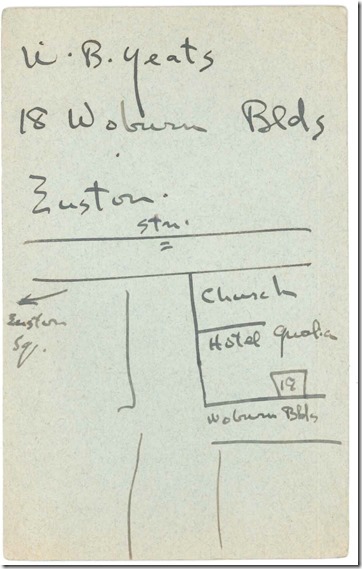
Imagism in action Ezra Pound, acting as a Georgian-era GPS, drew this map to show Frost how to get to Yeats place in London.
.
And there may have been another factor, a hoped-for connection with another poet: William Butler Yeats. Yeats wrote of the rural Irish countryside of course, and I had never associated Frost with the Celtic revival at all. Just in preparing for this post today, I took note for the first time that Frost’s mother was a Scottish immigrant. Why did I start to look into that kind of connection?
I started re-reading Frosts first English-published collection, A Boy’s Will, where I came upon this poem with a generalized title: “Love and a Question.” That poem stood out at first glance because I could easily see how it could be fit to a folk-ballad style musical accompaniment. It even included a close variation of a floating verse line used in several folk songs “Her heart in a case of gold/and pinned with a silver pin.” But then there’s a second line too: the woman by a country hearth with thoughts of “the heart’s desire.” Here’s a link to the full text of Frost’s poem.
That second line would have been unremarkable except for the accident of performing a Yeats poem from an early verse play of his The Land of Heart’s Desire this past winter. I link to my post on this if you are new or have forgotten, but this play sets up a nearly identical situation to Frost’s “Love and a Question.” A newly married couple are in a remote cottage on a stormy night. A knock at the door, and we are introduced to a stranger who asks for some comfort — but who is, it’s inferred, a fairy who wishes to enchant the new bride.
How well did Frost know this piece by Yeats? In research this week I found out that while in one of his short-lived teaching jobs before leaving for England he’d directed Yeats play with a company of his students. Cites I can find online mention him putting on this play,* but nothing I found mentions that he also wrote this poem rather directly dealing with the play’s same story.
What does Frost bring to Yeats’ material? While his poem is understandably more condensed than even a one-act play, Frost obscured the situation considerably over Yeats well-told fantasy tale. The few attempts to write about Frost’s poem I found online catch nothing of the fantasy element because Frost makes that so unclear. Yeats’ stranger at the door is portrayed as odd and troubling soon after the character’s arrival, yet other than the continued borrowings from Yeats plot, the only thing in Frost’s text that suggests that the stranger is not a mortal is the peculiar detail of the stranger carrying a ”green-white stick” which if read in the context of Yeats’ tale may be interpreted as a wand or wizard’s staff. The stranger in Yeats is an active character, throwing themselves into the newlyweds’ relationship rapidly. Frost’s stranger is but spoken to and doesn’t act or speak other than the knocking entrance. The bride in Yeats has some action and agency in her own thoughts. The bride in Frost is a single tableau by the fire. The fears of the bridegroom are expressed in both the verse play and the poem, but in Frost’s poem he seems to be talking almost to himself. Endings? Spoiler alert: in Yeats’ play the bride dies, and it may be guessed that her soul-spirit has been taken by the fairy-stranger. Frost’s ending is vaguer. The bridegroom seems to say he understands the protocols of regular alms-seeking, but he can’t understand why someone would be so rude as to interrupt a new wedded couple on their honeymoon. Yeats’ bridegroom is anxious, but wary as he tries to win the occult battle, even though he fails. Frost’s bridegroom seems, well, puzzled.** Is Frost satirizing Yeats tragic Irish tale, suggesting that a real rural bridegroom wouldn’t figure out what was going on? I might be missing something, but does the poem feel like a satire? For the bridegroom to be a fool wouldn’t surprise a Frost reader. Many kinds of human foolishness, misunderstandings and limitations are portrayed in Frost poems.
This brings up another factor. This early Frost poem isn’t very Frostian. The story, such as it is, isn’t clearly laid out, and the language and prosody — this seems impolite to say about this master — is awkward. I thought this poem would be easy to sing. It wasn’t, and I think that goes beyond my limitations and the brief time I could obtain to work on recording this. The poem strains natural, clear syntax and order at times to make the rhyme, and it doesn’t show well Frost’s famed use of metered verse that sounds like natural 20th century American speech. I don’t know if being so confusing adds to the weird tale, though as an aficionado of handed-down folk music there are times when the stuff that falls out through worm-holes or is forgotten in the folk process does add power by mystery. No one really knows for sure what “Smokestack lightning” is, or what it has to do with the rest of what Howlin’ Wolf sang about, and most don’t know what the hell a cambric shirt is either. We know only that something strange is going on. The listener here may be like Frost’s bridegroom: with some passion though puzzled.
So now you know that Robert Frost wrote a poem after a verse-play by Yeats, and you can hear me work to bring that Frost poem to music with the graphic player below. If that player doesn’t show up at your door, wave your magic pointer and strike this highlighted link to open an alternative audio player.
.
*Introduction to a Frost anthology The Road Not Taken by L. U. (I’m thinking, Louis Untermeyer), Yeats and American Poetry by Terence Diggory, and Robert Frost: A Life by Jay Parini. The latter quotes Frost writing that Yeats was able to “make the sense of beauty ache.”
**The ballad tradition includes tales of ordinary folks who by luck, pluck, or guile beat the occult challenger. I don’t know how well Frost knew his Child ballads, but he did know the golden heart box with a silver pin. Still, I can’t think of one offhand where the mortal wins just by being a bit dense about what is going on.
Are you familiar with the song “Reynardine?” You might be. It’s been performed by many of the best performers in the modern folk revival: Anne Briggs, Fairport Convention, John Renbourn, June Tabor, Bert Jansch and others.* Today as I extend our Halloween series, I’m going to introduce you to a version of the song you haven’t heard, a version that I’ll maintain uses more efficient and effective methods to convey an air of mystery. There’s supposition that this version may have been an indirect catalyst in the way the song you may know was presented, but this little-known version’s lyrics are so good that singers should consider using them in contemporary performances.
Where did I find this new version of “Reynardine?” In the 1909 book of collected poetry by Irish poet Seosamh MacCathmhaoil (AKA Joseph Campbell) titled The Mountainy Singer.
I’ve spent a day or so in hurried research on this, even though long-time readers (or readers of our last post for that matter) will know that Joseph Campbell** has been of interest to me for a couple of years now. Here’s the shortest version of what I know that I can make.
Songs related to “Reynardine” go back to the early 19th century in the British Isles and the U.S. Wikipedia gives us a representative early (1814) example, and this helpful page gives us a catalog of later 20th century versions. The older versions sometimes vary the name of the title character and contain no supernatural elements. The typical plot is a broadside ballad variation of what is still a staple romance-story trope: a woman meets an erotic stranger who she thinks may be disreputable and possibly stranger/dangerous — but who also may be wealthy or noble (Reynardine claims to have a castle in most versions.) Over several verses there may be Victorian code-words like “kisses” and “fainting,” and the title man may leave the lady wondering where he’s run off to.
Skip forward to the early 20th century: in 1909 (the same year that Campbell as MacCathmhaoil publishes “The Mountainy Singer”) a musicologist Herbert Hughes publishes the first volume in a series of successful song collections titled Irish Country Songs. A great many songs that will be featured in Celtic and general folk-revival recordings, performances, and song anthologies are included in Hughes series of books.*** Hughes’ printed version of “Reynardine” is shorter than most extant versions, a verse and a once-repeated refrain, and it’s even called a “Fragment of Ulster Ballad.” In a footnote at the bottom there is this note, unsupported by any of this song’s lyrics:
In the locality where I obtained this fragment Reynardine is known as the name of a faery that changes into the shape of a fox. -Ed.”
A century-old song, with many collected versions, and this is the first time that “Reynardine” is said to have supernatural elements. Where did Hughes get this? I don’t have a direct link, but there is our version of “Reynardine,” published in the same year by the Ulster-native Campbell who is not credited on Hughes’ score, though Campbell/ MacCathmhaoil is credited in at least two other songs in Hughes’ Irish Country Songs. The supposition is that Campbell is either “the locality” — or that Hughes and Campbell shared a traditional source which has left no extant song version that indicated to both of them that Reynardine is a supernatural creature.
Footnotes! Pretty scary boys and girls! Herbert Hughes’ songbook presentation of Reynardine that likely changed how the song was viewed.
.
Did some of the later 20th century folk revival singers know of this footnote? Possibly. One highly influential revivalist A. L. Lloyd sang a version that included at times a remark that Reynardine had notable teeth which shined. In pre-dental-care England this detail may have been enough supernatural evidence. Furthermore, he wrote of the were-fox context in liner notes more than once 50-70 years ago which led other performers to explain the song that way, either as their own subtext or to audiences.
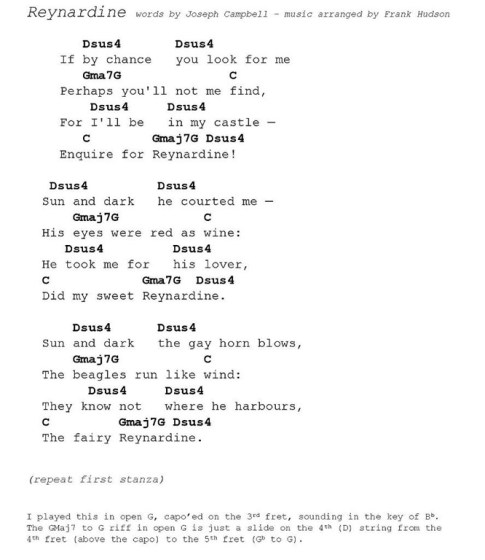
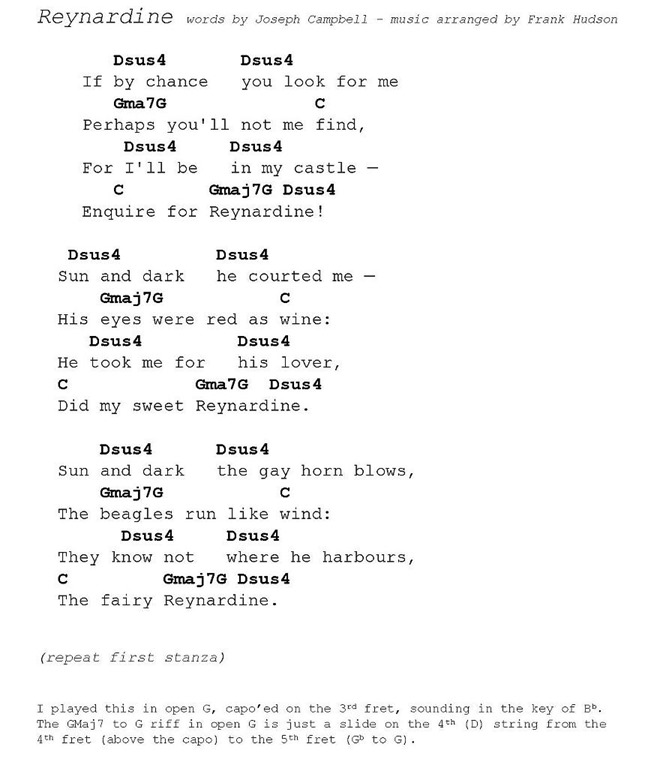
But here’s another mystery — and I’m saying, a useful one — why isn’t Campbell’s version of “Reynardine” known and sung? Let’s look at it. The chords here are the ones I fingered, though I used Open G tuning and I formed the chords while capoing at the 3rd fret, so it sounds in the key of Bb. But the music “Reynardine” is sung to isn’t harmonically complicated (you could simplify the chords), and a better singer than I could better line out the attractive tune used by myself and most performers. ****
I made one change to Campbell’s masterfully compressed 1909 lyric. I use the more instantly recognizable, less antique word “lover” where Campbell had the easy to mishear “leman.”
.
Poets and lyricists: this is a marvel. No need of footnotes or spoken “this song is about…” intros. The supernatural element is subtly but clearly introduced. The refrained first stanza was as published by Hughes, and is commonly sung in modern versions. The second makes the bold move of changing a folk-song readymade where some damsel’s lips are found to be “red as wine” with an animalistic short-sharp-shock of Reynardine’s “eyes were red as wine.” The third stanza lets us know he can be a fox in form, subject to fox hunters with the brief but specific statements of the horn and hounds. Another subtle thing: Campbell repeats the “sun and dark” all-day-and-all-of-the-night lyrical motif to tell us this isn’t an ordinary fox hunt scheduled for seasonable days befitting rich people’s leisure, but a 24-hour emergency. The hunters know this fox isn’t normal. The refrained first verse reminds us that the lover may know that the were-fox can also take a human form, and make use of human defenses, such as castles, which the assiduous hunters do not.
As a page poem this has the vivid compression that Imagism preached. Compare the efficiency of this story-telling to “La Belle Dame sans Merci” which has its sensuous pleasures, yes, but takes it’s time getting to the point. The two poems convey essentially the same tale, but Campbell can leave us with an equally mysterious effect using so few and aptly chosen words.
There’s a player below for some of you to hear my example of a performance of Joseph Campbell/ Seosamh MacCathmhaoil’s “Reynardine.” Those who don’t see it can use this highlighted hyperlink instead.
Hopefully, I haven’t put any of you off with my own footnotes about this song’s unusual history and transformation. If you skipped to the end, here once more is my message today:
If you perform this sort of material, consider using Campbell’s lyrics instead of those you may have heard from other singers. They’re that good.”
**Obligatory statement: no, not the Power of Myth guy. I suppose it could be worse, Campbell could have been named James Joyce or Sinead O’Connor, and confused us too.
***Besides “Reynardine,” Vol. 1 includes another popular folk-revival song, erroneously considered to have wholly traditional lyrics: “She Moved Through the Fair” which Hughes’ correctly credits lyrically to Irish poet Padraic Colum.
****I was somewhat working from a very rough memory of Bert Jansch’s version on his Rosemary Lane LP. It’s a good thing I was rushing this and didn’t stop to listen to Jansch — his version is an acoustic guitar tour de force. If you’d like one performance to demonstrate why I, and many acoustic guitarists, revere his playing, that would be a good choice.
In the past month I’ve presented poetry by Robert Frost and Emily Dickinson, two of the most famous and best-loved American poets, and William Butler Yeats, the great Irish poet — but I also like to go beyond Poetry’s Greatest Hits and hunt for overlooked writers to combine with our original music. That’s how I found the work of Joseph Campbell who also wrote under the Gaelic version of his name as Seosamh MacCathmhaoil.
Ireland takes great pride in their poets, rightfully so, but Campbell seems to have slipped out of memory for the most part. I’m not yet sure why. Something about his personality? Political scores? The wealth of other poets to read? The lack of some widely acknowledged great poem that anthologies can’t ignore? It may just be that his limited level of fame and esteem in his most-active years before WWI didn’t reach a high enough point for his glide path to carry him into the 21st century.
When I found Campbell’s work, two things immediately attracted me: it’s lyrical and easily fits into the Parlando Project, and that he is likely the first Irish national to write in the Modernist short free-verse form that became known as Imagism. I don’t know how he came to write excellent examples in this style, but as the 20th century progressed that highly compressed and unpresupposing poetry was compartmentalized into a “you’ve proved your point” passing corrective to 19th century verse, and so Campbell’s fine examples in this style that were not widely anthologized and commented on when fresh carried little weight later.
But there’s another reason that his work fits with our “The Place Where Words and Music Meet” motto. Campbell seems to have collected and worked with traditional British Isles folk music. A few years back, author Greil Marcus came up with a fine phrase for America’s mashed-up folk musics and their contexts: “The Old Weird America” — but the British Isles traditions love ghosts, mysteries, and general strangeness too. In Campbell’s early 20th century books, right next to the free-verse Irish landscape Imagism, we may find poems that look a lot like folk song and which contain elements from traditional sources; but Campbell also shows a talent for vivid condensation (no 30 verse slowly iterating ballads for him) and luckily for our Halloween Series, he retains an emphasis on spooky and occult motifs.
So, let’s kick off a short Halloween series here with one of those poems which I’ve set to music: “The Good People.”
What good’s a folk song if folks can’t sing and play it? Here are the accompaniment chords to my setting of “The Good People.”
.
The poem’s opening four lines set the scene, a mill path near a stream at night. Mist is rising off the mill stream, and it’s clear though dark. I was puzzled a bit by the black “lock,” but best as I can figure it may be a waterway-controlling lock. I don’t think it’s a spelling variant of the Scotch Gaelic “loch,” but it’s easy to think so just hearing it sung.
One misty morning early… Heidi Randen’s picture of autumn pond mist
.
In this quick-to-the mystery telling, the poem’s narrator lets us know there’s another group in this nighttime in the next quatrain. There’s a somber procession “along the grass.” I visualized small creatures, at least tall-grass short. One of them is apparently a queen of the creatures, and by now we should sense we’re in a fairy story. Two things, one obvious to any reader, and the other obscure to me until I read the poem are disclosed before this stanza ends: the queen is Aoibheall who is a prominent Irish supernatural creature. Besides noble prominence, she’s known for having a magic harp, and any human who hears this harp will soon die. Knowing that detail will set one up for the final two stanza’s concluding lines: the first of those lines we encounter tells us the little people are conveying a corpse.
This is not a victory march, the supernatural creatures are apparently The Good People in the title and they are sad and solemn. As the poem finishes, our narrator brings us to the final stanza-ending line, telling us that the corpse is possibly human.
Many, probably most, versions of traditional folk songs do not work like this, despite the rich folkloric flavor. Instead, British Isles folk songs often work like soap operas or podcast serials with a slow accretion of detail separated by many repeating refrains. At 12 lines and 72 words, Campbell’s lyric is very condensed.
To some who read or hear this, at least an air of strangeness should be conveyed efficiently. It’s also plausible, knowing the tales of Aoibheall and her harp, that a short sharp bolt of terror could occur to the narrator standing in this scene for us to imagine ourselves. The narrator surmises the corpse the fairies are bearing may be human. They (and now you) may know about Aiodheall’s harp. Did Aiodheall’s harp’s music kill the human they’re carrying? Will their dirge, already in progress, come to a harp part?
So, listen to today’s audio piece, if you dare. The player gadget will materialize below for some, but other ways to read this blog are under a powerful spell which forbids displaying it. Therefore, I’ve cast a highlighted hyperlink here to give you another chance to risk your life.
This project’s subtitle Where Music and Words Meet portrays its interest in the ways words, mostly poetry, might interact with music. How that works varies. I use different kinds of poetry, and different ways to combine those words with the music written for this project.
Song lyric writers, who intend their words to be sung from the git-go usually rhyme their lines, and most song lyrics are at least roughly metrical. That practice has continued even as free-verse without regular rhyme and strict rhythm became a substantial portion of literary poetry written for the page.
None-the-less, I find it’s often easier than you might think to sing free-verse. Here’s the text of today’s piece for our celebration of #NationalPoetryMonth: “Branches,” by one of this project’s favorites, Carl Sandburg:
The long beautiful night of the wind and rain in April,
The long night hanging down from the drooping branches of the top of a birch tree,
Swinging, swaying, to the wind for a partner, to the rain for a partner.
What is the humming, swishing thing they sing in the morning now?
The rain, the wind, the swishing whispers of the long slim curve so little and so dark on the western morning sky … these dancing girls here on an April early morning …
They have had a long cool beautiful night of it with their partners learning this year’s song of April.
One thing I notice right away that lets this take to singing: it’s ecstatic. Some of the sections of what has been our April National Poetry Month staple for the past few years, Eliot’s “The Waste Land,” are hard to cast into singing — even though that poem as a whole is very musical with its repetition and its outright references to musical pieces. Parts of “The Waste Land” use mundane dialog purposefully, and it’s difficult to sing that sort of thing without transforming its nature. “Branches” too uses repetition, along with sound-tricks like words that sound like what they are describing (swishing sounds like the word “swishing” for example). Repetition can stand-in for rhyme to some degree. Free-verse irregularity of lines is less of a problem than it might seem. Music is fully capable of filling in spaces where syllables aren’t, and it can be made comfortable too with melodic lines of various lengths.
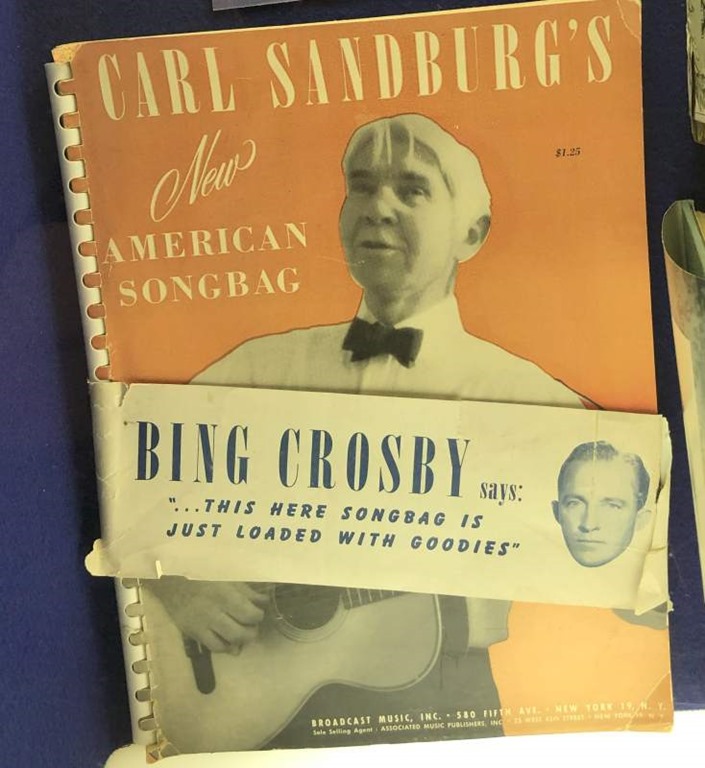
Carl Sandburg himself is an interesting combination of words and music. Besides his early and vital contributions to American Modernist poetry, he was also an important collector and popularizer of American folk song both by playing and singing those songs himself, and by the 1927 publication of his significant early anthology of them The American Songbag. I haven’t quite nailed down just how important he was in those matters, but I think it’s possible that without Carl Sandburg there’d be no Woody Guthrie as he was, and going forward from that, no Bob Dylan as he was and is.
When performing them, Sandburg accompanied those folk songs himself with guitar
.
I’m not alone in liking to set Sandburg to music, though I’m not aware that Sandburg himself ever did, oddly enough. I perform his “Branches” today with just acoustic guitar, nothing fancy, just as Sandburg himself could have. The player gadget to hear me perform it is below, or if you don’t see that, this highlighted hyperlink will play it too.




 Frank Hudson