Tis whiter than an Indian Pipe

Emily Dickinson poems are easy to set to music, but they can be more difficult for the performer. Having absorbed Protestant hymn books and folk songs in my youth, the common meter/ballad meter stanza Dickinson easily falls into makes it especially easy for me to find music for them. But then the composer me turns things over to the necessary performer me – and in that role I’m left with the question: what is she on about in this poem? What’s the attitude to the material she’s presenting: is she playful, joking, earnestly existential, or some hard to assay mixture of those approaches?

Here’s an example of how this dichotomy works out. In August I completed a setting and performance of a Dickinson poem, “Tis whiter than an Indian Pipe,”  inspired, as I was with the recent D. H. Lawrence “Bavarian Gentians”  poem, by a flower that my wife had seen and photographed on one of her nature walks. Working rapidly on that song setting I went with a casual judgement that this is a playful poem, a little portrait or riddle around the entirely pale white Indian Pipe plant. It has no green chlorophyll at all – doesn’t need it, it doesn’t use photosynthesis to get its nutrition, instead feeding parasitically off deep soil fungi. Dickinson may have been especially drawn to the plant (she had an avid horticultural interest throughout her life) because it’s, well, so weird. As the poem proceeds, my quick understanding was Dickinson commenting on its oddities. That would be consistent with other short nature portraits-in-verse that she wrote.

Ghost Pipe flowers photo by Heidi Randen 1080

If they are symbol of the afterlife, they aren’t immortal. The Indian Pipe/Ghost Pipe flowers are short-lived, and this one, near the end of its life, has lost its pipe-bowl shape.

.

Now in September, I looked again at the poem, and I can see the primary mistake I made leading me to understand this poem too soon. The poem begins “Tis whiter than an Indian Pipe.” Duh! While the things she writes in the rest of the poem could  be characteristics of an impressionistic plant description, she’s declaring right off that the poem isn’t about this unusual plant, though it will make use of the comparable flower as a symbol. Here’s a link to see the text of the poem and a scan of the handwritten manuscript including alternative words Dickenson considered.

What is the thing she’s sort of riddling us to guess is her subject? Some kind of immortal soul, some extension of being or consciousness past death. Oblivious to this at first, in this new understanding Dickinson’s poem is a good pairing with Lawrence’s “Bavarian Gentians” – each poem is examining the prospects of that “undiscovered country” past death, illuminated by a late-summer/autumn flower. This poem’s speaker (likely Dickinson herself) is unsure of such a thing: it’s colorless in the shade, makes no sound, is not something all can see. Belief in it might well be romantically exaggerated, “hyperbole.” This pale uncertainty continues, an ongoing “drama” about the possibility of an ongoing plot for our souls, instead of a tragedy’s concluding act.*

The original music and performance I created was lighthearted. In this new understanding, Dickinson is still playing, balancing thoughts about immortality, riddling with mysteries without solution. My new music would have a stronger “drone” center to depict on the necessarily faith or grounding in the unanswered question here. The core instrument in this recorded performance is my old Seagull Folk acoustic guitar, a smaller-bodied cedar-topped instrument, brown and worn as the leaf-beds the Indian Pipe might sprout from. For the drone grounds I played a tanpura, an Indian of a more correct than Columbian geography instrument. For drums, I stayed with the emerging South Asian sounds and played tablas with only the simplified technique I have for them.**

I liked how the new version came out. You can hear it with the audio player below. No player to be seen? Well, “not any voice denotes it here” – some ways of viewing the blog suppress the audio player gadget – but it be not tragedy, I supply this highlighted link that will open a new tab with its own audio player.

.

*Oddly, for all her oft-expressed gothic touches, she doesn’t use one of the symbolic plant’s other common names which include “Ghost Pipe,” and “Corpse Flower.” Perhaps the name she used was entirely predominate in her time and place? A supposition is that the plant’s long stem topped with a bowl-shaped flower is reminiscent of a ceremonial native American smoking pipe. By 1879, First Nations people were largely absent from Amherst (see also this extraordinarily brutal Robert Frost poem) – and to call this haunting plant “Indian” may have had a cultural or specific undercurrent for Dickinson.

1879 – I note this is a late Dickinson poem. Dickinson was very prolific in the early 1860s, but by this time in her life the number of poems we have of hers tails off. She’d gone through the death of her father, and her mother’s crippling stroke, and all the national casualties of the American Civil War – all occasions for considering if death was really the end. She wouldn’t have known this, but the 49-year-old poet would be dead herself in 7 years, but with the ghostly flowers we have within her poetry I can make customs of the air by singing them.

**Just to be clear – my studio space is cluttered enough – I used virtual instruments (computer databases of all the sampled notes and articulations of the actual instruments) to allow my MIDI guitar and little plastic piano keyboard to play those sounds.

Bavarian Gentians

One of the things I’ve loved about doing this Project is the varied ways that poems come into consideration for performance within it. I’m not even sure after reaching 850 of them today, that I could catalog all the ways the words have come forward. Here’s an example: last week my wife was visiting a wildflower area — something she does often enough that I kid her that she’s a nature nymph with all the powers and duties thereof. She’d taken some pictures. One she showed me was of gentian flowers.

“Do you know D. H. Lawrence has a poem about blue gentians?” I asked

“The flower or the dye?”

“Mostly the flower as I recall.”

In actuality, I couldn’t recall much about Lawrence’s poem, only that it had once impressed me around the age of 19 or 20 when I had started to read poetry more widely. Now the old man-me did a quick web search before going to sleep that night and found Lawrence’s “Bavarian Gentians,”  likely the Gentian poem I’d barely remembered. I copied it and saved it for further exploration around a Parlando Project performance.

This week I began to work on that. The first thing I noted was the poem’s odd word-music. There is enormous use of repetition: words “blue,” “black”, “dark” and “darkness” reoccur constantly, and the flow of the poem seems less that of normal prose or poetry and more like a stuck-record ostinato.*  In performance I couldn’t see how to treat this as an elegant set of refrains, so I based my eventual performance on my first impression of obsession.

But there are twin narratives inside the poem’s babbling: observation of the gentian flower itself in the Imagist manner, and a retelling of the Persephone in Hades myth. What I feel links them (other than the obsessive refraining about the dark blue color of the flower and the coincident darkness of Hades’ underworld domain) is that flowers are the reproductive organs of plants, and the Hades and Persephone, daughter of Demeter, myth is about a male/female couple in the context of Demeter’s goddess of fertility.

bottle gentians by Heidi Randen

The bottle gentians that led to today’s piece. Like the Bavarian gentians in Lawrence’s poem, dark blue and autumn-blooming. This genus’ flowers stay in this closed budded shape, which hampers pollination, while the Bavarian gentians open into the vase or torch shape described in the poem.

.

And then, as I was fairly far along in my work with the musical performance you can hear below of “Bavarian Gentians,”  I made a discovery. There are two candidates for the official, presumed final text of this poem. It just so happens, the one I found in my quick bedtime search was the lesser-known one. The version that instead will be found in most cites and collections treats the Hades/Persephone/Demeter material at a more abstract level, while the one I’d been working with is much more raw and troubling. Note: I’m not a strict adherent to content warnings, but the account in the version I was performing likely deserves one: it’s an incident of sexual violence. Here are links to the two versions of the poem: the smoother one, and the rawer one I used. Keith Sagar and some other scholars question the predominance given to the smooth version and argue that the more explicit take was Lawrence’s final revision.

I can see how the more often reprinted version of this poem was chosen. It’s more graceful I think, and one could read that kind of change as the path of an author’s revision where later, more-removed, artistic judgement polishes the rough-hewn inspirations — but it could also be the kind of revision made to make something more marketable. Now knowing of the other version, I briefly thought I should redo my performance using it — it might communicate better to a listener who might only hear it once —  and another reason I considered a redo: the sexual violence depicted in the version I had first found presented problems.

I’ll briefly outline that problem. Let me summarize the Hades/Persephone/Demeter myth. Hades, the god of death and the underworld, abducts the young Persephone to be his bride against her will and she is unable to escape from this situation. Her mother, Demeter, a more senior and powerful goddess, intercedes and a compromise is reached. Persephone will be able to rejoin the above-ground world of the living, but she must return every winter back to Hades and his underworld of the dead. The myth here is transparently an explanation of the growing season in non-tropical regions. Told at an abstract PG level, and particularly in the expectations and context of classical non-equalitarian and clearly patriarchal society, it’s a “just-so-story.” We are not to experience horror with it.

But in Lawrence’s lesser-known version, this scene is portrayed: the poet’s speaker, using the gentian flower as if it could be a lamp, follows an abducted Persephone and Demeter, this child’s mother pursuing in rescue. They enter Hades, a place of complete darkness, Persephone and everything else for that matter cannot be seen, but sound remains — and this is heard: Hades (called by his Roman name, Pluto*) is raping Persephone.

Did Laurence mean for this account to make us recoil in horror, as I did when I needed to confront the text for performance? Shouldn’t the text call for that? Or was it intended as just some ancient fantastic myth given a bit of specific detail for which the author had and expected no overwhelming empathetic reaction? There are readings of this poem’ that see a metaphoric synthesis which is only on some surface level horrible, and something else on a metaphysical level.

I don’t know enough to say for sure, if there’s a “sure” in this case. Like the sexual violence and exploitation that was woven into Eliot’s “The Waste Land”  without drawing significant emotional weight from most (and mostly male-oriented) readers for decades, it could go either way in authorial intent — but I’m not the author, I have to perform this, I feel that horror, and I expect some listeners will feel the same. Frankly, this makes me a little dissatisfied with my performance of this piece, though I tried not to shirk its implications, however imperfect the result.

What could have driven Lawrence to use this myth in such a way, and in this version, to keep in the horror? He was working on this poem knowing he was facing a mortal illness. Like poets John Keats and Adelaide Crapsey, he was dying of tuberculosis. I have no knowledge of his experience of sexual violence, but Lawrence was undergoing viscerally an abduction against his will into the underworld of the dead. He might have felt that his poem, starting and ending on the consideration of the (by natural fact) bisexual flower justifies that element of considering Demeter and Persephone, and his anima will be taken away to die along with the rest of him by the disease. Make your own judgements on these issues; they may be wiser than mine.

The final line of this version has a contrasting power to what precedes it. The erect yet open gentian flower — which despite its shape was after all useless as a torch in Hades’ dark —  spreads in dark welcome at the draught of the light of a day.

If you’ve progressed this far past the trigger warning, you can hear my performance of one version of D. H. Lawrence’s “Bavarian Gentians”  with the audio player below. No audio player to be seen? Some ways of viewing this blog suppress showing it, so I offer this highlighted link that will open a new tab with its own audio player for those situations.

.

*I figure much of my audience is old enough to grasp that metaphor, but a footnote for the rest: the vinyl record with a deleterious wound to its groove which won’t let the needle progress beyond one stuttering spiral revolution.

**Lawrence’s use in the poem of the Anglicized Greek names for Persephone and Demeter, but the Roman name for Hades, Pluto, puzzles some readers. I suppose it could just be a Cortez-on-a-peak-in-Darien kind of poetic error, but I wondered if this poem, written in 1929 might have been recently soaked in the Pluto name from the discovery of the then considered 9th planet. Close, but no cigar: Pluto was discovered in February 1930 at an observatory created by the poet-related astronomer Percival Lowell in the American Southwest region that had recently been Lawrence’s home.

My remaining theory on why Pluto? Having the underworld and its god-king both using the same name Hades makes it harder to distinguish between the two.

Lilacs (version) — Amy Lowell as Patti Smith

Attention is an investment. Today’s piece combines two poets that had my attention this Spring. Regarding one poet, this expenditure was long-standing, for the other, the attention is more short-lived, conditional. My attention requests yours, so let me get on with this as I try to be brief while providing context.

Fifty years ago I had just bought a cheap nylon-string guitar from the unsold Christmas stock at a local J. C. Penny’s store. I was learning to play it because I, a poet, wanted to write songs. I can’t say much for how substantially I’ve mastered guitar playing, but I have learned how to make songs.

I had models in early 1975 for what I was trying to do. My internal list of influences was shorter than it would be now, but it wasn’t just one or two. Certainly one was a young woman roughly my age who I’d read was performing her poetry with an electric guitar player and who had written a few literary pieces I’d seen published.*  In the Fall of 1975 she released her first record album. I bought that LP the week it was released, likely at the sprawling Lloyds store on the edge of town.

The Seventies were a heyday for recording. The record business had recently become bigger economically and Rock music was huge culturally. Oddly, at the same time of this growth there was a falling off of the visionary and exploratory stuff that had attracted me as a teenager. Key artists of the previous decade had died or been diminished. Commercial filters along with endemic chemical narcissism and dependency reduced the force of many of those still recording. That debut record I eagerly bought — Horses,  by the Patti Smith Group — was nothing like those compromises, and it retains considerable uniqueness to this day. It’s a poetry record as much as it’s a Rock music record. Large portions are chanted rather than sung. Smith’s words, however delivered, demanded a listen from the heart and the pelvis before taking the long-way around to the brain. What Smith was doing wasn’t unprecedented for a woman (or a man for that matter), but it was rare then, and still is. But I don’t want to diminish the music on the record either, the band, the Patti Smith Group, were also doing things underrepresented in 1975, despite their irregular formation. Writer Lenny Kaye had been the electric guitarist backing Smith at those NYC poetry readings earlier in the decade, and now he had another guitarist, Czech refugee Ivan Kral, to expand the sound, along with a rhapsodic keyboardist Richard “DNV” Sohl, and a drummer, Jay Dee Daugherty, who had joined the group just before going into the studio. They were fellow explorers to Smith, willing to go places they didn’t have charts or established trading routes for.

Horses  gathered some attention. It was the spearhead of a musical revitalization movement that soon got a reductionist name: “Punk Rock.” Released on a major record label in this era meant that it had to be reviewed. While Horses  is now recognized as a landmark, a signpost to new paths, the reviews then were mixed, though usually respecting its ambition. It was not a commercial blockbuster, sales were modest, but that was OK then as first albums were allowed mere “worthy of attention” response. My own reaction wasn’t as a critic or chart watcher — I needed inspiration, and I overwhelmingly welcomed it.

To get to today’s Parlando piece we need to move on to the PSG’s meeting up with the problematic-second-album syndrome. That album, Radio Ethiopia,  sold even less than the first, and the Rock critics were even more mixed in opinions. It was a shot-by-both-sides response. These contradictory judgments were issued: it was even less commercial than Horses,  it was trying to be a mainstream Rock record and so wasn’t Punk; it indulged too much in Smith’s self-mythologizing (evidence: she, a woman without credentials, played naïve guitar on the LP’s longest jam), it was too much a band-record featuring the Group instead of Smith.

I liked Radio Ethiopia. More inspiration as far as I was (and still am) concerned. A song from that doomed follow up has remained in Smith’s repertoire for the rest of her career: the breakup song “Pissing in a River.”   In this linked 20 minute 21st century account of Radio Ethiopia  and that song, Smith herself movingly describes her state of mind while making that expression. She was so full of doubts that the wholly committed vocals that mesh with Ivan Kral’s compelling four-chord cycle in “Pissing in a River”  are credited by Smith to her brother, who came to the studio just to stand next to her, silently, at the mic. Last time here I spoke of how our relationships with others broaden what we see and report as artists. I teared up listening to Smith’s account this week, another testimony.

Lilacs

The version I used for performance is roughly half the length of the original poem.

.

This Spring, as I made tentative plans for National Poetry Month pieces here, I made a note next to a poem “Lilacs”  by pioneering early 20th century Modernist poet Amy Lowell: “Long. Maybe do it Patti Smith style?”

I have not played much attention to Lowell, though one musical performance of a poem of hers is a personal favorite of mine. In the landmark era when English-language Modernist poetry emerged, she was a controversial figure — those mixed reviews again. It’s undeniable that she helped popularize the new free-verse style as a poet, anthologist, critic, and promoter — but otherwise these were arrayed against her: she was a woman, not gender-conforming, overweight, and suspected of being a wealthy bougie poetic interloper on the bohemian Modernists. I’ll add my own personal count against Lowell: a lot of her poetry doesn’t consistently reward my interest. My current theory is that she’s something like Wordsworth, a poet whose best work may be diminished by a mass of undistinguished work, and great lines sit next to meh ones. But also like Wordsworth, her value in theorizing and promoting a new prosody must be acknowledged.**

“Lilacs,”  the poem that gathered some of my attention, is an example of the good and bad as I see things with Lowell. There’s immediacy in the poem that attracts me for performance (Lowell was an enthusiastic public reader). “Lilac’s”  theme, remembering her New England ancestry,*** would befit her cousinoid Robert Lowell later in the 20th century, and I loved lines that sounded like Allen Ginsberg (“Clerks….reading ‘Song of Solomon’ at night, so many verses before bed-time, because it was in the Bible”) and Frank O’Hara (“Parks where everyone walks and nobody is home.”) ****

So, I did one of my “use what fits me best” editing jobs on Lowell’s original text, excerpting what I thought of as the most vital images in the poem, reshaping some of the lines, and following through on my first-thought of performing it in the manner of the Patti Smith Group.

That incantatory “Pissing in a River”  chord cycle was a good match. I needed to rotate myself into each player’s role to create the ensemble, getting the rhythmic core down with a drum program, adding a bass line, and then performing each channel of the song’s double-tracked rhythm guitar bedrock. I used a sophisticated arpeggiator to create a right-hand piano part, but on evaluation I was so proud that I could get the just-little-different precision of the doubled guitar parts that I removed the piano.*****

Now it was time for the vocal recording pass. I made an unusual choice to try to improve what I fear is the least successful part of my recordings: as my expedient to Patti Smith’s brother undergirding her resolve, and only as preparation for the take using Amy Lowell’s words, I recorded an entire “scratch take” performance of “Pissing in a River,”

My four-chord riff cycle isn’t played exactly as the PSG recorded it, but the last part of my recording was an even larger departure from my inspiration. As a musician I’m a full-idiot/half-way savant. The part I’m most comfortable in is lead guitar playing, so my version isn’t a copy of theirs, I looked to another mode, their adventuresome NYC scene-mate guitarists: Tom Verlaine, Richard Lloyd, Ivan Julian, and Robert Quine. The performance in my recording of “Lilacs (version)”  includes what some (many?) would consider overplaying. As I (too?) often do, I continue to play during the vocal passages. I know this is incorrect — but more than correctness, I worry that it might detract from the song. Asking myself why I do this, my answer is that because my voice can’t provide the melodic elaboration I’d offer if I was a more skilled singer; and as a poet, I think the words can be (are?) powerful enough to compete with wailing electric guitar.

I leave that last thought with this restatement: as a writer, it’s OK to whisper — understatement has its power — but even if you read unaccompanied, or write for the silent but companiable page, consider if your chosen words are committed so they could go toe-to-toe with a cranked guitar. Sometimes you might want that.

You can hear my performance melding impressions of the 1970s Patti Smith Group with parts of the 1920s Amy Lowell poem “Lilacs”  using the audio player below. No player? It hasn’t been dropped by the record company man — it’s un-displayed by some ways of reading this blog.  This highlighted link is an alternative way to rock it, as it will open a new tab with its own audio player.

.

*The page poem I still specifically recall was “Dylan’s Dog”  (aka “Dog Dream”).

**As I mentioned recently, the issue of being too prolix and prolific with putting out work is something I worry about with the Project and myself.

***Like fellow New Englanders Cummings and Millay (and the British Housman) already performed this National Poetry Month here, Amy Lowell is presenting Spring as a memory of the quill-written past wafting through graveyards unkempt by their Modern age.

****As with a lot of early 20th century female Modernists, Amy Lowell dropped off the canonical map in mid-century as High Modernism and the New Critics came to the fore. Lowell’s popularizing efforts gained little credit as poetry sought a refuge in elite understandings and “serious subject” male-centric viewpoints. Our current century is re-evaluating that.

*****As a naïve keyboard player, arpeggiators are a crutch I often lean on. Give them a chord and their rule-based fingers will present a more sophisticated output. I border on shame when using them, though similar tactics are all over modern music. I’ve tried to bargain with my guilt by referring to my favorite arpeggiator as “DNV” — the nickname Lenny Kaye gave to Richard Sohl who was a vital elaborator of the earliest PSG records. “DNV” stood for “Death in Venice” because Kaye thought Sohl looked like an actor from the movie version of Thomas Mann’s story.

Enjoying Flowers Walking Alone

I mentioned earlier this spring, that master classical Chinese poet Du Fu wrote in a troubled era that also troubled his life. Both he and his contemporary poet Li Po were exiled or forced to flee at times, and while I know no details of this poem, I get an exile sense from it somehow.

Have I mistaken this poem? It’s possible. To say I’m no expert on Chinese history, culture, and literature, is to greatly understate the concern one should have. On one level it seems to be a nature poem, set in spring with tree blossoms and flowers. The poem’s speaker walks out among them one morning and notes how extravagant their splendor is.

American nature poetry, such as Emily Dickinson’s, is often suffused with Transcendentalism and a sense that the book of nature presents truths to a close observer. It’s in that sense that I read this poem. The speaker (I’ll just call him Du Fu for the rest of this) is letting the wind (nature, fate) carry him on a path. He notes that the peach trees are blossoming, though no one owns them. No boss, no lord, no slave master, has sent the requirements for this work. Du Fu observing them wonders if he should prefer one shade of blossoms to another, and decides choice is beside the point.

Nor is there any need for an accounting and report of the number of petals that cover his path. They are not losses to be put on a balance sheet, for the trees simply have “more blossoms than they can hold.”

The concluding two lines have my greatest leap of faith or invention from the literal English gloss that I worked with. If, as I sense, this may be the poem of someone fleeing trouble or in exile, this beautiful morning presents a bittersweet scene. Should he simply stay and revel like the butterflies? I sense the final line’s “free and unrestrained” oriole bird is a contrast to that. That bird has choice. It, like Du Fu, can leave. That freedom, to flee beauty, is not a simple thing.

Here’s the text for today’s performance that I adapted from Du Fu’s Chinese poem using a literal gloss in English. All I had were two portions (#5 and #6) of what is apparently a longer poem or series:

Enjoying Flowers Walking Alone

.

Here’s what that gloss had:

Huang abbot pagoda before river water east
Spring bright lazy sleepy rely on light wind
Peach blossom one clump open without owner
Lovely deep red love light red

Huangsi girl house flowers fill path
Thousand blossom ten thousand blossom press branch low
Reluctant to leave play butterfly constantly dance
Free and unrestrained lovely oriole cry

The music today features an acoustic guitar that doesn’t harmonically move much with a root note of D. While an actual D minor chord is sounded at times, much of the music stays on suspended chords without a major or minor defining 3rd. At one point I’m fretting an F and F# at the same time which somehow works to my ear in this song’s mood. You can hear the performance with a player that appears below for many of you. Don’t see a player?  This highlighted link is an alternative way to hear it.


Dickinson’s “Bloom”

If I didn’t read the news, it would still be spring.

I’ve mentioned it’s been hard to produce new pieces here recently. While there’s a variety of reasons for this, here’s one: I’d planned a little series on May flowers. I was inspired by my wife’s love for our native northland wildflowers and some gorgeous photographs of cactus blossoms by Kenne Turner that I recently viewed on his blog. I had this witty little poem by Emily Dickinson with a not so obscure moral underneath about being an artist — Emerson with a dose of playfulness. I’d completed composing the tune for it. And I planned to pair that Dickinson with a couple of poems by the master of Chinese classical poetry Du Fu.

But I was only halfway there in how captured I was by transient beauty. Earlier this spring on my morning bike ride I started to mull over this line that hasn’t found its poem yet: “This spring is filled with bird-songs and the death of young black men.” So, the horrible and the hortatory were already mixing in my thoughts, while I have nothing but good will and empathy to claim there.

Everyday I try to will myself to make useful or pleasurable work toward this project, and this, among other things, makes me pause. Am I missing the point? Do I even know what the point is, or the series of points that lead to it? I feel bad for the limits of what I can offer, and then I feel bad for not offering that little. Still, I’m stubborn with this. I keep butting against it, trying to push it over or trick my way around it.

And Tuesday I did. Starting early, I recorded an acceptable performance of the Dickinson poem with my music, worked on music for the Du Fu flower poems, and practiced my understanding of how to perform a poem of Kevin FitzPatrick’s that I will present at a memorial event this weekend. A good day it seemed, even if I missed the day’s near-perfect spring weather outside — never mind, the internal weather of being able to create, to illuminate for myself and perhaps for others the work of Dickinson, Du Fu, and Kevin was pleasant and enough.

Never mind, as I got ready to go to bed after this fruitful day, and I caught the news of another rain of bullets. Grade-school kids!

Should I have something appropriate to say, something useful about that? The horrible and the hortatory. Something that isn’t so entirely obvious to some and beside the point to others? Long time readers here will know one motto I have here: “All artists fail.” I’m certainly failing here for some today.

So, you’re going to hear me perform this little poem about flowers, about the work that goes into making mere transient beauty. Here’s a link to the text I used today if you’d like to read along. Dickinson judges right off that she’s sure this isn’t some “minor circumstance.” And Dickinson would know. She knew her flowers, wild and cultivated, intimately.* She was a serious gardener of food and flowers, and despite her growing reputation for being some secular nun always in cloister, she purposely chose that outdoor work with plants over other household chores. She knew their use for food, she knew their use for transient beauty. Flour and flowers.

Her little poem goes on, and the little bud fights several ways for survival. I love the litigious line she uses in passing that she may have borrowed from her male family’s life as lawyers “Obtain its right of dew.”

Prowling Bee by Heidi Randen

A prowling bee “Assisting in the Bright Affair so intricately done…”

.

My dear wife left me on the rise to her job with a hug this morning, wishing me success in being creative today. Was she being a “prowling bee?” If so, as another bard had it, “Sail on my little honey bee, sail on.”

To fail in art, as with Dickinson’s final judgement on our flower that blooms past bud, is a “Profound Responsibility.” If you’re working on art this spring, I’m not asking you to fail, or to be happy with failure — at least I never am. This spring is full of bird song and dead people, the lightness of flower petals laid on us are a suffocating “heavy brocade” as Du Fu had it in a poem of his, one I was able to complete a performance of. All I know and can tell you is how that feels.

To hear my musical performance of Dickinson’s  “Bloom” (Bloom — is Result — to meet a Flower)  you can use the audio player you may see just below, or if you don’t see the player, through this alternative highlighted link.

.

*As I mulled over this poem’s presentation, I was reminded of how seriously Dickinson took her connection with gardens and flowers by Twila Newey musing on Twitter that Dickinson’s mature aversion to publishing could have been the result of her individual conviction that transient and intimate beauty, as in her garden, was sufficient, or even superior to a wider advertisement fixed in type.

Rain on a Spring Night (after Du Fu)

Early this week, Poet Jose Hernandez Diaz on Twitter put out a call for people to respond with their go-to poets in our troubled times. I’m always uneasy when being put on the spot for short-lists, because I’m by nature a person of various moods and needs. The poet I need today is not always the one I need tomorrow. And then, it’s the same or even more so with music for me. Perhaps some of that comes through here in this project’s variety?

Two names surprised me* as I tapped in the poet names that came to my mind that day this month: Edward Thomas and Du Fu. We’ve dealt with Thomas here more recently, so today I’ll speak of Du Fu.**

Two things seem to connect me to this master of classical Chinese poetry: Du Fu wrote his best work as an old man (such as I am) — and that productive period coincided with a great governmental rebellion and crisis in China. When Du Fu writes a lovely nature passage, I always read it as the work of someone who is also seeing great destruction and violence in the human part of nature.

Du Fu, not an Asian-American, but his poetry sometimes speaks to my country none-the-less.

.

In this troubled week I went looking for a poem I could get close to and perform, and I found this one of Du Fu’s. For practical reasons, I need to make my own translations of Du Fu from English language glosses (such as the ones found at Chinese-poems.com) and the difficulties of making a graceful poem in English out of an 8th century Chinese poem would seem daunting, but they attract me all the more. Obviously, there are great risks that I will misunderstand what Du Fu is trying to say — but not only do I accept those risks, I’ve been tempted more than once to transform key images from Du Fu’s time and place to contemporary America. For these reasons most of my Du Fu pieces should be understood as adaptations, the kind of thing that I’ve decided are best labeled as “After a poem by….”***

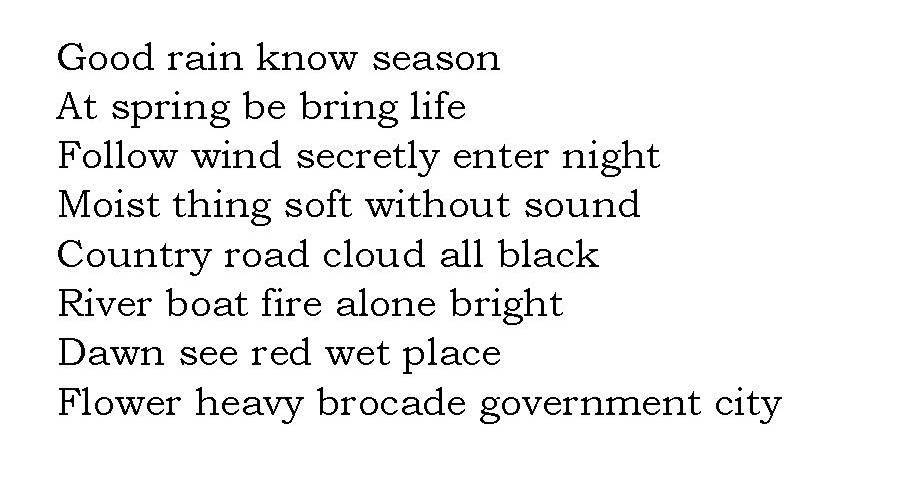
Here’s the English gloss of the Chinese I worked from, and for comparison here’s a link to another person’s English language translation.

gloss rain

This is the gloss I worked from for today’s piece.

.

And here’s my “Rain on a Spring Night (after Du Fu)”  version used for today’s performance:

Rain on a Spring Night by Frank Hudson

I usually would work longer on one of these, but it’s been too long since I presented new work here.

I think of my opening section as a good faith attempt at an accurate translation into a working English poem. I used English syntax and conventions, added the poetic device of parallelism to substitute for the word-music losses inherent to translation, and tried, as I always do, to present vivid images.

The last section of Du Fu’s poem is where I likely diverge. I do sense a turn in the poem at this point, I think it’s possible Du Fu’s trying to contrast the peaceful rain following nature’s order in his opening. The (cooking? signal? lantern?) fire on the boat is the only human sign in the poem. Is that only coincidental decoration? The gloss’ final line is most difficult. A single image there comes through to me: that flowers, perhaps even fallen blossoms, are like the patterns on a brocade fabric. “Government city” puzzles. Like brocade on rich courtiers? Or is this spring morning near a capitol city?

So, my choice was to allude, somewhat obliquely as Du Fu seems to have done, and the final scene is designed to depict not peaceful spring and beneficent rain, but the aftermath of violence as we all to well know it now and here: the yellow crime scene tape, the flower memorials left. A rain of bullets is not a good rain.

My music and performance is very sparse for this, but I decided that’s starkness was effective. You can hear the performance with a player some will see below, or with this highlighted link.

.

*I wouldn’t even have known their names, much less their poetry or something of their lives before starting this Project six years ago.

**I have to note his name was often spelled in the western alphabet as Tu Fu. Du Fu is supposed to be the better approximation, even though there are as many or more references to him as Tu Fu online or in books.

***I was aware of that sort of classification, but it was poet Robert Okaji (who has also produced graceful work in English from classical Chinese poems) who cinched down that tactic for me. Another thing that informed my practice here is my love for “the folk process” transformations that folk music lyrics go through. In that latter example, a tale of an unfortunate British Isles rake easily becomes the tale of a dying cowboy on the streets of Laredo Texas, or a run-of-the-mill elusive bad-boy-robber ballad gets pared down by a colonial subject whose nation has been dehumanized into the tale of a shape-shifting were-fox.

Hortensia

This has not been a month conducive to producing new content for this project, and I’m not sure about July and August either. At some point I’ll probably talk about some of the reasons for that, but I thought it’d be good to leave you with one more June piece, and it’s a fine summer song by a voice this project hasn’t heard from enough lately: Dave Moore.

Dave and I first performed as The LYL Band about 40 years ago, and we’ve kept at it over the years. Our typical encounters this century have been a sort of two-person song circle with each of us alternating in presenting a song, a piece most often completely new and unknown to the other. These first takes* get recorded, and one of them is today’s audio piece.

First takes with unknown material is not the way most bands work, and certainly not how they record. Bob Dylan worked with unknown, fresh material and new-to-it musicians in his classic years (and may still now, there’s just less documentation), often providing at best chord charts for assembled musicians or brief run-throughs. But Dylan would do multiple takes even trying different studios or musicians over time, trying get the right take.

It’s not uncommon for jazz musicians to do the same thing we do in their recording studio dates, though some feel that even with Jazz’s reverence for spontaneity that this is a practice brought forward for logistical and lowered recording-budget overhead reasons, not as a considered artistic choice. Miles Davis seemed to find this practice a considered choice though, and when one listens to a record such as Kind of Blue  we are likely to give some credit to that choice, which Bill Evans likened to spontaneous Japanese painting in the original LP liner notes. Later on, Davis took to the pentimento-practice of having everyone improvising on themes and then letting later audio editing assemble from the mass of recorded playing a post-recording compositional structure. A record like Davis’ A Tribute to Jack Johnson  assembled that way has a different vibe and timbre from Kind of Blue,  but it works for me in its different way.

Are Dave and I musicians like Davis and his band members? No. Nor are we musicians likely to be called to a Bob Dylan session (note to Bob: call us anyway). Most of what we record on any one day isn’t worth more than a self-critical listen on our own parts. And of the rest? There are usually rough spots that even a bit of focused audio editing can’t excise. And then, sometimes something like “Hortensia”  arrives.

If you accept (as I say often here) that all artists fail, then it can sometimes behoove one to make peace with failure. Do that, and then allow, then make possible, for the limited successes to arrive.

I often tend to overstate my guitar parts. I didn’t here. Dave’s keyboard skills at the time of the recording get some space, and while he’s not going to kick Bill Evans or Herbie Hancock to the curb, what he plays works. Dave’s vocals are usually more consistent than mine by a long shot, and his performance serves the song. I think Dave may have even improvised some of these lyrics during the performance — and this is the only performance of this song ever.  And that serves the song too.

You see, I hear this as a summer song, a song of long days, rich days, that are still days,  and must end in earth’s and fortune’s rota. “Now, sweet now” Dave sings. Yes.

Hortensia

I think I asked Dave what the song was about shortly after we recorded it. “The summer flower or the Roman woman?” I think he replied that it was more at something intuitive.

.

You can hear it with the player gadget below. Don’t see a player? This highlighted hyperlink will also play it. “Hortensia” is longer than most of our pieces here, but sit back with a cool drink and listen. Thank you hearty listeners and readers for sticking with this project!

.

*First, and in most cases, the only take. Since we haven’t focused on live performance much in our old age, we aren’t working up material for performance or developing a repertoire for that. Dave has been as prolific with words and with songs with his own music as I have been with musical pieces over the past few years. This means that there was always new material to be tried out, to be brought into existence, even if briefly and for one take.

Spring 2021 Parlando Project Top Ten, numbers 4-2

There’s another repeat author in this segment of our spring 2021 countdown of the most listened to and liked pieces here over the past three months. More than that, the number 4 and 3 positions are held by two installments drawn from the same poem, parts of my long serial performance of “The Waste Land”  that wound up this year. It makes sense then to deal with them together.

4 What the Thunder Said Part 1 and What the Thunder Said Part 2 by T. S. Eliot  As much as I enjoyed the challenge of taking on the range of Eliot’s poem and making explicit its implicit musicality, “The Waste Land” is not what many of us go to for poetry comfort food. The last section of the great poem was by all accounts written while Eliot was hospitalized with what is now considered depression. Most of his poem is a horror story, still and all twice-baked crafted, written by a man whose meticulousness had him working in a bank — and then revised by Ezra Pound, as merciless an editor as ever existed. That part of the poem can seem a cold-case puzzle to be solved, the likely source material for a volume by Dan Brown. It’s not.

It’s a series of songs made up of the overheard and the remembered bits caught inside Eliot’s educated mind, half in Parnassus and half in a Hogarthian vision of early 20th century London — and then we get to the last part of the poem, “What the Thunder Said,”  which is more Eliot’s own song, a long somewhat improvised song that was written, he later confessed to Virginia Woolf, in something of a trance, without even bothering to understand what he was writing. Up until then the poem, however despairing or dark, has been crowded: voices, characters, changes of scene. This last part is Eliot alone with himself. The waste land, the desert title-place that we only meet in this last section, isn’t the condition of post-WWI England or Europe, the waste land is Eliot alone with himself in only lightly-disguised self-pity, which eventually leads to a final expiation in its concluding portion.*  The accelerating four sections of “What the Thunder Said”  that I presented this past April are the journey of that mind.

You can hear the performances of Part 1 of “What the Thunder Said” here with this highlighted hyperlink, or if you see it, with the player gadget below.

.

And part 2, with this player, or alternate hyperlink.


So, what’s the next poem in our countdown after all that sturm und drang?

.

How Many Flowers

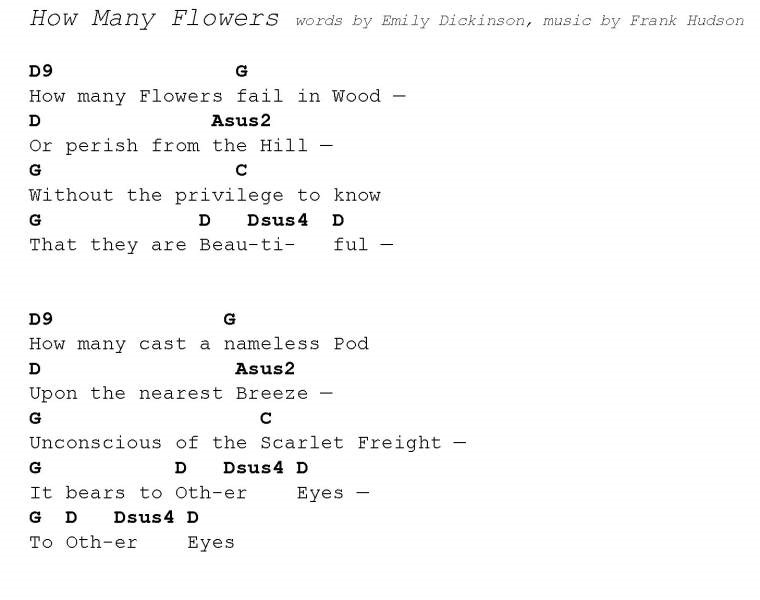
Seriously, singing poetry can be an even deeper inhalation of a poem. Here’ are my chords if you’d like to sing this poem of Dickinson’s.

.

2 How Many Flowers by Emily Dickinson  Just Emily: gardener, avid botanist, Transcendentalist meditator, a legal mind filing a concise argument in the case of the universe, folding her words up. It takes me a minute and a half to sing it.

I had some fun in my original post on this imagining how close she came in her poetic diction to writing an early 20th century Imagist poem, but we may have little trouble translating on the fly from her 19th century-isms to the vivid moment she observes: the observed or unobserved flower, the present and presence — and the future, their scarlet freight. Like much great poetry, maybe like all great poetry it doesn’t need me to prattle on about it, it just needs you to sing it, to carry that scarlet freight.

The player gadget that many of you will see is below for “How Many Flowers”  by Emily Dickinson. Can’t see the player in your reader or browser view? Here’s the alternate highlighted hyperlink.

*Unlike the other 3 parts, the 4th part of “What the Thunder Said”  didn’t get the listens and likes to make this top 10, possibly because of its length or general disinterest or dismay from the audience in its rough, less-exactly recorded nature. Still the electric guitar playing that builds from about 3 minutes in and finally becomes the brief solo that starts at 4:45 is as pure a piece of musical-emotional expression as I’ve ever played.

In German November, or What? Nietzsche was a poet?

As a person educated in the mid-20th century this is what I knew about Fredrich Nietzsche: he was a philosopher who was all the rage in the late 19th and first half of the 20th century and he had this thing about achieving a more perfected human condition. Oh, I knew one more thing about him, something that discouraged all other curiosity: the Nazis liked him, saw him as an intellectual forerunner of their decidedly non-intellectual movement.

I know only a little more than that now. In the past few years it’s become accepted knowledge that the Nazi connection was to a large degree accidental. Nietzsche’s sister was his literary executor,* and she was a Nazi fan-girl who did a great deal to forge that linkage; and since the Nazis were nationalists, the available idea that there was a notable German cultural figure whose contradictory writings could dab some intellectual cologne onto their bully-boy stink was useful.

I vaguely knew that one of my childhood heroes George Bernard Shaw had admired him, but I had no idea how many leftist and anarchist figures rated Nietzsche. Remember Gustav Landauer, the German Anarchist theorist and grandfather of the famous director and improv comic pioneer Mike Nichols, brutally killed in the post WWI revolutionary activity in Germany? He was said to be influenced by Nietzsche too.

But this fall, while reading a blog I follow,** I learned another thing: that Nietzsche was also a poet. Which shouldn’t be news to me I guess, but it had never occurred to me, even though as a philosopher Nietzsche seemed to be something of a human quote machine who could turn out memorable phrases. And today’s text, “In German November,”  was the example that introduced me to that fact.

November Sadness by  Heidi Randen

Ah sunflower! Weary of cold and $%*@! snow.

.

I know only a little about German literary Romanticism, but what I know makes Nietzsche’s poem part of that tradition: worship of nature, doomed love—Damn! There’s even a prominent talking flower for Odin’s-sake! This can seem very twee in summary, but Nietzsche redeems it with his gift for language and characterization. Unlike other translations I’ve done here, this one’s poetic images and plot moved rather easily into English.

This is autumn: it — it just breaks your heart.”

After the poem establishes its “This is Autumn…” refrain by opening with it, the first full stanza has a graceful post-equinox image of a now lower sun against a mountain that would please Wang Wei. The poem’s second scene, set in a orchard with post-frost fruit starting to rot mixes sex and death tropes effectively. And then there’s that talking flower.

It takes some nerve to carry that scene off both as a writer and as a performer. I felt I had to push myself as a singer to portray the sunflower, and part of the reason I’ve started to put chord sheets up for some of my compositions here is to encourage better singers to improve on my attempts.

German November My Translation for song

Simple chords, but this one has opportunities for a singer.

.

Because Nietzsche’s German moves fairly easily to English my translation doesn’t differ that much from the one in this link, which also provides you with the original German. One choice/change I made: I wanted to emphasize the existential angst of the sunflower and to strengthen an image—and so the original German: “in ihrem Auge glänzet dann/Erinnerung auf” gains a repeated word “memorial” reflected in the dying flower/eye. I also thought the implied pause in Nietzsche’s refrain: “This is autumn: it—just breaks your heart.” could be emphasized further by repeating the “it” for a stutter effect.

As I mentioned above, I went for it in this performance, and given my limits as a singer it may not be to everyone’s taste, but it was the best I could do given the more limited recording opportunities I have these days. The player gadget to hear it is below. Thanks for reading and listening in whatever November wherever you are.

.

*Nietzsche died in 1900, late enough to give his ideas access to the early 20th century’s cultural ferment, but with the benefit that the proponent of those ideas wasn’t around to contradict the uses interpreters put them to.

**Byron’s Muse. I like to think I’ve outgrown youthful goth romanticism, which fits badly with my aged frame and less virginal connections to death, but Byron’s Muse sometimes reminds me that artistically there is still some attraction there.

Some Rainbow coming from the Fair

There I was, thinking it’s been over a month since I’ve presented an Emily Dickinson poem here. I didn’t start this project thinking that Dickinson would be so prevalent as a source for texts, but that’s what happened, and during the past four years my appreciation and wonder at Dickinson has increased greatly.

One thing I came to sense in her poetry that I had not noticed before was an air of the mystical combined with an almost psychedelic playfulness. This can be dark or light depending on the poem, but since many of the things I’ve been working on lately have been in a darker, more gothic vein, I thought I’d look more to the lighthearted side. I started a search for Dickinson and spring, and while I’m not sure exactly what keywords I used, this poem turned up very near the top, and it immediately captured me. I had thought I’d be searching for a while but found my next piece in less than 10 minutes.

“Some Rainbow coming from the Fair”  is not one of the most famous of Dickinson’s poems, nor has it been commonly set to music (unlike many other Dickinson texts). Here’s the full text and a picture of the manuscript in Emily’s own handwriting if you’d like to follow along.

It opens with two remarkable and attractive lines that don’t present a distinct image. I’m not sure which meaning of the word “Fair” we’re to understand in the first line. Fair as in a celebratory meeting or market (like a county or town fair) or fair as in beautiful, but rainbows and fair in the first line and we could almost be in My Little Pony land if Dickinson doesn’t launch us further out quickly into a “A vision of the world Cashmere.” I first thought of the luxurious wool,*  but she also could be using this word as an alternate name for the Asian region called Kashmir. Peacocks complete the luxurious imagery of the first stanza. In later context we’ll see that this is an image of wildflowers, but at this point we’re still in mystery and allure.

Next stanza is lovely in sound and more specific in what it pictures. Butterflies are butterflies, ponds have insect sounds again, and in an image that might make one laugh out loud, bees are “barons” out of their castles and on the ambling march.

Third stanza, robins have replaced the enrapturing snow that Dickinson so ably described in a poem many liked here last winter. She next gives us an orchis flower prettying up for an old lover, the exotic Spanish nobleman “Don the Sun” who is revisiting her in her swamp.**  The sensual and the silly playfulness keep mixing it up.

In context we now suspect that the poem is describing wildflowers in its more impressionistic and feathered images. And the final stanza marshals the spring blooms into an army. And then, like it started, the poem departs with two lines that end in mystery. What’s up with the flower children of “turbaned seas” and the “Circassian Land?”

Well first, flowers again.*** The spring flowering tulip’s name is derived from the same word as the Turkish word turban because the bud’s shape is of a like shape to the head covering. The Circassians and their native region in the Caucasus mountains were in the news at the time this poem was written. Imperial Russia had invaded the area, and the Circassians were fighting back.**** Some of the coverage dealt with atrocities including the enslavement of Circassian captives and captured Circassian women being held in Turkish harems. As we’ve discussed before, this last trope was an exotic/erotic fixation for some westerners. Circassians were geographically “Caucasians”—and in the archaic understanding of ethnicity of this time, Caucasians were held to be the prototypical white race. Therefore, beyond the usual fascination with underdog fighters against Imperial forces and humanitarian concerns with displaced refugees, there was this additional element of “White Slavery” and a frisson of the forbidden.

So this is a very particular and odd way to end the poem—but even if you know nothing of the current events of the mid 19th century, it does still convey that exotic flavor. A reader reading this without context may still find it an enjoyable spring celebration poem. It certainly captured my interest at first reading. But wait, there’s one more bit of context!

It may well have been intended to capture it’s reader, as it did me, in that it’s one of the poems Dickinson sent in a letter to her friend, sister in law, neighbor, and possible lover Susan Gilbert Dickinson in 1859. If you look at the end of that handwritten manuscript, it ends with this note:

Emily's Dear Sue Note

Dear Sue, I haven’t “paid you an attention” for some time. Girl.


As with all things Emily and Sue, there’s a gathering amount of modern speculation and scholarship to these matters. Just a little friend to friend note or a bread-and-butter obligation repaid to a sister in law? Or is this poem meant to be an encoded mash note to a romantic crush?

If it’s consciously or unconsciously erotic, one may be able to see that reading without strain. Cashmere as fabric for a vest or blouse. The pervasive flowers now as the beautiful reproductive organs of plants. And butterflies. The bees, are they singing Slim Harpo’s “I’m a King Bee”  from a hundred years after Dickinson’s poem? That Orchis waiting for a lover? Oh, for certain. Sensuous feathers. The whole captive in a harem as role-playing. It’s not just the spring wetlands that are getting steamy in here!

In the end, the poem may stand either for spring’s desire and delight or the poet’s. And as I said last time, it captures you with it sound of thought either way. The player gadget for my performance is below.


* Dickinson might have had it in mind, as this textile from Asiatic goats had been introduced to western countries, and Massachusetts in her time had mills that wove it into fabric.

** The informal British English meaning for “bog” was not likely on Emily’s mind. However, one of Dickinson’s poetic heroes Elizabeth Barrett Browning had helped propagate the Latin lover trope with her publication of her love poems Sonnets from the Portuguese in 1850.

***Emily Dickinson was an avid gardener, and as a young woman compiled an elaborate herbarium classifying a great many flowers in her region. Whenever Dickinson mentions a flower you can be sure she knows more about it than the average person.

****These overseas battles were covered in the Springfield Republican,  a Massachusetts newspaper that was read in the Dickinson household and which was one of the few places that published an Emily Dickinson poem while she was alive. Alas for the Circassians, the final outcome of this invasion was diaspora and what in a quaint 20th century euphemism was called “ethnic cleansing.” And to think that I sought out this poem because I wanted contrast to other, darker stuff I was working on.