Timothée Chalamet, A Complete Unknown, and a mid-winter song: Three Angels

I’m trying to decide between work on finishing a new Parlando piece combining literary poetry and original music, and seeing what I can do for a February Black History Month observance here. The first is mostly done, the latter is but ideas at this late date.

What to do? In my typical direct approach, I did something else today. This weekend I watched Timothée Chalamet appear on Saturday Night Live as the musical act on the long-lived sketch comedy television show. Chalamet is fresh off an acclaimed performance as the young Bob Dylan in the film A Complete Unknown.

I mostly liked that movie. Biopics are always dodgy things to do, as most people’s biographies when told straightforwardly do not have enough dramatic concision to make a compelling two-hour film. Which means they all have fibs in them, and they will perforce leave things and people out. It’s become an apparently unavoidable cliché to remark on this element by quoting a line from another film, The Man Who Shot Liberty Valance: ” When the legend becomes fact, print the legend.”*  This misses the point of John Ford’s great film. When that line is uttered near the very end of that movie, Ford has shown us a compelling tale of a man, played by Jimmy Stewart, who had many great things about him, a man who at the end of the film had risen to become an honored Senator, a plausible Vice President even — but Ford also told us of another man, played by John Wayne, who may have been less interesting as a biography, but whose acts are critical to the movie, and who gave up more than legendary fame when making his choices. Ford isn’t praising that “print the legend” eventuality. Ford’s film prints “the fact.” He thinks that’s more interesting.

A Complete Unknown  tries within conventional running time to tell a complex story: of a young man who’s forming himself — not so much finding himself — as he wants to be unfindable. Instead of doing a “great man” tale, it wants us to see the other folks around him, lovers attracted to and understandably frustrated by Dylan; and a pair of men: one a businessman, the other a saint of citizenship (Albert Grossman and Pete Seeger). In between these, Johnny Cash plays an imp of the perverse. That complex tale is told at a brisk pace. I was able to forgive that. Yes, there are characters undervalued, incidents re-arranged in the timeline — but in the movie’s defense I’d say it couldn’t be otherwise, there were just so many  talented and interesting people in that time and place.

And then we got to the final incident, the film’s climax. Here time is suddenly allowed to expand and we are given more detail about something that lasted maybe 48 hours in real time. Some of that detail is accurate, much of it is not. Most of the inaccuracies are aimed not to expand the complexities of the relationships and times, but to simplify them and underline a simplistic point. Finally, the movie has introduced all these characters, and this is the place where the earlier parts of the film are exposition, and you can get them to fully spark and rub with their differing viewpoints. Instead, that doesn’t happen, you get instead a rock’n’roll pantomime, with caricatures shouting and everything but a pie-in-the face fight.**

This is not the fault of the performers though. The cast does a fine job, and before his actual work could be seen, Chalamet’s ability to pull off his performance as Dylan was generally doubted in online forums of musicians and music fans. He did fine, and as the movie publicity has informed us, he “did his own stunts” by learning to play guitar and harmonica and to sing live, and this led to this past weekend’s choice for him to appear as a musical act.***

Again, Chalamet exceeded expectations. His opening Dylan song, “Outlaw Blues,”  (done as a rap-chant with Jack White/Black Keys-like elements in the ensemble) was fresh and effective, including that Minnesota call-out to being “9 below zero at 3 o’clock in the afternoon.”  Even more surprising was Chalamet immediately going down-tempo with a real rarity that would have stumped all but the deepest of the deep-cut Dylan fans: “Three Angels.”   It’s a brief song from a now little regarded Dylan album New Morning.  It seemed a throw-away even in that less-celebrated collection, an off-hand narration of an urban winter scene post-Christmas. From my Parlando focus, it attracts me though. It’s got some elements of one of poet Frank O’Hara’s “walking around poems,” that paying attention to what we are not usually paying attention to mixed with a casual surrealism. Everyone in the song seems a non-sequitur somehow, and why does the truck have no wheels, why is the cop skipping? Three fellas are “crawling back to work” under the same number of angels playing silent fanfares in snow, and we may not know if those three are wise men or not, as nobody stops to ask why they are going to work. Here a link to his set of performances.

So, I admire Chalamet’s taste in Dylan songs there. Perhaps if he lives to my age he’ll also be good enough looking to play me in my biopic. But watching his performance my ego remembered that decades ago I did a cover of “Three Angels”  myself, one done early in my ability to overdub parts creating a one-man-band on a recording. Today I found the recording and made this short video to present it.

I think I did this recording on a “portastudio” cassette, or on my first computer-based recording system.

.

*Here’s a good run-down of that “print the legend” trope, which takes care to get the details right.

**If you really want to know the complexities, I recommend the book which the movie bought the rights to: Elijah Wald’s Dylan Goes Electric.   I thought I knew all the details of the film’s famous climactic Newport Folk Festival scene, but I learned stuff from Wald’s reporting and extensive context on the “folk scare” American folk revival. Sure, 99.5% of the folks who watched the movie will not benefit from getting this book, but the .5% who would, need to read it.

***In the post WWII era, there were a lot of poets who in their dreams wanted to also be musical performers. Easy to see why too: poetry was a small cultural sideline, but for much of this era it was possible to become highly popular and well-paid as a “rock star.” It’s less acknowledged, but the same could be said of some actors — despite the fame, adoration, and income levels achievable in commercially successful acting being roughly equal to popular musicians. In 2025, I believe this is less often true — more and more professional musicians these days have meager incomes. But there may still be some desire to play Orpheus in real life among a sub-set of actors.

What do I think? I think poetry and music are kin, and if my thought-dreams could be seen they’d probably put my head in a guillotine. And despite the fame level of Bob Dylan, Chalamet is helping Dylan’s art by illuminating it. Good on him.

The Dark Cavalier

Long time readers here will know I’ve referred several times to an observation by former US Poet Laureate Donald Hall that I’ve called Donald Hall’s Law. Here’s how I’ve recorded what Hall wrote:

The majority of poets who receive prizes, notice and ample publication in their time, will be unread 20 years after their death.

If they are unread at 20 years post-mortem, their fate beyond that rarely changes, save by scattered efforts like this weird Project and its versatile readers and listeners. So, today’s piece is by one such awarded and forgotten poet, Margaret Widdemer. I can’t really claim that Widdemer is a great talent awaiting rediscovery. I fear some antiquated elements in her poetry make reading her in large doses more of an academic exercise. As an indifferent scholar with many other tasks in this project, I can only say I’ve skimmed her work. Yet, per Hall’s Law, she was a prolific oft-published prize winner. Widdemer was first published as a novelist in 1915, and in the silent film era several of her novels were adapted into movies. Her poetry has several modes and subjects, and she wrote selections dealing with social issues, including child labor and women’s suffrage. Perhaps the height of her prize-winning resume came fairly early, when she tied Carl Sandburg in the voting for the 1919 Pulitzer Prize for poetry, becoming the co-winner that year. Anyone who knows me knows I maintain that Sandburg is due for a reappraisal — but if Sandburg’s undervalued, he at least has a current value. If Widdemer was his peer in 1919, her stock has long ago dropped off the literary stock exchange.

Widdemer’s Pulitzer Prize winning poetry collection was The Old Road to Paradise,  and it contained a representative mix of what I’ve seen while skimming her poetry. She writes rhymed verse, and her poems often seem to have music implied in their structure and prosody — you could class many of them as literary ballads or songs. Despite this structure, I’m unaware that she’s been commonly set to music by composers.*

At least to me, the most interesting of Widdemer’s work combines that “just asking for a musical setting” structure with strong fantasy elements.**  Given that fantasy literature retains cultural interest in the present day, these Widdemer poems are the ones that might have revival interest. Today’s selection “The Dark Cavalier,”  included in her Pulitzer book, is one such poem. Furthermore, if it was written more recently and set to music, we’d easily see it genre-wise as Goth. It certainly risks being disturbing, the poem being spoken by a seductive Death who wishes to lure the weary or troubled listener to settle for his stable and grave-set romance. The poem’s outlook is such that one could feel that reprints should have footnotes about the 988 number established for those dealing with suicidal thoughts. Yet it seems to be one of the relatively-known of her nearly-unknown works, and it was selected in 1958 as the title for a late selected poems collection.

Dark Cavalier

I didn’t know Widdemer married a cellist when I composed this, but this setting is acoustic guitar with a simple string quartet accompaniment.

.

In musical performance I tried to undercut the poem’s speaker’s luring spiel, to bring out a little of the subsumed caddishness in a suitor who offers an everlasting relationship, when we know, that even for prize-winning poets, their attention will quickly fade.

You can hear my performance of the musical setting I did for Margaret Widdemer’s “The Dark Cavalier”  with the audio player gadget you may see below. No player to be seen? Some ways of reading this blog will suppress that player, so I offer this highlighted link that will open a new tab with its own audio player.

.

*Widdemer married the year she received the Pulitzer. Her husband was also a prolific author, but it’s also said he was a proficient cellist who wrote book-length biographies of composers.

**One recent reader noted that she wrote a poem about a “Gray Magician” in “Middle Earth” before Tolkien, which indicates that Widdemer may have had some knowledge like JRRT did of Old English. I also suspect that she must have been aware of the revival of interest in older British Isles folk-music by Cecil Sharp, Francis James Child, et al.

I’m Nobody Who Are You?

Last time I talked about how hard it is to be sure how Emily Dickinson meant her poems to be read. Some poems seem gentle, some fierce. She sent some to her more conventional friends enclosed in letters or gifts—but some she never shared, and puzzle even hard-core literary critics to this day. When is she applying a clarifying simplicity to complex or profound subjects and when is she undermining simple statements or homey images with subtle side-glances? She’s a small-town 19th Century person, a stalwart reader of the book of nature—and yet she sometimes reminds me of later 20th century urban wits, like Frank O’Hara or even Dorothy Parker as much as she reminds me of Ralph Waldo Emerson. Am I reading this into Dickinson, or is it already there?

Emily D the T Shirt

Been there, done that, got the T-Shirt.


Well, I take today’s Dickinson piece pretty much as it seems, a humorous conspiracy with someone, perhaps the reader, wherein lack of credentials or claims to the podium/lily pad are brushed aside. This is a good place to begin observation and then art, or the circle back from art to observation of it, perhaps the best place.

So here’s Emily Dickinson’s “I’m Nobody Who Are You?”  as I performed it, available through the player below. And not to shout from the lily pad, but the only reward I get for the time and effort of doing this is you, the audience who listens to these various words from past nobodies who want to talk to us. Thanks for doing so, and if you find something here you like, please let others know about it.


Seventeen Almost to Ohio

Two threads lie here, waiting to be woven together. One thread: those young pre-WWI Modernists, the other: writers in old age.

Young: Mina Loy, Alfred Kreymborg, Glaspell and Cook of the Provincetown Playhouse, early in their careers, workers shaping modern literature—though none of them are remembered much now. Older poets: Longfellow, Donald Hall, and even Sarojini Naidu, Dave Moore and I, all speaking for carrying on past youth. Longfellow of course is no longer read for his intrinsic value, Naidu’s poetry is not read in the West, and Donald Hall concludes in his late-life essays, that he, like the majority of poets who receive prizes, notice and ample publication in their time, will be unread 20 years after their death. Moore and I of course are in a different, more perilous, class of ranked achievement. If Hall is right, Dave and I can look forward to equaling prize winner and American Poet Laurette Donald Hall’s status (unread, forgotten) in only 20 years!

There’s your writer’s affirmation for today.

What happened to those bright young Modernists? Cook died young. Kreymborg, that pre-WWI networking avant garde-ist, had a long post-war career judged by literary critics as undistinguished. Glaspell had an increasingly difficult second half of a career, though she won a Pulitzer Prize for drama in 1931 for a play that few praise now, the sort of late plaudit that sometimes comes to pioneers when prize committees compensate for overlooking earlier achievements. Like Hall, Mina Loy lived into her 80s, but unlike Hall, the last half of her life seems fallen from any career path. So, even before she died in 1966, she’d already achieved Hall’s 20-years-past-death status.

In 1960, Loy was 77 and living in the Western US when young poet Paul Blackburn was sent to interview her. A creaky hundred-minute tape exists of the encounter. Loy’s memory of things a half-century old seems spotty by this time, and this once eloquent poet grasps for words, even her own words, when asked to read her still modern sounding verse from her youth. Her readings are flat, though she occasionally is stirred by remembrance of the times and places when the poems were written. Once or twice she humble-brags or finds sincere surprise at how clever she had been. Listening, I wanted her to claim outright the fierceness she had shown back then. Instead, she seems an old 77, tired and distracted.

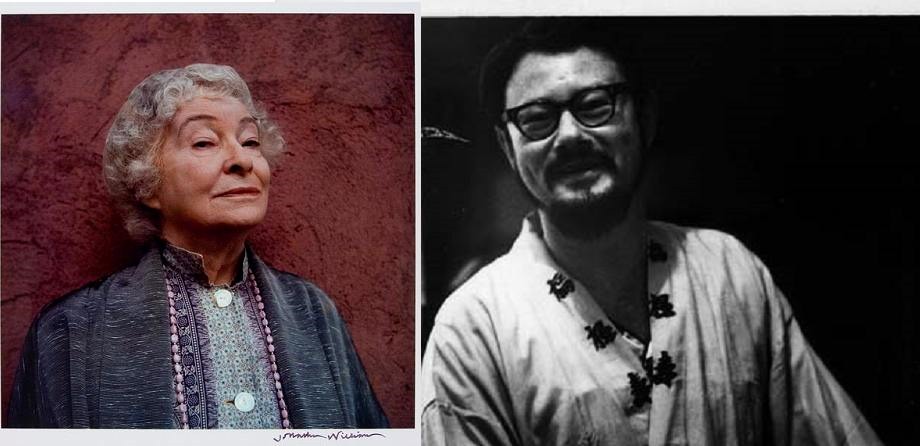
Mina Loy Paul Blackburn

Mina Loy in later life by Jonathan Williams, Paul Blackburn 1966 by Elsa Dorfman


Blackburn is patient, and he rarely man-splains or talks over Loy, something I would be all too prone to do if I was the man holding the microphone. He seems to genuinely admire Loy’s poetry as he seeks to add to a record of a career that was forgotten then, and he wants her to know that in 1960, at least one reader “gets” what she wrote in 1914.

Just past one hour in the recording, something extraordinary happens. Blackburn, touched by one of Loy’s recovered memories, a feeling perhaps amplified by additional visual clues he would have in the room that are not imprinted on the audio tape, exchanges with Loy a memory from his own youth during the second instead of the first world war.

I have taken that story, much as Blackburn expressed it that day in 1960, with some minimal editing and shaping for the words of today’s audio piece.

Of course, we’ve now largely forgotten Paul Blackburn as a poet too, following Hall’s law. Blackburn died too young, and more than 20 years ago, but his story struck me as a tightly expressed spontaneous poem. What was this: a poem he had already written, one he was paraphrasing from memory for Loy? Was it a poem he was thinking of writing as he interviewed the aged poet, perhaps thinking the tape recorder could serve as well as a notebook jot to put a first draft down? Was Blackburn simply a practiced poet who could orally improvise from his skills a well-shaped improvisation?

Whichever, I think it’s beautiful. His story combines looking back at youth and a landscape that is no more, with Dante’s Inferno moved forward to Greatest Generation Pittsburg, and it has a closing that contains a remarkable Imagist jump into synesthesia. I call my arrangement of Blackburn’s anecdote told to Loy “Seventeen Almost to Ohio.”

Today’s music, like the interview, is restrained: contrabass, a pair of cellos, piano, and percussion. I strove in my  performance and arrangement to do justice to Paul Blackburn’s story. To hear it, use the player below.