A Murmur in the Trees

I said, when I was listening to the Tell It Slant Festival’s marathon reading of all of Emily Dickinson’s poems, that I was jotting down lesser-known Dickinson numbers which I might perform in the Parlando Project manner. Well, here’s one of them.

If you’ve followed my various Dickinson performances over the years you may have seen me emphasize Dickinson’s visionary aspects, her outlooks gothic and satiric (often combined), and sometimes her abstract poems of philosophic thought. One thing I noted again during the marathon was that she can be a very acute and intimate poet depicting pain. She’s all that. But sometimes she’s more at playful. Today’s piece, “A Murmur in the Trees,”  for example.

It’s glancingly a nature observation poem, but fancies have taken it over by half-way in, as a fairy tale seems to break out. The opening stanza sets things at night, and perhaps we are in the Dickinson garden (where Emily, predicting an REM song to come, sometimes did gardening tasks at night). There’s a noise, the title’s murmur, in the trees.

The second stanza breaks with a line of alluring consonance that remains a mystery to me, the “A long — long Yellow — on the lawn.” Sunset’s last light beams or dawn’s first ones? Filtered moonlight? And then we are told, something like little footsteps are heard.

The third stanza portrays little fairies or gnomes trooping home, the fourth, robins that could be strange birds who wear nightgowns and sleep in “Trundle beds” or Robin Goodfellow with wings. The poet’s speaker, presumably Emily herself, reminds us these are not metaphors in this moment for normal animals, since what she observes “would never be believed.” She finishes by saying that she won’t test the credibility of her observations anyway because she’s in league with those she’s observed, she’s promised “ne’er to tell” what her night garden contained. The final two lines return to mystery — if nightgown-wearing birds or gnomes, or the both of them hanging out together aren’t ambiguous enough — by saying “Go your way — and I’ll go Mine — No fear you’ll miss the road.” What’s the road? Are they birds seasonally approaching their autumn migration time where Dickinson is famously staying put? If we take that aspect, Dickinson appreciates they know a road away where she may not. Or is the road that other mystery, the “long Yellow on the lawn?” Fairies* are said to have paths (not to be obstructed) that are often difficult for regular humans to detect, but sometimes different colored grass or vegetation is said to be a sign of fairy roads. Is that the long yellow in the grass?

Fairy Birds or Tiny Gnomes

Actual photograph of enchanted birds attempting a marathon reading of all 1789 Dickinson poems. Meanwhile, tiny gnomes have paths and “houses unperceived” if you look hard enough in your night garden.

.

The little song I made from Dickinson’s “A Murmur in the Trees”  can be heard with the graphical player below. No sign of the player? No fear you’ll miss the road, there’s this backup highlighted link  that will open a player to play it.

.

*This second reading assumes some understanding of Celtic or British Isles folklore on Dickinson’s part. I’m not sure what is known of that possibility. There were Irish immigrants in Dickinson’s Amherst, eventually some as domestic workers at the Homestead.
The Changeling

Have you heard the name Charlotte Mew? I hadn’t until I came upon it in Herbert Monro’s 1920 Some Contemporary Poets  this month. Last post I presented Walter J. Turner, another now-forgotten early 20th century poet found in Monro’s book-length survey of his era’s British poetry. While I doubt we will ever see a full-fledged W. J. Turner revival, with Mew I think there’s room for growth in interest. She’s that unusual and that good.

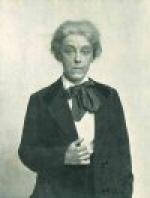
I’ll probably spend more time on what I’ve found out about Mew when I present another piece, but to hit some highlights: she cut a notable figure even among the unconventional artists of Bloomsbury, wearing tailored men’s suits and displaying a wide-ranging intellect. Mew was both parodied for her eccentricities and praised. Among her literary admirers: Thomas Hardy, Virginia Woolf, Sara Teasdale, Ezra Pound, Siegfried Sassoon, Walter de la Mare, and Harold Monro himself, who published her first collection of poetry.

Charlotte Mew

Maybe she looks like Gene Wilder as Willy Wonka, but read/listen anyway…


Why haven’t I (and likely you) heard of her? Fame forensics is a fraught subject. She’s one of those authors that straddles the centuries, though she didn’t start publishing poetry until the 20th. Some of her subject matter looks backwards, and individual lines will sound like they could be from a Victorian-era poet. Even so, her poetic style is her own. She uses uneven line lengths and unstable rhyme schemes, yet they don’t fall into doggerel. Mew died in 1928 and was not active in publishing in the last years of her life, so as Modernism was taking over she may have been just a bit “yesterday’s papers.” She may be one of those cases where her career didn’t rise high enough and maintain sufficient altitude to carry her glide-path into the second half of the 20th century. But like her admirer and champion Hardy, Mew is another one of those poets who at first, in some superficial respects, can seem old-fashioned, yet her core outlook is modern and unconventional. If one comes upon her work today and doesn’t expect her to sound like T. S. Eliot or Wallace Stevens, her uniqueness can still deserve your attention.

“The Changeling”  is a fairy story of the chilling variety, more “Belle Dame sans Merci”  than Disney. It’s Peter Pan meets Tam Lin! Like some other Mew poems I’ve already read as I start to look at her work, it’s extraordinarily easy to see modern psychological and sociological analysis in it’s situation. The narrator’s outsider sensibility is right there from the start, and the lure of the old wild natural world makes the order of the urban home and nursery regimen seem like a riot against that.

It’s Peter Pan meets Tam Lin!

Despite there being no regular line lengths or stanzas, I found it reasonably easy to set Charlotte Mew’s “The Changeling”  as if it was a folk song of the “Tam Lin”  variety. Alas, as is the case with many of my favorite old ballads, the result is lengthy by song standards. To compensate and decorate the time while you hear Mew’s tale unfold, I’ve added things that a handful of adventuresome British Isles folk-revivalists might have added 50 years ago: there’s tambura, sitar, and my first effort at playing tabla drums.*

So brew up some tea or elfin grot and listen to “The Changeling”  with the player gadget below.


*I tried an inexpensive electric sitar a few years ago, but never got the hang of it. I now play sitar and tambura using a MIDI guitar, retuning when desirable. For my attempt at tabla today, I didn’t use a drum controller or pads, but instead triggered the drum hits and pitches with my MIDI guitar as well. As I should always do, I offer my apologies to the real masters of those instruments who have given me much listening pleasure over the years.  On the other hand, my 9 minutes or so today is a short piece compared to many traditional South Asian numbers.