You could put Willa Cather within a group: writers known as novelists who also wrote some worthwhile poetry. I didn’t know she wrote verse, but this poem of thwarted love, “The Hawthorn Tree” charmed me when I read it in an anthology this summer. Furthermore, I had sense immediately that it wanted to be sung.
Cather’s best-known prose deals with European immigrant pioneers settling in the rural American Great Plains; but though they’ve been recommended to me, I’ve never read her novels.* Cather’s family moved to Nebraska when she was 9 and she attended college there. After college she moved east, and she lived most of her long life in New York, where she wrote of Nebraska while living far from it – a distance that has fueled many a novel.
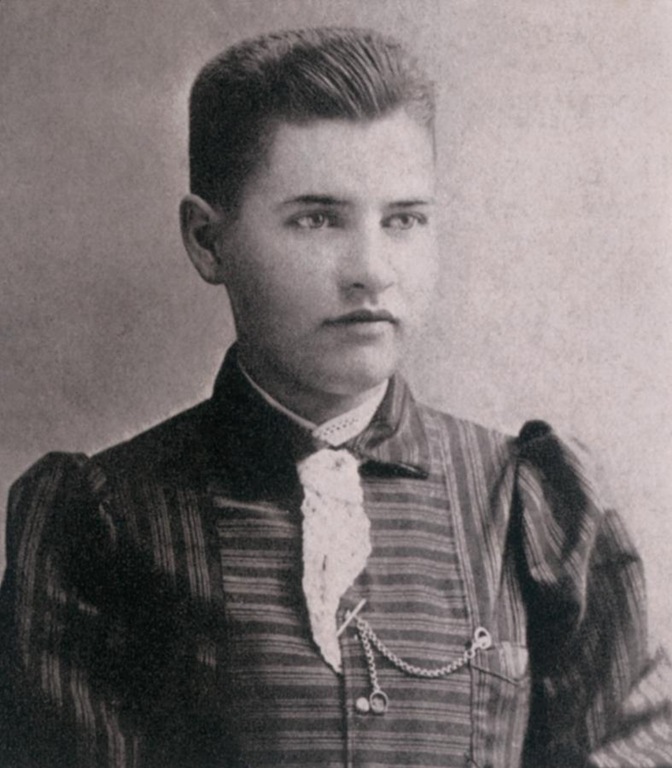
The young Willa Cather in her student days
.
“The Hawthorn Tree” poem doesn’t tell us where it takes place on any state map — it refrains instead on the titular tree somewhere, a location of a tryst between two people that the poem’s voice will tell, and not tell, us about. Since the hawthorn tree is a very widespread species, it’s not a clue about what state or time it occupies – but let’s ask: why is it a hawthorn, not an ash, maple, or apple tree? Perhaps it’s an accident of biography – a specific tree in some incident Cather herself experienced or knew of. I can’t rule that out, but it’s given such importance within this short poem I think the author made a choice to name it.
Here’s a link to the text of Willa Cather’s poem.
As the name implies, a hawthorn has thorny branches, a prickly botanical feature which is a common trope in poems and songs of thwarted love. Likewise, it has blossoms and sweet fruit in season, more reasons for it to be in a love poem. Not knowing Cather’s work, or much detail of her life, I can’t say what she might know about the myths, legends, or herbal-medicine knowledge regarding the hawthorn. I read that it’s a tree sacred to fairies, it’s thought to be a sentinel or guardian of gateways between worlds, and that the fruit can cure a broken heart.**
So, invention or memoir incident? That mystery accompanies the mysteries in this story’s telling. It could be rendering the common folk-song plot of a couple who briefly meet (and perhaps make love) somewhere while out in nature, and who are then parted. Cather could be taken with such folk songs and tales, could be writing her version of that – or it could be autobiographical.*** One other thing: we’ve been exploring poems of the faery world recently, it could be slyly fantastical – the unnamed creature who meets the poem’s singer from out of the mist could be from the faery realm. Cather’s poem happens in spring-time, another marker found in many of the folk-songs – which often start with some variation of “one morning in May” or the like – but Cather’s mysterious tale says its tryst happens in the night-time.
Whatever the exact and unsaid details, the poem had captured my attention, and those references to folk-song elements drove me to write music for it. I used an unusual open tuning here, one called Csus (CGCGCD), and the lower pitch of the tuning and the chord voicings I used caused me to break out my less-used larger-bodied dreadnaught guitar for this one.
I followed Cather’s text for the resulting song, but then at the end of the performance you can hear with the audio player below I adlibbed my own short variation expanding on the mysterious details of the meeting under the hawthorn tree. What ho? There’s no audio player for you? Ah, I have provided a gateway to a dimension that will show the audio player that’s hidden to you, mortal – likely due to the method you’re using to read this blog. Use this hawthorn branch – no, this highlighted link – which will open a new browser tab manifesting its own audio player.
.
*I’m far from well-read regarding novels. Poetry captured me in my youth, and that art meshed so easily with my love for music that I can easily be embarrassed in any literary crowd which takes “literature” to largely mean “fiction.”
**Besides folk-medicine, there’s been some modern pharmaceutical investigation of the hawthorn fruit’s ingredients. This video explains a bit about the hawthorn and the beliefs surrounding it.
***Cather’s love life is not an open book, but her life partner was a woman. The one from the mist who the poem’s voice meets under the hawthorn tree is a “he.” I made a choice not to alter the genders here, perhaps because this spring my home has been full of gender-dynamic visitors and residents. Or perhaps I’m following the example of famous gender-crossing singers like Eric Burdon and Ringo Starr.