Yeats’ The Second Coming

I will not write much about the Yeats poem I present today. Unlike some others I’ve performed here, it’s quite well-known. Phrases in the poem like “things fall apart; the centre cannot hold,” “the ceremony of innocence,” “the best lack all conviction, while the worst are full of passionate intensity,” and “what rough beast…slouches towards Bethlehem to be born” have been quoted, reused, and brought out as touchstones and summaries alongside distressing events. Still, if you’d like to see the entire poem “The Second Coming”  as it appears on the page, here’s a link.

Where folks do explainers for this 1919 poem, it’s usually pointed out that the Irish poet William Butler Yeats studied mysticism and magic, and alongside this short poem, he wrote other texts explaining his esoteric theories of the rise and fall of epochs. This was more than colorful stuff for poetry for him, he believed it, and believed that the 20th Century was some kind of end-times. Now that we’re a quarter of the way into the 21st Century, we seem to be running a little late — but Yeats was writing of millennia, so being off a hundred years or so might be a rounding error. And as he starts off writing of the cycles, the widening gyres of history, his sonorous phrases of dread keep coming back to us.
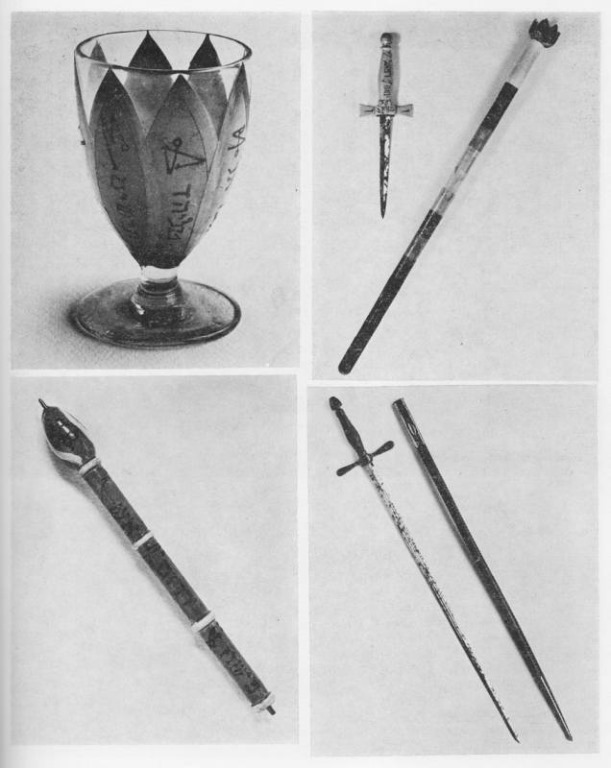
W B Yeats Magical Weapons

Yeats as wizard. Here are some of Yeats magical weapons. Photos from “Yeats, The Tarot and the Golden Dawn by Kathleen Raine” which I found at this web page.

.

Even ignoring all the mystical back-story, this is a poem about the breaking of nations. Therefore,“The Second Coming”  fits with the theme of civic poetry, and I put this poem down on a short list of poems to consider combining with music for this April’s National Poetry Month, but we’re nearly half-way into the month before I could complete a version that I felt was presentable.*  Given its grand scope it called for some big music, and my orchestral scoring skills have atrophied from where they had developed earlier in this project. Another way to make a large noise is to perform it with a full rock band, and I have been trying to recover my skills in that kind of ensemble playing this Spring. But there was another obstacle: I found that, unlike other Yeats’ poems, this one isn’t easy to fall into singing. The blank verse here tends stentorian, and I’m not a big-voiced powerful singer. For one stubborn section of the poem, I felt I needed to break into chant rather than try to keep the lyrical lift of singing. This sort of thing is a consequence of a composer needing to rely on a limited singer to realize the work.

The raw tracks I recorded for today’s song were somewhat messy due to the number of instruments: three guitars, organ, piano, bass, and drums, It was quite the operation to mix them even to my “good enough” level. You can hear that musical performance of W. B. Yeats’ “The Second Coming”  with the audio player you should see below. What, has that rough beast not slouched onto your screen? It’s not the end of the world — some ways of reading this blog suppress showing the player gadget. Here’s an alternative, a highlighted link that will open a new tab with its own audio player.

.

*As I write this sentence, I take stock and consider that since this Project began 9 years ago, I’ve been composing and recording the more than 800 pieces presented here at a rapid pace. To create a single album’s worth of music in a month is considered a challenge — since 2006 there has been an “RPM challenge” to write and record an album of songs during the month of February. I’ve been doing something like that, nearly every month, for nearly 9 years!

Has that been good for the quality of the work? I don’t think the answer is a straightforward “Of course not.” While there are times when I wonder about some months-long work focused on a single composition, at my age I figure anything I want to explore or express needs to be a matter of getting down to it and getting it done as well as my current skills allow.

Pippa Passes

One never knows where strangeness will arise in this Project. Take today’s piece, which I thought was the most routine little poem in a pair of 1920s anthologies of children’s verse I’ve been exploring this National Poetry Month. I wrote down Robert Browning’s “Song from Pippa Passes”  as a candidate early in this process. It’s short. It claims in its title to be singable. It contains a well-known line that’s so often repeated we may have forgotten it came from a poem. Those are all good things for a Parlando Project piece. In the context of my planned series, I figured this innocuous poem could stand for the elements of the innocence of childhood portrayed in The Girls  andThe Boys Book of Verse.

Here’s the childhood context known and unknown for the editors of these books in 1922. There was much change afoot:

  • The United States had emerged from a pair of overseas wars — the second, WWI, broader and more deadly.
  • World maps had been redrawn. Kings deposed and monarchies ended.
  • American women had just gained the right to vote.
  • In the arts Modernism was breaking through, music and poetry took on forms that seemed formless.

Children are born into a world they know is new only by definition, but their parents, the ones who’d purchase such books must have sensed these changes. Is this poem a way to rest from all that change?

And then there’s what we know, but the editors would need to be prophets to foretell to those children starting to read or be read to:

  • The world would soon be plunged into a widespread economic depression.
  • Totalitarian dictators as cruel as any evil historical monarch would arise with popular backing.
  • A greater and more widespread world war was to come as these children reached young adulthood.
  • That great war would end with a fearsome weapon’s deployment and a cold war standoff between two global alliances.

Could they repeat this poem later in a breadline, bomb shelter, or landing craft?

So far this month we’ve learned that the editors would include poems of blood, murder, war, and strife. These weren’t considered off-limits for children. They would almost completely ignore Modernist poetry however (save for our special child prodigy exception). There would be some poems of adventure in the girls volume, but more poems in the realm of imagination, and no notice of women at work (though there’s little about men at work in the boys volume either). The boys volume would have sections of poems on war and battles, and another section devoted to “words to live by” poems of virtue. The girls were not given a similar section of poetic instruction. *

Pippa Passes

A thorough introduction? It does show that the editors had knowledge there was a context to this short poem. Now read the rest of this post.

.

And Browning’s little poem? Well at least I won’t have to do any research for it. It’s just a poem of Springtime childhood safety and innocence. I think I ran into the poem in schoolbooks in my youth, and it was never explained as anything other than that. Well, I have to write something about it now. Let me check.

OMG, in heaven or otherwise.

Turns out the verse drama the song comes from is a nasty little piece of work. Smutty adultery, political assassination, trickery, dirty deeds done with wills and waifs. I read the first act, the part that includes this well-known poem. It portrays a scene between two adulterous lovers fondling each other and panting about their ardor. We learn this bodice-ripping ceremony celebrates that they’ve just killed off the third-wheel husband. The Pippa in “Pippa Passes”  wanders by singing our 8-line ditty, and without an ounce of explanation on the part of Browning, the adulterous man kills the new widow and himself out of guilt for — well, it’s complicated — guilt for being seduced by the hot wife, not thanking the dead husband enough, and maybe a little for the murdering part, though obviously the song has occasioned him being up for some more murdering.

TL:DNR summary: more “Double Indemnity”  than “Mr. Rogers.”

My reading? Browning’s intent, however ham-handed, was to draw bitter contrast between humankind’s fallen state and Pippa — a poor, innocent, factory girl, who’s passing by these scenes of mayhem on the only day-off she gets in a year. To give Browning the best I can give him: the total incongruity of this tiny song that ends “God’s in his heaven — all’s right with the world” moving the plot to some new if not exactly benign resolution is Brechtian a century before Brecht.

Now here’s what’s strangest. How the hell did this become a popular short poem all on its own as just a piece about Springtime happiness? What’s the path here? Was there a shortage of happy short spring poems? Did someone misunderstand it and promote it as such? My musical performance is left with just trying to make this set of happiness words seem vaguely strange. I’m writing this in a world with manifest suffering and dutiful cruelty explained by “You don’t understand, we have reasons and rules that prescribe that suffering.” We are slow as snails on that thorn. So, I had help.

The audio player to play my performance of Robert Browning’s “Song from Pippa Passes”  is below. No player? This highlighted link will open a tab with its own audio player.

.

*My wife galsplained this: “Girls were supposed to be just naturally good and virtuous.” If you’re wondering why I didn’t prompt you to guess if the poem was from the girls or the boys volume of these poetry anthologies today, this is another one that was in both books.

William Blake’s “The Tyger”

It seemed a long time since I last had a new performance to share. I checked, and found it’d only been a week, but since then the moon has had a red eclipse, and in my country there’s been a couple of mass shootings motivated by ignorant ethnic hatreds. Willful ignorance combined with violence is particularly ugly, and presently a state-leader with missiles and bigger guns wants to kill to impress too.

I’ve completed no new pieces. I tried to start two, but so far nothing is developing. So today I thought I’d present this new-to-you performance of William Blake’s “The Tyger,”  mostly because it’s pretty good and I don’t have anything else ready. I made that decision this morning, and then I suddenly realized that “The Tyger,”  a poem first published in 1794 by a mystical Englishman, has turned just about right for this ominous spring and our current year.

Over 40 years ago, I was in bed and my partner asked me how I could account for the presence in the world of evil.*   Strange place and time for that question — for in that moment I was more impressed with beauty and joy. I stumbled for my answer: good was always present in the universe, and always powerful enough to overcome evil — but not always both at the same point. Alas, “not always” is more painful than it sounds to nakedly say.

Visionary poet William Blake asked that question too. Blake was born into a family of religious dissenters and progressed to rebel even further from Christian dogma. He intuited a moral universe where evil was caused by over-justified powers of the creator. Interesting thought that. In “The Tyger”  poet Blake asks a manifestation of terrible predatory power a series of rhetorical questions, meaning to direct our thoughts in the direction of his conclusion.

Now, to get to my performance of Blake’s poem, we need to make a jump cut. Ready?

Year of the Tyger

Year of the Tyger, three times.

.

In what’s usually called the Chinese zodiac, years go through a 12 year cycle. I wrote this musical setting for a video of an event in 2010 tied to the Chinese Year of the Tiger. In order to extend the length of performance to the length needed for the video, I refrained Blake’s “Tyger Tyger burning bright” stanza after every verse, a tactic which makes it longer than I’d like it to be today. As it turned out, the video ran longer than planned, and I needed to cross-fade even my lengthened “Tyger”  with another piece then for the final cut of the video. Given how long ago the recording was done, I only have that completed mix from the video’s soundtrack, so “The Tyger”  I present today ends on the start of that cross-fade.

The “Chinese Zodiac” progresses, and as it goes we’ve once again come to the Year of the Tiger in 2022. I think this performance from the previous Year of the Tiger retains its power and so I present it to you now.** There’s an audio player gadget below that will play it for many of you, and where that’s absent, here’s a highlighted link that’s an alternative way to play it.

.

*This all seems way too Leonard Cohen doesn’t it? No, it actually happened like that.

**I often find I have one more question as I think I’ve finished a post. This time, I asked myself, what year in the Zodiac cycle was Blake’s 1794? Why, another Year of the Tiger of course.

The Quadroon Girl

Remember back a few posts ago when the Parlando Project performed a question posed by poet Vijay Seshadri? He asked what poetry, or any art, can say about children in cages. There are many answers to that for poets. One obvious one: to say in your work that it is wrong and that you oppose it. One can argue that shouldn’t be avoided. Even if denunciation is simple and obvious, it could still be appropriate. Others will find simple denunciation worse than not sufficient, that it may only be signaling your self-removal from it.

Some will say, poetry or art is beside the point in such cases, to the barricades! or the voting booth! The former is easier to say than a poem, though harder to do successfully—so hard, that the consequences of power, due should the revolution succeed, can most always be avoided. The later seems so prosaic and lacking in artistic verve and purity that we shrug it off as too easy or uninspiring.

Seshadri ends up suggesting that poetry and art can express reality and some moral order vibrating in the universe in a compelling way, that this is the sharp edge of its weapon or scalpel. A good point. That’s what art does, it’s a way to transfer experience, including the experience of this. But his question about dealing with great and obvious evils in a poem is still difficult to answer successfully. It’s easier to write a successful poem, a small sound-machine made out of words, against menial human faults: ignorance, self-importance, narrow thinking, the ordinary follies.

Perhaps it’s those small faults, ones we all share, that accumulate, and lead to great evil.

Henry Wadsworth Longfellow, that once hugely popular and now deeply unfashionable poet, seems to have tried but once to use his poetry to address great evil: a pamphlet of poems addressing slavery. His effort was not long-remembered, and it has not saved him from his fate to be cast off as a poet of undistinguished, conventional and sentimental verse, the very sort of thing that the Modernist movement needed to supersede.

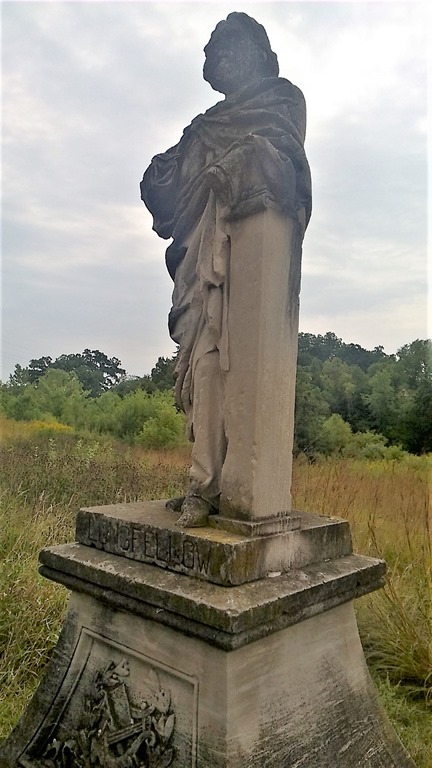
Mpls Longfellow Statue 6!!

This eroded statue of Longfellow stands, missing its hands, in a little visited corner of an otherwise busy Minneapolis park, somehow saying something about how Longfellow is viewed today.

I’ve already performed one of those Longfellow poems on slavery: “The Witnesses.”  I could have performed “The Quadroon Girl”  instead, but I didn’t think I could. This is a level of evil so deep, compounding even the evil of slavery, that it is, paradoxically, a sort of sacred space. I didn’t think I was ready or worthy to go there.

I’m not going to further explicate “The Quadroon Girl”  here. Despite the shakiness of my singing, it’s better to listen to it, to follow the story as it unfolds. I’ve performed it exactly twice, and I don’t know if I could perform it again. The player is below.