Walter de la Mare’s Winter

I know nothing interesting about the life of Walter de la Mare—other than he was a successful writer in poetry and prose for roughly half of the 20th century*. There appear to be no interesting movements or manifestos to tie him to, and though his lifetime corresponds roughly to those 20th century Modernists I often like and present here, he’s not considered one of them.
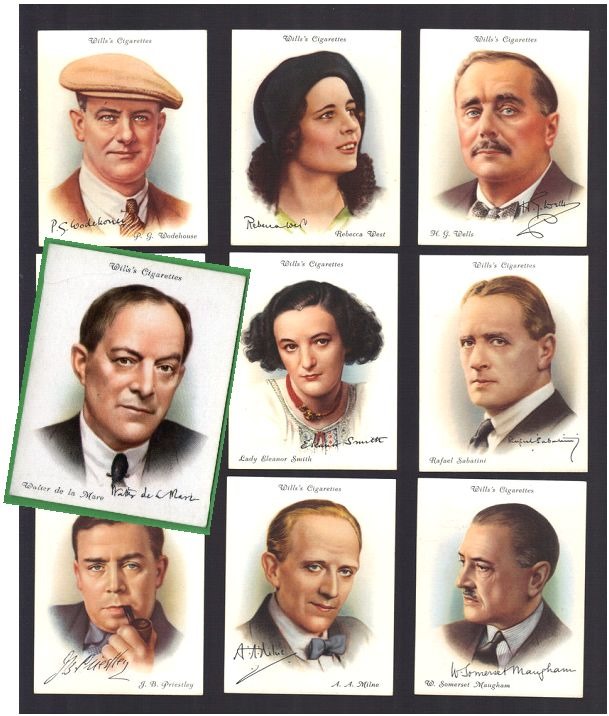
Famous British Authors Willis Trading Cards

20th century British authors who got trading cards in cigarette packs level fame.


Certainly, his poetry doesn’t sound or look like Modernist verse. It’s frankly musical, and supple yet regular musical verse of his type is not that easy to write in English. Modernists took up with free verse for a number of reasons, partly because they were likewise enamored of the wider and more fanciful rhythms of Modernist music and visual arts, and because they wanted to explore new ways of relating reality, and the tight and formal clothing of metrical forms and rhyming seemed to restrict their range of movement.

There were folks with a Modernist sensibility who worked in rhyme and more regular metrical forms. Early Robert Frost and Edna St. Vincent Millay did. Frost in particular is often writing Imagist poetry with fresh, plain diction that rhymes in the era when his fellow Modernists were immerging.

Today I use a short poem of de la Mare’s, “Winter,”  and the first thing that struck me about it is the word-music. Every line rhymes, and with perfect, not partial rhymes. Though de la Mare uses common rhyming words, the poem seems effortless, there are no lines that seem twisted to make the rhyme. But notice something else about “Winter:”  the way it treats its matter, as opposed to its music—that’s close to the Imagists credo. It directly shows a winter scene. The opening lines “And the robin flew/Into the air, the air,/The white mist through;” are solidly in the Imagist mode. That opening “and” making sure we know this is an immediate experience. The entire second stanza too is Imagist through and through. Nothing is “like” anything. This is a real, immediate scene, and we stay there. The robin** flying through white mist is a bird flying through white mist, not a mere symbol, a counter for something else. Frozen bushes waver in the slight breeze casting varying reflections from the new rising moon or last sunlight. Yes, what we are apprehending through the poet has connotations, has feelings that will be invoked, but we aren’t told by the writer what they are, he assumes we’re capable of forming those ourselves.

Only in the ending stanza does de la Mare break the rules of pure Imagism. In his last two lines he personifies a speaking star or cardinal direction which speaks the final line. For me this works largely because this contrasts with the rest of the poem. If instead, de la Mare had started with talking stars giving us messages in so many words and continued in that vein through the poem with bushes and birds telling us what the poet wants them to say, the impact of the conclusion would be lessened, and the poem would be trying to work, not just sound, in the old way.

Musically, I unabashedly say I like what I did for this one. The piece began for me with the guitar part, which I was going to play on acoustic guitar, but my family came home early and there’d be no chance to record that with an open sensitive mic, but then many acoustic guitar parts translate well to the Telecaster which I substituted. The bass guitar part is unusual in that it’s played entirely on open strings, a sound that the instrument is rarely allowed to use. But it’s the orchestral parts which really pleased me. There’s a bunch of tracks here combining “real” strings played via a virtual instrument with a somewhat overdriven Mellotron violin mixed in there which brings the string section some grit***. I gave a top line part to an English horn. Use the player just below this to hear my performance of Walter de la Mare’s “Winter.” 


English Robin in Winter

English robin showing its all-weather operational capabilities

 
*I recall reading some of de la Mare’s ghost stories decades ago, but I hadn’t really considered his poetry until I was reminded of that by Toby Darling, who does a lovely job of writing and playing music to sing many de la Mare’s poems to.

**Residents such as I who live in the Northern parts of the U.S. may be surprised that de la Mare has a robin in his winter scene. The American robin is a different species, which migrates south for the winter, and as such the robin here has a strong symbolic association with spring. English robins stay put. The same name for different North American and European species could lead one to read some promise of spring that de la Mare didn’t intend in his poem, in the same way that Robert Frost’s American winter hemlock branch may not have been a Socratic hemlock branch. Anyway, both robins have a bright red-orange breast, which even though de la Mare doesn’t state it, adds a dot of color to the white mist flight.

**The Mellotron was an early, primitive attempt to do what modern “virtual instruments” do. Typically, if a virtual instrument wants to present a “real” violin it will sample a violin playing various notes, and the notes as well with a variety of articulations which are stored and organized as digital audio files to be played later. The 1960’s Mellotron had a simple tape strip of a violin playing a note in one legato articulation assigned to each key of an organ-style keyboard. The former can sound strikingly realistic if care is taken to make use of the various articulations (vibrato, marcato, pizzicato, etc.) while the later sounds artificial despite the tape strips being conceptionally the same. Of course, “artificial” is a state of mind, and the close-but-not-quite sound of a Mellotron instrument always reads as “England” to my ear due to it use on many 1960s and ‘70s recordings by English groups.
In the Time of the Breaking of Nations

As we celebrate the 100th anniversary of the armistice ending World War One, let’s bring in a writer not primarily known as a “war poet,” Thomas Hardy. Hardy is one of those bridge-poets between the era of the romantic and sometimes sentimental Victorian poets and the Modernists. Though I’m told Hardy never felt at ease in London artistic circles (he was country-born, son of a stone-mason and largely educated through apprenticeships as an architect) his poetry was admired by some of the Modernists. Why might that be? While his language can sometimes seem antique to modern ears, it was his language, the language of a rural 19th century working class Englishman. And while he will write about sentimental subjects, he’ll balance that with a cold eye.

In the Time of the Breaking of Clods

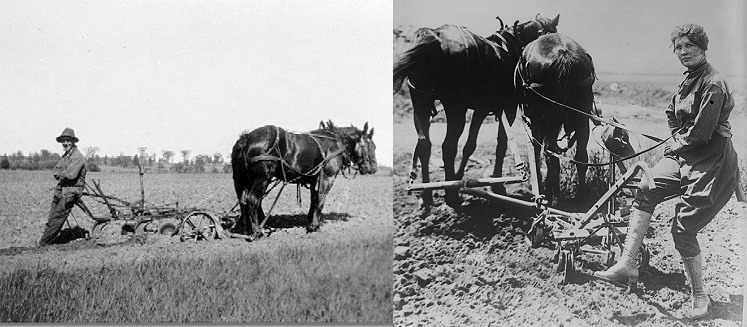
The horse-drawn harrowing time of the Breaking of Nations. But what’s that woman doing behind the horse?


Hardy grew up in a rural, farming district, as I did, and it may have been natural for him to relate the violence of the Great War to that setting. And I love how he does it here with three spare quatrains: the boustrophedon horse-drawn disk or rake plow that is literally breaking the earth*, in contrast with the prophetic “Breaking of Nations” warning from Jeremiah used for the title. Then there’s smoke rising, not a razed town after an army has swept through it, “only” the burning of invasive weeds. And finally, a mysterious third stanza with a mysterious word: wight.

It’s an old word, one of those that came to English with the German Saxons centuries ago. Chaucer knew it, used it in The Canterbury Tales,  and as best as I can tell it meant a sort of unimposing person or creature. Sometime later, perhaps after Hardy learned the usage of the word and after this poem was written in 1915**, it’s taken on a supernatural connotation. It’s fairly easy to trace that back to J. R. R. Tolkien’s use of the word in The Fellowship of the Ring  written decades after Hardy’s poem. Tolkien was a scholar of the ancestor languages of modern English. Did he know of other usages of the word, or did he simply take a very old word and choose to use it for an undead-spirit slain in battle?

So, in this last stanza, what does Hardy mean by his whispering maid and “her wight.” A flirting young couple? Are they whispering merely to shield their romantic bantering from others? Or is it something weirder? Is this a young woman whose man is off to battle, or even one of the battle-dead? Or, as part of Hardy’s theme are they both immortal ever-returning spirits, whispering because you only barely sense them in our time-bound world?

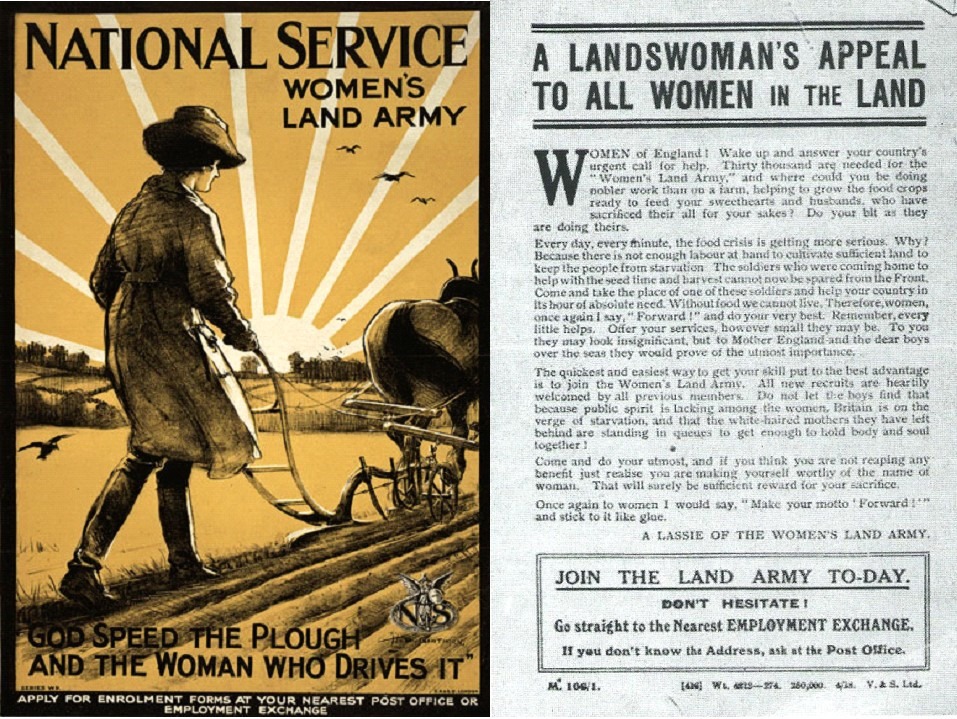
I don’t have the detailed historical knowledge to know how depopulated the farming areas of England were by the need for soldiers during WWI. From Edward Thomas’ poem from last month, Gone, Gone Again I get the idea that the absence of farming men was noticeable. And it was at least enough of an issue that England formalized an effort to recruit and train women as replacement farm labor.

Womens Land Army

Not just whispering to her boyfriend. “There’s not enough labour at hand to cultivate sufficient land to keep people from starvation.” Recruitment ads for the Women’s Land Army in England during World War I.


Well, I just like it that this is blurred. Do the final two lines give us any clues? Why does Hardy say that “War’s annals will cloud into night?” In early drafts, Hardy wrote “fade,” and “cloud” seems a more peculiar choice. In the context of the 2nd stanza weed-burning, I’m thinking he’s saying they will disappear in a cloud of smoke. Also in context of the 2nd stanza, this would make such war records in some future as valueless as weeds, but smoke/cloud again reiterates that there’s something unsubstantial about the couple.

“In the Time of the Breaking of Nations”  demonstrates a lot of what I like about short lyric poetry. T. S. Eliot could write a Modernist masterpiece like “The Wasteland”  extending to the farthest lengths of lyric expression, 15,000 words—but a poem like this can touch a lot in its 63 words.

It may not be apparent due to the instrumentation used, but I might have been subconsciously inspired by Bob Dylan’s repeating chord progression used for his masterful three-short-stanza song “All Along the Watchtower,”   which is very much in the same mode as Hardy’s poem.

Here is my performance of Hardy’s poem. Use the player below.


*Note too, Hardy’s pun on “harrowing.” For another discussion of boustrophedon plowing and time, see this earlier post. Near the end of his life, while visiting a farming museum, my father wanted me and his grandson to know that he’d walked behind a horse-drawn plow.

**Though the poem was published in 1916 when Hardy was asked for submissions of poems to support the war effort, one biographer says it may date back to 1870.

To Autumn

October 4th is National Poetry Day in the U.K. this year, an event similar, though more condensed, to the National Poetry Month in April promoted out of the U.S.

No one’s revealed why April for the Poetry Month, though Chaucer and T. S. Eliot may have put in their votes, and the reasons for the fall date for Poetry Day could be arbitrary too. But autumn would have an emotional claim. Fall is changeable in weather, an underrated Spring of warm days and cold shuffling themselves. It has its long-established events: school years underway, harvests and harvest festivals, the closing of summer venues, Halloween, Veterans Day/Remembrance Day. Fall can also be an easy metaphor for approaching death, but poetry is one buffer we use to handle that subject anyway.

John Keats wrote one of his last and finest poems to the season almost 200 years ago in the autumn of 1819. It’s full of the strengths of Keats’ writing. Even in his time Keats was both praised and dismissed for the sensuousness of his poetry, and not a line goes by without some sensation of taste, touch, color and sound, and all that is contained in beautiful word music and an off-balance rhyme scheme that may couplet-rhyme two lines together, or tantalizingly wait two or four lines for the rhyme.

John Keats listening to the Nightingale on Hampstead Heath c1845 by Joseph Severn.

Look at that great single-track behind you John. In only 160 years someone will invent the mountain bike


Even if some of his words are 200-years-old antique, or for us Americans, peculiarly English, he crams all these sensations in his poem without them seeming forced, as if they were special or unnatural “poetic” things. Many of the sense words in this poem are of ordinary manual labor: load, bend, fill, set, reap’d, laden, press, and borne.

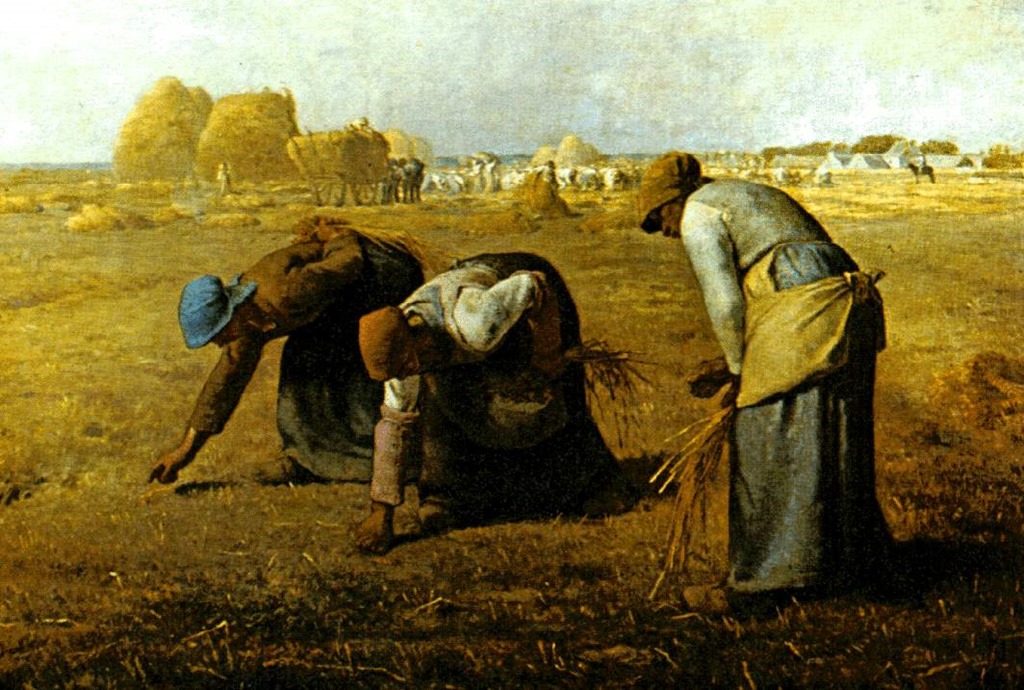
Where he is outrageously poetic is that this poem is an apostrophe. The entire poem is addressed, just as the title says, as if the season was a person: “To Autumn.”  A poet doing that today would, intentionally or otherwise, produce a humorous effect. Still, if we allow it, the second stanza gives us a leisurely fall, a farmer taking a break on a warm autumn day from rural labor, hiding in a barn, or taking a nap in a half-harvested field, but yet also returning to pressing cider from apples down to the last drop, and bearing away hand-gathered food on his head “like a gleaner.”

Gleaner is one of those antique words. It was a practice in some places to allow the poor and those without land to gather what leftover grain might be left in the fields after harvest. Just this week I was reading on the always Interesting Literature blog that Keats may have had this practice on his mind as gleaning had just been outlawed in England, and that other images in the poem may have had social resonances with Keats at the time.

The Gleaners by Francios Millet

Painters whose names suggest a subject for their painting: “The Gleaners” by François Millet


The poem’s final stanza retreats with distant banners flying, a symphony of extreme audio dynamic range. The infinitesimal sound of gnats flying is a choir. The wind crescendos and decrescendos. Lambs bleat loudly and then there is silence. Crickets arpeggiate for time. Birds whistle, twitter and leave in the sky, migrating away, and the poem ends.

Keats himself ends as a poet, this being one of his last works. He leaves for Italy in hopes it will help his tuberculosis, which it won’t. He’s dead in about a year.

My music for this today is acoustic guitar with bass and some orchestral parts: winds, a couple of cellos, a pair of violins. The player to hear it is just below.


Here’s a #nationalpoetryday bonus, featuring a very different British poetry from about a century later, T. E. Hulme’s “Autumn.”  Hulme was a too-little-known instigator of Modernist poetry in English, and like a lot of instigators he moved by opposition to previous schools. In particular, he disliked the English Romantic tradition of Keats, viewing it as too flowery, to full of images that were no longer real and which had become only conventional symbols.

Interestingly, in his “Autumn,”  Hulme’s central image is similar to Keats: instead of a farmer taking a break in his granary or napping in a field, he has a harvest moon looking over a hedge like “a red-faced farmer.”

Here’s my performance of Hulme’s “Autumn,”  which you can also listen to with the player gadget below. If you like this sort of thing, be sure to spread the word about what we do here at the Parlando Project.


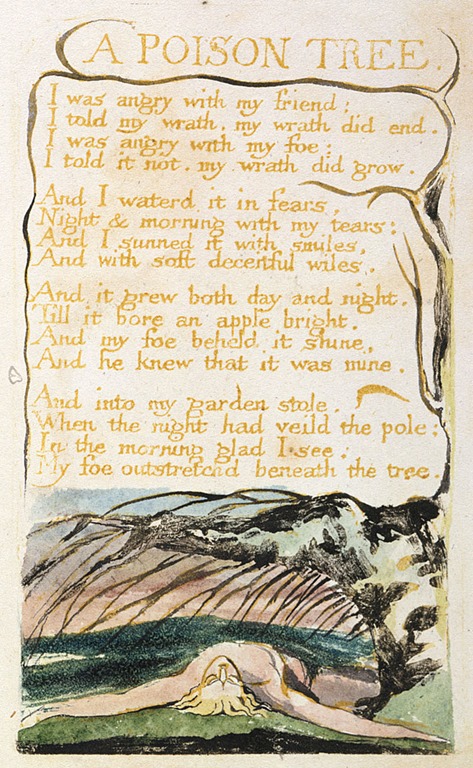
A Poison Tree

Earlier this month I mused a bit about renowned poets’ “batting averages” when I use their words here, that the hall-of-famers and MVPs don’t always get the most likes and listens, that many of our most popular pieces use words from poets that are much lesser known. Of course, those levels of response may be secondary to the music Dave and I supply and our performances having their own range of attractiveness, or it could be that the subject matter of the popular lesser-known poems resonates in some way with audiences.

Perhaps it’s just random fate at play, but poet and artist William Blake never attracts much of an audience here, though he remains dear to my heart for his stubborn individual persistence and production. Blake is an 18th Century writer who looked backwards to Milton and Dante as much as he predicted the early 19th Century romantics. In America, he’s loved by some outsider poets such as Allen Ginsberg* and Patti Smith, but in England he may be encountered as the lyricist of a national anthem “Jerusalem.”   Compared to our founders of American Modernist verse, he can be in his “prophetic books” more long-winded than Whitman—and yet also as seaming simple and elusive as Emily Dickinson in his short lyrical poems. If you hear Blake as hard to value or difficult to appreciate quickly, you are likely hearing him right.

Take the piece that the LYL Band performs today, “A Poison Tree.”  It’s Dickinson-short, and like some Dickinson, if you give it only cursory attention, it seems like a simple moral tale. It certainly starts off like one. To paraphrase, I was mad at my friend, but we were open about it, and it all blew over; but with my enemy, I kept my anger a secret from him and it didn’t go away. This poem was even once published under an (ironic) title “Christian Forgiveness,”  and that may be what you expect to hear extoled. After its few moments this poem ends, it goes away, and that could be what you think you heard. But it’s stranger than that—unvarnished fairy-tale strange.

Blake A Poison Tree page

One nice thing about William Blake poems: I don’t have to hunt for illustrations

By the third verse the poet/speakers’ hidden, festering anger, has produced an apple, an Adam and Eve apple, a Snow White apple. Sure, magical realism, expected poetic imagery this. How’s the plot going to go on from here? Will he wicked-witch-trick the foe into eating the apple? Will he somehow reconsider his anger and resolve it? Will he somehow eat the apple himself by some misapprehension? Will he patent the apple’s genetic design and make so much money that the foe will be forever jealous?

Two lines into the third verse, it goes somewhere else than any of those easily comprehendible endings. The enemy sees that apple, that property of our poet/speaker. He wants it! He breaks into the speaker’s garden and steals it undercover of the night. Thus, the poison apple kills the foe. And the poems speaker sees this and is “glad.” Roll the credits, and anyone who’s been paying attention should walk out puzzled.

What the fruit!

Could Blake be saying that hidden anger is dangerous material, you need to be careful with it, as stuff could happen? Or is it a more elaborate allegory? Is Blake saying that our enemies will covet our anger, even if we think we are keeping it hidden, and the foe, seeking to seize this anger (perhaps it’s righteous or powerful) will kill themselves? Or, in the context of Blake’s overriding mythos—where the righteous, authoritarian deity, similar to the Old Testament Jehovah, is not simply good, and must be opposed—is Blake demonstrating that our festering anger will turn us into a trickster god who will allow the fall of man from Eden? Or is this a simpler anecdote about passive-aggressive sins, where the story is: well I was mad at him and he was my enemy after all, so why warn him off from my poison apple, he had it coming?

To those attracted to it, “A Poison Tree’s”  power derives from this mystery couched so simply. But if it only confounds you, that’s OK too. The Parlando Project tries to vary things—not to confound you, but because we’re attracted to a diversity of ways this can work or fail.

To hear the LYL Band perform Blake, use the player below.

*Allen Ginsberg sang Blake poems regularly, once issuing an LP of his performances with an eclectic group of accompanying musicians and performing them live. His unguarded and guileless performances of Blake were one influence for what I do here.

An August Midnight

Today’s episode is something of a companion to our last one, what with moths appearing in each. Emily Dickinson’s sister-in-law Susan Gilbert Dickinson let the Book of Job fly in with her moth, and today Thomas Hardy’s open summer window lets in four bugs.

Our scene: a summer night, window open, a 19th Century lamp letting Hardy literally and literarily burn the midnight oil. The breeze and light brings on the bugs, and beside the moth we get a daddy-longlegs spider, a fly, and a dumbledore. Besides it making his rhyme, I think Hardy must have liked that charming name for his fourth bug, which is either a bumble bee or a beetle, though either will disappoint Harry Potter fans brought here by a search term.

Dumbledore Beetle and DOD Carcosa fuzz pedal

A dumbledore beetle and a DOD Carcosa fuzz pedal. They could be filed under “things you step on.”

What was Hardy writing when the bugs arrived? He doesn’t say, though of course to be meta, it should be this poem now shouldn’t it—but even if it was some other piece, the bugs interrupt it, marching over his just-penned wet ink and drawing his attention away to their antics. Susan Gilbert Dickinson called her moth “silly” and Hardy has his insects more or less performing a Three Stooges skit bumping into the glass of his artificial light.

Susan Gilbert Dickinson wanted to remind us of that harrowing Old Testament lesson that God can crush a human as easily as a bug. She wrote “Irony” and underlined it over the top of her poem’s manuscript. Hardy writes a slightly different conclusion. After watching his fab four beetles make a farce out of replacing the poet on top of his manuscript paper, he ends by declaring that those insects know more about nature than he does. I think that little insect play on his desk reminds him that he, like other poets, struggle to understand and portray nature.

Just as the last time I worked with Thomas Hardy poetry, the melody just flowed out effortlessly when I went to set his words. I quickly had the basic vocal and guitar track, and then added a couple of cello parts and an additional guitar melody that followed what I had so easily fallen into as I sang Hardy’s words.

That electric guitar melody line uses a DOD Carcosa fuzz pedal which I’ve been using a fair amount here lately. It’s a very flexible effects pedal, but I won’t interrupt this with any more guitar nerd material than that tonight. To hear my performance of Thomas Hardy’s “An August Midnight,”  use the player below. Don’t see a player? This highlighted hyperlink another way to play it.

America, A Prophecy

July 4th is celebrated in the U. S. as Independence Day, the day that our congress signed a declaration of independence from the British Empire. I know this project has an international audience. So, why celebrate a provincial event here?

Because the American Revolution was not simply a patriotic event. Ralph Waldo Emerson said that its initial battle was “the shot heard round the world.” What was so singular about it? It was not merely an anti-colonialist act—after all empires have had rebellious provinces forever, and empires always fall—but it was also an act that founded the modern democratic republic. Overthrowing a colonial government, as the American patriots did, is not in itself a remarkable event. I don’t mean to denigrate the sacrifices, the risks, they took. I don’t mean to overlook the evils inherent in armed struggle. I won’t today seek to re-litigate the proximate issues of the Revolutionary War, with its details of commercial interests (including, yes, commercial interests in human properties) and debate the best tactics for redress of grievances. No, those are all important, but they are not what makes the American Revolution worth our unique attention today.

signing the declaration

Silent thoughts in the room: What a fine statement of the Rights of Man we sign today! I hope they wrap this up before traffic on the turnpike gets crazy. None of my slaves have learned to read, right? Why am I the only one wearing a hat? I can’t get tickets to Hamilton? I am Hamilton!  All middle-age white guys, when does the prog-rock concert start?


Americans did not replace a king with a president for life. They didn’t exchange one dictator for another. They were not, in the end, interested in only replacing a bad man with what seemed to be a good man, and job-done. They instead instituted an imperfect, constantly challenged and constantly changing structure based on human rights and rule by reason and popular consent. The struggles, the risks of the Revolutionary generation were indeed great, but they pale in contrast to the struggles and risks born by the successor generations who sought to maintain and improve those structures. So, this is not a holiday honoring a person, a generation, or a concluding event, but instead, it is one marking a beginning.

Today’s piece was not written by an American, but by an Englishman who followed those revolutionary 18th Century events, but dealt with them on a spiritual plane: William Blake. The words come from his self-created 1793 book America, A Prophecy,  which he wrote, lettered, illustrated, and printed himself. It’s not an account of the actual battles, and its characters are largely his own imaginary beings, but he never lets his visionary eye fall away from what he sees as the core struggle in the events. It’s spiritual—not in sense of its fantastic stage—but in the sense of its divining the essence of the battle: human beings being held back from their potential and dignity by corrupt structures.

America_a_Prophecy_copy_a_plate_08

A plate from William Blake presenting part of today’s song


In our worldly plane, the men who signed that declaration were all men, all white men, mostly men of property, and yes, we should remember that some of those men of property’s properties were indeed other men, women, and children. Blake explicitly understood that. In his prophecy, the essence that they are declaring for, the angelic forces that cry for freedom and dignity are for all nations, for all genders. If the American structure had to struggle for generations to refuse slavery and give full citizenship to women, Blake says that, in essence, and in the philosophy of their republican structures and statements, they have already declared those evils as tyranny, even if they don’t perceive that yet.

It’s almost a reverse Faustian bargain, isn’t it? Instead of the devil tricking them to eternal slavery, freedom’s angels have them agreeing to dissolve their allegiance to a bad king—but the codicils they have signed declare for more than that! They’ve put their lives on the line to declare that humans have inalienable rights and that governments must work with the consent of the governed. How entirely can they understand what that entails? July 4th 1776 is a Thursday. Some are no doubt thinking of Friday; the men of foresight, to the possible course of the rest of the war; the wisest, perhaps, are thinking, of what, a generation ahead?

The sections I use from William Blake’s America, A Prophecy  are spoken by an angelic character he calls Orc, who personifies the overturning of the old tyrannies. With the limits of our short-piece format I’ve tried to give some flavor of what Blake understood was being overturned by the American Revolution. Musically, it’s a simple structure, though not the most common of chord progressions.  I tried to chant Blake’s words with as much passion as I could in this one-take performance by the LYL Band. If you are in the U. S., enjoy your cylindrical explosives and tubular sausages, but do not mix the two things up. Their shapes are similar, but keep your mind on their essences. The performance of an excerpt from William Blake’s America, A Prophecy  can be played with the gadget below.


I Wandered Lonely as a Cloud (Daffodils)

It may be U. S. National Poetry Month, but one can’t deny the impact that English poets have had on poetry, particularly before the Modernists launched with significant American participation.

Modernism, as practiced by those early 20th Century Imagists sought to cleanse poetry of the rust and rot of “poetic language” and rote abstract metaphors. Strong, exact words, no more complex or numerous than necessary were to describe things that were actual things, not merely decorative analogies to describe something else. By the 1920s, that American import, T. S. Eliot, became the standard of one large stream of Modernism. Although inspired by this fresh use of language, the Eliot wing of Modernism sought to rid poetry of “romanticism,” defined as a relentlessly subjective expression of personal experience unshaped by a greater historical and cultural understanding. Poetic language might be refreshed, but the cult of the great poem returned, and said that poetry is best to be in service of great themes and elaborate—rather than elegant—structures of thought.

Early Imagist/Modernist poems were about moments. The High Modernism of Eliot allowed it to be about eras. Imagists prized images of things formerly ignored or costumed only in the rhetorical finery in 19th Century poetry. High Modernism still allowed the mundane to stand for sublime thoughts, but it often sought to display a level of knowledge and literary scholarship along with the everyday in its choice of images.

This is why it’s important to look at the early part of artistic movements. Often their best ideas become mutated as the movements develop. Their revolutions become the new orthodoxy.

Today’s piece, “I Wandered Lonely as a Cloud (Daffodils)”  is by English poet William Wordsworth, one of the founders of Romanticism. It’s a poem that can be attached to an exact (April, Poetry Month) date: April 15th, 1802, and to a walk that Wordsworth and his sister took in rural England. But that’s not how the poem was written. Wordsworth wrote it a couple of years later. He referred to his sister’s detailed journal entry about the April walk to refresh his particulars. His wife supplied two critical lines for the final stanza. This was not a spontaneous outburst of subjective personal feeling at all.

Daffodils at Kew Gardens

I couldn’t make it to the Lake District, but even a month ago, daffodils were blooming during an English Spring in Kew Gardens
In a few weeks my lawn will look like this in Minnesota—only dandelions, not daffodils.


When I performed the version you’ll hear below, I made one significant change and one minor one. The minor change? I dropped the adjective golden from his line “A host, of golden daffodils.” I suspect I did this by accident as I performed it. Not to dis Wordsworth (and by the way, Billy, what’s with that obvious pen name “Words-worth” for your poetry gig?) but I think I improved the line when I sung it as “A host, a host of daffodils.” First off, daffodils are a common flower, and they are in the wild always yellow. Strict Imagists would say the golden adjective is therefore unnecessary—and it is, well, a gilding of the lily. I can’t recall my reason for the major change, dropping the next to last stanza—I may have desired to shorten the piece for performance—but it is the weakest stanza in the poem.

The resulting “Daffodils”  I perform wouldn’t have been far from what F. S. Flint or Richard Aldington would have written a century or more later as pioneering Modernists. After all, Wordsworth said that he was trying to cleanse English poetry from special, high-flown, poetic diction too, to return it to “as far as is possible, a selection of the language really spoken by men.”

I do retain something else Wordsworth does here, something I don’t recall the Imagists doing much. “Daffodils”  is presented in a framing device, while the Imagists were all about the presentation of immediacy. Wordsworth doesn’t say merely that looking at all these wildflowers, the temporary exultation of spring, was transfixing—and he says that less with that next-to-last stanza removed. This is not a poem only about letting us see them in their wild, external multitude through his eye on an April walk in nature.

No, the poem starts, deliberately, in past tense. “I wandered lonely as a cloud.” And the poem closes even more removed. The speaker of the poem is not the energetic nature-walker strolling in Spring. In the actual, unknown, later time of the poem, he’s lying on a daybed, vacant or pensive. These daffodils are now only obtainable by the “inward eye” of recollection.

Setting something in the past can be seen as a tactic of sentimentality, something the Modernists distained, but what we have here is worth that risk. How so?

I thought it a delightful little nature poem when I read it as a teenager. Then I read it decades later, as my Eagle Scout father, the angler long accustomed to waiting perpendicular on the flat surface of lakes, the man who had bicycled across his rural state many times—while then, as I re-read, he was further and further confined to lying flat in rooms with the erasing of days. In that later time, noting the wild daffodils bliss is told to us in memory, I reversed Wordsworth’s famous dictum on the origin of poetry. In my reading, in that time, it became a poem, a song, of tranquility recollected in emotion.

Here’s my performance of “Daffodils”  as I sang and accompanied it on acoustic guitar.

The Poplar

We’ve already met most of the small circle of poetic Modernists that assembled itself in London before World War I. From the United States, H. D. (Hilda Doolittle) and her one-time fiancé Ezra Pound; and from England, the combative and influential T. E. Hulme, and the risen from poverty F. S. Flint. Other poets, William Butler Yeats, T. S. Eliot and Robert Frost, touched them tangent in England, but were still bent with the gravity of what Flint called, and Pound promoted, as Imagism. If you’re new here, you can check our archives (now almost 200 audio pieces) and you’ll find all of them represented.

Today we use the words of the man we’ve left out, Richard Aldington. Another Englishman, he married the American H. D. in 1913. He worked with Pound to promote T. S. Eliot. Unlike T. E. Hulme, he survived WWI, but many said his combat experience changed Aldington, and retroactively the diagnosis of PTSD has been associated with him.

His long career had more than a few bridge-burning episodes, all disputes which I know not enough to have an opinion on. Partially because of this, Aldington is not well-remembered as a poet, even though at the start of the Imagist movement he was universally considered a principal.

Richard Aldington in sweater

Aldington, wearing an example of regrettable fashions of the early 20th Century


Like his partner H. D., Aldington looked to, and translated, classical Greek poetry; and like Pound he was fascinated by Chinese and Japanese compressed poetic forms, and produced work connected with these traditions. Today’s piece, “The Poplar”  isn’t one of those poems. In some ways “The Poplar”  reminds me of F. S. Flint (that other too often forgotten early English Modernist), as it’s free verse in Flint’s “unrhymed cadences” mode. It’s blissfully easy to read. It’s homey and unfussy images remind me of T. E. Hulme. It’s odd now that we think of Modernist poetry as requiring obtuse and learned images, when it’s founders like Hulme and Aldington in this poem have no images that wouldn’t be clear to a grade-school student.

Musically, today’s piece has a core guitar part that I played on a small acoustic guitar I’ve owned for 35 years now, but instead of “real strings” (which in my case would be “virtual instruments” where various notes and articulations of actual acoustic string instruments are sampled and then played by a keyboard or a guitar MIDI controller) I used a virtual instrument which sampled a 1970’s vintage keyboard “strings” instrument. I feel the dual falsity of this instrument, a simulation of a simulation, produces something that has its own validity. I also wanted to use a harmonium, but I don’t have that available as a real instrument or a sampled one. The closest I could come was a slightly modified “toy organ” patch which had some of the wheezy reed timbre I wanted.

Enjoy “The Poplar”  by using the player below. Even though it’s from the dawn of modern English poetry, it remains fresh because it’s not that well-known; and it doesn’t ask you to enter some dimly-lit labyrinth of images you cannot decipher. Yes, elusive images can have their pleasures, but so do these.


My Mistress’ Eyes are Nothing Like the Sun

Last time we made some fun of Shakespeare’s honest love poem, his Sonnet 130, “My Mistress’ Eyes are Nothing Like the Sun.”  Well today, let’s give it it’s due.

The fun was that if was a poem meant to attract or hold a lover, it’s, well, not complementary—but there’s no evidence internal to the poem or external to what little we know about its writing, that says that was its intent. It’s one of Shakespeare’s sonnets that was written to “the Dark Lady.” Great title that. We may feel put off if the meaning of a poem isn’t clear to us right away, but in love and biography, most of us love a mystery. Let’s examine that mystery a bit.

First bit of mystery: it’s not clear exactly how autobiographical the typical Elizabethan poet, such as Shakespeare, intended their poetry to be. The idea of art as a mode of direct self-expression has become increasingly more common in the past 200 years, but it wasn’t necessarily the mode of the 16th Century poet. Showing off one’s language skills and elaborate allegorical metaphors while speaking of popular and entertaining subjects scored points in the game then, and it was less about biography that rhymed.

Poets of that era liked to revisit the same subject over and over, because playing on the same topical court let them measure themselves against each other. And so it was when writing a series of sonnets about love troubles.

But no author can avoid the personal entirely. This has lead to the detective game to identify the “Dark Lady.”

A leading solution is Emilia Bassano Lanier. Like a lot of Elizabethans, a fascinating character of which only scattered but intriguing facts are known. She may have been Jewish, North African, or Italian. Family described as “black” in Elizabethan times. Had connections to the same theater and artistic world that Shakespeare did in London. Musical family. Her father helped Queen Elizabeth with her lute when she was a young girl. Emilia wrote the first book of poetry published by an Englishwoman, and she seems remarkably independent and kick-ass. She even makes it onto the lists of the people who “really wrote Shakespeare.”

Nicholas Hillard possible Emily_Bassano
This may be a portrait of Emilia Bassano Lanier

Shakespeare wouldn’t be the first writer to use a person they knew as a model for a literary character as an in-joke that his crowd would get, or just as a handy way to gather a matrix of characteristics. And yes, Shakespeare and Lanier might have been a thing.

It’s fairly clear that Sonnet 130 is another answer record/dis cut like our dueling shepherd poems from the same era. However biographical or invented, the poet is telling us that as far as his love is concerned, all the bullcrack about white skin, golden hair, and rosey cheeks doesn’t get his motor running. There is that breath “reeks” thing in his poem, but I’m not sure it was automatically funky in Shakespeare’s time. The word comes from the Middle English word for smoke or steam—so not necessarily stinky breath, just not literally like perfume.

Elsewhere in the “Dark Lady” sonnets Shakespeare praises “black beauty.” Was the Dark Lady Black in the modern sense of the term? I don’t know if we can say for sure. Sub-Saharan Africans were in England in those times, including a trumpeter who was part of Elizabeth’s father’s court.

Meeting of Henry VIII and King Francis 1 c1520 with John Blanke shown

Birth of the Crewel? Henry VIII and the king of France take in a WWF tag team match.
In the upper left of this tapestry, on trumpet, is John Blanke, also spelled Blak

Was Shakespeare “answering” one particular poem? One doesn’t have to look far for targets, but some point to a poem set to music by William Byrd “Of Gold All Burnished:”

Of gold all burnished, brighter than sunbeams,
Were those curled locks upon her noble head
Whose deep conceits my true deserving fled.
Wherefore mine eyes such store of tears outstreams.
Her eyes, fair stars ; her red, like damask rose ;
White, silver shine of moon on crystal stream ;
Her beauty perfect, whereon fancies dream.
Her lips are rubies ; teeth, of pearls two rows.
Her breath more sweet than perfect amber is ;
Her years in prime ; and nothing doth she want
That might draw gods from heaven to further bliss.
Of all things perfect this I most complain,
Her heart is rock, made all of adamant.
Gifts all delight, this last doth only pain.

The poem’s 9th line might be a mondegreen, as it makes sense if the last words aren’t “amber is,” but the perfume “ambergris.” Who wrote the words? That’s not stated in the book which published Byrd’s piece in 1589, but a modern musician and relative of Emilia has put forth the idea it’s a poem by Emilia Bassano Lanier, though I can’t access any cite for his evidence.

Maybe I should have tried to make a lute sound here for the music, but it’s 12-string guitar, bass, a small string section and just a bit of recorder back in the mix for Sonnet 130. To hear it, use the player.

Ring Out Wild Bells

This guy was once famous. Not just writer-famous, but Beyoncé or Beatles famous. In England, and to a large degree in America, he was the face of, and the center of, Victorian poetry. And poetry in Victorian times, the written-down and printed in books kind, was still a force in mass culture.

tennyson

Once an empire’s most famous poet, now reduced to modeling a Slanket.

The town I grew up in was platted and settled around 1880, its success achieved by the industrious Swedish-American farmers around it and the railroad that went through it. The town was named Stratford, after Shakespeare’s birthplace, and so it was that the town’s main street, with it’s block of stores, was named Shakespeare Avenue. Shakespeare Avenue was met just north of the shops by the town’s central cross street, Tennyson Avenue.

That’s a remarkable piece of trivia isn’t it? Think of how many suburbs and housing developments were similarly planned and platted in the centuries since in the United States. How many of them had main streets named for contemporary poets? Milton and Byron had their streets along with Shakespeare in Strafford, but even Byron was 50 years dead; but here was Tennyson, a man still in his career across half a continent and one ocean away, and here this proud avenue in a farming town was written down to bear his name.

The problem with being a big-thing Victorian, as Tennyson was, is that our Modernists came after them. Came after them in time and eventually, opposition. Even though you can see the influences of the Victorians on the early work of some Modernists, you can also see the things they came to reject in search of an art for their own time. In those scattered small settlements where page poetry is still read or studied, we are now more likely to be reading Hopkins or Hardy for the English, or Dickinson or Whitman for Americans, or hinge figures like Yeats who spanned the eras, than Alfred Lord Tennyson, the once leading poet of his age.

Besides the street in my tiny town, Tennyson lives on in a handful of phrases from his poems that have become commonplace mottos such as “It’s better to have loved and lost, than never to have loved at all”words well-enough known even as their author’s fame and esteem has faded, that many people think they must be Shakespeare’s.

Today’s words come from another section in the same long poem or collection that premiered the “loved and lost” phrase, Tennyson’s broad meditation on loss and perseverance “In Memoriam A.H.H.”  If we’ve forgotten Tennyson, this makes it possible for him to be new again, and this is a piece, as I recast it, that seems very appropriate for our age—even for this year. The New Year’s bells ring in a new year, but they also chase away the devils of the old one.

So, enjoy the music I wrote and recorded for “Ring Out Wild Bells”,  but you may be surprised at how well Tennyson’s sentiments fit as you sing along with them while 2017 ends. The player for the audio piece is right below this for many of you. Don’t see a player? This highlighted hyper link will also play my performance of a new setting for Tennyson’s words.

.