The Day Undressed Herself

Next week I’m going to be attending a number of events online that are part of the Emily Dickinson Museum’s annual “Tell It Slant” festival.*  While I’m not sure how this will change my production schedule for new pieces here, I’m hoping to present a series of Emily Dickinson musical settings before September ends.

The first of these pieces is Dickinson’s “The Day undressed Herself” — and what a charming poem it is. As my reading of Dickinson has expanded, I’ve become aware that some Dickinson poems are so compressed and abstract that extracting a clear meaning is very difficult, but despite this poem’s use of an un-introduced conceit throughout, it’s clearly a poem depicting a sunset. If something of a riddle, the subject is one most readers will “get” easily.

But poetry isn’t just plot and foreground. I don’t mean to replace the direct evidence of hearing the words sung in my performance, but the sounds here are so lovely, and the poet here is clearly choosing words for sound, starting right off with the fabric swish of the poem’s first line and continuing in the 1st verse with the now antique word “Dimities” (which are undergarments.) And Dickinson’s metaphoric details aren’t just sounds, they set this sunset, this emblem world and its cosmic time, in an intimate female universe.
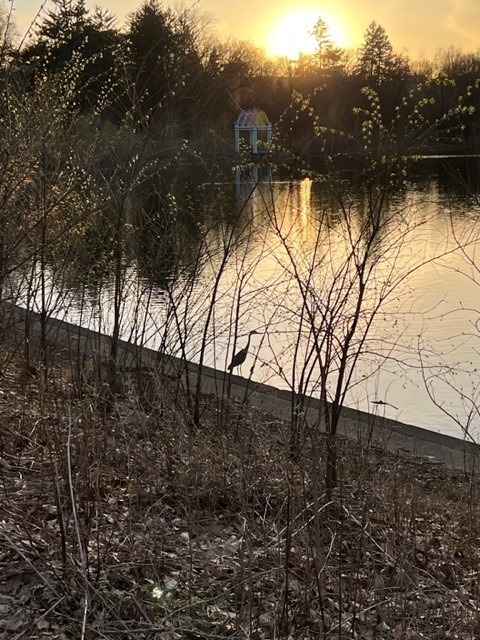
Heron at sunset

The window next to me as I write this faces west too, but it’s only an urban alley. Here’s a sunset a few blocks east, the heron doesn’t seem to know they’re in a city.

.

It starts with a woman undressing, where in art a long tradition of erotic gaze comes with that choice. If that’s so here, it’s a deep and unstated undercurrent. Is she just readying for bed, for dreams perhaps? Or something else? By accounts, Dickinson wrote often at night. I don’t know if she wrote after a change into her bedclothes or not, but this possibility: the sunset’s heralding of an opening to the looser dress of imagination may be in Dickinson’s mind.

The 2nd stanza expands from Earth’s sunset, to let us know, as scientifically educated Dickinson did, that the Sun is but a single star — and if I read her right, that stars are being born daily in the universe.

Another trope that comes with the sunset: day’s end meaning life’s end. The poem’s 3rd verse indicates this is considered and taken as a side issue of this sunset — sunset’s ars longa isn’t so concerned with that — and as it happened, Dickinson’s night-scribed poetry became more than a lifetime-lived. In some mythologies, the sky gods are male —in this one, our western, setting sun is a “Lady of the Occident,” female.

The final stanza starts with a line: “Her Candle so expire” which if considered more fully isn’t just sunset extinguishing the last light before bed. My ear may be over-pun-sensitive, but I hear the rhyming word “fire” in “expire,” and once more the cosmologist is saying in that line that stars themselves have lifetimes.

Someone has been sailing on frigate-books in the closing two lines. I’m surprised at her knowledge of the truck in a sailing ship’s rigging, a ball where the halyard’s pass. It’s an unusual word, no-doubt chosen to consonante with Bosporus, the water separating Europe and Asia next to Constantinople/Istanbul. The dome in the final line is then the Hagia Sophia (“holy wisdom”) church in that city. And the final words, “Window Pane.” What’s this definitive, capitalized pane of glass? Dickinson’s bedroom faced west, her little writing table at a western window.

The Day Undressed Herself

Here’s a rough chord-sheet of today’s musical Dickinson.

.

I wanted to do something featuring a lush sounding steel-string acoustic guitar for this one. With luck I was able to just squeeze in the final take you can hear below as my studio space time so expire. You can hear that performance with the audio player gadget below. No player seen? This highlighted link is an alternative that will open a new tab with its own audio player.

.

*This Festival features a multi-day round-robin reading of all of Dickinson’s 1789 poems, and each time I go through that experience I’m reminded that it is as impossible to comprehend all of Dickinson’s poetry as to remember all the stars in the night sky. Each time through, “new poems” seem to have been inserted — which are in reality ones I had heard in previous years but wasn’t ready to feel until now. Just sitting through a small portion of the readers’ reading — an hour or even a half-hour — can change your appreciation of what Dickinson offers. Busy people might want to choose only one of the reading sessions that has a convenient time for them, and maybe do some hand mending, cooking, or housework as the variety of readers speak the poems in turn. Let the poems that you are ready to feel come to you in your household, as their author composed them in hers.

There are also a variety of programs discussing other aspects on this year’s schedule. It’s all free to attend, but you should sign up at this link.

Like trains of cars on tracks of plush

Later this month I’m hoping to attend remote online sessions of the Tell It Slant Poetry Festival run by the Emily Dickinson Museum in Amherst, perhaps as many as I did last year. Something they do that I enjoyed was listening to all the sessions where a range of readers read all of Dickinson’s 1789 poems.

Now was I sitting in rapt, solitary devotion for every hour of that multi-day marathon? No, though I was paying some attention throughout. I restrung some guitars, reduced the clutter in my office and studio space, put away laundry, and tended to the dishes. If I gardened or cooked, I could pretend I was work-a-day Emily herself.

What makes the marathon meaningful, even if one does it only in part? The multiple voices for one thing. A group of several people read the poems in rotation each session, so there was no careful preparation from foreknowledge of which poems exactly each reader would read. A prepared reading might be powerful — having trained actors or voice artists read the whole corpus would bring something to it. This is not that, yet worthwhile.

I’ve heard a lot of folks read poetry over the years. Several of the readers struck me as better than most, even given that they might be reading the poems that came up in rotation for their turn essentially cold.*  Of course, every so often one of the readers in their turn would get one of ED’s greatest hits, and all of us: the reader, the other readers, and the attendant listeners would perk up. If one pays attention to this, that happenstance, it “dazzles gradually.”

But then too the ordinary readers, the times when someone stumbled on a word, the lesser-known poems, the small ones that might be no more than a quatrain or two — they two are part of the fullness of Emily Dickinson. She may have been a genius, but she produced these hundreds of poems among a more-or-less ordinary life, infusing them with worthwhile attention. With this many poems it’s unlikely anyone (certainly not I) can really hold all of Emily Dickinson’s work in memory. And so it is, in such a complete reading, that some poems will spark with my attention as if they were just written and never before read or heard. With the smaller poems especially, it may be not much more than a glimpse we share in real-time with Dickinson’s ability to see and think differently. Yet, those small visions add up over the hours, grander from their numbers of unique takes.

Which are the poems she drafted while baking, head full of the hymnal meter, hands dusted with flour? Which while in the garden? Which while caring for her sick mother?

Virtual attendance is planned for many of the Tell It Slant sessions that run from September 25th through October 1st. You can sign up for them at no cost at this link. No one’s taking attendance — see or not see any of the sessions as they fit into your life or level of interest. Given the uncertainties in my life, I’m not sure how many I will be able to fit in.

One game I played during the readings — where I eventually jumped into the chat window with exclamations — was whenever the poem cycle came upon a bee. Dickinson closely observes many plants and animals, but she seems to have had a particular affinity for the bee. Is it a symbol of the Puritan work ethic? A chunkier, easier to observe bug? A symbol of fertility? A flying rose with sweetness and a sting? A coworker the knowledgeable horticulturalist knows is essential to pollination?

like trains of cars on tracks of plush illustration

Billy Strayhorn and Duke Ellington aside, sometimes the muse takes the bee train,

.

Here’s one of her short bee poems, particularly extravagant in its imagination. And here’s a link to what I believe to be the authoritative text.**  That opening image alone should astound. Bees as a railroad train, with the plush flowers as directive as train-tracks —yet soft, not iron.***  “A jar” in the second line is ambiguous. A jar as in a container for the pollen it collects? Possibly, but I’m suspecting more at ajar’s meaning as apart or out of harmony. Bees as locomotives and their train of cars makes them outsized from reality’s proportions. They may move the petals on close examination, their industry is harder and heavier than the plants.

In the second stanza, the metaphor shifts. Now the bee is a knight, the flower a fortress or castle they assault. The bee-knight seems a strangely chivalrous marauder, if inconstant and ready to move off to the next bloom.

As an Imagist poem, this then can be apprehended as simply a picture, an observation of a charged moment of attention. How strange to see the tiny bee as a train or even a knight — but yes, it must travel in appointed commerce on its compelled track, and yes, like a wandering knight-errant it must move on.

But this bee could be a muse too, couldn’t it? It knows its schedule, even if we don’t. It arrives, shakes us like a passing train, assails our walls, then bids a courtly adieu and passes on to another artist, writer, musician.

You can hear my musical performance of this short Emily Dickinson poem “Like trains of cars on tracks of plush”  below with the audio player gadget you should see there. No player? This highlighted link is another way to hear it, as it will open a new tab with its own audio player.

.

*I once worked for a radio network. Watching the on-air folks, I was reminded that the ability to cold read text is a skill. It sounds easy to do — when it’s done right.

**There’s a twice as long version out there which I think is derived from the 19th century Mabel Loomis Todd and Thomas W. Higginson posthumous collections. These were straightened up for easier public assimilation and were given, by the editors, their ideas of meaningful titles. Did they append two fragments thinking them connected? My apologies for not researching this issue further.

***As striking as Dickinson’s image is here, railroads were as essential to 19th century American commerce as bees are. Towns grew and shrunk based on their routes. Another plausible reason for the train image: one of Dickinson’s father’s commercial achievements for Amherst was assuring that it’d get a railroad line.

The Emily Dickinson Tell It Slant Festival

Productivity on this Project has been lowered this week for what seems to be a good reason. I’ve been attending online some of the Tell It Slant Emily Dickinson Festival put on by the Emily Dickinson Museum in Amherst. My focus from their offerings? So far I’ve heard every session of their multi-day, 15-hour, reading of all of Dickinson’s 1789 poems.

These marathon public reading sessions are wonderful, more rewarding than I would have predicted. Their format is to read from the Ralph Franklin edition of Dickinson’s poems, organized in a best estimate of order of composition, with a revolver of readers reading one poem, and then on to the next reader without pause. Online during weekdays, it’s been a Zoom thing, with the reader’s face appearing as they read in turn from their own office or home, and with the poem’s complete text appearing on-screen at the same time. The readers vary in voices and coldly-judged reading skill* — but this is a feature not a bug. You get a sense of humanity breathing the words of Emily Dickinson, and as it’s online, the readers and listeners aren’t even all in America as they celebrate this American poet.**

This process really impresses one with the immensity of Dickinson’s verse. There are often surprises with lesser-known poems catching my interest in-between the “greatest hits.” Dickinson’s various moods and voices come out, reinforced by the various readers approaches. In the side-chat text window, folks (and sometimes myself) react as the progress through the 1789 reaches their favorite poems.

In summary, even though I’ve read — and then spent the time to internalize and perform many Dickinson poems — this marathon reading has overwhelmed me with the facets and power of Dickinson’s work.

Tell It Slant 1

I’ve spent most of my Project time here this week.

.

There are still events this weekend, including two final sessions of the marathon reading, though I think the readers may be at a public event rather than in their homes and offices on the weekend. Here’s the event’s schedule and sign up site: The Tell It Slant Poetry Festival 2022 Schedule – Emily Dickinson Museum

Thanks to all the readers and the organizers. Want a musical piece? Here’s my expression of another Emily Dickinson poem that asks us to consider the slant. Player gadget below. Can’t see the gadget? This link then.

.

*I’ve worked for a radio network with experienced and skilled voices that expect/achieve a consistent performance when speaking with microphones, so I appreciate those easy-to-take-for-granted skills. But the variety of the readers in this marathon are a modifier of multitudes. Think of the difference between a professional, polished studio music recording and an informal get-together of an assortment of enthusiast musicians. Each has its flavor. The majority of the volunteer readers are as least as good technically as I would be in their role.

**These readers are volunteers. There are indications that one can just sign up to read, but the general level of reading skill I’ve seen indicates at least some self-selection is going on. Maybe 75% of the readers are women and there was only a smattering of people of color. This isn’t a gotcha note on my part. First of all, an all-woman roster could have expressed Dickinson’s range — after all Dickinson herself did — but modern English-language poetry has such a range BIPOC voices that I’d like to see more shades of faces volunteering and reading. I wouldn’t be surprised if the organizers feel the same way.