Stones Under the Low-Limbed Tree

Today’s piece has an eerie history. It started as a poem by Robert Frost, but I think four years ago I turned it into a song. I had more or less forgotten about it, but this past week I found it in some past work that I had separated out to work on for this project.

Looking at it, I put it near the top of the pile. I thought it representative of the best of early Frost, when he was a supple lyric poet. “This’ll be great. So clean in language. So concise in his laying out of the story.”

The process of producing the performance and recording that you can hear below went well enough. So today I was getting ready to write about my experience of Frost’s poem after going through this project’s process. As usual, I wanted to find a location for the original text for those that want to read along. I found a good link to Frost’s poem. It’s here.

Surprise! Turns out I had modified Frost’s poem much more than realized. I had recalled only that I had repurposed a pair of Frost’s lines to create a chorus/refrain—but when looking at the original poem I hardly recognized the text I had been working on during the recording of the performance this month. It turns out, “Ghost House”  (as he titled this piece) was an early poem of Frost’s, written in 1901 and included in A Boy’s Will,  his first collection of poems published in England in 1913. Unlike most of the poems in that collection, “Ghost House”  had been published, back in 1906 in a magazine. The reason A Boy’s Will  was published in England was the Frost had made little headway as a poet in the United States. At that point he was nearing 40 years old, so it’s possible that if Frost hadn’t traveled to and succeeded in England, this greatly loved American poet would be nearly unknown.

I stress the actuality that I had no recollection of recasting the poem extensively when I say that I prefer “my version” to Frost’s original. The lack of any memory of the work I did means that this judgement is rather impersonal. Frost’s “Ghost House”  isn’t bad, but it’s not as distinguished as other poems in his early work. It seems more 19th century for one thing. It also overdoes it, seeming to confuse more elaboration and details for more impact and substance.

Stones Under the Low-Limbed Tree

Here’s Frost’s poem as revised for singing.


When I briefly try to reconstruct what I did to make the text for today’s piece, I see I used his lines for the most part, but I trimmed out much. My lyric is essentially 17 lines. Frost’s is 30. I dropped entire images, some inconcrete and a bit trite (“I dwell with a strangely aching heart”—you’ve shown us that mood Robert, telling us that is less vivid), and some redundant (we’ve got raspberries and grapevines, we don’t need the apple tree* too). Then too, I chopped the entire whippoorwill stanza, which some argue contains the key image in the poem.**

I also may have just been trying to make it more sing-able.

These two things are lessons. First, poetry often gains power by saying something in its most striking, sensual, and strong way—or even when it’s being less direct, by combining a few things (perhaps only two things) in an unexpected but powerful way. Everything beyond that may detract. The second-best or third-best image subtracts by its addition. Frame your best images, don’t embarrassingly hide them in clutter. And secondly, at least with lyric poetry, when it sings it means.  Poetry works through the music of thought. Even something that clarifies the meaning or explains further a point may sometimes be dispensed with in order to make a poem a musical statement that will lodge in the reader/listener’s ear, and via that canal to their brain. In this case I don’t think I sacrificed clarity, but also I don’t think I could sing Frost’s version—and at least in my case, I didn’t remember his.

Did what I do mean I think I’m a better poet than Robert Frost? Nope. I also may not be a better poet than you. But on any one day, on a particular task, with a particular aim, I might be. Frost was a famously grumpy personality, but perhaps his ghost has mellowed with immortality. If so, I hope he might think I served the inspiration of his early poem by trimming it back. Or maybe I didn’t make these changes, since I don’t remember? Perhaps Frost’s ghost came by and made the revision?

To separate this version from the canonical Frost version I call it “Stones Under the Low-Limbed Tree.”   The player gadget for my performance is below. Oh, and do follow at least one of the links in the first footnote below. You’ll visit other ghost farmsteads in search of fruit still yielding outside fallen cellar walls.


*This morning I read this fascinating story that went out on the AP wire. It covers something called the “Lost Apple Project” which is haunting abandoned farmsteads looking for old varieties of apples that sustained—or tried to sustain—homesteaders. Oh man did this resonate when working on this piece!

**I didn’t know, but some readings of “Ghost House”  say the whippoorwill is known as a bird foretelling death or other disasters. News to me. Even if I knew that, foretelling seems to blunt the impact of the poem as I cast it. In my mind the point is that the death/disaster has already occurred. Yes I know, some readings say that the poem’s speaker is either dead or gothically welcoming death for himself. I don’t disagree with that, but it doesn’t change my view. Even if the speaker is still alive but wants death, an omen bird’s warning is gilding the raven.

From Our Breasts, Frances Cornford’s “The Old Nurse”

I’ve been planning on presenting this eerie ghost story by English poet Frances Cornford for awhile now, but I wanted to take care with the musical setting while working on our recently completed countdown of the most popular pieces here from this past winter.

Heidi Randen was interested in doing this as a guest reader, and it’s her voice you’ll get to hear today. She’s also the guest blogger for this piece, so before I say our customary few words about the music let me turn it over to Heidi.


From Our Breasts, Frances Cornford’s The Old Nurse

By Heidi Randen, guest writer for Parlando (and Frank’s wife)

Like the subject of this poem, I am an old nurse. When my husband shared these sad, sweet, ghostly, gothic verses, they resonated with my experience of nursing in the biological and professional sense. I breastfed our kid and have worked as a Registered Nurse in hospital and clinical settings with very old and very young people.

Frances Cornford wrote this poem in the 1920s when professional nursing was still a new concept.  Florence Nightingale pioneering nursing in the field during the Crimean War would have been about as far back in the collective memory as the Korean War is to us now.  Nightingale started the world’s first professional nursing school in London in 1860. This occupation would have been as relatively novel as computer programming or palliative care are today.  In an English village in the 1920s, an old nurse would most likely mean an old wet nurse or an old nursemaid.

Wet nursing is a humble and humbling profession:

Against my breast I felt a small and blunt-nosed head.

To breastfeed is to be reduced to a mammal, a one-person dairy operation.  To share your milk with an infant in need who is not your own is an extravagant act of human kindness, yet it carries great stigma. In my family’s American immigration story, relatives on my mother’s side repeat the line: Our family was so poor that your great-great grandmother had to work as a wet nurse in the Netherlands.

Breastfeeding is like still being a little pregnant.  Your body is not wholly your own, still providing shelter and sustenance for another.  This is also the case in professional nursing.  When I worked in the hospital, I would often forego sleep, meals and bathroom breaks if it was a particularly busy shift.  This self-sacrifice is why nursing is still considered a calling and is listed as the most trusted profession in the United States and the United Kingdom.

From Our Breasts 1080

The circle of life: the woman who breastfed me and who suffers from Alzheimer’s, being helped long by the person I breastfed, my kid who talks about going into nursing when they grow up.


In my experience talking with fellow nurses, neonatology, pediatrics, oncology and hospice are considered extra special callings.  It takes greater emotional mettle to get close to babies and children in pain, to help people with serious or life-limiting illness and their families.  Put any of those specialties together: neonatal hospice or pediatric oncology and you are exponentially special, perhaps super-human.

But nurses are very human.  We see things that are unbearably sad.  And there is nothing sadder than a dead baby.  It seems like the worst violation of the order of things.  But it is not.  To me, the worst thing in the world is when people are left alone in sadness and fear.  Like the woman in the poem, the nurses of the world—in all senses of the word—hear crying over the sound of storms, seek out those in distress and provide comfort.  The satisfaction of this experience is expressed tangibly by the poet:

And a sob-quivering body slowly growing calm
And toes like round cold buds that warmed inside my palm.

Like the subject of this poem, I too see dead people and they don’t frighten me. The longer you watch human beings move through all their stages, you see that the end of life has much in common with the beginning of life.  This became most apparent to me in the space of one day when I visited a friend in the hospital with a newborn and a friend dying in hospice.  The mystery of where that baby came from was the same as the mystery of where my friend was going.  To nurse is to help for a little while on another’s journey, then—like the old nurse at the end of the poem—to be alone again with this mystery after they leave.

The Old Nurse as published in Cornford's Autumn Midnight 1923

The page from Cornford’s “Autumn Midnight” collection where the poem was published in 1923. Woodcut by Gwen Raverat

Heidi didn’t mention this when she wrote this earlier this year, but of course now we are asking nurses and others to put their bodies on the line with our current Covid-19 crisis.

Here’s those few words on the music. My original starting idea was to use singing bowls as part of the arrangement, but I have only one available, and while I could manipulate the single pitch after recording, I wanted them to play intervals and triads and decided to go another route. I used some gongs and bell for the piece’s intro, but much of what sounds like the singing bowls is an electric guitar being sustained to feedback levels and then being fed through a modulated reverb. I also made use of one of my favorites, the Mellotron cello sound, because that instrument’s uncanny aural valley always sounds spookier than the real thing to me.

The player gadget to hear Heidi’s performance of Frances Cornford’s “The Old Nurse”  is below. If Cornford intrigues you, I’ve presented two of her poems with original music earlier this month.


The Changeling

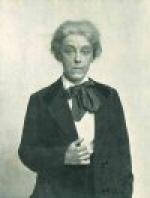
Have you heard the name Charlotte Mew? I hadn’t until I came upon it in Herbert Monro’s 1920 Some Contemporary Poets  this month. Last post I presented Walter J. Turner, another now-forgotten early 20th century poet found in Monro’s book-length survey of his era’s British poetry. While I doubt we will ever see a full-fledged W. J. Turner revival, with Mew I think there’s room for growth in interest. She’s that unusual and that good.

I’ll probably spend more time on what I’ve found out about Mew when I present another piece, but to hit some highlights: she cut a notable figure even among the unconventional artists of Bloomsbury, wearing tailored men’s suits and displaying a wide-ranging intellect. Mew was both parodied for her eccentricities and praised. Among her literary admirers: Thomas Hardy, Virginia Woolf, Sara Teasdale, Ezra Pound, Siegfried Sassoon, Walter de la Mare, and Harold Monro himself, who published her first collection of poetry.

Charlotte Mew

Maybe she looks like Gene Wilder as Willy Wonka, but read/listen anyway…


Why haven’t I (and likely you) heard of her? Fame forensics is a fraught subject. She’s one of those authors that straddles the centuries, though she didn’t start publishing poetry until the 20th. Some of her subject matter looks backwards, and individual lines will sound like they could be from a Victorian-era poet. Even so, her poetic style is her own. She uses uneven line lengths and unstable rhyme schemes, yet they don’t fall into doggerel. Mew died in 1928 and was not active in publishing in the last years of her life, so as Modernism was taking over she may have been just a bit “yesterday’s papers.” She may be one of those cases where her career didn’t rise high enough and maintain sufficient altitude to carry her glide-path into the second half of the 20th century. But like her admirer and champion Hardy, Mew is another one of those poets who at first, in some superficial respects, can seem old-fashioned, yet her core outlook is modern and unconventional. If one comes upon her work today and doesn’t expect her to sound like T. S. Eliot or Wallace Stevens, her uniqueness can still deserve your attention.

“The Changeling”  is a fairy story of the chilling variety, more “Belle Dame sans Merci”  than Disney. It’s Peter Pan meets Tam Lin! Like some other Mew poems I’ve already read as I start to look at her work, it’s extraordinarily easy to see modern psychological and sociological analysis in it’s situation. The narrator’s outsider sensibility is right there from the start, and the lure of the old wild natural world makes the order of the urban home and nursery regimen seem like a riot against that.

It’s Peter Pan meets Tam Lin!

Despite there being no regular line lengths or stanzas, I found it reasonably easy to set Charlotte Mew’s “The Changeling”  as if it was a folk song of the “Tam Lin”  variety. Alas, as is the case with many of my favorite old ballads, the result is lengthy by song standards. To compensate and decorate the time while you hear Mew’s tale unfold, I’ve added things that a handful of adventuresome British Isles folk-revivalists might have added 50 years ago: there’s tambura, sitar, and my first effort at playing tabla drums.*

So brew up some tea or elfin grot and listen to “The Changeling”  with the player gadget below.


*I tried an inexpensive electric sitar a few years ago, but never got the hang of it. I now play sitar and tambura using a MIDI guitar, retuning when desirable. For my attempt at tabla today, I didn’t use a drum controller or pads, but instead triggered the drum hits and pitches with my MIDI guitar as well. As I should always do, I offer my apologies to the real masters of those instruments who have given me much listening pleasure over the years.  On the other hand, my 9 minutes or so today is a short piece compared to many traditional South Asian numbers.