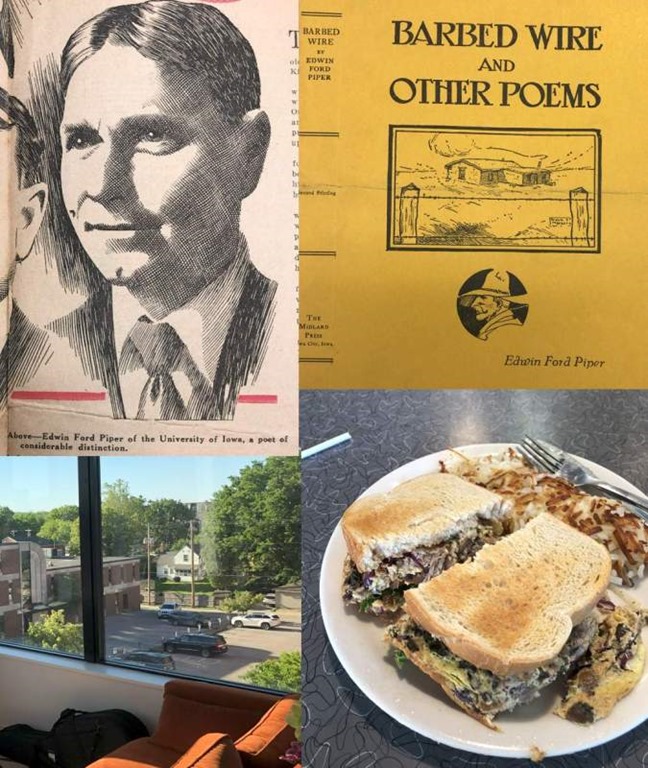
Those following my June series on my trip to investigate the life of a largely forgotten poet, folk-song collector, and teacher Edwin Ford Piper may wonder why I titled it “Paying the Piper.” There were a couple of reasons I knew as I started writing the series after returning home after the trip.
The first: I’d be paying attention to Piper when nearly no one else was. That may be a strange choice, though it’s one I’m largely comfortable with. I enjoy looking at places others aren’t, and I love stories that connect seemingly unlike things. So, Piper’s settler family moving to the frontier of Nebraska just after The Civil War, raising a poet-son who educated himself on the plains amid those who stayed, and those who passed through. I being a guitarist who grew up in the folk song revival, I appreciated that he collected the songs that entertained those people, songs that I could run into decades later because of the work of collectors like Piper. Even my search on that elusive question I couldn’t solve had it’s rewards: what of the pervasive Workshop and MFA culture of poetry of the last 70 years arose, perhaps unwittingly, from Piper’s own methods.*
The reason we call it paying attention implies it has a cost. I could have done more new musical pieces here, ones featuring poets there is more general interest in. The longer posts in June took a lot of work for a small audience. I chose to pay that cost. If you come here for the more known poets and for the musical performances, some of those are already in progress this week.
My wife and I returned home in the evening after my sojourn to the University library in Iowa City. I had a lot of notes, and pages captured but not yet analyzed, and I had ordered a couple of books to help that would arrive in the upcoming week. It was good to have gone on this trip. It was good to be home. Now the second paying.
What was the one thing I was most looking forward to at dawn the next day? Getting on one of my bicycles and moving my old body briskly through the cool morning air. I would ride to a café and have a frittata and a big glass of iced tea, read the newspaper, and think about poetry or music tasks for the upcoming day.
I walked out that next morning to the garage access door, and I found it slightly ajar, unlocked. I opened it. Sometime during my Iowa trip, my family’s bicycles had been stolen.**
I could write a thousand words here on the stolen bikes if I thought there was a readership for that. I lost my old original generation mountain bike. It was the first bike I bought to ride through Minnesota winters back in the early 1980s instead of buying a car. I rode it in snow as planned, and over rough trails in woods — and in a couple of returning trips, in the river valley hills and gravel roads of Iowa where I grew up, With less knobby-tires it worked well to ride around the city too. Over a decade ago it was the bike I attached a trailer bike to, to take my young child for rides. In the last few years it had become my rain bike since it had full length fenders, and it was the one I rode when the place I’d need to lock up was a little more risky. I’d figured, scratched up and faded, outdated in every regard, it didn’t look like anything to steal. But, it was gone, though I tell myself the memories aren’t stolen.

Picture of the OG mountain bike taken a bit over 10 years ago, when it still had the trailer-bike hitch on it.
.
20 years ago I decided to replace it, and bought what was then a modern “Hybrid Bike.” It was an aluminum Trek, not the fanciest in their line then, but it had indexed gear shifting and the ability to run thin high-pressure tires that I thought would make the bike nimbler. However, the bike and I just didn’t bond. It never was a joy to ride, even with the 28mm narrow tires that were expected to make it faster and easier rolling. Aluminum frame bikes, particularly the ones from that generation, are known for having a harsh ride, maybe that was it I told myself — but whatever, it just wasn’t any fun. Then a couple of years ago I obtained a set of new wide 50mm tires that didn’t fit the bike they were bought for. I’m not sure why, but I mounted them on the aluminum Trek along with a Brooks Flyer leather saddle (that’s the one with springs). The bike was transformed. The extra tire air volume and the saddle not only made the bike more pleasant to ride, those tires made the bike feel more nimble (and more tolerant of bad street surfaces). In the past year it had become the bike I rode more than any other. It had been some mice and a pumpkin, then a splendid carriage and horses — and now, poof, it was gone.
The bike I was looking forward to ride that morning? A purple REI Randonnee that my wife and I had bought used with the idea that she might want to try longer bike rides at some point. It too was probably 20 years old like the Trek, but it had a smooth riding double-butted steel frame. That touring idea never worked out, but I had modified it over the years with a better set of handlebars, a tweaked stem height, some used “brifters” for indexed shifting (my wife never cared for the bar-end shifters it came with). I ended up riding it on longer rides. It was comfortable, responsive, and I miss it.
Also lost, both my wife’s and my winter “Fat Tire” bikes.
Just inanimate things, but I ride my bikes almost every day for joy and utility, the loss was something like loosing a pet.
All lost as I was in a library studying the life and times of a largely forgotten poet and singer of songs people kept.***
.
*I might write more on that Workshop/MFA issue for poets and writers later this summer, but one of the folks who helped guide me on my search S. L. Huang wrote a thoughtful article on the dangers of this paradigm for many writers which I’ll link here.
**I won’t go into the details of how/why the garage was unlocked, though I likely know.
***Besides the thing-grief of these oft-used tools for joy being gone, and the work of trying to nail down details with the Edwin and Janet Piper stories, a large part of my June was taken up replacing the stolen bikes. You’ll meet the replacement bikes later, likely in use.


 Frank Hudson