The Lent Lily

Here’s a poem by British poet A. E. Housman that’s not an Easter poem — and then again, might be. On its heathered surface it’s a poem about wildflowers. My wife, who likes to hike in natural areas, could probably make good sense of it on first reading — but if you don’t know your wildflowers and aren’t attune to some Britishisms, you might be left with just a pretty set of words.

Lent Lily

Trying to mesh Housman’s poem to the music I was forming, I ended up making changes to the poem as it appears on the page (linked here).

.

Right off in the poem we’re rambling on “brakes.” As a bicyclist, “hilly brakes” might make me think of brakes squealing on my old much-missed mountain bike. While I’d like to think of Housman in a tweed jacket enjoying such a ride, the “brakes” here are a Britishism for a thicket or area of shrubs and other undergrowth. Other words that would have “special” British or archaic English meanings? Young girls are asked to “sally” — which is not the given name of one of the girls, but a word meaning to go forth. In the first stanza besides the “brakes” Housman calls the place of the flowers “hollow ground,” a word-choice that’s a little harder to parse. Hollows are an old word for a small valley, which is likely what Housman means (he calls out valleys in the last stanza). One reading I came upon thought the “hollow” a variant of “hallow,” as in “hallowed ground,” and derives from that the idea that Housman’s wildflowers have sprouted in a graveyard. I can’t find a cite for that variation, but hollow is a somewhat odd choice here, and without regard for hollow meaning hallow, graves do produce hollows in the ground.

Our first wildflower, primroses, are found in that opening stanza. Next stanza, next wildflower, the windflower, which I first thought was a Gerard-Manley-Hopkins-like compound word, but windflower is the common name for another wildflower. The stanza goes on to introduce the flower featured in the poem’s title: The Lenten Lily which the poem tells us “dies on Easter day.”

Third stanza, the primrose and windflower are still present to decorate May Day, but the daffodil we’re told is not. And the poem ends with a final stanza telling us again that the daffodil dies on Easter day.*

Here’s more wildflower ignorance on my part: the Lent or Lenten lily is the daffodil — just another name for the same flower. I’d never heard that Lent lily name, but for a long time I really didn’t know the daffodil either. The daffodil is a common wildflower, but unlike my wife, I don’t know it to call it out by its name and properties on sight. I knew the daffodil not from the book of nature, but from the famous poem by William Wordsworth** “I Wandered Lonely as a Cloud.”

A few years ago while visiting England in the early Spring I came upon an entire lawn at Kew Gardens filled with yellow flowers. “Daffodils” my wife told me. This was a London park, not the hilly brakes of Britain’s Lake District, but I suddenly found myself, from her knowledge imparted to me, inside Wordsworth’s poem and the physical, now knowing, presence of this flower. The dark green grass and the sunny yellows in array before me were ever brighter because back at my home in one of the most northern states, things were still snow covered in early April.

My view soon after entering Kew Gardens.

.

Housman is telling us something else about the daffodil: not only is it one of the earliest blooming Spring wildflowers, giving rise to the Lenten lily alternative name for it, but it’s also one of the quickest flowers to die and disappear. That name, that property, gets us to the question of “Is this an Easter poem?” Housman is not at all a Christian devotional poet — he was a devoted academic classics scholar and agnostic.

Well, maybe that’s his point. Easter is the particularly Christian holiday of resurrection and eternal life. Housman, not a Christian believer, has written a poem that refrains on something natural — this flower — that’s not spiritual like a soul or godhead, but a piece of lovely, wind-caressed carbon that dies by Easter Day. In that natural order, this brief wildflower certainly dies. A Christian apologist could easily counter: that’s the promise of The Resurrection, that it is something else. One can read the poem and see either side. Of course, there is a thumb on the balance: Housman has written a poem, and I’ve gone along with him and made a song of it. Poems are not so much about what they say — because they have sound and a carefully selected order, they are more about what it feels to say or see or sense something.

You can hear what I made of what Housman’s poem portrays with the audio player you should see below. What, has any player disappeared like the daffodil? It’s not that — some ways of reading this blog don’t believe in showing the player. So, you can roll away the stone and use this highlighted link to hear it instead.

.

*I’ve read that English churches are decorated with picked daffodil flowers during Eastertide, which may be what Housman is referring to when he says that other Spring flowers survive April. Or the primrose and windflower et al may just be hardier species.

**As it turns out, William Wordsworth based his daffodil poem partly on journaling done by his sister Dorothy Wordsworth who had accompanied him on his Lake District walks. That’s a wonderful thing about our relationships with others: what we see and sense can be informed by them.

Whispering Often

Perhaps we should remind ourselves in this pre-AI age that every poem, any poem, is written by another human being. I did the math with the years, and this is a poem published and likely written about a hundred years ago by a 40-something Midwestern American.

I’m decades past that age, as was Donald Hall when Hall gave us his law that states that most poets, even prize-winning ones, will be forgotten 40 years after they die. This may sound callous, but that process is likely necessary. How many poets can we hold as a culture, as a reader? Dozens? Certainly more. Hundreds? Whatever, there’s a limit. The poet who wrote today’s piece? Who would we give up in the pantheon to let him in?

I came upon the poet who wrote today’s poem, Edwin Ford Piper, by reading a striking poem he wrote of the closing American wilderness that I’ve already presented earlier this year. I know little about him as a person.*  I almost worry to find out more, since human beings are full of all kinds of faults, deleterious opinions, vanities, and misapprehension. Did he write this poem in this time of the year, in the Spring? Who can say. Writers are full of memories, and imagination that can redress any cold or baren place, but it feels like he did. The poem’s trope of Spring’s reincarnation of driving/seeking life paired with the Christian holiday of Easter is far from unique — but the poem’s not, in feeling, much of a Sunday-dress observance — it’s luxuriously pantheistic. “Whispering Often”  was written in a past era we still call Modernism, published in a journal that put forward many of the great English Language Modernist poets, Chicago’s Poetry Magazine, and it was included in Poetry’s  founder’s anthology shortly afterward that had Modern American Poetry  imprinted on its end-boards — but I can’t call it an example of Modernism.

Whispering Often song

If you can un-embarrass yourself, you could sing this Spring poem too.

.

It’s not end-rhymed. It does sing on the page, despite having a meter that I can’t easily chart out. There’s a familiar iambic rise to many of the phrases, but I don’t think I can call it blank verse, a form that Piper used elsewhere. Oh, but does this rite of Spring want to sing! The title says whispering, so maybe the poet is abashed at the voice that is called forth. Not a lot of today’s poetry sings like this. Instead, we’re more often interested in a poem showing us a particular apprehension the poet has uncovered, an apprehension we are to recognize and share. We are want to pause and recognize the matter of typical 21st century poems, like a friend speaking with us. A wise friend perhaps, a little better with language than we normally are — but still, we wouldn’t want them to break out into a song over shared teacups or beer glasses. How gauche that’d be!

And so, I think of this poem now, as Spring is rebeginning here in my Midwest, as the Abrahamic religions are celebrating holidays of freedom, rebirth, and revelation — but more so as the northern half of earth is celebrating something that Abraham could have seen in a place outside Ur. In this case, a man in his 40s, a Midwestern American like myself, stopped and wrote this down.

What an odd act! If he paused to think about it, he would know that by all odds this poem will be soon forgotten. Yes, Piper was a professor of literature, but he was an adult, someone who knows the comings and goings, the correct way to behave, the agreed worth of this and that. Yet the poem will appear as something as outrageous as an unbidden public song, one with a crush of erotic desire for life. Religion can shape and seek to make that solemn — and perhaps such a transformation teaches wisdom, brings thoughtful ethics to our roots and melting eddies — but that Spring is older than wisdom.

It’s enough to make a grown man break out into song after all.

So I did. Earlier this month I hurriedly sang a bunch of pieces I had written that I feared wouldn’t have time to shape and improve into full arrangements in an interrupted life. Long-time listeners will know my voice isn’t going to be polite, though maybe it should be. You can hear that quick, short, performance with the graphical audio player below. No player? You don’t have to rush past, you can use this alternative highlighted link that will open a new tab with its own audio player.

.

*It’s not certain, but there’s a fair chance that later this year I will make another trip to pay respects to one of my poetic heroes, Carl Sandburg, and on the way tarry awhile to see if I can learn more about Edwin Ford Piper.

Beneath the Poplars, César Vallejo’s Easter Locus Solus

As National Poetry Month continues, let me take a brief break from the personal history of Parlando inspirations to again do in the present what this Project does: explore a poem as I combine it with new music. A few weeks ago I found an early poetry collection by the Peruvian poet César Vallejo. Before looking into this collection Vallejo was just a name to me, a poet who is best known as being a favorite of other poets whose work I had read.

If I had time to write more tonight I could go into his troubled life, but I do not. Suffice to say he grew up poor in rural Peru, and by paths he traveled to Lima and studied some in Peruvian universities, but poverty and trouble with the authorities seems to have always followed him. He fled to Europe and had down-and-out adventures there, but eventually died there 85 years ago this April. In a brief interchange with another poet on Twitter this spring we agreed that from what we know Vallejo seemed to always be an expatriate, an exile — and unhappy from that. If so, unhappiness for a man, but poetry deals with diaspora often and well — perhaps because even when we are dealing with our native language, the dialect we spoke from childhood, we are seeking in poetry to find its real home. So often poets stand in the midst of other native speakers of their language and find this so.

My adventure with a poem in a foreign language forces by nature a greater travel. Even if I have another English translation, I try to find it in the original and start again with the awkward literalness of a machine translation of that. Other translators likely have smoothed over the troubles of a literal with their chosen solutions, and out of some pride and a desire to not appropriate the work of other living writers, I then try to make a vivid poem in English out of it. Besides recreating the poem’s images and music of thought* in English, I often drill down into individual words by looking at foreign language dictionaries and examples of usage to see what plausible other English words might convey the author’s intentions. Though I feel conflicted about this, the process of collaborating with a dead author engages me as if I am writing my own poem, and from that arises a danger that I may be tempted to extend the poem or add variations on the original’s theme. In this Vallejo poem, my translation has a couple of gray areas, which I’ll note for accuracy’s sake.

Here’s my translation of “Bajo Los Alamos”  into “Beneath the Poplars:”

Beneath the Poplars

Jose Garrido was another young Peruvian writer that Vallejo knew before exile.

.

A few notes on my translation. In the first line “bardos” might well be translated into poets or bards. I made an eccentric choice, “scriptores,” trying to make the image more clear and mysterious at the same time. I thought of the poplars branches swayed over in the pasture wind would be like monks hunched and copying manuscripts, and that would be consistent with a poem that I feel is about labor and respite. I believe poets labor, but as a word poet doesn’t suggest it directly enough.

The 11th line was difficult for me, and I can’t right now recall all the struggles I went through to arrive at the line in my version. Given that the poem is about an old shepherd falling asleep in autumn, a clear image of the falling leaves being like sheared wool may have attracted me more strongly than a literal line translation.

I think the 12th line describes a sunset — and while Vallejo didn’t say sky, I decided to clarify the sense of “azul” here as the blue sky, as we mean it when we say “out of the blue.”

Lastly, did you notice that this poem mentions Easter, but is set in autumn? Peru is south of the equator and April is autumn there. All those easy connections we northerners feel about Easter and spring as a resurrection metaphor fall apart in the global south.

A gorgeous poem of work and rest, and I hope my rustic music helps set the mood for it. Given Vallejo’s life it seems he’s writing here of his locus solus, his essential place that he’s exiled from. Here’s how you can hear my performance of it: there’s an audio player displayed below for many of you. No player? This highlighted link will open a new tab with an alternate audio player.

.

*I give priority to transmitting what I think are the poet’s images to our eyes through our words. The word-music, such as rhymes and meter where present, I generally take as what is unfortunately lost in translation, though I like the resulting poem to have an attractive sound in English. The “music of thought” is my own term for the order and manner of repetitions in the presentation of the poem’s substance by its images and statements. This has its own musical structure and can more easily be transferred into a different language.

The Easter Flower

I could have chosen another poem for Easter, but besides this one’s song-setable qualities, “The Easter Flower”  is a poem about a Christian holiday written by a non-believer.

No, let me strike that casual term, “non-believer,” which doesn’t seem to fit McKay. He was a life-long radical, an unwavering believer in workers rights and social justice, always stalwart against colonialism and racism. As a radical, black, gay, immigrant man these beliefs were no simple balm to his soul, and by that I judge his beliefs to be strong and tested. McKay was also a confirmed skeptic, analyzing situations and sometimes changing his views on how these goals may be achieved, but that doesn’t alter those beliefs.

Now some of that may or may not resonate with you. Believers who do not share your beliefs can be rough companions to your reading or listening. Rest easy, this poem isn’t like that.

Here’s a link to the full text of the poem.

First off, like Wordsworth’s famous “Daffodils,”  this is a poem about a past-tense experience, something that exists for the poem’s singer only as a limerent memory as he sings of the flower. McKay who grew up in rural tropical Jamaica spent much of his life in more northern climes. The weather forecast for Minnesota calls for a few inches of wet snow for this Easter, and if non-tropical Minnesotans find this disappointing, all the more so for McKay.

So, the lily in the poem is likely a childhood Caribbean memory, and the plant the Trumpet Lily, the Easter Lily, is not native to these then English colonies. It was introduced there by a missionary who brought it from Japan in the 19th century. I don’t know if McKay knew that, but this flower he remembers at Easter time amidst thoughts of home is a colonial artifact as well as a Christian symbol.

Claude McKay and Easter Lily

Claude McKay and the flower of his complex memory


In the poem’s second stanza McKay modulates the flower memory, displacing the pale flowers in his mind by liking it to a formation of “rime,” the hoar-ice that forms along shapes when foggy water vapor freezes rapidly, uniting the poems present voice in a colder Easter with the warmer past. The end of this stanza and the beginning of the next form a vivid spring rebirth image, as devotional as any Christian mystic could have written.

And then the poem let’s us know that McKay isn’t a Christian. Indeed, at the time the poem was written he was an atheist.*  Therefore, the remembered image of the Easter flower is extraordinarily alienated from the singer. It’s in the past, in the ground of a country he no longer lives in, it’s a religious symbol not of his religion, it’s a non-native plant introduced by colonialists, growing in a climate of soft fragrant April nights, not a sleety cold northern city.

How easily we might skip through this poem, hearing but it’s lovely sounds and involuntarily resonating to the memories of a holiday with flashbacks of chocolate bunnies and jelly beans—or for devout Christians, one might hear only the inspiration of the image of the tomb earth giving way in resurrection. But that’s not this poem. McKay ends saying that he, “a pagan,” is overcome by this none-the-less, worshiping at another religion’s shrine. Why? From what? I think he chooses to make it undetermined. Homesickness even for a colonial homeland he felt he needed to leave is there. A certain ecumenical mystery too. The sensuousness of the flower is an undercurrent, the night smell of the flower has pheromonic power.

To hear my performance of Claude McKay’s “The Easter Flower”  use the player gadget below.


*In the last decade of his life, 20 years after this poem was written, McKay was attracted to the Catholic worker movement. After a period of self-searching he became a member of the Catholic Church.

In Memoriam Easter 1915

Here’s a story about a poem appropriate for this Memorial Day, though the story includes three Easter holidays.

First Easter: on Easter 1913 in March, a freelance writer, normally so pressed for a paycheck that he worked 15-hour days writing piece after piece, started off on a bike tour across Britain from his home near London to the south-western coast of England. Of course, there was a paycheck involved, a travel book was planned and resulted, which was called In Pursuit of Spring.

Edward Thomas Easter Bike Trip 1913 crop

Can’t tell the model, but from the front it’s clear that Thomas was riding a classic English “roadster” on his tour.


This trip started in overwork and near the ending of a glum winter, and finished in May with true spring; and this bicycle journey allowed the harried writer to expend a bit more focus on his writing. In the book, his trip ends in Somerset England, but a packet of photos he took during the trip indicates that he must have somehow crossed the Bristol Channel to Wales, the homeland of his ancestors. A tell-tale photo with his handwriting on the back was discovered recently, saying it was taken near Tinkiswood, the site of a Welsh Neolithic stone burial chamber. A year later the site was excavated, and 920 human bones were located. Welsh legend has it that staying the night in the chamber will cause any surviving visitor to go raving mad or become a poet. That wasn’t included in the book.

The overworked freelancer who took this journey was Edward Thomas. Shortly after the journey completed, he met a then little-known American poet who’s work Thomas had reviewed perceptively. The poet was Robert Frost. Frost read In Pursuit of Spring  and suggested that Thomas should write poetry.

“How so?” asked Thomas.

Frost told him that Thomas had already shown close readings of the book of nature and the rhythm of verse in passages in In Pursuit of Spring.

So, at this time Thomas began writing poetry, extraordinary poetry that is little known in the United States, but which is much loved by poets and readers in the U.K. Some of it so concise and so infused with deep attention to the natural world’s calligraphy that it rivals classical Chinese and Japanese forms.

And World War I breaks out.

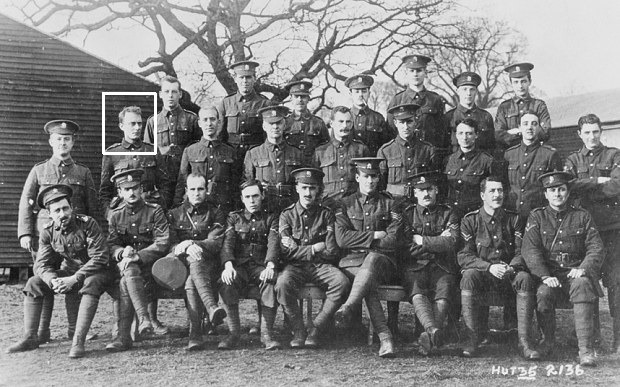
I’ve already written about Thomas’ dilemma in deciding if he should enlist in the war, and Frost’s part in Thomas’ ambivalence, so here I’ll just say that Thomas did enlist. The records say it was in a company called “The Artists’ Rifles.”

Can Americans of our time imagine such a military organization? Of course, artists of all kinds have served in America’s military services, but I can’t envision that sort of name being used here in place of something like “The Screaming Eagles.”

Edward Thomas' company in training with Thomas in rectangle

Thomas’ company in training camp


The second Easter: the somber name today’s poem was published under was not his. Thomas in his manuscript simply wrote down the Eastertide date in 1915 when he apparently wrote the first draft of this, two years after he’d started the trip that had indirectly formed him into a poet. That summer he was even stationed for a while on military training in one of the towns he’d passed through on the bicycle journey.

But never mind the name, what a poem. It’s four lines, a single quatrain. Nearly every word is telling, even ones you slide over in the first line. Decades later Pete Seeger wrote a song, “Where Have All the Flowers Gone,”  condensing an episode from a WWI novel expressing a similar idea to Thomas’ poem. Seeger’s song is not long as songs go, but it’s a good length for a room to sing along with. Thomas’ poem has only started when it comes to its fourth line. The previous line breaks abruptly, enjambed, with “should,” and its final line reveals itself as it unwinds in heartbreaking fashion.

And Thomas? A third Easter: another spring, 1917. His diary entry in France wonders if the enemy is unseen in the fields ahead of him, which he still must view with the precision of a nature poet. He pauses to light his pipe. A bullet pierces straight through his beating heart that, will, do, never, again.

To hear my performance of the poem eventually published as “In Memoriam (Easter 1915)”  use the player below.


Additional notes:  There’s a new paperback edition published a couple of years back of In Pursuit of Spring,  which includes for the first time the photographs Thomas took during his journey, and it’s available from booksellers. Yes, English people do take up the idea of trying to duplicate Thomas’ bicycle trip today, for example Kimberly Rew, the  guitarist alongside Robyn Hitchcock in The Soft Boys and songwriter and guitarist of Katrina and the Waves, and also the Nick Drake estate manager and vintage bike enthusiast  Cally Callomon, whose plans included riding the trip on a period-correct English roadster bike.

I recognize that Memorial Day is an American Holiday, directly derived from the post American Civil War Decoration Day. I know this blog has a large segment of U.K. readers, so to explain: in the U..S. we have two holidays celebrating the armed forces, Memorial Day, which retains some of it focus on honoring the dead who served, and Veterans Day, which is the U. S. holiday that coincides with Remembrance Day. For readers on either side of the Atlantic who’d like to hear the LYL Band present a performance of an American poet for Memorial Day, here’s Carl Sandburg’s “Grass.”