In Just Spring

It’s the first day of Spring.

This E. E. Cummings poem is often read as delightful. And it is. It’s also a poem some encounter in childhood. At least in my youth, it was an anthology favorite that vied with Carl Sandburg’s “Fog”  as an introductory example of free verse. And no verse is ever more free than this: the letters smattered like mudprints all over the page, capital letters not yet grown, stuff smushed together. No colonnaded sonnet, no astringent exhale of meditative breath like a haiku. On your poetic menu, this is a mudpie for Spring.

Is it just this?

I set it to music. That’s what this Project does in Spring, and Fall, and Winter too. Every chord in the music I made today is a minor chord. Is this a sad poem, did I want to force it to be one? Not that simple. Just lowering the 3rd note in a scale a half-step to form a chord from it, is that really determinative? These are just sounds playing together.

But this is a considered song about Spring and the distance in half-steps from childhood, not just some neutral exhalation of it. The poem itself grew up, or blew up, over a few years. It was first submitted for a class assignment by a Harvard college student in 1916, and that version, while free verse, lined up this way.

In Just Spring 1916

I found this excerpt of the original version of the poem in a section on Cummings written by Michael Webster included in A Companion to Modernist Poetry published in 2014.

.

That college student would soon go overseas into a world war as an ambulance driver, and Cummings and his cohorts there took exception to simplistic war piety. I’d guess the logistics of suffering didn’t firm up the young man’s patriotism. In something I see echoed in this week’s American news, his talk was deemed an imprisonable thing to say, and Cummings was imprisoned in France. It’s one thing to write free verse, it’s another to convert the currency of one’s free thought into loss of freedom. I wonder if at this point the blood-soaked mud of WWI’s trenches were known to the young man. Anything but mud-luscious.

Cummings had enough luck or privilege to be released. In 1920 The Dial  publishes a new version of that college poem. In a few years more this magazine would publish an expatriate American’s poem that indicted Spring, starting “April is the cruelest month…” But this is Cummings’ poem, and this is how it looked on The Dial’s  pages.

in Just-spring dial 1920

On first publication it’s largely the poem we now know, but it doesn’t have a title. And curiously, the second instance of balloonman is “balloonMan.” Did a proofreader just get exhausted editing Cumming’s manuscript?

.

In 1923 Cummings published a poetry collection, Tulips and Chimneys. He put the still untitled poem in a section “Chansons Innocentes” (Innocent Songs). By innocent did he mean from childhood’s sensibility, or a plea of not guilty? And this is how that version went.

In Just Spring Tulips and Chimneys 1923

Nope, the balloonman to balloonMan thing must have been Cumming’s intent.

.

We’re near the final version, but at some later date (I’d assume a selected or collected poems publication) it converted its first line (strictly constructed) into a title with some typographical marks to make it look like Cummings was establishing Bon Iver’s song titling methods a few decades before the bard of Eau Claire. In the end, the poem that a lot of folks informally recall as “In Just Spring”  is [in Just-].   I can’t help but read that title as a pun.
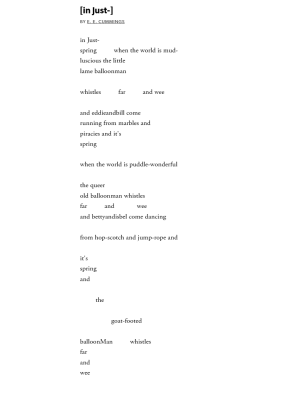
In Just Spring final 400

Here’s how the poem in it’s final form appears collected on the PoetryFoundation.org web site. “Just” is the only capitalization and man stays lowercase.

.

And now decades have past — and I, an old man, have gone to perform this poem for this year’s Spring, and I pick minor chords. Much has past us, dancing toward or running from: another world war, and current cruel wars happening somewhere further than the far distance whistle of the balloonman. Cummings’ childhood was close enough to me that I can actually recall playing marbles in the dry dirt finger-writ circle of a schoolhouse playground.*  I know how a hopscotch chalk field is laid out. Do children still jump rope with rapping rhymes, and if not, what has poetry and hip-hop lost? If there’s a balloonman, his creatures are mylar and determinedly decorated no doubt. All this 20th century stuff is now as archaic as the arcadian goatfoot-god Pan who whistles like escaping air. I, and once-girls with names like Betty and Isbel, know this. Now, as I experience the poem this year there’s more distance there than there was for a twenty-something poet who wrote it. I put a distance far and wee in the music — for Cummings was of an age that he knew he was to be an adult now, while still young enough in years to know within his body’s memory the lost experience of the playing children delighted at the balloons. Balloons that would either fly away or deflate — escape/ascent vs. air loss or a pop as sharp as a bullet.

It’s the first day of spring. My chords have a third a half-step deflated. Disordered self-important dolts are running things, and I think better to have an old halt body with a bouquet of floating hearts. If the world can still seem puddle-wonderful — to be aghast is not to wonder. So, I must recall how to wonder, far and wee.

You can hear my performance of E. E. Cummings “In [Just] spring”  with the graphical audio player below. Did someone let go of the string and a player is blown away? Don’t whistle, just use this highlighted link alternative that will open a new tab with its own audio player.

.

*And playing pirates without extra-faceted dice, is a lost quattro too — but I wonder if Cummings was thinking of Barrie’s Peter Pan  in choosing that manner of play. I’ve just finished watching an absorbing 2022 TV documentary series called Wonderland on BBC Select that often asks over its episodes how much childhood trauma, WWI, and social injustice informed English children’s literature a hundred years ago.

Crepuscule (I Will Wade Out) for National Poetry Month

Today’s re-released Parlando piece from our early years is “Crepuscule”  by American poet E. E. Cummings. This is certainly a passionate, ecstatic poem, isn’t it! Looking back at what I wrote about it in 2018, I was then taking the main meaning of the poem to be a portrayal of falling into a Surrealistic dream state. In the same post I confessed I hadn’t remembered that Björk had performed a version of this poem that seemed filled with erotic desire.

Rereading and reconsidering, I’m more unsure which is metaphor and which is meaning — and I think that’s often a good thing in poetry. We’re in one of those gestalt drawings created with a spell of words. We could be in the transport of desire, and it is like unleashing a spectacular dream: flowers are not just colorful, but burning with color. We will be still in bed, yet leaping with sleep-closed eyes. And so on.*  It’s difficult to not feel the erotic pull of the text. For a dream, the mystery is very much of the flesh. Mouths, thighs, bodily curves, fingers, lips…is it dream as sex or sex as dream?

An argument for the dream is the framing device of the poem reinforced by the title (crepuscule is an archaic word for twilight). Night and the dreamer have swallowed the sun, and the final line has one biting on the voltaic silver of the moon. But then Rimbaud took the arrival of dawn and sexualized it, so why couldn’t Cummings do the same for nightfall?

Here’s the new lyric video.

.

Three ways to hear my performance of E. E. Cummings “Crepuscle:”  there’s a player gadget below for many, and there’s a backup highlighted link for the others. Want some dream images flowing behind the words of a lyric video? That video is above.

.

*The most mysterious line has lovely word-music: “with chasteness of sea-girls.” I’m assuming a reference to nereids, sea nymphs, but I’m unsure if the poet’s speaker is becoming one, or trysting with one, in the rush of their dream. If water spirits, perhaps gender fluidity is a subliminal?

Parlando Project Summer 2019 Top Ten part 3

Is everyone aligning themselves with autumn already? Here we’re looking back at summer and the audio pieces that the audience made their most liked and listened to, and we’re getting near the top of the countdown, moving toward the most popular single piece of the past three months. Today we look at numbers 4, 3, and 2.

4. Summer Silence by E. E. Cummings. Another one from our “Before They Were Modernists” series, “Summer Silence”  is an early E. E. Cummings poem published when Cummings was a college sophomore at Harvard. One doesn’t usually associate Cummings with constrained poetic forms, but “Summer Silence”  was written in 1913 in the Spencerian Stanza form, long before he could have learned from Hawk or Susan.

I try to do the best work I can with recording the music compositions here within the rapid pace I’ve accustomed myself to with this project. My equipment is modest, and my recording engineer’s skills are too, but I make the effort. That said, this one was recorded on a cell phone sitting in a cabin on the North Shore of Lake Superior: just me, an acoustic guitar, and a few summer birds that you can hear at the very end that wanted to enjoy July there too. The text of Cummings’ poem is available in the original post linked in bold above.


3. Higginson’s June by Thomas Wentworth Higginson. From another series, one that started before this summer but carried over into it: “The Roots of Emily Dickinson.” Higginson is essential to the Emily Dickinson story, the literary insider who Dickinson sought out in what I think was an attempt on her part to verify the worth of her unprecedented poetry. They met at least once, but the rest of the relationship was carried on via letters, of which we have only Dickinson’s side of the correspondence.

From Dickinson’s replies and Higginson’s later recounting, it’s been summarized that Higginson “didn’t get it,” thinking that her work needed some further polish to appeal to the mid-19th century public. Here in the 21st century we feel pretty smug about Higginson, thinking him like the infamous record exec who passed on the Beatles.*

Higginson had a highly eventful life outside of the Dickinson connection, as I’ve talked about in another post, but one thing I discovered this year was that Higginson at least dabbled in poetry himself. I can find no context for the poem of his I used here, but I speculated that it could be something he wrote in his youth. Whenever and for whatever reasons he wrote it, it is a good short summer lyric. And coincidentally it’s opening two lines could stand as the better judgment of Dickinson’s genius as it does in his poem for summer.

The music for this one is as electronic as “Summer Silence’s”  is acoustic. The text of Higginson’s poem to June is also in it’s original post bolded above.


Indian Pipes and 1st Edition of Dickinsons Poems

Higginson wrote the preface and helped edit and promote the publication of the first collection of Dickinson’s poems two years after her death. The flowers on its cover are usually called Indian Pipes and they were said to be a favorite of Dickinson’s. It’s a truly odd summer plant, which my living wife found and photographed in Northern Minnesota this year. The other common name for this translucent apparition: the ghost plant.


2. For You by Carl Sandburg. I kept going back to Sandburg this summer, and you the readers and listeners came along with me. Why? I frankly find him healing.

I started off this project in 2016 with a Sandburg-based audio piece which also served as a memorial for David Bowie; and for the 3rd anniversary of that launch I used this Sandburg poem as a memorial to my late wife who died near the beginning of this century.

That either of those Sandburg poems could be used as memorials does not make them passive elegies, and “For You”  is future-focused—just as it is full of ghosts. I’m not familiar enough to say how English speakers in the British Isles, in South Asia, the Antipodes, or elsewhere feel of the current times and challenges; but in Sandburg’s America when I read or listen to “For You,”  I too feel our ghosts and feel our future—close—even if each are unreal as we stand before the great door of a year with great hinges.

The text of “For You” is here if you’d like to read along.


*”Guitar groups are on their way out” is the famous rejection phrase, attributed to Dick Rowe of Decca Records. In Rowe’s defense, Beatles producer George Martin has been quoted that the Decca audition performance was not very good and that he wouldn’t have signed them on the basis of it either. A few months later, Rowe took a tip from George Harrison and signed another of those guitar groups, The Rolling Stones. Sometimes you get a second chance.

Summer Silence

I’m trying to get back into the swing of production of audio pieces here, so maybe the best way to get around that is to not “produce” an audio piece. Here’s a field recording I made just south of the Canadian border this month while working out music for E. E. Cummings’ early poem “Summer Silence.”

In normal times I’d probably have added a bass guitar part and perhaps some more instruments. Even the acoustic guitar and vocal that’s present would sound better for not being recorded on a cell phone—but it’s a fair representation of what I was aiming for in the piece and it doesn’t sound terrible or anything. If you listen carefully as the last note fades out you can hear some bird song in the background.

E E and John W Cummings

I can’t find out if they’re related: E. E. Cummings and Johnny Ramone (born John W. Cummings). Down sagging air with shimmering bars of sullen silver vs. relentless down-strokes of sullen barre chords.


On the printed page “Summer Silence”  looks awfully conventional for an E. E. Cummings poem. It was published when Cummings was a Harvard sophomore in 1913 in a college publication. And as printed there, it contains the sub-title “(Spenserian Stanza)”  as if this was possibly an academic exercise in trying Edmund Spenser’s old form. The poem reflects 19th century poetic language somewhat. Though the rhymed and metered lines follow the form, there’s a lot of enjambment and phrases beginning in the middle of the printed line, a hint of Cummings later more scattered pages. The imagery shows tendencies toward the Modernist/Imagist ideal. This might be the experience of a real night. The images in the poem aren’t presented as stock-photo stand-ins for what the poet wants to say even though there’s a bit of emotional adjective-overload here and there which the pure Imagist would excise: “Eruptive” and “sullen” for example.

Summer Silence as originally published

Today’s poem when first published in the Harvard Advocate in spring 1913 by the 19-year-old E. E. Cummings.


I don’t know that Cummings ever really abandoned those overt romantic and emotional expressions, a tendency to unabashed overstatement rather than pure Modernist show not tell. That’s part of why many like him while others down-rate him. In the end a set of words either work for you or they don’t. Aesthetic theories may give you a different way to look at them, but why should they take away any pleasure they give you?*

I had collected this poem in search of some summer poems to compose music with last month, but then particularly I was able to work on the music after a night with distant heat lightning over Lake Superior in July. This led me to interrogate the night with Cummings’ poem. Out on the edge of the lake the thunder in my night was distant, muffled by windows and walls, a broadcast on the edge of reception. Its intermittent bark highlighted the “panting silence” in-between lit by the avant garde of the heat lightning. My night had no stars, translated or not. Perhaps Cummings’ night had a storm front approaching a less cloudy night on his lake shore?

So, as tardy as I am with more complex productions recorded more formally, the drill for you my valued listener is the same: use the player gadget below to hear my performance of E. E. Cummings’ “Summer Silence.” 


*There are answers to that question. I used to know some of them, but I’m old now and have forgotten them. Theories and suggested other ways and contexts to look at poems are still fine with me though, adding another soul’s experience to the artistic transfer may enrich it.

Fall 2018 Parlando Project Top 10 Numbers 4-2

4. Tell All the Truth but Tell It Slant words by Emily Dickinson. It should be no surprise that Dickinson turns up often here. I’m attracted to short poems that have a word music of sound or thought, and Dickinson has both in abundance in this, another very short text: 41 words.

This poem is often read as Dickinson’s private artistic credo. In summary paraphrase: “I’m going to write about things obliquely, because you people can’t handle the truth.” Still, I think there are other elements here, other harmonic overtones. One is the human tendency to slant the truth. In the poem’s one simile, she likens this slanting to the pleasant myths told to children threatened by lightning, and I don’t believe that’s Dickinson’s goal in her writing.

Another aspect, reflected in another Dickinson poem, There’s a Certain Slant of Light,”  is the Transcendentalist outlook, one that she seems to have been aware of. In that other poem there’s that word “slant” again, but here we are to know it’s nature itself that’s slanting reality. The transcendence in Transcendentalism is the belief that the surface of reality is not all there is, that study and insight and a visionary approach can reveal a deeper reality.

In that harmony, Dickinson isn’t saying “Hey poets, just do what I do! Obscure your real thoughts and insights so the non-hip won’t gather what you’re talking about until someone takes a post-graduate course a hundred years from now.” Rather she’s saying “Reality will seem to tell you children’s-story myths. Get around them. Keep looking, and gradually the blinding surprise will come.”


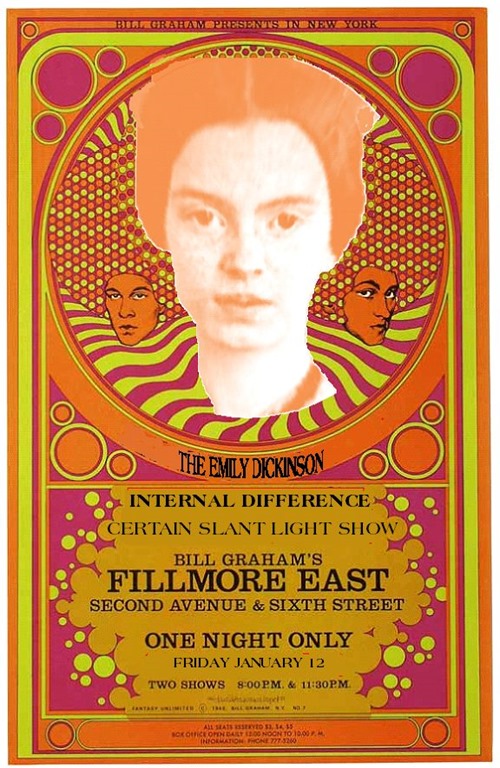
The Emily DIckinson Internal Difference

My soul’s been Transcendentalized!


3. Crepuscule (I Will Wade Out) words by E. E. Cummings. More slanted light here, as Cummings meditates on the arrival of a sensuous night. If the 19th Century American Transcendentalists were the ancestors of the 20th Century American beats and hippies, Cummings here seems to be heralding the Surrealists that would soon emerge within a decade in the dreams of a European night.

With much extravagance of language, Cummings risks ridicule without a care.

I’m quite fond of the music I wrote and played for this one. The acoustic guitar is tuned in “Pelican tuning” which is named after a piece by John Renbourn that used it.


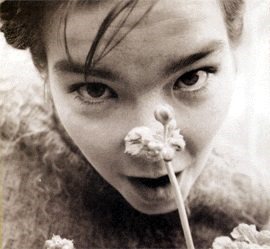
Bjork Lipping Flowers

“I will rise after a thousand years lipping flowers.” No, I’m not covering Björk Guðmundsdóttir, I don’t have enough diacritical marks or musical genius.


2. Cold Is the North Wind words by unknown. This is a piece taken from the Confucian anthology of ancient Chinese poetry titled variously in English The Book of Odes, The Classic of Poetry, the Book of Songs,  or just Poetry.  Since the collection’s poems date from deep antiquity, perhaps as far back as 1000 B. C., authorship is unknown, though not a few of them are written in a woman’s voice, and the subjects of the first section, The Airs of the States, are often everyday people and everyday activities, not Emperors or scholars, not heroes and their great battles.

The reason for collecting the poems and making them required reading is also hard for history to remember. The consensus over time was that in studying these poems an understanding of the Chinese empire’s subjects and concerns would be engendered. In England and its colonies, it was contrastingly once assumed that its future leaders would study ancient Latin and Greek poetry as a core subject.

Weighing something as large as history is hard, and I can’t say if either of these two traditions helped much. Evil and ignorance, mendacity and violence—how far can we range in history without running into lengthy annals and imposing monuments to those things? We can’t avoid these monsters, and yes, and so, we must study them. Yet, yet, what if our leaders were expected to study a song such as this? I can’t believe it would help most. I also believe it would help some.


Chinese  flying Teapot

Cold enough that some hot tea would be good, but Gong have flown off with the teapot.

We have just one more number in our countdown of the most liked and listened to audio pieces this past Fall. We’ll be revealing Number One in our next post.

Crepuscule (I Will Wade Out)

Another short break in the Dave Moore series to present an unabashedly ecstatic poem by E. E. Cummings.

The kind of Modernist poetry we often use here rarely presents itself like this, as the early 20th Century pioneers tended to be a downbeat and skeptical lot, even before the great tribulation of the First World War. Cummings isn’t the only exception, but a poem like this is so extraordinary in its exuberance that it will always stand out.

E E Cummings self-portrait

Lipping flowers…the ecstatic poet’s self-portrait in pencil

As a page poem, “Crepuscule”  is laid out on the page in staggered lines sans punctuation, something Cummings may have picked up from Apollinaire, but the syntax isn’t as jumbled as some E. E. Cummings poems. It actually reads fairly easily once I lined-out the dismembered sentences. The images are surreal, though written before official Surrealism, and paradoxical sensations and states come one after another. Can one gather what is happening in the poem beyond the welcoming of sensation and exploration?

Crepuscule as a page poem

Cummings’ “Crepuscule” as a page-poem.

The title is “Crepuscule,”  an antique word for twilight, and so the poem is set in that proverbial border time. The poem goes on to either explore sleeplessly and fearlessly in the unknown darkness, or launch itself into the imagination of dreams, which surreally complete and supersede the “mystery of my flesh”—at night exploration, or dreams, at once, indistinguishable.

I didn’t see this until after I finished performing it, but I suspect the poem may have bookended images near the start and at the end, the twilight beginning with the swallowing of the sun, the ending with the moon setting the teeth (on edge) with the metallic bite-taste of the moon.

As sometimes happens when I compose the music for these pieces I find out or remember that others have done this before me. As soon as I saw the title I thought immediately of Thelonious Monk’s instrumental compositionCrepuscule with Nellie  and the idea was planted to use piano in my music for this. I did end up with some piano, but I reverted to guitar, my home instrument, to express the unrelenting long line of this poem that leaps into the bothness moment of twilight.

Embarrassingly, I had forgotten that Björk had performed all but the last part of Cummings’ poem as Sun in my Mouth  on her album Vespertine.  Björk brings big time sensuality to Cummings’ words, bringing out the eroticism that was always there, not just by her commitment to the performance, but by ending on and repeating the “Will I complete the mystery of my flesh” line, bringing fleshiness to the mystery. But this is a poem of the borderline, and the flesh is also hymned to complete a change to something else.

My fearless borderline tonight is presenting this music which would have difficulty reaching the level of originality of Monk or Björk. To hear my performance of E. E. Cummings’ “Crepuscule,”  leap into the ripe air by clicking on the player below or click this highlighted hyperlink to open a new tab window that’ll play it.