Some of you made it through my summarization of the musical career of the Cats and the Fiddle Jazz combo this week, but even though I was writing about music, we didn’t add much poetry there. One little thing I found out since I wrote that summary: that eBay matchbook collector item should have tipped me off about the site of one of those young Chicago kids’ gigs — a way stop on a trip to Hollywood to try breaking into the movies. It wasn’t at the “Airplane Café Club” as Marv Goldberg had it from his research, but the “Aeroplane Café. I’ve found a postcard. Looks pretty swanky. I wonder how the Cats act went down there in 1936 — did the Denver white swing kids dig their act? Four or five years later I’d give our band of audacious teenagers better odds on that.
Well, however they were received, they were young, they had dreams of a career ahead of them.
Looking at what musical acts were playing Denver at this club and elsewhere during the ‘30s, it was mostly white bands for dancing. Black bands started appearing on the bills in the ‘40s. My research said the Aeroplane Cafe lasted until the ‘80s, hosting in its last years rockabilly bands.
.
So, let’s combine some literary poetry with music, Parlando style today. The words are by Langston Hughes, one of the first poets to recognize that Blues and Jazz were poetic, suitable for praise in poems, suitable to combine with Jazz words he’d contribute. When the young Hughes wrote today’s words for publication, he called the short poem “Dreams.” I heard it as a kind of Blues, a Blues with a sorrowful side, but with an admonishment to endure. If some reading this are having a February of backlash and disappointment tempting despair, this is after all Black History Month. Afro-American poet Hughes knew that dreams may well be knocked down, ignored, belittled. Yes, I know the word “woke” is a word in present contention. I find it odd it is used by those who smirk and dismiss the word as they speak it, aiming it toward those who know very well the reasons that dreams are extinguished.
Hold fast to dreams
For if dreams die
Life is a broken-winged bird
That cannot fly.
Hold fast to dreams
For when dreams go
Life is a barren field
Frozen with snow.
I’m looking at a bare and snowy landscape out my window this evening. I rode to breakfast in 10 degrees with a cold wind this morning. I read the newspaper when I got to the cafe, because I’m a man who still spills eggs and hot sauce on the news in the morning. None of the news was good.
I spent my last couple of days making the musical piece work as well as I could make it, tickling an old guitar that I played when I was young, playing piano the way I can: a finger or two on the keys, tracking the left and right hand parts separately to disguise my ham-handedness — because music may find a way. I sang Langston Hughes’ words quietly, mouth up near the microphone. I had to, it was near midnight when I sang them, and my family was asleep and I want them to keep their dreams.
I want you too to keep the sweeter of your dreams. Waking right now can script all the nightmares and anxiety dreams that need no help. When the best mysteries come under the eyelids, ones almost too good to remember, I want you to keep them, even just the sense of them.
The audio player to hear my adaptation of Hughes’ poem I call “Langston’s Blues” can be heard with the audio player gadget below. No gadget? It’s off dreaming, but you can also use this highlighted link which will open a new tab with its own audio player.
I’m planning to return in a few days with more on why I wanted to work at figuring out all I could about that young Jazz combo of the 1930s and ‘40s.
We’re going to have some William Carlos Williams poetry turned into a song below. If you’ve missed that sort of thing from me, I’ve returned with time to focus on what we do here.*
I think I’ve already mentioned that I’m disappointed in my country and its follies this past year after the national election. I could take your time and patience with some personal punditry on where to apportion blame for this. The electorate? The winning vassal party and it’s red duchies? The oligarchs and emperors ever-richer and more protective of prerogatives? And then too, the losing party, who gets apportioned blame for everything else on the list as well as bearing the sting of defeat?
I’m not going to do that. A complete list opens up the vulnerability of adding one’s own self to the blame. While many personalities have strong defenses against that self-indictment, I’m not sure if that’s a good or bad thing. By now, if you wanted any variety of that, you’ve already had your fill. Rather, if you’re on the side that lost, you might feel left alone. As we approach the new regency in a matter of hours, let me repeat something I said after the election: we can, we should, forgive ourselves for hope. It is a right-sure prediction that we’re going to need more not less hope in the next few years.
As we approach the new regency in a matter of hours, let me also repeat something I said after the election: we can, we should, forgive ourselves for hope. It is a right-sure prediction that we’re going to need more not less hope in the next few years.
Further in that feeling alone — except for the exchange of blame and shame — I’m not thinking this group are presently at risk of being visited by reporters seeking to understand their sorrow, fear, disappointment, despair. They’ve had over 60 days to file those “I must understand them” stories, but there’s a general silence on that front. Perhaps there will be some stories of the manifestations to come of what some of us fear — though if the worst fears come, those could be harder to find, and stories after injury may be less efficacious than the now-impossible to file stories that could have come beforehand.
I urge folks to sing these Parlando songs themselves, so here’s a chord sheet for today’s piece. Some will likely do a better job than I do, and additional voices strengthen a song.
.
So, I was happy to find, write music for, and sing this short William Carlos Williams poem this winter, even though it was written back in the last decade called The Twenties. I too feel forced into the mud, and so much now depends on the stink of the ash-cart rolling toward us. You can hear it with the graphical audio player gadget that should appear below. No player? No editor looking over his shoulder at their owner-baron has spiked it. No algorithm has ruled against it in court. The audio gadget has always been impartially suppressed by some ways to view this blog — but you can use this highlighted link to open a new tab with its own audio player.
.
*This isn’t the first holiday season that has caused a drop in new pieces or posts, but I’ve spent a good deal of time in this cold bilaterally looking January shopping for a replacement for my 20-year-old car. I had previously figured I’d wait until that car had reached its full majority this upcoming fall to shop for a replacement, but like some others I played the odds that new tariff taxes and repercussions would raise prices.
It happens to us alone, but it happens to so many it’s a trope we share. It goes like this: you have one of those bad dreams. Something terrible has gone wrong — and you, inside the dream, feeling it is real, try to fix it — but you can’t because the other people in the dream are oblivious to the terrible and are acting stubbornly in odd, irrational ways. While dreaming you’re trapped in this desperately unsolvable situation only you can clearly see and try to act rationally on, running in place, thinking in circles.
I had one of those dreams this week: felt so real, so heart-wrenching. Then the dawn comes, and you realize that experience was a dream — oh, that’s why you couldn’t fix it, that’s why everyone else in the dream was acting so wrongly!
OK, exiting satire mode, but let’s stay strange.
Early this Fall I was cleaning out something: a box, a drawer, a binder, a little used bag, I can’t remember exactly what. But in it was a clutch of papers. I glanced at the pages and recognized it was a mix of things: some works-in-progress looking for first reads from the old group of poets I used to meet with every month, and some initial drafts of a longer, multipart poem I was writing as my mother was going through her last hospitalization, the one from which she would ask to return to the home I grew up in with my father and sisters in order that she could die there. I set those sheets of paper aside.* I figured I’d look them over later, maybe digitally scan them, or put them in my filing cabinet. At that later I’d also look to see if there were any drafts in the small stack that were unfinished pieces I could revisit.
Now here it is, we’re November and I finally got around to that sort-out. One of the pages was a college-ruled notebook sheet with a complete intermittent draft of an irregular (American) sonnet. What was this? While I remember well working on the longer poem around my mother’s last illness 20-some years ago, I had no memory of working on this sonnet. Complete blank. Moreover, the sonnet seemed to speak of someone’s story that I didn’t recognize as mine — nor anyone else’s I could recall either.** With the time-interval between discovery of the papers and my finally going over them, I can’t even be sure if this sonnet was found among the stuff from the time of my mother’s death or not. Trying to determine why I didn’t remember it, I wondered if it was even older. I recalled that scholars date Emily Dickinson manuscripts by looking at the changes in her handwriting over time, so I tried that assay. Looked to me more like my 20th century handwriting, so the poem could be older. Still, it was my handwriting, testifying I, however unremembering, wrote this poem — and “What was it about?” That intrigued me. The poem asks the reader to work obliquely, details are supplied but not all the details, something that can tantalize.
The gardening stake metaphor used in the final section reminds the 2024-me of Robert Frosts “Pea Brush,” a poem I didn’t know when the me I was back then wrote it
.
Why did the voice in the poem not mail their first letter? What was it about the recipient’s husband that was germane to that decision? Was there an affair or appearance of one? Clearer to me was the latter part, the stuff of the second letter, a recalling of youthful aspirations and a friend who by what they said helped make them more substantial than pretensions. What an interesting yoking, I thought. The imperfect, the not said, or the thing whose saying we keep hidden — combined with the things that were said that help us realize our lives.
As you might tell from the previous paragraph, I was experiencing this poem just as I would the general run of Parlando Project poems, ones written by others in a project which has as one of its mottos “Other People’s Stories.” Its mystery and ambiguity captivated me, and so I set about making it into a Parlando song.
I did a revision of the initial handwritten draft I had found and worked on combining it with the music you’ll hear with it below this week. The music today is played as a conventional LP-era rock ensemble: there’s the usual quartet: bass, drums, chordal and “lead” guitar. Added to that are two keyboards, piano and Hammond organ. You can hear the result with the audio player gadget you should see just below. No gadget? Wake up, this highlighted link opens a new tab with its own audio player.
.
*Two of those poets have since died, I re-handled those pages, ones they’d typed in and handed to me years ago, and thought tenderly of them. My part of the household is due for an austere “death cleaning,” the tossing of those things an old man keeps to extend something of the life of that-and-those who’ve passed on. I have no grave illness, but the keeper now must consider that they will pass on and that there’s no real keeping.
**I did write from personas in my writing life regularly, a bit more so in prose than poetry. I was likely imagining the “short-story” plot that I then went about expressing in the sonnet.
If we think of poetry as more than a barren art, we might think of things we read in poems as things that occurred to another person, somewhere, sometime. Oh it may be a mistake to automatically read poems as memoir — invention has always been one of those occurrences — but the more universal the poem’s account, the more we may think: this decorated thing I’m reading came from the senses of someone feeling an experience.
If we do that, we can think today that somewhere in China, sometime in the 8th century, an adventurer turned poet in middle-age awoke at night. What kind of bed, what kind of bedroom? The poem tells us nothing posh, despite its brevity: the poet’s expectation in the shining he sees around his bed is that it’s frost. It might be a lean-to, or even a bedroll on some improvised pallet out in the open. At best it might be an unheated room.
But still he’s awakened to something shining. He soon re-adjusts. No, this brightness that has occurred is moonlight not the frost of a more northern climate. Commentaries I read on classic Chinese poetry note that “bright” is something of a favorite poetic ideogram in those poems. A good symbol for immanence and essence? That light from the now open eyes of our poet must be seen. Oh, it’s the moonlight, likely a full moon on a clear night, he figures out. But that realization says something about near and far. The moon is more than 200,000 miles away. Yes, the moonlight is near, he could touch it but feel nothing.
What can he touch? He can put his head back down on the bed and think, perhaps to think himself into dreams of his home. Feel that now with him as the side of face and scalp touch back down. How far, that home? Moon far?
The 8th century poet who wrote this, Li Bai (also known as Li Po), was an itinerant for much of his life. Choice? Consequences of other choices? Exile? The traditions seem to indicate a mixture of all that.
This is a well-known poem in Chinese, taught as an early lesson in poetry to children like Sandburg’s “Fog.” In my translation I did something I don’t normally do: imposing an English meter & some rhyme.
.
Now another man, in another bed. I can tell you with more exactness where and when: September 18th, 1970 comes in within a night in London, England. The man has been out to nightclubs, “sitting in,” playing music with others, something that consistently energizes him. For much of his life music has possessed him like that. He’s been blessed or cursed with the compulsion to make it. It’s just a couple days past the harvest moon in this room, the moon as far away as Li Bai’s moon.
He’s with a woman whose role is somewhere between girlfriend and convenient stranger, but this is not strange to him. He barely knew his mother, his father’s time was taken with drink, low wages, and a skin color that marked him as an outsider, and so he could rarely care for him. This had often been. As a child, taken in by other women, neighbors, and relations — and as he left home, others in the various valences between girlfriends and strangers.
Do non-performers understand how hard it can be to transition to sleep after the active interaction of live performance? Performers likely have tried it all: sex, boring TV, cannabis, food, and even more alcohol than they drank to take the edge off self-consciousness before performing — enough to move them from the level of self- to un-consciousness. And yes indeed, other drugs.
This man had moved from at least some of the above to the other drugs: his companion’s sleeping pills. A foreign formulary, they were much stronger than he anticipated.
September 18th, 1970, Jimi Hendrix, the man in London, quiet night thoughts. Did he awaken in that night as Li Bai did in his poem? Accounts differ from that London night. Let me think that at least his consciousness tried to return — in his head the sparkling currents like the magnetic waves when electric guitar strings are strummed. Did he think of home as the great Chinese poet did? If so, what would be home? Did he think of America? He was doubly American in a fierce way: some of his ancestors had been kidnapped and sold to enslavement there, and some of his ancestors had had their before-it-was-named-America taken too, a trail of tears. Did he think of his parents, even more so because of their relative absence in his life? Others who had episodically cared for him? He might have. Maybe too his night thoughts were of music, of songs. We can still hear him sing about dreaming on recordings, so he could have dreamt of singing a new and elusive verse. Did he open his mouth to say it, and there was nothing? No air. No breathing. No life.
You can hear my performance of Li Bai’s “Quiet Night Thoughts” (for Jimi Hendrix) with the audio player below. See just a pool of moonlight at the end here, no audio player? This bright link will open a new tab with its own audio player.
Is it even possible to mention Stonehenge without risking the unbidden memories of the feet-to-inches comic debacle from Spinal Tap? Well, that’s one reason I’m a little hesitant to introduce today’s piece in our Halloween Series this year.
But still, I’ve been talking and singing about ghosts, ancestors, spirits, and their home fires a good deal, and I remembered this performance by the LYL Band of this song I wrote after visiting an altogether homier set of Neolithic English standing stones at Avebury several years back. I understand Stonehenge is fenced off, and that enforced distance probably does little to staunch the tales of quasi-Medieval druids with magical rites floating stones in the air. Avebury’s large henge basically had a country hamlet grow up inside it, there’s even a pub in the midst of the circle. You can walk right up to the stones, feel these cool earth-aerials, measure them against one’s own height and age. A walk around the Avebury henge is a good walk, and one may also look over the equally amazing earthen ditch-works that are part of the site. As you stroll a flock of official government sheep wander the grassy meadow keeping overgrowth at bay without internal combustion clatter. So at Avebury, as I was walking around all this, I did not think of druids. I thought of men and women who dug and moved that earth, dug and moved those stones, erected them watching over each other.
There are several rings in the henge at Avebury, and the stones are individual in shape and size, furthering the thoughts I had while visiting the site.
.
Did they have some chieftain or matriarch who planned and ordered its construction? Perhaps. What belief was being expressed in large rocks? Some likely, at least to the level that metaphor asks of us. But as I said, I thought of who did the work — the sweaty, hard-breathing, hand-callousing work. They worked stones with stones, dug with pickaxes made of antlers. At night in what huts did they sleep, on dried grass beds perhaps? And in that night they no doubt slept hard after their day of work, dreamt dreams harder than those of old poets who need only to move words around. If the energy of the earth and sky was transmitted up and down those big stone antennas, so too must the energy of their dreams be drawn in there. And I was there where they must have slept, dreaming under night breaths, their aches soothed by the rest. Dreaming of what? Children, parents, lovers, siblings, colleagues, whole days of rest, the mighty thing they would construct, a story, a prayer, a melody, the little joys of a meal or exactly good weather?
Not druid magic in my thoughts at Avebury, but I felt those dreams might be — no must be — harder than the dulling mutes of time. They sparked around in their heads, and when their heads became skulls and then dust, where is that spark, and can we read it still, tune it in? A belief, at least to the level of metaphor, felt we could. That’s the song.
Here’s the songsheet. If you ask for scenery to back your performance of this, get the measurements right.
The player many will see below will play “Avebury Song #2,” and if you don’t see it, you can use this alternative highlighted link. I hope to complete at least one more new Halloween piece to present here yet this month, though the moving pieces of my life doesn’t make that sure.
Continuing our National Poetry Month celebration, here’s another poet’s love poem, loved by other poets, William Butler Yeats’ “He Wishes for the Cloths of Heaven.” If Millay’s “Rosemary” portrays a relationship turned cold, “He Wishes for the Cloths of Heaven” is more at the wooing stage.
The speaker in Yeats poem begins by saying that they’d offer their beloved heaven or the heavens — well, to be exact, a luxurious simulation as some kind of cloth — and then not care that the beloved might just use it like a rug and walk all over it. And then they say they don’t have those cloths of heaven, only a dream. Still, the beloved can walk on that, the poet’s dreams; but the poem finishes with a plea that they should walk softly on that treasure, the wooer’s dreams.
In this short eight-line poem, Yeats does some fine things. First — no surprise if it’s Yeats — it sounds beautifully, and he does this almost entirely with meter, supplely alternating two and three foot beats in my scansion of it, though you can force an iambic feel.* Unlike many poets and poems that pour on the consonance seeking musical sounds, he avoids this here other than “dim and dark.” Nor is end rhyme a factor, though there are 2.9 internal rhymes in the entire poem (“night” – “light,” “spread” – “tread,” and “cloths” – “enwrought.) Instead, Yeats leans on repetition of words, even though one can read or hear this poem without noticing just how heavily repetition is used. These words are repeated at least once: “cloths,” “light,” “feet,” “I,” “dreams,” “spread,” “under,” “my,” and “your” along with generally-repeatable articles like “and” and “the,” and with only 61 words in the entire poem, almost half the poem has another half echoing it.
It’s also subtle in it’s meaning. Yes, it has been used in “real life” as a wooing poem by others, but being subtle in a valentine is a risky business. Yeats himself originally published this as a persona poem in the voice of a character as “Adah Wishes for the Cloths of Heaven,” even though many identify this as an expression of his in-real-life love for Maude Gonne. But notice this: the poem’s speaker would be extravagant with something he doesn’t own (and maybe no one could own fabric as rich as heaven) — but he’s asking for some mercy with the actuality of his immaterial dreams.
So, there’s a lot here for other poets to admire, but there’s more: this poem restates the situation of most poets when they are writing too. We plan to create the closest we can with words and their weave to the heavens — and those plans, those wishes, are our dreams. And then — like Maude Gonne, the plausible love interest this poem may have been directed to — people walk, not on them, but around them. Don’t be dismayed, such is life. All Artists Fail. We are the wooers, and then when we read or perform poetry such as this one by Yeats, we become the lovers, the beloved.
Watch here for views of a statue depicting this poem created by Jackie McKenna that I much admire. One thing I just noticed when doing this video: the crouching figure of the wooer looks quietly satisfied viewed straight on, and then in the final profile shot, a little sad or resigned. Intended or trick of the light?
.
Three ways to hear my music and performance of Yeats’ “He Wishes for the Cloths of Heaven:” there’s a player gadget for some, this highlighted link for others to use, and, at least for now, I’m continuing to create new lyric videos for this National Poetry Month series, and that is available above.
.
*That sort of repetition with variations, trod gently, gives a better musical effect in most cases.
Long time readers here will know that one of this Project’s ideas is “Other People’s Stories.” I’ve chosen to make that one of its principles for a couple of reasons. First, the Internet is full of folks telling their own stories, and this is fine (after all, to me those would all be “Other People’s Stories”). I wanted to do something different, to focus on how you and I experience a variety of words from a variety of writers with a variety of outlooks. The second is that I’m rather uncomfortable with promoting myself. That one’s complex.* Like most writers or composers or artists I think my own work has value at some percentage over half the time. Which then, mathematically, allows that I doubt its value, or my handling of its value, or the costs of declaiming its value to the universe a bunch of the time too.
No one creates without the first thought. It would be impossible. And no one who cares about what they create, about their audiences, or about how much craft and care can be devoted to any art; without seeing the faults, the missed communication, the needs for just one more revision or tomorrow for any work.
Many of us create instinctively, because we have to — but sharing that work is a choice. I’m nearing 600 Parlando Project audio pieces presented here. I could have presented at least half or two-thirds of that easily with things Dave or I wrote, but I made a different choice. It’s less conflicted for me to publicly look at, to be honestly surprised and delighted at Emily Dickinson, William Butler Yeats, Carl Sandburg, Langston Hughes, Sara Teasdale, or Du Fu; and then to share that with you.
But there’s a problem with “Other People’s Stories.” I’m likely not understanding everything those authors intended.** And they’re their stories, their visions. I’ve talked recently here about how when I translate a poet who wrote in another language how I want to honor their work and transfer accurately their particular powers, and yet then become tempted to break off into something their work makes me see through my own eyes.
A long prolog to presenting today’s piece, one I wrote and titled “Ethna’s Dream.” Ethna is Ethna McKiernan, a poet who I used to meet and talk about work with once a month or so, along with two to four others. Ethna cared and crafted her work over decades, and in her life did other useful work: running an Irish heritage book and art shop, working with the homeless. She’s currently in hospice, comforted by family, and the reports are that she’s now mostly in an out of what appears as sleep.
I couldn’t call Ethna a close friend. I always sensed a distance there. I think often of her none the less these days, and of every rudeness, awkwardness, or self-dealing on my part around her; and those or any number of things could have caused that. The very fact of writing a poem about her death, her dying, that mostest personal thing, seems problematic.
So, when you listen to my piece “Ethna’s Dream” you now know all that. This is not a poem about those things I’ve discussed in prolog, or at least I hope so. Instead, my intent is that it’s a poem about what we should treasure of that sharing of the unconscious that we have with artists (including those whose main art is just living). What I present in “Ethna’s Dream” is not a romantic, imaginary, sentimental metaphor in my own mind — though it may attract or repel you if you see it as such — it’s more at the essences of what we do, share, and take with art.
There’s references to Bottom’s speech in Shakespeare’s A Midsummer Night’s Dream. Am I prettifying myself up with pretentiousness, or comparing myself to the foolish play character? I wrote it, and yet I can’t tell.
*One problem, leading to one fear, is that when offered the chance to promote myself I see myself as overdoing it, and coming off as a self-absorbed narcissist that runs on too long about the arts I work in, prattling about the obvious and the obscure in equally embarrassing ways. If you’re still reading at the footnote stage, you may have forgiven me for that.
**Beside just plain embarrassment of ignorance, we now more often talk about cultural appropriation in regards to this. The travesties of cultural appropriation are real, but my belief is that they should, must, be risked.
Let’s pickup the countdown of the pieces that drew the most listens and likes over this past winter. Each bold-faced listing is a link to the original post on the piece in case you’d like to read what I wrote back then, and those original posts will also contain links to the full text of the poems used.
7 Thursday by William Carlos Williams. Quite often when reading through early 20th century Modernist poetry, I repeat my surprise of how plainspoken and outwardly simple some of it seems. This poem by Williams is one of those. There’s not a single word in it that would be unfamiliar to a grade-schooler. One need know no complex allusions to anything other than ordinary life. Not all his contemporaries wrote like this. Wallace Stevens will pleasingly stump us with his love of obscure words, T. S. Eliot will ask us to consider how history rhymes its myths, and William Butler Yeats will make English sing with beautiful and metrical word-music. Against that sort of thing, this poem by Williams may seem ordinary. As ordinary as a Thursday.
There’s only one bit of word-trickery in it — and having no other in this short poem should invite us to ponder it: that unusual use of the common word “carelessly” in the context of “I remain now carelessly/with feet planted on the ground….” Carelessly? Huh? How many quick readers would slide over that and not notice anything out of place! In the opening of his poem Williams has told us his dream has come to nothing. Is this dream one of our ordinary nighttime hallucinations or a strong and potentially life-changing imagination for the course of things? He doesn’t say and may perhaps mean either. His stance on this? Back to observing the world standing simply and unmoved with both feet on the ground, “carelessly” in the sense of “without a care” regarding that; with the sense also that the overlords of guilt and ambition or the lure of more surreal and spectacular verse are saying he should care and he’s going to ignore them.
In place of that care, of that “tyranny of the shoulds,”* Williams offers us ordinary life, ordinary words, the meditation of breath. That resilience and carelessness, those two steady feet able to stand up to the sky, is this song. You can hear it with a player gadget that may appear below, or with this highlighted hyperlink that will also play it.
.
6 I wake and feel the fell of dark by Gerard Manley Hopkins. What a combination this makes with Williams’ poem that it happens to sit next to in our countdown! Hopkins’ poem has its speaker also awakening from a non-productive dream “Hours I mean years, mean life” — this dream is clearly both a nightly and a life’s dream. And he’s in the opposite of careless: roiled with distress and self-disgusted guilt over it.
What a combination this makes with Williams’ poem…
The language here is extra-ordinarily charged. Some of us have had such a self-castigating night, but few of us could express it in such a tight compressed form as a sonnet that moves musically and emotionally. Hopkins’ feet are not firmly on the ground at all — he’s rolling and tumbling as the great American floating Blues verse has it — and that’s the nature of Hopkins’ song.
This is the distress half of the engine of the Tao. We may more easily recognize it quickly as great poetry, and should, though without some balancing aspect it cannot long whirl.
My performance of this greatest of his “Terrible Sonnets” can be heard with this hyperlink, or in cases where it appears, the player gadget that may be below.
.
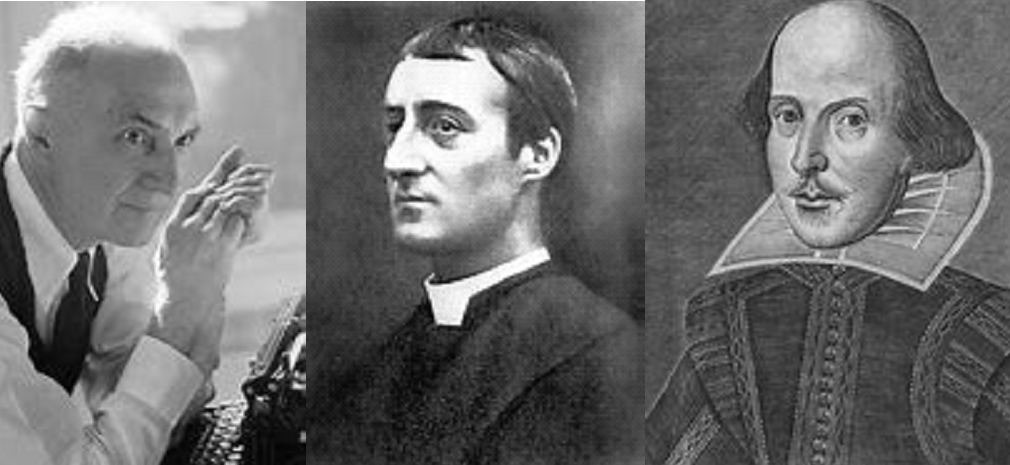
Collar styles of poetry, a retrospective. William Carlos Williams, Gerard Manley Hopkins, and William Shakespeare
Well, the jury’s still out on that one. It is always so with art, as art happens in the present when we look, read, listen, hear. That’s a large part of what this blog is about: encountering stuff written in various ways and times and seeing what we can make of it in the immediacy of a musical performance.
“Sonnet 97: How like a Winter hath my absence been” is neither the calm meditation after a dream’s failure nor the roiling disgust our first pair of poems had. Instead, this sonnet is all about the ambiguity. What kind of ambiguity? Shakespeare will pick several. One of the basest tests of mental state is “oriented to time and place.” This poem certainly isn’t — that’s its most pressing point. Is it winter, summer, fall, or spring? Can’t say for sure. The purportedly male authorial voice dons rhetorical drag and speaks of his sonnets as if they are birthed from a poetic womb as if the addressed “fair youth” is the only begetter in a very patriarchal metaphor for these sonnets. And what’s the true nature of the relationship between that authorial voice and the fair youth being addressed? Complicated. Author as vassal of the ruling class?** Lover? High-minded patronage? Some of all? Well, that’s Shakespeare’s song for us. This hyperlink will play my performance of it, or if you see it, you can use a player gadget that may appear below.
.
*The phrase is psychotherapist and author Karen Horney’s, whose mid-20th century work may still have something useful to say about us today.
**It was while dealing with this sonnet that this aspect of the “Fair Youth Sonnets” first occurred to me. I assume it’s occurred to others, but not being a Shakespeare scholar I can’t say who or where.
Returning now to the poets presented in Alain Locke’s 1925 The New Negro anthology, we’ve come to the poet I most associate with the Harlem Renaissance, Langston Hughes. Though he was born in the Midwest and traveled some, Hughes actually lived for much of his life in New York City, unlike some others associated with that artistic flowering. And though Locke’s book concentrated on young, up and coming writers for the most part (Hughes was 23 when The New Negro was published) Hughes’ literary career continued on a more or less continuous path until his death in 1967.
So, if I was asked “Name a Harlem Renaissance poet.” My first answer would have always been “Langston Hughes.” And if Locke’s book is the launch point for that, Hughes was as prominent as any other young writer featured there and then, even if in 1925 he had yet to publish a single book.
Young Langston Hughes. Hey Pharrell, pretty sharp work on those fedora creases don’t you think.
.
This makes it strange then when I went to do a little research on how Hughes was judged during his 40 plus years as a literary artist. The summaries I read often point out that he was down-rated during his career, and to some degree up to the present day. Why? Well, he did have to go through the dangerous 1930s when political engagement was expected of writers, and like some others he had to handle the double-bind of associations and sympathy for the Russian Revolution and Communism and then later criticism of its faults. Many of the promotors of The New Negro era were so focused on up-lifting the race and demonstrating high-culture acceptance that they were uneasy about Hughes’ embrace of a wider range of Afro-American experience. And finally, there seems to be an element of purely literary judgement he shares with Carl Sandburg and Walt Whitman (two of Hughes’ influences) that what he wrote was judged as too simpleminded and unironic. Sure, the high-culture critics would essay: that kind of poetry might have readership broader than many, but it doesn’t fit the literary criteria ascendant as the 20th century unrolled.
Today’s piece, “Dream Variation,” one of Hughes’ poems printed in The New Negro, is a short nature poem. Here’s a link to the full text of it.* Like a lot of lyric poetry, you can read it quickly and superficially with some pleasure. It has rhyme and its rhythms. It counts off some pleasant if not overly spectacular word-music. The first time through you may think it’s just pointing out a commonplace, something one could summarize as: “Hey, it’s nice when it sunny and you’ve got a day outside. And then a summer night when you finally go to bed — that’s nice too.”
Wait a minute. What’s with Hughes’ title: “Dream Variation?” First off, that seems to say that kind of summer carefree pleasure isn’t something the poem is experiencing right now. Like Wordsworth’s daffodils, the poem’s speaker is experiencing this mentally, as if in a dream. That’s a different thing isn’t it. In the same way that a love poem about lost love is not the same as a poem about present love, this is a poem containing longing. Many of us are reading this during this February in North America. Likely you may relate to that state the poem is actually portraying.
I have no way of knowing what the weather was like when Hughes wrote his poem, but Hughes estranged father lived in Mexico where Hughes visited him before embarking for New York City and the beginnings of his literary career. So that titular variation may be a dream not only of passing seasons but of lost places too.
But there’s another way that variation means. In music it’s when a composer modifies elements of an established motif and we see it morph into a new related shape. Do you see what Hughes does here in his short poem? There’s a statement about dancing, arms wide and accepting, in the sun — and then resting in the evening “beneath a tall tree.” An interlude, when inside the body of the poem they express that this is “my dream” — not what they’re doing as they speak the poem. Next we learn that the “bright” day is now described as “quick” and the following “cool” evening is now “pale” evening. And finally, the real metamorphosis: the poem’s speaker is now not “Beneath a tall tree” — there is just a tall tree that remains as night comes.
This variation is subtle and somewhat undefined, mysterious, once you notice it. Is this a statement of the poem’s speaker’s absence from the warm place, that in the variation he’s no longer present? Has the speaker’s life, the proverbial “quick day” ended? Or, is it something even stranger: in the dream he’s no longer the external dancer beneath the tree, external to the day, external to the night, but now he’s become them?** In dream logic it can be all those separate things at once. That’s part of why a dream experience can be so striking!
In this poem, like in some of the poems of Sandburg that I’ve presented here, I maintain that the simple language and seemingly straightforward scene of the poem has misled some readers and some critics. If I was encountering this poem as if I was translating from some Tang Dynasty Chinese classical poet, I would be aware that the poem may not be whamming me on the head about “Look it’s clever metaphor after metaphor! My, how complex a plot I can stuff into my poem! I bet no one ever said anything as complex as this ever before!” Perhaps the assumption is that a working-class Afro-American or the son of a Swedish immigrant can’t be thinking anything more complex than class-struggle position papers.
In my performance of Hughes’ “Dream Variation” I consciously sought to bring out the mysterious element here. Stubbornly the harmonic progression I composed sticks closely to a core around the D note of the scale. Chords move between major and minor however and there’s a rub up and down with a D# Major7. The player to hear my musical performance may appear below, but if you don’t see it, this highlighted hyperlink is another way to hear it.
.
*I used the text as printed in Locke’s anthology for my performance as it’s in the public domain. The version I link to is later and includes some, well, variations. In the newer version taken from Hughes’ Collected Poems, the title has become plural, “Variations,” “the bright day” has become “the white day,” and a couple of other smaller changes were made. One could speculate that the “bright day” vs “white day” could have been suggested by an editor as less confrontational.
**And I haven’t even entered into the significant racial aspect that is there as well. The dark night in the poem’s first experience as being first external to the poem’s speaker and being one with it in the second “Black like me.” As an Afro-American poet, Langston Hughes almost certainly intends this, and it may be the most consciously intended message he wished the reader to receive: that poem’s journey via its variation is from experiencing one’s Blackness as externally to an internalized appreciation of it, and that later revision from “bright” to “white” for the first instance of the day underlines that reading. I featured the above reading not to obscure that, but because our particulars as persons bleed into our commonalities as people. When William Butler Yeats or Joseph Campbell speak of being colonialized Irish, it’s not just about their particulars. When Du Fu speaks of being overcome by great events, it’s not just 8th century China that has felt that. When Emily Dickinson’s mind grasps onto a flower or abstract thought and sees its edges always curling, she’s not reduceable to a bourgeois New Englander. And so to when Langston Hughes speaks about being Afro-American in 1920s America. And frankly, I’m hesitant to assume an Afro-American identity as a performer of Hughes’ poem, even as I want to bring it forward to your attention.
Update: An alternate primary reading that the first dream variation is an unachieved dream and that the second is a reflection of the reality of Afro-American life colored by racism seems widespread. Widespread enough that I wonder if Hughes wrote of his intent or understanding of his poem’s meaning at some point. For example many of the alternate readings say the poem’s second dance and whirl is work-a-day and likely menial work inside a Capitalist and Racist system that wouldn’t value Hughes. Hughes experience and political thoughts could be consistent with writing a poem that expressed that. As much as I should doubt my reaction to the text of the poem as printed in 1925, I’m still not seeing that as being the inevitable and singular reading of the second variation, but I offer this update as a self-confessed non-expert on Hughes’ work and because I suspect not a few students come here via web searches to seek insight into poems, and so they should be aware of this other reading.
I’m going to take a walk around to get to a good small poem by Emily Bronte today. It won’t be a walk about the English moors, alas, but it’ll have to do in this otherwise wild and windy place we call the Internet.
My spouse and I have a worthwhile understanding that we are both a sort of introvert. Definitions vary between peoples and time, but one short definition of an introvert is that they are the people that gain strength and restoration from solitude rather than from gatherings of people. One can easily suspect that writers and their close allies, the readers, may be more likely introverts, but of course that’s not always so. That indispensable pioneer French Modernist Apollinaire* was famously sociable within his element, a joyous bohemian boulevardier. Other writers, even while writing, seek out crowded places filled with voices and humanity to concentrate on their silent work. August Wilson, the great 20th century American dramatist, liked to write in cafes and coffee shops, places where other peoples’ voices were staging their own improvised plays.
But we can’t be sure that those two, or others like them, still aren’t introverts. My wife is good in typical social situations. I’m not. I’m so bad at social interactions that I’m sure I often leave a bad first, second, or last impression.** Still, one thing that joins most introverts is that however well we perform the social whirl, it tires us out—and when we need to recharge it’s not a different self-selected group, even a group of friends or family, that we seek in order to recharge, instead it’s solitude.
So, I have a phrase that I use with my wife when she needs to recharge: “Oh, have a good time at your Introverts’ Support Group.” Which of course isn’t a group—it’s time alone.
I have a phrase that I use with my wife when she needs to recharge: “Oh, have a good time at your Introverts’ Support Group.” Which of course isn’t a group—it’s time alone.
This sort of time alone is particularly hard for non-wealthy women to find. In Bronte’s time a great deal of domestic and family labor was assumed to be their unquestionable duty, something that modern times and insufficient good intentions haven’t eliminated. I have some idea of the particular domestic duties of Emily Bronte admirer and like-named Emily, Emily Dickinson, but less of Bronte’s own family obligations, but I assume they were considerable.***
In our current Covid-19 age of shelter in place recommendations, the pressures of everyone at home may make more and more of us like unto residents of an isolated parsonage in the North of England like the Bronte’s. If so, today’s Emily Bronte poem, written it says in her collected poems on Sunday December 13th, 1840, may still speak to us. Arithmetic tells me Bronte would have been 22 when she wrote this. Here’s a link to the complete text in case you’d like to follow along.
Introvert Irony: the only image we have of Emily Bronte is a group portrait painted by her brother of her with her sisters.
.
On publication this poem bore the title “Retirement,” but I’ve chosen not to use it as I don’t think Bronte is using the word in the sense most of us use it today. I believe the sense she intends is more at a wish to retire (as one would “retire to bed”) to rest and refresh oneself after a day of labor.
Indeed, the scene she wishes for and describes may be staged in sleep and dreams—though if so, her dreams are outside, alone, and in God’s nature. My wife’s most favored respite spots are walking in parks, nature reserves, and around wild lake shores. For introverts like Emily Bronte, my wife, and I, a concertedly apprehended nature is the other that somehow comforts us.
When we last did an Emily Bronte poem as part of this project, it was her spooky poem “Spellbound” in which the poem’s speaker seems to be suspended in the air figuratively or in imaginative actuality. Interestingly, in today’s joyous poem, the speaker speaks poetically of “wings,” and a wish to “quit this joyless sod,” and so is again in “mental flight” somewhere between heaven and earth. Just as if I wondered if A. E. Housman’s spell-caster’s poem and Bronte’s were in conversation, and if Emily Dickinson’s bird and hope poem was reacting to an Emily Bronte bird and hope poem, Bronte herself returns to an airborne state in today’s poem.
Wishing all the readers and listeners here the companionship and solitude they need and desire, and, and but, in the proper mixture! The player gadget to hear my performance of Emily Bronte’s “O Let Me Be Alone Awhile” is below.