Thomas Hardy’s “Transformations”

If you’ve noticed I’ve been gone for a while, I have as well. The last few weeks have had a lot of other things to attend to. Mostly happy things: travel, and work around the teenager’s graduation from high school. Still, I found myself picking up a book from my teetering “plan to read” pile that I thought would be mildly diverting:  Donald Hall’s Old Poets. This book is a hybrid, like one of my favorite books from last year, Lesley Wheeler’s Poetry’s Possible Worlds.*   Like Wheeler’s book, Hall’s book contains some memoir elements mixed with consideration of poets the writer knows, and from there the qualities and connections of poetry and poems with the poets. Hall’s memoir material covers the bildungsroman years, that life era of a few posts about my life I’ve done this spring, while Wheeler’s examines her relationship to her parents and poets well into midlife. The time settings of the two books are different: Wheeler more in this century, Hall centered around the last midcentury.

Here’s something I found striking in Hall’s accounts from his time and place. As an undergraduate he had access to not just his Harvard contemporaries** but to Robert Frost and T. S. Eliot. Since a good portion of Hall and my lives overlap, Hall being only about 20 years older, I found it strange to read that as a 20-year-old he had a series of informal interactions with these two while they were giants in a way that no poet today is. The effect was scarcely less shocking than some SF novel where the author dines and discusses poetic topics with Shakespeare, Milton, Keats, and Whitman. I suspect much of Hall’s access is due to Ivy League effects, whereas I think today’s poetry scene is more decentralized even while being more academic/MFA connected. If I was 20 in 1949, I would have been as likely to repeatedly meet the two great poets as I am to contact them by Ouija board today.

Hall’s book has 6 sections devoted to 7 poets, including ones on Frost and Eliot. Hall’s portrait of the older Frost is particularly vivid and special, while his stories of drinking with Dylan Thomas are less unique.*** Yet, within his Thomas chapter, Hall dives into why Dylan Thomas’s poetic stock fell off by the end of the century. Hall reveals that Thomas himself told him that he had only written about three good poems.**** The one Thomas poem we all think of, the villanelle whose refrain has become memeable, was not one of those three. Thomas and Hall agreed over potent-potables that “Do Not Go Gentle Into That Good Night” was only a skilled attempt to put on Yeats’ coat.

Now to get on to today’s new audio piece. Hall compares one of the poems Thomas thought was one of his best early works unfavorably to a poem by Thomas Hardy, and Hall’s Thomas chapter gives us that Hardy poem, “Transformations”  in full.

If reading Hall’s book was to be a portable replacement for work on this Project, that Hardy poem was stunning enough to cause me to try to get something composed and performed in the spaces between other things this week. Hardy’s “Transformations” is an account of the experience of a non-spiritual approach to immortality — not to life after death, but life as a thing that only changes form, of which we as people are only incarnations. Here’s a link to the text of this poem.
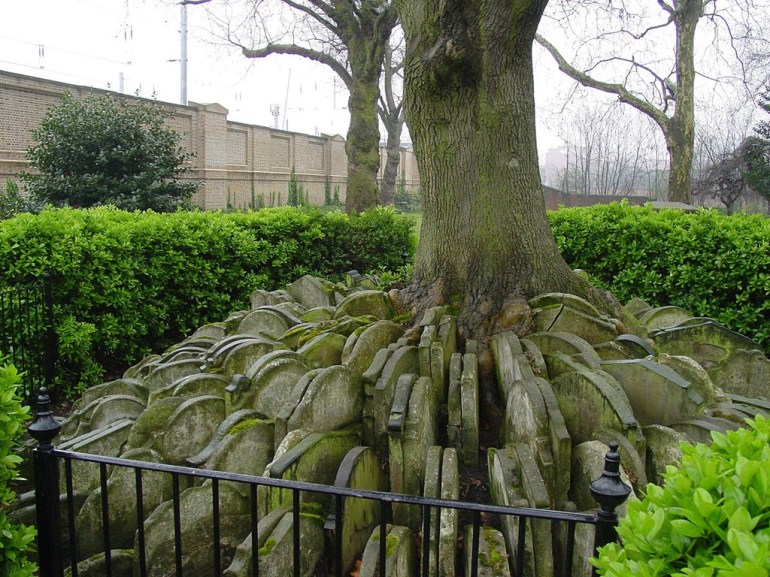
Hardy himself worked out this method of consolidating a graveyard’s worth of tombstones, and it makes a striking illustration for his poem.

.

Hardy, an Englishman born of the middle of the 19th century drops in but one or two anachronistic words in this poem — but while “grandsire” doesn’t sound natural on a 21st century American’s lips, the gist of this metrical and rhymed poem is easily singable in 2023 I thought. Down went Hall’s book and up went the efficient composer! I whipped up the music quickly. Long time listeners here will know that my music is usually not harmonically complex, but my simple cadences often try to confound the usual chords and progression resolutions. I hope I’ve done that with this one. The time to record the piece was scant, so I went with my go-to “I may have to hop a freight train shortly” folk music standby, the acoustic guitar and overdubbed a quick bass guitar part. You can hear it with an audio player below — or if you can’t see that graphical device, with this backup link that will open a new tab with its own audio player.

.

*Few click hyperlinks, so let me put this in a footnote. Wheeler’s book has these additional reasons to read it beside just being good: its story and poetry is contemporary, and as a writer and a woman Wheeler focuses on elements of our lifetime journeys that other poetic memoirs gloss over. Here’s those hyperlinks: Wheeler’s book. Hall’s book.

**Hall’s Harvard classmates circa 1951 included Frank O’Hara, Robert Bly, Adrienne Rich, Kenneth Koch, John Ashbery, and others. Eliot — and to a trivial extent, Frost — were Harvard alums. My personality, alas, is not socially skilled, but even at my most sociable, my circle of working-class Lake Street poets and state college teachers in my 20s is not as name-dropingly famous.

***It’s possible that everyone even vaguely literary in sundry metropolitan areas around this time had drinking with Dylan Thomas stories, even if Hall’s analysis of Thomas’ poetry is individually savvy.

****In his Eliot chapter Hall says that Eliot said more than once to him that no poet knows if their work is any good. When Eliot said this in an interview Hall did with him that was destined for print in a literary magazine, that statement was cut because it seemed too down-beat.
Seventeen Almost to Ohio

Two threads lie here, waiting to be woven together. One thread: those young pre-WWI Modernists, the other: writers in old age.

Young: Mina Loy, Alfred Kreymborg, Glaspell and Cook of the Provincetown Playhouse, early in their careers, workers shaping modern literature—though none of them are remembered much now. Older poets: Longfellow, Donald Hall, and even Sarojini Naidu, Dave Moore and I, all speaking for carrying on past youth. Longfellow of course is no longer read for his intrinsic value, Naidu’s poetry is not read in the West, and Donald Hall concludes in his late-life essays, that he, like the majority of poets who receive prizes, notice and ample publication in their time, will be unread 20 years after their death. Moore and I of course are in a different, more perilous, class of ranked achievement. If Hall is right, Dave and I can look forward to equaling prize winner and American Poet Laurette Donald Hall’s status (unread, forgotten) in only 20 years!

There’s your writer’s affirmation for today.

What happened to those bright young Modernists? Cook died young. Kreymborg, that pre-WWI networking avant garde-ist, had a long post-war career judged by literary critics as undistinguished. Glaspell had an increasingly difficult second half of a career, though she won a Pulitzer Prize for drama in 1931 for a play that few praise now, the sort of late plaudit that sometimes comes to pioneers when prize committees compensate for overlooking earlier achievements. Like Hall, Mina Loy lived into her 80s, but unlike Hall, the last half of her life seems fallen from any career path. So, even before she died in 1966, she’d already achieved Hall’s 20-years-past-death status.

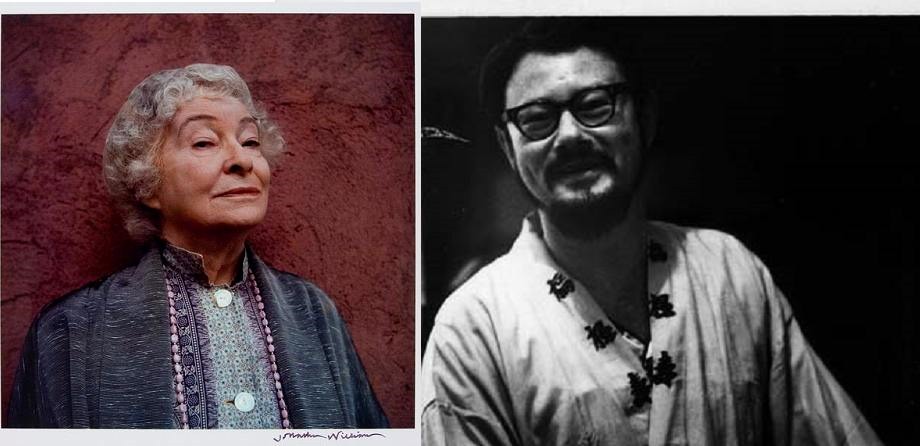
In 1960, Loy was 77 and living in the Western US when young poet Paul Blackburn was sent to interview her. A creaky hundred-minute tape exists of the encounter. Loy’s memory of things a half-century old seems spotty by this time, and this once eloquent poet grasps for words, even her own words, when asked to read her still modern sounding verse from her youth. Her readings are flat, though she occasionally is stirred by remembrance of the times and places when the poems were written. Once or twice she humble-brags or finds sincere surprise at how clever she had been. Listening, I wanted her to claim outright the fierceness she had shown back then. Instead, she seems an old 77, tired and distracted.

Mina Loy Paul Blackburn

Mina Loy in later life by Jonathan Williams, Paul Blackburn 1966 by Elsa Dorfman


Blackburn is patient, and he rarely man-splains or talks over Loy, something I would be all too prone to do if I was the man holding the microphone. He seems to genuinely admire Loy’s poetry as he seeks to add to a record of a career that was forgotten then, and he wants her to know that in 1960, at least one reader “gets” what she wrote in 1914.

Just past one hour in the recording, something extraordinary happens. Blackburn, touched by one of Loy’s recovered memories, a feeling perhaps amplified by additional visual clues he would have in the room that are not imprinted on the audio tape, exchanges with Loy a memory from his own youth during the second instead of the first world war.

I have taken that story, much as Blackburn expressed it that day in 1960, with some minimal editing and shaping for the words of today’s audio piece.

Of course, we’ve now largely forgotten Paul Blackburn as a poet too, following Hall’s law. Blackburn died too young, and more than 20 years ago, but his story struck me as a tightly expressed spontaneous poem. What was this: a poem he had already written, one he was paraphrasing from memory for Loy? Was it a poem he was thinking of writing as he interviewed the aged poet, perhaps thinking the tape recorder could serve as well as a notebook jot to put a first draft down? Was Blackburn simply a practiced poet who could orally improvise from his skills a well-shaped improvisation?

Whichever, I think it’s beautiful. His story combines looking back at youth and a landscape that is no more, with Dante’s Inferno moved forward to Greatest Generation Pittsburg, and it has a closing that contains a remarkable Imagist jump into synesthesia. I call my arrangement of Blackburn’s anecdote told to Loy “Seventeen Almost to Ohio.”

Today’s music, like the interview, is restrained: contrabass, a pair of cellos, piano, and percussion. I strove in my  performance and arrangement to do justice to Paul Blackburn’s story. To hear it, use the player below.


The Poet to Death

Here’s a short piece using a poem by a person who started out as a poet but who spent the greater part of her life working for her country, India’s, independence: Sarojini Naidu.

Sarojini Naidu, like Edna St. Vincent Millay around the same time in the U. S., impressed people as a capable poet while still a teenager. Her talents lead to her being sent abroad to England for college, and eventually she connected with the Rhymer’s Club, the turn of the century London organization that was the last stop in the 19th Century for some of the poets who would launch the poetry of the 20th century.

Today’s piece, “The Poet to Death”  was first published in England as part of Naidu’s initial collection of poetry The Golden Threshold  in 1905. Fluent in several languages, the pieces in The Golden Threshold  are in Naidu’s own English. Some accounts say that the young Sarojini was modest about her poetry at the time, worried that her work was less-substantial because it is lyrical and song-like; and retroactively English-language Modernism did discount that sort of poetic gift. So, while her poetic work is still remembered in her homeland, where Wikipedia says she’s called the “Nightingale of India,” Sarojini Naidu will be a new name to most of our reader/listeners.

During the WWI years Naidu transferred her focus from poetry to working for Indian independence, a cause in which she became a principal, alongside Gandhi and the other independence leaders.

Did the world loose a poet for India to gain its independence? Perhaps. I do not know enough to say. In her English poetry, I can see the influence of the earlier 19th Century English romantics, but her language is less extravagant. She can remind me at times of Christina Rossetti (readers here will know I consider that a good thing), and “The Poet to Death”  is a concise version of a trope Keats used as well.

Sarojini Naidu Real Folk Blues

India gave us chess. Chicago gave us Muddy Waters on Chess records.


Today’s music employs a polyrhythmic blues. Perhaps I was subconsciously moved by the “till I am satisfied” line in Naidu’s poem to think of Muddy Waters and his “I can’t be satisfied,” though what I ended up playing has some elements of Skip James’ guitar style too. At a conscious level, I was working on this while thinking of poet Donald Hall, having read a review of his new collection of essays coming out this month, and then hearing later in the same day that he had died at age 89. In his last couple of decades, Hall has often written of what continues until it ends in the course of aging.

Donald Hall
Donald Hall. His book of essays “A Carnival of Losses: Notes Nearing Ninety” drops in July.


For some reason the version of the text I worked with did not have Naidu’s first stanza, which specifically speaks, as a younger poet, for death to stay his hand. In the remaining two stanzas, the age of the speaker is less determined, and so the situation is joined whether it is a young poet or old. The blossoms are always there a short time, at any age.

To hear my performance of Sarojini Naidu’s “The Poet to Death,”  use the player below.