Before the Snow

Long time readers know that the Parlando Project is largely about our encounters with other people’s words – usually their literary poetry. Poetry, even impersonal or hermetic poetry, is a rich way to transfer experience between consciousnesses. Poetry’s strengths in this transference over memoir, blog post, or informal conversation are largely the strengths of focused beauty – that thing that attracts us even before knowledge, expressed as sound or by novel connections.

Still, these beautiful elements of poetry come with costs, which is why many, most of the time, prefer other modes. Yet, I think the shortness and the compressed incidents of lyric poetry offer a possible compromise. We’re asked to share a little burden, a few minutes of reading or listening, subconsciously absorbing the word-music and linkages, which may in leisure or with mood be extended by re-reading and re-thinking such a small number of lines.

One of the things that caused me to begin this Parlando Project was thinking that a short musical accompaniment might add pleasures to possible serial re-encounters with the words. Is this so? I’m not sure, though I persist in doing this.*

That preamble out of the way, I’m going to look like I’m violating the “Other People’s Stories” maxim that is a principle of this Project, because I’m presenting today words I wrote to go with the music I compose and record – but hold on, I’m going to tell you this is still about a poetic transference across a gap.

Here’s why: once again I’ve been running into things from decades ago as I do my “death cleaning” reduction in things stored away or unlikely to be of foreseeable use. Just last week I moved aside a drum set that had been played by Dean Seal when he was in the LYL Band,** and found under the bass drum a plastic carryall tub with things hurriedly packed up after some gig: a Radio Shack battery-powered mixer, cables, a guitar strap, a cassette recorder, and a few tambourines we’d hand out for audience participation. And more spiral, college-ruled notebooks have come to light. Glancing through one I found a page with 9, untitled, lines – the start of a poem. From the style of the poetry in the fragment I think it’s from the 1990s, but it might be earlier or later. It caught my attention because it seemed to be talking about November in Minnesota in that interval right before the first snows come.

I remember nothing about writing this poem, or what prompted it, but it had some nice word-music and was roughly pentameter. That pentameter made me think I was writing a sonnet, and for some reason left off at this incomplete draft. That night, before bed, with my aching muscles and joints from twisting, bending, and hauling I decided to complete a full 14-line draft.
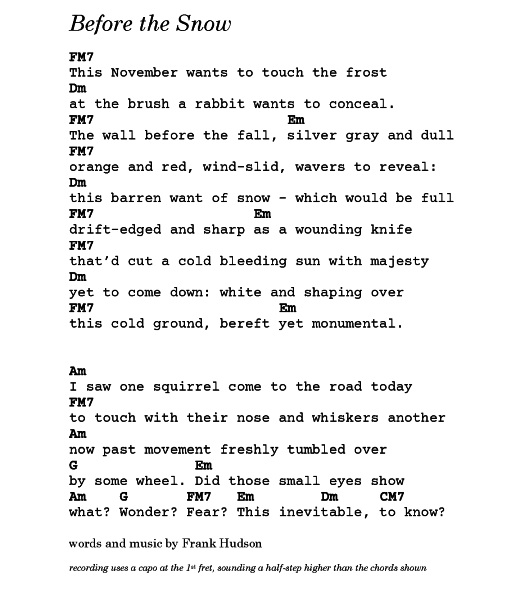
Before the Snow

More musical perversity: the difficulty in finding times to record acoustic guitar with sensitive mics in the past year or so has increased the number pieces I’ve done with that instrument.

.

For the final 5 lines I used an incident from a recent bike ride. Rolling down to a favorite breakfast destination at the borders of my wooded city I’m usually met with a rewarding bit of wildlife (outside of deep winter): constant squirrels, rabbits, small rodents, birds, including waterfowl by a pond and creek I pass, insistent crows, and so forth. If Keats wrote his “Ode to Autumn”  on Hampstead Heath in the Highgate section of the city of London, these near-daily rides of mine with this contrasting nature in the midst of modest single-family houses and parkland is my equivalent. What I saw this day was a little epiphany – a squirrel had been quite recently struck down crossing the road. Not smack dab run over, for it was not squashed, and there was only a little blood – yet it was clearly not moving or breathing, and even from the height of my bicycle its eyes could be seen fixed and dead. And then, as I was approaching, carelessly another squirrel scampered out onto the road and up to the corpse. Though I was riding onward, and only slowed a bit moving to the side, this squirrel bent down right to the head of the dead one, close enough to touch it barely with whiskers, clearly looking closely at it, for a moment regardless of my vehicular approach.

And then, just as I was beside them, it scattered off, missing by accident or close design, my slowed, but rolling, bike wheels. What was that squirrel after, what was it thinking in those few seconds with the dead one? This  was the matter to finish the poem that had started years ago with a rabbit finding scarcely-leaved autumn bush and brush to hide in. And I too had had my customary Parlando encounter without firm context, working with the part of the poem written by someone I hadn’t seen for decades: though in this case, it was my younger self. Not really that different from the usual encounters here with Frost, Dickinson, Sandburg, Millay, Stevens, Hardy, et al.

I originally gave the resulting sonnet the title “Before the Rapture of Snow,”  because I thought that tied-in the rabbit’s anxious waiting and the dead squirrel. I drew back from that thinking it too grand a reach, and because the theological implications of “rapture” would repel, puzzle, or draw in too-determinant reactions.

I was lucky enough to have a Monday to record this, finishing what felt like a good take of the vocals and acoustic guitar just before I had to leave my studio space. I added piano yesterday and mixed the tracks. As a non-pianist I’ve fallen into using that instrument simplistically as I do here, and I’ve grown fond of how these pounded single notes mesh with the timbre of acoustic guitar. You can hear “Before the Snow”  with the audio player below. Has the player been raptured up to heaven? No, it’s just that some ways of reading this blog suppress displaying such a thing, so I provide this highlighted link that will open a new tab with its own audio player.

.

*Besides my lack of talents for promotion, I sometimes feel what I do with this Project presents a number of detriments to gathering an Internet-scale audience. Poetry, as I write above, is not something sought out by modern Americans in great numbers. And then the music I make suffers from these things that reduce audience interest: I’m not a singer with a beautiful voice, nor do I think of myself as a performer with charisma or erotic appeal, and the music I make despite that is both too varied and too limited.

Many potential listeners or readers, presented with an infinite library of options in our modern age, will avoid things that have but one of those strikes against it – and to add another one or two against the Parlando work wouldn’t be rare either.

All this isn’t breast-beating or humble-brag, and I’m even hesitant to waste your time writing this. I am proud of much of the work I’ve done over the last decade here. While my audience is Internet-small, I believe it’s not all that small by poetry standards, and increasingly, not completely outsized by the audience for much non-Pop Indie music. Thanks to my hardy listeners!

**Dean was working elsewhere in comedy, and with at least one other partner in music, when he played in the LYL Band in the 1980s. He was talented and creative, we were looking for a drummer or bass player, and we perversely came upon him as both – unconcerned with the challenges of one person filling both roles! He may have grown to think of us as less professional or ambitious than he was, I don’t know, or events of his life may have intervened, but for reasons unknown to me we just stopped playing together – but this happened without him picking up the small drum set he played with us, and stored at my place. While working on my cleanout this fall I briefly tried to find contact info for Dean to see about the drums, but the trail ran cold after finding articles about him being part of the pastoral lineup at a church that no longer listed him on staff.

A Ghost’s Leavetaking. Returning to an odd-ball instrument and a resulting musical sketch

Today’s piece, continuing our series as we consider the variousness of Halloween including the surrounding Days of the Dead and associated horror/fantasy elements, has odd origins. It starts, since it’s useful to mark a starting point, with the death of my late wife decades ago, something that led to an unusual instrument.

Shortly after my wife died, and I was left alone in the house we once shared, I decided I’d take to playing more music in the silence. I went looking for new instruments to inspire me. This intimate death, as it happened, was followed by another kind of ending. To tell you about that, I won’t get too deep into the weeds of the musical instrument business, but one of America’s largest musical instrument makers, Fender, had in the late 1990s quixotically decided to introduce an entirely new guitar brand, DeArmond. In short order they created an entire line of electric guitars and basses, around two dozen models, priced between their budget Squier line that featured inexpensive renditions of traditional Fender instruments and their more expensive American line that the Squier guitars copied – but the DeArmond guitars weren’t copies of the highly popular Fender designs at all. Instead, they were versions of electric guitars and basses once produced by another company, Guild, which had around the same time been absorbed into Fender. I expect few who read this Project will know anything about Guild guitars, and that explains why they ceased to exist as a separate company. But those who do hear the name “Guild” and have a light bulb illuminate, are most likely to think of Guild acoustic guitars.*  Guild produced a successful line of acoustics. The Guild line of 12-string guitars were highly thought of: John Denver, Tim Buckley, and Ralph Towner constantly played jumbo-bodied Guild 12-strings, and other folk artists played acoustic Guild guitars in this era: Richie Havens, Paul Simon, and Bonnie Raitt.

So, this was a strange business idea: create a new brand, but make it closely reference past electric instruments many players had never heard of. So how did this turn out?

To quickly answer, I step back in marketing time and type: “Edsel.”**

OK, where are we getting to Halloween? This started with one death – trust me, we’ll get there – and now there’s the pseudo-death of guitar line. Fender pulled the plug abruptly just as our current century was getting underway. They had lots of unsold DeArmond electric guitar stock. I mean lots.  They gave some away to schools and music programs. They sold the rest at fire-sale prices. Guitars made to be sold for around $600 ($1200 in 2025 dollars) were being blown out at $200. I quickly bought three of their guitars: a large hollow-body archtop, a 12-string electric solid body, and a 6-string electric with a Bigsby vibrato bridge – not at BOGO pricing, but at those BOG2 prices. I’m writing about a lot of things today, but not those – instead, it’s another DeArmond.

One of the weirdest Guild designs that that Fender/DeArmond revived only to kill – indeed one of the oddest guitar designs of all time – was the Ashbory bass. Guitarist readers are now visualizing an electric bass: bodies at least as big as an electric guitar, but with longer necks. Old guys like me that play electric bass also are thinking weight – heavy, too often more than 10 pounds.

Nope. This is my Ashbory bass:

My Ashbory Bass 800-600

White lines, don’t do it. The Ashbory is a fretless instrument, the fretboard lines are just markers. Exact intonation with the thick strings and very short scale is a challenge.

.

Weighs less than a Stephen King novel. Less than half the length of a regular electric bass. Body just a little bigger than a CD case. The original strings, specially designed for it, were translucent rubber bands. The current strings on mine are smooth white opaque nylon, essentially extra thick versions of a modern classical guitar string. Unlike a normal fretless electric bass, which is a beast to play, you need to be almost delicate when playing these extraordinarily low-tension strings.

Other than the tiny size, a goal here was to approximate the plucked sounds of the even more unwieldy upright bass, but neither the original 1980’s Guild Ashbory or the late ‘90s DeArmond copy sold well. I used mine when I wanted upright and fretless bass sounds for a while, but in the last few years I’ve moved over to using other methods to get that sound on Parlando recordings. This week someone mentioned they’d just purchased a used Ashbory, reviving memories of that time and leading me to revisit the instrument musically. In my studio space I got the tiny bass out and plugged it in to record. To get the upright bass sound from it you want to use bare fingers, but for some reason (habit?) I decided to use a thick rubbery pick – which is one way I play regular electric bass. This gave me a slightly more aggressive sound than I recall getting out of it and I then programmed in a drum pattern to match where that result was leading me. Building from the groove, I played some electric guitar and added a piano part, producing a short two-minute piece as my studio time ran out yesterday.

Listening to the result this morning I felt the music had a sense of longing or leaving. That may have leaked from my connection between the DeArmond Ashbory and the time after my wife’s death, which was followed by my mother’s, and then after an interval, my father’s death. Could I find some words to go with this music? Nothing I had in my files of poems for Halloween seemed to fit, so I did a web search for “poem about a ghost leaving or disappearing.” Bam, this lesser-known Sylvia Plath poem came up, right on point!

Plath’s “A Ghost’s Leavetaking”  is an 8-stanza/40-line poem, not all that long, but longer than my just-over-2-minute music could cover. The poem describes a somewhat distressed awaking in a morning where the speaker is mixing dreams and remembrance of the dead with an ongoing adjustment to mundane household tasks.*** Just as in Phil Dacey’s “Frost Warnings”  poem from earlier this month, Plath sets up tired laundry and bed sheets that “signify our origin and end” while they play the role of ghosts of the departed.

A good poem, but now I had two problems: an apt text too long for my music and a poem not in the public domain.**** “A Ghost’s Leavetaking”  was written in the 1950s and has not yet reached PD status in the U.S.*****

I made a quick decision. I would use only some lines from Plath’s poem. Artistically I thought that worked. It made a shorter set of text to fit the music I had finished. I was able to zoom in on the Day of the Dead and ghost elements of the poem, shortening the examination of how we sometime wake still recovering mundane reality from our dreams. If you would like to read the entire poem, as Plath published it, here’s a link. As to the PD situation, my solution is at best mixed. “Fair use” is not a firm concept, and my Project’s entirely non-revenue and educational purposes are no guaranteed Kings X. Using only a few lines would bolster my case, but as I used about a third of the poem, that’s not clearly kosher. Even forgetting laws, if Plath were a living author, she’d be well in her rights, regardless of the law, to take issue with someone cutting her poem up, making it less than she intended it to be.

So, from that decision, we’re left with this musical piece where I quickly sketched out today in my little home office “Studio B” how one might sing some lines from Plath’s poem with the music I finished yesterday. I’m aware of the limitations of my voice, and in an ideal world the melodies could be better worked out and ornamented by a better singer. None-the-less, I found it personally rewarding to inhabit Plath’s words and do the best I can today to convey the emotions and images she put in them, and some listeners may gain something from that performance. You can hear my sketch using lines taken from “A Ghost’s Leavetaking”  with the audio gadget below. Has the audio gadget gone to Plath’s “lost otherworld?” I offer this alternative as a keeper of the “profane grail,” a highlighted link that will open a new tab with its own audio player.

.

*Fender had never been able to make itself a factor in the upper end of the acoustic guitar market, so it was assumed that’s why they snapped up the distressed Guild company: for the well-thought-of acoustic guitars.

** There are car folks who will tell you that the Edsel was a perfectly fine late 1950’s American car, but that doesn’t change what the brand name invokes.

The Guild electrics were pretty good guitars, if not answering what the market wanted back in their day. Some of the DeArmond sort-of copies were arguably better instruments than the originals, but they were just as out of sorts with what the market wanted. In 1998 the electric guitarist customer wanted a Stratocaster or a Les Paul, with a Fender or Gibson name on it, or one of the slightly hot-rodded extensions of those Fender or Gibson models. The sort of funky, oddball looks of the DeArmond guitars would have stood a better chance a decade later after Indie rock stars started to come forward making a point of playing anything but a Les Paul or a Strat.

***I had the vivid experience of my late wife seeming to return to my bedroom in the liminal hours. From things I’ve heard from others, this is not uncommon for those who’ve lost intimates.

****I’m not all that troubled by asking for forgiveness from a ghost, but one of Plath’s children is still alive, and may hold the IP rights to Plath’s work. Her web site lists the Faber and Faber UK offices as the contact for Sylvia Plath rights permissions, but I got no reply early in this project when I asked that very organization about my small-time, non-revenue use of another Faber and Faber author. I would remove this piece on any objection.

*****If I did a little day trip up Highway 61, to say Thunder Bay Ontario, Plath’s poem would be PD there. And thanks readers for following me on this post’s road trip.

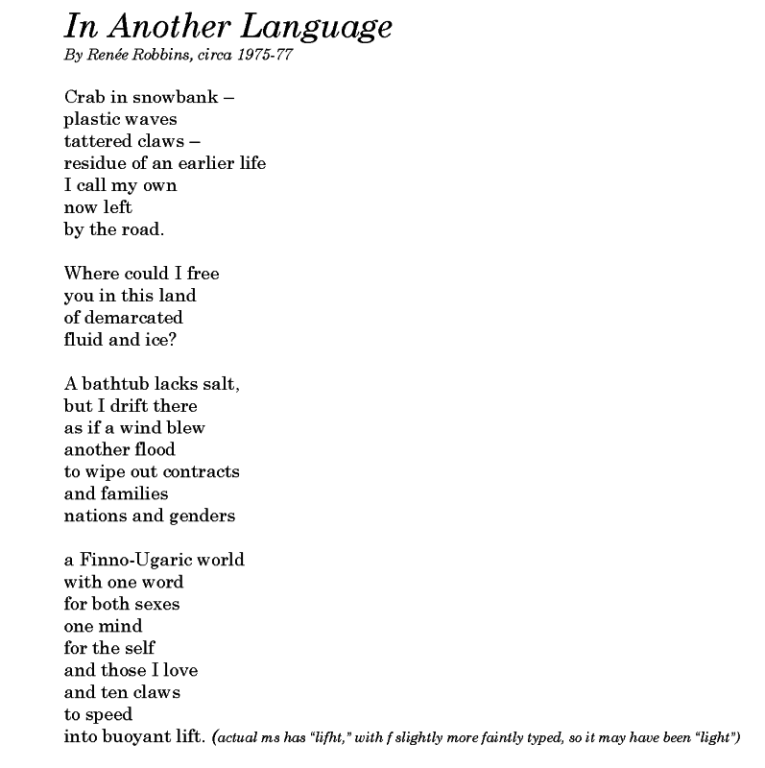
In Another Language

I mentioned last time that I’m cleaning out things I can no longer reasonably expect to use, and found a box which included poems by my late wife. Perhaps such things are past the use test, but I asked what use can I make of them?

After paging through the papers, I transcribed the handful of poems I found, typing them into documents on my computer, a now ordinary device which would have been a SciFi marvel to her back when she wrote these poems in the 1970s. Could I perform some of them, here, as part of the Parlando Project? Could that seem like special pleading, an enforced overlay of widower husband wants you to shed a tear for his dead wife? Let me try to move you past that. Decades after a death, and when one is old enough to reasonably consider one’s own death to be a nearish interval, shorter than the one from that loss, loss begins to take on a universal and obligatory aura. These aren’t sentimental poems – my late wife, Renée Robbins, was funny and was wearing the full costume of life when she wrote them. Those costumes of life go back into storage, kept for use in later productions. Perhaps her poem “In Another Language”  can be worn by someone still treading the boards?

Yes, these poems are little pieces of someone I loved deeply, written early in her too-short life, and bringing them on to you extends a tiny bit of what she was. Yes, it was particularly nice to feel I was working with and playing this part of her when I performed this poem this month – but yes too, it’s October: everyone’s wearing costumes and pretending they can see ghosts.

I can hear her responding to this situation. How? I’ll explain it with a quote from Woody Allen* that has been reverberating through my mind:

I don’t want to achieve immortality through my work; I want to achieve immortality through not dying. I don’t want to live on in the hearts of my countrymen; I want to live on in my apartment.”

So here you have it, a poem likely written while she was still in college, studying writing under Howard Mohr and Phillip Dacey. I’m fond of the obscure strangeness in the framing image. I can’t be sure what she, the author, was seeing. My best guess is a whole crab or lobster on ice in a seafood display, a mundane piece of unintended Surrealism – and being in a world of frozen water is also an accustomed strangeness to Minnesotans. I like the poem’s leaps, like the dream of the crab escaping to her bathtub, and the totally unexpected leap into the genderless cross-shifting-borders of “Finno-Ugaric.”**

In Another Language

Besides the crab image, I see Noah’s flood in the third stanza. I chose “lift” from the alternatives for that last line because it’s more sensual.

.

I performed Renée’s poem in a style that still hadn’t gone-out-of in the Seventies, as spoken word with an approaching-Jazzy musical backing: drums, bass, and two electric guitars. I believe the music, taken by itself, might shows the subliminal influence of a current band, Khruangbin. It’s subliminal because I don’t use as much reverb.

So, there you go. Looped through with the footnotes, we’ve got Khruangbin, Krasznahorkai, Woody Allen, my late wife Renée Robbins, Phil Dacey, The 1970s, and a fifty-year-old poem by a twenty-something. There’s a lot of intervals and strange harmonies there, but I’ll end with another quote from an artist (actually, from his less famous brother). I read this one in a recent interview answer given by Ken Burns when asked how he makes those famous “Ken Burns Effect” intelligence flights over photos as he edits his work:

It’s all music—my brother, Ric, said that all art forms, when they die and go to heaven, want to be music.”

So, there you go Renée, not immortal from non-dying – but you get music.

As you can see today, we stay narrowly focused on the topic here at the Parlando Project, and we will return with poems by more famous literary poets soon – but to hear Renée’s poem “In Another Language”  as I performed it with music, use the player gadget below. No graphical audio playing gadget? I offer this heavenly highlighted link that will open a new tab with its own music player.

.

*I know a fair number of possible readers of this have strong opinions when they hear his name. I’ve got at least half of those myself. There’s a second, artistic, set of subjects regarding his work that would overwhelm the focus of this piece. To stay on topic, let me just say that my late wife was a comedy fan who could recite from memory the entire 30-minute Firesign Theater Nick Danger radio drama parody, and that Woody Allen movies were a constant date night thread in our relationship. Renée had opinions too, consistently caring ones, but she would have laughed at that quote, and I’m laughing now too, but with a deeper resonance to that laugh.

**My memory of seeing Woody Allen movies with my late wife was intensified by the recent death of Diane Keaton, but there was even more coincidence as I worked on this: the Nobel Prize for Literature went to László Krasznahorkai, who writes in a Finno-Ugaric language. And yes, that language group is non-gendered, even the pronouns – at least from what I find when I checked on Renée’s reference in her poem. And if I may risk one more Woody Allen reference, in my life back then I was (roughly speaking) playing more the Annie Hall role.

Exhumation

I’ve already mentioned that I’ve been dispensing with a lot of stuff, the kind of winnowing that I like to refer to as “Death Cleaning.”* This has included going through a series of stored-away boxes and plastic bins which dated back to moving into my present house in the 1980s. While somewhat illogical, this isn’t, I think, unusual. When we move, we’re moving forward, and there’s a tendency to liberally bundle and box up those things we think we might still want – and then in the new place, present time takes over and one never gets to unboxing things one doesn’t need right away.

Things of mine I found in these dusty bins? Music tutorial books, and books on French poetry and language. The former because this was the height of the LYL Band’s live performance era and I was hoping to increase my skills and knowledge, the latter because I was interested in translating Symbolist and Modernist French poetry.** More than 40 years have passed. I now know that I know just a bit more about music: mostly what I’ve found out about in order to create the over 850 Parlando Project pieces composed this century. That’s what became my tutorial: doing. I never got around to translating as much French poetry as I planned, though you will still see that interest playing out here sometimes. Back then, I thought French poetry was the key to English-language Modernism, and while that’s not entirely untrue, I now know the American influences some of the French poets took note of.

One night in this clean-out task, working in a small room with shelving that I think had once been the coal or oil bin for our Edwardian house’s early furnace, I pulled open one of the stacked boxes there.

It was likely the contents of a desk or file cabinet drawer packed away by my late wife in the 1980s. Inside the larger cardboard one, there was a metal box, the kind one might keep important papers in – but this one was filled mostly with things she had written. Looking through the pages, there were a few things that might have dated back to high school, and a selection of poems and short-stories, some for college classwork,*** some for her just post-college time when she submitted and had published poetry. A couple looked like work for articles she had published in Seventeen, then a glossy magazine for the teenage girl market. Also in the cardboard box were the contents of many a desk in that era: sheets of typing paper, the chalky white strips that one could carefully pinch just above the belettered hammer of a typewriter to blank out a mistyped character, and a few miscellaneous things from a job she’d had with Control Data.

I was steeled for the job of getting rid of things that had an adjudged expiration date of meaning or usefulness. I could easily chuck the general detritus of this typewriter wielding ghost, but I couldn’t throw out the manuscripts. How many poems were in the stack? Might I be able to perform some of them here? Maybe. “Death cleaning” sternly says you won’t get around to it. The Parlando Project whispers otherwise.

Renee's Metal Box

In this case, Public Image Ltd was not involved: Renee’s metal box and folder of youthful creative writing work.

.

So, the metal box went into the to be saved pile – but of course there is no real keeping. I’ve survived my late wife for 24 years, and I’ve been with my living wife for almost exactly as long as I was with my wife who died all too young at 43 years old. Actuary tables say I will die before any more such multidecade interval. Death cleaning has its solid argument: the writings of a young woman, or those of myself, the young man she partnered up with, will not have any enduring memorial. It’s a near certainty that is so too of all the poets I’ve known. We write words like the immortals do, with the same goals, to the best of our craft – but there are only so many niches in the pantheon.

Today’s musical piece is a poem I wrote condensing that experience. I can imagine the readers I used to have in my small group of poets wondering at an imperfection of the poem’s ending. “Why end this personal poem with such a mundane little observation about – what? – a business you don’t even name? Needs another draft.”

And I confess to you here, that’s the thing I’m trying to say. The most practical and commercial things we do in life come to an end, are forgotten – all that stuff we’re told we should be doing instead of writing poems, making music, or creating art. So then, forgive us our arts.

You can hear my musical performance of the poem I call “Exhumation” with the audio player below. I wanted this to have rough edges, and so the guitar recording tries to capture and leave in pick and fretboard noises that you’d usually not hear by intent. What if the intended audio player gadget is not where I say it will be? No worries, some ways of reading this blog toss it out, but I supply this highlighted link that will open a new tab with its own audio player.

.

*I think when I first heard the term it was “Swedish Death Cleaning” and the process was imbued with practical Scandinavian modesty. The florid sentimentalist of objects within me has to listen to the memento mori enlightened elder in me: these are simply artifacts of one person’s life that are meaningless once that life ends. Somewhere in the corner, there’s a Modernist, smoking unfiltered cigarettes, in an Existentialist infested coffee shop, who exhales in blue and says to no one in particular, “Well, it’s all meaningless, save for what you compose it to be.”

**Mixed in were some faded to brown music papers from the Seventies and Eighties: Punk, New York Rocker, Sounds. I had them in the to-the-trash pile, but my kid wondered if they could digitize them and upload the scans to the Internet Archive. I doubt they will ever get around to that, but they’re young and should enjoy those provisional ideas.

***The little college she attended allowed her classes with Howard Mohr and Phillip Dacey.

Tis whiter than an Indian Pipe

Emily Dickinson poems are easy to set to music, but they can be more difficult for the performer. Having absorbed Protestant hymn books and folk songs in my youth, the common meter/ballad meter stanza Dickinson easily falls into makes it especially easy for me to find music for them. But then the composer me turns things over to the necessary performer me – and in that role I’m left with the question: what is she on about in this poem? What’s the attitude to the material she’s presenting: is she playful, joking, earnestly existential, or some hard to assay mixture of those approaches?

Here’s an example of how this dichotomy works out. In August I completed a setting and performance of a Dickinson poem, “Tis whiter than an Indian Pipe,”  inspired, as I was with the recent D. H. Lawrence “Bavarian Gentians”  poem, by a flower that my wife had seen and photographed on one of her nature walks. Working rapidly on that song setting I went with a casual judgement that this is a playful poem, a little portrait or riddle around the entirely pale white Indian Pipe plant. It has no green chlorophyll at all – doesn’t need it, it doesn’t use photosynthesis to get its nutrition, instead feeding parasitically off deep soil fungi. Dickinson may have been especially drawn to the plant (she had an avid horticultural interest throughout her life) because it’s, well, so weird. As the poem proceeds, my quick understanding was Dickinson commenting on its oddities. That would be consistent with other short nature portraits-in-verse that she wrote.

Ghost Pipe flowers photo by Heidi Randen 1080

If they are symbol of the afterlife, they aren’t immortal. The Indian Pipe/Ghost Pipe flowers are short-lived, and this one, near the end of its life, has lost its pipe-bowl shape.

.

Now in September, I looked again at the poem, and I can see the primary mistake I made leading me to understand this poem too soon. The poem begins “Tis whiter than an Indian Pipe.” Duh! While the things she writes in the rest of the poem could  be characteristics of an impressionistic plant description, she’s declaring right off that the poem isn’t about this unusual plant, though it will make use of the comparable flower as a symbol. Here’s a link to see the text of the poem and a scan of the handwritten manuscript including alternative words Dickenson considered.

What is the thing she’s sort of riddling us to guess is her subject? Some kind of immortal soul, some extension of being or consciousness past death. Oblivious to this at first, in this new understanding Dickinson’s poem is a good pairing with Lawrence’s “Bavarian Gentians” – each poem is examining the prospects of that “undiscovered country” past death, illuminated by a late-summer/autumn flower. This poem’s speaker (likely Dickinson herself) is unsure of such a thing: it’s colorless in the shade, makes no sound, is not something all can see. Belief in it might well be romantically exaggerated, “hyperbole.” This pale uncertainty continues, an ongoing “drama” about the possibility of an ongoing plot for our souls, instead of a tragedy’s concluding act.*

The original music and performance I created was lighthearted. In this new understanding, Dickinson is still playing, balancing thoughts about immortality, riddling with mysteries without solution. My new music would have a stronger “drone” center to depict on the necessarily faith or grounding in the unanswered question here. The core instrument in this recorded performance is my old Seagull Folk acoustic guitar, a smaller-bodied cedar-topped instrument, brown and worn as the leaf-beds the Indian Pipe might sprout from. For the drone grounds I played a tanpura, an Indian of a more correct than Columbian geography instrument. For drums, I stayed with the emerging South Asian sounds and played tablas with only the simplified technique I have for them.**

I liked how the new version came out. You can hear it with the audio player below. No player to be seen? Well, “not any voice denotes it here” – some ways of viewing the blog suppress the audio player gadget – but it be not tragedy, I supply this highlighted link that will open a new tab with its own audio player.

.

*Oddly, for all her oft-expressed gothic touches, she doesn’t use one of the symbolic plant’s other common names which include “Ghost Pipe,” and “Corpse Flower.” Perhaps the name she used was entirely predominate in her time and place? A supposition is that the plant’s long stem topped with a bowl-shaped flower is reminiscent of a ceremonial native American smoking pipe. By 1879, First Nations people were largely absent from Amherst (see also this extraordinarily brutal Robert Frost poem) – and to call this haunting plant “Indian” may have had a cultural or specific undercurrent for Dickinson.

1879 – I note this is a late Dickinson poem. Dickinson was very prolific in the early 1860s, but by this time in her life the number of poems we have of hers tails off. She’d gone through the death of her father, and her mother’s crippling stroke, and all the national casualties of the American Civil War – all occasions for considering if death was really the end. She wouldn’t have known this, but the 49-year-old poet would be dead herself in 7 years, but with the ghostly flowers we have within her poetry I can make customs of the air by singing them.

**Just to be clear – my studio space is cluttered enough – I used virtual instruments (computer databases of all the sampled notes and articulations of the actual instruments) to allow my MIDI guitar and little plastic piano keyboard to play those sounds.

Bavarian Gentians

One of the things I’ve loved about doing this Project is the varied ways that poems come into consideration for performance within it. I’m not even sure after reaching 850 of them today, that I could catalog all the ways the words have come forward. Here’s an example: last week my wife was visiting a wildflower area — something she does often enough that I kid her that she’s a nature nymph with all the powers and duties thereof. She’d taken some pictures. One she showed me was of gentian flowers.

“Do you know D. H. Lawrence has a poem about blue gentians?” I asked

“The flower or the dye?”

“Mostly the flower as I recall.”

In actuality, I couldn’t recall much about Lawrence’s poem, only that it had once impressed me around the age of 19 or 20 when I had started to read poetry more widely. Now the old man-me did a quick web search before going to sleep that night and found Lawrence’s “Bavarian Gentians,”  likely the Gentian poem I’d barely remembered. I copied it and saved it for further exploration around a Parlando Project performance.

This week I began to work on that. The first thing I noted was the poem’s odd word-music. There is enormous use of repetition: words “blue,” “black”, “dark” and “darkness” reoccur constantly, and the flow of the poem seems less that of normal prose or poetry and more like a stuck-record ostinato.*  In performance I couldn’t see how to treat this as an elegant set of refrains, so I based my eventual performance on my first impression of obsession.

But there are twin narratives inside the poem’s babbling: observation of the gentian flower itself in the Imagist manner, and a retelling of the Persephone in Hades myth. What I feel links them (other than the obsessive refraining about the dark blue color of the flower and the coincident darkness of Hades’ underworld domain) is that flowers are the reproductive organs of plants, and the Hades and Persephone, daughter of Demeter, myth is about a male/female couple in the context of Demeter’s goddess of fertility.

bottle gentians by Heidi Randen

The bottle gentians that led to today’s piece. Like the Bavarian gentians in Lawrence’s poem, dark blue and autumn-blooming. This genus’ flowers stay in this closed budded shape, which hampers pollination, while the Bavarian gentians open into the vase or torch shape described in the poem.

.

And then, as I was fairly far along in my work with the musical performance you can hear below of “Bavarian Gentians,”  I made a discovery. There are two candidates for the official, presumed final text of this poem. It just so happens, the one I found in my quick bedtime search was the lesser-known one. The version that instead will be found in most cites and collections treats the Hades/Persephone/Demeter material at a more abstract level, while the one I’d been working with is much more raw and troubling. Note: I’m not a strict adherent to content warnings, but the account in the version I was performing likely deserves one: it’s an incident of sexual violence. Here are links to the two versions of the poem: the smoother one, and the rawer one I used. Keith Sagar and some other scholars question the predominance given to the smooth version and argue that the more explicit take was Lawrence’s final revision.

I can see how the more often reprinted version of this poem was chosen. It’s more graceful I think, and one could read that kind of change as the path of an author’s revision where later, more-removed, artistic judgement polishes the rough-hewn inspirations — but it could also be the kind of revision made to make something more marketable. Now knowing of the other version, I briefly thought I should redo my performance using it — it might communicate better to a listener who might only hear it once —  and another reason I considered a redo: the sexual violence depicted in the version I had first found presented problems.

I’ll briefly outline that problem. Let me summarize the Hades/Persephone/Demeter myth. Hades, the god of death and the underworld, abducts the young Persephone to be his bride against her will and she is unable to escape from this situation. Her mother, Demeter, a more senior and powerful goddess, intercedes and a compromise is reached. Persephone will be able to rejoin the above-ground world of the living, but she must return every winter back to Hades and his underworld of the dead. The myth here is transparently an explanation of the growing season in non-tropical regions. Told at an abstract PG level, and particularly in the expectations and context of classical non-equalitarian and clearly patriarchal society, it’s a “just-so-story.” We are not to experience horror with it.

But in Lawrence’s lesser-known version, this scene is portrayed: the poet’s speaker, using the gentian flower as if it could be a lamp, follows an abducted Persephone and Demeter, this child’s mother pursuing in rescue. They enter Hades, a place of complete darkness, Persephone and everything else for that matter cannot be seen, but sound remains — and this is heard: Hades (called by his Roman name, Pluto*) is raping Persephone.

Did Laurence mean for this account to make us recoil in horror, as I did when I needed to confront the text for performance? Shouldn’t the text call for that? Or was it intended as just some ancient fantastic myth given a bit of specific detail for which the author had and expected no overwhelming empathetic reaction? There are readings of this poem’ that see a metaphoric synthesis which is only on some surface level horrible, and something else on a metaphysical level.

I don’t know enough to say for sure, if there’s a “sure” in this case. Like the sexual violence and exploitation that was woven into Eliot’s “The Waste Land”  without drawing significant emotional weight from most (and mostly male-oriented) readers for decades, it could go either way in authorial intent — but I’m not the author, I have to perform this, I feel that horror, and I expect some listeners will feel the same. Frankly, this makes me a little dissatisfied with my performance of this piece, though I tried not to shirk its implications, however imperfect the result.

What could have driven Lawrence to use this myth in such a way, and in this version, to keep in the horror? He was working on this poem knowing he was facing a mortal illness. Like poets John Keats and Adelaide Crapsey, he was dying of tuberculosis. I have no knowledge of his experience of sexual violence, but Lawrence was undergoing viscerally an abduction against his will into the underworld of the dead. He might have felt that his poem, starting and ending on the consideration of the (by natural fact) bisexual flower justifies that element of considering Demeter and Persephone, and his anima will be taken away to die along with the rest of him by the disease. Make your own judgements on these issues; they may be wiser than mine.

The final line of this version has a contrasting power to what precedes it. The erect yet open gentian flower — which despite its shape was after all useless as a torch in Hades’ dark —  spreads in dark welcome at the draught of the light of a day.

If you’ve progressed this far past the trigger warning, you can hear my performance of one version of D. H. Lawrence’s “Bavarian Gentians”  with the audio player below. No audio player to be seen? Some ways of viewing this blog suppress showing it, so I offer this highlighted link that will open a new tab with its own audio player for those situations.

.

*I figure much of my audience is old enough to grasp that metaphor, but a footnote for the rest: the vinyl record with a deleterious wound to its groove which won’t let the needle progress beyond one stuttering spiral revolution.

**Lawrence’s use in the poem of the Anglicized Greek names for Persephone and Demeter, but the Roman name for Hades, Pluto, puzzles some readers. I suppose it could just be a Cortez-on-a-peak-in-Darien kind of poetic error, but I wondered if this poem, written in 1929 might have been recently soaked in the Pluto name from the discovery of the then considered 9th planet. Close, but no cigar: Pluto was discovered in February 1930 at an observatory created by the poet-related astronomer Percival Lowell in the American Southwest region that had recently been Lawrence’s home.

My remaining theory on why Pluto? Having the underworld and its god-king both using the same name Hades makes it harder to distinguish between the two.

The Unquiet Grave

August brings me this triple obligation: it’s the anniversary of the public launch of the Parlando Project, of my late wife’s death, and of the atomic bombings — three things varying in nearness, scope, and heart-weight. Two of them plainly have to do with grief — and poetry’s connection to matters of death and survival is there to be examined too.

Today’s musical piece isn’t exactly literary poetry, as its survival can largely be laid to singing, not printing and the murmuring eye.*  “The Unquiet Grave”  is one of those works from that prolific author Anonymous. Their publisher? The memories of people who wanted something to sing. The version of “The Unquiet Grave”  that you can hear below was collected by Cecil Sharpe in Great Britain from the singing of a “Mrs. Lucy White at Hambridge, Somerset, 6 August 1904.” This is a portentous coincidence: I just went to the book where I saw that version to gather the note on its collection, and that date of the year is the very day my late wife died; the year of collection, the same that the house my late wife and I bought and I still live in was first occupied; and the place it was sung “Somerset,” says August in its sound.

The Unquiet Grave

With all the words flowing through the Internet, you still might want to pause and listen when the ghost begins to speak.

.

The story in the ballad is compressed, but it opens with a lover’s mourning. The next event, the dead partner becoming present and speaking is not just supernatural, it’s also an empirical report of what many of those in grief experience.

Just last week I was listening to Fresh Air’s Terry Gross interviewing podcaster/comic Marc Maron.  As they talked, ostensibly about Maron’s career, the two bonded over their own recent partner’s deaths — Maron’s a couple of years ago, Gross’ earlier this year. They each shared that their dead spouse’s presence and voice had vividly returned to them, and each averred that this experience was not horror-show scary — rather it was, while remaining strange, comforting. I can remember one of my own experiences around a year after my wife’s death. I was becoming involved with my present wife around this time, and I felt it awkward that here was the presence of my dead wife returning. I don’t know if I spoke to my dead wife’s presence out loud, but then in such a spirit world our conversations likely needed no sound or syntax, only the sense, and that sense was a common realization between us that it was  awkward, but that this new complexity was fine. More than speaking — do ghosts laugh? Do we laugh in their presence? I think we both might have that night.

I’ve always felt that “The Unquiet Grave”  has a practical, darkly humorous, intent. If ghosts have additional knowledge, extra-existential wisdom, what the ghost in the song shares is that one can cherish the dead, even hear them speak, but that they are changed forever — and the living can, should, change too. When the ghost says that you wouldn’t want to kiss the corpse’s lips, the gothic joke on deadly “mourning breath” almost writes itself.

The words in Lucy White’s version, which I remained faithful to, somewhat fumble the lyric’s closing statement. What the final exchange the lovers share means to say is “When the autumn leaves fall from the trees/and (then) spring up green again.” I just sang what was on the page, but that fumble is, I now think, also exemplary of grief, it’s misdirection. Grief’s disruption, like a slight-of-hand magician: something is here (like what you meant to say), and then it’s, poof, gone.

Today’s musical performance of “The Unquiet Grave”  is a tribute to Fairport Convention, the pioneering British folk-rock group — a choice of mine inspired by recently listening to Andrew Hickey’s 500songs.com history on how that group formed its own Cecil Sharpe revival-with-Stratocasters after their own encounter with death and grief. You can hear my performance with the audio player below. Has any such player failed to materialize? If so — mourn but organize — and click this highlighted link which will open a new tab with its own audio player.

.

*It’s hard to date the ur-versions of folk songs, though many were printed in the 18th and 19th centuries, first by commercial broadsheet publishers and then by collectors and song-catchers like Cecil Sharpe and Francis James Child. Child collected “The Unquiet Grave”  in America in the late 19th century and numbered it 78 in his ballad collection. It’s always seemed to me that “The Unquiet Grave”  (also known in versions as “Cold Blows the Wind”)  is an extended variation of one of the oldest fragments of English language poetry “Westron Wynde,” which has been dated to the Middle Ages, plausibly to quite early in that era.

Dirge Without Music

I’ve worried a bit lately that I’ve been doing too many Parlando pieces presenting sad poems. It’s likely that mood is part of my nature despite living a life I’m grateful for — perhaps even more so because I live a life I’m grateful for, and I’m therefore aware of its temporary nature that I cannot keep. Because of this, I’ve kept a quote, a suggestion, from Kurt Vonnegut close to me:

I urge you to please notice when you are happy, and exclaim or murmur or think at some point, ‘If this isn’t nice, I don’t know what is.’”

Vonnegut wrote this in one of his last books, one that might again speak to my mood in this state of my nation and its ideals, A Man Without a Country.

At my age, it’s no longer morbid to think about death. This past weekend my wife and I went on a goth date, and visited one of the fancier local cemeteries. We mostly went for the 1910 main chapel building full of early 20th century William Morris/Pre-Raphaelite derivations which echo back to the start of the era I mine for a lot of the poetry here.*  The cemetery was taking part in a special open-house event held around the Twin Cities offering more access for the public to “behind the scenes” parts of the facilities.

We walked by famous early citizen’s gravesites, some elaborate with statues and such, and then too the many small vaults with names and dates on their file-cabinet sized faces. One room’s space was maximized with rows floor to ceiling across the room — so much like a library, even up to having a rolling metal staircase that would facilitate viewing the topmost. Instead of spines one views in those tall rows names, and partner’s names, and those bookend years. Every one of them, like every book I suppose, expects that there’s someone left to see and remember them, and I paused to consider that that wasn’t always so.

In another part of our tour, another portion of my nature was stoked. Walking by the cemetery’s crematorium, I noticed this homely implement hanging on the wall. As the old prayer book has it: ashes to ashes, dust to dust — and that passage now had a corollary: and dust to pan.

Dome and Dust Pan

Part of the main chapel: tiled mosaics, stained class, intricate motifs, capitol mottos. Crematorium: clean, professional, and an inexpensive hanging broom and plain white plastic dustpan, the same model as hangs in our home pantry.

.

Oh, it was a beautiful Spring day, full of decoration, full of evidence of grief, inscriptions of loss — and to the puritan, evidence of vanity. Life is so big, or so small, we must laugh at it.

Which brings us to today’s poem I’ve performed with music: Edna St. Vincent Millay’s “Dirge Without Music.”   I had finished this piece earlier this Spring, but at first held it back because I feared it was too much like some other musical pieces I was working on — and then after those coincident issues expired, I started to worry that it was too much-more sadness. Revisiting it this week, I now think no, it’s not just bleak — it’s a bald-faced statement of honest feelings about death and loss. Here’s a link to the full text of the poem.

In writing music and preforming this poem, am I disrespecting the author who titled her poem “…Without Music?”   I think Millay’s intent here was to speak against sentimentally decorating loss. Loss has patterns, resolutions, codas, and rests — and music too, even if it has repeat marks, has an ending measure — but music’s part of the equivalence is so often beautiful. In such ways fine poetic word-music, as well as that with express melodies, may speak over loss, interrupt it. Perhaps my rough-hewn voice with its limits and plainness, its lack of precise or elaborate lyricism, is apt for Millay’s mood here?

You can hear that musical performance of Millay’s poem with the audio player below. What if you see no player? That’s likely because some ways of reading this blog suppress showing it, but this alternative highlighted link will open a new tab with its own audio player.

.

*A few years back here I did a series on “before they were Modernists” with early poems by some Modernist figures. More than a few had roots in those retro-hipster movements of the late 19th century, and many a free-versifier had carried around a Swinburne volume in their youth.

Kevin FitzPatrick’s Farewell

Nearly 50 years ago when I moved to the Twin Cities I fell in with a group of Irish-American writers — only they didn’t call themselves that, they called themselves the Lake Street Writer’s Group, and when my friend Dave Moore wanted to roughly categorize them back in those days he’d say many of them worked as bartenders. And so, at first, their monthly meetings would be at a bar table, I think the first one I attended was at the Artist’s Quarter, a bar and music venue.

Time and writing changes one, and so it changes groups of writers. Over the years some wandered off to other pursuits, or to other cities, and one or two died. In its last decade of existence, the group winnowed down to four people. Dave Moore and myself, and two other poets: Ethna McKiernan and Kevin FitzPatrick.*  None of us remainers were bartenders. Dave worked for a co-op grocery after working in bookstores. I worked for a public radio network. Ethna ran an Irish-Arts store until it needed to close, and then worked as a social worker. Kevin had a job with the state labor department, but he spent every non-workday at his life-partner Tina’s farm across the border in rural Wisconsin.

The poet I perform today and his last book.

.

Kevin was a healthy seeming guy, able to handle the manual small-farm work in contrast to his desk job. During that decade our little quartet of poets would hear Kevin recount his latest news from the farm, and then we’d hear what he’d transformed out of that when he showed us drafts of poems about the odd turn his post middle-aged life had taken. In this series of poems an office-worker who grew up in the Cities was encountering country labors, mores, and situations, being befuddled or making sense of them.

Kevin’s poems were narrative, and he had a real knack for that form, particularly in his talent for drawing characters in a few words and letting you get a sense of them in a stanza or two.**  One of the charming characters we met as the series of poems spun out was the farm dog: an incongruous poodle named Katie — not a Collie or German Shepard, not any other breed you’d naturally think of protecting the flock and farm. The poet didn’t invent that detail of the farmstead’s dog, but the poet knew a symbol when he came upon one.

Farm dogs are pets with job descriptions, but I don’t think Katie was a herding dog in a professional sense, any more than Kevin was a professional farmer. Still, there were in the poems a sense of Katie being an intermediary between the livestock and the bipeds, and she was portrayed as a useful watchdog and companion when Kevin needed to return to his workweek office job.

In Kevin’s poems we learned that Katie had gotten sick; and though it strained budgets, she had gone through some veterinary treatment. Then, at one month’s meeting, we learned that the poodle farm-dog had succumbed to her illness.

The Kevin FitzPatrick poem I perform today came shortly thereafter. For me, this poem works well, even though intellectually it could seem maudlin or sentimental if summarized. We should be wary of such reduction — poems are much more than AI summaries. Kevin undercut the merely weepy here with his dry sense of humor and understated anger — and then too there’s the poem’s sensual detail: a man at work with the remains and memories of a working dog, the corpse as light as a cardboard cutout, the unthawed March cold.

The poem’s ending has extra poignance for me: it was not that long after the poem was written, and the collection that contained it, Still Living in Town,***  was published, that Kevin unexpectedly took sick and died. I think I remember talking with Kevin — before that knowledge on either of our parts — about liking the final part of the poem, how it implies that when the fear and final of death might come to the poem’s speaker, that the dog’s spirit, preceding over the hill, that hearth and home animal in-between livestock and us humans, would be there faithfully there to assuage the fear of what may be nothing in an empty darkness. I call the piece today “Kevin FitzPatrick’s Farewell”   because to me its writer ended up making that statement while writing a poem about a farm dog.

Kevin heard a couple of my performances of his poems, and his feedback was that I overstated them — and my performances were certainly different from his. He had that drier Robert Frost reading tone down whenever I saw him do public readings, mixed with the kind of Irish wit that evidences just a slightest eye twinkle and unvocalized “a-ha!” while it spears some folly with an off-hand brickbat or dagger. So, to honor that contrast between us I had to fire up the electric guitar and make the speaker in his poem a little shoutier than Kevin. You can hear that performance of mine with the audio player below. No audio player to be seen? Listen: Katie is barking that you can use this highlighted link that will open a new tab with its own audio player.

.

*Kevin and Ethna took to hosting a poetry reading every St. Patrick’s Day. The last ones not at some Lake Street dive bar, but at a more tony academic site: The University Club near St. Paul’s Summit Avenue. I’m not Irish, but personally I don’t favor the mandatory cute intoxication elements endemic to that celebration, so I preferred a spotlight on that culture’s poetic side. As the holiday approaches this year, I’m planning to get to Ethna’s poetry too in time for St. Patrick’s Day.

**I admire conciseness. I’ve sometimes compared Kevin’s poems to the narrative poems of Robert Frost. While Frost’s longer blank-verse narrative poems have their power and richness, it’s not the mode that I read for pleasure. Kevin’s rural life poems take more after Frost’s shorter narrations like the “Mending Wall.”  And Kevin’s poems make more use of humor than Frost’s do.

***That book, and others, are available via this web site link.

The Fade, a Rock song about aging and loss

So here it is, our 800th officially released audio piece from the Parlando Project. Perhaps it’s not representative: it’s not by a dead poet, and unlike almost everything else we do it may not have been written for the page without thought of it being sung. “The Fade”  was written and sung by the leading alternate voice of the Project and all-around inspiration Dave Moore. Dave and I go back to when we were leaving our teenage years. I met him then when he read two pieces in a church: one was his own poem, a cheeky number that mixed eros and agape, and the other was a reading (as if it was page poetry) of Bob Dylan’s “With God on Our Side.”   A decade later we started doing music together as the LYL Band, and some of what we were doing has become melded into what became the Parlando Project.

So, as I think again — is there any way to have a representative Parlando Project piece? Maybe not, and if so, by design. Variety and seeking something unexpected are founding goals.

Dave’s writing here, and our common efforts in making it the song you can hear below, strikes me as something too little done. Rock, whether it’s Rock’n’Roll, punk-rock, Alt-Rock, Indie-Rock, has tended to speak from a youthful perspective. Even the Classic-Rock acts that are still treading the boards at Dave’s or my age hew to topics that would interest those younger than they are. “The Fade”  is far from those common tropes: it’s about the diminishment of aging and particularly about the fogging and loss of memory.

Early this morning I watched an old documentary, a British South Bank Show done in the mid-1980s about the Velvet Underground, a band that was more than a decade defunct at that point, but all the principals (several dead now) were alive then, only entering into middle-age in the 80s, and of a mind to answer questions about the band’s influential work. The topic most covered as they spoke about their former joint project was what made the songs the original lineup put out of lasting importance when the idea of 20-year-old Rock songs having currency seemed novel.

Chief songwriter Lou Reed had it that he wrote about the things he saw around him rather than using the regular subjects of pop songs. True enough, but he chose subjects decidedly less ordinary in song in the times when he wrote them. He specifically wrote about things that frightened people enough that they left them out of the songs they wished to listen to: drug dependency, gay and gender issues, less-vanilla sexuality, and mental variations. And then several others, including the band’s PhD, Sterling Morrison, took pains to note that Reed presented those stories without editorial comment or stance, without sentimentality.

I’ll note now, that later in his career, past the times of that now 40-year-old documentary, Reed wrote one of the few Rock albums about aging and its disabilities: Magic and Loss.  It still stands pretty much alone. It’s also unlikely that even the adventurous readers and listeners that this Project has have heard it.

Dave and I recorded “The Fade”  this past spring. When I talked to Dave this morning we exchanged info on folks we know, folks our age or even a bit younger, who are moving into assisted living or who are suffering from dementia. I don’t know, there are probably a few songs about how sad Alzheimer’s and the like are, probably some songs that try to mitigate it with a chorus that mixes in the memories the sufferer no longer maintains. Dave’s song isn’t like those songs — if they exist — and I’m glad I helped make his song exist, and that I get to share it with you today.

The Fade

This is the sheet Dave handed me with brief scribbled chord notes on the day we recorded this. As you listen to the performance you may see that he did a masterful job of revising his typed words. I think the song gained power from the verses he left out.

.

You can hear that recording of “The Fade”  with the audio player below. I think Dave gets a bit of the VU-ara John Cale sound with the keyboards in it. I’m using feedback in it too, but not quite as the Velvet’s did. What? No player visible? No, you didn’t forget it along with where your keys are or what you came into the room for, it’s just not shown in some ways of reading this blog.  You can use this highlighted link as an alternative.

.