John Renbourn, the English guitarist, and the subject of our last episode, once introduced a song in concert by saying he was now going to play an English song, “It’s a nice little melody—alas, there are just not that many good English ones.” As we said last episode, John’s repertoire was vast, so he had many musical traditions to draw from and could pick and choose. I mention this only in passing today, because when it comes to music, musicians accept no borders.
In the US today we have an odd holiday, St. Patrick’s Day, where we broadly and vaguely celebrate—well, not missionary saints. Instead many engage in an approximate celebration of Irishness, where amongst the dyed green rivers and dyed green beers, the “Kiss me I’m Irish” T-shirts, and the saucy leprechauns on everything, there is some occasional notice given to Celtic culture.
Indiana Jones : “Snakes. Why’d it have to be snakes?”
Alas, I have nothing prepared to be dyed green. I expect we’ll revisit Irish writers’ words soon enough though.
Instead I have a piece by the LYL Band’s keyboard player and alternate reader Dave Moore titled “He Hit Me First.” I think his words speak well enough for themselves, so I’m not going to add much here to them. When I asked him if the words were written about a particular incident, he told me that it was inspired by working on a book
Lester Moore: preacher, Dave’s father
collecting some of his father’s sermons. Looking over a pre-publication proof of that book, and the sermons Dave decided to include there, I don’t see where Dave used any exact words from his father, Lester Moore, in He Hit Me First; but I do see how Lester Moore’s inclination and approach informed it. Here’s a few words from a sermon Lester Moore delivered in 1981:
Christianity conquered an empire that was more cruel than Hitler’s Auschwitz. And it was done by Christians who were willing to live the love that God gave them in the model of Jesus.
I sometimes wonder why it is that we still fail to see this. Christians who offer love in today’s world are called ‘soft-headed.’ But what happens when we bluster and threaten in today’s world? Are we nearer peace today because we speak in militant tones?
Psychologists tell us that we get a REACTION equal to the ACTION in the emotional world just as we do in the physical world. When we shake our fist at someone, we get a fist right back. So, who is soft-headed?
Love does not turn its back on evil. It does not pretend that evil does not exist. Love stands firm and insistent. It is disciplined and ready to sacrifice. It cares about what happens to people, whether it has to do with freedom or hunger or health or hope.”
This is a complex subject, and I’ve only given Lester Moore a few words for his position. Knowing the action/reaction pair he speaks of, I anticipate one response, something I could summarize as “That’s all very nice, but in the real world, you may want those fists, that military, those soldiers to protect your music, poetry, and preachers.”
I will note only that Lester Moore earned a Purple Heart, Bronze Star and Silver Star serving in WWII, before he took up the ministry and eventually gave this sermon.
To hear Dave Moore’s He Hit Me First, use the player gadget below.
We’re going to drop back into questions of death and life for a little bit with this one.
Arthur Koestler was a novelist and public intellectual who lived and wrote about some of the greatest issues of the middle of the 20th Century, and his breakthrough work was his novel “Darkness at Noon.” Let me be honest here: I know of Arthur Koestler, but I have not read Arthur Koestler. I’m not sure how much of Koestler this piece’s author Dave Moore has read either. Perhaps that is of secondary importance, as this song isn’t so much about Koestler’s life or his works, but is instead about his death.
By 1983 Koestler was in his mid 70s and was suffering from serious and incurable illnesses. With apparent deliberation, he decided to commit suicide, writing his suicide note in the summer of 1982. Nine months later, in this severe but promising month of March, he decided to go through with it.
Later that same year Dave Moore wrote this piece, and the LYL Band would perform it with our usual sound at the time, which featured somewhat distorted Farfisa organ, organ bass keys, and loud discordant guitar. My understanding of “Arthur Koestler’s Death Song,” as we performed it then, was it was about Koestler’s intellectual and philosophical approach to this choice, and the hubris that implied. Of course, we were Thirty-Somethings considering the choices of much more esteemed old man.
The performance of “Arthur Koestler’s Death Song” you will hear here was recorded almost 30 years after this. It’s a solo piece I recorded as part of a collection I put together then to showcase some of Dave Moore’s writing.
A key part of the story of Koestler’s act is depicted in one verse. In March of 1983, Koestler’s original suicide note of the year before now carried an addendum. His wife, 20 years younger and in perfectly good health, was going to join him in taking the barbiturates and alcohol that was his chosen suicide method. “I see my wife sitting across from me. She’s going to join me in death.” The verse starts.
Please allow this to disturb you, because it should.
One of these two people is a famous polemicist reasoning to end his life, but other person will die too.
I’m no psychic. I cannot know what went into that decision and what was in his wife, Cynthia Jefferies’, mind, but I do know all too many relationships where the spouse of the artist, the intellectual—even if that thinker is an avowed proponent of freedom, liberty, and equality—is reduced to the role of servant and subservient.
“Arthur Koestler’s Death Song” lays out the facts and lets you consider the possible motives. It assumes you will be an active listener, one who can not only form your own answers, but your own questions. To hear my performance of Dave Moore’s words and music, use the player below.
Today’s post returns to the issue we touched on last month with “Acting.” What is an artist’s proper role regarding politics and social issues? And why do artists who engage in politics draw especial condemnation for doing so?
This may be the wrong question. Does anyone ask, what’s the proper role of a lawyer, real estate tycoon, school teacher, doctor or fry cook in politics? None that I’ve heard of lately. My working answer to this possibly disingenuous question is going to be long, so if you can, bear with me.
Probably the only other profession that has its participation in politics questioned in any way would be clergy, and I think there are a pair of oddly similar issues with artists and clergy speaking on politics.
Artists, at least good ones, by their nature tend to be “progressives.” Please, if you can, skip by any associated political stances you attach to that label, it’s honestly the best word I could come up with. By “progressives,” I mean that artists naturally seek change, novelty, and the advancement of new ideas even if they are built on older ones. Scientists and technologists have a similar bent, but artists like to think of themselves as ahead of even the sciences in this regard. Religious leaders, teachers, preachers, tend to be “conservative.” Please apply the same caution to that word as I asked for “progressives.” By conservative, I mean that they see the values in cultural traditions as possibly being given by supernatural forces that are of a higher order than mere human thought, or at the very least, that traditions are time-tested in such a way that they need to be honored, and to extent that seems reasonable to them, for those traditions to remain unchanged.
Are there “conservative” artists. Yes, they are. It’s quite possible to be artistically progressive (important for good artistic work) and politically conservative. Shakespeare presents himself as conservative politically, but was a culture changing artist. And it’s easy for me to think of some 20th century artists who are not “conservative” but “reactionary,” Ezra Pound for one. Caution again, just a label, let me explain: I use reactionary as a label here to denote people who believe that some important elements have failed to have been conserved, and that change is necessary to return to that state or set of values that no longer effectively exist.
Are there religious “progressives.” Yes indeed. Remember that religious people overwhelmingly believe that certain values are given by superhuman forces, ones that exceed what humans themselves might honor. There has always been a large part of religious thought that says that mankind is “fallen” and so therefore is in constant need for change toward the good, a good that might never be properly illuminated by fallen human thought.
So for both our “conservative” label (clergy) and “progressive” label (artists) we’re talking associated tendencies, not absolute dictates. Humans are complicated after all; but I think that’s one thing that strangely joins concerns about artists and clergy in the political arena. Opponents to conservative clergy and progressive artists see these groups as respectively prejudiced, temperamentally oriented toward resistance to necessary change or moving toward too broad and untested change. In this outlook, their self-selected temperaments that lead to their professions blind them, and so they aren’t viewing things fairly or deeply enough because of who they are. One proof we can see in this is that it’s rare for conservatives to criticize conservative artists in politics, or for progressives to criticize religious leaders who champion progressive causes. The belief here would be that those who go against natural tendencies in their professions must be significantly immune to that issue of characteristic prejudice.
You might next think or ask: well doesn’t a fry cook or a real-estate tycoon have their own prejudices based on their livelihoods? What’s different about artists or clergy?
My answer to that moves to another thing those two professions have in common: they are both pretty much in the same business. When a religious leader gives a spell-binding sermon, or a writer moves us to tears, when a religious visionary tells us what the angels said to them, or the musician brings sounds together in a way that moves us, when the crowd rises as one, with one hosanna on their lips, does it matter here who is at the front of the house?
What is important to our question comes after these remarkably similar experiences. Are we in that crowd, and yet not moved to rise in praise like the others? Is there often a let-down, however vague and hard to explain afterward? A way in which we feel unworthy, a way in which we feel we thought we were changed and yet we are not changed? Do we ever feel tricked: fearing, or perhaps even knowing, that the artist or preacher has engineered this with the techniques of their craft, techniques that might work regardless of the content they convey?
Now what if the person at the front of the room is not an artist or a preacher, but a political figure? Don’t all the same things apply?
So all this is a prelude to a very short, yet puzzling piece, with words by William Butler Yeats: “On Being Asked for a War Poem.”
Why puzzling? Yeats is good example of an artist engaged both in spiritual concerns and politics. In the struggle for Irish independence, Yeats was a leader in the idea that Irish cultural independence as a pre-requisite for political independence. If skeptical of armed rebellion, Yeats consistently pushed for what eventually became the independent Republic of Ireland and he become a Senator after Irish independence. One of Yeats inspirations, Percy Bysshe Shelley had famously said “poets are the unacknowledged legislators of the world.” Yeats in effect revised Shelley’s passage by striking “Unacknowledged!”
Couldn’t make it in the NBA, but an artist engaged in politics
What would you expect from such a man in regards the use of his art for political purposes? You’d guess he’d be all in. Well, he was asked, just like the title says. Edith Wharton asked for a poem from Yeats for book meant to raise funds for Belgian war victims during WWI, and this was his response, which indeed was printed and therefore served its charitable purpose. Here is the entire poem:
“I think it better that in times like these A poet’s mouth be silent, for in truth We have no gift to set a statesman right; He has had enough of meddling who can please A young girl in the indolence of her youth, Or an old man upon a winter’s night.”
So why is Yeats seeming to refuse to put his artist’s shoulder to the wheel and write a “war poem,” as so many others did? Well first, Ireland’s position in WWI was complicated, as it was not yet independent. Ireland’s colonial ruler, England, was engaged. The ancient principle of “the enemy of my enemy is my friend” might make an Irish nationalist (at the least) abstain from taking sides.
He goes beyond that however, on the face of it saying that a poet—“a poet,” unqualified, not “this poet,” or “given that I’m a colonial subject against my will, don’t ask me for poetry about your war.” Poets, he says, have “no gift to set the statesman right.”
I don’t know what was inside Yeats’ mind, nor am any kind of expert on his work, but in thinking about these things, about how the artist, the clergy, and at times that statesmen, are all in the same line of work; an alternative reading has come to me.
That pronoun “He” that starts the fifth line, why did Yeats not make the antecedent clear? Most readers believe that the “He,” the one who’s suited to pleasing an indolent young girl or an “old man upon a winter’s night”—that last, a character who could be that frightened and lonely farmer in Frost’s poem we recently featured here—is the poet, or a poet performing his rightful role. If so, it’s a surprisingly modest, even dismissive, statement of a poet’s worth. However, the last noun before that pronoun “He” isn’t the poet, it’s the “statesmen.” English syntax rules indicate that “statesmen” could likely be the “He.” If I write “Frank went to a Minnesota Timberwolves basketball game, saw Karl Anthony Towns, and he scored 42 points.” We know that I couldn’t score 42 points, even in an empty gym, not because of my athletic ineptitude, but because we usually think the pronoun refers to the last applicable noun before it.
Not the author of this post, but he can play some ball
So did Yeats slyly mean to say that a statesman, like the poet, like the artist in general, is engaged in the same game, fooling the youth and the feeble old?
I have more to say about artists with political opinions in the upcoming week, but to hear the LYL Band and William Butler Yeats “On Being Asked for a War Poem” use the player below.
Today’s post, as I’m reminded specifically today about the clergy and political action by his life, is dedicated to Lester Moore, the father of Dave Moore. You’ve heard Dave reading and playing keyboards here (including the various keyboards in today’s piece).
As promised, here’s my “bird in the house” piece presented as a companion to Dave Moore’s episode from yesterday.
I wrote this about a decade ago. I was going through a bit of a rough spot in my life then, and just as the words place the narrator in the piece, I was alone in a house in the wintertime, acutely aware of the sounds in winter. In that house, with no other human sounds but my own, I found myself thinking of my aged father, now widowed, living alone as well. In a somewhat morbid, gloomy mood I thought of unwitnessed death, of my father, or myself, dying alone.
Just as in the dream reported in Dave’s piece “The Bird Dream,” the trapped bird image came to me as I wrote the words for “A Rustle of Feathers.”
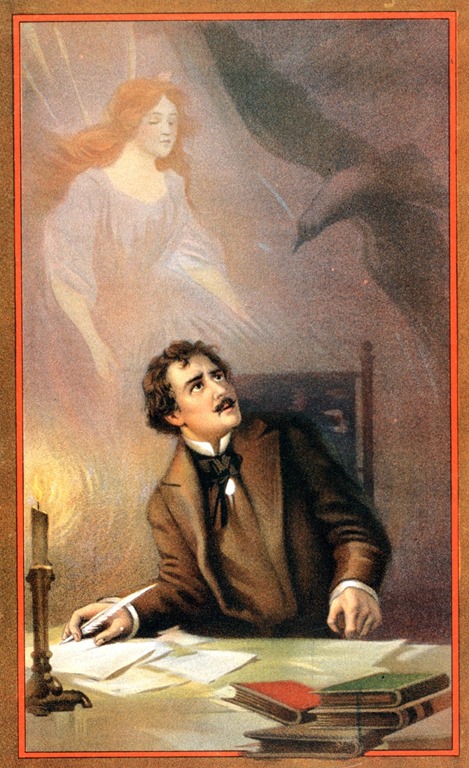
Odd that that trapped bird image occurred to both of us thinking of our aged parents. I don’t know if this is a common image or archetype, something that waits in our common human unconsciousness, waiting for a writer’s words to awaken. “A Rustle of Feathers,” with it’s aged narrator in an otherwise empty house acutely alert to sounds, shares a bit of the mise-en-scène of Robert Frost’s “A Old Man’s Winters Night” that was presented here earlier this month. Possibly I had read the Frost poem somewhere in my youth, but I don’t believe it was present in my unconscious as I wrote this; but shortly after I wrote “A Rustle of Feathers,” I did think that Edgar Allan Poe’s “The Raven”—a poem widely known to Americans of my generation—might have been a subliminal influence.
Yes, I am using a plucked feather as a pen—but it’s a goose’s quill—so get out of my house!
Musically I was thinking a bit of a Johnny Cash feel as I composed the music, but I’m not sure that much of that came through in the final result. The guitar sound is a lovely example of a Fender Telecaster using both it’s pickups.
Well the muses keep dancing, and they are hard to keep in our narrow field of vision. The piece got written, and now it’s here for you to listen to. Just click on the gadget that appears below to hear it.
You can be in my dream, if I can be in yours. Bob Dylan said that.
You may have noticed that blog post frequency has fallen off a bit this month. Well besides the usual struggle of an upper Midwest winter, both alternative Parlando Project reader Dave Moore and I have had some extra tasks this month. I’ve been helping transition my mother-in-law to new living arrangements, and Dave has been working on editing a book of his father’s sermons.
Today’s post is a piece that Dave wrote a few years back about his parents, and his father’s experience after Dave’s mother had died. Like many good stories, it seeks to find meaningful connections in the flow of coincidental events.
And speaking of coincidence or archetypes or something, I wrote another piece myself a few years back. Though I did not mention it explicitly, my piece was also engendered by thinking of my father now living alone after my mother had died. Both pieces used the image of a bird trapped in a house.
I’ll not attach any more meaning than that to this. Today’s piece is Dave Moore’s story, read by Dave. Click on the gadget below to hear his story. Tomorrow I’ll post mine.
Names are funny things. I was recently watching an old TV show from 1969 where Janis Joplin sat on the talk-show couch with a young British-accented rock critic named Michael Thomas. A Platonic dialog of sorts broke out on that show. Janis, the more intellectual than she liked to pretend singer, proposed that rock critics fundamentally obfuscated the experience of music. Thomas, self-evidently aware that he was a member of said tribe, tried to counter that all he was doing was presenting in words the same subjective experiences that Joplin said were the essence of music.
He could have said more, said that he was providing meaning and context for those experiences. She could have replied that meaning was beside the point, or at least meaning was beyond the point of the approximate trivialities that he writes. They could have agreed that experience was the greater part of the meaning of art, but that something remains, and can be changed and reflected upon after the experience and in doing so they could come to the conclusion of poet William Wordsworth, that it’s “Emotion reflected in tranquility.”
But they didn’t say that—commercial breaks stopped the dialog just as it was getting interesting, but I wondered about that guy, Michael Thomas. What had he written? Did he evolve a unique understanding of music as he developed as a critic? There he was, young and good looking, a member of the generation that was going to, like most generations, reform and reconstruct our culture. How did his individual story turn out?
I found a couple of magazine articles online he had written by the time of this TV appearance. Elaborate little hip-bourgeois celebrity profiles of no great import—but then most magazine articles are like that. And he was fairly early in writing about “Rock,” that more serious outgrowth of rock’n’roll that was still new in 1968. There as a lot everybody had to learn then. So, what did he learn?
Turns out there’s no way to tell. Wikipedia has over two dozen Michael Thomases listed on its disambiguation landing page, and none of them are him. Rolling Stone’s archives list a few articles by Michael Thomas, the earliest written in 1970 seem to be by the same man, while the last under the byline are about buying stereo equipment at the end of the same decade. After that? More than 35 years of nothing I can find on the web. If I want to catch up on what, for example, Jaan Uhelszki did after writing about music in the Seventies, it’s pretty easy. Michael Thomas—not so much.
Frequent keyboardist and alternate voice here, Dave Moore has his own eponymous issues, but let’s cut to another name issue.
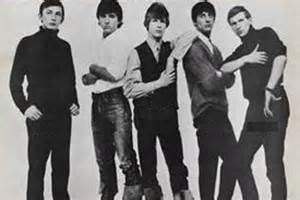
In 1964 a young English guy wanted to get into the performing business as a singer. Lots of folks did in those days. His first recording, a single with his teenage blues band Davie Jones and King Bees came out that year. He kept plugging away at English pop-blues to no great success, until 1967, when he had a problem.
Davie Jones is the teenager in the middle
Well, he had a couple of problems. First, no one was buying any of this records; but secondly, his performing name Davie Jones, the informal diminutive of his given name David Jones, was more-or-less the same name as the performing and birth name of much more successful performer and teen heart-throb: Davy Jones of the Monkees. So, he changed his performing name to David Bowie and remained unsuccessful for a couple more years without being confused with the Monkee or the roughly 100 other David Joneses on the Wikipedia disambiguation page.
Eventually, he got his first hit. Eventually he started changing more than his name. Eventually he helped change our culture, making some dazzling records along the way. There was an immediate experience, and then something remained to be reflected on over time.
A year ago, he died. The official launch post of the Parlando Project here last August was the tribute I choose for Bowie, my setting of Carl Sandburg’s “Stars Songs Faces” that the LYL Band recorded the day after Bowie died. Now for our 41st official Parlando Project post, here’s Dave Moore’s self-written tribute “This One’s for David Jones.” Dave recorded this the same session as we did “Stars Songs Faces.” It’s a rockin’ little number, because it seems like it’s been a bit since we rocked out. If you see it, you can click on the gadget below to hear it, or if there’s no visible gadget, this highlighted hyperlink will work too.
Here is a little Halloween sidetrack. Last year, before the Parlando project, when people asked me what I was doing, I’d tell them I was writing a rock opera.
Daft looks on their faces, particularly if they’d heard me sing. It was pretty much a conversation stopper.
“It’s about Vampira.” I’d follow up with.
Blank looks now.
But it wasn’t my idea. The idea was Dave Moore’s. Well, not the rock opera part—that was mine—but the idea of a series of pieces on Vampira was Dave’s. As I read those pieces they had voices, various emotional states, and a loose tread of events. It just seemed they needed music and I got working on that along with Dave. In the end, we had around 10 complete songs worked up as demos. This is one of them.
Vampira was the creation of Maila Nurmi, who in that character originated the concept of the drolly comic host presenting old horror movies on television in 1954 in Los Angeles; but by the time of this song in the sequence, she has left show business and is recounting one of her last roles, an appearance in 1958’s “Plan 9 From Outer Space,” often judged the worst film of all time. Oddly enough, that conspicuous badness gave the film a robust second life. Plan 9’s auteur, Ed Wood, the Ed sung about in this song, even got his own biopic.
Nurmi’s successful earlier TV work was never archived (save for this small fragment). Since her attempts to find other outlets for her character came to naught, for many people she was only known from her short appearance in this bad movie.
So here is the story of a true original who, alas, is largely remembered for being part of the worst project in her career. To hear the song selection from the Vampira project, click on the gadget below.
Looking over the pieces the Parlando project has presented so far, I think we’re a little over-representing the romantic and the tragic. It’s easy for the page-poet to fall into that kind of thing. After all, there we sit with a mute page and all the time until a piece of paper rots in front of us. It’s time to get serious. It’s time to set down those final things, time to let the future know we have felt the tragic pangs of life.
Oh, and it’s a lot easier to go that route. Say sad things badly, muff the music, grab at the easy statements that this is so hard—no matter—we’re overcome with tragedy and within our just-past-real visions. Such imprecision is to be forgiven, even expected. After all, we suffered for our art, now it’s your turn.
That’s something live spoken-word poetry balances better than page-poets I think. In any case, page-poets and critics favorable to them, will make that case for me while marking down live spoken-word poetry as relying too much on humor; but when you have an audience in front of you the need to entertain, to connect, to make it worth their while, is hard to escape.
So as baseball fans look forward to the start of the World Series this week, we present this piece about Yogi Berra who participated in 21 World Series, meaning that the man was in almost a fifth of all Word Series ever played since 1903. As time passes, fewer remember him as one of the greatest baseball players of all time, a deadly serious student of the game, yet his rhetorical gift for humorously expressing the quantum state in many a duality lives on, and that’s what this piece celebrates.
The voice and author of Yogi Berra is Dave Moore. Musically, the LYL Band just lets it rip and avoids making any wrong mistakes or playing harmonica. To hear it, click on the gadget that should appear just below.
Earlier here you’ve heard me proclaim that Bob Dylan changed how folks wrote songs. Before Bob Dylan circa 1964, no one wrote songs like Bob Dylan. Afterward, the things he did (portrayal of fragmented personal experience, florid and unlimited imagery, a questioning attitude toward accepted beliefs) were everywhere, until by today we may have forgotten (or for younger generations, never knew) that these things were once “Dylanesque.” And because songs with lyrics were the primary way late 20th century people experienced poetry, that revolution impacted the culture generally.
Of course, page-poets had already done those things. Some European poets worked with these concepts decades before Bob Dylan. American modernists of the first part of the 20th century did these things too, and in American English. And the Beats, Dylan’s slightly older siblings, knew those achievements and applied them to the post WWII American landscape.
So, take away the Nobel prize! Dylan had influences! And his revolution was maybe the fourth time around!
No. First off, the page-poets did not generally ally their words with music. Yes, I know there were exceptions to this “generally” statement—and I think those exceptions deserve more notice and listening—but that’s my point, those exceptions didn’t get much of an audience. As the Parlando project seeks to demonstrate, poetry gains resonance when paired with music. The inherent abstractness of music allows listeners to more easily accept abstractness and difficulty in words, so those producing the more difficult, abstract or hermetic writing needed music even more. Add to that music’s ability to amplify and re-cast emotions, and Dylan’s linking of those page-poet concepts to music meant his was a new force.
So, I say the very thing that causes some to say Dylan should not be considered a literary hero: that he is a songwriter, is one very good reason he is just such an authentic hero.
And here’s another reason. We sometimes like to pride ourselves in finding what we believe are the first movers of things. In songwriting, Dylan is just such a first mover, but if we take his words or his music in separation, he is not the first mover. However, as to impact, it makes less difference who did something first compared to who got the experience to the audience, the listener, and/or the reader at the time and way they were primed to hear it. So, if we artificially separate Dylan’s words and music we can say they weren’t the first, we can even believe they were not the “best,” however we figure that out, but that combination of words and sound was a revolution that succeeded in ways that previous efforts didn’t. It’s romantic to mourn failed revolutionaries, but let’s not let our mourning obscure the power of successful ones.
While I wrote this post’s audio piece “On First Hearing Blonde on Blonde,” it is not the sort of work I usually put here. It’s a recounting of personal experience, something that is already over-represented in poetry and particularly in spoken word poetry. That can be a valid kind of poetic expression, but there’s no lack of it elsewhere, and as a creator I’m instructed by my experience as a reader that most poems about the writer’s personal experience fail for several iatrogenic reasons, such as the writer’s inability to fully see and question their own assumptions, an approach to individualization that can cut the writer off from their connection to and balance with the rest of the world, or even the simple ability to judge what another person will be interested in.
If I work out getting permissions for more current work by other authors, there will be more poems spoken in a personal voice here, but I believe they will gain from being selected by someone else, and spoken by someone else, not by the poet themselves. That’s one of my Parlando principles: “Other People’s Stories.”
“On First Hearing Blonde on Blonde” is published here, not because it’s a tale about myself, but because it tries to convey that listener experience that occurs when the listener is primed to hear something. Will someone who listens to Bob Dylan’s “Blonde on Blonde” record album, as suggested by the Nobel Secretary last week, hear a different album than I heard nearly 50 years ago? On one hand, surely they will. Every ear in every time is always its own. On the other hand, I could give you answers—I just typed and erased some now—but instead I leave you with wishes for more, and perhaps better, questions.
Next post we move on from Bob Dylan. Which is about right. After all, even Bob Dylan got tired of being Bob Dylan, several times in fact.
To hear the LYL Band and the audio spoken word piece “On First Hearing Blonde on Blonde,” click on the gadget that should appear below. We recorded the basic tracks the afternoon the Nobel Prize for Dylan was announced. Yes, the Dave Moore mentioned in the piece is the same Dave Moore whose voice and keyboard playing has been heard here.
Early on here I mentioned that I didn’t care for Robert Frost when I was young. When I first was introduced to him he was still alive, but the very image of an old man. I think of him on a cold, windy and monochrome day reading at John Kennedy’s inauguration ceremony, more than 80 years old, more than 70 years older that I was then.
Teachers introduced him as moralist:
“What does this poem tell us?” “What does he mean by the ‘road not taken?” The teachers would ask.
And as a formalist:
“Free verse is like playing tennis without a net.” That was his most famous quote not taken from a poem. All that wild bohemian, beatnik stuff–that’s like cheating!
Meaning in poetry can be problematic. It’s not that poets can’t express original observations or analysis of things, but poetry’s preference for brevity tends to make poems more like a hint than an instruction manual. I wonder how many students ended up hating poetry, thinking the poetry the teacher wanted them to interpret and “understand” was tricking them with irony and obscure metaphor. Frost, as he was taught when I was young, was “meaningful”—but worse than that, he seemed to be held up as someone whose poems were meant to teach good behavior and noble thoughts. As a teenager, I already felt I already had all I needed of that.
It was only a few years ago that I was looking for poems to set to music and sing, and to my surprise came upon the Frost of a hundred years before, the writer of short poems that just sang off the dry page. This sort of thing is very hard to do in English. I know, I’ve struggled to do it. What Frost could do wasn’t just tennis with the net strung up, this was playing grand slam tournament tennis while dancing classical ballet!
So here’s an example of Frost doing that: “October” written in 1913. Frost is a master here of singing vowels. This is less a poem than a singing mediation. Meaning? Well, yes this is one of many poems that look at October as the time of approaching Winter. That this is not a strikingly original thought is not really an issue, because the poem isn’t about the thought, it’s about the moment of that thought, common to many of us, and how to hold ourselves inside that thought. The real, valuable, “meaning” is in the sound and the way of saying it.
Musically I tried to serve that feeling of meditation, and once more I have a tambura drone grounding the melody lines. Dave Moore, who you may have heard reading other pieces here, is playing the keyboard part, which I call your attention to because I think it’s a fine performance on his part.
To hear that performance, click on the gadget below.


 Frank Hudson