I’ve made note that I didn’t do a piece from Dave Moore for St. Patrick’s Day, but I’m about to deal with that. Readers of earlier posts this month know that I was writing about falling in with a group of Irish-American writers almost 50 years ago. The group in its last decade or so was just four of us, and you’ve heard my performance of words from the two of them who died a few years ago. Dave’s not in that group — well, he was in the group, but he isn’t dead — and I don’t know if Dave ever considered himself an Irish-American writer either. At the other pole, we have Ethna McKiernan who spent time living in Ireland, whose father was a figure in the Irish cultural renaissance, who ran an Irish-arts focused store for many years, and some of her poetry was published by an Irish publisher. That’s more Irish than green beer.
What makes one an Irish or Irish-American writer? I’m just an observer here, but I suppose opinions differ. It never crossed my mind to consider Edna St. Vincent Millay an Irish-American writer, but there’s Irish heritage there, and while her most well-known poems don’t explicitly speak of Irish themes or history, I eventually found and performed this poem of hers that’s quite Irish. Shortly after I discovered Joseph Campbell and was in my first burst of enthusiasm for him, I asked Kevin and Ethna if Campbell was counted in the realms of Irish culture. He was as unknown to them as he remains generally, but he was deeply embedded in Irish culture in his writing and life in both Ireland and the United States, and even his downfall was largely due to ending up on the losing side in the Irish Civil War. Campbell’s clearly an Irish writer who lived in the U.S., but he’s just so little-known. Let me add one more: does anyone consider Frank O’Hara an Irish-American writer? I once did a web search looking for anything written along those lines. If I didn’t come up dry, what I found wasn’t enough to dampen the leather above my bootsoles. If I was asked to find such a connection, I’d point to O’Hara’s manifest sense of mischief and his greater interest than most mid-century Americans in poets who weren’t British.
Perhaps it’s somewhat a coincidence if one is an Irish-American writer or one isn’t. You don’t have to write one way or the other, and it may not have to do with where your parents or grandparents were born. And by coincidence too long to interject here, I came to see that this Tuesday, the day after St. Patrick’s Day, is the anniversary of SciFi writer R. A. Lafferty’s death. I saw this and — ta-da — I remembered that I have a recording of Dave Moore singing his song about that writer. Recalling that, I found that recording and worked today on spiffing it up a bit sonically since it was 10-years-old and reflects some older recording tech. And sure enough, right in the lyrics Dave claims Lafferty as an Irish writer. So, an easy job to complete today’s musical piece and post?
Sort of. I didn’t plan this enough ahead of time to give Dave time to say anything about Lafferty and his writing. I had memories of his telling me, or trying to tell me, about Lafferty’s writing, which had a brief flowering in the 1960s-80s — but what was that he said back then? I thrashed about this afternoon finding a copy of his 1972 short-story collection Strange Doings. I rapidly read a half-a-dozen of his stories just trying to get a flavor, and I got some sense of why Dave had a hard time encapsulating Lafferty’s virtues. At least in this collection, his prose style is somewhat creaky pulp, yet with that instrument he sets out to tell rather strange metafictions in even stranger ways, often ending in a shaggy dog joke. The image I got was I’m at a dive bar, and there’s this man sitting on one stool. He wants to tell me a story. As he goes on, I try to get a read on who he is. Is he some kind of scientist on a weekend bender, or an in-his-cups academic from a nearby Catholic college? Or maybe he’s a man who’s watched too many episodes of Ancient Astronauts, and takes Neil Oliver and Graham Hancock as his vademecum? Are the beverages why the story started to twist, or are you just not ready to understand the essence of the fractal he’s generating? I ask him what he does for a living, and he tells me he’s an electrician.
One thing’s certain: he needs just one more drink to finish his story.
“So why are you so interested in all this you’re telling me?” I ask.
“Oh, I’m also a writer. You said you’re a writer. I thought you might be interested in this.” He looks at me, expecting reply.
“If you write like you talk, you’re more like how I play electric guitar. I run off in some direction until I hit something, then I bounce off in another direction.”
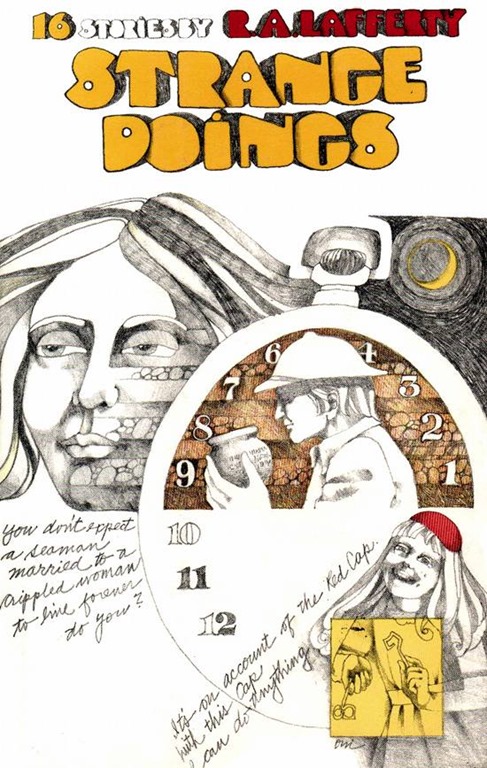
This 1972 collection of Lafferty short-stories credits the cover design to “ONI”
.
There should be a graphical audio player gadget below to hear Dave and I playing Dave’s song “R. A. Lafferty” back in 2015. At the very start of the Parlando Project I set this recording in a folder of possible pieces to use for it, but I never did because I feared the audience for literary poetry might not find much relevance in Lafferty. Well, the imp of the perverse convinced me otherwise. No audio player? You see, Lafferty has documented that the audio player gadget was invented by Higgston Rainbird and — oh never mind, you can use this highlighted link which will open a new tab with its own audio player if you don’t see the gadget.
So here it is, our 800th officially released audio piece from the Parlando Project. Perhaps it’s not representative: it’s not by a dead poet, and unlike almost everything else we do it may not have been written for the page without thought of it being sung. “The Fade” was written and sung by the leading alternate voice of the Project and all-around inspiration Dave Moore. Dave and I go back to when we were leaving our teenage years. I met him then when he read two pieces in a church: one was his own poem, a cheeky number that mixed eros and agape, and the other was a reading (as if it was page poetry) of Bob Dylan’s “With God on Our Side.” A decade later we started doing music together as the LYL Band, and some of what we were doing has become melded into what became the Parlando Project.
So, as I think again — is there any way to have a representative Parlando Project piece? Maybe not, and if so, by design. Variety and seeking something unexpected are founding goals.
Dave’s writing here, and our common efforts in making it the song you can hear below, strikes me as something too little done. Rock, whether it’s Rock’n’Roll, punk-rock, Alt-Rock, Indie-Rock, has tended to speak from a youthful perspective. Even the Classic-Rock acts that are still treading the boards at Dave’s or my age hew to topics that would interest those younger than they are. “The Fade” is far from those common tropes: it’s about the diminishment of aging and particularly about the fogging and loss of memory.
Early this morning I watched an old documentary, a British South Bank Show done in the mid-1980s about the Velvet Underground, a band that was more than a decade defunct at that point, but all the principals (several dead now) were alive then, only entering into middle-age in the 80s, and of a mind to answer questions about the band’s influential work. The topic most covered as they spoke about their former joint project was what made the songs the original lineup put out of lasting importance when the idea of 20-year-old Rock songs having currency seemed novel.
Chief songwriter Lou Reed had it that he wrote about the things he saw around him rather than using the regular subjects of pop songs. True enough, but he chose subjects decidedly less ordinary in song in the times when he wrote them. He specifically wrote about things that frightened people enough that they left them out of the songs they wished to listen to: drug dependency, gay and gender issues, less-vanilla sexuality, and mental variations. And then several others, including the band’s PhD, Sterling Morrison, took pains to note that Reed presented those stories without editorial comment or stance, without sentimentality.
I’ll note now, that later in his career, past the times of that now 40-year-old documentary, Reed wrote one of the few Rock albums about aging and its disabilities: Magic and Loss. It still stands pretty much alone. It’s also unlikely that even the adventurous readers and listeners that this Project has have heard it.
Dave and I recorded “The Fade” this past spring. When I talked to Dave this morning we exchanged info on folks we know, folks our age or even a bit younger, who are moving into assisted living or who are suffering from dementia. I don’t know, there are probably a few songs about how sad Alzheimer’s and the like are, probably some songs that try to mitigate it with a chorus that mixes in the memories the sufferer no longer maintains. Dave’s song isn’t like those songs — if they exist — and I’m glad I helped make his song exist, and that I get to share it with you today.
This is the sheet Dave handed me with brief scribbled chord notes on the day we recorded this. As you listen to the performance you may see that he did a masterful job of revising his typed words. I think the song gained power from the verses he left out.
.
You can hear that recording of “The Fade” with the audio player below. I think Dave gets a bit of the VU-ara John Cale sound with the keyboards in it. I’m using feedback in it too, but not quite as the Velvet’s did. What? No player visible? No, you didn’t forget it along with where your keys are or what you came into the room for, it’s just not shown in some ways of reading this blog. You can use this highlighted link as an alternative.
If Halloween is about shadows, ghosts, the dead and un-dead etc etc, it comes in the month I celebrate the birthday of my friend, the living Dave Moore, an occasional alternate voice here at the Parlando Project. Dave’s a poet, songwriter, cartoonist, and my longtime musical partner in the LYL Band. Back in the 1970s his lyrics were frequently used by “The Greatest Original Music Band Minneapolis Ever Forgot,” Fine Art.
I wrote about Dave and Fine Art a few years back. TL:DNR summary: Fine Art were a Rock band that emerged in 1978, issuing a self-produced, self-titled, vinyl LP, and then performing often in what few Twin Cities locations that were open to the handful of original music bands.* “Punk” was still the sticky label used for young bands that performed non-conformist new material then, but it was not a homogeneous scene of Ramones and Sex Pistols cadre three-chord-shouting-in-leather-jackets-and-frayed-cotton.** Television, Patti Smith, Pere Ubu, Talking Heads — all these were formative bands in the Seventies, present at the beginning. Yet, oddly enough, labels like New Wave, and Post-Punk were generated to try to describe those that didn’t follow the stance of regimented simplicity for concentrated force and/or skill-set necessity. Fine Art were one of those from that non-traditional tradition.
As the famous Minneapolis First Ave club moved to presenting young original music bands, Fine Art played there regularly in the early Eighties, both in the small side-room the 7th Street Entry and in the big main room. When someone reprints a poster of that fabled club’s scheduled acts from that era to highlight Husker Du, The Replacements, Soul Asylum, or even Prince, you’ll often see the Fine Art band name playing the week before or after.
When this era is covered in overview, even by locals who want to concentrate on “the scene” not just the national acts that emerged, Fine Art barely makes the footnotes. That’s not exceptional, history-is-written-by-the-winners and all that. But here’s the thing: Fine Art’s material was all original (they never performed a cover), and it was very very good. The band two guitarists were excellent: Ken Carlson’s driving chordal center on rhythm guitar and Colin Mansfield the genius lead guitarist who could do song hooks or Free Jazz, sometimes in the same song. The two women lead singers format was unusual then as now, and the original pair Kay (Carol) Maxwell and Terry Paul, and later Kay and Jennifer Holt were effective. But it’s the songs, those constructions that were passing sounds on a club stage and remain only on the barely surviving and out-of-print records that shock me to revisit. They’re still unconventional — and as such, they still sound fresh 40 years later. Dave’s lyrics are part of that, even if he wasn’t the only lyricist in the band.
Vampires. Coffins. Fear of being suffocated. A song with a Dave Moore lyric from Fine Art’s LP issued at the start of the band’s existence in 1978.
.
Fine Art didn’t survive past the Eighties, but the LYL Band still gets together. You still can hear songs Dave wrote and ones he contributes to here sometimes. I do my best trying to be musically adventurous to support Dave’s words.
In one’s youth you are told you should think of the future.
Generally, you don’t.
In one’s old age you are said to think too much of the past. I generally don’t. A smaller future is the treasure I consider, the treasure I want to spend. Playing with and knowing Dave is part of the treasure.
.
*I think this surprises some younger indie musicians or fans today. In the Twin Cities in the Seventies, if you wanted to play in public in a band you were expected to perform songs people knew, which meant cover songs. If you wanted to buck that trend, there were in 1978 maybe 2-3 places that would let you try it. When you hear of The Replacements doing one of their live piss-take cover song tangents, there’s likely just a bit of residual anger at that constraint behind it.
**In retrospect, many assume an amoeba, fish, surfacing amphibian, stooped monkey, biped man with club picture of how indie evolved from punk. But the earliest CBGBs bands were a very mixed lot. The Ramones stood out because of their fast, faster, and fastest strumming rock minimalism in that scene. And Ur-source band The Velvet Underground mixed simple and complex, pop ambition and alienation noise with abandon. New Wave and Post-Punk existed from the beginning — or before the beginning. Fine Art may have produced fewer hard core adjacent songs as the band evolved, but they were always composing fresh, heterodox musical concepts.
It’s been an eventful June so far for me, and I plan to be writing like a real blogger about what I’ve experienced in the last couple of weeks shortly. Then too, just this week I started working on a few further Parlando audio pieces. At least one may make the cut to appear here in the next few days.
This weekend is Father’s Day, and a new musical piece that I thought I’d present for that turned out too rough, even for my tastes. So, here’s a well-loved poem by Kevin FitzPatrick that alternate Parlando Project voice Dave Moore performed with The LYL Band a couple of years ago. It seems apropos. Kevin’s books of poetry are available from this website: kevinfitzpatrickpoetry.com Today’s poem appears in his 1987 collection Down on the Corner.
“Bicycle Spring” was first presented here in 2022, but for today’s post I remastered it and made this little video for it. Here it is:
.
Wishing my versatile readers and listeners a happy Summer.
We’ve come to the end of our Black History Month series on early 20th Century Black Chicago poet Fenton Johnson. Let me try to wrap things up with a few summary points — which as I’ll warn again, are preliminary and include speculation on my part. Long post, so the headings may help you if parts of this are of more or less interest.
Was Fenton Johnson able to achieve his goals during his lifetime?
No. He seems to have had very high goals however. He wanted a general readership for his poetry across racial lines, he wanted to be part of the solution to “the racial problem” in America. For an Afro-American poet of his time being able to publish several book length collections, or to receive any notice for his poetry should mark him as achieving something. But those books were all self-published and likely had a small audience. It’s unlikely that he had anything like Paul Laurence Dunbar’s audience in the Black community, and his white cross-over audience was small. These are estimates: but it’s clear he didn’t “break-through” with either audience — and his political platform seems unremarkable and no more successful than early 20th Century America was in general when addressing racial discrimination and oft-times violent white supremacy.
Why did he fail in that?
Remember one of this Project’s mottos: “All Artists Fail?” Even the most successful will be misunderstood and will be downrated for cause by some, will have a limit to their reach even if popular or well-ranked. But even if we don’t rate him against a perfect score, he didn’t succeed to the level of Dunbar, and he was superseded by his successors in the Harlem Renaissance such as Langston Hughes in Black or white readership. My guess: he overrated the audience value of his verse and likely highly overrated the value of his prose/journalism. It’s easy to suppose that he was a bright young man seeing himself in the eyes of youth protected at least at first by the loving support his family was able to give him, but not necessarily with the eyes of a skilled careerist or marketer. His early poems have more value than his contemporaries judged, but some of that value was too deeply coded for some to appreciate in the pre-WWI era. Judging from the small portion of his journalist-writing I’ve read, his efforts there may have displaced his stronger talents. His later poems? James Weldon Johnson’s evaluation of Fenton Johnson in the 1931 version of The Book of American Negro Poetry points out that FJ was uniquely despairing for an Afro-American poet, and contrasts him with Claude McKay’s famous poem “If We Must Die” from the same era as “Tired,” discerning that McKay at least says we can, we should, fight back. One thing that is odd about Fenton Johnson, he’s unsparing about deprivations of rights and dignity for Black Americans in his poetry while maintaining this public face in his presentation of “we just need to listen to each other and work together.” Even onward into the era of Jim Crow and the Great Depression he might have been both too down-beat and too optimistic.
Further supposing on my part: Johnson seems to have been discouraged around 1920 by the evident failure of his audacious goals, and there’s a report that the self-funding from family sources had dried up. I don’t know how dire his life was after 1920, but his pre-WWI Black middle-class status might have changed in ways that refocused his life and added new obstacles. A lot of modern poets reach their heights in writing quality and audience in middle age, which was about the time Johnson’s poetry stops being published.
The Harlem Renaissance has been informally extended to include writers who weren’t NYC located in retrospect, but Frank Marshall Davis and Margaret Walker from between-the-wars Chicago indicated that patronage support and publishing contracts were not at New York levels in Chicago then. Yes, there was a Chicago Renaissance in Black writing, but that came after Johnson stopped publishing.
If Johnson’s early attitudes continued, he may have had a disconnect with some Black literary cultural outlooks that followed WWI. I’ve yet to find anything linking him directly to Temperance/Prohibition, but he writes often enough about alcohol as the marker of a fallen state. He seems to have retained a religious component until he stopped writing — and even the religious have been known to disdain those whose religion differs only slightly from their own, as much or more than non-believers. And lastly, Johnson is explicitly adamant that he’s against “the Bolsheviks,” and commented to friends that this was hurting him in literary circles.
If he’s just some poet who didn’t rise to an undeniable level of success, why read him?
I think there’s unqualified value in the best of Johnson’s poetry. Historically, reading even his lesser-known poems can tell us something about what a smart Black man in this “bridge era” was thinking and writing.
Johnson is precedent-setting in the use of Afro-American musical forms in poetry. This particularly endears him to me. This element alone is highly important culturally and should cause him to be more widely considered. He was active in an era when our resources for Afro-American speaking and musical expression are scarce, so there’s some musicological interest on top of literary value.
You were so down on his political essays. Would you rather he was some kind of radical who might have been tied to between wars dictators? Or hassled by the Red Squads?
No. They were just disappointing in their slack writing and surface allegiance to common political stances without any vivid insights. The man I see in his poems is much sharper than the essayist I’ve read so far. It’s possible that that writing was insincere, that he’s trying to market himself, probably to white audiences who might help fund him. Was he conscious of this split in himself? I can’t say. One may think of one of Dunbar’s best-known poems “We Wear the Mask.”
After he stopped publishing poetry, his friendships in Chicago included those who would be aligned with more leftist politics. As with his non-extant post-1920 poetry, his political analysis might have continued to evolve.
Even some relatively unsuccessful writers influence those who come later. Is Johnson one of those?
Incomplete, but there may be something there. Although his post-WWI poems are few, they were anthologized, and anthologies are still a place younger writers find ideas of the possibilities of their own poetic voice. This Project is an anthology of a kind, and I’ve tried to add that his “spirituals” are worthy of re-evaluation.
This month, I was able to read two accounts of the next generation of Black midwestern poets (Margaret Walker and Frank Marshall Davis) who lived in pre-WWII Chicago, knew Johnson, and mention Johnson’s connection with other writers in this period when Johnson was no longer publishing. Davis (who is himself a bridge between the pre-WWII Black poets and the post WWII Black Arts Movement) admired Johnson and found his work validating his own. Little that I know beyond that, but at least by association there’s a possibility that a later-in-life Fenton Johnson may have influenced these other writers first or second-hand, even after he ceased publishing himself.
AFAIK, this is the only known photo of Fenton Johnson, from when he was in his 20s. We have more photos of Emily Dickinson or Robert Johnson.
.
Summing Up, and A Musical Piece for Today
In closing, there’s still more for me to find out about Fenton Johnson, even if it’s likely that I (or any “we’s” reading this and sharing my curiosity) will never find out other details that would illuminate him. We have those final poems before he “went dark” as far as literature is concerned, and I’ll maintain that his earlier work has qualities worth re-assessing. Yes, he’s a case of someone who dreamed big, maybe spread himself too thin, maybe his self-regard was blind, maybe he underestimated the resources and skills needed — all that “reach exceeds his grasp” stuff. And he certainly had to deal with generalized and persisting cultural undervaluing of Afro-Americans — so this isn’t a simple case of hubris. His most famous poem, that despairing “Tired” remains on various printed pages silently waiting to be found — but there’s an unwritten poem that sums Fenton Johnson up for me: “Tried.”
His most famous poem, that despairing “Tired” remains on various printed pages silently waiting to be found — but there’s an unwritten poem that sums Fenton Johnson up for me: “Tried.”
For today’s musical piece I’ll give you something sung by Dave Moore. It’s called “When the Dream Outruns the Real.” Dave didn’t write it about Fenton Johnson, but it is about anyone who tries, dreams, and doesn’t make it. Here’s what I think is cool about what Dave wrote and sang: it’s not a rote put-down. Easy to laugh at the over-reachers, easy to mark it all down to vanity. The Qoheleth in Ecclesiastes preaches that “All is vanity.” Could that mean we laughers are vain too? You can hear The LYL Band perform this with the audio player below, or with this backup highlighted link.
.
Here’s my sketchy and incomplete timeline of what I know of Fenton Johnson’s career.
1888
Born in Chicago on May 7. An only child and his parents are middle-class. There seems to have been at least some modest wealth in other branches of his family. According to his later friend Arna Bontemps, he starts writing at age 9.
Circa 1905
At least one play was produced in Chicago while he’s a high school student. There are scattered other mentions of Johnson writing plays, but I’ve found nothing about what they were about or if there was much notice of them.
1906
His early model, Afro-American writer Paul Laurence Dunbar dies. Around the same time he graduates from Wendell Phillips High School in Chicago. Attends Northwestern University and the University of Chicago, does post-graduate work at Columbia University in NYC circa 1914.
1910
Briefly teaches at a HBCU, Simmons College in Kentucky, founded by the Baptist church.
1909
He submits a manuscript (handwritten on lined paper from the scanned copy I’ve seen) to Doubleday as a non-fiction diary, though it’s fiction. It survived, though unpublished. Titled a “A Wild Plaint,” the main character in the story commits suicide due to the stresses of his Afro-American life. I have not read this yet.
1913
Self-publishes his first book, a poetry collection A Little Dreaming which has a wide variety of poems in subject matter and styles reflecting mainstream 19th century poetry modes as well as dialect poetry. Dedicated to a relative who may have helped finance its printing.
1915
Returns to Chicago, presumably ending his education. Self-publishes his second book Visions of the Dusk. Dedicates it to Albert Shaw, a well-known white reviewer who had given a favorable review to his first book.
1916
Founds The Champion magazine in Chicago and is listed as its editor. It’s uncertain how many issues are published. One issue does exist as a scanned complete copy. I just found it online, though I haven’t read it yet. Also in 1916 comes a third volume of self-published poetry, Songs of the Soil, which concentrates on his dialect verse.
1918
Founds The Favorite Magazine. Again, it’s unsure how many issues there were, but it may have been as few as two. Published Three Negro Spirituals: “How Long, O Lord,” “Who is That A-Walking in the Corn,” and “The Lost Love” in the June issue of Chicago’s influential Poetry magazine.
1919
Publishes his best-known poem,“Tired,” in the January issue of The Others. The Others circulation is small, but it’s an influential landmark little magazine focusing on the new American avant-garde poetry
Publishes five poems in the February issue of The Others: “Aunt Hannah Jackson” “Aunt Jane Allen,” “The Gambler,” “The Barber,” “The Drunkard”
Publishes “The Artist” and “Dreams” in The Others April-May issue.
1920
Self-publishes two short books: For the Highest Good and Tales of Darkest America. The former is a reprint-collection of pieces from The Favorite Magazine and they are largely anodyne Republican party material. The latter is a short stories collection which sustains some interest while not demonstrating that Johnson is a great undiscovered short-fiction writer.
Around this year Johnson seems to have another ready manuscript of new poems, but is apparently unable to find a commercial publisher and family funds to self-publish another book are denied.
1921
Published Two Negro Spirituals: “A Dream” and “The Wonderful Morning” in the December issue of Poetry magazine.
1922
James Weldon Johnson publishes the first anthology of Afro-American poetry at the dawn of the Harlem Renaissance. He includes five of Fenton Johnson’s poems including “Tired,” marking down Fenton Johnson as someone to be remembered in future surveys of Black verse. JWJ says little about FJ in his preface, saying he “gives promise of greater work than he has yet done.” Fate laughs: FJ is no longer publishing poetry. Nearly a decade later JWL publishes a new edition of A Book of American Negro Poetry and has more to say about FJ then, notes his work is uniquely despairing.
1925
The Cabaret Girl, a play he wrote was staged at Chicago’s Shadow Theatre. I know nothing about the work, nor of any other public work by Fenton Johnson after this.
Works for the Federal Writers’ Project part of the WPA. Others recall he was also in the “South Side Writer’s Group” of Afro-American writers including Richard Wright, Arna Bontemps, Margaret Walker, Theodore Ward, and others. The young Gwendolyn Brooks may have been connected to this group’s later incarnations.
Margaret Walker says she worked with WPA/FWP in Chicago while a senior at Northwestern. She reports Nelson Algren, Jacob Scher, James Phelan, Sam Ross, Katherine Dunham, Willard Motley, Frank Yerby, Richard Wright, Arna Bontemps, Sterling A Brown, and Fenton Johnson were also in the Chicago WPA.
Personal note: my relative Susan Glaspell was also associated with the Chicago FWP during the Great Depression. I don’t know how officially or unofficially the FWP was racially segregated, so there’s no guarantee my relative and Johnson even knew of each other. I know of no work of interest ascribed to Fenton Johnson from the FWP, at least as yet.
1958
Fenton Johnson dies in Chicago on September 17. Some of his papers etc. reported destroyed in a basement flooding event. Arna Bontemps was his literary executor.
One of the interesting things about 20th century Modernism was that so much of its propagation seems to be based on a handful of pollinators who migrate from one place to another. Some of these pollinators are known but little-read today, others lesser-known, their names themselves faded from cultural memory.
I suspect Gertrude Stein fits into the first group. As a personage, often handily viewed via Picasso’s painted portrait, she remains known. Her main location, early 20th century Paris, remains revered for its scene, and her salon there filled with Modernist paintings can’t be left off the maps as Americans in Paris then gravitated to her. We can add to that notableness, that as the fluent domestic partner in a long-term relationship with another woman, she remains to this day something of a gay icon.
But is she read? I suspect her The Autobiography of Alice B. Toklas retains interest for its witness to the era. Her novels? Not sure they’re read much beyond scholars — and maybe they’re under-read even there. I gather her poetry remains controversial in this sense of the word: it’s spoken of in passing, its unusualness taken stock of — and after that its import is generally dismissed. When it was new, Stein’s poetry was often treated as a breathalyzer test. If you heard it and took it as meaningful or important you must be an intoxicated acolyte of Modernist excess. I don’t know if we’ve moved on from that stance. We may forget Hemmingway was a Modernist nowadays,* but we can never see Stein as anything more than an Modernist provocateur.
Reading Stein’s prose-poems today we still find them sounding unlike most literary poetry of the present. If we’re reminded of anything, it might be Dr. Seuss books for early readers, full of repetitions rhythmically repeated.**
Sometime in my Twenties I was curious about her work, part of my early interest in Modernism and the movements that emerged from it in the last decade to be called The Twenties. I remember plowing through one or more of her novels*** and reading what of her poetry I could find, out of consideration that as an experimentalist she might have some discoveries I could put to use in my own writing. What do I remember from doing that a half century ago? Not so much passages or particular elements, more an idea which I continue to hold for: that the way we use language to express reality and consciousness has been constrained by expectations and convention.
What remains of that interest in Stein now decades later? I enjoy her in limited doses because it still can break those expectations on the floor, and stomp on the broken fragments in time to a word-music I can enjoy.
Gertrude Stein, Carl Van Vechten, Mabel Dodge, Dr. Seuss. First 3 pictures are photographs by Van Vechten.
.
I don’t know how much of that old interest of mine my friend, poet, and bandmate in The LYL Band, Dave Moore remembers, but when we got together earlier this fall to record some new things, he broke out this Parlando-worthy selection from Stein’s prose-poetry portraits of those she had met and interacted with. I asked him what he’d want readers/listeners here to know about “Van or Twenty Years After,” and this is what he wrote back:
To avoid Morrison conclusions, I might shift the title to Van & Stein (Iowa boy made weird) — otherwise, references to Mabel Dodge in a history of first American surrealists, found in the library free stack, made me seek out the Gertrude piece about her, which turned out to be in a collection featuring this piece referencing her friendship with Van (sheesh my brain won’t pull up his name, I’m sure it wasn’t Dyke or Heusen), from which I excerpted this section delighted the way it concluded with a joke, then when I presented it to Frank I was incapable of delivering the sound of repetitious notes I had in my head, so anything salvageable here is probably due to Frank’s remixing skills.”
So, who’s the man the Van in Stein’s piece? Carl Van Vechten. Like Stein, Vechten was another of those Modernist pollinators, and he was an early and ardent proponent of Stein’s writing. His name, his own writing? By now he’s largely fallen into the second group, as Dave’s honest stumble testifies. Myself? I knew his name from my interest in Modernism, but nothing of his biography or work until I began to run into him as I read and studied more about the Harlem Renaissance which he was intimately involved in.**** It was only then that I discovered where he was born and grew up: Cedar Rapids, Iowa. And the Mabel Dodge Dave mentions? If you were to cross-reference Gertrude Stein, Carl Van Vechten, and Mabel Dodge’s blue links in their Wikipedia articles, you wouldn’t have to make more than one Kevin-Bacon-jump to encompass the whole Modernist enterprise in Europe and the United States. Pollinators.
After all that history, some of it often forgotten, we’re left with Stein’s words. Here’s a link to the whole prose-poem portrait which Dave took his segment from. You might enjoy them as word-music not having to judge them, or risking them replacing other poetries you enjoy. I did when Dave performed them. You can hear that performance with the graphical audio player below. See no player? This highlighted link will open a new tab with an audio player.
.
*We’re likely to charge Hemmingway with a lot of other sins — most of which he committed in flagrante — while forgetting his successful revolutions. Hemmingway, the young writer forging his style, was one of those who sought out Stein in Paris.
**Dr. Seuss (Theodore Geisel) likely knew of Gertrude Stein from the circles he ran in. I did a quick web search and found no instant citation of any considerations of a stylistic influence there. I can’t be the only one this has occurred to.
***An admission: I’ve never been much of a novel reader. Most book and literature lovers can embarrass me by exposing my lack of chair time with novels.
****Van Vechten wasn’t just Iowan, he was white. Some early Modernists recognized elements of Black and African culture as aligned with their Modernist project, and some young Afro-American writers and artists felt the same way. Modernism was not immune to racism, but this cross-pollination brought attention and prestige to Afro-American artists and art. This connection had and has its strained and strange elements — no doubt about it — but it’s important.
Another connector here: Van Vechten was bisexual, so were some of the members of the Harlem Renaissance (though some variation of The Closet was usual then).
I think today’s audio piece is something many writers will relate to, but since it’s one I wrote I’ll be brief later down the page in writing about my encounter with it. The top part of this post will be a process post about music and working “live in the studio” with Dave Moore again after a long break. Feel free to skip to the bottom if this process stuff isn’t your thing.
For many years I’ve taken time every September 18th to remember guitarist and composer Jimi Hendrix. This September 18th I planned to get together with Dave Moore to do what we’ve done off-and-on for more than 40 years: attempt to make music together as The LYL Band.* For almost all that time we’ve done this in a peculiar way.
I have a space with various guitars, basses, drum pattern software, and a couple of keyboards. Dave comes there after I’ve setup the recording equipment. I start playing something harmonically simple (often a one-chord groove) and Dave walks up to a keyboard. I start with some words (usually something from another writer) as we play off the top of our heads while the recording software rolls.
After that, Dave hands me a sheet of paper with something he wrote or wants to play. Sometimes there are chords handwritten on the sheet, sometimes not. I ask for a key center. He starts off and I try to follow and figure out a part on the spot. We finish playing to that set of words. I hand Dave a chord sheet with chords written out, something I’ve composed or want to play. I start out and Dave tries to come up with a part on keyboards.
We almost never do second takes. We rarely present the songs to each other by playing the sections through to demonstrate before recording. This alternation of I, then Dave, leading a piece continues for a couple of hours with a short break in the middle to rest our hands and voices.
A great many musicians cannot do this, wouldn’t do this, are perhaps afraid to do this. It is not an exact way to accomplish the art of music. Many skilled folk, Blues, and Jazz musicians can do this if they choose to.** Dave and I are not at that skill level. What comes out can be inarticulate, chaotic, of no use whatsoever. We give it permission to utterly fail.
Are we just lazy or eccentric. Well, maybe the latter, but the aim is to catch moments when something happens spontaneously that has a quality of that type of creation. You know the expression “Building an airplane while it is flying?” That’s the feeling when something coheres as we feel our way into the piece. I believe the best of the pieces that come out of this process may transfer some of that feeling to a listener later on.
When I work on the Parlando Project pieces I work as a composer, usually playing or directing most of the parts myself. It’s a thoughtful process, painstaking to a degree though I try to create more pieces rather than a few most perfect and maximally impressive pieces. There’s lots of do-overs, retakes, instruments attempted and rejected. What Dave and I do when we play together uses a very different part of the brain. I love the change, each type of music-making refreshes the other.
Part of collating the useable material from a session is creating a cover image. I had no idea who Epimetheus was until I encountered this Greek titan in a Longfellow poem that you may hear more about later this fall.
.
Today’s new audio piece
Back to today’s new audio piece. It’s the first thing Dave stepped up to the keyboards to play with me this past Monday. “The Terror of the Blank Page” is a poem I wrote more than a decade ago during what the US liked to call “The War on Terror.” I think the germ of the idea may have come from finding out that Saddam Hussein had fashioned himself as a novelist and had several books published attributed to him as an author. The finished piece isn’t really about that, it’s about how we punish ourselves if we are writers for fearing and avoiding starting new work. What if it’s not the best idea? What if it’s bad, embarrassing, revealing of our faults as artists? In the end, I think my poem and this performance makes fun of that fear as it names some imagined incarnations.
The process I talked about above, the one that Dave and I use to make music quickly is a way to get out the door before the fear arrives to arrest us. To hear our live in the studio performance of “The Terror of the Blank Page” you can use the audio player gadget below. No gadget? This highlighted link is there for those whose way of viewing this doesn’t show the gadget — it will open a new tab with its own audio player.
.
*Various other musicians have played with Dave and I from time to time in The LYL Band. Given our peripatetic musical path, it takes a special kind of musician to enjoy playing with us. One could easily say that a model for The LYL Band is The Fugs, an intently impolite band created around a core of two poets and assorted others. Don’t go listening to The Fugs recordings around your parents, your children, your school board censors, or anyone who can’t help but mention when your singing or guitar is out of tune.
**Two accomplished musicians who have used something like this approach are Miles Davis and Bob Dylan. Dylan’s classic mid-60’s ensemble recording sessions would start off pieces live in the studio which (just maybe) a music director of a sort had prepared the musicians somewhat for. He’d try a few takes, and if it didn’t work, he just went on to something else or some other combination of musicians. A record like Highway 61 Revisited is corralling the best attempts to make chaos cohere. Miles Davis hired exceptional musicians with extraordinary ears and knowledge of the Jazz repertoire. Even though Davis was comfortable with charts and pieces with set forms and sections, he had periods when he worked with a roomful of musicians given little direction. He made a series of records from In a Silent Way on that were mostly assembled after these live sessions by editing and collaging the best parts of this spontaneous playing.
That approach by Davis is similar to what I do with some pieces that Dave and I originate together in spontaneous live playing. I’ll add parts and remove or edit parts to create a resulting hybrid recording that contains live and composed playing.
As we celebrate National Poetry Month this spring, let’s continue with my condensed memoir with footnotes of how and why the Parlando Project came to be. Last time I was leaving home for college in The Sixties.
I was an undistinguished student, able to connect with some teachers and subjects and unable to connect with others. I think I went on to college because I still had curiosity and desire to learn about some things and because I had no other firm idea of what I wanted to do other than write poetry. Even the naïve teenager in me knew that poetry was an exalted vocation but a dreadful-paying job. The fool in me thought that if I was good enough with poetry, things would take care of themselves. Is there a word for a fool that stumbles upon wisdom for other reasons than their own? There should be. That was me.
Is there a word for a fool that stumbles upon wisdom for other reasons than their own? There should be. That was me.
There was another reason to attend college in The Sixties if you were male. There was a military draft. Depending on where you lived (draft bards were local, county-sized, units and their quotas and pool of 18-26 year olds to fill them varied) most of the most eligible would be drafted to serve 2 years in the armed forces. The “most eligible” part was the trick of the inequality of this system.* Those married with kids or students were put in a “deferred” level. With the rising deployments in the Vietnam war in The Sixties, concerns about the common inconvenience of military service were escalated into a fear that “I’ll be drafted, sent to Vietnam, and I’ll be killed.” **
Because my experience with school was in a small town, small school, I went to a small college of just about 1000 students, one still in Iowa, Simpson College. Road not taken thoughts could wonder: what if I had been more adventuresome? The English Literature department was largely younger professors who taught the smallish classes directly. One of those younger teachers was a quiet but scholarly type who loved St. Thomas Aquinas and Gerard Manley Hopkins. I’m no Thomist but he did introduce me to Hopkins. Another had a full John Berryman beard and curl-dangle cigarette ash while he talked on. He loved Norman Mailer and encouraged unconventional thought. I picked up the idea that French poets were important in the emergence of modern English poetry, so I tried to take French for my language requirement. As remains the case to this day, I found myself entirely unable to form the correct sounds to pronounce the words. My young French teaching professor had a great story though. She’d taken the position at Simpson, located in Indianola Iowa. That summer she went to Indianapolis Indiana ready to start her professorship, and upon arriving asked for directions to Simpson.
Here are two people near my own age who I met at Simpson who changed me and eventually the Parlando Project.
One was Dave Moore, who readers and listeners here already know. How’d we meet? I met Dave in my first year at Simpson when he led an unconventional service at the school’s chapel. He read the words to Dylan’s “With God on Our Side” and made them vivid even as unaccompanied spoken word and then he read a poem of his own. I had to get to know him — and did — because here was another poet. Dave’s influence on the Parlando Project is impossible to understate, but in this era, Dave left Simpson for another school to further his education at the end of my first year. He’ll necessarily return often as this memoir continues.
In my second year at Simpson I took an inexpensive catalog-store acoustic guitar with me to college for just a few weeks at the beginning of the school term. It was an instrument that belonged in common with my siblings. In an act of cargo-cult magic one day, I remember walking around the little campus with it hanging by a strap across my back, like I was on some cover of a folk music magazine. I ran into this skinny guy wearing a Levis jean-jacket who said he played guitar too, and he invited me to his dorm room.
When we got there did I notice then that his guitar was likely better than my family’s shared plywood egg-slicer string-action guitar? No, I didn’t know anything about that then, but it was no-doubt a quality instrument. When he took it out of its case (his guitar had a case!) he tuned it up quickly and started to play a bit of this or that, and then launched into a piece he informed me was called “Vaseline Machine Gun.”
One or two of you may startle as I say the name of that guitar piece. It appeared later at the very end of The Sixties on a record by its composer Leo Kottke with the it-can-afford-its-understatement title of “6 and 12-String Guitar.” Within the smallish world of steel-string acoustic guitar instrumental music that record is a landmark. The album’s energetic playing in an original style, the polyphonic lines going on all at once from a single instrument was impressive — still are, though players have had decades since to try to work at that level. The record’s showpiece, the cut that was meant to make your jaw drop the farthest is “Vaseline Machine Gun.” So, you one-or-two know what I felt sitting a couple of feet away from someone playing it live in a small Iowa college dorm room in The Sixties. Here’s a 2-minute live version of the young Kottke playing it for the rest of you.
.
OK, you’re back. That skinny kid, a year younger than me, nodded at me with my plywood catalog-store guitar, one that I’d figured out three or four reliable chords on to be rung up with vigorous strums. His manner was hip, cool. “What do you play?”
One could write a whole chapter on that moment, that interchange. I write poems and attempt-to-be-short blog posts. I said, “I don’t really play.”
The skinny guitar player kid’s name was Don Williams. Like Dave Moore, there are other Don Williams, some of them better known than others. With that common a name, I’ve never been able to find him later in life. He was from the Minneapolis area, where Kottke was based and where he could have heard him in local coffee houses. His family had money enough to afford him the better instrument. He had the funds and inclination for lessons in that city, and the wherewithal to absorb them. He dropped the names of Twin Cities guitarists Dean Granros and Dean Magraw, who I suspect he may have taken those lessons from. I hung out with him some, heard him play more. He had an amp and a Howard Roberts model Gibson electric guitar too. If I was to meet him again, all these years later, I’d thank him for initially imprinting me with the broad possibilities of the guitar, acoustic and electric, and in particularly with bottleneck slide.
I went back to my dorm room. Sometime that fall before I had to return the guitar to the family home, I took a short poem by another Simpson student I knew, Keith Hill, and using that and those few chords played with some make’em pay up strums, I wrote what I will later call the first Parlando Project song, decades before there would be a Parlando Project. The poem was called “Eat At Joes” and Keith Hill was aiming for a gently satiric mood. I adapted or misconstrued it as an indictment of go-along acceptance. More than 40 years later I still remembered it well enough to attempt it with Dave Moore and the LYL Band. You can hear that remembered version with this highlighted link, or with the graphical music player below.
What happened next? Why did I stick with the idea of literary poetry combined with music?
.
*There were other deferments. Some professions were still deferred as I recall. Homosexuality along with mental illness was considered a no-go, though as throughout history, gay people served. Medical deferments were issued, and for those in the know during the era there was a saying “No one is too healthy to not have a reason for medical deferment.” If the proponents of conscription debate that it promotes an equality of service and sacrifice, the reality of the system manifestly reflected racial and class-based castes. I wasn’t analyzing this at 17, but it wasn’t subtle people!
**Like a lot of historical remembrances, this is accurate in terms of the believed myth and inaccurate in terms of the reality. In generational talk of “Boomers had it easy compared to…,” this level of existential risk for teenagers seems somewhat forgotten. Still, not only did most Boomers not get drafted — due to that range of deferments and the size of the pool — most draftees never went to combat even during the height of the war. None-the-less, this perception of a real risk is an under-acknowledged motivation for the growth in the antiwar movement then. I don’t know if anyone has written of this, but it seems to me that this was also one substantial reason that college enrollments increased even above the demographic bulge, which then helped set the expectation that college was a pre-requisite for many more jobs. Racial and class-based caste systems again.
Here’s a well-worn trope you’ll see somewhere as the year 2022 ends. Someone will write or say:
“2022 — would it ever end? Glad to see that sorry year done.”
Troubling and bad things happened this past year. I know. I’m a grateful and privileged person, but still this year has had stressful and even frightening things in my family. And if we are to look fully at our nations and the world? Distress might seem a slighting word there.
Here’s another trope, one portrayed in many a cartoon around the New Years, one old enough to be old when I was a child: an aged man with a 2022 sash around his stooped body, and a young smiling toddler just able to stand and show the New Year 2023 banner arrayed across its torso. When I was a child, even a younger adult, I always looked fondly at that baby with the New Year’s sash. What wonders, what new things will the upcoming year bring? What burdens will be set down with the expiration of the old year? Even if I didn’t know how the balance of the forthcoming year would settle with the debts of the passing one, I was looking forward, closer in age to that toddler than to that geriatric December 31st.
Now that I’m an old man, that expiring year is closer to me than that tiny child — and it’s not just years that expire or stoop with age. Since last winter, long time alternative Parlando Project voice and LYL Band-mate Dave Moore and I did our part to say goodbye to some colleagues in poetry, and we both have had some family deaths. No wonder that there’s been a good number of elegies presented by this Project lately.
I’ve had the rough tracks of today’s elegy since last spring, the best of which was a vocal track that Dave laid down as part of a session we did in memory of poet Kevin FitzPatrick. It was only this December as the year was coming to a close that I found an idea of what to do with Dave’s song. His words in “Don’t Have To” are all about the routine troubles, tasks, and stresses of life mixed with the aspirations we poets dream to grasp. Kevin, who wrote about work and labor, and who labored and worked at his writing, had all of that.
This was Dave Moore’s own corrected manuscript I worked from to complete today’s piece.
.
It struck me that this is a great life-lot of things, a glorious jumble — Kevin’s poetry that I was privileged to experience, the care and responsibility that his family, friends, colleagues, and clients were sheltered by. If the First Noble Truth of the Buddha is that life is dukkha sacca,* then noticing a cessation of dukkha is apprehending the punching out of the timeclock of a lifetime too. Might it be worthwhile for us on New Year’s Eve to notice, or even thank, the aged 2022 of our families, friends, colleagues, and ourselves for their labors however strained and imperfect they were? When we, like the year 2022, are gone, others will take up that imperfect and sometimes thwarted work.
That thought arose as I took Dave’s vocals from last spring and using the modern tools of audio editing, I sped up their tempo to increase urgency. For music I started with a rollicking piano part which I triggered on my little plastic keyboard but made sound impossibly knuckle-busting by invoking an arpeggiator that kept the sixteenth notes flying. After establishing that tempo, I had to give my fingers a workout on the bass to lay down a bass track, and frankly I was running to catch up the whole length of the song. I added a little vibraphone and guitar to add some visiting outside timbres to the dominant piano and that completed the unusual elegy “Don’t Have To (Now You’re Done)” you can hear with the player below. Don’t see any player? This highlighted link is an alternative way to hear it.
.
*A complicated term to translate, though the simple translation of “life is suffering” is common. Properly, it includes the sense of stress, unease, and dissatisfaction as well.
Our Halloween series continues with the voice, music, and words of Dave Moore today as I present his piece “Sam and the Ghosts.” And as bonus autumn content, this one takes place in a garden just past harvest time.
I haven’t kept a garden in decades, but Dave and long-time friend of this blog Paul Deaton do. They remind me that at about this latitude north, October is the time to have removed the final products and to prepare the bed for the interval until spring planting time returns.
I may not have done this for decades, but this process goes back — way back. Folks were planting crops in the Midwest long before colonization. The mound builders here, like the earthworks and standing-stone raisers in the British Isles, fed themselves on the invention of agriculture. So in that way, every garden — that small geographical gesture — is a memorial. William Blake said the rebellious angels of art must need to drive their plows over the bones of the dead. I don’t think he was speaking of colonization or commerce when making that point, but his maxim is true reportage anyway. Whether we are speaking of poetry or music or tomatoes, were we plant has likely been tilled before by dead people. Isn’t it proper then that we should honor them before we make our gestures in the soil?
The song sheet Dave handed me the day we recorded this song a few years back.
.
In Dave’s poem which he made song, Sam* has forgotten this. Some ghosts remind him. In his poem they are ghosts of settlers. Outside of the poem, they are people created by Bob Dylan.** Those definite levels in history are not the beginning, not the end. Who knows who ran the land from where the settlers’ family left to come to America? Then we do know who lived the land, and were so harshly displaced before the settlers’ opportunity. Who knows, maybe Hollis Brown’s farm is no longer farmland now after some other money has changed hands. How many songwriters are tilling Bob Dylan’s land?
Every seed you plant came from somewhere before you plant it. Every land has ancestors. Every garden is, or should be, a memorial. Winter will bury our gardens, turn our blank pages to blank pages again, and we wait and expect for spring.
The ancestors expect for spring too. We are that spring. The gaps of expecting are where the ghosts live.
To hear the LYL Band perform with Dave Moore singing his song “Sam and the Ghosts” you can use the graphical player below if you see it. No player? This highlighted link is your alternative.
.
*Neither Dave nor I can resist a pun. For extra Halloween-relevance points, Dave has named his gardener “Sam Hane.”


 Frank Hudson