Pig Cupid

Today we return to the early 20th Century Modernists with a piece using words by Mina Loy. Last post we had a poet taking a political stand: Longfellow aligning himself with the movement to abolish slavery. Decades later, the Modernists joined political movements too.

One might suppose that since Modernism sought to overthrow the old cultural order and revolutionize artistic expression that many Modernists would be attracted to political radicalism—and to a large degree that’s so.

You might also assume that these artistic radicals would be leftists, aligned with the growing Socialist movements in England and the United States, or attracted after 1917 to the as then untested promise of the new Communist government in Russia. Or perhaps they’d make common cause with anarchism. Or maybe they’d create their own playlist mixing all of the above.

And yes, you can find that. Carl Sandburg in the U. S. Midwest, most of the Surrealists, bohemians in New York’s Greenwich Village, Herbert Read and some other British Modernists.

However, one can also find Modernists who aligned with the right wing in this era—and not only garden-variety Tories, or even those who allied themselves with the “respectable” racist strains of U. S. politics. Even in the years before WWI, the social theories that would coalesce into Fascism found adherents in the new literary avant garde. As to Americans, the most famous case is the indispensable Modernist poet, editor and promotor, Ezra Pound, eventually charged with treason at the end of WWII.

Modernists seemed something like stem cells as their artistic revolution kicked off—they could develop into followers of any kind of political radicalism. At a time when political engagement for artists was common, there must have been a feeling in the air that a side must be chosen if one was to be a thorough-going cultural Modernist.

So, much as the French Surrealists once sought to make Communism a dictate for membership in the Surrealist movement, the slightly earlier Italian Futurists eventually made Fascism a core value of their artistic circle.

mina-loy

I love my baby, cause she does good sculptures, yeah!” The young Mina Loy

.

It’s now we get to Mina Loy. No, not the delightful Hollywood actress—that’s Myrna Loy (Myrna Loy was the stage name for the woman born Myrna Williams, and it’s just possible that Loy could have been chosen to refer to Mina).

It’s 1905. Modernism is kicking off first in the visual art world, followed just behind by the poets. Loy, in her 20s, has already done the visual art thing in London and Paris, but her marriage is failing, and she’s just had an infant child die. To change her life, she moves to Italy. She befriends Futurist artist Carlo Carra, and if you follow along on your Futurist score-card she had love-affairs there with two principals of Italian Futurism: F. T. Marinetti and Giovanni Papini.

Let’s re-set our scene. Here’s a young woman in a foreign country going through life stress events. The art-world is shifting under everyone’s feet. As a movement that will eventually fancy itself outright as the cultural well-spring of Italian Fascism, the circle she’s fallen in with isn’t just about making it new, it’s militaristic, paternalistic, nationalistic, and it worships violence. That isn’t what jealous opponents say about Futurism, it’s what its own manifestos brag about.
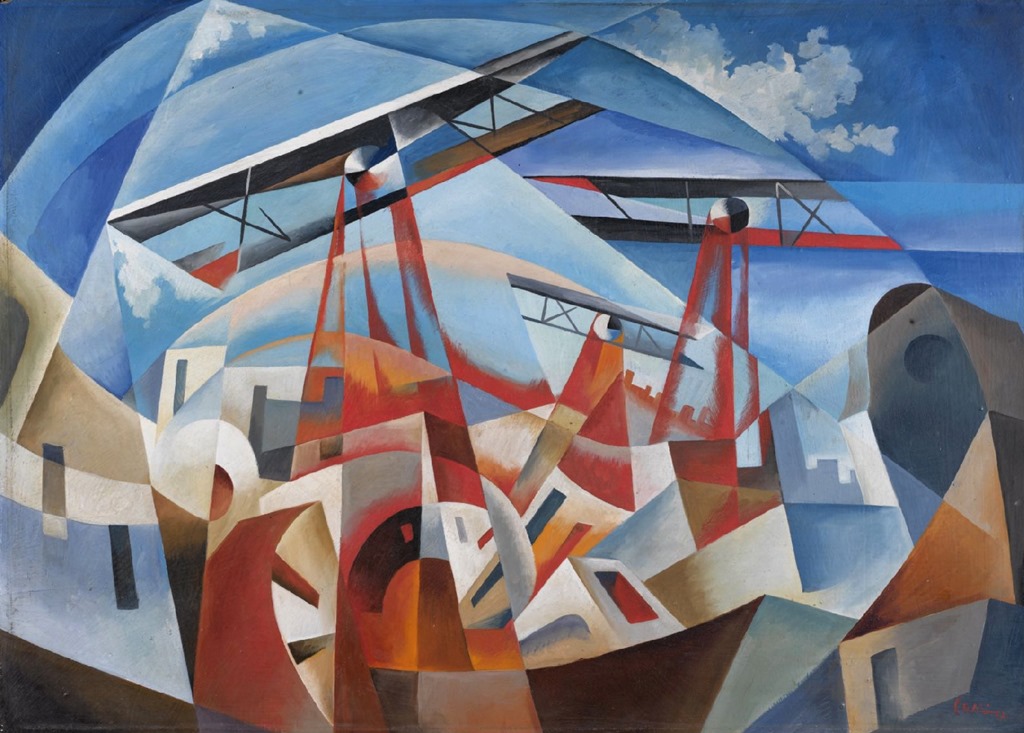
Tullio Crali - Bombardamento-aereo (1932)

Futurist war painting. Compare its outlook to Guernica or Flint’s poem “Zeppelins.
Marinetti’s Futurist Manifesto declared “We will glorify war—the world’s only hygiene”

.

As preparing actors say, all that would be part of the work to figure out what Mina Loy is experiencing. Here’s another bit of business you might grab onto: young, ambitious, male artists. I doubt some not-uncommon tropes have changed in that field.

What happens?

Mina becomes a poet. A fierce poet. Artistically she uses some of the new ideas that the Futurists are thinking about. Her poetry moves between time and tenses, voices and outlooks, in machine gun bursts. Conventional expression and sentiment? Blow them up, run them over with a locomotive. Sixty years later Harlan Ellison would write “Love is just sex misspelled” and be thought provocative. Mina had already been there in the horse-and-buggy era. How can a woman keep her selfhood (or for that matter, how can any human being do so) in the minefield of desire and relationships? What is deep and inherent in motherhood that society will not express openly?

Though she used some of the artistic ideas of Futurism as effectively as any writer, Loy seemed to resist most of its political ideas and she satirized the pretentions of the “Flabergasts” while writing about her Italian time as being in the “Lion’s Jaws.”  Leaving Italy, she next moved to New York, where she joined the Greenwich Village circle.

Today’s piece uses selections I took from a 34-poem sequence called “Songs to Johannes,”  inspired by the relationship with Giovanni Papini (Johannes and Giovanni are variations of the same root name). Loy published these in 1914, near the end of her Italian time. Within the little-magazine world of Modernism she made an immediate impact. Eliot, Pound, William Carlos Williams, and Gertrude Stein said good things about her work. Legendary founder of Poetry magazine Harriet Monroe seems to have been scared by Loy’s frankness. Amy Lowell, poet and influential anthologist, was so put off she is supposed to have said that she would not publish in any magazine that printed Loy.

If the patriarchy may have lost the battle with Mina Loy, for a long time they seem to have won the peace. It was only in the last few years of the 20th Century that Loy’s poems of the first part of that century began to be looked at again. Now, Loy has become a key poetic Modernist for literary scholars tired of the usual sausage-fest, but that opens up the danger that work like “Songs to Johannes”  may be introduced, academically, like this: “Loy in effect diagnoses an end to love poetry in the light of historical circumstance, anticipating that poststructuralist line of inquiry which urges a rereading of ‘lyric’ as a culturally responsive construct. Instead, her poetry constitutes a critique of the very demand that lyric expression be viewed apart from the social world.”

There’s nothing wrong with that view, but I find Loy’s pre-WWI writing here a lot more immediate assuming one has some applicable life experience to bring to it. Her diction sometimes reminds me of Emily Dickinson, and like Dickinson figuring out what is ironic, and what is earnest, and what is both, can sometimes be a challenge. In performance, any of those three choices seem to work for most phrases here. The greatest error would be to make them all of the same tenor. Also, like Dickinson, Loy will move from speaking concise abstraction to vivid metaphor using very few words. Thus, the high minded and the sensual nitty-gritty are juxtaposed.

My appreciation for this sequence grew tremendously as I constructed this performance. There are strong images, richly ambiguous expressions, and yes, lines that one could deconstruct at thesis length. I didn’t even have room to include the phrase from “Songs to Johannes”  that I’ve chosen to title today’s selection, but I can never look at a plump rococo cherub again without recalling it. But the real gift I got, the unique gift of art, is that I could experience some of Loy’s moments in the hot-house nexus of Fascism and Modernism.  “Pig Cupid”  would probably be more authentic if this was performed in a woman’s voice, but alas my voice is what I have available today. To hear my performance, you use the player below if your reader displays it, or this highlighted hyperlink will also play it.

Vegetables dream of responding to you

OK, let’s reveal where the words from the last post, Poetry in Translation,  came from and what I know about their context—but stick around, as this is going to relate back to those 20th Century theories about how poetry works. If you haven’t listened yet read and listened to Poetry in Translation,  this would be a good time to scroll down and do so.

Earlier this month I was making some tea and talking to my son in the kitchen. He asked about what kind of tea I was making. I picked up the box to show him, Tazo Peachy Green tea. I noticed there was something more than an ingredients list and those filled-circle graphs of how much caffeine was stuck inside the individually bagged dried leaves. So, I broke into my Parlando Voice, improvising line break pauses as the early 20th Century Modernists have ingrained in me, and read it to him:

Poetry in Translation from Tazo Peach Tea

Modernist verse in the supermarket?

My son, now a teenager, is making sure that he’s nobody’s fool. “They must be smoking that tea, not drinking it.”

We both laughed.

Modernists a century ago would have liked this. “Found Objects” and use of commercial ready-mades in art and Dada japes were ingrained in Modernism during its avant garde phase. I’d have fit right in at the Cabaret Voltaire in 1916 if I was to have read this wacky and rapturous advertising copy from the tea box while Hugo Ball played piano.

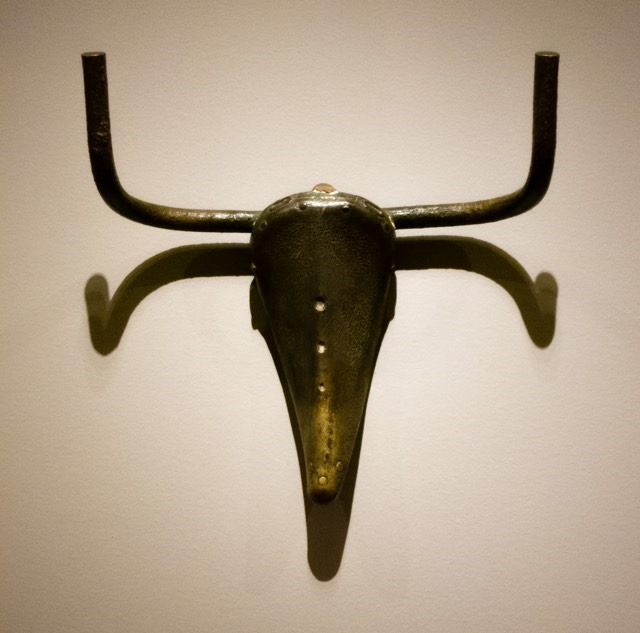
picasso-bulls-head
Some will see a Picasso sculpture, others will wonder if a bicyclist won’t be able to ride home

But as Modernism moved to the universities, and I. A. Richards’ and John Crowe Ransom’s “New Criticism” solution to the problem of unreliable interpretation became predominate by mid-century, things would change.

Simplifying wildly, the New Criticism suggested that the reader, not just poets and writers, needed to get under the hood and figure out what made poetry run. Inside every poem was the ideal poem, an expression of complex ideas or states of being placed there by it’s writer. The poems surface, though it may have some interest itself, was only the wrapper surrounding this more sublime poem. This bridged over the revolutions in poetic language, by making less important changes in the way poetry spoke, such as the widespread use of rhyme and free verse. John Donne, John Keats, Gerard Manley Hopkins, T. S. Eliot, Wallace Stevens—the different music of the words made no difference, the rich images portraying important thoughts could be studied side-by-side.

Imagery became poetry, more or less (yes, meter and sound were still attended to, but they dropped in importance). The original Modernists, including the Imagists, sought to kill off centuries of ingrained and tired imagery that had become merely decorative, and replace it with more integral and concrete images, palpable things. But just as when one finally cleans out a closet, time passing will clutter it again. If images contain the soul of poetry, and if deep reading is the best and proper way to encounter a poem, then complex and hermetic images will offer more of the poetic experience.

There’d been something of a cult of great poetry before, often based on important subject matter or the extent of readership, but as the New Criticism ascended to orthodoxy, the ideal of great poetry became stronger and used new criteria. Poems with densely jammed complex imagery requiring close reading and educational training to comprehend were great. Poems that didn’t do this were highly suspect—and likely harmful, in that they did not reinforce this new critical understanding of the soul of poetry.

As I said last time, this is how I was taught to understand poetry in the midcentury.

How can we return to the box of tea with its peach singing to the cucumber of its deathless desire? The midcentury New Critics presumed the supremacy of the poem and the poet’s intent. Later in the 20th Century new literary theorists arose, and the subjective experience of the reader became the place where the poem existed. The poem means what you think it means, which may be different from what another reader thinks it means. Meanings extracted from even the merest of texts could still be complex and valid. The intent of the author is not important, they could well be mistaken.

Now our singing peach isn’t a joke at the expense of exalted literature, it’s an expression of the woo of consumer culture signifying exotic essence through the appropriation of an ancient amphitheater dramatizing barely sublimated vegetable desires. Or it may be something a tired copywriter churned out on Friday afternoon before leaving work and picking up takeout on the way home to feed the kids.

As I said, I’m simplifying, but for the mid-century New Critics the poem existed objectively deep inside the poem where the poet put it. For the late 20th Century Deconstructionists and their contemporaries, the poem existed subjectively in its readers experience of it and the structures around that.

Coming up, is there a reconciliation between those two views? How will the 21st Century view what poetry is and where the poem lives? Will the cucumber and the peach find a meaningful relationship before they are dried and bagged?

Don’t worry if you’re missing the usual music and words meeting up here, we’ll return to that soon enough too. I promise variety, not predictability. To tide you over, here’s Dave Moore and the LYL Band running through his song, set in the late 19th Century, called “The Green Fairy.” 

Poetry in Translation

I remember reading about this some years back, and found it fascinating then. In my memory it was the American poet and critic John Crowe Ransom who was the teacher, but in searching this week for more detail, the perpetrator named was English poet and critic I. A. Richards. My memory still says Ransom did something similar, but let’s stay with Richards since I can verify it.

The time frame is the 1920s. The Modernists (due to painful copyright laws, the newest poets whose work can be freely used here by the Parlando Project) had begun their ascendency into the mainstream of English language poetry. But the Victorian era, including the later work of the Romantics and the whole of the William Morris/Pre-Raphaelite revival that preceded the Modernist revolution was not that long ago, within the memory of teachers and critics alive then, like the post WWII era or “The Sixties” would be today. The Romantics had been a revolution in how poetry speaks, and those that followed them took different paths from that revolution, and now the Modernists proposed a counter-revolution, once more changing how poetry speaks.

Had poetry, in some Platonic ideal state, it’s essence, changed; or had only the language and form it took to express its inner nature changed?

In such at time, the question of aesthetics, of what constitutes poetry and what are (or should be) its goals and effects, would naturally come to the fore. If one is a teacher, one might examine this by teaching, and so Richards devised an experiment. He gave students at Cambridge, a leading English university, a packet of poems which were without the names of their authors or any context about when they were written—they were even without their titles—and asked the students to write about them, to interpret them. I’m not sure if he presupposed what the results would be, but summaries of the experiment report he was surprised at the results. Their interpretations were poor, and often included what he knew to be misinterpretations. The students often resorted to personal experiences or rote sentimentality to explain the poems. As a result, the interpretations of the poems varied considerably as they missed their mark in different directions.

You might think, “Well, duh!” In subsequent theories of literature all these effects have been explained and codified in multiple ways, but at the time, in the 1920s, this was a new finding. Richards thought this showed a failure of literacy, defined as a kind of higher literacy; not the inability to read basic English, but to read and understand the kind of associative and musical language used by poetry. He spent his life trying to remedy this by teaching. In 1979, while in his eighties, he was still teaching, in China, when he fell ill and died. He wrote a book, titled “Practical Criticism”  setting out ways to properly read and derive the effects of a poem.

John Crowe Ransom and I A Richards

Know your Modernists: John Crowe Ransom, I. A. Richards, and two other blokes who don’t know from The New Criticism


But the way I heard of the experiment (and this may have been a subsequent experiment, inspired by Richards, perhaps by Ransom) the packet of unattributed poems given to students to interpret included a range of “not great poetry,” pop poetry as printed in mass-market publications as well as the work of more esteemed poets. And the result was the students couldn’t reliably distinguish the great poets from the hacks.

The challenge of the new poetic language of the Modernists, and the experience of teachers like Richards and Ransom demonstrated in this experiment with unattributed poems, lead to what was called “The New Criticism.”

When, a generation later, I began to encounter poetry in school, “The New Criticism” was by far the predominant idea of how poetry should be taught. At the end of my scattered schooling, new theories were arising, Deconstructionism and the like, and I can still recall professors muttering about its willful misunderstandings and mistaken goals as I struggled for money to pay for one more class that would fit into my work schedule.

Now in this century, I know less what happens in schools, but I sense culturally we’re concerned increasingly with the poet as the container that holds the poem and its experience. Some worry about “Identity Politics” and its correlate would be “Identity Poetry,” where the background, ethnic and otherwise, of the poet is integral to the poem. I’m too busy making art to have a coherent philosophy on this. I can easily envision problems arising from a division of poetry into ever smaller spheres where only the right combinations of ingredients can make or appreciate some work. On the other hand, I’m also suspicious of the motives of anyone who claims to hate Identity Politics or Identity Poetry, while showing no interest otherwise in smashing the walls and peeling off the labels from artists for whom those “stick to that” labels and barriers may not be self-chosen.

Oh my, what a long introduction to today’s audio piece! In honor of Richards and Ransom and their experiments, here’s a piece I call “Poetry in Translation”  for the purposes of the experiment. I’m not going to give you any more context for the poem used, the author’s name or their ethnic identity. I assure you I’m not in this for “gotcha” or obscure literary one-upmanship. It’s short, so give it a listen and see what you think. I’ll be back later this week with more.

Parlando Project Winter 2017–the Most Popular Piece of the Last Season

The last few days I’ve been looking back over the past three months at the audio pieces that received the most listens and likes from visitors here, and we’ve now counted up to the post revealing the most popular piece.

But before I get to that, let me let newer visitors here know what the Parlando Project is. For the past few years I’ve been experimenting with the ways that words can be used along with music. Most of the words are going to be poetry, if only because I like shorter pieces for this, and poetry accommodates that desire most easily. The music? My goal is: as varied as we can make it. The “we” here are largely myself and Dave Moore, who I’ve played with as the LYL Band since the late 1970s. Dave also is the alternative voice of the Parlando Project, one that’s read or sung several popular pieces during the history of this project.

Dave and I have also been writers (Dave’s also a cartoonist) since our youth, but this project is not, in it’s greater part, about presenting our written work. Rather it’s about looking at a variety of other people’s experiences and expressions, reacting to them, and seeking to embody them in a way we hope you’ll find interesting.

Do we turn the poems into songs? Sometimes. Sometimes they were, or were meant to be, songs anyway (Tagore and Campion for example). But often we aim for something that is cast between spoken word and chant. As best as I can figure out, this is akin to what William Butler Yeats once aimed to do with poetry and poetic drama, and he thought William Blake, Sappho and the Celtic bards did the same. And for myself, in addition to those Yeats pointed to, it’s my spin on what Jack Kerouac, John Lee Hooker, Allen Ginsberg, and Patti Smith (along with others) did.

Rap/Hip Hop does this too, but as varied as those artists’ approaches are, most of their tactics I can’t make work for me. No disrespect, it’s just my limitations.

Well, here’s the Parlando Project’s most popular piece from the last three months: Tristan Tzara’s “The Death of Apollinaire.”  It was number 3 last September, so it’s been getting the listens since last summer, yet it’s not one I selected because it was well-known or sure to be popular.

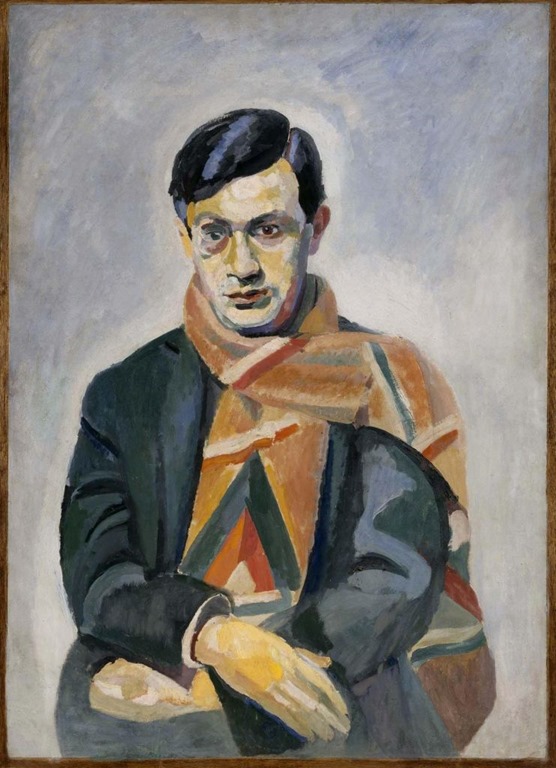
Tristan Tzara by Robert Delaunay

Accessorizing with knitted wear was the most important artistic dictum of Dada

Tristan Tzara, one of the founders of Dada, is not that widely available in English, and even the subject of this elegy, the influential Polish-French writer and critic Guillaume Apollinaire, has a fame that doesn’t transfer with full brightness off the European continent. I did my own translation from Tzara’s French for this piece. And though I’ve attempted to do this, off and on, since my youth, translating Surrealist, much less Dada, poetry into English has it’s extra complications: to what degree is an image meant to be impenetrable and random, meaningless as a stance; and to what degree is it instead a shockingly fresh juxtaposition?

I have a prejudice for the later. When I am translating poetry I take it for a given that I will not be able to convey the auditory music of the original, though I try to retain the musical development of its statements, and above all, I try to find English words and idiom that will grab the English-speaking reader’s interest with vividness.  This approach has it’s dangers, as I’m not enough of a scholar of the lives of writers or of the their languages to make the most informed decisions, but in the case of “The Death of Apollinaire”  I feel this leads to a very effective and affecting statement about the death of an artist still suffering from his battle wounds just after the end of the WWI.

My limitations aside, I hope I was faithful to Tzara’s voice, and I hope you’ll find it moving too. You can listen to it with the player below.

New pieces will be coming soon, so come back and check, or hit that “Follow this Blog” button up near the top-right to get notices of new pieces.

Call Any Vegetable

As I promised last month, there’s going to be a few more posts here without new audio pieces, discussing some side issues and ideas I’ve run into during the last year or so of the Parlando Project. Some of these are going to be lengthier, and they may not be as interesting to those who come here just hear surprising combinations of music and words. I’m using the tag “About” on this sort of post, so that you can easily filter the audio containing posts (Podcasts) from these.

Today’s post is about what I found as I looked at Tristan Tzara’s poem “Vegetable Swallow.”

Why was I looking at Tzara poetry? I have a long-standing interest in the Surrealists, a movement that followed Dada, and with whom Tzara sometimes made common cause. And my first translation of Tzara for use in an audio piece, his elegy to proto-Surrealist Apollinaire, was unexpectedly popular here, the third most listened-to piece of last summer. So, time to look into some more Tzara I thought.

I own books that I could have searched, but they are poorly stored and arranged, and so I relied on our modern vade mecum, The Internet, to see what else might be out there to compose music with. A familiar search engine found 122,000 results for Tzara poems, but of course all is relative. One of my favorite French Surrealist poets, Paul Éluard, still obscure to many English speakers, had 222,000 results, and Carl Sandburg turned up 448,000. Emily Dickinson? 23,000,000! So Tzara’s poetry is not as widely available as some. I did not look at all 122,000 results, but of the poems I found translated into English, a handful seemed to repeat, and looking through them, I eventually thought one titled “Vegetable Swallow”  had the most potential for use along with music. Here is how it appeared on several web sites, in an unattributed English translation.

two smiles meet towards

the child-wheel of my zeal

the bloody baggage of creatures

made flesh in physical legends-lives


the nimble stags storms cloud over

rain falls under the scissors of

the dark hairdresser-furiously

swimming under the clashing arpeggios


in the machine’s sap grass

grows around with sharp eyes

here the share of our caresses

dead and departed with the waves


gives itself up to the judgment of time

parted by the meridian of hairs

non strikes in our hands

the spices of human pleasures

Why did I select “Vegetable Swallow?”  It was a good, short length. It seemed to have some musical qualities. I liked how it concluded. Some of it was incomprehensible at first take—but it’s Dada isn’t it.  This is, after all, a poet who taunted the art-world with the idea that randomly arranged words could be compared to the value of recognized literary art.

I found I had preferred my own translation of Tzara’s “The Death of Apollinaire,”  and so I aimed to do my own translation of “Vegetable Swallow”  too.

As I started work on “Vegetable Swallow,”  I first had to find it in the original French. After some searching, I found an edition of Tzara’s “Poésies Complètes”  to work from. Right from the top, at the title, I started to dissent from the English translation used elsewhere. Perhaps you read “Vegetable Swallow”  as Dada: two unrelated words jammed together for the effect of absurdity, but one could also read it in English as a compression of the phrase “Eat your vegetables,” which can be a parent’s command, or a commonplace for feeling obligated to do the unpleasant but necessary thing. But in French, swallow as a verb is not the same word as swallow the bird. Tzara used: “Hirondelle,” and as Minnesota’s own Dada bards The Trashmen once proclaimed: “The Bird is the Word.” I would have chosen “Vegetable Martin” or “Vegetable Bird” as the title, because I clearly think I’m conveying Tzara’s presentation more accurately there—even though, in this case, I’m making the title more hermetic.

The next major puzzle I have is with the second line “l’enfant—une roue de ma ferveur.” In the online text the em dash has changed to a hypen, and we are pressed to visualize a compound noun “child-wheel,” rather than to break the thought after child/l’enfant. I made a more speculative translation of roue/wheel, when I saw that the same French word is used for the gymnastic “cartwheel”. Cartwheel is a very specific, vivid image. It’s also an inside joke relating to the story that Paul Éluard met his wife when she literally cartwheeled down the street. It does the job of making a hyphenated “child-wheel” comprehensible, even if child-wheel’s presence in the Internet version may be a typographical misunderstanding.

In summary, the first stanza is two lovers together, embracing (or at least realizing/admitting) their carnal physicality.

The second stanza to me describes a rain storm above our two lovers. I can’t tell if stags are the storm clouds, or creatures caught in the storm. I chose caught in the storm. Next up I probably make my own mistake, which I’m catching only now. I translated “coiffeur” as simply hair because one of my computer translators had it as hair and I didn’t double-check that, when it now looks like “barber” or “hairdresser,” as in the Internet version, is more likely correct. I love the image of the rain falling down like hair cut by the barber’s scissors. Maybe the image works better if the focus is on the dark hair as heavy rain instead of the immaterial hairdresser, but still, I’m likely wrong on what Tzara wrote.

I make the syntax of the third stanza more English, and I make the most substantial and speculative change in the last line there. I understand “mordues” to not mean dead, as the Internet version has it. It can mean bitten as a verb or a fan/fanatic as a noun from what I find. I chose to go with the fanatic choice. And “parties” can mean part, but it can also be used for a political or other faction. From my choice of “fanatic” I could have then gone with “faction” for the French “parties,” but instead I chose the image of the swirling waves as a convention of fans or fanatics. I liked that image in as a presentation of two ardent lovers sharing caresses within the stanza, but now I’m thinking maybe I should have gone with the ideas of bitten and apart, as it would foreshadow the final stanza to a degree.

In the final stanza, I change around some syntax a bit too, but, in the next to last line, I confront a typo, repeated over and over as the other translation is duplicated on the Internet: “non strikes in our hands.” This is surely Dada! Is this a crossword-puzzle clue for baseball fans with a naughty testicular subtext (but what does Tzara know of baseball?) Or is it a cry against our complicity in the suppression of organized labor’s rights? A clumsy bowler approaching the lane, about to roll another gutter-ball? Such rich poetry!

No. It’s a missing “o.”

Here again, accessing the original French helps, though I should have distrusted one of my machine translators more in other matters after it insisted on translating “midi”, the common French term for noon, as MIDI. Perhaps it knew that I would be using MIDI to play synthesizers from my guitar and little plastic keyboard?

Fixing the typo allows the poem to close strongly. The last stanza’s first line works in either the Internet translations more active voice (though I would have chosen the stronger “surrenders” to “gives up” if I went that way). My choice is more passive: “The hours’ judgement is offered.” I think the third stanza is something of a time-lagged aubade, were the lovers have reached a time (noon instead of the traditional dawn) when they must part. The Internet version of the next-to-last line, with the typo fixed:  “noon strikes in our hands” is fine. My version, “gone noon in our hands” means to clarify what I feel is the image here, the reclining lovers atop each other, hands clasped together above their heads, like the hands of clock at noon, knowing they must part as the day reaches the border of PM (Post-Meridian); but typo fixed, the Internet version may be more accurate to what Tzara wrote. I’m afraid that by this point, I had been letting my poet half overtake my translator half, and I wanted the poem to end as well as it could by my lights, even if I was recasting what Tzara wrote to a sense of what I think he was getting at.

In the end, the Tristan Tzara poem “Vegetable Swallow”  I found on the Internet in English is less of a Dada exercise in scourging language, and more of a sensuous love poem, albeit one with fresh images. And even if you are not an expert in the foreign language being translated, checking English translations against the original is revealing. Furthermore, just as in performing the work does, doing one’s own translations helps one see deeper into the choices the poet made.

So yesterday, proud of my work, I was disparaging the unknown translator of the “Internet Version” of “Vegetable Swallow.”  Reviewing and double-checking my work after the deadlines of performance and recording were finished, his work comes off better upon further review. In the second and fourth stanzas, his work is more accurate than mine, and arguably better than mine (even if I’m doing the scoring). And with the hilarious “non strikes” typo, he’s blameless.

And from further research last night, I think I can identify the translator of the Internet version: it’s Lee Harwood. I was even able to find an audio link on the web where he reads “Vegetable Swallow.”  Even just hearing the modesty in his voice at midnight, him reading “Vegetable Swallow”  across the network as I stayed up too late tracking this down, I wished I could sit down with him and ask him more about his own work and that of Tristan Tzara. Alas, he died two years ago this summer.

Lee Harwood

Several Internet sites use Lee Harwood’s translations of Tzara, yet do not credit him.


For easy reference, here are links to the players of my translations and performances of Tristan Tzara’s “Vegetable Swallow”  and “The Death of Apollinaire.”

“Vegetable Swallow”


and “The Death of Apollinaire”

Vegetable Swallow

As I started doing some translations of Tristan Tzara, the man who was most famous for being one of the “Presidents of Dada,” I was surprised in more than one way.

Like some writers I’ve presented here, Tzara was known to me only by reputation, as a name, and that reputation was not only as a founder of Dada, but of being the theorist of its most nihilist and avant-garde wing. Dada as Tzara spoke of it seemed to say: let’s destroy everything, and see what remains. Sounds like a pretty fearsome guy, and from my generation’s punk rebellion in music, his reputation reminded me of the those just past the first wave of punk that bought into a first principle of denigrating everything that came before. That could be a useful corrective, a way to clear the creative mind from everything you feel has come to a dead end, whether it was “Tales of Topographic Oceans”  or Tennyson; the horrors of WWI or the denigrations of Reagan and Thatcher. Such a stance, pure as it is, has dangers of discarding the baby with the bain-eau.

Tzara also provoked with ideas like his “How to Make a Dada Poem:”

Take a newspaper

Take some scissors.

Choose from this paper an article the length you want to make your poem.

Cut out the article.

Next carefully cut out each of the words that make up this article and put them all in a bag.

Shake gently.

Next take out each cutting one after the other.

Copy conscientiously in the order in which they left the bag.

The poem will resemble you.

And there you are–an infinitely original author of charming sensibility, even though unappreciated by the vulgar herd.

One can read this and miss the satire in it (particularly that last line); or one can read this laughing, and miss the value in this practice, variations of which were carried out throughout the rest of the 20th Century by Surrealists and Beats and unclassifiable modernists like John Cage. I, myself, independently discovered an analogous method as a teenager, and composing pieces by randomly opening a dictionary and blindly pointing with a finger at word after word. And Tzara did publish pieces that seemed to be just such an assemblage of words and phrases, for example Bilan.”

Bilan by Tzara

Never Mind the Boustrophedon, Here’s a Tzara Poem as published in Dada magazine


Not only is “Bilan”  typographically incoherent, the phrases are such things as “the bloody revenge of the liberated two-step” or “satanic horoscope dilates under your vigor.”

I believe this sort of thing can work: as a corrective, as a breaker of writer’s-block, as a reminder of the random and irrational component in creation, and as an insight into the dead and clichéd language which infests all societies. I think it works best in small doses when needed, and longer pieces based on it, or continued reliance on it, can be analogous to over-reliance on laxatives.

So that was the Tzara I assumed I would meet as looked for pieces to translate and use here with music: a man with little to say other than to point out with broken language that language is broken.

And to some degree that was reinforced as I looked at the few English translations available on the web of his work. Occasional beautiful lines, perhaps of accidental beauty, mixed with incoherent lines. Here is a link to an English translation of a Tzara poem “Vegetable Swallow,”  though its translator is never credited on the several sites which have it with identical wording. This is the same poem which I use in today’s piece, but with my own translation from the original French.

I’ll talk more about what I found as I translated Tristan Tzara in my next post here, but I’ll summarize by saying that I found problems in the translation I linked to, surprising problems that sometimes feel to me a bit like reading the “bad quarto” of Shakespeare. I could be wrong in my interpretation of Tzara’s “Vegetable Swallow (Hirondelle Végétale)”— I am neither a scholar of Dada nor anything even close to a fluent French speaker—but I don’t even like the translation of the title, though I have kept it, because it may be what an English speaker is likely to know the poem as.  “Hirondelle” is French for the species of bird, the swallow. I might have my own inevitable and anachronistic “Monty Python and the Holy Grail”  connection with the swallow, but in the title’s context along with the English word “vegetable,” one thinks of that scary and prescriptive phrase from childhood: “Eat your vegetables”—not how it’d be understood in French.

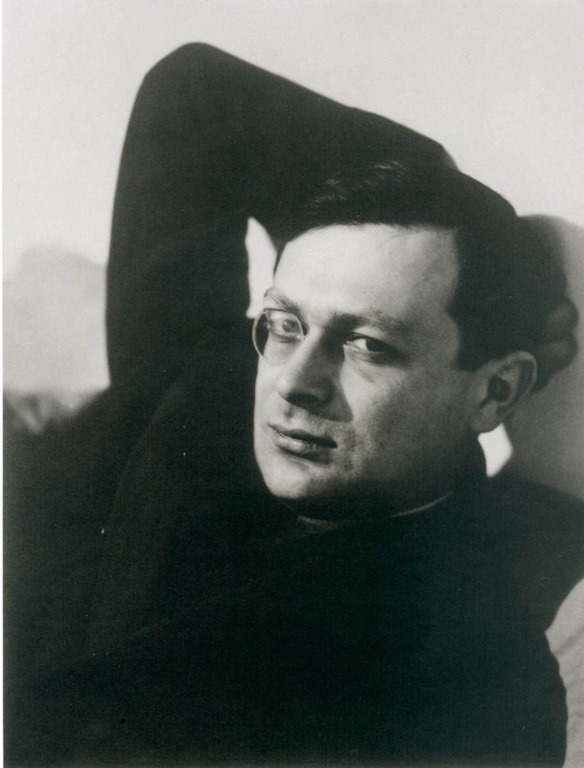
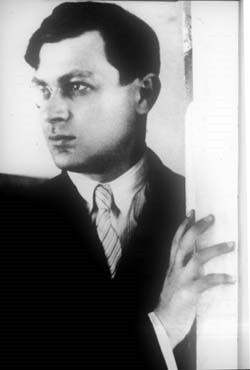
Tristan Tzara photograph by Man RayYoung Bill Gates grayscale

Steve Jobs would have told the young Bill Gates (on the right) to try a black sweater
Tristan Tzara (on the left, photo by Man Ray) would have suggested a monocle.

In my translation, Tristan Tzara is providing something more like a Surrealist’s Lover’s Rock lyric—more Paul Éluard than Dan Bern hilariously parodying Bob Dylan. Musically, I’m not attempting reggae though. I’m not even sure what genre to call my composition on this one, but it is,  like Tzara proclaims, “Swimming in disparate arpeggios.”

To hear it, use the player below.

Like John A Dreams

Today’s selection was also recorded a few years back, and is more conventionally in that “poet reading beat poetry while a band backs the poet up” school of performance. While that’s one of the influences that has led to the Parlando Project, I didn’t want to confine myself to that style, and if you’ve been following along here with what we’ve done over the past year, you’ve heard some of the other approaches we’ve taken.

As I’m in a busy end of August, I don’t have time for much commentary on this piece, but I don’t think it needs it either, which is part of why it’s here today.  This is a story set distinctly in South Minneapolis and the early 21st Century, and it talks obliquely about the time of falling in love with my wife. The Riverview Theater mentioned in the poem is still a going concern, a neighborhood single-screen movie house that shows movies near the end of their theatrical release without concentrating on any one cinema genre, leading to marquee billings like the one the poem mentions, a series of titles that often seem like little Dada poems to me.

Riverview Theater 1

Minneapolis’ Riverview Theater: Dada poem generator or movie house marquee?

  
Outside of the localism of the poem, the main obscurity in it is the title: “Like John A Dreams.”  That’s a reference to one of my favorite speeches in Shakespeare’s Hamlet.  In the play’s Act II, the hero Hamlet is asking why he cannot take action on the death of his father, and he rebukes himself as “Like John A Dreams, unpregnant of my cause, and I can say nothing…” John A Dreams was apparently a stock folk character in Shakespeare’s time, a foolish character who lived in his imagination and ignored more pressing reality—a character flaw all writers should be able to appreciate.

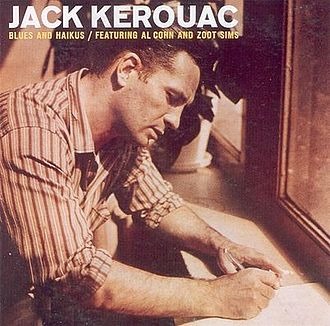
Blues and Haikus Jack Kerouac record cover

Parlando influence Jack Kerouac. “Beat poetry while a band backs the poet up”

Allen Ginsberg once recalled Jack Kerouac reading Hamlet aloud, and in particular this speech, with special emphasis in his voice when he landed on the “John A Dreams” charge.
 
So, if you’re a writer or other artist, Hamlet’s speech is for you. Your life is quite possibly bifurcated between that artistic thing you do and the life you press aside to do it. Art is often about making “and” choices. Life is often about making “or” choices.

To hear the LYL Band perform “Like John A Dreams,” use the player below.

Tender Buttons

Imagine this for the background and education for a poet. The poet is committed from a young age to see things exactly, so much so that they become fascinated with the very neurological functions that are the foundations of perception. In college, they study with the foremost psychologist in America, but they don’t stop there. They go on to study medicine at Johns Hopkins, stopping just short of a medical degree. The poet then decamps to the hottest art scene in the world where they discuss art with the painters who are revolutionizing how we depict reality in a frame, and this poet sees right away who are the great visual artists in this scene, with legendary precision. The poet’s next task was to use the ideas of this visual art revolution, along with ideas about how human thought and perception really work, to create a new kind of poetry.

You’d expect this poet would produce extraordinary work. She did. You might also expect this work to be revolutionary in its technique. It was, and still is. You might expect that you will want to seek out and hear this work, to experience what this background and conviction could bring to poetry. You might expect this writing to share with you exciting new ways of seeing. Well…

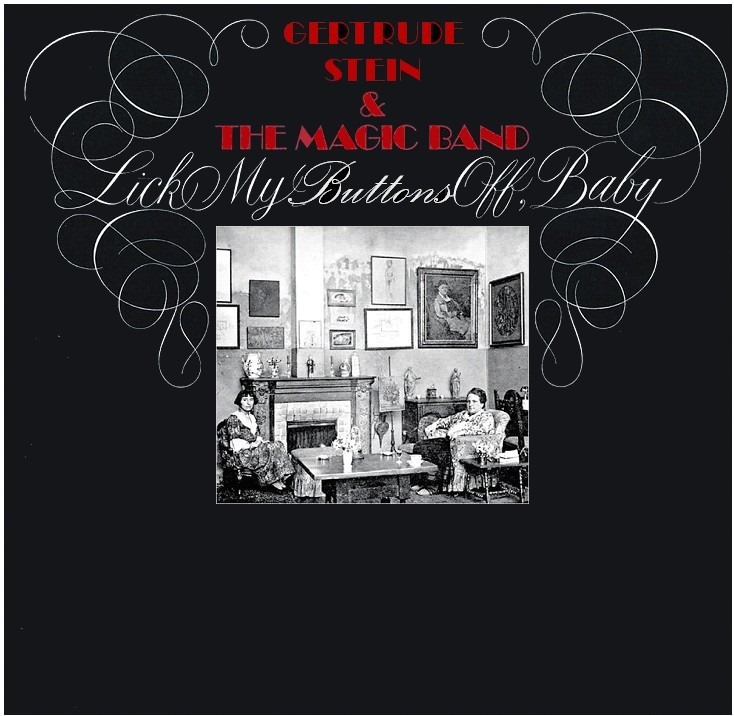
Gertrude Stein Lick My Buttons Off Baby cover

What percentage of my audience knows both who Capt. Beefheart and Gertrude Stein are?

 
Today’s piece uses the words of that poet, Gertrude Stein, from her 1914 collection “Tender Buttons.”  Even within the Modernists of her time, it was controversial, and it remains so today. Stein didn’t shock with her imagery like some of the provocative work of Dada and Surrealism. The radically condensed poems of the Imagists sometimes raised concerns that anything so seemingly simple and without the decorative rigmarole of 18th and 19th Century poetry couldn’t really be worthwhile art, but the Stein of “Tender Buttons”  was even more suspect. The imagists might withhold the complexity behind their shortest poems, but the words themselves were often plain-spoken, comprehendible on an immediate level—too quickly so, in some apprehensions, to be art. Here, the Imagists seemed to say, is the red wheelbarrow, the crowd at the Metro station, the stars above the Clark Street Bridge. I’m not giving you anything more, and you can take in these few words and shrug and say “so what?” for all I care.

Stein went further. In “Tender Buttons”  she wanted to project the messiness of real thought, real glancing perception, sticking to one thing only as repeated words that chorus and then disappear, only to appear a few poems later in the collection, but mostly moving from one atom of perception to another.
 
It’s as if, rather than speech recognition on a modern smartphone, that Stein turned herself into a human “thought recognition” device, registering in words not only the stream of consciousness but a stream of unconsciousness as well.

It’s as if, rather than speech recognition on a modern smartphone, that Stein turned herself into a human “thought recognition” device, registering in words not only the stream of consciousness but a stream of unconsciousness as well.

This is a brave idea, but what emerges from this sounds at first (and for many, at second, and then for as many times as they care to try) like nonsense. The words are plain, at the phrase or sentence level they can even seem to be intelligible, but as a whole, they seem to add up to nothing. Our brains are hard-wired to make patterns out of information, and so confronted with a chunk of “Tender Buttons”  this function may strive to make out coherence until one’s brain hurts, or it may just stop a few lines in and reject it as a failed experiment, perhaps even a fraud.

This is where I think that the Parlando Project’s secret weapon, music, can help. Music may have charms to soothe the savage beast of “I need to understand how these words fit together right now; and if I cannot, I will withhold my listening participation immediately.”

Musically I have put these two pieces from “Tender Buttons:” “Glazed Glitter”  and “Suppose an Eyes,”  against music from my memory of Capt. Beefheart, whose work helped me accept fractured non-narratives even while (perhaps because?) his were set against similarly fractured music. Alas, I lack the ability to emulate the timbre of Beefheart/Don Van Vliet’s voice as I declaim Stein’s words, but I assure you I’m hearing Don Van Vliet’s (or perhaps Kevin Coyne’s) voice in my mind as this piece nears it’s conclusion with the chant of “Little sales ladies, little sales ladies, little saddles of mutton, little sales of leather…”  The Parlando Project has always promised to surprise you with the variety of what we present, but we cannot promise you immediate delight all the time. If you like this piece combining two uncompromising artists, be sure to share us with the social media buttons you should see, and if you don’t like it, check out the other pieces already here or to come, as we use other types of music and other sets of words.

To hear “Two from Tender Buttons,”  use the player below.

The Death of Apollinaire

This is an elegy, not a love poem, but then an elegy is a love poem that replaces the focus masking the complexity of love with the common mystery of death. Even the images and incidents can have an eerie similarity, as an absence may be at the center of either.

The author of today’s piece, Tristian Tzara, is as much as anyone the founder of Dada—if that absurdist movement can structurally support a founder. Like much of the early 20th Century modernist movement, the horrors and changes of WWI accelerated Dada’s development. Proudly anarchistic and rejecting the whole lot of social norms and artistic traditions, Dada was at turns playful and bitter about a European world order that that was itself disordering everything on the continent though modern warfare.

Tristan Tzaratzara_by_picabia

When I look inside the back of my guitar amp,  do I find? Picabia’s portrait of Leo Fender, or a tube socket schematic?

As we’ve learned in earlier posts here, a whole generation was mobilized as part of The Great War. The teenage Tzara, residing in neutral Switzerland, escaped this, but he apparently tried to gain funds from both sides’ propaganda arms to fund Dada activities—which would be just the kind of audacious prank that Dada loved.

The subject of today’s piece, Guillaume Apollinaire, was a slightly older member of that WWI generation who should have gone on to even greater things after the war. As I mentioned last time, he had invented the name for Surrealism, the modernist movement that was a post-war outgrowth of Dada. Before that, he had also invented the term Cubism. In France during this time, Apollinaire seemed to know, and was admired by, everyone: composers, writers, painters, theater artists, the whole lot of this vibrant cultural scene.

Swept up into the military by the war, Apollinaire was seriously wounded at the front and weakened by his wounds, he died during the great flu outbreak of 1918.

Apollinaire with WWI head wound

Apollinaire, his war-wound bandages “pendaient avec leur couronne”

His death then leads to Tzara’s elegy, today’s piece. Given Tzara and Dada’s reputation, I was worried as I started to translate this. Translation, particularly for someone like me who is not a fluent speaker of other languages, is already fraught with issues, but doubly so with writers who can use arbitrary absurdist phrases intentionally. When is something unclear, and when is it meant to be so? That’s a question you ask a lot with these writers. I have a prejudice for vibrancy, and if I feel there’s a good image or English phrase hidden in an unfamiliar language’s idiom, I will generally seek to bring it out, but I also realize that I’m fully capable of misunderstanding the writer’s intent.

With Tzara’s “The Death of Apollinaire”  I grew to believe that this was a sincere elegy for this much-loved artist among artists, and so, translated and performed it as such. Yes, it has its absurd images, but I chose to translate them with clarity in mind. Apollinaire died in November, and so I took the mourning images as a series of late autumn images, and presented them as such. I had the most puzzlement with the line “et les arbres pendaient avec leur couronne” which can be simply left as an unusual combination: a (presumably, shiny metal) crown hanging in a tree-top.  As I looked at “couronne” it appears that it’s used also for a laurel wreath crown, and for a funeral wreath too, and for a while thought “wreath” or “funeral wreath” would be the best translation. And then I considered the botanical meaning of “crown” applied to trees, and the follow-up line “unique pleur” made me think of the last leaves in autumn, a rather conventional image—but a great deal of what makes that conventional in English is the popular song “Autumn Leaves”  written originally in French by Surrealist Jacques Prévert!  My translation: “And the trees, those still with hanging leaves” takes liberties with Tzara’s words, in hopes that I might have divined his image. I’m more confident in how I translated the last line, “un beau long voyage et la vacance illimitée de la chair des structures des os” which I proudly think is superior to other English translations.

Musically, today’s performance is a mix of 12-string guitar in Steve Tibbett’s tuning, with electric guitar and bass. As always, there’s a handy player below so that you can hear it. If you like a piece you hear here, go ahead and hit the like button, but it’s even more important in bringing this work to others attention to share it on your favored social media platform. Thanks for reading and listening, and double thanks for sharing!