To not be scared of death that doesn’t understand us

I’m going to start off the new year 2024 with something I do less often, presenting a new piece that uses my own words. I give myself permission in part because it was engendered by thoughts of another poet, Robert Okaji, who I’ve considered as something of a kindred spirit to my efforts here since this Project began 8 years ago. Like most every blogger I can’t help but talk about myself, but when I do that I fear I become a spendthrift of boredom, so one of this Project’s mottos has been “Other Peoples’ Stories.” Yet, for all that, this isn’t Robert Okaji’s story in any summary — he’s his own poet, his own writer. I’m presumptuous, but I won’t go there. I don’t know him, though I’ve read his blog, his poetry, seen him read online once. Is that like knowing him in some way?

Many of us poets could admit that we see ourselves in a timeless guild. Homer, Sappho, Shakespeare, Emily Dickinson, Du Fu, Yeats — they’re our co-workers. We flatter ourselves at times that we now occupy their offices. By the same conceit, I could think of Okaji as a compatriot. We live in the same country at the same time, we’ve exchanged the customary short notes over the Internet. At least once before today, something he wrote caused me to write something myself. I think I started writing translations/adaptations of classic Chinese poetry before reading his, but his approach (we both need to start from literal English glosses) ratified mine in effect.

So we poets, at the moments our heads swell up so that poetry can burst forth,* may think it’s as if we know each other, because we think we know each other in poetry. To say then that it’s like companionship, that it’s as if, is to do that thing that’s called in poetry a simile.

Every simile when examined harshly knows it’s pathetic. Every poem is not the thing it represents — even the great poems that change how we look at the thing they represent. Let all in the poetry guild admit this to each other within the walls of the guild hall.

I started writing today’s words on one of my more-or-less daily bicycle rides. In spring there may be many kinds of birdsong in my well-forested city, but in winter it may be only crows — which, as the poem describes, are quite vocal about a solitary early morning bicyclist in their midst.

Crows, ravens, big dark birds, are a death symbol of long repute. And it struck me that while we might chide ourselves for not having sufficient knowledge or understanding about death, we could just as well say that death doesn’t understand us. Living in our consciousness as if the present continues indefinitely, we don’t understand death, but death doesn’t understand that moment either. And then, we poets think we can capture the flow of consciousness and preserve it in poems. Today’s poem carries on in a series of similes and then makes a final summation of the series.

Okaji has written a group of poems over the years featuring the character of a scarecrow. Perhaps he too is riffing on crows as the death symbol, but his scarecrow is at times a comic figure too. A scarecrow is just another simile, a sort of, an as if symbol for us — and so I speak of Okaji’s scarecrow in my poem.

Scarecrow takes a winter bike ride

Scarecrow rides a bicycle in early winter mornings, and the crows object. (a note: I begat these AI illustrations with Adobe Firefly, which claims it doesn’t use uncompensated artists’ work to train itself)

.

I said my poem isn’t Okaji’s story — it’s more mine partway — but if you’re like me in some ways, particularly if you want to consider those of us aged to where a compatriot’s death seems next door, then it might be as if it’s partway yours too. The admonition in the poem’s title is therefore not addressed impertinently to Robert, but to myself and perhaps others who might read or listen to this.

Woody Allen wrote a great line: “I don’t want to be immortal from my work. I want to be immortal by not dying.” We write poems, we make those “like a” statements by writing poetry. As if: in our minds we walk into those poetic offices, write our metaphors, our similes. And some day, we must clean out our offices, leaving on our desks a few sheets of paper, maybe enough to stuff a scarecrow.

Today’s performance started with two electric guitar lines I recorded early on New Year’s Day, following the tradition of trying to do things on that day that one would like to continue to do regularly the rest of the year. The two somewhat irregular riffs were spontaneous,** thinking that promise to myself required doing  as much as planning. The bass line was laid down almost a day later to try to hold things together, and the decoration of the keyboard parts arpeggiating the spontaneous chord changes which had started things off, were the final tracks. Those things done, I had my rock band to declaim my sonnet “To not be scared of death that doesn’t understand us” over.

You can hear that with the audio player you should see below. No player?  This highlighted link is a back-up method, as it will open a new tab with its own audio player.

.

*A metaphor that sounds more like a sneeze than Athena’s birth when I re-read this.

**I fancy the right channel line played on my Telecaster has some crow-call-like moments.

A Dust of Snow

Here’s another winter poem by Robert Frost to put to our uses. Writing about my last piece here, Frost’s “Stopping by Woods on a Snowy Evening,”  I wondered about the actualities of the scene the poet was describing: a New England winter road in a dark snowy evening before the coming of rural electrification. Frost would know, of course, that it would be quite dark in those conditions. But did he use that knowledge when he wrote the poem? Did he, the author—like I did as a reader once (despite knowing too the darkness of rural night)—visualize a well-lit snowfall on trees, an alluring and beautiful sight that might tempt him to stay and watch for a while?

I can’t say for sure.

Frost’s “A Dust of Snow” is even shorter, and the accepted meaning of its images has been a settled thing for some time. Last time I wondered if “Stopping by Woods”  was more a poem about a man who was lost in the dark in both levels of meaning rather than a man who was tempted by bright beauty. I could have been wrong, but I think it’s worth considering. With “A Dust of Snow”  certain images have been determined by most academic readers to be, well, symbolic. What if we consider them as real, natural objects and not as handy metaphors?

Robert Frost with axe

Let’s cut down on our use of overdetermined symbols with Robert Frost

We start right off with a crow. “A symbol of death” it is said. Perhaps it doesn’t hurt the poem to think that. I think it’s a crow. A dark bird, darker yet against the snow, and no crow would let the poet that near without a racket of loud caws. The poet doesn’t let us hear the caws though. Instead, like the uncanny sound of sifting snow in “Stopping by Woods,”  Frost wants us to feel just a dusting of snow falling from the branch as the bird flaps off. He wants the main action in the poem to be almost microscopic. He could have written that the bird’s takeoff “dumped a pound of cold slush down my collar”—but that wouldn’t be the poem he wrote. Is the dust a symbol of death too? Or is it an image of a tiny action of little weight? I hold to the later.

Oh, and symbol alert! The tree the bird left is a hemlock tree. Or as the movieReal Genius  reminds us in “the immortal words of Socrates, who said: ‘I drank what?”

How aware was Frost that the American Hemlock is a pine tree and the European poison is a completely different, smaller plant? If this were written by the avid amateur botanist Emily Dickinson, we’d know the poet would know this. Even William Carlos Williams M. D. might have need to know about the derivations of poison. Like the crow being “death” or a bird, “hemlock” could be a reference to death or suicide—but the evergreen is also a symbol of life in winter too, if it must be a symbol. Frankly I think either taken in a one-to-one direct simile way may overdetermine the poem. In the book of nature, having a black bird against white snow causing the small, light amount of snow to fall from an evergreen tree is sufficient.

And this snow falls on the narrator of the poem, and the small sprinkling of snow lifts the rueful mood. I think that’s the essence of the poem: the smallest action of nature, a flighting crystalline snow sprinkle that may not have weighed an ounce, can lift a human out of their dense internal fixations. I think that’s a more graceful poem than the leaden march of death-crows, grave-dust snow and poison trees. I could be wrong, but I like that poem better.

Musically, a much simpler arrangement than last time, just a bass and 12-string guitar. I’m trying to carve out time to prepare for some more recording with the LYL Band tomorrow. Even if we are successful, you won’t hear those pieces for some time, so use the player below to hear “A Dust of Snow.”

Thanks again for the likes, comments, and the sharing of these pieces on your blogs or on social media.

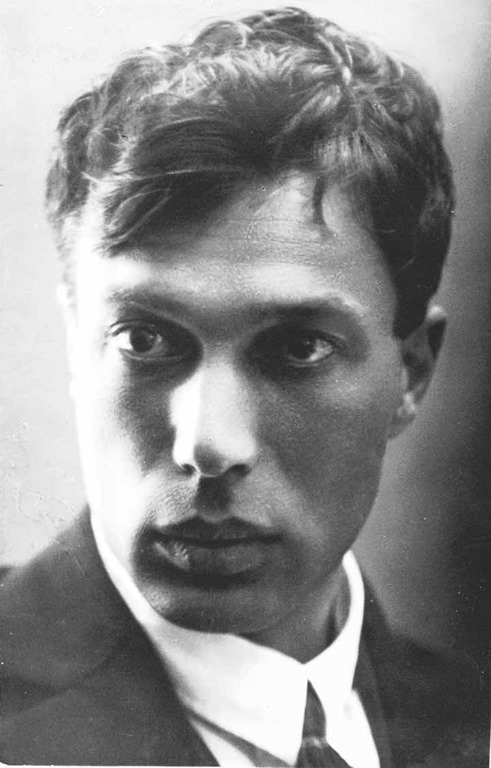
Boris Pasternak’s February

A couple of posts back I mentioned that we’d meet Yeats “rook-delighting heaven” again as we visit some more expressions of the month of February. Well, here’s one, Boris Pasternak’s “February.”

Coincidently, it appears that Pasternak wrote his “February” within a few months one way or another of Yeats’ “A Cold Heaven.” And both poets put ravens in these poems, though Yeats’ crows show up early, and Pasternak’s drop in near the end.  Though Yeats wrote his “A Cold Heaven”  in more temperate Ireland, it resonated with a Northern Midwesterner like me with its burning ice and unwarming sun. Pasternak, presumably familiar with a colder climate more like my own, sets the thermostat on his February to an early spring melt; but this is a muddy, sodden spring. His black spring holds cold rains, mud, and slush—more like a real early spring than a happy-butterflies-and-wildflowers May spring.

Young Boris Pasternak

Bluesman?


I’m not fluent in Russian, but the challenge of translating this lyrical poem from Russian to English has attracted many. As I recall, when I tried to put together the text for this performance, I used several of those as gloss, tempered with Internet translator apps fed the Russian. I know nothing of Russian diction, so I aimed for an informal American diction, and unlike some translators, I didn’t try to keep the original poem’s rhyme scheme in English—after all, I knew I’d be supplying music for this.

I believe the music I choose here, bluesy rock’n’roll, while American, is fitting. I hear Pasternak here singing the Russian Blues: blues like unto our great American music of endurance, and rock’n’roll that cares only to seek the state he speaks of in the last two lines:

The more haphazard, the more true, the poetry that sobs its heart out.

So I’ll be putting this post up, and then I’ll go out in our haphazard too-early spring February myself. I too will head out past the noise of city church bells, past the cars, biking to the edge of my city where I’m going to buy George Saunders sad new novel.

Renee Self Portrait in Mirror cropped

Today’s episode is dedicated Renee Robbins, who once was lost on the edge of Moscow herself, the last passenger remaining at the end of a bus route. She found her way back long enough for us to know her.

To hear the LYL Band perform Boris Pasternak’s “February” use the player that appears below.

A Cold Heaven

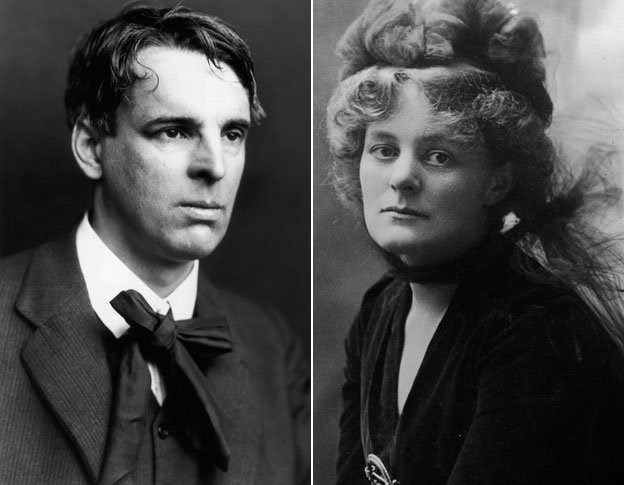
We’ve already met Irish poet William Butler Yeats with a brief poem earlier this month. Now his words return with a piece suitable for the aftermath of Valentine’s Day, for “A Cold Heaven” is the tale of a rejected valentine. It’s also fitting, because Valentine’s Day comes in the midst of late-winter. February, as Margaret Atwood put it, is a “month of despair, with a skewered heart in the centre.”

Here in the northern Midwest it was a “seasonable” 19 degrees F. this morning, and hardy ice has outlived any soft covering snow. There is a promise of a thaw this weekend, but that will only recall mud and the detritus of what the snow once remembered inside it.

Critics from more temperate climes praise Yeats for his oxymoron here of “ice burned,” but up north we know that’s just what happens to skin in the cold, with no need for poetic intercession. And my back yard, my cities’ parks, and our central greenway have been home to that “rook-delighting heaven” he speaks of as well. Strange isn’t it, that the bird of death is so smart, so intentional, so sure, and yet inscrutable.

In “A Cold Heaven,” Yeats’ winter and his death-omen birds lead to a missed and misunderstood, “crossed” love; and he takes the blame: if not for the season, for the failed love. Like so many, and without the succor of chocolate or flowers, he is left in the rejected lovers worshipful, davening stance, “rocking to and fro.”

But he is a poet still! “A Cold Heaven” breaks itself in two with an image that is also a pun: “Riddled with light.” Yes, we Northerners know that winter light. Brighter than summer, and paradoxically the sign of a piercingly cold day. He knows his love’s in vain, and yet no amount of blame that he can assign himself—even if he exhausts “all sense and reason” to catalog that blame—can account for the failure of his love. What can solve this “riddle?”

Yeats begins again, with a majestic “Ah!” only to take us on a short ghost story, the spirit of his love in purgatory, in bardo, naked as a corpse or as a lover, wandering and asking why clear skies, clear answers, seem like punishment.

So to all those whose valentines were not accepted yesterday: peace. Such riddling has no end to its depths. I know this: that hole is too deep to be plumbed, just know that it’s deep. The correct prayer for such things is unknown.

Yeats and Gonne

Look, maybe she’s just not that into you…

As a performance, “A Cold Heaven” had some challenges because Yeats makes use of enjambment, where lines break in the middle of sentences; and where the meaning too, often forks, seeming to mean one thing before the line break and another afterward. Since I like to let the lines “breathe,” so that the music can interject, and so that the words’ impact can sit a little bit before the next line, I resorted to repeating a few words. There are also a couple of other audio tricks in the piece. The string parts, particularly at the beginning have a “backwards tape” articulation where the sound swells from louder to silence, in the reverse of the normal decay of strings, which I hope signifies the drop into the past in Yeats’ text.

To hear “A Cold Heaven” use the player gadget you should see just below this.