A Sonnet of Two Letters

It happens to us alone, but it happens to so many it’s a trope we share. It goes like this: you have one of those bad dreams. Something terrible has gone wrong — and you, inside the dream, feeling it is real, try to fix it — but you can’t because the other people in the dream are oblivious to the terrible and are acting stubbornly in odd, irrational ways. While dreaming you’re trapped in this desperately unsolvable situation only you can clearly see and try to act rationally on, running in place, thinking in circles.

I had one of those dreams this week: felt so real, so heart-wrenching. Then the dawn comes, and you realize that experience was a dream — oh, that’s why you couldn’t fix it, that’s why everyone else in the dream was acting so wrongly!

OK, exiting satire mode, but let’s stay strange.

Early this Fall I was cleaning out something: a box, a drawer, a binder, a little used bag, I can’t remember exactly what. But in it was a clutch of papers. I glanced at the pages and recognized it was a mix of things: some works-in-progress looking for first reads from the old group of poets I used to meet with every month, and some initial drafts of a longer, multipart poem I was writing as my mother was going through her last hospitalization, the one from which she would ask to return to the home I grew up in with my father and sisters in order that she could die there. I set those sheets of paper aside.*  I figured I’d look them over later, maybe digitally scan them, or put them in my filing cabinet. At that later I’d also look to see if there were any drafts in the small stack that were unfinished pieces I could revisit.

Now here it is, we’re November and I finally got around to that sort-out. One of the pages was a college-ruled notebook sheet with a complete intermittent draft of an irregular (American) sonnet. What was this? While I remember well working on the longer poem around my mother’s last illness 20-some years ago, I had no memory of working on this sonnet. Complete blank. Moreover, the sonnet seemed to speak of someone’s story that I didn’t recognize as mine — nor anyone else’s I could recall either.** With the time-interval between discovery of the papers and my finally going over them, I can’t even be sure if this sonnet was found among the stuff from the time of my mother’s death or not. Trying to determine why I didn’t remember it, I wondered if it was even older. I recalled that scholars date Emily Dickinson manuscripts by looking at the changes in her handwriting over time, so I tried that assay. Looked to me more like my 20th century handwriting, so the poem could be older. Still, it was my handwriting, testifying I, however unremembering, wrote this poem — and “What was it about?” That intrigued me. The poem asks the reader to work obliquely, details are supplied but not all the details, something that can tantalize.

A Sonnet of Two Letters

The gardening stake metaphor used in the final section reminds the 2024-me of Robert Frosts “Pea Brush,”  a poem I didn’t know when the me I was back then wrote it

.

Why did the voice in the poem not mail their first letter? What was it about the recipient’s husband that was germane to that decision? Was there an affair or appearance of one? Clearer to me was the latter part, the stuff of the second letter, a recalling of youthful aspirations and a friend who by what they said helped make them more substantial than pretensions. What an interesting yoking, I thought. The imperfect, the not said, or the thing whose saying we keep hidden — combined with the things that were said that help us realize our lives.

As you might tell from the previous paragraph, I was experiencing this poem just as I would the general run of Parlando Project poems, ones written by others in a project which has as one of its mottos “Other People’s Stories.” Its mystery and ambiguity captivated me, and so I set about making it into a Parlando song.

I did a revision of the initial handwritten draft I had found and worked on combining it with the music you’ll hear with it below this week. The music today is played as a conventional LP-era rock ensemble: there’s the usual quartet: bass, drums, chordal and “lead” guitar. Added to that are two keyboards, piano and Hammond organ. You can hear the result with the audio player gadget you should see just below. No gadget? Wake up, this highlighted link opens a new tab with its own audio player.

.

*Two of those poets have since died, I re-handled those pages, ones they’d typed in and handed to me years ago, and thought tenderly of them. My part of the household is due for an austere “death cleaning,” the tossing of those things an old man keeps to extend something of the life of that-and-those who’ve passed on. I have no grave illness, but the keeper now must consider that they will pass on and that there’s no real keeping.

**I did write from personas in my writing life regularly, a bit more so in prose than poetry. I was likely imagining the “short-story” plot that I then went about expressing in the sonnet.

Rilke’s Black Cat — and expanding the pie in the face of translations

Is today’s piece the Parlando Project’s surrender to the Internet’s pervasive cat fancies? No, this is a very serious piece of cultural distribution — and it’s Halloween fans, that grave and gothic lot, that we’re serving with content this month.

I do fresh translations into English as part of this Project semi-regularly. Translations bring benefits, important ones that would fulfill that serious…cultural  claim. Since poetry exists in nearly every society* no matter the language spoken, translation allows us to casually absorb more outlooks as readers. And as proud as English speakers can be about the home-team’s innings in verse, a great many poets have taken tactics, forms, and inspiration from writers that wrote in other languages. Adding to the corpus of translations then, is a service to readers and poets.

A couple of the poets I’ve translated here have almost nothing available online in English, a few more, little. Rilke, who wrote today’s piece in German is not such a case. He’s a favorite poet of many English-speaking readers, and has had many well-known translations. But even so, adding another Rilke translation is like adding another human perception of a piece of his writing. All translation comes with a viewpoint and a path taken by the translator to the point of translation. My viewpoint is not particularly learned. I’m not an expert in German literature, and I don’t speak German beyond a few phrases. While I happen to like my approach to writing or performing poetry (most poets get little love for their verse other than self-love, so we’d better have that regard to do the work) that’s about all I bring in qualifications to translating.

My translation approach is primarily image-centered. I want to try to absorb what the poet is seeing, and feeling and transfer that portrayal of sensation into contemporary English. I usually don’t try to convey the parallel sensation of the poems word-music in its original language, but I will give some weight to a sequence of the images as they convey the poem’s argument, the thing I call “the music of thought.” I do like there to be some English word-music in the end result, but as with my original poetry in English the images shouldn’t suffer much just to make some formal lock-step.

Which brings me to the other benefit of translating, the reason I recommend translation to every poet, to every creative-writing class: translating forces you to consider choices made by the original poet intimately, and to make subsequent English-language choices that are not dictated at origin by your  desire to tell your life-story or outlook. This separation allows you to practice, in separation, the craft of poetry.**

I took on Rilke’s “Black Cat”  because it seems like an apt Halloween poem — after all, it does start out with the cat being described as an apparition of mysterious supernatural powers.***  As I dug into the poem there was one mystery I didn’t solve: how much is Rilke joking with us? Is this cat a dark vision, a domestic cosmic black hole with a gravity that absorbs light? A real Rilke scholar might have a learned opinion on this, but I am not that person. The Rilke poems I know, and famous Letters to a Young Poet  essays seem utterly serious — I’d say almost to a fault as weighed by my own tastes. There’s a certain kind of Rilke fan, like a certain kind of Robert Bly fan, that makes me wary of the seriousness with which they take their precepts and scriptures.

Black Cat

The Internet was designed so that scientists, the military, and government could exchange ideas. And cat pictures like this one I found there. Well, the cat pictures came later, but I’m sure it was in the design. Now, who’s my dark little existential vision of non-being that meets my gaze…

.

But as I translate Rilke I occasionally find images that seem to fall into slapstick. Did Rilke intend this, or is that my own path, my outlook, reflecting off the surfaces of poems? Seriousness is indispensable to slapstick after all. My favorite part of this poem is when the frustrated viewer of the black cat resorts to enraged stomping about. Last time we had a poem about the pathos of black & grey ghosts seeming to manifest in a dark house. Is this dark cat a solemn symbol of ever-so-serious human-condition dread — or an excuse to burlesque the frustration of life we cannot fully control, things we cannot perceive clearly, yet are stuck trying to figure out anyway?

Black Cat Translation

This is what I came up with for today’s performance

.

It may not be what we’d wish, but as Rilke gets to his last line, I smile. We try to see in the darkness, we might try to command capricious cats, but in the end we’ll all be extinct as prehistoric insects captured in amber crystals — but at least by translating Rilke (or other poets) we can see our gaze in their gaze.

To hear my spoken word performance of my fresh translation of Rilke’s “Black Cat”  you can use the audio player below. What, has a black cat crossed your screen and obscured any such audio player gadget?  This highlighted link will open a new tab with its own audio player.

.

*Do historians and anthropologists know of any documented society that didn’t have a form of poetry? I’m neither — but I don’t know of one. If so, this seems a strange fact in the face of poetry’s peripheral place in modern American culture. Is poetry just an archaic skill, like how to make a stone knife or knowing which fungi are safe or sacred to eat?

**Current online language translators (Google’s seems particularly good) are generally adequate at giving you an English-language gloss to start with. For key words conveying images in a poem, online foreign language dictionaries can drill down into further insight. The translator’s job isn’t just turning some decoder ring though: the job is to find effective English language poetry to hold the poem you’re translating.

***Admitting my lack of portfolio to do so, there’s a third reason to do my own translations: I want to avoid — even for my “absolutely-no-profit” Project — taking other writer’s work that isn’t free for reuse. Rilke’s work is in the public domain in the U.S. — but this isn’t true of most English translations of it.

I Sing to use the Waiting — What Emily Dickinson does while waiting for that carriage

Is there a name for a poetic form made of two quatrains? Emily Dickinson wrote a good number of these 8-liners — brief, but a bit longer than one-stanza forms such as the haiku or the cinquain. One advantage of short forms is that they are easy to hold in memory, allowing them to be shaped and revised while one’s hands are busy with other daily tasks. We know Dickinson sometimes jotted down short pieces on household paper scraps, but maybe even those had earlier drafts before she could grab a pencil.

What can she put in such a container?

This one implies a short narrative. Someone (we’ll just say Dickinson for simplicity’s sake) is waiting at her house for something to arrive. She’s ready to tie on her bonnet (her outdoor hat) and on the waited arrival she’ll be going outside her home. In the second quatrain she says she’s awaiting “his…step.” The something is revealed as a male someone. Where are they going? Dickinson writes of a “journey to the Day.” Is this an odd way to say she expects a day-long journey? Perhaps, but she did capitalize “Day” as if it’s a particular concept rather than a 24-hour interval, and the poem ends with mention of a similarly capitalized “Dark.” Dickinson was fond of circular intervals standing for a lifetime, with a day’s sunset or nightfall standing for death. I suspect that’s what she’s getting at here.

I was captured by this poem, given my musical interests, by its citing of singing in each stanza. Examined carefully, the first line says something distinctive. “I sing to use  the Waiting.” What a striking statement to a musician — or to music’s sister art poetry and poets. Life is time, that’s its waiting. What counts its meter and shapes the air in-between? I think of composer Frank Zappa’s quote “Without music to decorate it, time is just a bunch of boring production deadlines or dates by which bills must be paid.” Poets and musicians sing to use that waiting.

In the ending sentence Dickinson says both she and the awaited are singing to “Keep the Dark away.” Does music — does poetry — hold off, or prevent, death? Well, it may not be that death=dark exactly. Dark may be the unknowable aspect of death, the frightening nature of the threshold we cannot see beyond.

A thought occurred to me as I was living with this poem over the past couple of days: it would seem to pair well with — as a prequel of sorts — to one of Emily Dickinson’s most famous poems: “Because I could not stop for Death.”   In “I sing to use the Waiting”  she’s awaiting that other poem’s he, Death, to bring around a carriage for her. If that’s so, we might expect that on the ensuing carriage ride the two, Death and Emily, are singing as they ride past the playground and the cemetery toward eternity.

The Phantom Carriage 1921 film still

I’m OK with all the night-time transparent carriage traffic, but I wish they’d stop singing so loud. Still from The Phantom Carriage (1921)

.

I had immediate ideas for the musical sounds for today’s Dickinson poem setting, which helped me get a rapid start of the process of composing and tracking it. I was aiming for mysterious, but when I went to mix the various tracks it began to sound odder than I had thought it would be. I explored different options at that point, but in the end I decided there was no going back from strange. I should more often remind listeners here that I go exploring a lot of different musical ideas, so don’t take any one piece you hear here as representative of what you might hear in the next piece, or the one after that.

You can hear my musical performance of Dickinson’s “I sing to use the Waiting”  with the audio player gadget below. Awaiting a gadget that never shows up?  This highlighted link is an alternative.

.

The Day Undressed Herself

Next week I’m going to be attending a number of events online that are part of the Emily Dickinson Museum’s annual “Tell It Slant” festival.*  While I’m not sure how this will change my production schedule for new pieces here, I’m hoping to present a series of Emily Dickinson musical settings before September ends.

The first of these pieces is Dickinson’s “The Day undressed Herself” — and what a charming poem it is. As my reading of Dickinson has expanded, I’ve become aware that some Dickinson poems are so compressed and abstract that extracting a clear meaning is very difficult, but despite this poem’s use of an un-introduced conceit throughout, it’s clearly a poem depicting a sunset. If something of a riddle, the subject is one most readers will “get” easily.

But poetry isn’t just plot and foreground. I don’t mean to replace the direct evidence of hearing the words sung in my performance, but the sounds here are so lovely, and the poet here is clearly choosing words for sound, starting right off with the fabric swish of the poem’s first line and continuing in the 1st verse with the now antique word “Dimities” (which are undergarments.) And Dickinson’s metaphoric details aren’t just sounds, they set this sunset, this emblem world and its cosmic time, in an intimate female universe.

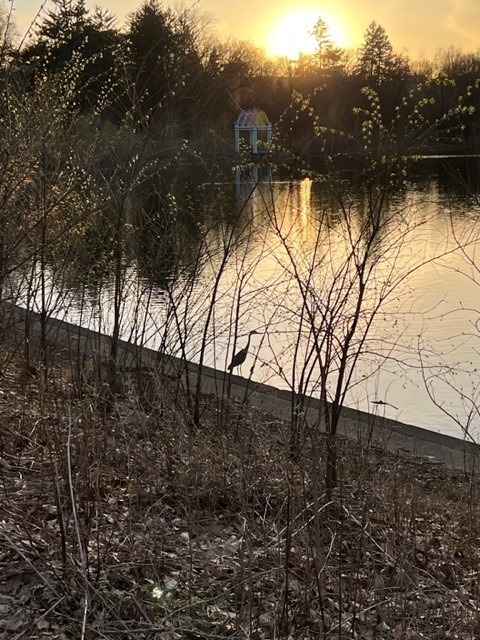
Heron at sunset

The window next to me as I write this faces west too, but it’s only an urban alley. Here’s a sunset a few blocks east, the heron doesn’t seem to know they’re in a city.

.

It starts with a woman undressing, where in art a long tradition of erotic gaze comes with that choice. If that’s so here, it’s a deep and unstated undercurrent. Is she just readying for bed, for dreams perhaps? Or something else? By accounts, Dickinson wrote often at night. I don’t know if she wrote after a change into her bedclothes or not, but this possibility: the sunset’s heralding of an opening to the looser dress of imagination may be in Dickinson’s mind.

The 2nd stanza expands from Earth’s sunset, to let us know, as scientifically educated Dickinson did, that the Sun is but a single star — and if I read her right, that stars are being born daily in the universe.

Another trope that comes with the sunset: day’s end meaning life’s end. The poem’s 3rd verse indicates this is considered and taken as a side issue of this sunset — sunset’s ars longa isn’t so concerned with that — and as it happened, Dickinson’s night-scribed poetry became more than a lifetime-lived. In some mythologies, the sky gods are male —in this one, our western, setting sun is a “Lady of the Occident,” female.

The final stanza starts with a line: “Her Candle so expire” which if considered more fully isn’t just sunset extinguishing the last light before bed. My ear may be over-pun-sensitive, but I hear the rhyming word “fire” in “expire,” and once more the cosmologist is saying in that line that stars themselves have lifetimes.

Someone has been sailing on frigate-books in the closing two lines. I’m surprised at her knowledge of the truck in a sailing ship’s rigging, a ball where the halyard’s pass. It’s an unusual word, no-doubt chosen to consonante with Bosporus, the water separating Europe and Asia next to Constantinople/Istanbul. The dome in the final line is then the Hagia Sophia (“holy wisdom”) church in that city. And the final words, “Window Pane.” What’s this definitive, capitalized pane of glass? Dickinson’s bedroom faced west, her little writing table at a western window.

The Day Undressed Herself

Here’s a rough chord-sheet of today’s musical Dickinson.

.

I wanted to do something featuring a lush sounding steel-string acoustic guitar for this one. With luck I was able to just squeeze in the final take you can hear below as my studio space time so expire. You can hear that performance with the audio player gadget below. No player seen? This highlighted link is an alternative that will open a new tab with its own audio player.

.

*This Festival features a multi-day round-robin reading of all of Dickinson’s 1789 poems, and each time I go through that experience I’m reminded that it is as impossible to comprehend all of Dickinson’s poetry as to remember all the stars in the night sky. Each time through, “new poems” seem to have been inserted — which are in reality ones I had heard in previous years but wasn’t ready to feel until now. Just sitting through a small portion of the readers’ reading — an hour or even a half-hour — can change your appreciation of what Dickinson offers. Busy people might want to choose only one of the reading sessions that has a convenient time for them, and maybe do some hand mending, cooking, or housework as the variety of readers speak the poems in turn. Let the poems that you are ready to feel come to you in your household, as their author composed them in hers.

There are also a variety of programs discussing other aspects on this year’s schedule. It’s all free to attend, but you should sign up at this link.

I Dream I Am Falling

This August 6th is the 8th anniversary of the Parlando Project — but it’s also the 23rd anniversary of my late wife’s death and Hiroshima Day. This isn’t the first time I’ve linked these three observations with a single post and musical piece.

Given two-thirds of this anniversary, it’s not surprising that “I Dream I Am Falling”  is about grief and remembrance. It is a departure from the Parlando Project’s focus in that this freshly completed song uses a poem I wrote rather than our regular use of others’ words.

I continue to write poetry, though less often as I’ve aged. I think sometimes about prize-winning poet Donald Hall revealing in old age that he’d given up writing poetry. I don’t recall if he knew why he stopped writing poetry, or if he revealed the reasons for stopping if he knew them. For myself, there are elements of regular life interfering, but throughout my life the writing of poetry was the easiest art to interleave with other busyness. I would compose stanzas in my head, trusting memory retention as a good test of their value until they could be transcribed. Or like William Carlos Williams, I might jot down first drafts on prescription pads in slow worknight moments in the Emergency Department of a hospital.

Remembering that, I think writing poetry is unlike musical composition and recording, which for me is constrained by my life’s current contexts. Looking back I recall that as a younger person I was eager to write down observations from life which seemed to me to be important and unique. Now, in my older age, when I see similar things they seem less unique, and my expression of them less apt, for I sense that life I was once observing has all along been watching me too — watching me as the hunter does.

Still, the reason I set the official launch of this Project on my late wife’s death anniversary was to counter that. Life, the actuary, knows something, but I can sing in the meantime. The reason I sing others’ words in my unkempt voice is that the writers here are already dead, and I can stick my thumb in death’s eye by making their words current. Given that death’s eye socket is empty, that there’s no sensitive eyeball there, this does not stop Death — but it feels good to do it anyway.

Partway into this Project’s course I started to include Hiroshima Day, the anniversary of the first use of atomic weapons, in my August 6th observances. Death of one’s specific partner has an intimacy that sears because it’s so personal, but it’s not unique nor fully shareable. The death of thousands in a way that still threatens us by the millions or more — well, shouldn’t we share that?

Let me take then a tiny digression to this presentation of today’s musical piece. This summer I’ve been watching a 10-hour multi-episode documentary on Netflix titled Turning Point: The Bomb and the Cold War. I’m only about ¾ done with it, and maybe there’s something at the end that I should have waited to observe before writing about it, but I’ve found it so good I want to mention it today. For something of this length, its storytelling is compelling, and it often takes the sophisticated choice of leaping out of time’s lockstep to connect things. OK, it is 10 hours, but also roughly equivalent to a graduate-level course on the Cold War and atomic weapons strategy in the breadth of its concerns and detail.

I Dream I Am Falling

This is an American Sonnet, following my longstanding practice of breaking up the 14 lines in different ways.

.

Now, returning to the new song. I hope it speaks for itself. Many of you, my treasured audience, will have their own experience of grief to resonate with what it sings. I was able to compose and realize it without access to a studio space where I could use acoustic instruments and sensitive microphones. Only the vocal, through a less-sensitive microphone* recorded sounds vibrating in the air as I played the block chords appearing in the left-channel that established the song’s harmonic structure on my little plastic MIDI keyboard. You can hear “I Dream I Am Falling”  with the graphical audio player below. No player seen? This highlighted link is an alternative.

.

*ElectroVoice RE-20. Worth considering for anyone needing to record vocals in a space that is not acoustically proper for recording, where low-level unwanted sounds would otherwise end up on the recording. For my budget level, expensive, but it’s been an important tool for me. No, it’s not magic — louder sounds will still intrude — but the sensitive condenser microphones I use to record with acoustic guitar in my studio-space hear everything: HVAC sounds, louder computer fans, outside traffic, even sometimes footsteps on another floor of the building. In my converted bedroom home office where this was recorded, the studio-space condensers would be highly problematic.

Paying the Piper: Epilog

Those following my June series on my trip to investigate the life of a largely forgotten poet, folk-song collector, and teacher Edwin Ford Piper may wonder why I titled it “Paying the Piper.”  There were a couple of reasons I knew as I started writing the series after returning home after the trip.

The first: I’d be paying attention to Piper when nearly no one else was. That may be a strange choice, though it’s one I’m largely comfortable with. I enjoy looking at places others aren’t, and I love stories that connect seemingly unlike things. So, Piper’s settler family moving to the frontier of Nebraska just after The Civil War, raising a poet-son who educated himself on the plains amid those who stayed, and those who passed through. I being a guitarist who grew up in the folk song revival, I appreciated that he collected the songs that entertained those people, songs that I could run into decades later because of the work of collectors like Piper. Even my search on that elusive question I couldn’t solve had it’s rewards: what of the pervasive Workshop and MFA culture of poetry of the last 70 years arose, perhaps unwittingly, from Piper’s own methods.*

The reason we call it paying  attention implies it has a cost. I could have done more new musical pieces here, ones featuring poets there is more general interest in. The longer posts in June took a lot of work for a small audience. I chose to pay that cost. If you come here for the more known poets and for the musical performances, some of those are already in progress this week.

My wife and I returned home in the evening after my sojourn to the University library in Iowa City. I had a lot of notes, and pages captured but not yet analyzed, and I had ordered a couple of books to help that would arrive in the upcoming week. It was good to have gone on this trip. It was good to be home. Now the second paying.

What was the one thing I was most looking forward to at dawn the next day? Getting on one of my bicycles and moving my old body briskly through the cool morning air. I would ride to a café and have a frittata and a big glass of iced tea, read the newspaper, and think about poetry or music tasks for the upcoming day.

I walked out that next morning to the garage access door, and I found it slightly ajar, unlocked. I opened it. Sometime during my Iowa trip, my family’s bicycles had been stolen.**

I could write a thousand words here on the stolen bikes if I thought there was a readership for that. I lost my old original generation mountain bike. It was the first bike I bought to ride through Minnesota winters back in the early 1980s instead of buying a car. I rode it in snow as planned, and over rough trails in woods — and in a couple of returning trips, in the river valley hills and gravel roads of Iowa where I grew up, With less knobby-tires it worked well to ride around the city too. Over a decade ago it was the bike I attached a trailer bike to, to take my young child for rides. In the last few years it had become my rain bike since it had full length fenders, and it was the one I rode when the place I’d need to lock up was a little more risky. I’d figured, scratched up and faded, outdated in every regard, it didn’t look like anything to steal. But, it was gone, though I tell myself the memories aren’t stolen.

Diamondback Ridge Runner Spring 2013 600

Picture of the OG mountain bike taken a bit over 10 years ago, when it still had the trailer-bike hitch on it.

.

20 years ago I decided to replace it, and bought what was then a modern “Hybrid Bike.” It was an aluminum Trek, not the fanciest in their line then, but it had indexed gear shifting and the ability to run thin high-pressure tires that I thought would make the bike nimbler. However, the bike and I just didn’t bond. It never was a joy to ride, even with the 28mm narrow tires that were expected to make it faster and easier rolling. Aluminum frame bikes, particularly the ones from that generation, are known for having a harsh ride, maybe that was it I told myself — but whatever, it just wasn’t any fun. Then a couple of years ago I obtained a set of new wide 50mm tires that didn’t fit the bike they were bought for. I’m not sure why, but I mounted them on the aluminum Trek along with a Brooks Flyer leather saddle (that’s the one with springs). The bike was transformed. The extra tire air volume and the saddle not only made the bike more pleasant to ride, those tires made the bike feel more nimble (and more tolerant of bad street surfaces). In the past year it had become the bike I rode more than any other. It had been some mice and a pumpkin, then a splendid carriage and horses — and now, poof, it was gone.

The bike I was looking forward to ride that morning? A purple REI Randonnee that my wife and I had bought used with the idea that she might want to try longer bike rides at some point. It too was probably 20 years old like the Trek, but it had a smooth riding double-butted steel frame. That touring idea never worked out, but I had modified it over the years with a better set of handlebars, a tweaked stem height, some used “brifters” for indexed shifting (my wife never cared for the bar-end shifters it came with). I ended up riding it on longer rides. It was comfortable, responsive, and I miss it.

Also lost, both my wife’s and my winter “Fat Tire” bikes.

Just inanimate things, but I ride my bikes almost every day for joy and utility, the loss was something like loosing a pet.

All lost as I was in a library studying the life and times of a largely forgotten poet and singer of songs people kept.***

.

*I might write more on that Workshop/MFA issue for poets and writers later this summer, but one of the folks who helped guide me on my search S. L. Huang wrote a thoughtful article on the dangers of this paradigm for many writers which I’ll link here.

**I won’t go into the details of how/why the garage was unlocked, though I likely know.

***Besides the thing-grief of these oft-used tools for joy being gone, and the work of trying to nail down details with the Edwin and Janet Piper stories, a large part of my June was taken up replacing the stolen bikes. You’ll meet the replacement bikes later, likely in use.

Paying the Piper chapter 6: bonus library time & the widow Piper has some formidable opinions

After my rewarding visit to the Carl Sandburg birthplace, our plan was to return to Iowa City and leave early the next morning to return home. I felt I knew more about the lesser-known early 20th century poet I’d come to find out about, Edwin Ford Piper, and I had had the experience of seeing something of Sandburg’s roots. My wife had gotten to explore several habitats. And I was pleased to find out my old body could still get around walking while carrying a 10 pound bag — even as a shade of the young student I once was.

Every trip is like this for me: enjoyment at the new place, appreciation of the new things experienced — but once the final day arrives, I’m ready and looking forward to returning home. But that evening as we were getting ready for bed, I was making a quick check of Internet things and saw that I’d received a response from S. L. Huang, a writer who had initiated my interest in the idea that Piper had been foundational in the University of Iowa Writer’s Workshop method of teaching creative writing students.

Why would I (and plausibly you) care about that? The Iowa Writers’ Workshop was the origin-point of some things that have become pervasive in creative writing: the MFA degree, the workshop method of developing writers and critiquing work in progress, and the practice of literary writers being brought in and paid to be instructors in such programs.

Little I’d read in the Edwin Ford Piper papers before the Sandburg finale had addressed that element of his life directly, but Huang’s reply said there was more info on this in his widow Janet Piper’s papers which the University special collections also had. I mentioned this to my wife — she was agreeable to leaving at noon instead of dawn for the long drive home, and she would find one more landscape to explore while I made the walk back to the library for a half-day looking at Piper’s wife’s papers.*

By now I already knew the routine in the special collections reading room. The tough part would be that Janet Piper’s collection was larger than her husband’s, and only generally cataloged. I had gone into the husband’s papers knowing at least a few things about him, but all I knew about Janet Piper were references that she thought “politics” had led to her husband’s early and sudden death in 1939 just as the Workshop was getting underway.

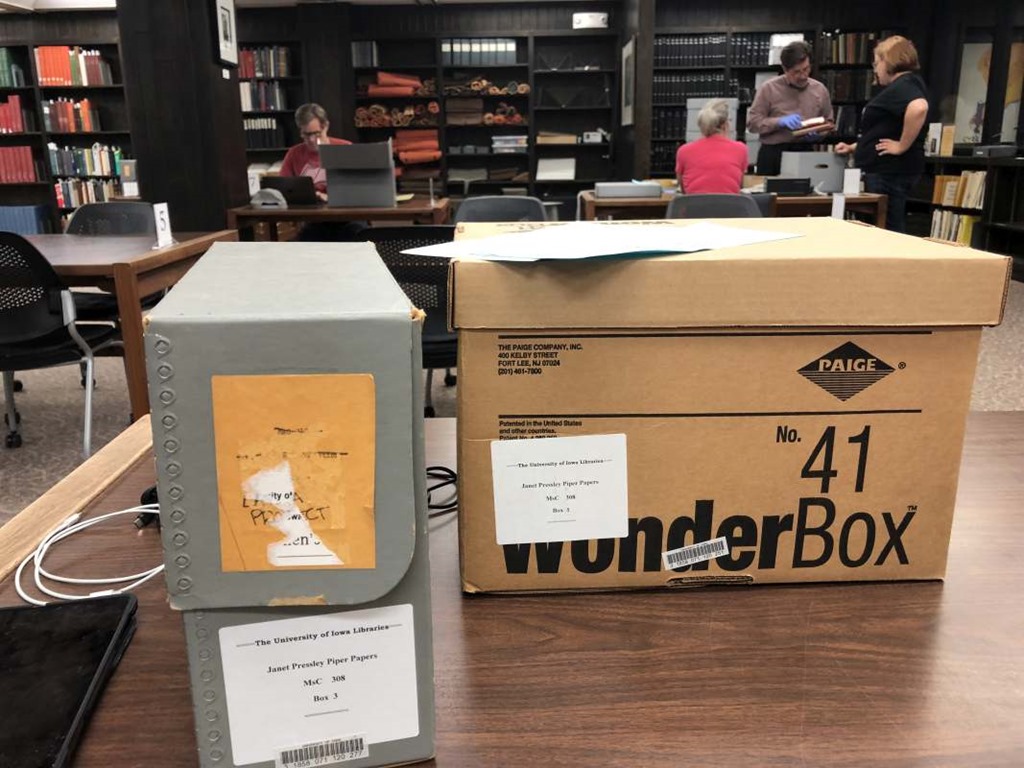
Janet Piper files 800

A small portion of Janet Piper’s papers in the University of Iowa collection, but my best guess at what might answer my questions about the beginnings of the Iowa Writers’ Workshop.

.

It’s taken me until the first day of July to read and comprehend what I captured for later perusal in those few last hours at the reading room. Later in June I also read Stephen Wilbers’ 1980 book The Iowa Writers’ Workshop  which aimed to show how that noted program came to be. Wilbers corresponded with Janet Piper while researching his book, duplicating a slightly earlier attempt by Janet W. Wylder to get information from Edwin Ford Piper’s widow. Wylder was attempting a similar book on the Writers’ Workshop that was never completed.**

Janet Piper’s papers include correspondence from these two with her, and a more than 100-page, response that seems to have gone through several revisions and titles, eventually being called “Edwin Ford Piper and the Iowa Workshop: a prehistory.”   It’s likely the best we have on the later adult life of Edwin Piper, who taught at Iowa for more than a generation and encouraged student creative writing throughout that time — right up until his sudden death just as the official Writers’ Workshop was launched. But spoiler alert: his wife’s account doesn’t live up to that promising title.

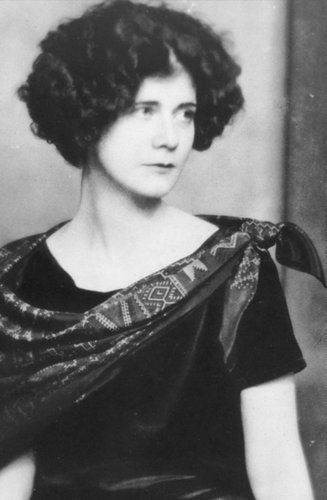
Since Janet Piper is even lesser-known than her husband, here’s a capsule bio extracted mostly from what I read in her papers and some web research:

Born (family last name: Pressley) in 1902 in Des Moines Iowa. May have moved to eastern Nebraska sometime in her childhood, and eventually attended college there and completed a Masters. She knew other young literary people in Nebraska and was already a poet who had won a couple of awards for her poetry while in that state. Began advanced degree work at the University of Iowa in Iowa City in the 1920s. Her academic work was interrupted by her 1927 marriage to Edwin Ford Piper, one of her professors, and by the following birth of their only child Edwin Ford Piper II in 1928.***  She writes little about the day to day of her marriage other than asides to the considerable duties of motherhood and being a faculty wife. She seems to admire and support her husband in his work and notes increasing change, stress, and conflict at the University then. She had resumed her academic work toward a PhD by the later 1930s — and then in 1939, her husband dies suddenly. She describes completing her final thesis defense in the midst of new widowhood in a disassociated state, flying on under auto-pilot. Various statements, some as corroboration, say this is likely the first PhD granted for a thesis consisting of creative writing.

She leaves Iowa in 1940 and within a couple of years takes up a teaching position at Sam Houston State in Texas, where she taught until retirement. In 1949 she made a suicide attempt by pills and was committed by her 21-year-old son to a facility in Texas, where she later writes she received the kind of coerced treatment, including electro-shock, that was common then. There’s some heartbreaking but formally-stated correspondence in her papers with her son from the early 1950s when they are estranged. She blames him for that mental facility commitment, and she says that he blames her for expecting too much of him as a child and not giving him appropriate attention.**** At her retirement in 1972 it’s written that she has continued to write poetry. She lives until 1997.

The Iowa Writers’ Workshop in their official histories started in 1936 — or it started in 1939 in other accountings. Edwin Piper had been encouraging students creative writing for decades, but the administration was now committed to allowing these efforts to be given academic credit and to become substantive toward degrees, a new concept for American academia. From Wilbers’ book and Janet Piper’s account, Edwin had some level of prominence in the mid-1930s in this now officially academic writers’ program — Wilbers writes it was more over the poetry sub-section while Janet Piper portrays her husband as being increasingly marginalized by the department’s administration, making the department head Norman Foerster a particular villain in the matter.

Yet, in a 1976 letter Wilbers includes in a footnote, a fascinating (but secondary to our story) figure Wilber Schramm recounts that he took over as director in 1939, being drafted into the job because of a pressing need occasioned by Piper’s death. In the Workshop’s official history, Schramm was the first director of the Iowa Writers’ Workshop, but Schramm doesn’t tell it that way.

Alas, from what I’ve been able to find out so far, there’s no solid information about how central Edwin Ford Piper was to instigating those Iowa Writers’ Workshop changes to how literary writing and writers live and work in our century. His career shows he’d long favored working with young writers, but Janet Piper portrays that she and her husband didn’t like some of the leaders making Iowa a pioneer in granting degrees, or their matter of going about it. There’s a cryptic report from the 1930s that Edwin didn’t like how the Workshop was turning into a promotional effort which I cannot completely evaluate. I was at first skeptical at Janet Piper’s constant reference to the malign forces of something she calls “New Humanism” ruining her life, her husband’s life, and literature in general. I knew nothing of that term, but a little research confirms that that was overtly the flag that her chief villain Norman Foerster and some of his allies were flying.*****

For a person like me who likes to know how directional changes happened, to see what turned us from one path to another, it was engrossing to try to chase this down, even if the crossroads turned out to be shrouded in fog. I’ll close by saying I’d like to thank Edwin and Janet Piper. Though they are dead, and they likely never concerned themselves exactly with my questions being formed in the 21st century, their papers gave me a window into their times and challenges. I’d like to thank the folks at the University of Iowa Special Collection section who were always helpful to this old and informal scholar. And thanks to you, rare and curious readers, who granted attention to this 1930s couple caught up in the changes in American literature and this 2020s couple celebrating their anniversary with their particular interests.

Watching my time carefully, just a few minutes before noon I packed up in the library, went down to the street, and swung into the car as my wife pulled up at the entrance curb. We were leaving for home.

.

*Coincidence: as I went looking into the beginnings of the Iowa Workshop, she visited the Devonian Fossil Gorge which I later read famed Workshop Director Paul Engle also liked to examine while still a student.

**This double pump seemed to frustrate Janet Piper. She at first thanked Wylder for rekindling her memories of her dead husband and her time with young writers at Iowa. Piper’s response appears to be a version of the around 100-page memoir which includes a long side-discussion of New Humanism. In her following correspondence with Wilbers she’s upset that Wylder had in effect ghosted her, and she wonders why Wilbers doesn’t have the material she sent Wylder. Moderns, remember: this is the era when producing 100 pages meant typing that singular ms. entirely and inhaling correction fluid, not just cutting/pasting and pressing send, or dumping pictures off your phone’s camera roll.

***More notes for Moderns: I can hear the ick factor bursting in your minds. This sort of thing was quite common, even into the years of my youth. Their contemporaries wouldn’t necessarily think this scandalous — or even unusual — though the age difference (56 to 25) here is broader than many of these male prof/female student marriages. That said, everything you object to was still possible despite different mores. Janet Piper’s papers give no indication it wasn’t a happy marriage.

****Whatever led Janet Piper to her suicide attempt isn’t spelled out in what I’ve read. The number of stressors and level of endurance it would take to be a single mom, a widow, a rare woman/academic in an era when that was even tougher than today, and while society is in the transition from the Great Depression to a World War — all that might batter anyone’s defenses. Similarly, I can only imagine a 21-year-old son having their only parent, their mother, trying to kill herself and being put in a position to try to decide what to do about that. I don’t know the particulars of Texas law at that time, but authorities themselves might be pressing for civil commitment. I’m not suited to be a novelist, but reading in Janet Piper’s papers on this matter I thought “There’s a novel.”

*****Let me resist trying to give an outline of New Humanism. Like a number of Fugitives, New Criticism proponents, and neo-Thomists that followed this movement and somewhat evolved from it, they tended toward political conservatism, and in the 1930s many were, at the least, permissive of fascist authoritarians, which some (including JP) might lay to them being already authoritarian in aesthetics. Janet Piper speaks distressingly of fascist Iowa professors in that era, even names some. Janet Piper’s papers that I’ve read don’t tell me exactly what Edwin Piper thought of this. Though a Chaucer specialist carrying that interest into a project completed at the end of his life, Edwin’s papers don’t demonstrate a pervasive appeal to timeless classical truths, and his folksong fascination would likely oppose a tight highbrow/middlebrow/lowbrow outlook. I can’t say for sure what Edwin Piper’s politics were, but his widow seems left/liberal in the 1970s and makes no mention that they disagreed on politics back in the 30s. Janet Piper’s summary that “politics” led to her husband’s early death leads to the question: what level of politics? In her mind it appears university politics and civic politics were indivisible.

When asked about this era in the 1970s. Janet Piper continually wants to talk about what she views as more than a cultural tendency or scheme, and more at an active, effective, powerful conspiracy originated by New Humanism. At times she’s detailed and footnoted with her charges, at other times vague and implying great harms in a broader and fuzzier way. More than once in her papers she refers to Ezra Pound, T. S. Eliot, and Conrad Aiken as the heads of a secret cabal advancing evil work — and I can’t quite “read” if I should take those expressions as satiric exaggerations. In a letter from Robert Hillyer, he agrees with her that she’s not a crank, using that word as if it had been applied to Janet. In what I read she spends less time than my curiosity would like expounding what she prefers in literary or cultural theory rather than what she damns.

It would take more study and knowledge to fully understand or evaluate that element in Janet Piper’s later writing. This element, often present in what I read, shows a life of great reading and learning exceeding my own, evidence of great energy for a person roughly my age — and likely at times I can’t quite measure, effective moments of literary criticism and insight.

Paying the Piper chapter 1

Very often I find myself unable to tell a story simply. While I find internal joy in expanding complexity there is a painful element too. Even when under the spell of things I’ve experienced and learned, I retain enough self-awareness to see what effect my expression has on others, the burden of strangeness. Then the reach between the teller and the listener becomes haphazard, unstable — pile it too high and it tiresomely topples — and so in some break for breath partway in, I realize I’ve dumped a cluttered mass of thought debris on a listener, long past any interest.

Perhaps this is why I’m attracted to lyric poetry, constrained as it is to moments, often held tight within the stiff glass bottles of forms.

Here’s a personal story that’ll go many places coming from the place I find myself in this June. It starts, I’ll guess, earlier this year when I came upon a poem, “The Last Antelope,”  a striking, empathetic account of the end of an animal’s life and wildness after settlers captured it. Edwin Ford Piper was the author, and there were only scattered bits of information to be found about him. Scattered and bits do not constrain my curiosity — if the bits were great distances apart, the space between them could hold a lot of things: born 1871 in rural Nebraska, parents part of early European-origin settlement there. Largely self-educated in a land of necessary child-farmhand-so-never-more-than-half-year schools, still goes on to university in Omaha studying literature with a specialization in Chaucer, and then to the University of Iowa where as a professor he helped establish the idea of teaching and granting degrees in creative writing.

The modern convention of a university as patronage for artists, and the rise of the credentialed MFA-holding poet is not without controversy — but isn’t it odd, this man who taught himself in a small town on the fluid boundary between the 19th Century Wild West and the 20th Century staid Midwest took that journey.

In the middle of this, the same man had a compulsion to collect songs ordinary people brought with them while journeying, the words and music carried in the light baggage of memory. He wrote down songs his relatives and townsfolk knew by heart. He asked others to send him more by mail. He paid particular attention to the songs of those on the move: hobos, cowboys, and other traveling workers. Did this connect with his literary poetry? There are no recordings of Piper reading his poetry, but accounts say he declaimed it with a musical lilt — perhaps like the surviving recordings of Yeats, or maybe like the more bombastic Vachel Lindsay — and at times he would break into full song. His students took to calling him “The Singing Professor.”

Since this Project is “Where Music and Words Meet” you can see why I’d be attracted. And I’m a small-Midwestern-town boy, though without degrees. But did that seem strange then, to mesh high culture and the songs remembered by old women and rude mechanicals?

Piper was born just west of the Missouri River in Nebraska — and in Illinois, just to the east of the Mississippi River and less than a decade later, Carl Sandburg was born to an immigrant railway blacksmith who signed his name with an X. Iowa, the state where I was born in the middle of the next century, and Minnesota, the state where I’ve lived the longest, sit in a delta between those two tremendous rivers. Sandburg too mixed the latest in Modernist poetry with folk songs he collected and sang. Did Piper influence Sandburg? Did Sandburg influence Piper? Or are they the same genus of plant, raised in the same climate, but in separate plots? Questions.

Answers fork like river systems. Even with little information being readily available on Piper, I was already in flood stage. And here’s how much my wife loves me: for our 20th anniversary she agreed to go on a road trip with me to Iowa City and Sandburg’s home-town of Galesburg. My scenery in Iowa City? An archive of Piper’s papers* held in the university library there. Our grand museum of the arts of poetry and song to visit on the trip: a railway worker’s shack in a small rust-belt city, a town worn-out but still running like a paint-shedding Oldsmobile.

Two considerations worried me as I thought about this trip, one for my wife and one for myself. For my wife, I worried if there’d be something rewarding for her to do while I enthused at the library. She was able to solve that one easily, locating nature reserves, parks, and trails within an hour’s drive. I often tell her that she’s a nymph, and I complement her on how seriously she takes her job to supervise the plants and animals when she returns with soggy hiking boots from her hikes with pictures of landscapes, mushrooms, wildflowers, birds, and other critters. I love her pictures and stories on return (her stories briefer and better organized) — but my old joints ache just thinking about hiking for hours.

For myself I worried about my old-ager endurance. The library was two-thirds of a mile from where we’d stay. I’d need to hoof it with my laptop bag back and forth, which would have been a trifle in my youth, but nowadays longer term standing and walking is troublesome. I considered taking a bicycle with me, which would have made the library to-and-from easy, but a lot of hotel/AirBnB places don’t have any good places to lock up overnight, and on further consideration I thought that a bike would just be one more thing to worry about, taking my focus away from the trip’s main goals. And then I worried too about spending full days at the library’s special collections reading room. Because my time was limited, and to minimize the walking, I planned no break for lunch. I’d need to keep my focus and energy up, something that I have not been consistently able to do this year even with all the comforts of home.

On average I bike at least once every day in my normal routine, often in the morning. In the past two years I’ve not been a longer distance bicyclist, but 30-50 miles a week easily exceeds those 150 minutes exercise recommendations, and it lets me get to a café for morning breakfast and handle a lot of routine shopping and other trips. I ride year-round. In 2016 I bought my first 21st Century winter bike with studded tires; and in 2019 I upgraded the winter season bicycle to a Fat Bike with monstrous 4.5-inch-wide tires that handled ice and snow with the challenging ice ruts and potholes that my city’s current “We’ll get to all the streets in 3 days after the snow stops” plowing regime supplies. My overall stamina for the walk wasn’t my worry so much as how well my joints and stiff back would take the more load-bearing walk.** And to make it through the day I’d planned, there’d be no old-man’s afternoon nap either.

Pay the Piper Chapter 1 800
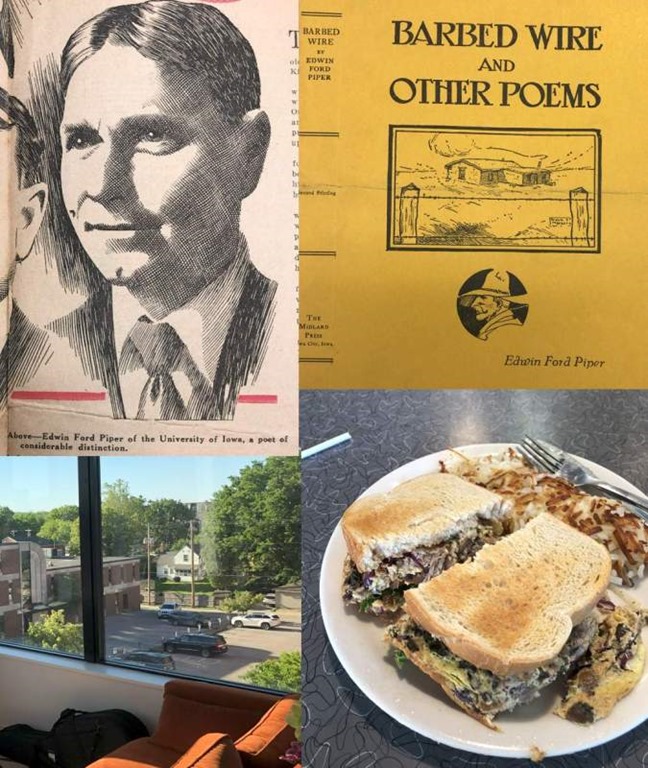
Piper, once a “poet of considerable distinction.” A later version of his collection Barb Wire. My Iowa City view, and yes the guitar got some use. Example breakfast.***

.

The first day we arrived at Iowa city was hot and very humid, so I put on my best hot weather clothing. Spouse-nymph headed off at dawn for her day’s supervisory encounter with nature, and I planned a big breakfast fuel-up. I’m a “eat little meat” kind of guy, but for good or ill I take the lacto-ovo part of my lesser meat diet seriously, so I’m a big frittata, omelet, hash, scrambler kind of guy most mornings. I note that I eat like an old-time farmer, despite never farming, but the good thing about this higher fat/protein kind of meal is that it can hold me until supper, and that was my plan.

I put on my best hot weather clothes, slung my bag over my shoulder, and headed for the university’s main library building for my encounter with poet-professor Piper’s papers.

Thus ends Chapter One.

Here’s a musical performance I put together in March of Piper’s “The Last Antelope.”   You can play it with the audio player you should see below. No player?  This highlighted link is another way to hear it.

.

*When I arrived at the library archives will-call desk, I asked them to pick Piper’s Papers. The librarian suggested puckishly that I was nearly reconstructing the old tongue-twister folk-rhyme, Roud Folk Song index 19745.

**Local papers/forums are full of folks who bemoan bike lanes in my city, often remarking that “not everyone is young and fit.” Despite that, most bicyclists I meet and see on my city’s streets aren’t of the MAMIL (Middle-Aged Man in Lycra) variety — and I’m maybe 1.5 letters of that acronym. I joke with my wife that as my joints get older, a bicycle is becoming a “fore-and-aft wheelchair” for me, allowing me increased mobility and beneficial low-impact movement for the old joints.

***That’s a St. Paul Sandwich: egg foo young on sourdough with lettuce, tomato slices and mayo. Near as anyone knows, my Twin City of St. Paul has no tradition regarding it, and no restaurant there serves it now. Its origin is something of mystery.

Pea Brush

There are more things than well-made that a poem can be — but as someone who’s worked to make their own poems work, I can use that experience to admire what Robert Frost does in today’s piece.

“Pea Brush”  is a rhymed iambic poem, based on four-foot lines, but it throws in enough variation that it never seems like it’s limping along in its gait. The rhymes aren’t fancy, and at least for me, they quietly chime along in the background without calling attention to themselves. This is prosody that isn’t bragging or showing off. It was easy to sing in my rough-hewn manner for the most part,*  but if I was to reformat it into blocks as if it was prose, it wouldn’t seem all that strange either. Indeed, as I performed it, I wanted to stress its conversational quality.

If you’d like to follow along, here’s a link to the text of Frost’s poem used for my performance.

I myself haven’t had a garden in decades, but one friend of the blog Paul Deaton covers their kitchen garden regularly at his blog, and alternative Parlando voice and keyboardist Dave Moore has a garden that we talk about sometimes. I could imagine reading the first-layer plot of this poem as a post Paul might make. “I’ve arranged with a neighbor to use the small limbs from some birch trees he’s clearing as poles for some of my climbing garden plants. When I went to pick them up on Sunday, I noticed bent-over wildflowers** blooming under the brush pile. My reuse of the felled branches will help my pea vines and give the wildflowers room to grow.”

Besides this clear plot line, there are fine clear images in the poem’s story: the smell of sap still in the air from the just-cut trees, the pause in the frog’s song, the near-like to a baby’s grip of an adult’s finger to the tendrils of a climbing plant on garden stakes.

Pea Vine Tendril!

 Wishing good luck to all the gardeners reading this.

.

Below this surface, what is the poem trying to convey? The poem’s speaker (as a character perhaps a more prosaic farmer than the poet and indifferent farmer that Frost was) just notes the practicality of the arrangement — free garden stakes — while letting us in on the blooming of May flowers and the promise of harvest aided by this arrangement. Frost the poet has written this well-made play, painted this scenery, blocked and directed its performance. The play portrays the give and take of humankind in nature. We’ll grow (and consume) the peas with their infant tendrils. Neighbor John has amputated the treescape for his own agricultural designs. These are planned acts of life and death. The episode of the frogs has them portraying those things outside our plans, their Sunday-service silence to hide from a two-footed demigod that might come to capture them to a final silence.

I’ll note too the poem’s ending “had to come” interjection breaking the meter to make a final statement of the budding wildflowers that couldn’t wait for humans to make their plans.

I had to make do with a single hour to get this musical performance down today, and I chose to grab an acoustic guitar to get this accomplished. The results felt right enough to produce this new piece that you can hear with the graphical audio player below. No player?  This highlighted link is an alternative that will open a new tab with its own audio player.

.

*The line “The same as you seize cat’s-cradle strings” is a bit of a tongue-twister. And while I get Frost’s image clearly in that line’s stanza, the syntax is a little disordered I think.

**Frost names his wildflowers as trillium. I don’t know if Frost was the exact botanist that his friend Edward Thomas or his great New England predecessor Emily Dickinson were. Neither am I, but I’m often open to researching specifics like this in poems. I find that one of the species of trillium that grows in Frost’s New England is the Nodding Trillium, a variation that grows crooked stems naturally, not because a brush pile has altered its growth.

Happy May Day to the workers in song

It was quite the April for me, and I’m resting up today before getting on with a bunch of tasks I’ve put off while working on the accelerated posting schedule for National Poetry Month. Readership was up substantially, busiest month ever for visitors at this blog, and page views blew past the old record by over a thousand. I should be better at replying to your comments and encouragement, but besides being focused on the work I have a mental Catch 22 where I often can’t decide the best way to respond, and in that indecision put off responding.

Car Sandburg - The Sandburg Test

.

I didn’t put anything new for International Workers Day today, but I’ll repost this piece with Carl Sandburg’s words from his longer poem “The Windy City”  that I created for last autumn’s U. S. Labor Day. In posting it last year I suggested something I had bounced off my old compatriots in The Lake Street Writer’s Group, something I call “The Sandburg Test.”

Let me suggest a rough analog of the Bechtel Test.  Let me call it The Sandburg Test. To be clear, it’s not my suggestion that every poem has to be about work, about the things we do for our daily bread. But, if we are viewing an anthology or substantial poetry collection from a poet, to pass The Sandburg Test it has to have poems that deal with work in some substantial way. How does the speaker or characters in the poem relate to work? What are they doing that work for? What is it in presenting them that portrays something about life? What are the mysteries, sensations, and systems of that work?

Here’s that musical performance of Sandburg’s words from “The Windy City” accessible with the graphical audio player you should see below. No player to been seen?  This highlighted link is an alternative.

.