The Day Undressed Herself

Next week I’m going to be attending a number of events online that are part of the Emily Dickinson Museum’s annual “Tell It Slant” festival.*  While I’m not sure how this will change my production schedule for new pieces here, I’m hoping to present a series of Emily Dickinson musical settings before September ends.

The first of these pieces is Dickinson’s “The Day undressed Herself” — and what a charming poem it is. As my reading of Dickinson has expanded, I’ve become aware that some Dickinson poems are so compressed and abstract that extracting a clear meaning is very difficult, but despite this poem’s use of an un-introduced conceit throughout, it’s clearly a poem depicting a sunset. If something of a riddle, the subject is one most readers will “get” easily.

But poetry isn’t just plot and foreground. I don’t mean to replace the direct evidence of hearing the words sung in my performance, but the sounds here are so lovely, and the poet here is clearly choosing words for sound, starting right off with the fabric swish of the poem’s first line and continuing in the 1st verse with the now antique word “Dimities” (which are undergarments.) And Dickinson’s metaphoric details aren’t just sounds, they set this sunset, this emblem world and its cosmic time, in an intimate female universe.
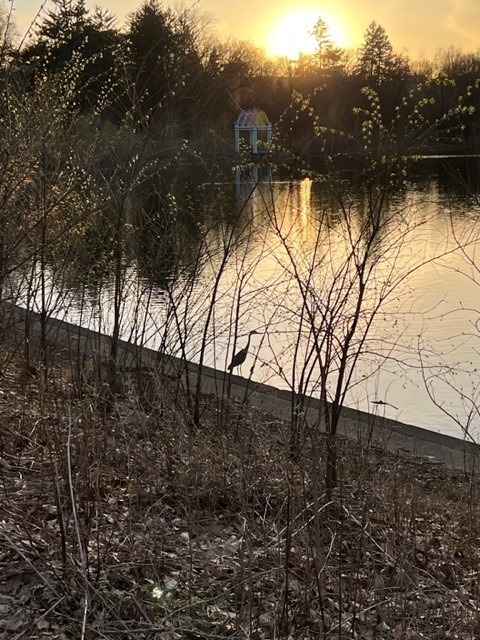
Heron at sunset

The window next to me as I write this faces west too, but it’s only an urban alley. Here’s a sunset a few blocks east, the heron doesn’t seem to know they’re in a city.

.

It starts with a woman undressing, where in art a long tradition of erotic gaze comes with that choice. If that’s so here, it’s a deep and unstated undercurrent. Is she just readying for bed, for dreams perhaps? Or something else? By accounts, Dickinson wrote often at night. I don’t know if she wrote after a change into her bedclothes or not, but this possibility: the sunset’s heralding of an opening to the looser dress of imagination may be in Dickinson’s mind.

The 2nd stanza expands from Earth’s sunset, to let us know, as scientifically educated Dickinson did, that the Sun is but a single star — and if I read her right, that stars are being born daily in the universe.

Another trope that comes with the sunset: day’s end meaning life’s end. The poem’s 3rd verse indicates this is considered and taken as a side issue of this sunset — sunset’s ars longa isn’t so concerned with that — and as it happened, Dickinson’s night-scribed poetry became more than a lifetime-lived. In some mythologies, the sky gods are male —in this one, our western, setting sun is a “Lady of the Occident,” female.

The final stanza starts with a line: “Her Candle so expire” which if considered more fully isn’t just sunset extinguishing the last light before bed. My ear may be over-pun-sensitive, but I hear the rhyming word “fire” in “expire,” and once more the cosmologist is saying in that line that stars themselves have lifetimes.

Someone has been sailing on frigate-books in the closing two lines. I’m surprised at her knowledge of the truck in a sailing ship’s rigging, a ball where the halyard’s pass. It’s an unusual word, no-doubt chosen to consonante with Bosporus, the water separating Europe and Asia next to Constantinople/Istanbul. The dome in the final line is then the Hagia Sophia (“holy wisdom”) church in that city. And the final words, “Window Pane.” What’s this definitive, capitalized pane of glass? Dickinson’s bedroom faced west, her little writing table at a western window.

The Day Undressed Herself

Here’s a rough chord-sheet of today’s musical Dickinson.

.

I wanted to do something featuring a lush sounding steel-string acoustic guitar for this one. With luck I was able to just squeeze in the final take you can hear below as my studio space time so expire. You can hear that performance with the audio player gadget below. No player seen? This highlighted link is an alternative that will open a new tab with its own audio player.

.

*This Festival features a multi-day round-robin reading of all of Dickinson’s 1789 poems, and each time I go through that experience I’m reminded that it is as impossible to comprehend all of Dickinson’s poetry as to remember all the stars in the night sky. Each time through, “new poems” seem to have been inserted — which are in reality ones I had heard in previous years but wasn’t ready to feel until now. Just sitting through a small portion of the readers’ reading — an hour or even a half-hour — can change your appreciation of what Dickinson offers. Busy people might want to choose only one of the reading sessions that has a convenient time for them, and maybe do some hand mending, cooking, or housework as the variety of readers speak the poems in turn. Let the poems that you are ready to feel come to you in your household, as their author composed them in hers.

There are also a variety of programs discussing other aspects on this year’s schedule. It’s all free to attend, but you should sign up at this link.


Sadie and Stephen Hawkings

It’s leap year, and the last time there was one of those, Dave Moore wrote this song about the mysterious cosmologies and quantum physics of love.

We’ve already met Stephen Hawking here, though in a roundabout way, as the universe may be. When Hawking died a couple of years ago, at his public memorial an astronaut read a passage about the cosmos from a Percy Bysshe Shelley poem to eulogize the great cosmologist. Coincidence? Well I looked, and I was surprised to learn that Shelley, that early 19th century romantic poet, could write on the physics of light and calculate the speed of a light-year. Not quite quantum theory, but a better performance than many poets today might do. Romantic wonder and physics may be objects that are closer than they appear.

I suspect Sadie Hawkins is a more obscure star in our firmament these days than Stephen Hawking. Dave would know Sadie first-hand because he’s much more knowledgeable than I am about what once were comics and are now whatever they are fancied as an art form. Back when they were funny papers Sadie was created by cartoonist and satirist Al Capp.

The Montgomery Story comic book

Al Capp ran a comic book company too. In 1957 he published a comic book about the Montgomery Bus Boycott, which helped bring to the fore Martin Luther King. The story in Dave Moore’s family is that his mother typed MLK’s thesis in Boston. Like I said, objects are closer than they appear.


I can’t quite fathom how to condense Capp into a short blog post. I proudly thought I could come up with two or three sentences to sum up Capp’s career—but that’s impossible. His Wikipedia article covers the high points I guess. I will say that by the time I was reading comic strips the Al Capp mythos was probably past its prime and unappealing to me. But that didn’t mean that I didn’t know Sadie Hawkins. Schools still had annual “Sadie Hawkins dances” where young women were licensed to ask men to a date or dance, and all this (along with some legends about Irish Saint Brigid) got melded into a tradition that women could propose to men on Leap Year day.

That’s enough to get you into Dave’s song. As long as you’re willing to entertain a song about a once highly popular cartoon strip and theoretical physics, you’re the audience for this one. I don’t know if that’s enough to fill a Sadie Hawkins Dance floor, but the wallflowers are more interesting there I’d think.

How do quantum forces work? I doubt I know more than Percy Bysshe Shelley. I planned to present this piece for leap year day sometime back, but what did I think two years ago when I heard Shelley’s poem? That he had written of a mazzy  heaven, and that flavorable word brought me to think then of Mazzy Star, an indie rock group that can trace its way back to Minnesota about the time Dave and I started to make music together. Now as I write this post this week, I read that the person whose particle path made that traverse, Mazzy Star principal David Roback, has just died.

The player gadget to hear the LYL Band perform Dave Moore’s “Sadie and Stephen Hawkings”  is below.


Anglers

Next weekend is the Minnesota sport fishing opener. Today’s piece, “Anglers”  is appropriate for that—but to that opener I’ll bring 8th Century Irish monks, a strange airship cosmology, a Nobel prize winner, and tenderly, a pair of brothers.

I wrote the words for “Anglers”  combining two things, one biographic and one literary, mixed with some phrases that occurred to me.

The biographic? My grandfather died when my father was a young man, shortly after I was born. My father had four brothers and a sister, and the youngest of his brothers was only a few years older than I was. My grandfather never lived long enough to teach him much, and so my father helped teach his youngest brother some things their father did not live long enough to do. One of those things was sport fishing. As my young uncle grew up, he and my dad became fishermen of the most avid kind.

Over the next fifty years, the two men fished many places in Minnesota, but most memorably for me, in Canada. Not just on the border lakes like Lake of the Woods, but halfway up Ontario to lakes above the little town of Redditt. Their base there was a rustic fishing lodge: log cabins, outhouses, small aluminum rental rowboats to which they’d attach a 1930s Johnson Sea-Horse outboard their father had bought decades ago onto their flat stern. Their routine: out with the dawn, fish until noon, pull in some inlet, fry up some fish for shore lunch, then fish again until late solstice dark. The poem I wrote doesn’t mention it but I was with them as a child on some of these trips, though fishing was not something I kept up with as I grew up and went East. The two brothers though continued their angling until my father before his death became too frail and sickened with senility to continue.

Johnson SeaHorse outboard motor

“Uncoiling the Sea-Horse.” My grandfather’s Johnson Sea-Horse outboard used by his sons


That’s the biographic. The phrases? I often write, at least in part, in my mind’s ear. Sometimes it’s entire first drafts of shorter poems that are composed there, other times it’s only beginnings or endings, or even phrases that somehow seem to mean to be in a poem. I’ve told myself an advantage of writing this way is that poetry often works best if it’s memorable speech, so composing this way pre-tests things by holding them in memory and seeing if they adhere.

As I get older it’s harder for me to memorize works in process, and this piece had only phrases and parts of the beginning and end stanzas in my head before I started my first paper draft. One of the phrases was the idea of the sport fisherman, the angler, being at right angles to the surface of a lake. Another was a phrase which occurred to me, “lattices of fishes,” which I simply loved the sound of, but it also seemed like unto the vertical angle from the surface of the anglers in their boat.

It was that angle word-play that brought in the literary. The anglers point up and down in their angle from the surface. What do they point to? And lattices, obviously there’s another level under the water-surface plane.

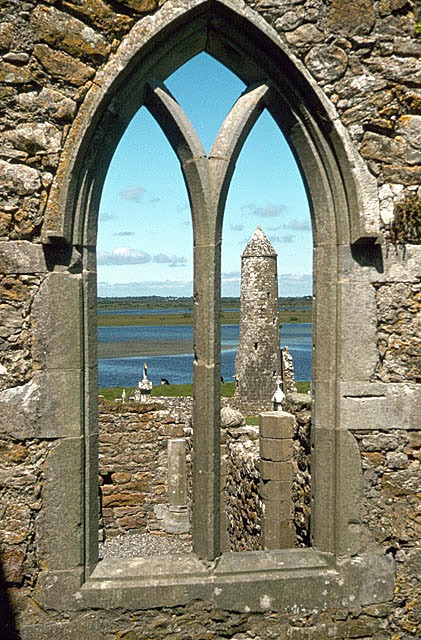
The literary? Seamus Heaney, the Irish poet, wrote a poem I much admired about a story from the medieval Irish annals. The story was some monks at Clonmacnoise in 749 A. D. observed an airship snagged on the tower of their monastery and a crewman of that airship who climbed down from it to free his ship.

Clonmacnoise tower

Clonmacnoise tower. Don’t snag your anchor on the weeds or rocks.


In combining the two, I created a cosmology where the air breathing anglers on the surface of a lake are like angels, or the crewman of that medieval airship, to the barely comprehending fish who are brought across to the airy world. And that echoed the idea I had developed in my head from the anglers pointing up 90 degrees from the surface of the lake in their boat. They are pointing to the heavens, a place we can no better understand than the fish can know about the world of our air-breathing.

And there you are, that’s the entire poem’s metaphoric magic-trick revealed. Yet that isn’t the poem, much less this audio piece that presents it. I still had to work on the language through several drafts, and I may work on it more after this presentation—but the poem and the audio piece is more than its images or its ideas, because a poem and a musical composition are both machines that think with sound.

So, listen to “Anglers”  using the player below. And please, let others know what we’re doing here. I would so much appreciate that.