Racial Relations and gender play in the 1940s-‘50s scrapbook, Part Ten

Early this morning, I was reading a blog of a modern avant garde poet who has lots of philosophic theories about prosody, and there this quote of Walter Benjamin’s is brought up: “To write history is to give dates their physiognomy.”  Well, yes, I thought, that’s what I’ve been doing in this Black History Month series. This scrapbook, its photographs, ephemera, ads, and clippings from newspapers — all a picture of the history of an American Black man: Lawrence Kasuth “Hank” Hazlett, a musician and singer who lived from 1911 to 1990. That scrapbook that had come into my hands portrays his nation-touring time in the 1940s and a residence in South Minneapolis in the 1950s. When it comes to civil rights or diversity, we tend to see change, or the preceding things that needed to change, from a later vantage point. The scrapbook documents such a preceding time, and the sort of things that musician Frank Zappa liked to call “mutations” — the tiny breaking of norms. But, isn’t it just a scrapbook?

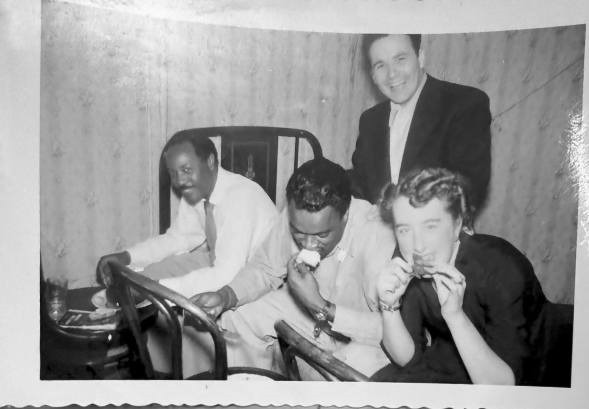
There are pieces in the scrapbook that may give us a glimpse into what its maker noted and selected to save. In the last post, we saw a picture of Hazlett playing on stage with a white bass player with the hippest of truncated neckwear — but overall, the performance photos show black musicians with him, playing (as far as I can see) to black audiences. Yet, here’s a photo from the scrapbook that stood out from that segregated norm:
Bedsitting photo

.

In this photograph two black men (the one on the left appears to be Hazlett) are sitting on a cheap enameled-bedstead bed eating. Sitting on the same bed is a white woman and behind those three, a white man in a dark suit is standing. Black and white, men and the woman are smiling. It looks like an inexpensive hotel room, and maybe they’re all on tour.

Jeannie and her Boyfriends promo

On the back of the postcard they wrote: To Edith and Hank. So nice meeting you, it’s a pleasure to be an entertainer along with you. Jeannie Bill and Don

.

The scrapbook also collects this promotional picture postcard for an act called Jennie and her Boyfriends, who issued a single 45 RPM do-wop style record in 1959. Jeannie in the promo picture has a completely different hairstyle and hair-color, but it’s plausible this is her and one of the members of her trio in the bed-sitting photo.

Also in the last post in the series, we showed some clippings in the scrapbook of Black entertainers working to defeat limiting stereotypes, but one thing that struck me was that the scrapbook also contains clippings showing white entertainment figures. Ephemera in the book, like that MGM W2 form from ’44 and Los Angeles addresses for Hazlett make me think that he might have had at least tenuous connections with some of them during the 1940s. Here’s a page from the scrapbook showing a clipping featuring Lana Turner, which may have been included because its caption says Turner likes Duke Ellington records.**

Lana Turner likes Eillington records

Lana Turner isn’t into vinyl, she’s spinning shellac.

.

These are old clippings, sometimes from lower-res reproduction, and occasionally I’m misled by the ambiguities of race in the photographs. Take this one of Jean Parks found on this page with both white and Black entertainment figures. I figured she was white.

Jean Parks et al

Find the second Afro-American woman on this page.

.

Those who’ve followed this blog will know that I was immediately saying to myself “Who’s Jean Parks?” The story outlined from asking that is as rich or richer than the story of Bruce Dybvig from earlier in this series. WWII military service put a crimp on the supply of male musicians — so just as with other occupations, there soon arose a number of female bands — Rosie the Riveter, only with saxophones. Popular pre-war bands often enough had female singers, and there were a smattering of woman pianists (and small-group guitarists) — but women playing horns, reeds, drums in big bands— important featured instruments in those ensembles — I can’t think of one. Then came the war and mobilization. All of a sudden there were groups entirely made up of Black or white lady musos sprung full borne from the brow as it were.

One of those was Eddie Durham’s All-Star Girl Orchestra.   OK, now we’re studying history, so we have to do dates. It’s Victory over Japan Day, the war is over. In NYC a sailor grabs a nurse in a crowd without her consent, starts kissing her in front of a cameraman, and everything thinks this is splendid because the immense horrors of world war are over — and the, you know, sissy stuff  of regular old living is to return. The All-Star Girl Orchestra are in the middle of an engagement on the opposite coast, in Oakland California. The link above says that manager Durham sees that the men are going to return — and just then, dissolves the act. Well, sort of. Some remainder is rebranded around singer Jean Parks. As it turns out, the post-WWII years will be tough for all big bands — and all-around, the all-girl band thing doesn’t survive the peace.

And here’s what happens when Parks meets the world of The Fifties. Just look at the bad-girl triple-double implied and indicted in this paragraph: Black, caught with a 6-foot-tall platinum blond “friend”/roommate, sex-work — and drugs? We got’em all: reefer, opium, cocaine. Other than a Communist Party membership card signed Mr. and Mrs. and documents linking her to a plot to cancel Howdy Doody, this is complete “All-Star” material.***

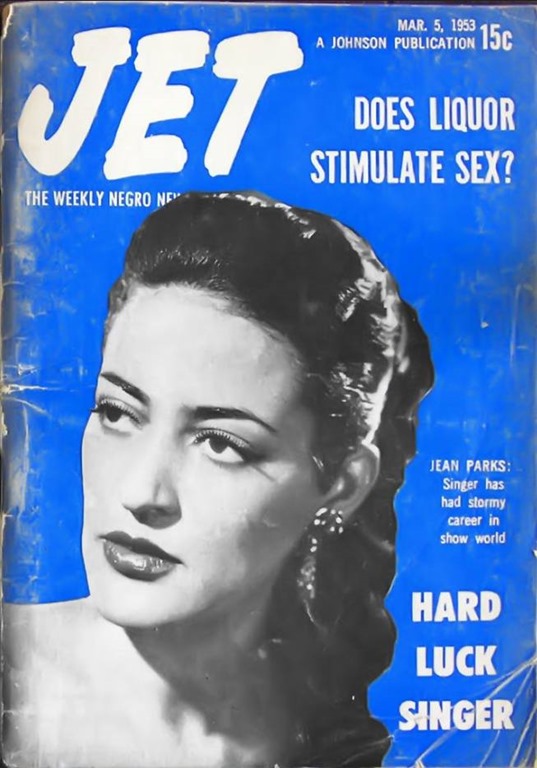
Parks arrestHard luck singer Jean Parks Jet cover

Seeing that other headline on the Jet cover, and suddenly I’m a teenager in the back row of the classroom muttering to a classmate “I must be drinking the wrong kind of booze.”

.

Two other pictures in the scrapbook seem to tell some kind of story about connections between the races, likely in Minneapolis in the ‘50s. There’s this snapshot, pasted on the same page as the similarly posed picture I speculated last time might be of a child of the Hazletts. I have no idea who Maxine is, or who’s Chuck. But as with the other pictures and accounts in today’s post, I’d reckon that mixed race connections like this had elements of risk beyond just social disapprobation. White school integration riots, Emmett Till, the beating and burning of the Freedom Riders buses, all were contemporary with the scrapbook.

Maxine Chucks wife

.

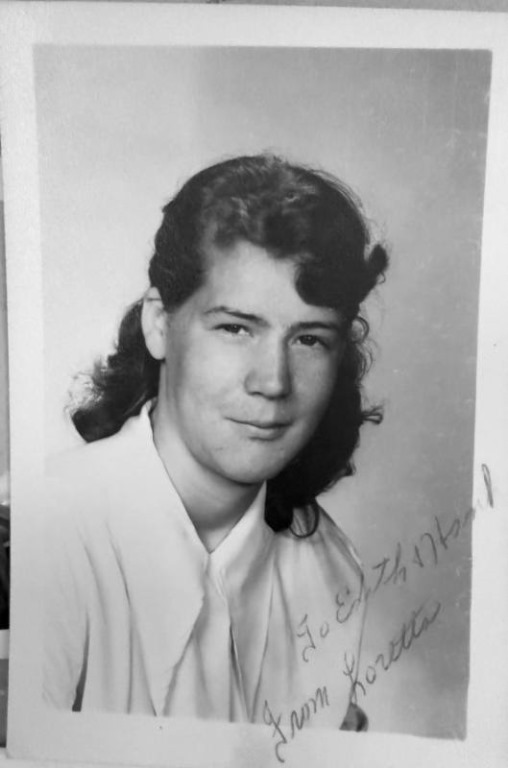
Then there’s this picture, inscribed to Hank’s wife Edith and so presumably from the early 1950s. So many of us have awkward school-picture-day photos, but I found this one more arresting than awkward. This is hard to detail, so I’m going to be more awkward than the picture, where after all Loretta is smiling and seems comfortable with themselves: Loretta looks quite masculine. Unattributed, it could easily be a 20-year-later photo of a mullet-head male guitar player in someone’s high school rock band. Burn-out the long-point blouse collar and retouch the long tresses in the back and it would be a 1950s boy who wants to grow up to play in Elvis’ band.
Get Back Loretta

Loretta.

.

There’s no other context other than the inscription and being in the scrapbook. Looking at Loretta’s photo this month I immediately thought of “Get Back,”  the Beatles lyric. Some of you may be singing the applicable verse in your head now that I’ve said that. My second thought: I’d love to know Loretta’s story, but there’s next to no chance I ever will.

And now a transition that may or may not be apt. There are several pictures of Hank Hazlett, and Hazlett with his Trio, dressed in drag. I can’t place the club stage shown in most of the pictures. The Telecaster he’s playing says this is likely during the Fifties when he’s largely working out of Minneapolis, and it may be a Minneapolis club. Everyone looks like they’re having a good time, and dressing in drag is a multivalent act that can be meant to convey different things.
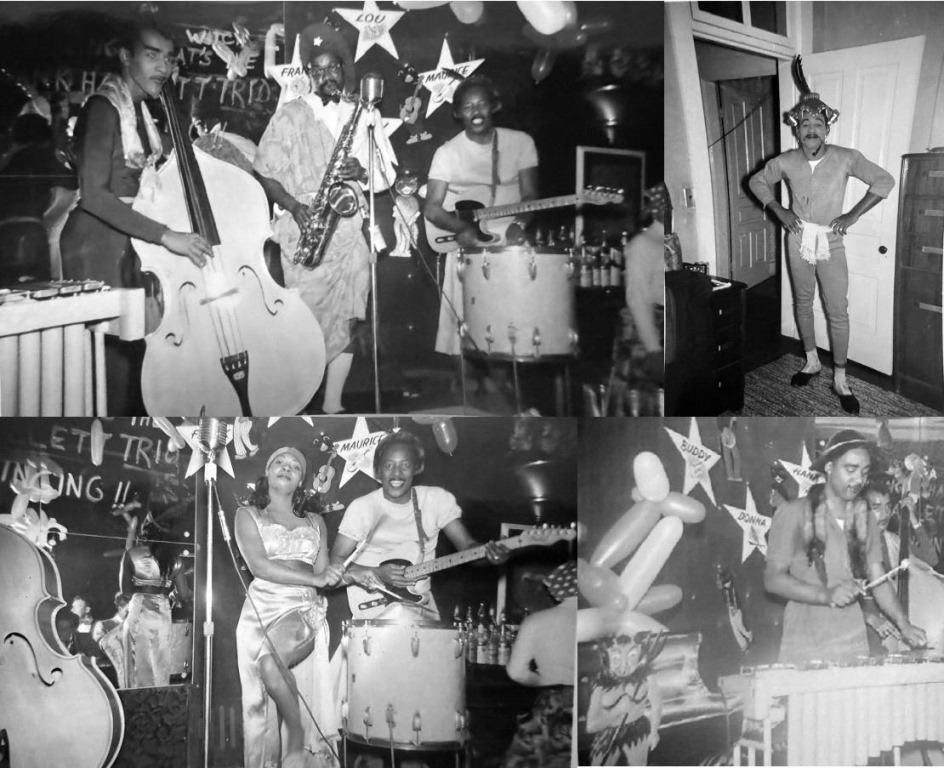
Drag performance Hank Hazlett Trio

..

Everyone seems to be having a good time. Of course, right now we know it’s supposed to mean danger to children, and therefore we must let rich folks get richer so they can stop those goings on, because…religion. That’s a very serious opinion, mandate and all — you ought to pay attention to it instead of looking at this approaching 20,000 word series on — what? — a scrapbook about a Black musician who few have even heard of. And the scrapbook is mostly pictures,  where’s the meaning in them? Of course, then there are these other Walter Benjamin quotes: “Those who do not learn how to decipher photographs will be the illiterate of the future” and “We collect books in the belief that we are preserving them, when in fact it is the books that preserve their collector.” Benjamin’s life, which we know more about than Hank, or Edith Hazlett’s, or Loretta’s life, could be called in to rebut those quotes. In a corporeal sense, he had little future, books didn’t extend his human, breathing, skin-coated living. But Benjamin did have his quotes, groups of words that might work like poems to let us see something new, and there are even some who will read philosophy at length.

There’s a new musical performance today, taken from a piece of folded and unfolded paper that was pasted into the Hazlett scrapbook. Did Edith carry it? Did Hank? On it, in faded pencil, are written 6 quotes, 6 maxims that someone wanted to carry in order to carry on. They are from a mixed-bag of writers, numbered 1-6 on the page, and in which order I read them in this performance: M. B. Whitman, H.D. Thoreau, Lloyd C. Douglas, Helen Keller, Herbert Kaufman, and Ambrose Bierce.

You can hear that performance with the audio player below. What? No player to be seen? Well, there’s injustice, carelessness, and cruelty we don’t see, and that’s a bigger deal than a couple of minutes of me dressing up in weird Jazz-band drag and reading some inspirational quotes — but you could use this highlighted link which will open a new tab with its own audio player.

.

*Marv Goldberg mentions that the Cats and the Fiddle might have had some involvement with the 1945 MGM Judy Garland film The Clock,  which would have been several years and lineups past the original Cat’s quartet burst of Hollywood film appearances in 1938 — those all even before they had made their first appearance on recordings. A 1945-released film would have overlapped the time that Hazlett was in the Cats, could explain the 1944 W2. Mysteriously, I distinctly recall seeing a clipped advertisement for that movie when I first looked into the scrapbook years ago, thinking I should check the film out — but for some reason it isn’t in the scrapbook now.

**Frank O’Hara poetry fans will note Turner is fully upright and operational in this photo.

***Like The Clock ad, I also distinctly remember seeing an article about someone in entertainment arrested for prostitution when I first looked through the scrapbook years ago. It too is missing now. The scrapbook was part of at least one move, and when I look at it now, I have to take care, as it’s falling apart. I now suspect that might have been more on the Parks case. The All-Star Girl Orchestra could have shared bills with the Cats in Hazlett’s time — they played the same theater circuit during WWII.

When Black History Month was just what you were living, Part Nine

My feature this February has been centered around an Afro-American scrapbook entrusted to me after it was found in a crawlspace at a former South Minneapolis rooming house in the middle 1970s. This series has taken me away from the usual Parlando focus, which is combining literary poetry with original music in differing styles. If you’ve been missing that, look to the bottom of today’s post — I’ll have something new for you today.

This exploration has taken a tremendous amount of time and effort, and I sometimes doubt how many readers will share my level of interest in looking back at what’s in and surrounding that scrapbook. It seems worthy of notice to me, and that supports my mind and heart work in this month’s effort. I did warn at the start of this series that what I’m writing here is coming fresh from an examination of the scrapbook, and some of my findings will be preliminary or subject to better evaluation — even little things in this larger than usual collection of writing. I just finished fixing a handful of typos on the previous episode that escaped my eye last night before I went to sleep, and now it’s time for the next one.

As a document the scrapbook spends a lot of time in the World War Two years. The book’s leading man, guitarist and singer Hank Hazlett, got his big show-business break then with the Jazz quartet The Cats and the Fiddle,* and the scrapbook evidences notice of the war in the things its maker chooses to include.

Here’s a Roy Wilkins column collected by the scrapbook maker rejecting racial prejudice in the US armed forces published during the war.

Roy Wilkins on WWII Racial Stereotypes

.

And here are a few more war related clippings in the scrapbook.

There's a war on montage

.

Another war-related story included in the scrapbook is a newspaper clipping that tells us of the Hank Hazlett era Cats opening for and then backing Lena Horne in a musical appearance in front of a hospital’s wounded soldiers. The Cat’s opening set was “Stomp, Stomp,” I Miss You So,” “Straighten Up and Fly Right,” with “Another Day” as their encore. With Horne at the mic, the combo supported her singing “Sometimes,” Stormy Weather,” and “Honeysuckle Rose.”

Lena Horne and the Cats

Thank You for entertaining wounded troops

.

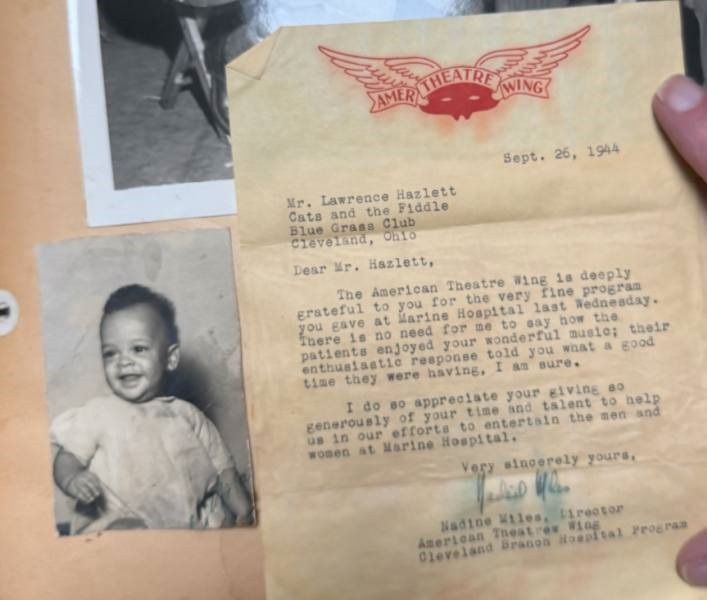
Having this dated letter from 1944 pasted next to the baby picture opens a theory regarding a possible child of Hank and Edith that I wrote about yesterday. A 1940s child could be part of Hank’s deferment, could be the right age to write Felicia’s letter to Daddy a few years later quoted in yesterday’s post, and later yet could also be a young, teenage woman, the subject of another picture in the scrapbook. That the thank you letter is addressed to Hank indicates to me that he might have been the de facto bandleader for the Cats and the Fiddle during his time with them. He was likely 6 or 7 years older than the other Cats in addition to taking the place of their regular lead singer — so, that role might have fallen to him.

A strong theme throughout the scrapbook is Afro-American pride and their struggle for equity in the arts. Many clippings demonstrate that the maker of the scrapbook was concerned with the stereotyping and constraints on Black entertainers and some clippings celebrate their achievements in overcoming that. Here are a few of those items from the scrapbook:

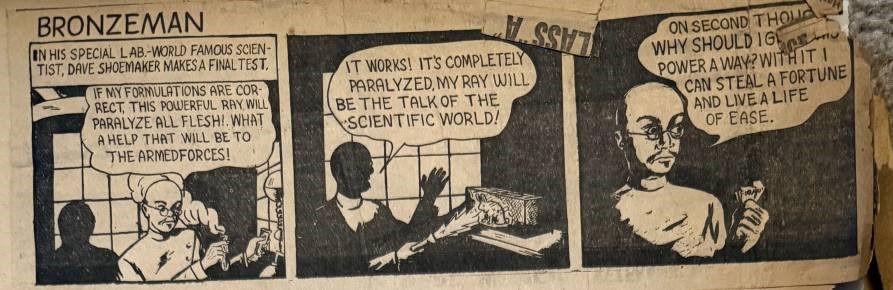
Bronzeman

Did a bronze man create this? Yes. A.C. Hollingsworth created Bronze Man in Blue Beetle #42. As in Paul Laurence Dunbar’s famous poem, he was to “wear a mask.” Publishers changed things though. See this link.

.

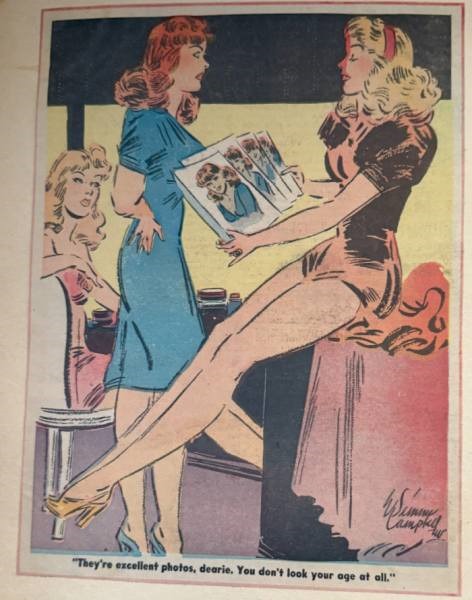
E Simms Campbell cartoon 600

I wondered about a series of cartoons in the scrapbook. All white characters, nothing about music. What was the reason the scrapbook took note of them? The cartoonist E. Simms Campbell. was the first Afro-American cartoonist published in the big time U.S. “slick” magazines. His Wikipedia page says his work appeared in nearly every issue of Esquire magazine from 1933 to 1958, and in many other publications.

.

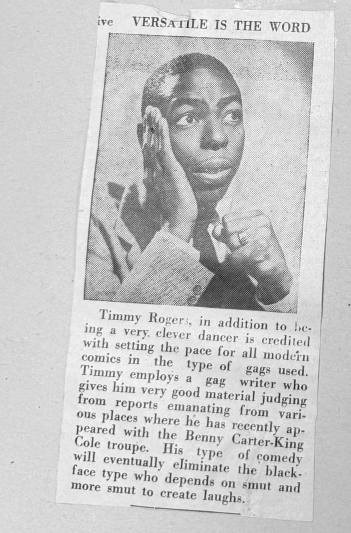
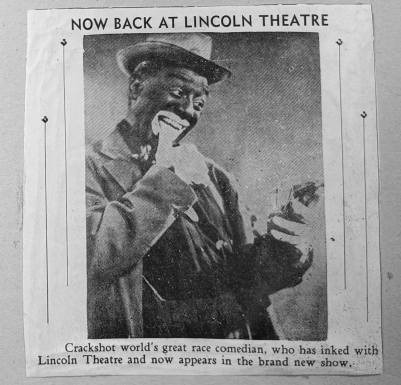
.Timmy Rogers wants to change Black comedyCrackshot in Blackface

Dialectic, but make it funny: the clipping tells us Timmy Rogers was a Black comic who wanted to move beyond the blackface fool stereotypes. More info on Rogers.  I can find nothing on Crackshot, though he’s given his clipping in the scrapbook too.

.

Othello staring Paul Robeson program

The entire multipage program for this landmark stage production starring the multi-talented Paul Robeson was pasted into the scrapbook.

.

Horne and McQueen with a GI sitting in with the Cats

Lena Horne, Dorothy Dandridge, and Butterfly McQueen. Three black women in entertainment who needed to struggle for non-stereotyped parts in the ‘40s. And keeping with our WWII subject, here are the Cats jamming with a white G.I. on bass. The armed forces may have been segregated, but music has established a beachhead. I note too, the scrapbook maker is paying considerable attention to women in the arts.
 
Pearl PrimusI knew about Lena Horne and Paul Robeson.
I knew about Robeson, Horne, Dandridge et al. I’d never heard of Pearl Primus before this month’s examination of the the scrapbook. Her Wikipedia entry tells what she did. This, Robeson’s Shakespeare, and the comics artists above are examples of how the scrapbook’s maker wasn’t just interested in music, but had a broad interest in the arts.

.

Our summary today: not all warriors carry a gun. We’ve had war today, and prejudice, and stereotypes — and me writing a bunch more words (with maybe  fewer typos). So, let’s have a little music, and poetry — and love not war. Here’s a poem by Afro-American poet Alice Dunbar Nelson written in the last decade to be called The Twenties. This may be Black History Month, but all I read next to my breakfast each morning this month is telling me that the nonsensical denigration of Black American military and cultural contributions along with a side-helping of gay panic isn’t history, just as it wasn’t history to the maker or makers of the scrapbook. To hear Dunbar-Nelson’s poem “You! Inez!”  as I sang it to music composed today in-between typing this, you can use the audio player gadget below. No player? Elon hasn’t fired it, it’s just that some ways of viewing this blog suppress it.  This highlighted link will open a new tab with its own audio player.

.

*A founding member and most often featured singer of the Cats and the Fiddle was drafted. The scrapbook doesn’t deal with this, but I did wonder why Hank or other members of that quartet weren’t drafted. Hank Hazlett was born in 1911, and in 1940 he’d have been 29. The WWII draft was different than the Vietnam draft I’m most familiar with — in my day, most called up were younger than 27. In WWII draft men up to age 35 were commonly drafted. I only know the age of one of the original Cats quartet, but the bass player would have been 22 in 1940, and since the original quartet all knew each other from high school, I’m assuming they were near the same age — yet, as far as I know only Austin Powell was drafted. This is a complicated subject and we know so little about the men in the Cats. There were classes of deferments for various reasons, and even stories that some draft boards didn’t want to draft Afro-Americans for Jim Crowish reasons — this even though the Armed Forces were segregated throughout the war. There were also stipulations for physical condition that histories tell us bedeviled the system during WWII. One oft cited report had it that in the draft first year, 1940, “nearly half the men drafted were sent home” for not being fit enough for service.

Or course a great many Afro-Americans did work in war-industry, or were drafted or volunteered for the military, despite the Armed Forces still hewing to the Jim Crow segregation/white superiority regime of mid-century America.

Dunbar

Here’s a piece using an outwardly modest poem by a modest poet, Anne Spencer. It spoke so quietly to me, that at first I overlooked it when I was reading James Weldon Johnson’s seminal “The Book of American Negro Poetry”  anthology, which included it. Just a few weeks later I saw a small story online about her exemplary life as a behind-the-scenes civil-rights activist, which mentioned that she was also a poet.

From it’s title we know she is following one of the Parlando Project mottos: “Other Peoples’ Stories.” When the poem utters its refrain “Chatterton, Shelley, Keats, and I…” that “I” is to be understood as Paul Laurence Dunbar, who was at that time a decade dead at the age of 33, but who was still the most famous Afro-American poet.

Long-time readers here have already met up with Dunbar, and Shelley and Keats require little introduction to those acquainted with English verse. That first name, Chatterton may draw a blank however.

Thomas Chatterton was the most famous failure in 19th Century English literature. A poor boy with pluck he had tricked his way into a modicum of fame by pretending to be the discoverer of a tranche of medieval poetry by a Thomas Rowley. To keep the pot boiling and to engage in the roiling politics of the day, he wrote journalism and opinion pieces under more than one pseudonym, as well as further literary works. The gig economy of his time was not kind to Chatterton. At the height of his career, he would earn about $9 in current dollars for his longer articles. In contrast, writers of our last post’s Burma Shave’s jiggles were paid over $800 in today’s money.

So how does Chatterton make it onto Anne Spencer’s words for Dunbar?

Chatterton was doing all this as a teenager. Fatherless, broke, starving, seemingly at the end of his resources, he took a fatal dose of arsenic and died in his garret. He wasn’t yet 18.

Death of Chatterton by Henry Wallis

Morbid it might be, but “The Death of Chatterton” was a popular and often reproduced 19th Century painting
Given its time, social media was not blamed for his death, but political and class prejudice was.

.

A few decades later, the British Romantics grab on to Chatterton’s case as the perfect example of rejection of the beautiful by the unperceiving. Keats, who was himself tagged as a low-born pretender writing “Cockney poetry” in “uncouth language,” wrote a sonnet to Chatterton. The too-little-appreciated-in-his-short-life Percy Bysshe Shelley, exiled from his culture for radical political and social views, writes “Adonais,”  the now famous ode on the death of Keats at age 25. In it, Chatterton is met on a heavenly throne “Rose pale, his solemn agony had not yet faded from him” as he greets the now dead Keats/Adonais.

Note here the unperceiving in each case has something to do with politics and class prejudice.

And now we return to Anne Spencer. At age 11, the legend has it she was barely literate, six years later she was the valedictorian of her graduating class. Two years later she married and settled in Lynchburg Virginia. Eventually she wrote while raising children and working as a school librarian. In 1918, she helped found the local chapter of the NAACP. Her home became a waystop for numerous notable Afro-Americans traveling in Virginia (“Jim Crow” laws would have segregated public accommodations). James Weldon Johnson (one of the founders of the NAACP) was one of those visitors, and finding that Anne wrote poetry, he helped her work get first published in 1920.

whites only smaller

Two “Whites Only” signs from the Diane and Alan Page collection.
Homes like Spencer’s were important facilitators for Black American travel.

.

Spencer was nearly 40 years old before that first publication. Clearly not the live fast/die young sort. In 1922 when Johnson published the first ever anthology of Afro-American verse, Spencer was included, along with the obvious choice of Dunbar himself. Concluding his introduction to that collection, Johnson said of Spencer’s verse that she was “The most modern and least obvious in her methods.”

“Dunbar”  demonstrates that. Shelley’s “Adonais”  is hundreds of lines. Spencer’s “Dunbar”  is five. Shelley will tell it, repeating and restating his theme in stanza by stanza of glorious English Romantic verse. Spencer’s “Dunbar”  sits quietly, in the midst of this history of poets who died young, whose voices were muffled by prejudice before they were stilled by death. It’s just one chorus. She groups them, tells us Paul Laurence Dunbar found himself with them, a statement of quiet, powerful, assertion.

Perhaps you need to know this history to appreciate the power of that, that “Chatterton, Shelley, Keats, and I” isn’t some arbitrary listing, a line that happens in a small poem talking about a poet—but it’s good to know history, it’s good to have a Black History month, it’s good to know that Keats and Shelley, who now are hallowed in our textbooks, weren’t greeted as worthy poets by their times. It’s good to know that one woman around a hundred years ago in segregated Virginia, quietly but eloquently wrote, and steadfastly worked, to assert a different world.

To hear my performance of Anne Spencer’s “Dunbar,”  use the player below. Don’t see a player? This highlighted hyperlink will also play it.