Edmund Vance Cooke was a Canadian poet. At least I think he was. There’s not much on his life I can find, and sometimes his last name is rendered as “Cook.” His sparce Wikipedia entry says he was born in what was then known as West Canada in 1866, and back around the beginning of the 20th century he wrote a type of popular published poetry in a style that has largely died out. Wikipedia calls his genre “inspirational verse,” and some of it I’ve found is that: paeans to earnest striving and social virtues that now-a-days would be reduced to short easily-sharable quotes or the captions on “hang in there” motivational/affirmation posters. But there are indications that social criticism was also part of his repertoire, and this poem I perform today has some bite to it. Though written in 1917, I felt I should work up some music and sing it as a freshly-made song in 2025.
One of the things that irks me most this year is the outrageous lying by my country’s mad despot and his fawning courtiers. I can’t say for sure what drives all these fabulations and alibies across his administration. For some personalities a lie is a demented reflex, a neurological tic. Others spout the lies as a cold tactical choice of propaganda, with a sense that it will gain them some rewards. A more generous assumed motivation: that by saying this or that is so, when it’s not, may help manifest the thing not yet in existence – and this is akin to what affirmations invoke for personal improvement. Alas, most of the things not yet in existence that our current regime members are manifesting by statement are ugly, cruel things. We shudder – while considering the exaggerations, we fear they might not stay lies for long.
Today’s Cooke poem “Sedition” is a statement of the countervailing powers of truth. It reminds me of an anonymous poem about truth that was widely printed in the same era as Cooke was writing, “Truth Never Dies.” Five years ago in this Project, I presented that poem and wrote about what I found about who had republished it. This link will be of interest if you wonder about that. Though it’s a statement without evidence, it’s not impossible that Cooke was the author of the much reprinted “Truth Never Dies” poem – but “Truth Never Dies” is a more religious and spiritual poem than “Sedition.” I composed music for the former with acoustic guitar and strings presenting it as a firm, but gentle prayer. The latter, Cooke’s poem, is more sardonic, defiant, even militant – and so I decided to crank up some electric guitars for it.
Here’s a chord sheet for my version of Cooke’s poem. I won’t take responsibility if you decide to play and sing it yourself, – that might make you part of a conspiracy.
.
I played three guitars in the recording via multitracking. For the electric guitar nerds, the center channel has a Gretsch hollow-body playing the chords, the right channel’s a Jazzmaster solid-body with a pitch-shimmering wiggle stick, and the left side a Telecaster whose wide vibrato here was created by having enough personal frustration to expiate that my fingers directly wrung the strings sideways to way above their fretted pitch.* I associate this kind of guitar solo with Canadian Neil Young’s credo that sometimes your intent is to not sound like a “professional guitarist,” some master of tasteful licks and precise intonation.
You can hear the performance with the graphical audio player gadget below. No gadget? I’m not lying – some ways of viewing this blog suppress the player, so I offer this highlighted link that’ll open its own tab with an audio player.
.
*”Hey, posh-guy, you’ve got a lot of guitars there.” I accumulated cheap imported versions of these guitars over 30 years, using trades, hunting up second-hand examples, and waiting for sales. Coincidently, the current regime’s tariffs are threatening what has been a golden age of reasonable quality, good sounding instruments for musicians with limited funds.
We’re going to travel to one of the best short poems that late 19th century American poet Richard Hovey ever wrote, a strange poem about approaching death, a place far or near, with no trusty mileposts. As I like to do, we’re going in a round-about way. Let’s start with a blue lake.
I can remember what a wonder it was. My father and his youngest brother loved to fish on lakes, and in search of ever more pure sport-fishing beyond the sky-blue waters of northern Minnesota, they took to traveling up further into Ontario Canada. I was maybe 10 or 11, still at an age when I was open to whatever my parents led me toward. We stayed at a family-owned fishing lodge at the end of a gravel road outside of Reddit. A few small, well-kept cabins, a couple of outhouses, and a lake-dock — which was all the two brothers needed, as the day was mostly spent out fishing.
As I said, I was accepting of this. I gamely came along, earnestly operating a rod and reel, waiting, sensing for any piscatorial tugs on the line, listening to the two men occasionally talking about what fishing tactics were most promising. My youngest uncle, maybe 18 or 19, had been about my age when their father died, and my father now served as his younger brother’s father-figure. I was unaware then that more than lures and casting targets was in their talk.
I was never bored. I had a vast imagination when young, and could sit quietly daydreaming stories and ideas in my head for hours. I suspect a good poet would have been more observing of the boundless nature around me; and while I watched and listened to my dad and uncle some, they were too commonplace for me to treasure.
Instead, here is what I recall being fascinated by: I was in another country, Canada, subject to its laws, and a Queen, a governmental oddity that seemed a little out of time to me. A gallon wasn’t even the same gallon there, nor a dollar exactly a dollar! The lodge owning family and everyone we met in Canada spoke English of course, but since my imaginative and book-minded mind lived in words, I was amazed that all the groceries we picked up in Kenora on our way up had bilingual labels including French.
I was as if I had found the Rosetta stone all by myself. As a native Iowan, I already had a passing place-name experience with French from my state’s then 160 year past life as a French possession, but here in Canada a box of Wheaties or a carton of milk could be held inside other words. So, later in high school and in my truncated college studies, I selected French as my foreign language.
I was terrible at it as a school subject. I did OK (not outstanding) in basic vocabulary. I was passable in recalling the tenses and such. I accepted the arbitrary gendering of nouns. But my mouth stumbled entirely in the speaking of French, so obtusely bad at speaking it that I strongly suspect it is something in my neurological wiring. That I persisted with French as I entered college was at least in part because I was learning that French poetry had been so interactive with English language poetry, particularly in the formation of Modernism.*
After my formal education ended, I continued translating French poetry, not by any right of fluency, as I’ve confessed above, but because I wanted to bask in the secret sauce that helped form Modernism.
Richard Hovey seems to have been greatly enamored of what was modern French poetry to him. His published work includes translations of Verlaine, Maeterlinck, and Mallarmé. While going through his published work this summer I came upon this sonnet “Au Seuil,” in French, dated as having been written in 1898. When I translated it, I found this graceful consideration of dying and some possible judgement and afterlife which I present to you in English today. As an old person, dying no longer requires any heroic situation, acute illness, or grandiose gothic stance to make such consideration apt for me. It’s a matter of petty logistics now.**
The poem as published posthumously in a collection by the Vagabondia co-author titled “To the End of the Trail.”
My translation, presented here as a chord sheet for the musical performance you can hear below. In performance I refrained the final line of the sonnet as shown here.
.
Was today’s poem written by an old man, or a young man staring down a deadly disease? No, Hovey was 34 years old, likely in vigorous health. Still, in less than two years he’d be dead, dying during a routine operation for something as unromantic as a varicocele. One can only wonder how he would have coped with the upcoming English poetic Modernism that would be sparked in part by French writers he admired.
Though subject to my language limitations, today’s poem to song turned out to be a relatively straightforward and faithful translation — with one exception. My usual poetry translation tactic is to primarily find the images in the poem and work at carrying them over vividly to English. I strive to have a non-creaky, natural syntax and word choice in the target language, and to make from that a poem in modern English word-music rather than trying to mimic the prosody of the poem’s native language. What was that one exception? In the poem’s 13th line, “ Qui nous benira de ses grands yeux bleus,” there’s an image I think.*** It could be that Hovey intends a witty little aside about a Nordic male god-in-heaven sitting on a throne of judgement, the cliché being then his point. As I worked on this line I wanted the possibility, however unexpected and wishful, of something universally marvelous. I dropped the andromorphic gendered pronoun as more than unnecessary, and then perhaps unconsciously recalling the poetry of the first-nations name for my current home-state of Minnesota, made the apprehending eyes more than humanly large.****
You can hear my musical performance of what is now an English language poem with the audio player gadget below. No player seen? This highlighted link is the alternative, and it’ll open a new tab with its own audio player.
*Oddly it wasn’t Spanish poetry. In England we can assign this to not forgiving the Armada and all that — but large portions of the United States had been Spanish possessions after all. And while Canada’s French is spoken regionally, Spanish is the predominate language across our equally large southern border and in the American commonwealth of Puerto Rico.
**For example: when I replaced two bicycles stolen early this summer, ones I’d ridden for 20 and 40 years, I wondered at the return-on-investment of spending like-amounts in current market prices to replace them. My favorite old-person’s joke is that when someone offers me a lifetime guarantee, I ask if there’s a better offer.
***Literal: “Who will bless us with his big blue eyes.”
****Lakota compound word for the place of sky-reflecting-waters. And there I have returned to that boat with my father and his youngest brother, as Hovey wrote in a different language: “we know this hidden way/as one knows the ghost of a dead friend.”
Today is Juneteenth, a holiday coming into greater recognition as a celebration of the ending of America’s race-based chattel slavery. Why this date? I repeatedly warned you that I can’t tell a story simply and briefly, but for this holiday I have an excuse.
Slavery began in the American British colonies somewhat haphazardly, but by the time we became an independent country we had lots of laws, customs, and beliefs to entrench it. As it often is with the mechanics of oppression, the structures to hold it up took work to maintain, and by the 1850s there was great worry between slaveholders that it would collapse. In the 1860 election, Lincoln won, and even though he’d stated a politician’s compromise middle ground on the slavery issue, his party included enough abolitionists that most powerful slave-holders were ready to press their states to rebel and set up their own government. Civil war ensued.
Which didn’t free the slaves — at least not yet.
Of course the enslaved had been freeing themselves, when they could, all along. Armed rebellions hadn’t worked for more than moments, but the brave, lucky, and skilled might successfully flee at least from the slave-holding states if not to Canada where US law couldn’t touch them.* But it wasn’t easy traveling all that far.
Once the war started in 1861, some enslaved people recognized they could try a shorter route: just make it to the Union troop’s camps, and a good many did just that, which created an awkward situation. You see: nothing had ended slavery’s legal framework, Lincoln still maintained he wasn’t doing that (if only because a few slave-holding states and slaveholders remained on the Union side). He just wanted to put down the rebellion.** Law still said the slaves were property.
Someone on the Union side came up with a peculiar idea. If the enslaved were legally property, they could be confiscated during wartime like a cannon, horse, ship or other enemy property could be. Dehumanizing language? Sure, but escaping past the Union lines meant an increasing chance that they wouldn’t be taken back.
Eventually, Lincoln supersized that freedom, by declaring that all the enslaved in the states in rebellion were free. This, the Emancipation Proclamation was issued at the beginning of 1863. American slaves elsewhere? Nope, not in the Proclamation. Slave owners in places under Confederate rebel control? Not gonna listen to Lincoln’s order. In April of 1865 Robert E. Lee surrendered the bulk of Confederate troops, but that still didn’t mean all enslaved were free, and the legal matter wasn’t consolidated until December of that year with the adaptation of the 13th Amendment.
A couple chapters back I talked about how slow by modern standards communication could be in the mid-19th and early 20th century. Well, it was slower yet when not everyone was on-board with the news. Juneteenth, with an absurdity that is so often a part of America’s racial history, celebrates when Union troops got over to Texas in June of 1865 to announce that the war had been over for over a month and the enslaved in Confederate Texas were no longer legally slaves.
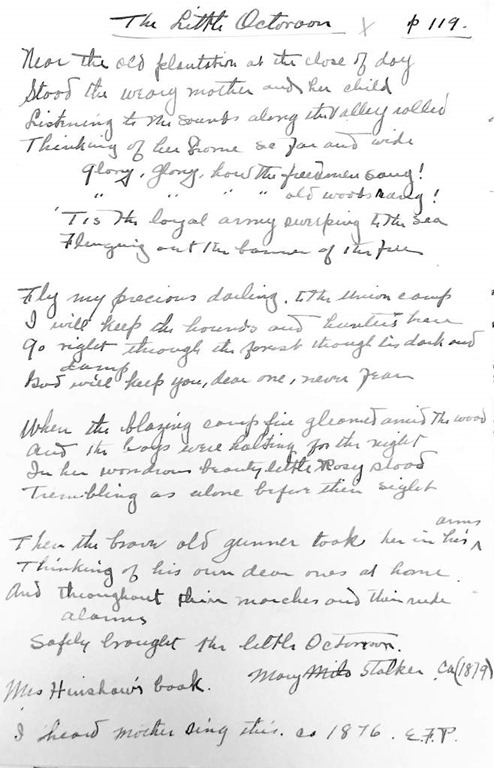
When I left off I was (more or less) talking about folk songs and the songs collected in the American Midwest before WWI by poet Edwin Ford Piper. I’ve also already mentioned that folk songs aren’t unchanging, and aren’t pure. While going through the yellowing paper in Piper’s archives, I came upon this song, handwritten in his own handwriting. He has the title as “The Little Octoroon.” Things aren’t going to get simple here readers. I can’t be simple.
The song as Edwin Ford Piper heard it from his mother
.
Octoroon is a largely obsolete word, derived from a lot of rigmarole regarding how Black someone was. It means 1/8th (octo=8) Afro-American. In general, the mumbo-jumbo legal biochemistry in American history regularly said it didn’t make much difference. Half, quarter, sixteenth — hell, for those who had trouble with fractions it was sometimes written down as: 1% Black, you’re legally Black.
An octoroon may not look Black. I can still recall when I was 14 or so, and having grown up in a tiny rural Iowa town. An Afro-American man who was a civil-rights activist was to visit my church camp. He arrives. Wait — that man’s Black? I remember in my naivete looking at his summer hands and forearms. The man had freckles people!
So why does this song, which is clearly a song from the Union and Abolitionist side make some point about the child being an octoroon? This will get weird: it was possible to be an abolitionist and a white supremacist thinking Afro-American’s inferior. Yes, you could be smart and ignorant at the same time! If you’re trying to end chattel slavery, and you’re counting votes or troops, you might not care to make a sticking point about this, ugly as it is. Those with pseudo-scientific beliefs such as an octoroon is “nearly a white person” might have stirrings of respect. (Ugh!) And then at the unconscious, illogical level, there’s the factor of that person looking much like me, so maybe they should have rights like me. Even if it’s a song (something with no visual element) those factors may have entered into its composition.***
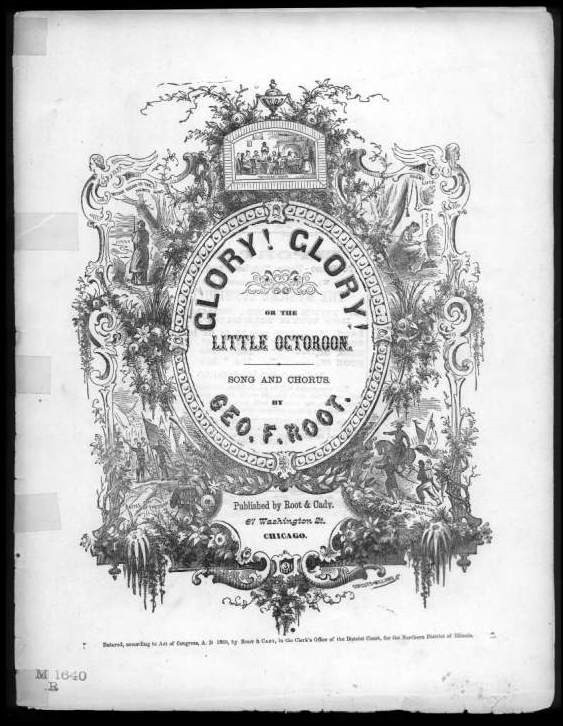
While there are no notes I saw in the archive that Piper knew this, this song does have a composer: George F. Root. Root didn’t quite reach Stephen Foster or Dan Emmett level of 19th century American songwriter fame, but he had his “hits” such as they were in the pre-recording era. During the Civil War period and based out of Chicago, he specialized in songs for the Union side.
The sheet music from George F. Root’s music publishing firm. When Piper remembers his mother singing this tune, it would have been only 10-years-old.
.
Did Piper’s mother learn this from someone else? Was there sheet music in a piano bench for this, unknown to the 5-year-old Piper? In the quiet library archive, I visualized two white people, a mother and child, in rural frontier Nebraska sharing this song. The differences in the printed song from the one Piper wrote down from his mother’s singing say this isn’t likely a handwritten copy from sheet music.****
Here’s my conclusion, which I hope I’ve demonstrated even though I’ve trimmed parts of this piece back: Juneteenth is the most complicated American legal holiday. The only simple thing about the holiday is that it stands for freedom and the lifting of oppression. Taken at its whole, though messy and with calculated delay, that makes it a favorite of a person like me, who still cries and wonders at how simple truths and rights take so long to be established. The song I’m performing today, its path and turning into a folk song, isn’t that complicated — but yes, the path of American freedom is.
You can hear my performance of Root’s “The Little Octoroon” with the audio player below. No player? This highlighted link is an alternate.
.
*In 1850 a Fugitive Slave Act was passed that required northern state governments, not just the federal government to return enslaved people who reached northern states. Some cities and states wouldn’t comply (there’s this Minnesota case for one example).
Piper’s mother was in Canada near the US border in this era. It’s possible that fugitive slaves might have crossed over into her region. I also note that Piper says she was singing it in 1876, perhaps because that’s the border of Edwin Ford Piper’s memory, but I read the date and think about it being the year Reconstruction largely ended and new de-jure laws and customs greatly restricted Afro-American citizenship.
**No, Nicki Haley, slavery was the cause of the Civil War, even though many liked to parse Lincoln’s compromise and coalition statements of this time to make it sound like it wasn’t. The flaw in that framing? Lincoln didn’t start the war, the South did, and they were explicit in proclaiming why they did it.
***There’s another song using this terminology that this Project has already presented: Longfellow’s scathing pre-Civil War poem “The Quadroon Girl.”In Longfellow’s poem the situation leading to that poem’s mixed-race child is laid out: feudal concubinage and/or rape by slaveholders. For making a speech implying the same, Longfellow’s friend, US Senator Charles Sumner was beaten to within an inch of his life on the floor of congress.
****The biggest difference: the printed song’s title calls out the chorus — it’s officially “Glory, Glory, The Little Octoroon.” I only sang the martial chorus twice in my performance because I was more drawn to the bravery and sacrifice told in the verses. We have two holidays that say soldiers made us free, but it’s not only soldiers.
I followed Piper’s transcription for the words, not the printed lyrics, honoring the chain of transmission to me rather than accuracy. I also modified Root’s tune and chords to suit my tastes and tendencies. I could not help but think of these things as I sang this: first, the mother, her family heritage caught in that sexual exploitation making the choice to stay and face the slave hunters and their dogs to assure her child’s escape. We never find out if she and the daughter will be reunited, or even if she survives. Then next I think of those pursuers who to the degree they are portrayed in the song would be gaslight villains — but in history they would be real people doing great evil, who could be thinking they were serving justice. And then lastly, the final-verse gunner who cares for the child, though he’s more the Horatio of the story, with the mother being the tragic hero. I ask you not to skip over the villain characters. It’s fine if you empathize with the gunner, but some great dangers in one’s life (and often to other lives) are those middle souls, like the slavecatcher pursuers, who have a system that tells them they are arduously, justly, doing right.
The world of this poem is scribed with the understanding that when you’re on a lake’s surface you are at the boundary level of two worlds. Like unto angels in Medieval drawings, those fishing are pulling the fish from the aqueous world into the sky world, and I often felt I could sense the hooked fish’s wonder and distress. “Who are these scale-less giants unconcerned by gaseous air?” This poem is called “Anglers.”
Meanwhile, back in Chicago, the Yip Abides blog and rmichaelroman caught this wall painting in 2009. Whimsey aside, the very fish the anglers are seeking to catch in Minnesota today are spending their day trying to catch other fish.
.
It’s unsaid in the poem, but I was in the boat described. I didn’t put myself there because I wanted to focus the reader’s attention on the two brothers and yes, on the fish. There are other undercurrents that I think I kept out of the poem, and someday should make at least one other fishing boat poem. If any in this blogs’ diverse readership reads this before or after getting in a boat and wetting a line, net, or spear, the poem asks you to consider this if you like to think on the water and not just chum with talk: you are frighteningly miraculous.* Don’t let it give you a big head or anything. There are angler forces without skin on another level above our surface.
My grandfather’s actual Johnson Seahorse outboard motor mentioned in the poem
.
I recall that the more published and noticed members of my little writer’s group Kevin FitzPatrick and Ethna McKiernan were not particularly satisfied as readers/listeners of this poem in an earlier version, and I may have made a couple of changes based on that in the version you can hear today. I think they may have been puzzled or unimpressed** by the pun at the heart of the title: that on the flat surface of the lake, the “anglers” are the highest upward length of a right-angle to the water surface, the sharpest break vertical the fish would ever experience. And then there’s the even more obscure eye-rhyme-ish pun of anglers and angels. Neither of them cared much for puns, while Dave Moore and I indulged generously, enough to wrinkle the other half of the group’s noses.
Now Kevin and Ethna have been, like the fish, also pulled through the surface, and today there’s a church-based memorial service for Ethna which I don’t think I will be attending, though I’m glad to have attended a poetry-centered one for her earlier this year, and I’m planning to attend the poet-focused one for Kevin later this May. In lieu of today’s service attendance, and out of guilt from my absence, I’ll say that if their skin-less existence is in wonder and distress, that my thoughts go with them, and in my dim watery existence here I ask us on all our levels to turn our circle-eyes toward wonder.
And I know too there are practical voices in the fishing opener today. “That’s what I get for getting into a fishing boat with a poet. Such high-flown thoughts! Damnit. I’m trying to get a worm on this rig’s hook. We feed worms to fish, and then well, we feed worms.”
If you’d like to hear my performance of my own poem “Anglers” there’s an audio player gadget below this for many of you, and for those who can’t see that, this highlighted link will open an audio player for it in a new tab. My music for this uses what I often call my “punk rock orchestration.” I use very simple orchestral instrument colors both because I lack the knowledge/skill to do more complex ones and because I think there’s a direct charm remaining and being featured by stripping that sound down.
.
*Ah, footnotes, the sinker-weighed lures bobbling along near the bottom! No, I’m not out fishing today, or most any days in this part of my life, though I think about my hours of fishing as a young person. I always considered the fish though, a little to a lot. One thing’s simple though: every poet wants to be miraculous.
**When a poem or poet doesn’t “hook” us, these two feelings can be cause and effect in either order.
Next weekend is the Minnesota sport fishing opener. Today’s piece, “Anglers” is appropriate for that—but to that opener I’ll bring 8th Century Irish monks, a strange airship cosmology, a Nobel prize winner, and tenderly, a pair of brothers.
I wrote the words for “Anglers” combining two things, one biographic and one literary, mixed with some phrases that occurred to me.
The biographic? My grandfather died when my father was a young man, shortly after I was born. My father had four brothers and a sister, and the youngest of his brothers was only a few years older than I was. My grandfather never lived long enough to teach him much, and so my father helped teach his youngest brother some things their father did not live long enough to do. One of those things was sport fishing. As my young uncle grew up, he and my dad became fishermen of the most avid kind.
Over the next fifty years, the two men fished many places in Minnesota, but most memorably for me, in Canada. Not just on the border lakes like Lake of the Woods, but halfway up Ontario to lakes above the little town of Redditt. Their base there was a rustic fishing lodge: log cabins, outhouses, small aluminum rental rowboats to which they’d attach a 1930s Johnson Sea-Horse outboard their father had bought decades ago onto their flat stern. Their routine: out with the dawn, fish until noon, pull in some inlet, fry up some fish for shore lunch, then fish again until late solstice dark. The poem I wrote doesn’t mention it but I was with them as a child on some of these trips, though fishing was not something I kept up with as I grew up and went East. The two brothers though continued their angling until my father before his death became too frail and sickened with senility to continue.
“Uncoiling the Sea-Horse.” My grandfather’s Johnson Sea-Horse outboard used by his sons
That’s the biographic. The phrases? I often write, at least in part, in my mind’s ear. Sometimes it’s entire first drafts of shorter poems that are composed there, other times it’s only beginnings or endings, or even phrases that somehow seem to mean to be in a poem. I’ve told myself an advantage of writing this way is that poetry often works best if it’s memorable speech, so composing this way pre-tests things by holding them in memory and seeing if they adhere.
As I get older it’s harder for me to memorize works in process, and this piece had only phrases and parts of the beginning and end stanzas in my head before I started my first paper draft. One of the phrases was the idea of the sport fisherman, the angler, being at right angles to the surface of a lake. Another was a phrase which occurred to me, “lattices of fishes,” which I simply loved the sound of, but it also seemed like unto the vertical angle from the surface of the anglers in their boat.
It was that angle word-play that brought in the literary. The anglers point up and down in their angle from the surface. What do they point to? And lattices, obviously there’s another level under the water-surface plane.
The literary? Seamus Heaney, the Irish poet, wrote a poem I much admired about a story from the medieval Irish annals. The story was some monks at Clonmacnoise in 749 A. D. observed an airship snagged on the tower of their monastery and a crewman of that airship who climbed down from it to free his ship.
Clonmacnoise tower. Don’t snag your anchor on the weeds or rocks.
In combining the two, I created a cosmology where the air breathing anglers on the surface of a lake are like angels, or the crewman of that medieval airship, to the barely comprehending fish who are brought across to the airy world. And that echoed the idea I had developed in my head from the anglers pointing up 90 degrees from the surface of the lake in their boat. They are pointing to the heavens, a place we can no better understand than the fish can know about the world of our air-breathing.
And there you are, that’s the entire poem’s metaphoric magic-trick revealed. Yet that isn’t the poem, much less this audio piece that presents it. I still had to work on the language through several drafts, and I may work on it more after this presentation—but the poem and the audio piece is more than its images or its ideas, because a poem and a musical composition are both machines that think with sound.
So, listen to “Anglers” using the player below. And please, let others know what we’re doing here. I would so much appreciate that.
I describe the Parlando Project as various words (mostly poetry) combined with various music. The limits on the music portion are largely the limits of my own musical abilities and those of the LYL Band, but I try to stretch those limits as much as I can. The words we’ve used have been poetry more than 90% of the time, but I like to mix up eras and writing approaches there too. Today’s piece uses words that weren’t published as poetry, but they are instead taken from an interview with Laurie Anderson published in The Believer magazine about 5 years ago. The interviewer (a couple of whose interjections I’ve included) was Amanda Stern.
Just before the small section I used from the interview, Anderson was relating that artists do not necessarily need to invent something new themselves, rather they can use art to just call attention to things that already exist. That’s an idea that we honor here with the Parlando Project. Instead of endless creating and featuring new sets of words that Dave or I write, we instead largely seek to pay attention to the work of others. That thought, attention versus creation, led Laurie Anderson to her meditation on the sky that I have now combined with my music for today’s piece, “Sky.”
American artist Laurie Anderson: famous long ago for playing electric violin…
Part of what attracted me to this was her attribution of her sky meditation to growing up in the American Midwest, in a town without big mountains or large bodies of water. In such matters I could easily resonate with her feelings, having been similarly enraptured myself by the sky blue and clouds or the black with serious stars in my youth in Iowa. The book of nature has few words and a lot of blank spaces, but it reads deeply if you look at it.
The book of nature has few words and a lot of blank spaces, but it reads deeply if you look at it.
While I write this, I’m still reading more about the last episode’s author, pioneering English modernist T. E. Hulme, finding out that he felt the need to change his art after spending time on the Canadian Great Plains. Certainly, there was sky where he grew up in England, but the sky of great open places, with its null, yet present reflection on the earth, is the whole garment, after which having seen it, one can be reminded of it, even if all one currently has is a tattered swatch.
Laurie Anderson gives some advice to young artists—might work for old ones too.
I cannot describe Laurie Anderson fairly in the space I take for these things here. There are no other better-known artists like her, and so resorting to record store clerk shorthand such as: “She’s like Garrison Keillor combined with Yoko Ono and Andy Kaufman and…” is so strained it doesn’t really get the point across. I can see the lineage from Dada though the developments of 20th Century art in her work, but after all, everyone has influences and comes upon things they resonate with, just as Laurie Anderson’s way of combining spoken word with music is an influence on me.
Anderson’s spoken voice phrasing and speaking style is one of the distinctive things about her audio art. Some describe it as a monotone, but I’d say that’s incorrect. Yes, there’s a compression of affect, but that doesn’t mean there isn’t considerable impression of mood and attitude in it. Perhaps she’d ascribe that to Midwesterness as well. Even her non-pitched performance speaking has in intensely lulling cadence and music to it, not just hypnotic in metaphor, but very much in the mode of the spell-casting of a stage hypnotist.
That shouldn’t work—and as much as I love her work, in larger doses I sometimes find it hard to retain even sub-conscious attention throughout the whole work—but with the right amount of attention, it’s extraordinarily powerful stuff.
As she has developed her audio style over the years, she’s added singing and a strong use of electronic voice modifications. As far as I know, she’s one of the pioneers in the use of that electronic voice manipulation. I even considered using some of that in “Sky,” but opted instead for a more straightforward presentation.
To hear my music accompanying words excerpted from this print interview with Laurie Anderson, use the player below. The whole interview, is also a great read for any artist.
This is a more difficult piece for me to put out for you to hear. Not because of the quality of the performance by the LYL Band, the performance is fine. Nor do I disagree with the performance, as it does what a performance should do: it represents a physical, working version of the feelings in the piece. The problem with it is, that taken in particular, it can be heard as out of balance.
I wrote this at a specific time in my life, for that matter at a specific time of year and even a specific time of day. When it was written and performed, I was exiting my middle ages, and elements of my life were out of balance. And it was written at this time of year, which in my upper Midwest US means that it is now dark when one awakens in the morning. At this time in September, there is no more promising summer sunlight tempting you to arise early, the sunlight that says the day has already started and you should go and catch up with it.
Perhaps you’ve had the thoughts I had on the day. You know you have things to do, many of them things you would not choose to do at that morning moment in time. How should one view this predicament?
Albert Camus wrote of this famously in his essay “The Myth of Sisyphus.”You can read the concluding section of that work here. It is not long, but if read thoughtfully it is arduous. Was I thinking of Camus when I wrote this? No, I was thinking of my own life; but other people’s stories, in effect, other people’s myths to explain this mystery, show that we hold these thoughts in human commonality.
I will not try to explain Camus thoughts on this, he does this better than I could. I have no quibble with his analysis of the situation, but as I’ve mentioned previously here, I currently suspect all myth of understanding more than it knows. Furthermore, the close association of myth and heroism makes me the more skeptical.
And that’s why I found this piece, one I myself wrote and performed, problematic. Inside it I come to the same consolation that Camus did, but Camus’ “Myth of Sisyphus,” and my piece “This Is the Darkness” can both be easily experienced in an unbalanced way: the absurd predicament is so strong an image that the consolation, our revolt and continuance of seeking right action in the face of that predicament, can seem all too vainglorious.
So let me suggest another myth. One plainer and less heroic. There is a plainspoken yet strange hymn associated with Christianity “Work for the Night Is Coming.” You can hear it sung here in this short video. As I said, this is a Christian hymn, still sung in Protestant Christian churches. Does it mention Jesus or any divinity? No. Does it elaborate any moral code? No, not really. Does it offer a sure explanation of any mystery or absurdity? No, not directly. It simply says “Work, because soon enough you will not work anymore”. In the context of Christian myth, this can be taken to mean heaven or the advent of heaven on earth, but this strange hymn decides not to say either.
Not so strange that this was written by a Canadian—the natural brethren of us upper Midwesterners, someone who would know intimately that the darkness beyond summer is long—but strange in that Anna Walker Coghill was 18 years old when she wrote it. I had to be much older to understand her words.
That’s a lot of context for this piece, but to hear “This Is the Darkness” performed by the LYL Band, use the gadget that appears below:







 Frank Hudson