Tender Buttons

Imagine this for the background and education for a poet. The poet is committed from a young age to see things exactly, so much so that they become fascinated with the very neurological functions that are the foundations of perception. In college, they study with the foremost psychologist in America, but they don’t stop there. They go on to study medicine at Johns Hopkins, stopping just short of a medical degree. The poet then decamps to the hottest art scene in the world where they discuss art with the painters who are revolutionizing how we depict reality in a frame, and this poet sees right away who are the great visual artists in this scene, with legendary precision. The poet’s next task was to use the ideas of this visual art revolution, along with ideas about how human thought and perception really work, to create a new kind of poetry.

You’d expect this poet would produce extraordinary work. She did. You might also expect this work to be revolutionary in its technique. It was, and still is. You might expect that you will want to seek out and hear this work, to experience what this background and conviction could bring to poetry. You might expect this writing to share with you exciting new ways of seeing. Well…
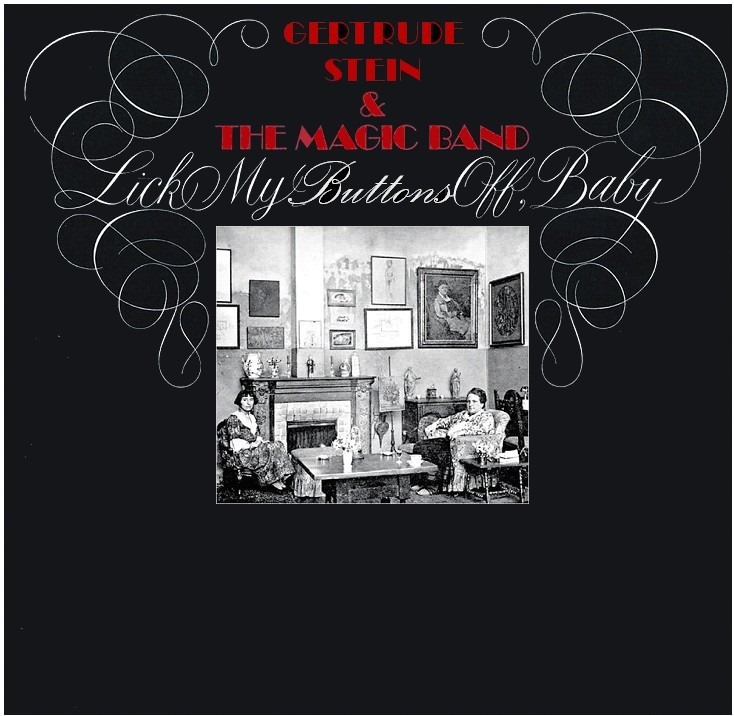
Gertrude Stein Lick My Buttons Off Baby cover

What percentage of my audience knows both who Capt. Beefheart and Gertrude Stein are?

 
Today’s piece uses the words of that poet, Gertrude Stein, from her 1914 collection “Tender Buttons.”  Even within the Modernists of her time, it was controversial, and it remains so today. Stein didn’t shock with her imagery like some of the provocative work of Dada and Surrealism. The radically condensed poems of the Imagists sometimes raised concerns that anything so seemingly simple and without the decorative rigmarole of 18th and 19th Century poetry couldn’t really be worthwhile art, but the Stein of “Tender Buttons”  was even more suspect. The imagists might withhold the complexity behind their shortest poems, but the words themselves were often plain-spoken, comprehendible on an immediate level—too quickly so, in some apprehensions, to be art. Here, the Imagists seemed to say, is the red wheelbarrow, the crowd at the Metro station, the stars above the Clark Street Bridge. I’m not giving you anything more, and you can take in these few words and shrug and say “so what?” for all I care.

Stein went further. In “Tender Buttons”  she wanted to project the messiness of real thought, real glancing perception, sticking to one thing only as repeated words that chorus and then disappear, only to appear a few poems later in the collection, but mostly moving from one atom of perception to another.
 
It’s as if, rather than speech recognition on a modern smartphone, that Stein turned herself into a human “thought recognition” device, registering in words not only the stream of consciousness but a stream of unconsciousness as well.

It’s as if, rather than speech recognition on a modern smartphone, that Stein turned herself into a human “thought recognition” device, registering in words not only the stream of consciousness but a stream of unconsciousness as well.

This is a brave idea, but what emerges from this sounds at first (and for many, at second, and then for as many times as they care to try) like nonsense. The words are plain, at the phrase or sentence level they can even seem to be intelligible, but as a whole, they seem to add up to nothing. Our brains are hard-wired to make patterns out of information, and so confronted with a chunk of “Tender Buttons”  this function may strive to make out coherence until one’s brain hurts, or it may just stop a few lines in and reject it as a failed experiment, perhaps even a fraud.

This is where I think that the Parlando Project’s secret weapon, music, can help. Music may have charms to soothe the savage beast of “I need to understand how these words fit together right now; and if I cannot, I will withhold my listening participation immediately.”

Musically I have put these two pieces from “Tender Buttons:” “Glazed Glitter”  and “Suppose an Eyes,”  against music from my memory of Capt. Beefheart, whose work helped me accept fractured non-narratives even while (perhaps because?) his were set against similarly fractured music. Alas, I lack the ability to emulate the timbre of Beefheart/Don Van Vliet’s voice as I declaim Stein’s words, but I assure you I’m hearing Don Van Vliet’s (or perhaps Kevin Coyne’s) voice in my mind as this piece nears it’s conclusion with the chant of “Little sales ladies, little sales ladies, little saddles of mutton, little sales of leather…”  The Parlando Project has always promised to surprise you with the variety of what we present, but we cannot promise you immediate delight all the time. If you like this piece combining two uncompromising artists, be sure to share us with the social media buttons you should see, and if you don’t like it, check out the other pieces already here or to come, as we use other types of music and other sets of words.

To hear “Two from Tender Buttons,”  use the player below.
Love Is Enough

I drove to Des Moines Iowa this past weekend for a wedding of a niece. The reception was in a tap room attached to a small indie brewery. My 12-year-old son asked “Why is it in a brewery?”

I asked my son if he knew what a hipster was. “Yes, it’s someone who always needs to have the latest iPhone the day it is released.” My son likes to remind me that he is not  a millennial, and that he will have no truck with their ways.

I laughed and said that it’s more than that though. I tried my best to explain, doing badly, as I usually do when speaking. What I was aiming to say was that hipsters are interested in things that are different and off-beat, that in doing so they often revive things from the past and redo them in the now different context of the present. This kind of rebellion against the too-ordinary incumbent culture eventually changes the culture, remaking cities and what they offer. “When I was a kid and went to Des Moines, there were no small breweries serving their own beer, or restaurants that serve those Asian noodles like you like. Instead I’d get to go to Bishop’s Cafeteria.”

“What did you like about Bishop’s?” my wife asked.

“I liked that you could choose your own desert. Usually something with whipped cream on top.”

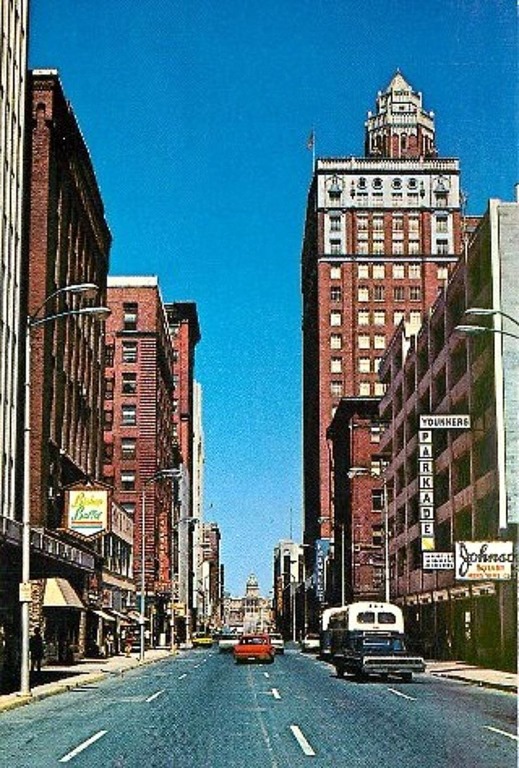
Des Moines Early 60s

News from Nowhere: Des Moines dreams of hipsters to come. Shop at Younkers, eat at Bishop’s.

Now that isn’t a complete explanation of what a hipster is either. Nor does it tell how hipsters are seen and labeled by others, or that to call someone a hipster generally has a negative connotation. If you want a hyper-precise definition with lots of reasons to be wary of being called a hipster you can read one here.

Every cultural change movement like this gets made fun of, and provides lots of rich examples of foolishness. And unlike frankly political change movements which often generate mutual veneration between generations, many cultural rebels see the next generation of young novelty seekers as a bad, devolved outcome; while the young often find and fix their cultural novelty in rejecting the enthusiasms of their immediate predecessors. Can anyone be sure that hipsters are any more or less authentic than punks, hippies, beatniks, or swing era hepcats and so on? I can’t. Is some rampant cultural appropriation going on? Yes, and that has its foolish and even harmful side-effects for all these cultural movements—but are their benefits as well? I believe there are, and anyway, rigidly contained cultural silos seem stifling.

This rejection of immediate predecessors, doesn’t mean an inevitable total rejection of the past. Small breweries were common in America a century ago. Beards, mustaches, fedoras—the clichéd markers of the male hipster, all are revivals of past fashions.

Remember with the Christina Rossetti poem last month. I mentioned her brother Dante Gabriel Rossetti’s boys club “The Pre-Raphaelite Brotherhood?” Formed by art students, they signed their paintings with a “PRB” as secret tag for their movement. They hated the classical art and design standards of their day, and even though they were living in the original Steam Punk era, instead of fetishizing brass, well-oiled gear trains, and leather, they propagated their love for Medieval art and hand-made crafts.

Dante Gabriel Rossetti - Ford Madox Brown 1867

Dante Gabriel Rossetti. Can he interest you in some beard oil?

Sound familiar? The Pre-Raphaelites seem to me to be late 19th Century versions of early 21st Century hipsters. If they were ironically enjoying Midwest beer in a can, would they have signed their paintings “PBR”?

Today’s audio piece is William Morris’ “Love Is Enough.”  Morris was intimately connected with the Pre-Raphaelites. Like them, he was fascinated with Medieval art and culture, but he was a man with many interests—many more than I can touch on this time—including writing influential fantasy and speculative fiction. In that vein, we’re going to time-travel the Englishman William Morris like we did with Americans Walt Whitman and Emily Dickinson, so that this 19th century poet can sing a nugget of garage band blues with the LYL Band.

Watts painting of William Morris

William Morris fading into the wallpaper. He did just about everything but start a brew pub.

This one is a good song for a wedding and for lovers. To hear “Love Is Enough”  use the player gadget below.

Soul Selector Blues

Sometime around the end of the 19th Century, a century that had seen accelerating change in technology and social order, new artistic movements began to flower on either side of the Atlantic. In the UK the Arts and Crafts movement and the Pre-Raphaelite Brotherhood looked backwards at things that had disappeared or were nearly gone, and revived them within a the new context of their present day. Interest in neglected folk-cultural traditions of nations began to arise. Others looked to new orders: utopianism and socialism. The seeds of what would be called Futurism began to take shape, a worship of the inherent art in technology.

Here’s a funny thing: all these things mashed-up in the ferment of the times. Some of the artists held to several or even all of these beliefs, participating in more than one of these seemingly different or even opposed movements. Call this brew “Modernism,” for the one thing that united it was a desire for something new, or at least new for the times, to be produced.

As the 20th Century got underway, American artists forged ahead in these movements. The reasons for that are multifold, but one is that they had a head start: Walt Whitman and Emily Dickinson and the Emersonian Transcendentalists had already pioneered distinctly American ways to be modern.

Let’s leave the salons and literary magazines now for a moment. Here’s something else that was happening at the same time, with only spotty distribution beyond its creators. Some African-Americans, presented with nominal freedom, economic serfdom, social repression, and what must honestly be called a sub-human classification by many learned men, continued to come to terms with European instruments and tempered scales, combining them with the already juicy stew of American music and the remembered modes of Africa. They produced their own Modernism, something that eventually got called “The Blues.”

Lyrically, this was an inherently skeptical art. As it percolated through commerce, the Blues got re-defined as a sad song of loss, and loss certainly is part of its subject matter, but the outlook of the original Blues writers was not simply that. A lot of it was satiric comment, and when the Blues dealt with the desire and farce of love and lust, as it often did, it wasn’t just about loss.

I could go on and on about the Blues, but for the moment, I’ll ask you to just absorb this: when William Butler Yeats was having a harp built to chant his poems to, as he believed the Celtic griots of old had done; and when Ezra Pound, Robert Frost, HD, Amy Lowell, William Carlos Williams, Gertrude Stein or T.S. Eliot were inventing their strain of Modernist poetry, often abroad, some other Americans were back in the States retuning guitars and looking for the notes between the keys of the piano with their own poetry that sought to “make it new.”

Emily Dickinson is a special case in so many ways, but one of those ways is that although she wrote much of work during the Civil War in the middle of the 19th Century, she was only published much later in the century. Her poems, so stripped down, so skeptical of received notions, so vivid in fresh images that didn’t map easily to conventional meaning, fit right in with work being written 50 years later by the Modernists.

Emily Dickinson Uncrowned Queen of the Blues 2

Warning: time travel plots often are ridiculous.


Today’s episode “Soul Selector Blues”  takes this time travel one step further. What if Emily Dickinson was a serf on the Dockery Plantation in Mississippi early in the 20th Century? Maybe she’d tune a guitar to “Spanish” and grab a slide to get those in-between notes, and then what would have been “The Soul Selects Her Own Society”  would come out like this.

To hear the LYL Band cover “Delta Amherst” Emily D’s classic 78 r.p.m. side “Soul Selector Blues” use the player below.


Boris Pasternak’s February

A couple of posts back I mentioned that we’d meet Yeats “rook-delighting heaven” again as we visit some more expressions of the month of February. Well, here’s one, Boris Pasternak’s “February.”

Coincidently, it appears that Pasternak wrote his “February” within a few months one way or another of Yeats’ “A Cold Heaven.” And both poets put ravens in these poems, though Yeats’ crows show up early, and Pasternak’s drop in near the end.  Though Yeats wrote his “A Cold Heaven”  in more temperate Ireland, it resonated with a Northern Midwesterner like me with its burning ice and unwarming sun. Pasternak, presumably familiar with a colder climate more like my own, sets the thermostat on his February to an early spring melt; but this is a muddy, sodden spring. His black spring holds cold rains, mud, and slush—more like a real early spring than a happy-butterflies-and-wildflowers May spring.

Young Boris Pasternak

Bluesman?


I’m not fluent in Russian, but the challenge of translating this lyrical poem from Russian to English has attracted many. As I recall, when I tried to put together the text for this performance, I used several of those as gloss, tempered with Internet translator apps fed the Russian. I know nothing of Russian diction, so I aimed for an informal American diction, and unlike some translators, I didn’t try to keep the original poem’s rhyme scheme in English—after all, I knew I’d be supplying music for this.

I believe the music I choose here, bluesy rock’n’roll, while American, is fitting. I hear Pasternak here singing the Russian Blues: blues like unto our great American music of endurance, and rock’n’roll that cares only to seek the state he speaks of in the last two lines:

The more haphazard, the more true, the poetry that sobs its heart out.

So I’ll be putting this post up, and then I’ll go out in our haphazard too-early spring February myself. I too will head out past the noise of city church bells, past the cars, biking to the edge of my city where I’m going to buy George Saunders sad new novel.

Renee Self Portrait in Mirror cropped

Today’s episode is dedicated Renee Robbins, who once was lost on the edge of Moscow herself, the last passenger remaining at the end of a bus route. She found her way back long enough for us to know her.

To hear the LYL Band perform Boris Pasternak’s “February” use the player that appears below.

To A Locomotive In Winter

A few years back there was a little Internet brouhaha about a woman who looked like she was talking on a cell phone as she was filmed walking down a street in 1928. “Proof of time travel?” asked the rhetorical askers “In 1928 there’d be no cell phones for 50 years, so she has to be from the future.”

time-traveler-cell-phone
About time we get cracking on Bluetooth don’t you think?

We’ve been talking here recently about Ralph Waldo Emerson, Emily Dickinson, and Walt Whitman, three 19th century Americans. As far as we know, none of them used cell phones, and their considerable accomplishments may have been easier insomuch as they didn’t have to worry about PokéStop locations. But maybe they were time-travelers none-the-less?

One of the remarkable things about Emily Dickinson was that she seemed to be writing 20th Century poetry in the middle of the 19th Century. Oh sure, skeptics will say, she was a genius, and through her genius became influential to later writers. Typical debunkers!

Walt Whitman too, often seems a prophet and precursor of a new age, but maybe he wasn’t a prophet? Maybe he was just reporting from the future, and he knew all his bets were sure things. How else can you explain Whitman’s podcast on gender equality streamed here?

Today’s piece, Whitman’s To a Locomotive In Winter, was written sometime between 1874 and 1876, but it reads like a “Futurist” poem written 40 years later. The early 20th Century Futurists embraced technology and sought to bring it into the arts. Poems, paintings, sculpture and musical works celebrating bicycles, airplanes, motor cars and trains were their stock in trade. Was Whitman a time traveler from 1914 who had read the Futurist Manifesto?

futurism_meccanica_pannaggi_speeding_train

Thee for my recitative!

Another American who paid attention to the Futurists (besides time-traveler Walt Whitman) was George Antheil, a composer, who by the 1920’s was trying to engineer machines to make music. He had this idea that he could realize a musical composition by syncing more than one player piano together so that an even greater mechanized noise could be exactly made. By the 1940s, perhaps after hearing Whitman’s podcast on women’s strength, he was in Hollywood and hooked up with actress Hedy Lamarr—no, that kind of hook up. You see Hedy had this idea for a radio-guided torpedo. One problem: if you used radio to guide it, you could use radio to jam it. What if the control signals could use random radio frequencies Lamarr wondered? How would the controller and torpedo stay in sync? Antheil had the solution, the same thing you used to control player pianos: a roll of punched tape. The tape would tell the radios to switch frequencies in perfect time with each other. You couldn’t jam that jam because the radio frequency could hop at some sick number of beats per minute.

George Antheil with machines

Maybe I should have just developed MIDI instead?


Antheil and Lamarr tried to interest the US War Department on this. Those square faces listened to this idea of randomization and said “No dice!”

hedy lamarr

Not interested in my remote-controlled, frequency hoping torpedo? Can I tell you I invented Fizzies too?


Antheil and Lamarr patented their idea, but after rejection no one cared. Then decades later folks are trying to setup CDMA, the core technology for cell phone transmission. The engineers dig up that patent in a pre-existing-art search—or were Lamarr and Antheil time travelers who had been reading the cell phone engineers’ PowerPoint decks? Maybe that woman in the 1928 street scene is the elderly Hedy talking on a cell phone with Walt Whitman?

So back to Whitman then, and To A Locomotive in Winter, and to time travel. In this piece, Whitman time travels forward to 1956, to Chess studios in Chicago. Earl Phillips kicks off the loping beat. Hubert Sumlin, Willie Dixon and Hosea Lee Kennard fall in. The band is playing a drone their bandleader had heard Charlie Patton play back around World War I, but the bandleader is letting this strange traveler, this gray bearded old white man who says he’s from the over-soul, from the Emersonian universal mind. The bandleader has had to deal with racism for almost half the 20th Century, has had to figure that out as a practical matter, he’s seen enough to not ever be surprised. Walt Whitman steps to the mic…

Walt-Whitman-001

No sweetness debonair of tearful harp or glib piano thine


You’ll need to click on the gadget below to hear the LYL Band portray that that event.


Slim Harpo Marx

Let’s a take a break from Whitman’s attempt to embody everything in his poetry and turn to a Dave Moore written piece where two Americans become one.  Dave might comment here later and bring more insight into his composition, but for now I’ll speak as myself.

I encountered Slim Harpo and Harpo Marx at roughly the same time, somewhere in the early 1960s. Slim Harpo then was a part-time bluesman (full time job: ran a trucking company) who was able to occasionally get records saturated with a humid southern feel onto pop charts where I could hear them.

I was young, and I knew little about where music came from. I also knew little about how it could be separated out into bins with labels stuck on the front of them, like “blues.” So, I didn’t know Slim Harpo was “blues” until sometime later. I’d never heard Muddy Waters, Howlin’ Wolf, Robert Johnson, BB King, Memphis Minnie, Bo Carter, or even any of the jazz-tinged blues divas like Bessie Smith—but I had heard Slim Harpo. He was right there on the Midwestern teenage radio in the early Sixties, just like Bobby Vee or the Shirelles. After dark, when the lone local teenage station would fade out by law to allow “clear channel” stations to bounce off the stars and the wire I’d run out my window to an apple tree, I’d hear KOMA in Oklahoma and WLS in Chicago spin records as late I could stay up.

Harpo Marx and the Marx Brothers came in via another late-night broadcasting practice: the late movie. TV stations then would run old movies at the end of their broadcast day, after the local news. The Marx Brothers movies were only around 30 years old at the time, but they seemed set in another century. In the Marx Brothers movie-world fresh off the boat European immigrants mixed it up with society matriarchs dressed like empresses, and leather helmeted varsity football players and professors in Victorian beards were collaged together.

Which was farther away: the Marx Brothers 1930s or Slim Harpo’s Jim Crow Louisiana happening in my time?

Somehow it didn’t matter that Slim Harpo was a near 40-year-old Louisiana African-American, or that the Marx Brothers were steeped in a disappeared immigrant vaudeville culture, or that either of them were ambassadors from the country of adult sexuality that I had yet to visit.

Did a poem ever speak to you before you could understand it? At night, Harpo Marx and Slim Harpo spoke to me, and neither exactly needed words to say what I heard.

Dave Moore’s piece “Slim Harpo Marx” fuses those two characters. Let me be clear, I realize this is a dangerous melding. In the course of “Slim Harpo Marx” an Ashkenazi German-American imitating a mute Irishman becomes one with an African-American born into a region retaining French colonial overtones. Is that harp Celtic, or a Germanic Hohner harmonica, a “Mississippi Saxophone?” Dave thinks that’s funny. If cultural appropriation is evil, well…

As Americans, we largely came here from pogroms, poverty, thwarted revolutions, and refused authority. Those here first from Europe got to rob the native peoples—and worse. Those here first got to declare the foundational republic of the modern world—and establish an economy buttressed with human slavery. Those here later got to both benefit from the appropriations of these tragedies—and suffer the disapprovals of those who were here sooner. That lesser Marx brother, Karl Marx, said “History repeats itself, first as tragedy, second as farce.”

Karl, Karl, you say that like it’s a bad thing.

Harpism Cover

The words and music this time are by Dave Moore. He usually performs the words too, but for reasons to embarrassing to recount, this version has my reading. To hear “Sim Harpo Marx” click on the gadget that will appear below.

Blues Summit in Chicago 1974

Let’s continue for a one more episode on the theme of the musician, but since here in the Parlando project we believe music and poetry to be naturally joined, let us go there though a poet.

Decades ago, in a small Midwestern classroom, a teacher wrote on the chalkboard “It is better to read (or study) Homer than to be Homer.” I do not remember the teacher’s name. I do not remember who was the author of this epigram–though I have vague memories that the teacher wrote that down too—and no amount of modern web searches have ever been able to give me the source of it. But except for that one ambiguous word (“read” or “study”) I have never forgotten that line. Perhaps what helped me remember the line is the teacher gave us no context. I simply encountered what they had written on the blackboard.

Though I’m going to violate that impact here in regards to that epigram, I endorse it with the Parlando project’s audio and podcast element, where the audio pieces are meant to stand alone without resume or external authority. None-the less, if any readers here do know where the Homer epigram I remember came from, I’d like to know.

What I took that line to mean is not just that the life of an artist may be difficult or cursed by troubles; but the revelation, emotional resonance, and sensuousness of art when it is experienced, can easily be greater than the costs of its creation. Greater for even one reader. Greater than the author’s own understanding of that which is so close to them that they may not see all its sides and size.

So here’s a meditation on that idea. I wrote it after watching a re-broadcast of the initial episode of PBS television’s Soundstage which shares this piece’s title. I believe the producers of the TV show wanted to reproduce a somewhat similar gathering of older and younger blues musicians that resulted in an excellent LP called Fathers and Sons recorded in 1969. Musically, what they captured wasn’t at that record’s level alas, but it was well-filmed and that alone makes it worth watching, for there are small, moving, privileged moments between the musicians captured on camera. About halfway through watching it myself, I found myself noting that almost every musician on that stage is now dead, and it didn’t matter if they were the younger generation or the old guard. Some of the old guard outlived the young guns.

That’s part of the nature of a working musician’s life: there may not be a full measure of it.

And then I looked at the close-in audience filmed at the same time. Since they were my contemporaries I felt I could see through the period clothes and hair styles and make some rough but fairly accurate estimate of their class membership and likely demographic future.

Let’s just narrow our focus to one musician. If you could step back in time, would you ask Michael Bloomfield if it was worth it? “Hey Mike, I’m from the future and I know you’re going to die at 37. Would you rather have stayed in college now knowing that?”  How complex that question is for just that one instance, and equally complex in different ways for each of the musicians on that stage. I suspect some days they’d say “yes” and some days “no”—and much of the time they’d say (in so many words) that your question was beside the point.
 
Now ask yourself:  would you rather Mike Bloomfield had a longer life or you had recordings like Highway 61 Revisited, Super Session, or East/West to listen to? Assuming you weren’t Mike’s friend or relative, and that you know and have experienced his art, then honestly your answer is likely: you’d take the records.

And those college students in the bleachers? Maybe some of them became doctors, nurses, teachers, faithful and helpful friends. Maybe one day one of them will write something on a chalkboard like that epigram I read decades ago, and I will not be able to remember their name.

So to play The LYL Band performing  my piece “Blues Summit in Chicago 1974” click on the gadget below.

As August Empties

In the prairie states of the US, we have come to the season of schools supplies and state fairs. All around the country, the weeks and days that students only lived during the summer now cannot escape becoming a countdown to the school-year.

It’s been decades since I’ve been pinched between the rollers of that calender, but August and September still hold some sense of a time to begin things before something ends or because something else is beginning. That’s one reason this project has been launched this month.

Nearly 50 years ago I met Dave Moore, the chief collaborator in this project, one September. 60 years ago, Frank Zappa met Don Van Vliet, who later performed as Captain Beefheart. 40 years ago, my late wife met the teacher Phil Dacey.

Across the country this fall, people are going to be meeting folks who will alter their lives. You may know or not know that as you meet them. Most likely you will be somewhere between knowing and not knowing—that’s the way our lives are—but what comes from those meetings depends on what you do.
“As August Empties” imagines that middle meeting, when two high school students made common cause over some old blues and R&B songs. Dave Moore plays the keyboard part.

I’ve always appreciated Don Van Vliet/Capt. Beefheart as an artist, but Frank Zappa became a model for me on how to be an artist after a brief meeting in 1970. I had other artists I emulated before that meeting, but I had not met them. For example, I admired William Blake for his visionary imagination and his stubbornness—but I did not yet know the full extent of his self-sufficiency. The William Blake I would have imagined in my youth would have been out there conversing with the angels he found waving in the boughs of trees. I didn’t yet know Blake the painstaking and inventive engraver, the man whose impoverished household none-the-less contained a printing press. Frank Zappa would have laughed himself silly thinking of anyone conversing with angel/trees, but Zappa and Blake honed the desire and skills to take the ideas they had and make them into things. Through a happy coincidence, Frank Zappa was able to be generous to me in showing a little of the making of things.

It’s a mistake to think that creative people are the people who come up with great ideas. No, creative people are the people who make things.

So hop into your Oldsmobile, cruise somewhere with an Internet connection, and then click on the gadget below to hear “As August Empties” coming out of your dashboard.