Before the Snow

Long time readers know that the Parlando Project is largely about our encounters with other people’s words – usually their literary poetry. Poetry, even impersonal or hermetic poetry, is a rich way to transfer experience between consciousnesses. Poetry’s strengths in this transference over memoir, blog post, or informal conversation are largely the strengths of focused beauty – that thing that attracts us even before knowledge, expressed as sound or by novel connections.

Still, these beautiful elements of poetry come with costs, which is why many, most of the time, prefer other modes. Yet, I think the shortness and the compressed incidents of lyric poetry offer a possible compromise. We’re asked to share a little burden, a few minutes of reading or listening, subconsciously absorbing the word-music and linkages, which may in leisure or with mood be extended by re-reading and re-thinking such a small number of lines.

One of the things that caused me to begin this Parlando Project was thinking that a short musical accompaniment might add pleasures to possible serial re-encounters with the words. Is this so? I’m not sure, though I persist in doing this.*

That preamble out of the way, I’m going to look like I’m violating the “Other People’s Stories” maxim that is a principle of this Project, because I’m presenting today words I wrote to go with the music I compose and record – but hold on, I’m going to tell you this is still about a poetic transference across a gap.

Here’s why: once again I’ve been running into things from decades ago as I do my “death cleaning” reduction in things stored away or unlikely to be of foreseeable use. Just last week I moved aside a drum set that had been played by Dean Seal when he was in the LYL Band,** and found under the bass drum a plastic carryall tub with things hurriedly packed up after some gig: a Radio Shack battery-powered mixer, cables, a guitar strap, a cassette recorder, and a few tambourines we’d hand out for audience participation. And more spiral, college-ruled notebooks have come to light. Glancing through one I found a page with 9, untitled, lines – the start of a poem. From the style of the poetry in the fragment I think it’s from the 1990s, but it might be earlier or later. It caught my attention because it seemed to be talking about November in Minnesota in that interval right before the first snows come.

I remember nothing about writing this poem, or what prompted it, but it had some nice word-music and was roughly pentameter. That pentameter made me think I was writing a sonnet, and for some reason left off at this incomplete draft. That night, before bed, with my aching muscles and joints from twisting, bending, and hauling I decided to complete a full 14-line draft.
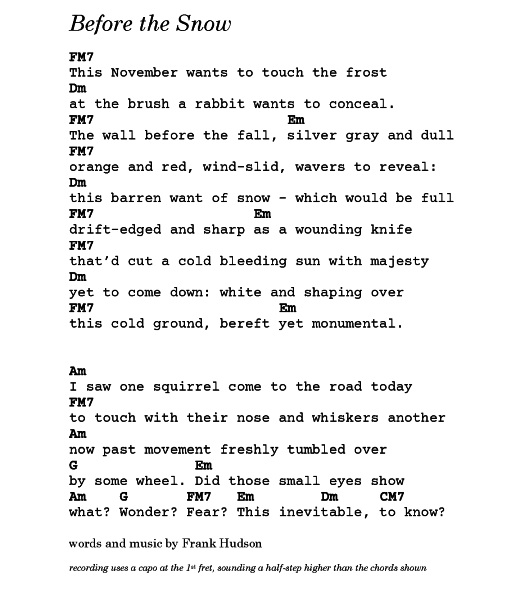
Before the Snow

More musical perversity: the difficulty in finding times to record acoustic guitar with sensitive mics in the past year or so has increased the number pieces I’ve done with that instrument.

.

For the final 5 lines I used an incident from a recent bike ride. Rolling down to a favorite breakfast destination at the borders of my wooded city I’m usually met with a rewarding bit of wildlife (outside of deep winter): constant squirrels, rabbits, small rodents, birds, including waterfowl by a pond and creek I pass, insistent crows, and so forth. If Keats wrote his “Ode to Autumn”  on Hampstead Heath in the Highgate section of the city of London, these near-daily rides of mine with this contrasting nature in the midst of modest single-family houses and parkland is my equivalent. What I saw this day was a little epiphany – a squirrel had been quite recently struck down crossing the road. Not smack dab run over, for it was not squashed, and there was only a little blood – yet it was clearly not moving or breathing, and even from the height of my bicycle its eyes could be seen fixed and dead. And then, as I was approaching, carelessly another squirrel scampered out onto the road and up to the corpse. Though I was riding onward, and only slowed a bit moving to the side, this squirrel bent down right to the head of the dead one, close enough to touch it barely with whiskers, clearly looking closely at it, for a moment regardless of my vehicular approach.

And then, just as I was beside them, it scattered off, missing by accident or close design, my slowed, but rolling, bike wheels. What was that squirrel after, what was it thinking in those few seconds with the dead one? This  was the matter to finish the poem that had started years ago with a rabbit finding scarcely-leaved autumn bush and brush to hide in. And I too had had my customary Parlando encounter without firm context, working with the part of the poem written by someone I hadn’t seen for decades: though in this case, it was my younger self. Not really that different from the usual encounters here with Frost, Dickinson, Sandburg, Millay, Stevens, Hardy, et al.

I originally gave the resulting sonnet the title “Before the Rapture of Snow,”  because I thought that tied-in the rabbit’s anxious waiting and the dead squirrel. I drew back from that thinking it too grand a reach, and because the theological implications of “rapture” would repel, puzzle, or draw in too-determinant reactions.

I was lucky enough to have a Monday to record this, finishing what felt like a good take of the vocals and acoustic guitar just before I had to leave my studio space. I added piano yesterday and mixed the tracks. As a non-pianist I’ve fallen into using that instrument simplistically as I do here, and I’ve grown fond of how these pounded single notes mesh with the timbre of acoustic guitar. You can hear “Before the Snow”  with the audio player below. Has the player been raptured up to heaven? No, it’s just that some ways of reading this blog suppress displaying such a thing, so I provide this highlighted link that will open a new tab with its own audio player.

.

*Besides my lack of talents for promotion, I sometimes feel what I do with this Project presents a number of detriments to gathering an Internet-scale audience. Poetry, as I write above, is not something sought out by modern Americans in great numbers. And then the music I make suffers from these things that reduce audience interest: I’m not a singer with a beautiful voice, nor do I think of myself as a performer with charisma or erotic appeal, and the music I make despite that is both too varied and too limited.

Many potential listeners or readers, presented with an infinite library of options in our modern age, will avoid things that have but one of those strikes against it – and to add another one or two against the Parlando work wouldn’t be rare either.

All this isn’t breast-beating or humble-brag, and I’m even hesitant to waste your time writing this. I am proud of much of the work I’ve done over the last decade here. While my audience is Internet-small, I believe it’s not all that small by poetry standards, and increasingly, not completely outsized by the audience for much non-Pop Indie music. Thanks to my hardy listeners!

**Dean was working elsewhere in comedy, and with at least one other partner in music, when he played in the LYL Band in the 1980s. He was talented and creative, we were looking for a drummer or bass player, and we perversely came upon him as both – unconcerned with the challenges of one person filling both roles! He may have grown to think of us as less professional or ambitious than he was, I don’t know, or events of his life may have intervened, but for reasons unknown to me we just stopped playing together – but this happened without him picking up the small drum set he played with us, and stored at my place. While working on my cleanout this fall I briefly tried to find contact info for Dean to see about the drums, but the trail ran cold after finding articles about him being part of the pastoral lineup at a church that no longer listed him on staff.

The Pumpkin

Last time I was musically blasting your ears with twin electric guitars, bass, drums, and keyboards as I commemorated the snark of the early Internet’s “flame wars.” Today’s piece combines – just in time for American Thanksgiving – a quiet nylon string “classical” guitar, and a 19th century poetic ode to pumpkin pie.

The words I sang were written by John Greenleaf Whittier, one of a circle of New England worthies who were grouped as the Fireside Poets. Back in my parents or grandparent’s time the Fireside Poets were as celebrated as pumpkin pie. As a group they took on the job of creating an American poetry written by Americans with American subjects.* Alas, that’s a job that once done, doesn’t inherently demand continued interest, particularly in a country like America that has become a cultural superpower. American poems written by Americans about American subjects are a commonplace thing now.

But to do this was a piece of work in the first part of the 19th century – and in furtherance of this Whittier chose an indigenous American plant for his poem. The pumpkin represents American autumn is so many ways, starteing with jack-o-lanterns in October, as a decorative harvest tote, and for its curtain call, the fruit for pumpkin pie at Thanksgiving. Whittier wrote his ode mentioning all these things, and here’s a link to his entire poem. I read Whittier’s tone as “mock heroic” in his poem, but I chose to make a small song using only his ending, the pumpkin pie part, since I was racing to complete it before American Thanksgiving. Friends of our officially young-adult kid are gathering downstairs tonight to do whatever they will, as I hole up under the slanting roof typing this.

pumpkin pie

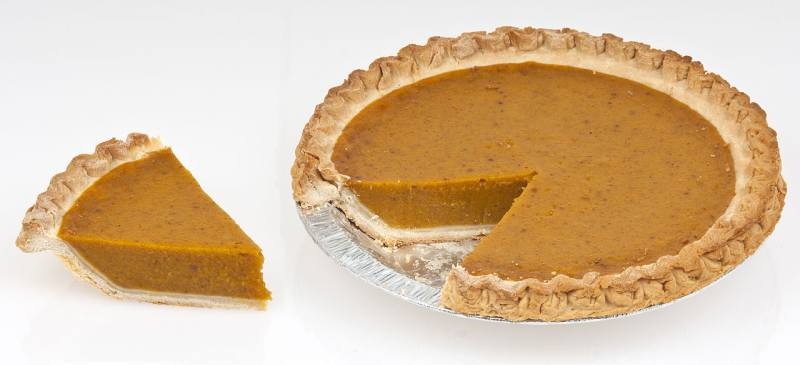
“Fairer hands never wrought at a pastry more fine.” Pumpkin pie picture by Evan-Amos

.

Is it just me, or is there a touch of what my wife calls “comfy gothic” in this passage at the end of Whittier’s poem? The poem starts out addressing the pumpkin plant itself, but as it continues we see it speak to the humans associated with it from childhood to grey-hair-dom. When I have Thanksgiving tomorrow with my little family I’ll have thoughts of everyone distant or dead that made or attended Thanksgiving meals over my life. In the poems final stanza Whittier speaks of, praises, the hands that make the wonderful pumpkin pie, and then as the poem ends, he sings them away with a wish that their final sunset is as orange and lovely as a pumpkin.

There’s an audio player gadget, or should be, below that will let you hear me sing that last stanza of Whittier’s poem. I focused on the simplest and most modest of musical settings for this one, purposeful contrast to the previous musical piece here. If you don’t see the audio player that’s likely because some ways of reading blogs suppress it, so I provide this highlighted link that will open a new tab with its own audio player. Consider that the apple or blueberry pie option to hear this song about pumpkin pie.

.

*Earlier this year when I asked AI to create some protest songs, it defaulted to a musical style stuck somewhere between Bro-Country and Indie Americana. When I needed to make up names for the faux acts I chose Fireside Poets’ names like  “Greenleaf Whittier” for them – because though writing for the page, those Fireside poets were the poetic roots of Americana.

Frost Warnings: an appreciation of the poetry of Phillip Dacey

I mentioned earlier this month that my late wife took creative writing classes with poet Phillip Dacey in the mid-1970s. Later, through her, I met Phil and was able to talk to him a bit about poetry. Phil was generous about this, and I’ve never forgotten that.

It’s always hard to accurately, objectively, analyze where one is in in their writing craft. I knew I was only partway in craft, but I self-judged myself as better than average in the imagination aspect. Looking back at that young man I was then, I’d re-set my judgement now to say I was even less far along in craft than I thought, but I still think my imagination was as good or better than many. Those models that I looked to back then: Blake, Keats, Sandburg, Stevens, and the Surrealists were good enough for starters.

Of course, old men can be wrong when looking at themselves too – presently or retrospectively. I’ve come to consider self-judgment as so unreliable that I treat it as a traveler’s tale: something to listen to, but with a duty of skepticism. If I get time, I might extend this informal series engendered by finding old 1970’s manuscripts packed away in boxes with a few of my youthful poems. If I do, I’ll try to make it worthwhile for you rather than self-indulgence.

This Project takes author’s rights into strong consideration, and you may notice that we almost always perform works in the Public Domain.* As the Parlando Project was starting I learned that Phil Dacey had died. I hadn’t seen him in over a decade at that point, but I contacted his website on hearing the news, and got permission from one of his sons to perform a couple of his poems here. This autumn, while in a dusty boxes clean-out, I came upon a letter from Phil to my late wife dated November 1977, and within the handwritten letter was a typed copy of a poem of his about this time of year.**  I felt I had to perform it for you. Phil’s personal site is no more, and I retain no contact info for the family, but this not just a non-profit – non-revenue – Project would propose that the promotional/educational aspect far outweighs any abrogation of the rights holders. If one wants to seek out and read any of Phillip Dacey’s poetry collections, you’d be following my recommendation. I don’t know if today’s poem made it into a collection (I only have some of Dacey’s many books), but you will find poems like this in them.

This picture of Dacey is from the poetryfoundation.org site. There are some other poems of his linked to a short bio there.

.

The subject matter of Dacey’s poetry when I met him was spread out between memories of his childhood in St. Louis (a city that punches above its weight in modern American poetry), a Roman Catholic upbringing, erotic desire and its complications, and family and marriage. He came into a long-term teaching gig at a rural Minnesota college, and stayed in the state during his retirement; and as a result, the setting for many of his poems is distinctly Midwestern. In my early posts here where I wrote about Phil’s poetry, I stressed the humor in it and the unusually engaging way he presented his work to audiences. Both of those things might endear him to listeners and readers, but I fear they might blind the completely earnest (or the envious) to other strengths in his poetry.***  I don’t know how he taught the craft professorially, but he models for young writers a subtle kind of poetry, and the piece I perform today is an example of that strength.

“Frost Warnings”  begins – and with only casual attention might remain – an occasional poem about the present point in an Upper Midwest autumn. Afternoons remain warm, yet the hours before dawn drop lower and lower until they eventually sink below 0 degrees Centigrade – frost and freezing time for plants. Food gardeners must make their household harvests, flower gardeners, preserve their late bloomers. The poem’s bed sheets with rips and out-worn baby blankets start as reportorial items in a task to stave off frost-burn, but are, if we think again, stealthy deep images of desire and parenthood, the kisses from which we make mankind as Éluard had it our last post.

Then a third of the way in we meet the bedding again, cast as shabby Halloween ghosts. Dacey’s unshowy poetic compression of the worn-life of young parents “too much revelry and worry” is masterful, but might you overlook it on first reading? The modesty of how Dacey uses his craft pleases me – and then he playfully indulges himself by breaking into Wallace-Stevens-voice for the word-a-day-calendar delight of writing down the ridiculous sounding “tatterdemalion.”

On the page it’s also easy to miss the use of rhyme and near-rhyme in this poem: that “revelry” with “worry,” “find” and “vine,” and the comic “jalopy” and “credulity.” Finally, the poem sticks the ending with a rhyme: “Fall” and “mortal.” For at least a while, I think Dacey was associated with “New Formalism” in poetry. “Frost Warnings”  is Formalism unfettered.

I wish I’d spent more time on the music I made for this one. It’s been a busy week or so for me, getting vaccinations, some banking business, attending a large gathering against cruel and capricious authoritarianism, getting my own “garden” of bicycles and composing/recording equipment ready for the upcoming winter. As a result, the music I performed with Phil Dacey’s poem is quite short, and is just a trio. I wanted to add a melody instrument, and strip back or deemphasize the piano part for a guitar, or even a horn or wind instrument part, but that would delay things, and I have a half-a-dozen other pieces in WIP state that also want completion.

Phil was a great performer of his own work. He’d have done a great job presenting this, so I tried to use my memories of him to guide me. I attempted to memorize the poem for the performance (Phil often did poetry readings without “reading”) and I hope I brought out some of the elements in my recording that a quick reader of the page poem might miss. So, it’s done, and you can hear Phillip Dacey’s “Frost Warnings”  with the audio player below. Worried that someone’s taken the audio player away and spread it over last roses in the garden? Don’t wilt, I’ll provide this alternative: a highlighted link that will open a new tab with its own audio player.

.

*Yes, I have bent the rules a few times – and as the Project was beginning, I thought I’d get permission to use more recent poems by sending simple requests, only to find that would too often require prodigious effort and persistence.

**Here my late wife and Dacey were operating like 19th century Emily Dickinson and Thomas Wentworth Higginson well into the 1970s. By the end of the 20th century it’d be emails, and by now, social media or chat software. My dusty boxes and my late wife’s metal box held things for near 50 years, but who knows at what interval current inter-author correspondence-in-effect goes all Library of Alexandria.

***Often humor has a shorter shelf-life and lower canonical trajectory in literature. Using humor, or other approaches which seem to attract a wider audience, can attract a distrust of “mere entertainment.” The argument here, to be fair to detractors, is that such an audience is shallower even if broader, and that “fan-service” audience-pleasers keep an artist from growing and dealing with difficult subjects. My personal belief? Those most difficult subjects are absurd, incongruous, impossible mysteries and dichotomies to solve, and that humor can portray them as well as any other mode.

Phil read a few times with musical backing, as I present him today. One performance I attended was with his sons’ alt-rock band. His “readings,” even if acapella, could have performance elements. He’d weave well-told stories into the poems in such a way that you didn’t always know when the poem had started and explanatory introductory material had ended. He sometimes sang lines when he quoted a song inside a poem. Again, let me concede this sort of thing can be cloying. I’ve heard poetry readers down-rated for an “AmDram (amateur drama) style of presentation, and the “You are hereby sentenced to attend my one-man-show” jokes are easy to make – and that’s sometimes justified. My summary? This can be done badly. Just about all ways of presenting poetry can be done badly.  I thought Phil did it well. Other than talent and attention to his craft (including presentation) one reason it may have worked for Phil was the modest and subtle nature of his poetry that awaited and welcomed being presented more expressively than on the silent page. Still, and unlike some performance-oriented poets, Dacey’s poetry does stand up on the silent page – I just have had the pleasure of seeing it in that other framing.

Michaelmas Day, and a new short video

I’ve got things to do today, but I awoke, thought of this piece from the early days of the Parlando Project, and figured I could make a quick “lyric video” for it. I don’t know how many get introduced to the things the Parlando Project does via videos, but I’m always looking to find new listeners to these musical combinations with various words (mostly other people’s literary poetry).

This one is unusual in that I use one of my own poems for the text. Long time readers here will know that one of our mottos is “Other People’s Stories.” It pleases me to generally make these pieces with other poets’ words.

When the Year Grows Old

Here in Minnesota, the weather is turning, as it does at a time of its choosing in the Fall. Tomorrow morning the Fahrenheit temperature will be in the teens when I get up, and the forecast says single digits will greet me by Friday.

I began work on setting this poem by Edna St. Vincent Millay last week after seeing it at the Byron’s Muse blog. Two things grabbed me when I saw it: sitting there as silent words it begs to be sung, and it’s tantalizingly ambiguous.

This poem was from Millay’s first collection, published (1917) as Modernism was starting to find an audience in America. Americans in the last decade to be called The Twenties saw Millay as a Modern, though her prosody wasn’t like the free-versifiers, and her lyric’s narratives weren’t fragmented word-Cubism. So, a more comfortable Modernist to those whose expectations of poetry still flowed from the 19th century? Somewhat. Still, though not so much in her first book, but soon, Millay began to stand for The New Woman, a character that took up the prerogatives of independent thought, act, and agency in love and desire. A William Carlos Williams might have absorbed radical Modernist visions in Modern Art into prosody. A Carl Sandburg may have taken his Imagist eye and cast it toward workers and immigrants in his poems. But soon after this poem, Millay was using somewhat traditional verse to speak about female independence in life and desire. Cubism and Socialism were controversial, sure, but the kind of change Millay was covering in her poems was large in scope. Man Ray or Monet, Debs or Debussy, Pound or Reverdy — change was in the air — but as far as art such as poetry was concerned, the charge for change from women (and Afro-American artists) in the Last Twenties is a big deal, not something to shelve off as some sideline.

OK, so what does this early poem have to do with that? I’m not entirely certain. Yes, the overall scene of the poem is clear to any Northerner — but even as the poem starts the seemingly simple language has faceted surfaces. The poem is titled “When the Year Grows Old,”  but I’d suspect you might mistakenly remember it as “When the Year Grows Cold.”  It’s not just the rhyme, the poem is clearly about the weather getting colder, all the images intensify that. Intensities of anything old are not there directly at all. And then, I can’t say how idiomatic the opening statement (refrained at the end,) “I cannot but remember,” would be in 1917 — but it’s easy to read it (out loud, or in understanding) more than one way: “I will reflexively remember,” “I have only memory of this,” or even “I can’t do this, but I am forced to remember.”

And who’s the “she” in this poem? I had a thought in early-days with the poem it might be a pet, likely a housecat. Beside a generalized factor of love for warmth, cat owners might recognize the bird watching vocalizations — that, and a reference to “the warmth of fur” led me to that consideration. One reader’s reaction I read online this week thought “she” was a mother. I’m not sure of Millay’s mother’s (if that would be the mother here) characteristic feelings for tending a fire or even the specific kitchen task of making tea. My cursory non-scholarly thoughts are: not likely her happy place.*  Still, I could imagine that a general poetry reader in 1917 (like the Internet contemporary I came upon this week) could think that, or that the “she” is a friend of the poem’s speaker (which we might expect to be Millay), and so find this poem Millay’s predecessor to something like the young old Bob Dylan writing “Bob Dylan’s Dream”  about his remembering lost friends who’d once gather around a wood stove.

When the Year Grows Old

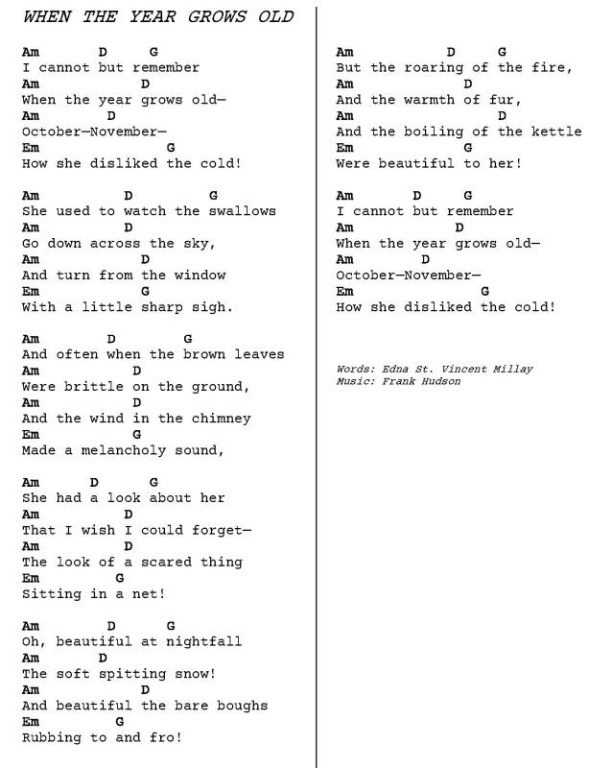
Simple chords for today’s piece, presented here as chord sheet  in case you’d like to sing it too.

.

Living with this poem as I set it to music and performed it, I came to think of it more at “Girl from the North Country” — a song about a lover who is longingly thought of lovingly, but who is now separated. By the time of the performance that you can hear below, that was how I was singing it. Why did I think that?

Partly from reading later Millay poetry, partly in biographic clues of Millay’s sexuality. There’s a definite undercurrent in the poem of the “she” feeling ambivalent: the sighing look at the flying birds, the melancholy chimney wind, and most directly in the abrupt “look of a scared thing/sitting in a net!” And what follows that line feels lustily sensual to me: those rubbing “bare boughs,” that fur by the fire verse.

That reading also answers the why the year being “old” is the title, not “cold,” other than just seeking variety. A once passionate attachment has been reconsidered by the other party, has grown old/cold.

Millay could have made other meanings (“cat lady,” “dear old mom.” etc,) clear with no commercial readership risks, but following my understanding, this presentation is coded so those who know will see that, and others will see a vaguer poem while recognizing late autumn weather. If I’ve misread it, or if Millay ever explained what she was intending — well, it wouldn’t be the first time — but it worked for me to find an experiential place to inhabit the poem.

You can hear my performance of Edna St. Vincent Millay’s “When the Year Grows Old”  with the audio player gadget below. No gadget? It’s nothing personal, just that some ways of viewing this blog suppress that. This highlighted link will open a new tab with its own audio player.

.

*As poetic testimony: tender as Robert Hayden’s well-loved poem “Those Winter Sundays”  is, it’s not a story of a parent finding happy beauty in loading up a household’s fire box.

To Waken an Old Lady

It’s National Election Day in the United States, and it’s seen as an extraordinary consequential election. Amid that great matter, I fielded a clutch of social media queries on poetry and music in the last 24 hours or so. I think I understand this seeming paradox. Though I myself will likely stay up late tonight listening to returns — as it is after voting early in the morning, I’m expecting to have only the maelstrom of worrying and hoping to spend over the rest of this national event tonight.

But since I last left my listeners at the end of October with an atypical audio piece, I thought it’d be a good day to release this performance by the LYL Band of a poem by the American early Modernist poet William Carlos Williams. That’s what we usually do here: take other folk’s literary poetry never meant to be sung and combine it with original music in differing styles.

What’s my personal history with Williams? Oddly,* my introduction to Williams was in the guise of his printed introduction of Allen Ginsburg to me (and many) in the thin City Lights paperback Howl and Other Poems.  Williams’ name was printed right on the cover of Howl,  and while in a smaller font than Ginsberg’s, it’s not fine print either. They must have thought it would help.

Howl Cover

Published November 1st, 1956. Did the choice between Eisenhower and Stevenson seem quite so existential?

.

As a young man I don’t think I absorbed much of what Williams said in his short introduction. I didn’t have the experience of life to fully grasp it, and about all I knew of Williams was that he was an established, a somehow certified, real poet — and the man he was introducing, Ginsberg, was not. At that point, the younger poet had not been elected to such a post by the cultural electoral college, but WCW was vouching for him beyond the matter of a questionable Beatnik fad. As a teenager at the time, what did I know about what made a real poet? I can’t fully remember. I had some romantic ideas about vision, seeing intensely what others couldn’t sense, and some idea that that would likely put the poet in opposition to elements of society. This was not some structured critical philosophy on my part, it was more a gut feeling, a wish for something more. I look back at that kid I was and think: well, maybe I’m still no better a philosopher than he was, though I now know complications — but yeah kid-of-the-past, there’s still something to that.

Williams’ name on the Beat landmark paperback did not lead me to read Williams then. Rereading that introduction today that may have been because while it had words that Ginsberg took as validation, it was somewhat between hands-off and off-hand about Ginsberg’s poetry. He called Ginsberg “disturbed,” recalled that he didn’t think the young man would develop into a poet (or even survive). He characterizes the title poem of the collection, “Howl,”  as a howl of defeat. I adamantly heard it as a howl of survival. So, thanks old man. Glad you at least said we should pay attention, be “arrested” Williams wrote, by Ginsberg’s poetry.

It’s only been in this century that I read Williams early 20th century work. I found a lot to like in his clean spare early poems written as Modernism sought to clear out the tired excesses of decoration. Now as I re-read Williams mid-century introduction to Howl  I’m arrested by things I, an old man, resonate with. He did  see the poem’s survival testimony. He wrote this there about Ginsberg’s poetry:

He proves to us, in spite of the most debasing experiences that life can offer a man,
the spirit of love survives to ennoble our lives if we have the wit and the courage and the faith — and the art! to persist.”

And he continues in the introduction to Howl:

Poets are damned but they are not blind, they see with the eyes of the angels. This poet sees through and all around the horrors he partakes of in the very intimate details of his poem. He avoids nothing but experiences it to the hilt. He contains it. Claims it as his own — and, we believe, laughs at it and has the time and effrontery to love a fellow of his choice and record that love in a well-made poem.”

It seems to me now, from my old age, that to “see with the eyes of angels” may be its own curse, and thus the angels may howl.

Is today’s small William Carlos Williams poem, one turned into a little song sung with the LYL Band, too slight to serve on a night where we look as nations move? I don’t know. I already told you, I’m not much of a philosopher. Williams’ “To Waken an Old Lady”  is a poem that yokes old age and the descent into winter. Here’s a link to the text of the poem if you’d like to follow along.

I now can often feel like the small birds he puts in this poem. In the course of life, I’m here past the days of career or work harvest. In the summer, the summer of this political campaign, I felt the cold dark winds plenty of times. The poem doesn’t say, but I suppose the poem knows spring comes. I suppose also the poem knows that death comes and preempts spring too.

“But what?” Williams interjects as the poem turns. Look: there are these broken seed husks, the ones that didn’t bloom. So what if they are not to bloom, they are sustenance for survival.

You can hear the LYL Band performance of “To Waken an Old Lady”  with the audio player below. Are the returns of an audio player yet to come in?  This highlighted link will open a new tab with its own audio player.

.

*Well maybe not odd for me. If you’ve read many of these posts, you may have recognized that I love the odd connection.

Nature Can Do No More Blues: Combining mysteries with bottleneck slide guitar

I thought I was done with my Emily Dickinson series. I had started to think of what poets would be next, and….

Emily came back.  Not the mystical psychedelic Dickinson. Not the weird indie-folk Dickinson. Oh, still mysterious, still a trickster — but she asked not for unusual harmonies or strange timbres this time. She wanted to Rock!

Well, if you’ve been in a mode lately of working with acoustic guitar, and you want to transition to Rock, then there’s no better way to start than Blues. I grabbed my bottleneck slide and my resonator guitar* and it was time to get down with some rough ‘n’ ready Delta Blues — at least the way I play them.

I didn’t learn how to play slide from some Papa Legba at the crossroads, nor by grizzled tutelage from an in-the-tradition player. I was an Iowa teenager when a white college kid from Minnesota pulled out a severed wine bottle top from his jean-jacket pocket and proceeded to show the results of the guitar lessons he’d had in Minneapolis.**   I recall his technique was not pristine, but the sound including the incidental noises of the slide grinding into the strings and occasionally slapping onto the fretboard entranced me.***  Five years later I finally decided to try to figure out how to play guitar, by myself, living in a little rented travel trailer, and unable to afford any lessons.

We know Emily Dickinson played piano. Did she have lessons her family could have afforded her? Did a family member teach her? I don’t know if we know what kind of music she played, but it may have been hymns and popular parlor pieces that were sold as sheet music. Did the Celtic immigrants in Amherst leak any of their music to her? Was Black American music in her ken, and if so what variety? All mysteries, but it’s unlikely she had any idea of Blues music, because as best as can be determined, it didn’t exist yet. Sometime around the time her poetic writing was tailing off, it seems that Black Americans began mixing the musics they heard around them in North America with the music that survived the slave ships, and lullabies, and work-a-day chants of work-gangs or field laborers. Most were newly freed from enslavement. Commercial entertainment was a newly opened field for them as musicians and as audiences. In this new situation they had a new story to tell.

Extracted as musicological theory, Blues can be expressed in a lot of ways, but my appreciation says it’s an attitude as much or more than a scale, timbre, or harmonic framework. What attitude? The Blues isn’t “the Blues” as Western European derived Americans knew it. It’s not melancholia or simply depression. It’s not elevated Romantic despair. Sad, bad, and difficult things happen in a Blues song, but that’s not the main point: the main points are that the singer is still here, can tell you about it, and has maybe figured out something about what has led to this situation that they’ll share with you.

So, here’s what Emily Dickinson did that was Blues-like. Like the Blues, Dickinson is going to use humor and incongruity to describe her experience. If death is a fact of human existence, she’s going to write its Yelp review telling you about it. She’s going to tell her tales using coded language at times, so as to not rile up those who think she shouldn’t have the thoughts she has — and besides, coded language gives one the paradoxical freedom to choose the strongest, sharpest words.

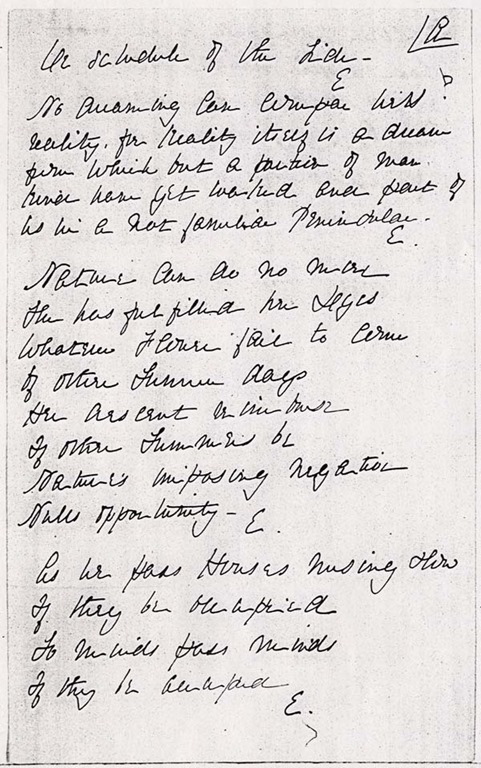
Now the poem I took today is from late in Dickinson’s life, and it’s more puzzling than many of her often puzzling poems. “Nature can do no more” strikes me as an Autumn poem. Here’s all it is, as she wrote it down:

Nature can do no more
She has fulfilled her Dyes
Whatever Flower fail to come
Of other Summer days
Her crescent reimburse
If other Summers be
Nature’s imposing negative
Nulls opportunity —

Nature can do no more in Manuscript

Dickinson’s “Nature can do no more” in manuscript. Above the poem she wrote: No dreaming can compare with reality, for reality itself is a dream from which but a portion of mankind have yet worked and part of us in a not familiar Peninsula.“

This poem expresses itself strangely. “Fulfilled her Dyes?” Floral blooming colors? Autumn leaves? Punning “dies?” The transcribers think she scribed “crescent” but it might be “descent” — but what’s accounts receivable here? “Negative Nulls opportunity?” As the Pythagorean math-lyricist Billy Preston put it “Nothing from nothing leaves nothing.” Or it just clearing the field for new growth? I saw a short presentation on Dickinson poetry this week where the presenter compared Dickinson to Joyce’s tangled Modernist word-play mode. This poem would be an exhibit for that.

But this struck me as Blues-like too. You see, following up on my mid-century, Upper Mississippi white-blues-kid introduction to this old acoustic Blues style, I wanted to hear more of this music performed by its originators, and you did that listening to LPs re-recorded off of worn, made-cheap, second-hand-store shellac 78s, cut fast in any handy room with a single approximated microphone. It’s a powerful sound, but it’s not a pristine and clear sound. And the singers, even if I was in the room — maybe because I was in the room, a white guy like almost all the recordists — aren’t always going to speak out. They’re asking to be heard by other Afro-American listeners perhaps, so their patois and accents aren’t lightened or toned down.

To this day, after years of listening, after much more study of Afro-American history and language, after generations of audio restoration advancements, there aren’t 100% agreed upon transcriptions of lyrics sung and said on all those early 20th century records (and their meaningful context) — “crescent” or “descent” isn’t the half of it.

So mysterious Emily Dickinson, meet Geeshie Wiley.****  What’s “Eagles on the half dollar” have to do with commerce and sex, was it “bolted meal” and flour or flowers?  I was ready to combine the mysteries here — and yes Emily Dickinson, rock a little.

I might have performed Dickinson’s exact words for this piece, but I wanted them to fit into a common Blues music form, and so I was already prepared to modify them. I decided to make words that were more my extrapolation of what I feel she might be saying as she views the null of winter coming on with the knowledge of the cyclical phase of the seasons meaning another summer follows. I tried to mumble the words a bit as I sang them to give it the air of those old slide-guitar Blues records. Here’s what I sang:

Nature can do no more, she has fulfilled her Dyes
Flowers that failed to bloom left for other summer days

The crescent moon decrees, other Summers yet to be
Colors’ slow cremation — nulls for opportunity

Yes, there’s a spoken aside in the middle of the song. I’m not printing that, because the spirit of the old 78s says you have to try to figure it out. You can hear my performance of this “after a poem by Emily Dickinson” song with the audio player you should see below. No player seen? You don’t have to jump the Katy looking for it, you can use this highlighted link that will open a new tab with its own audio player.

.

*The, neck and the body’s outline shape is like a regular acoustic guitar, but the top and interior are replaced with a 10-inch metal speaker cone. This cone is driven to vibrate by the bridge holding the guitar’s strings producing a louder piercing tone that has a directness and can’t-ignore-it volume that Blues players liked.

**The kid’s name was Don Williams, an all-to-common name. If he’s still alive he’d be in his 70s. I’d love to meet him again if only to tell him that for all his pretentions and mine he imprinted my approach to the guitar.

***This is not how everyone plays slide guitar, even Blues slide. Precise touch and technique can produce music with tight intonation that avoids all these artifacts. I just like hearing those artifacts. I love recording piano with key or pedal noise or even a bit of a squeaking bench too.

****I often fear I’m too long-winded when a feeling starts me up. But I’m nothing like what recordings like Geeshie Wiley’s can do to folks whom the muse has touched. Here’s two of them (warning: long form writing)  Daphne A. Brooks. John Jeremiah Sullivan.

Free to Fall

Allow me to be more internal than I usually am when presenting these pieces. Today’s piece uses my own words (we do that rarely here) and it’s here today for a peculiar reason — and peculiar is something I enjoy indulging in.

Early this autumn I was looking for a musical piece that represented the season, and I recalled this poem of mine that I had written music for. When? I probably wrote the poem early this century, and from a file I found, I was able to determine I wrote the music in 2007. Sometime after writing the music, I recorded what I recall was a pretty good version of it, likely with Dave Moore playing keys.

“Maybe I made this one of the early Parlando Project pieces” I thought. At the beginning of this Project as I was figuring out how to compose and record our combinations of original music with literary poetry, I had used several recordings of that vintage. Having some already completed pieces gave me time to get a handle on other tasks while getting this thing going.

But, what, I didn’t know? Well, I’ve put up over 700 publicly accessible pieces in this Project’s lifetime since 2016 — and that doesn’t count the ones that just didn’t work or didn’t fit the concept. One might like to think I keep my eye on every sparrow — but with that amount of catalog, it’s not fully accessible in my head. So, I looked. Here. For my own work.

Nope. I hadn’t presented it. It might not have made the cut because I wrote the words, and the Parlando Project is about other people’s words. Where else might it be? I looked in my somewhat disorganized collection of sessions and finished non-public pieces. Nope, not found there either.

My solution then was to re-record it. Recording time has been hard to come by lately, but I remembered this poem-which-became-song as being effective, so I tried to have it ready when I could open my microphone and record.

The piece is called “Free To Fall.”  As I wrote at the start of this inward story, I said I remembered it as being an interesting variation on the poetic perennial of autumn. In the first verse I already hit the falling leaves motif (can that one be escaped?) and I think the “every tree grows tall” was me referencing the British folk song “The Trees They Do Grow High.”   I continued to try to bring some longstanding tropes into this brief song: my own restatement of François Villon’s “Mais où sont les neiges d’antan*” starts off the second verse. I think the lines “Old men carry winters/in which the children play” are my own, but like my memory of where I put this song’s older recording, who knows if I just don’t recall some inspiration or reference.

The third verse’s reversion to summer memories and grief may be influenced by what I consider to be one of the great autumn songs, one found in every fakebook: Joseph Kosma/Jacques Prévert/Johnny Mercer’s “Autumn Leaves.**”  That song too begins with falling leaves, but references a summer lover now gone. Having lost my late wife in August might have made sure I made that step back in memory in the song.

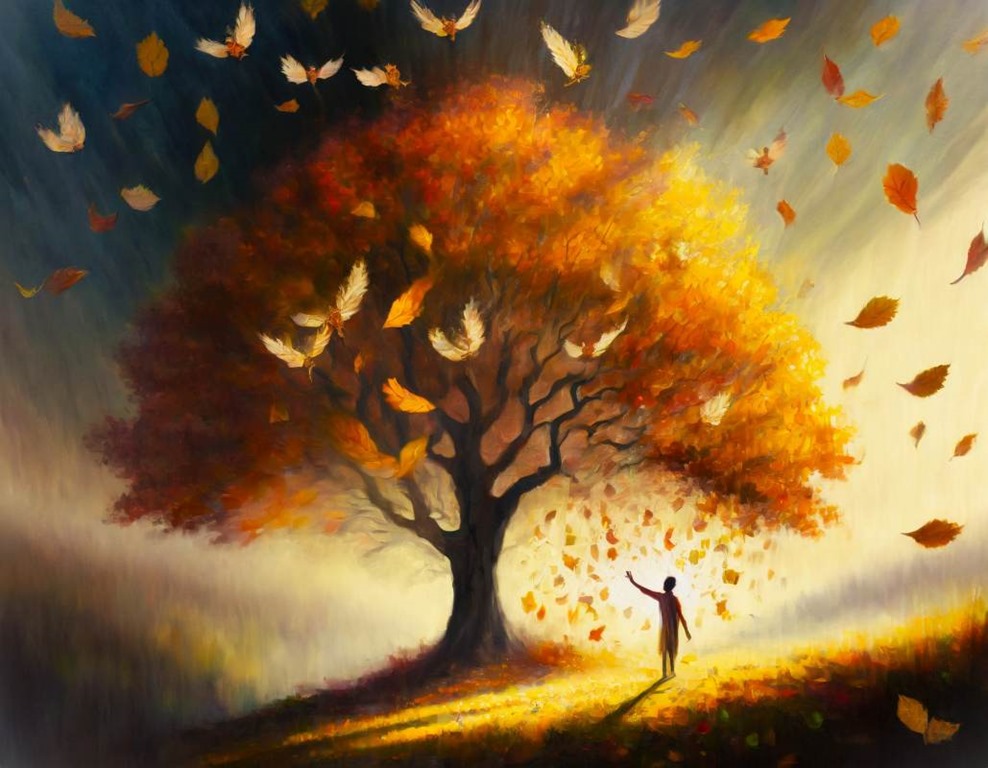
Free to Fall Illustration 800

“Everything is free to fall”

.

The originality of this compressed catalog of autumn thought comes in the refrained pair of lines “I grew up believing/everything was free to fall.” What was my intent there? I’m not sure if I’m articulate enough to do as brief a job as the poet me did in writing the poem. Yes, I knew many readers/listeners would think of things like free will and predestination, shibboleths of theology — but in the lines’ first statement I wanted the connotation that autumn’s falling leaves are freed from their work in photosynthesis and now can flutter and drift. The fourth verse refrain may (or may not) put this in a different context. Is this a compressed statement of “free will,” the doctrine that humankind has the choice of choosing good or evil, which also carries a connected thought that this is what makes good, good, not just an inherent trait? I was likely aware of that when I wrote it, but in performing it this fall I took another plausible memory: that there are those who believe in an afterlife, or a rising or rebirth of the souls of the dead, but that the song’s singer believes that however temporary or final autumn’s dying off is, that there’s a freeing element in it, like that leaf that has been loosed at the start. That’s a bittersweet freedom I wanted to convey.

Free to Fall

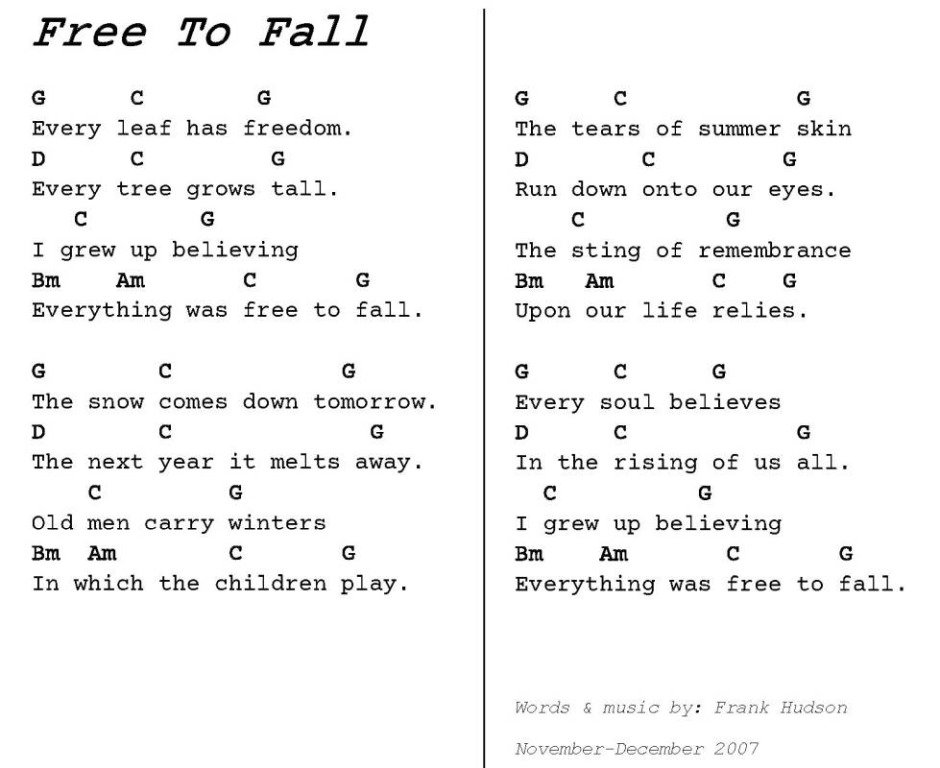
Here’s a chord sheet so that other singers can extend or improve my performance

.

This poem/song works for me. Maybe it has some worth to you. In summary, the way I think it works is from the ability of compressed verse and song to collect things in a small memorable chunk of words, a portable experience. I’m glad I remembered this 16-year-old song and that I was able to record a new version to share with you. You can hear it with the audio player gadget below if you see that. No gadget? Some ways of viewing this blog won’t show them, but this highlighted link will open a new tab with its own audio player.

.

*“Where are the snows of yesteryear” is the concluding line of his “Ballade des dames du temps jadis”  published in 1533. Yup, those snows are definitely gone.

**One of the abandoned Parlando Project songs you won’t hear came from my idea to do a fresh translation of Surrealist-associated poet/lyricist Prévert’s French “Autumn Leaves” lyrics. I got a hold of those lyrics in French, and found that Johnny Mercer’s English lyrics are a freer, looser sort of translation. Prévert’s lyric is longer and more miserable, while Mercer’s cuts right to the nub of the situation without wasted elaboration. I found there was nothing I could do with Prévert’s French that would even approach the recasting that Mercer had already done.

Emily Bronte’s Cold Halloween Spell

Continuing our Halloween Series featuring some of our listener’s favorite fantasy and supernatural pieces from the seven years of the Parlando Project we get to today’s short Emily Brontë poem “Spellbound.”   Once more we have an eerie situation with withheld information that adds to the mystery while paradoxically compelling our attention.

Before beginning the Parlando Project I was only aware that Emily Brontë had written poetry, holding that fact as having no other consequence. I’m not even sure what drew me into her poetry — memory fades — but it may have been finding out that another Emily, Emily Dickinson, read it. Brontë’s poetry, which preceded her famous novel Wuthering Heights,  was at least partially extracted from a series of writings she and her young siblings created within a set of fantasy worlds — and though this short discussion of Emily and Anne Brontë’s imagined world of Gondal doesn’t list this poem as being part of that universe, “Spellbound’s”  setting doesn’t sound out of place from the northern, winter island in their Gondal.

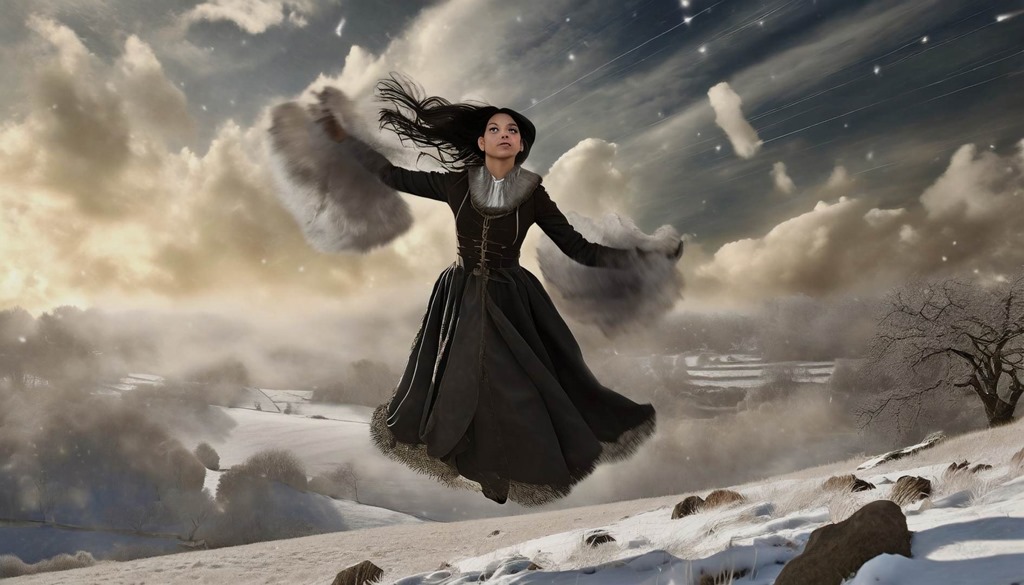
Nor out of place in the northern U.S. where I live, where the wind and weather is casting us to cold with predictions of snow and ice within the next 24 hours. When I first presented this poem three years ago,* I was intrigued by the prepositional position that the poem’s speaker seems to be in. In the poem they say that clouds are above them and the wintery wastes are below. It could be that Brontë was only envisioning a highlands or hillside perspective, but my mind’s eye had the spellbound speaker suspended, frozen in mid-air. Perhaps again, my imagination overtook me in that detail, but then I’m glad for Brontë’s imagination which created this chilling and enchanting poem that let me picture that.

Bronte's Spellbound 1080

Another illustration created by enchanting Adobe’s Firefly with an incantation. Firefly claims that it doesn’t use uncompensated artists work in its AI model.

.

I rather like the music I came up with for this one. Maybe you will too. An audio player is below for many of you so you can hear the performance of it, but some ways of reading this blog will suppress that page element, and so I also offer this alternative: a highlighted link that will open its own audio player gadget.

.

*If you follow this link to my original presentation of “Spellbound”  you can see the lyrics as part of a chord sheet in case you would like to perform this song yourself.

Thinning Shade

This month, as I wondered what poem to explore through setting it with music, a voice — my voice from a portion of myself — often spoke up. “You still have sheets of poems by Kevin FitzPatrick that you typed-up after he died, ones you thought you might perform.”

This week I finally listened to myself.

In my studio space I have a short stack of those sheets, printed out when I thought I might perform them around a year ago. I picked this one up. I had scribbled some chords on it, and I now tried to recall what melody I’d planned over those chords on a day last spring when Dave Moore and I performed things we recalled of Kevin and Kevin’s poetry. That spring day, I had reordered and reduced that stack as the two of us alternated suggesting musical pieces. This one was shuffled to the bottom then. Had I not felt I had finished the composition? Could be. More likely? From what I could see on the page, it had more chord changes than things which work best when I hand them to Dave and he has to try to follow my eccentric phrasing in real-time.

I picked up a guitar and started running through the chords, trying to discover, or rediscover, a likely tune. In doing so I made a few alterations and after an hour or so of that, I sat at my acoustic guitar recording location in my studio space and performed the guitar and voice tracks of the song you can hear below. As I played, I was thinking of Kevin and some full measure of retirement, that as it turned out, he didn’t get.

But then, none of us know what we’ll get. Part of the reason I have had a rapid release schedule over the years with the Parlando Project — its get-it-down-and-move-on-to-the-next pace — is that factor. Not only do I skip over additional steps toward perfection, the amount of things released probably wears some listeners out. Though somewhat more talented, my fellow studio-rat Prince used to get pushback from his record company that he should trim back his output, that it was too much, bad for his career and their business. Well, should he have waited? Did he get enough time?

Thinning Shade 2

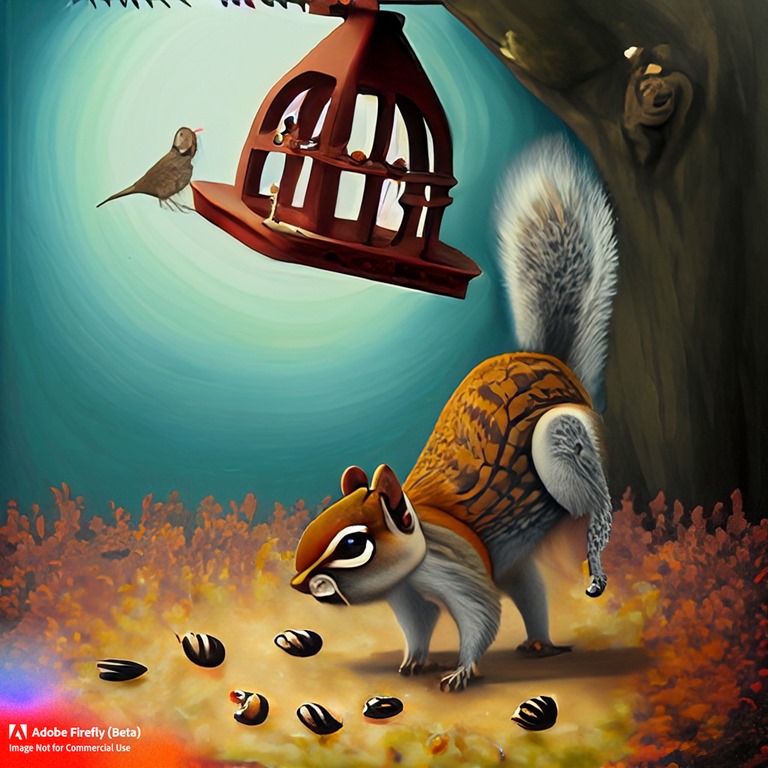
More playing with Adobe Firefly, the AI art generator that claims to not use uncompensated artists’ work.

.

Like most of Kevin’s poetry, his poem “Thinning Shade”  doesn’t call out for my extemporaneous insights to direct the attention of readers. But while going through the process of composing the music and going over the performance, the poem did get deeper for me as it repeated in my ear. I see myself as his sparrows and that “fattening squirrel,” “pouncing on seeds…in fussy haste.…”

Thinning Shade 1

Extending Robert Hunter: Talk about your plenty, talk about your ills/One squirrel gathers what the fussy bird spills. Great analysis of the song “St. Stephen” linked here.

.

You can hear my performance of Kevin FitzPatrick’s poem as a song with the link below. As the poem reaches it’s volta, I decided to slow down and add a string sextet to my guitar accompaniment. You can hear it with the player gadget below. No player you can see? You haven’t missed your chance at gathering the seeds, there’s this backup link that will open an alternative player in a new tab.

.

Interested in reading more of Kevin FitzPatrick’s poetry? His books are available at this site, KevinFitzPatrickPoetry.com that I’ll link here.