Wrapping up Fenton Johnson, for now

We’ve come to the end of our Black History Month series on early 20th Century Black Chicago poet Fenton Johnson. Let me try to wrap things up with a few summary points — which as I’ll warn again, are preliminary and include speculation on my part. Long post, so the headings may help you if parts of this are of more or less interest.

Was Fenton Johnson able to achieve his goals during his lifetime?

No. He seems to have had very high goals however. He wanted a general readership for his poetry across racial lines, he wanted to be part of the solution to “the racial problem” in America. For an Afro-American poet of his time being able to publish several book length collections, or to receive any  notice for his poetry should mark him as achieving something. But those books were all self-published and likely had a small audience. It’s unlikely that he had anything like Paul Laurence Dunbar’s audience in the Black community, and his white cross-over audience was small. These are estimates: but it’s clear he didn’t “break-through” with either audience — and his political platform seems unremarkable and no more successful than early 20th Century America was in general when addressing racial discrimination and oft-times violent white supremacy.

Why did he fail in that?

Remember one of this Project’s mottos: “All Artists Fail?” Even the most successful will be misunderstood and will be downrated for cause by some, will have a limit to their reach even if popular or well-ranked. But even if we don’t rate him against a perfect score, he didn’t succeed to the level of Dunbar, and he was superseded by his successors in the Harlem Renaissance such as Langston Hughes in Black or white readership. My guess: he overrated the audience value of his verse and likely highly overrated the value of his prose/journalism. It’s easy to suppose that he was a bright young man seeing himself in the eyes of youth protected at least at first by the loving support his family was able to give him, but not necessarily with the eyes of a skilled careerist or marketer. His early poems have more value than his contemporaries judged, but some of that value was too deeply coded for some to appreciate in the pre-WWI era. Judging from the small portion of his journalist-writing I’ve read, his efforts there may have displaced his stronger talents. His later poems? James Weldon Johnson’s evaluation of Fenton Johnson in the 1931 version of The Book of American Negro Poetry  points out that FJ was uniquely despairing for an Afro-American poet, and contrasts him with Claude McKay’s famous poem “If We Must Die”  from the same era as “Tired,”  discerning that McKay at least says we can, we should, fight back. One thing that is odd about Fenton Johnson, he’s unsparing about deprivations of rights and dignity for Black Americans in his poetry while maintaining this public face in his presentation of “we just need to listen to each other and work together.” Even onward into the era of Jim Crow and the Great Depression he might have been both too down-beat and too optimistic.

Further supposing on my part: Johnson seems to have been discouraged around 1920 by the evident failure of his audacious goals, and there’s a report that the self-funding from family sources had dried up. I don’t know how dire his life was after 1920, but his pre-WWI Black middle-class status might have changed in ways that refocused his life and added new obstacles. A lot of modern poets reach their heights in writing quality and audience in middle age, which was about the time Johnson’s poetry stops being published.

The Harlem Renaissance has been informally extended to include writers who weren’t NYC located in retrospect, but Frank Marshall Davis and Margaret Walker from between-the-wars Chicago indicated that patronage support and publishing contracts were not at New York levels in Chicago then. Yes, there was a Chicago Renaissance in Black writing, but that came after Johnson stopped publishing.

If Johnson’s early attitudes continued, he may have had a disconnect with some Black literary cultural outlooks that followed WWI. I’ve yet to find anything linking him directly to Temperance/Prohibition, but he writes often enough about alcohol as the marker of a fallen state. He seems to have retained a religious component until he stopped writing — and even the religious have been known to disdain those whose religion differs only slightly from their own, as much or more than non-believers. And lastly, Johnson is explicitly adamant that he’s against “the Bolsheviks,” and commented to friends that this was hurting him in literary circles.

If he’s just some poet who didn’t rise to an undeniable level of success, why read him?

I think there’s unqualified value in the best of Johnson’s poetry. Historically, reading even his lesser-known poems can tell us something about what a smart Black man in this “bridge era” was thinking and writing.

Johnson is precedent-setting in the use of Afro-American musical forms in poetry. This particularly endears him to me. This element alone is highly important culturally and should cause him to be more widely considered. He was active in an era when our resources for Afro-American speaking and musical expression are scarce, so there’s some musicological interest on top of literary value.

You were so down on his political essays. Would you rather he was some kind of radical who might have been tied to between wars dictators? Or hassled by the Red Squads?

No. They were just disappointing in their slack writing and surface allegiance to common political stances without any vivid insights. The man I see in his poems is much sharper than the essayist I’ve read so far. It’s possible that that writing was insincere, that he’s trying to market himself, probably to white audiences who might help fund him. Was he conscious of this split in himself? I can’t say. One may think of one of Dunbar’s best-known poems “We Wear the Mask.”

After he stopped publishing poetry, his friendships in Chicago included those who would be aligned with more leftist politics. As with his non-extant post-1920 poetry, his political analysis might have continued to evolve.

Even some relatively unsuccessful writers influence those who come later. Is Johnson one of those?

Incomplete, but there may be something there. Although his post-WWI poems are few, they were anthologized, and anthologies are still a place younger writers find ideas of the possibilities of their own poetic voice. This Project is an anthology of a kind, and I’ve tried to add that his “spirituals” are worthy of re-evaluation.

This month, I was able to read two accounts of the next generation of Black midwestern poets (Margaret Walker and Frank Marshall Davis) who lived in pre-WWII Chicago, knew Johnson, and mention Johnson’s connection with other writers in this period when Johnson was no longer publishing. Davis (who is himself a bridge between the pre-WWII Black poets and the post WWII Black Arts Movement) admired Johnson and found his work validating his own. Little that I know beyond that, but at least by association there’s a possibility that a later-in-life Fenton Johnson may have influenced these other writers first or second-hand, even after he ceased publishing himself.

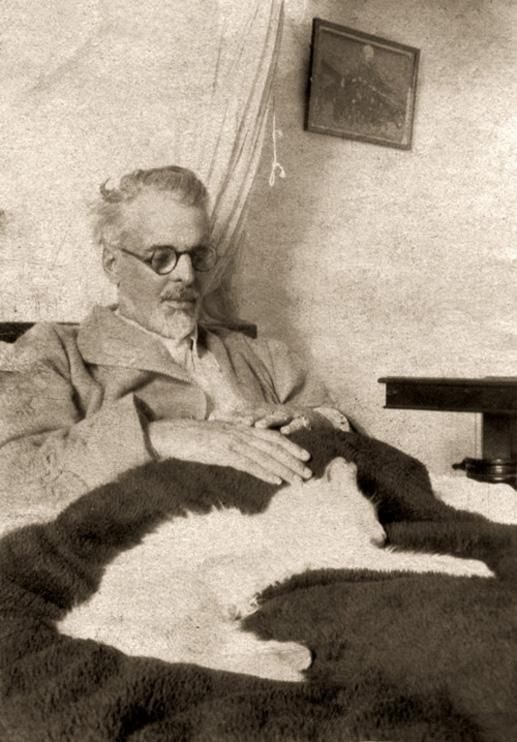
The only photo of Fenton Johnson

AFAIK, this is the only known photo of Fenton Johnson, from when he was in his 20s.  We have more photos of Emily Dickinson or Robert Johnson.

.

Summing Up, and A Musical Piece for Today

In closing, there’s still more for me to find out about Fenton Johnson, even if it’s likely that I (or any “we’s” reading this and sharing my curiosity) will never find out other details that would illuminate him. We have those final poems before he “went dark” as far as literature is concerned, and I’ll maintain that his earlier work has qualities worth re-assessing. Yes, he’s a case of someone who dreamed big, maybe spread himself too thin, maybe his self-regard was blind, maybe he underestimated the resources and skills needed — all that “reach exceeds his grasp” stuff. And he certainly had to deal with generalized and persisting cultural undervaluing of Afro-Americans — so this isn’t a simple case of hubris. His most famous poem, that despairing “Tired”  remains on various printed pages silently waiting to be found — but there’s an unwritten poem that sums Fenton Johnson up for me: “Tried.”

His most famous poem, that despairing “Tired”  remains on various printed pages silently waiting to be found — but there’s an unwritten poem that sums Fenton Johnson up for me: “Tried.”

For today’s musical piece I’ll give you something sung by Dave Moore. It’s called “When the Dream Outruns the Real.”   Dave didn’t write it about Fenton Johnson, but it is about anyone who tries, dreams, and doesn’t make it. Here’s what I think is cool about what Dave wrote and sang: it’s not a rote put-down. Easy to laugh at the over-reachers, easy to mark it all down to vanity. The Qoheleth in Ecclesiastes  preaches that “All is vanity.” Could that mean we laughers are vain too? You can hear The LYL Band perform this with the audio player below, or with this backup highlighted link.

.

Here’s my sketchy and incomplete timeline of what I know of Fenton Johnson’s career.

1888

Born in Chicago on May 7. An only child and his parents are middle-class. There seems to have been at least some modest wealth in other branches of his family. According to his later friend Arna Bontemps, he starts writing at age 9.

Circa 1905

At least one play was produced in Chicago while he’s a high school student. There are scattered other mentions of Johnson writing plays, but I’ve found nothing about what they were about or if there was much notice of them.

1906

His early model, Afro-American writer Paul Laurence Dunbar dies. Around the same time he graduates from Wendell Phillips High School in Chicago. Attends Northwestern University and the University of Chicago, does post-graduate work at Columbia University in NYC circa 1914.

1910

Briefly teaches at a HBCU, Simmons College in Kentucky, founded by the Baptist church.

1909

He submits a manuscript (handwritten on lined paper from the scanned copy I’ve seen) to Doubleday as a non-fiction diary, though it’s fiction. It survived, though unpublished. Titled a “A Wild Plaint,”  the main character in the story commits suicide due to the stresses of his Afro-American life. I have not read this yet.

1913

Self-publishes his first book, a poetry collection A Little Dreaming  which has a wide variety of poems in subject matter and styles reflecting mainstream 19th century poetry modes as well as dialect poetry. Dedicated to a relative who may have helped finance its printing.

1915

Returns to Chicago, presumably ending his education. Self-publishes his second book Visions of the Dusk.  Dedicates it to Albert Shaw, a well-known white reviewer who had given a favorable review to his first book.

1916

Founds The Champion  magazine in Chicago and is listed as its editor. It’s uncertain how many issues are published. One issue does exist as a scanned complete copy. I just found it online, though I haven’t read it yet. Also in 1916 comes a third volume of self-published poetry, Songs of the Soil,  which concentrates on his dialect verse.

1918

Founds The Favorite Magazine.  Again, it’s unsure how many issues there were, but it may have been as few as two. Published Three Negro Spirituals: “How Long, O Lord,” “Who is That A-Walking in the Corn,”  and “The Lost Love”  in the June issue of Chicago’s influential Poetry  magazine.

1919

Publishes his best-known poem,“Tired,”  in the January issue of The Others. The Others  circulation is small, but it’s an influential landmark little magazine focusing on the new American avant-garde poetry

Publishes five poems in the February issue of The Others: “Aunt Hannah Jackson” “Aunt Jane Allen,” “The Gambler,” “The Barber,” “The Drunkard”

Publishes “The Artist”  and “Dreams”  in The Others  April-May issue.

1920

Self-publishes  two short books: For the Highest Good  and Tales of Darkest America. The former is a reprint-collection of pieces from The Favorite Magazine  and they are largely anodyne Republican party material. The latter is a short stories collection which sustains some interest while not demonstrating that Johnson is a great undiscovered short-fiction writer.

Around this year Johnson seems to have another ready manuscript of new poems, but is apparently unable to find a commercial publisher and family funds to self-publish another book are denied.

1921

Published Two Negro Spirituals: “A Dream”  and “The Wonderful Morning”  in the December issue of Poetry  magazine.

1922

James Weldon Johnson publishes the first anthology of Afro-American poetry at the dawn of the Harlem Renaissance. He includes five of Fenton Johnson’s poems including “Tired,”  marking down Fenton Johnson as someone to be remembered in future surveys of Black verse. JWJ says little about FJ in his preface, saying he “gives promise of greater work than he has yet done.”  Fate laughs: FJ is no longer publishing poetry. Nearly a decade later JWL publishes a new edition of A Book of American Negro Poetry  and has more to say about FJ then, notes his work is uniquely despairing.

1925

The Cabaret Girl, a play he wrote was staged at Chicago’s Shadow Theatre. I know nothing about the work, nor of any other public work by Fenton Johnson after this.

Circa late 1920s

Midwestern Black free-verse poet Frank Marshall Davis moves to Chicago, and besides white Modernist Carl Sandburg, he is surprised to find a fellow Black poet who wrote free verse there: Fenton Johnson. Davis admires Johnson’s free verse poetry and later published a poem riffing on Johnson’s poem “Tired.”

Circa 1935

Works for the Federal Writers’ Project part of the WPA. Others recall he was also in the “South Side Writer’s Group” of Afro-American writers including Richard Wright, Arna Bontemps, Margaret Walker, Theodore Ward, and others. The young Gwendolyn Brooks may have been connected to this group’s later incarnations.

Margaret Walker says she worked with WPA/FWP in Chicago while a senior at Northwestern. She reports Nelson Algren, Jacob Scher, James Phelan, Sam Ross, Katherine Dunham, Willard Motley, Frank Yerby, Richard Wright, Arna Bontemps, Sterling A Brown, and Fenton Johnson were also in the Chicago WPA.

Personal note: my relative Susan Glaspell was also associated with the Chicago FWP during the Great Depression. I don’t know how officially or unofficially the FWP was racially segregated, so there’s no guarantee my relative and Johnson even knew of each other. I know of no work of interest ascribed to Fenton Johnson from the FWP, at least as yet.

1958

Fenton Johnson dies in Chicago on September 17. Some of his papers etc. reported destroyed in a basement flooding event. Arna Bontemps was his literary executor.

She had concealed him in a deep dark cave…

It’s usually of little use for an artist to apologize for their work, and this is so even though most have self-doubts. Perhaps more so, women artists will speak about “imposter syndrome,” but I’d guess that many/most male artists have the same feelings, they just don’t talk about it. The plain fact is that we’re all pretending to be what we want to be, to go to the place we want to go to. We maybe get there, we maybe don’t — but we’re all traveling, and we all get lost sometimes.

I even have trouble with the word “pretentious.” I say that, though I know the problem that word is describing: the embarrassing failure where something doesn’t achieve what it clearly wants to achieve. It’s just that most good, and nearly all great art, starts out with exactly that urge: to make something better, to make it new, to stretch and extend the maker’s talents, to make something over the horizon from what the artist knows. Since the same urge produces success and failure, it’s not the urge or the hubris that’s the problem. Don’t beat yourself up over that urge, don’t beat your breast over the failures. Reflexive humble-brag is exceedingly boring. If you must, get through any of that quickly. One of my animating maxims is “All Artists Fail.” As I’ve written about that maxim extensively here, that paradoxically comforts me.

I’m not an expert on Kenneth Patchen, but the general impression I get from him is like a 20th century American William Blake, that he self-invented himself and his credentials, and that’s easy for me to admire. I spent much of this week looking for a poem, a text, that would inspire me, and shake me out of some creative doldrums; and after striking out both swinging and looking during several at bats inside several books, I came upon this one. Since the text of this Kenneth Patchen poem doesn’t appear to be available to link, here it is:

she had concealed him

One can think on the statement that “death is something which poems must be about.” That’s sort of true, and I laugh at it.

.

It doesn’t appear to have a title in the early Selected Poems  volume I found it in, but the first line was used as such when Patchen was recorded reading it. The poem is read unaccompanied, but Patchen predated the Beats in doing the mid-century poetry with music thing that’s an inspiration to me. He reads it slowly, precisely. I hear it silent on the page as more anguished in its effect, and in trying to record a performance of it this week I first tried almost shouting out parts of it. After trying that I decided that wasn’t working, and tried a more understated take — only to find that my voice was horse from the earlier takes. I did my best in the time I had, and that’s the performance you can hear today.

“She had concealed him”  seems to be using something of a collage of voices. Not so directly as a Patchen favorite of mine “Do the Dead Know What Time It Is,”   but the opening seems like the start of a fairy tale, then there are bits of realistic daily speech, and then the fantastic metaphor of the poems final lines. As so often in Patchen poems, there’s a sense not so much that God is love, but that Love is god.

The music today makes use of some concepts of mine that are, to convention and many listeners, wrong. I like the rub of outside notes and grotesque melodic contours.*  Rather than having a straightforward harmonic foundation below a singular or a mathematically related set of melody notes, I’m fond of twined melodic lines that respond or contrast in turns with each other. And as an electric guitar player accompanying singers or poetic readers, I clearly don’t know when to shut up and not play my guitar. This last one I might change, perhaps should change, but in the immediacy of the playing moment I’m believing that strong words, read with force, are able to stand toe-to-toe with electric guitar.

Frankly, I worry that the resulting musical performance may have too much of all of the above. Is that from a failure of nerve, or a failure of execution? Am I reflexively using old habits, not stretching out to something else? Well, I meant what I played, meant my reading performance of Patchen** — but meaning and intent didn’t allay my doubts. Yesterday I made four completed attempts to mix this. With my self-expected release schedule and time conflicts, it’s rare to go beyond two alternate mixes. I still decided to let the music continue for a bit more than an extra minute past the reading, because I liked the echoing musical conversation in the deep dark cave.

And there’s this perspective: all that is just one musical mode here. I have other pieces that are less cluttered, more accessible, and less contrary to expectations.

Returning to the thoughts of the opening of this post: the middle parts of what I write today are parenthetical and not something I want to take more of your time with. Non-paralyzing self-analysis is likely uninteresting to readers or listeners, but it can be effective as part of the journey of making art. I’m done trying to make this piece any better. I think the best moments that I hear in it and what Patchen wrote may be worth your time. My job with this Project is to move onto the next piece, to see what I can find and do with that. Thank you for reading and listening. The player gadget to hear the musical performance of Kenneth Patchen’s “She had concealed him”  is below for many, and this highlighted link is there for the others.

.

*More than once, what I play has been characterized as out of tune or dissonant. Some of that is timbral, and some of it is wide vibrato, but often it is note choice and sequence. I don’t always hear it that way. I think harmony has rules, that can be broken or bent, but there’s propriety there. But melody? Melody is free. Yes, I’ll acknowledge that certain melodic contours generally cause admirable effects, but I myself am easily bored with stock moves. Two bands I admire, Television and the Velvet Underground, were each said to have banned playing Blues riffs that were part of the expected electric guitar vocabulary. I on the other hand, and in today’s piece for example, am playing Blues expression (stinky, funky notes and wide vibrato) without the expected sequence.

I think the opening electric guitar chord today was likely a subconscious attempt to refer to the chord at the opening of Peter Green’s Fleetwood Mac version of his “Black Magic Woman,”  and Green’s Fleetwood Mac was another band like the combo I constructed for today’s piece that tried to find room for an overplus three-electric-guitar frontline. That band’s Live at the Boston Tea Party  set is foundational to me.

**I felt my earlier more histrionic reading was less effective and my more resigned reading better and more true to the poem, not a retreat.

May Music Find a Way. Spring 2022 Parlando Top Ten numbers 7-5

Tonight is Jazz Night here at the Parlando Project Top 10 countdown. I’m going to ask the folks who come here for the talk about words to murmur down quietly today as I speak about the music.

Funny how these quarterly counts sometimes become nice little “sets.” Both today and tomorrow’s segments as we countdown to the most popular piece this past spring are as good as any planned ones I could have devised. So, let’s get the musicians on stage!

7. Sonny Rollins, the Bridge, 1959 by Frank Hudson.  Remember that the bold-face headings at the start of each entry in this countdown are links to the original post presenting them, where you can read what I had to say about it then. I had a lot to say about this one back in January, and so even though this is a piece where I wrote both the words and music, today I’m going to talk about how this (and many of our Parlando Project musical pieces) was realized.

With significant accuracy I hesitate to call myself a musician. My home instrument is the guitar, but even there my knowledge is not something to brag about, my skillset a bit unusual, but limited, and my consistency not up to a professional (or even many dedicated amateurs’) level. But I have a secret weapon: I can choose to compose or improvise (spontaneous composition) the things I present here. My Jazz guitar chops are not strong, but the chordal part was something I was able to execute. Listening back today to the second guitar part I improvised for this I think it was a good day with the wind at my back for me.

In another world I’d more often use other musicians who could add their skills to this enterprise, but logistically and financially the one-man-band approach is what makes it possible for me to express the variety of different musical ideas that I present.

To hear this or the other musical pieces here, use the player that may appear below, or this highlighted link.

.

6. Lenox Ave Midnight, an Extension by Langston Hughes.  Another little miracle pulled from my limited, if a bit unusual, skill set? On a good day I can do a passible impression of a guitarist, but my keyboard playing is always naïve. The advantage I can find? Modern MIDI lets me use my mind where my fingers don’t know what to do. In a piece like this I figure out some kind of harmonic flavor by trial and error and my sketchy knowledge of music theory. I played that part and then improvised a right-hand part, editing on a MIDI “piano roll” to correct bad dynamics or altering notes I didn’t like. To an actual pianist this could be called “cheating.” To a composer, it’s called “composing.” You see, I use the term composer protectively, because I really do feel ashamed sometimes that I couldn’t play in real time with two hands the keyboard parts that to casual listeners make a sound like I could. And I think: to a real pianist realizing this simple composition would be a trifle. To me: achievement!

Near the end of this piece, to open up its musical world before I speak the two lines I added to Langston Hughes poem (the reason I call this piece “an extension”) I did something I rarely do here, which I personally try to avoid, because it really does feel like cheating to me. I used a couple of small loops of recorded melodic material from Apple Logic’s free-to-use loop library. My composer’s need here was that my simple and not very convincing saxophone part, that I did play on MIDI guitar, needed something to camouflage those issues.

Why does this bother me to do? After all sampled loops have been part of popular music since the hip-hop DJ’s started dropping riffs from vinyl records. Because I use “composer” as my excuse, my get-out-of-pretender-jail free card, I believe I (or at least some human present in the room with me in the creation process) should have played or scored the notes. I think the two short horn section loops used here sound fine, helped make this piece successful for listeners — but that’s why I feel guilty for using that tactic. Whoever played them, devised those short motifs, didn’t know what I was doing, wasn’t working in concert with my aims.

Now look, I don’t generally mind when other artists do this. Returning to words briefly now: I spent many an April here performing the words of Eliot’s “The Waste Land”  which includes — even more than I imagined — squadrons of quotations and paraphrases from pre-existing works. Selection, curation, recombination, and recontextualization are easily defined as creative acts. Maybe my qualms and self-imposed rules in this have a most self-interested reason: I worry that the casual listener here will think I’m just reading poems over pre-recorded music, when I’m proud that I had to write and play and record the majority of the music on this Project, one track at a time.

Player below, or link.

.

Sonny Rollins, inspiring to me, yet my distance from that discipline shames me

.

5. Autumn Movement by Carl Sandburg.  I stopped writing this post here yesterday, because what I had written so far seemed embarrassingly solipsistic, pretentious, and uninteresting to my audience, and yet also because some of the things I’m feeling as I write about my musical work are hard to condense into a reasonable length post — to be better, it would be even more. And so here we are at this, my presentation of a short nature poem by one of my heroes Carl Sandburg, illuminated by lovely music I made for it. How am I to feel about it tonight? Amazed that I, a non-musician, was able to make it? Or something that feels almost like shame or embarrassment that I present it publicly, when there are days I can’t play anything of any value? Knowing enough to know that what I know as a composer (little) and what I can bring to the composer as a player (limited). Knowing that at my age (old) there isn’t much lifetime to remedy those things.

This, though I cannot say I have sufficient understanding or skills, is where Jazz comforts me as no other art does. Jazz is always confronting the empty sky. Always a critique of silence — and able to the fears inside silence, now, not later, and with surprise and failure. There can be no surprise without failure. I’m a small man, it’s a big sky and a big silence. There are better musicians, better composers, but it’s a big sky and a big silence. This the musician’s and composer’s prayer: may music find a way.

Player below, or link.

.

Yeats’ “He Wishes for the Cloths of Heaven” for National Poetry Month

Continuing our National Poetry Month celebration, here’s another poet’s love poem, loved by other poets, William Butler Yeats’ “He Wishes for the Cloths of Heaven.”   If Millay’s “Rosemary”  portrays a relationship turned cold, “He Wishes for the Cloths of Heaven”  is more at the wooing stage.

The speaker in Yeats poem begins by saying that they’d offer their beloved heaven or the heavens — well, to be exact, a luxurious simulation as some kind of cloth — and then not care that the beloved might just use it like a rug and walk all over it. And then they say they don’t have those cloths of heaven, only a dream. Still, the beloved can walk on that, the poet’s dreams; but the poem finishes with a plea that they should walk softly on that treasure, the wooer’s dreams.

In this short eight-line poem, Yeats does some fine things. First — no surprise if it’s Yeats — it sounds beautifully, and he does this almost entirely with meter, supplely alternating two and three foot beats in my scansion of it, though you can force an iambic feel.*  Unlike many poets and poems that pour on the consonance seeking musical sounds, he avoids this here other than “dim and dark.” Nor is end rhyme a factor, though there are 2.9 internal rhymes in the entire poem (“night” – “light,” “spread” – “tread,” and “cloths” – “enwrought.) Instead, Yeats leans on repetition of words, even though one can read or hear this poem without noticing just how heavily repetition is used. These words are repeated at least once: “cloths,” “light,” “feet,” “I,” “dreams,” “spread,” “under,” “my,” and “your” along with generally-repeatable articles like “and” and “the,” and with only 61 words in the entire poem, almost half the poem has another half echoing it.

It’s also subtle in it’s meaning. Yes, it has been used in “real life” as a wooing poem by others, but being subtle in a valentine is a risky business. Yeats himself originally published this as a persona poem in the voice of a character as “Adah Wishes for the Cloths of Heaven,”  even though many identify this as an expression of his in-real-life love for Maude Gonne. But notice this: the poem’s speaker would be extravagant with something he doesn’t own (and maybe no one could own fabric as rich as heaven) — but he’s asking for some mercy with the actuality of his immaterial dreams.

So, there’s a lot here for other poets to admire, but there’s more: this poem restates the situation of most poets when they are writing too. We plan to create the closest we can with words and their weave to the heavens — and those plans, those wishes, are our dreams. And then — like Maude Gonne, the plausible love interest this poem may have been directed to — people walk, not on them, but around them.   Don’t be dismayed, such is life. All Artists Fail.  We are the wooers, and then when we read or perform poetry such as this one by Yeats, we become the lovers, the beloved.

Watch here for views of a statue depicting this poem created by Jackie McKenna that I much admire. One thing I just noticed when doing this video: the crouching figure of the wooer looks quietly satisfied viewed straight on, and then in the final profile shot, a little sad or resigned. Intended or trick of the light?

.

Three ways to hear my music and performance of Yeats’ “He Wishes for the Cloths of Heaven:”   there’s a player gadget for some, this highlighted link for others to use, and, at least for now, I’m continuing to create new lyric videos for this National Poetry Month series, and that is available above.

.

*That sort of repetition with variations, trod gently, gives a better musical effect in most cases.

Marianne Moore’s “Poetry” for National Poetry Month

Here’s an old American joke I recall.

“No one knows the words to the second verse of the National Anthem.”

“Sure they do.”

“Oh? What’s the second verse then?”

“Play ball!”*

We continue our celebration of National Poetry Month while tipping our hat to American Baseball’s Opening Day. Marianne Moore’s poem “Poetry”  seemed fitting, not just because she was a lifelong baseball fan, but because this poem of hers always seemed to me to be American poetry’s National Anthem. Like our constitution’s “More perfect union” the overall thrust of the poem is that a real, complete poetry is still a goal, still in process, and so in the meanwhile it’s OK to snub poetry’s failures, but to pass the time, OK too to enjoy its at bats anyway.

Partway through the poem Moore explicitly calls up a baseball metaphor:

the base —
ball fan, the statistician—case after case
could be cited”

Here’s today’s lyric video. Baseball has Blue Jays, Cardinals, and Orioles. Why not Cockatoos?

.

Moore has already given us the choice to “Not admire what we cannot understand,” but my estimate of what she’s getting at there is that hitting a baseball effectively at a major league level is extraordinarily difficult. The very best players ever to play over more than a century fail to do it about two-thirds of the time over a career. Careful records have been kept. Fans know this is so. Poetry too may be a sublime effort to try to hit the implausible cleanly to land in the improbable place.

It’s become a common observation that baseball has diminished popularity because of this, because one needs to endure so much failure and not-quite to get to the aim of the game. Perhaps poetry can commiserate.

Here’s hoping my home team’s opening-day rookie pitcher can throw implausible stuff this week. Gnomic fastballs. Hermetic curves. Enjambed change-ups. Surreal sliders. Let the opposing bards wave their wands and form nothing but wind, and all their strokes come up trite and merely sentimental. Let their bats hang upside down, asleep.

This performance from our archives has vocals recorded in 2018 by the then members of the Lake Street Writers Group: Dave Moore, Ethna McKiernan, and Kevin FitzPatrick. Two-thirds of that lineup have been called up to another league since then, the one where we have no statisticians or toads — you may have read our memorial pieces to them here this winter. And now it’s spring, even if we don’t understand. How can we admire what we cannot understand?

Three strikes and you’re out, but three ways to hear this performance. There’s a graphical player below for some of you, and if you don’t see that, this highlighted link. And if you want to see the lyric video that I just made that is part of the series of those I’m doing for National Poetry Month, that’s above.

.

*Joke footnotes — they always add so much to the humor — but I know we have a lot of foreign readers. American baseball games traditionally start with a singing of the National Anthem. Yes, just the first verse. Patriotism, but in a measured dose there. After which, the head umpire announces the commencement of the game with the cry of “Play ball!”

Heartened

We are over half-way through Black History month and I’ve mostly spoken obliquely about it. I think that’s my nature. As poet I’m often doomed to reader response that they just don’t get it, and that bothers me, because in my mind I’m intending to link disparate things because I think that’s powerful. But in intending to do that, I make myself obscure—and painfully, some fine people who’ve heard or read my work think that’s my intent or my error.

So, when I speak about one of my discoveries, a law I think is strangely comforting: “All Artists Fail,” I’m speaking from personal experience. You may think, that’s not true about famous artist X or highly revered artist Y, but it is. Even those that are—for a time or for a long time—popular, many will not hear of them, many will not care for their work when exposed to it, and even those that are treasured and ranked highly, how many will understand what they are trying to do sufficiently? Some? Perhaps. Many? One hopes. All? Never. It’s good to aim for the some and honorable to hope for the many. Be prepared for the never-all however. Sequester or armor yourself against that or be prepared to take comfort in it.

That’s part of why this project has a principle of “Other People’s Stories.” More than 90% of the time the words I’m presenting and talking about here are not mine. Trying to encounter those words a couple times a week with an open heart and whatever limitations or strengths I have is the goal. I’ve done that here over the 420 audio pieces and the over 500 posts in the last few years.

The great majority of those that I present here are now dead, many long so. As my son points out to me, mostly white men too. One needs to interrogate the past to form the future. I have a culture I inherited. One that spoke English, was based in the middle of the U.S., and was as blinkered as any. Everyone inherits a culture. It’s inevitable, as inevitable as “All Artists Fail.” What do you draw from it for strength and inspiration, what do you oppose, what do you seek to add?

What can you find in what is not you? All those things. The future is not made of one heart alone, no matter how perfect, it’s made of many hearts. Good art can tear open our boney-caged chests and let us glimpse the beautiful glistening ooze within all of us: Chinese, African, Irish, English, indigenous, immigrant, and on and on. It’s right and wrong—yes, in some proportion, inside all of us—but it’s always beating as music and poetry does.

Long dead CIS white man Phillip Sidney wrote “Fool, said my Muse to me, ‘Look in thy heart, and write.” That can work. That can fail. My muse said, “Look in another’s heart, and no matter how dim your vision inside that swooshing pump, write there.”

More new audio pieces soon. But I was heartened today by a post over on the Yip Abides blog linking to a post from a couple of years ago here. Bob Roman has some very nice things to say about what’s attempted with the Parlando Project, things that reminded me why I do this. He also recomends that the archives here have a lot for those who’d like to find something different any day. The particular piece he linked to had Jimi Hendrix’s SciFi parable about an alien scout-ship dealing with observing life on the “Third Stone from the Sun.”  The alien gets it wrong, or sees that we get it wrong: the prime Earth species is a bird, not us warm blooded mammals.

The Fisherman

Complaints about the size of the audience for poetry are far from new. So too, complaints about the quality of its audience. Throughout the course of the 20th Century, one increasingly common theory was to assume that a quality audience for poetry is likely incompatible with a quantity audience for the art.

We’ve just about used up two decades of our century, and that theory is still around. This quantity/quality audience-linkage belief is not always stated plainly, but it’s not hard to see its presence. Poets that rise to modest or surprising audience size will sometimes face some degree of backlash from critics. It may naturally be so that their poetry is less worthy by some criteria. This could be coincidental, honest criticism. It may be that it’s hard to find an audience for poetry criticism, as it is for poetry, so writing about better-known practitioners who have failed in some way helps grow the audience for the critic.

Another way to hold to this theory is to limit what poetry is allowed to do, to narrow its practice or even its definition. Spoken word or slam poetry? Not really poetry, or it encourages a poor selection of poetry’s virtues. Song lyrics? Self-evidently a different art, though given that the consensus canon of poetry is so different among itself, surely difference alone cannot be the criteria. Mix those two as rap or hip-hop and risk both  explanations of why it’s not poetry. Short, aphoristic poems? Too insubstantial. Long poetic forms once much in evidence, like the poetic epic or verse drama? No longer living forms of the art for the most part, if for no other reason than the type of poetic techniques the modern academic poet often uses can wear out an audience in a matter of minutes.

Myself, I don’t disagree or agree with those judgements in particular cases, and they could even be theoretically correct, I just viscerally dislike the idea that this thing poetry is so small and limited, that it’s a desert island disc for a few scattered islands, deeply loved by solitary coconut eaters with a very constricted shoreline.

When I break out of those narrow roles and rules for poetry, I will fail, and I do get discouraged. My limitations are bothering me two years into this project; and now 240 published audio pieces later, I may be running out of rules to break and the motivating pleasures of audacity.

William Butler Yeats with cat

Also dreaming of catching fish. Are cat pictures the secret to gathering an Internet audience for poetry?


Here’s a piece today using a poem by someone who somewhat agrees with me: William Butler Yeats. In one way it’s specific to him, and his time. I’ve recently honored two working-class sport fishermen in one of my favorite pieces so far this year, but the fisherman in Yeats’ title, the simple man working his craft on nature to help feed himself rather than for hobbyist enjoyment—well, he, even in a much poorer Ireland of 1916, is admitted as imaginary.

Otherwise, how about those folks listed in the middle section of today’s piece that are harshing Yeats’ mellow? How little imagination is needed to see them today?

I admire Yeats in this poem, embracing his failure, even though he brought immense poetic talents to his work, so much so that I should be embarrassed to admit to that admiration. In one way, the fisherman here is Yeats, casting with deft wrist or verse, but not in the course of the poem catching anything. There’s a saying with the fishermen in my family, “It’s called fishing, not catching.”

But the imagined fisherman is also that audience Yeats seeks. Maybe once, Yeats says at the end, maybe once,  he can please an audience correctly, with a single valid poem and valiant audience—even if he can only see that audience in his imagination. I surely hope (and Yeats’ life helps me here) that the singular fisherman is an image for a possible greater audience, and not a headcount. After all, to write for something as large as “his race” (by which he means Ireland), is too small a target to hit, while that tweedy imagined fly-fisher inside his jacket might possibly expand to more countries, more times, more genders. In Yeats’ case, as with all artists, he failed; but he failed reaching for a larger audience with a larger poetry, a poetry which he risked allying with other arts. Many of us will not be able to accomplish that failure, but I’m glad Yeats tried.

You can hear my try to alloy William Butler Yeats “The Fisherman”  with a rock band by using the gadget below.