Potential Graveyard

Our last episode featured words by Phillis Wheatley, whose story I first heard about in a graveyard.

I was taking a walking tour in Boston, and there was a lot for the guide to talk about as we strolled through the Granary Burying Ground near one end of Boston Common, the cemetery where many of the instigators of the American revolution are buried. That’s where I heard Phillis Wheatley’s story.

Granary Tombstone Boston

the Granary Burying Ground, Boston Massachusetts


There’s no tombstone for Phillis Wheatley there, and no record of where she was buried, though it could have been there. So, we don’t even know her graveyard, but we know her story.

Only a few days after wrapping up the work on the Phillis Wheatley episode, I happened to catch Viola Davis’ Oscar acceptance speech. Like David Harbour’s speech earlier this year, it compressed an artist’s calling into a few well-chosen words, and so, I set about creating today’s audio piece.

I trimmed and recast Davis’ words a little, turning it from her own pledge and testimony, to an artist’s pledge than we all can take:

There’s one place that all the people with the greatest potential are gathered – that’s the graveyard.

People ask me, what kind of stories do you want to tell?

I say exhume those bodies, exhume those stories,

the stories of the people that dream big and never saw those dreams to fruition,

people who fell

in love

and lost.
Become an artist

They are the only profession that celebrates what it is to live a life.
Here’s to August Wilson, who exhumed, and exalted, the ordinary people.

There are only a few words here, but the opening sentence announces itself strongly, while going—to my take on it—in two directions. “There’s one place that all the people with the greatest potential are gathered—and that’s the graveyard.” In that magnificent sentence, we may think of all the potential that’s totaled up short in every graveyard: potential lost due to life’s duration, lost due to injustice, lost to just bad luck, potential never reached for the many human failings. One of the most common of those human failings is to just not try, and when we fail to try, the graveyard is where that potential will end up.

This direction, where the sentence could go, is not where Davis takes us however. She reminds us: there, in those graveyard lives is that precious struggle, the part-ways reach, all the somedays that someday may see victories. We should “exhume those stories,” she says.

And then Davis’ makes a daring statement. Art “is the only profession that celebrates what it is to live a life.”

Can that be so? Certainly, historians and social scientists collect and analyze information about lives too—but perhaps they must step beyond that role to light the footlights that art does. Art is the transference of the emotions and the perceiving inner being between people.  Only at that level of communication can the celebration of what it means to live a life be reached. That’s what we do when we create art, or when we consume it actively.

Davis repeats her specific charge to artists, as she praises the creative acts of August Wilson, the writer and playwright: art’s radical empathy empowers and obligates artists to tell other people’s stories.

Writers listen to her here, listen to her evoke August Wilson: even your story is not your story. It’s your great-grandparent’s story, perhaps it will be your great-grandchild’s story. The graveyard, the grocery store and the stars are full of stories. Allow them to ask you to tell them.


Viola Davis delivered her words much better than I could, but today’s Parlando Project piece “Potential/Graveyards” adds the music I composed and played to go with my recasting of them., To hear this short piece, use the player below.

 

Hymn to Evening

I’m going to tell you a very sad and very wondrous story. A little over 250 years ago, when America was still a colony of England, a young girl about 7 years old was abducted in West Africa by men who took and sold human beings for profit. This enterprise then shipped her across the ocean along with other abductees. This business, a very profitable and respectable business of the time, was slavery.

The way this business worked then, those who were deemed useful for labor would be shipped to the West Indies. There some were put to work as slaves, and others were—to use the term sometimes applied to the harnessing of wild horses—“broken,” so that they could be more useful as laboring slaves. In this case, with this ship, it took those that were not figured to be the good laborers— the odd lots and freight salvage of their cargo—and carried them on to Boston in the American colonies.

Our 7 year old girl was one of those less valuable pieces of cargo. And when she arrived in Boston, she was also sick, and so she was sold to a family for a very low price, because the ships master figured that if he didn’t sell her quickly she would die and there would be no profit in her.

The family that bought this girl treated her unusually. They named her Phillis, as that was the name of the ship that carried her away to America, and as was the custom, used the family’s last name Wheatley for her as well. They taught Phillis Wheatley to read and write English, and then as she showed extra facility with language, they allowed her to extend her learning. By the time she was teenager she was reading not just the Bible, but Greek and Latin classics and the works of the leading English classical writers of the time. And something even more remarkable happened: she started writing like these men.

Nothing like this had ever been seen. An American, in the far-off colonies, writing like an educated Englishman. No, an American woman—wait, not just a woman, an African-American woman, a slave, someone’s property, writing like an educated Englishman!

Did the business of enslavement of Africans, the thing that brought this girl to America, arise because of a belief in the inferiority of black Africans? Or did the widespread belief that black Africans were mentally and spiritually inferior become widespread because it allowed otherwise moral human beings to take part in this repulsive practice? Whichever, Phillis Wheatley, this young girl, had become a wondrous rebuke to those ideas of racial superiority.

phillis-wheatley-book-plate

First book of poems written by an African-American


In 1773, only 20 years old, Phillis Wheatley once more crossed the ocean and traveled to England, met Lords, Ladies, Counts and Countesses. A book of her poems was published there, the first book of poems by an African-American ever published. She was even going to meet King George, but she had to return to Boston before a date could be arranged. Back in America, as the foment leading to the American Revolution began, she wrote a poem to King George, reminding him that she was his loyal subject, but it might be wise to reconsider things like the Stamp Act that were riling up the colonies.

Yesterday, February 22nd was George Washington’s birthday, and three days ago I celebrated the holiday that replaced Washington’s Birthday with a piece based on a poem written by the teenaged Washington. After the Revolutionary War broke out, and Washington became the commander of the American forces, Phillis Wheatley wrote a poem and sent it to General Washington. Washington wrote back that he was impressed by her “great poetical talents” and suggested that if it could be worked out, he would “be happy to see a person so favoured by the Muses.” Alas, as with the King George, this meeting with the General (and slaveholder) never happened.

So here is Phillis Wheatley, a person who was abducted, torn from her family and home, sold for a pittance as damaged property, shipped across an ocean to a new land that speaks another language. She owns nothing, she herself is owned. And what then does she obtain? Poetry. The ability to speak fluently in the voice and art of this land of exile, and for a time, a measure of fame for this accomplishment. Is that enough?

I look at her words now, over 250 years later, and the style she wrote in is so mannered, often encrusted with the gilded and blushed Georgian portraits of Roman myths. I told you at the start: this story is sad and wondrous. We know, it is our obligation to know, the sadness of slavery, committed by humans on other humans. The wonder of what Phillis Wheatley was able to accomplish fades somewhat with time. As a small gesture to that wonder, today’s piece “Hymn to Evening”  uses a lyrical pastoral Phillis Wheatley wrote, wrapped in some music I composed and performed.


A few words about the music in this piece. The first line of Wheatley’s poem “Soon as the sun forsook the eastern main” somehow reminded me of an excellent if little-known Joni Mitchell song “Eastern Rain,” perhaps best known in an elaborate arrangement performed by Fairport Convention. I find that having an inexact memory is a benefit to composition, as my musical result has nothing in common with Mitchell’s, and the only thing I took from Fairport Convention’s version was a vaguely East Indian musical feel.  To hear my music and Phillis Wheatley’s “Hymn to Evening,” use the player below.


2ebruary

I decided on my own that Yeats’ piece in the last post was about February, but I have some other pieces that say, right out, in their own words, that they are about our current month. Here is one, “2ebruary.”

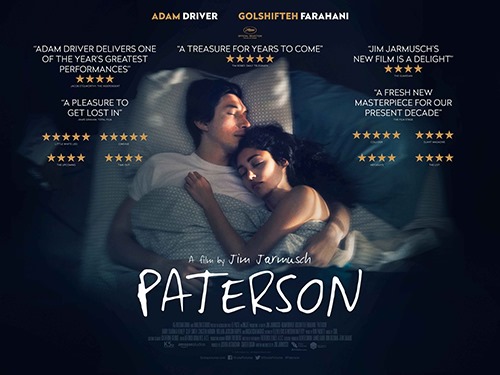
Earlier this month I saw Jim Jarmusch’s film, Paterson.”  This movie succeeds, in its modest and appropriate way, to do something impossible: to film poetry, or more exactly, the composition of literary work. It does this two ways: by having a writer, its central character, portrayed as a regimented, routinized person, grounded in a particularized working-class city and job; and then by having him compose “aloud in his head” his work against this background.

Paterson Poster

this movie has no light-sabers

This is a wonderful choice. The city, the routine clock of the days, the job, become the metrical, musical background for the flowerment of the writer’s consciousness that becomes the poems.

Though the movie is set in the New Jersey city of it’s title, the filmmaker refers often to the “New York School” of poetry, using the poems of Ron Padgett to stand-in for the work of the film’s main character.

The New York School uses a lot mid-20th Century Modern ideas, combining them into various combinations, depending on the individual writer associated with the movement. Some of it can be obscure and abstract, taking off from the same ideas that launched abstract expressionism in painting around the same time. But some also find a tenderness and wonder in the abstract patterns of urban existence, a Pop Art with a depth beneath its surface able to hold a beating heart.  At a point in the film, the main character opens his noon lunchbox to eat, and to write down the intermediate state of his morning’s writing aloud in his head, and there like a Thermos, nestled above an orange and a sandwich, is Frank O’Hara’s “Lunch Poems.” It has to be there.

Lunch Poems Cover

Don’t loose your Lunch Poems

O’Hara wrote in a great many styles, but this slim chapbook features several poems that someone once called his “I do this, I do that” poems. where O’Hara walks about, seemingly composing aloud in his head amidst daily tasks. These are my favorites, because, like “Paterson,” these poems seem to be about their own grounded creation in a city of routines, reflected inside the moist, encased, flowing mind of their writer.

Today’s piece “2ebruary” takes off from that Frank O’Hara mode, as I often like to do, though I’m an old man, writing in another century, in the Midwest, not New York City, and my old joints creak best on a bicycle.

Schwinn IG5 outside Turtle Bread in Winter slush smaller

a scene from today’s piece, breakfast not included


“2ebruary” is a short bicycle journey thinking of history, and past the events that are turning into history that we can still change. I take a pause, as every American should, to note that American culture is made from those who came here carrying something from elsewhere. And Midwestern culture? For many, those packing trunks are hardly great-grandparent’s-age-old, at the eldest.

At one point in the journey, I note those that had no trunks when they came to America, they had only their chattel bodies and souls—and even of those two things, the former had been appropriated by others for handy profit. What could they unpack? Well for one thing: the largest and grandest part of our American music. Our history is short compared to many nations, but it contains mighty things like this. We who are joining that history, already in progress, can turn it one way or another. Which way do you choose to turn?

To hear the LYL Band perform “2ebruary” use the gadget below.