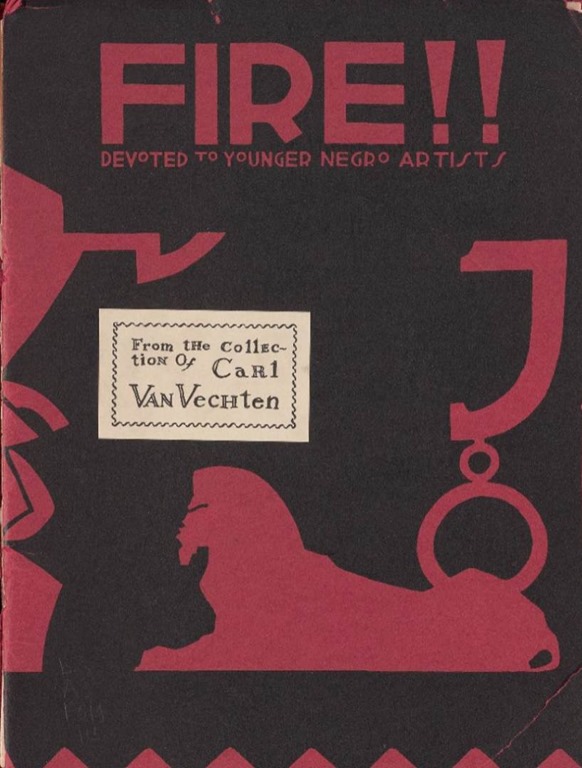
It’s February and in America it’s Black History Month.* In the past few years of this Project I’ve picked a publication that has entered into public domain status to examine.** This February I’m going to feature work from a singular 1926 publication, the first issue of what was to be a literary quarterly called Fire!! The cover advertised it would be “Devoted to younger Negro Artists.”
Want to read this issue of Fire!! in part or all? Here’s a link to a high-resolution scan of it.
.
It’s worth stopping and noticing that “younger” again. It’s easy to fall into a trap when considering a time so long ago to many who will be reading this in 2023 — but its contributors and instigators were in their younger 20s though some had been writing and publishing since they were teenagers. They may seem old to you by strange definition, but they were certainly young to themselves and their contemporaries.
I find that remarkable. While a range of Black American artists were coming to the fore in the last decade called “The Twenties,” I can’t think it was in any way a time friendly to them. Even artistic Modernism, which sought new sources of inspiration and often delighted in mocking old prejudices, was a mixed bag. Racism and ethnic stereotyping remained present in Modernism. Perhaps sociologists could tell us if it was greater or lesser in the world of art than in society at large then, but I’m certain it was no small factor. And yet here were these young writers who at this point thought it was time for them to unleash a record of their experiences.
It’s not so wild a theory to say that they were so audacious because they didn’t know any better. I’m not going to knock that — for this white elderly composer and amateur sorta-scholar to think I have anything to bring to their efforts is not how the smart money would bet either. And you? You’re reading a blog with poetry and a variety of non-commercial music. So clearly, we all don’t know any better.
In the previous year’s Black History Month series here we’ve noted that some forms of new expression that would be featured in Fire!! were not without opposition even from the existing Black Intelligentsia. Jazz and Blues musics were considered problematic. Literary examinations of the sequalae of poverty rather than stories of uplift were controversial. Even if the 1920s were the decade that free verse became more widespread, some of these young poets looked more to Shelley and Keats than Carl Sandburg or Langston Hughes.
Here’s Cullen’s sonnet as it appeared handsomely set in Fire!! It’s also the first poem in the poetry section of this issue, a section titled “Flame From the Dark Tower.”
.
Our lead-off poet is one such example. Countee Cullen was not a Modernist poet. Unlike other metrical/rhyming poets like Frost, and sometimes Yeats or Millay, he’s not even Modernist in outlook. While he’s 23 years old when this was published, he writes as if he was looking back to his last decade to be called the 20s, which would be the 1820s. None the less, “From the Dark Tower” is an impassioned account of the harms of white supremacy — and it is very well written within that style. If the premiere Afro-American poet Phyllis Wheatley was out to prove that she could write 18th century poetry as well as any white poet, Cullen demonstrates that he could do the same for the 19th century. Sure, there’s the matter that he was writing in the 20th century, and we are reading him in the 21st, but that’s likely a lesser sin now when there’s no fresh battle to be joined over free verse, Jazz rhythms, or Blues speech. It’s not unlikely that we read other older poems written in this poem’s style, and Cullen is in 2023 one of those old poets.
And then there’s this — this huge thing. I was trying to quickly get down an acceptable take of my simple acoustic guitar version of my song-setting of Cullen’s poem from Fire!! yesterday. Across my country, at the same time, in a city famed for its American music, so significantly Afro-American music, there was a funeral for yet another Black person killed by our official representatives in a manner that seems clearly to be an affront to civilization. Should we, musicians who’ve inherited that tradition, merely “beguile…with mellow flute?” To sing Cullen’s line, couched in careful rhyme and meter: “We were not made eternally to weep” — can I wish that situation would seem old-fashioned, out of date, a curiosity of the obsolete?
To hear that performance you can use a player gadget that should appear below. No player? This highlighted link is an alternative.
.
*Not to cast shade on this worthy endeavor, but Black History Month has been in my observation largely an Afro-American History month. There’s nothing inherently wrong with concentrating on that subject. I’ll just acknowledge that in the past century or so there’s been a counter-colonialist reassessment of African continental history — and while it has not risen to the level that this American has been aware of it (beyond some UK and other former English-speaking Commonwealth country reading) there may be worthwhile study and information coming forth on the wider African story.
**Because reusing, adapting, even performing, work not in the public domain is a legal gray area, this project shies away from using more modern work. Luckily as this nearing 7-year-long project has continued, more and more “Harlem Renaissance” work has entered PD status. Specific thanks is due to the Yale University Library for making Fire!! available digitally.
Monday is Martin Luther King Day in the United States, which I take as an occasion to honor the man but also to honor the American promise that changes for the better can be achieved, albeit via earnest efforts and personal costs.
At my age King and the mid-century struggle for what was then called “Civil Rights” were not history — they were current events. I can tell you that despite the somewhat anodyne holiday we celebrate this year, these things were in King’s time as fractious and deadly as any issues today. Some of the immediate issues in the struggle were things we might now assume are self-evident, equivalent civic rights for Black Americans: the rights to vote, to travel, to sit in a restaurant, to speak for change. I assure you these things were controversial, and that it was easy to find short and long arguments as to why they were impossible or contraindicated by the inherent and/or empirical nature of Black or white America. Those things, or so it was widely said, were impossible, impractical, ill advised, a poor use of resources, against human nature.
Are any of my readers thinking that the consideration of history including so many instances of injustices is depressing? Or what of the fears that this will cause inordinate shame? Let me then point out on this holiday: societies can advance, costs borne in the struggle for those advances will be honored. On July 4th we celebrate the improbable founding of our country as “A republic if we can keep it.” On Memorial Day we celebrate great losses to preserve that country. On your choice of Labor’s Day we say our nation takes broad-based work. On Martin Luther King Day we can see all those things too. while being reminded that King was not a President or General, but a man who represented and gained his power from us, American citizens, asking adamant with the effectiveness of soul-force, for our country to stop doing what harms us, to start doing better. Isn’t that a fine thing to celebrate?
The 56-foot-tall Birmingham Vulcan exhibited before installation overlooking the city. How the iron man looked around the time MLK was in Birmingham. How it looks today atop it’s base and observation tower. African ancestor: Ptah. The MLK memorial statue.
.
The Song
Are any readers still reading who feel what I wrote above is jejune? If you’re still here, thank you for your patience, but I’m about to try your patience some more. “The Birmingham Vulcan (for MLK)” has never found an audience, and there are times when I can see why. I have an unreasonable love for unusual connections — things that in my mind connect but to most seem trivial. You’d think poetry might allow some license in such things, but that’s not so. When I showed this to my former group of poets when we were all alive together a few years ago, this piece was to them confusing and without a shred of emotional connection. My takeaway? I had portrayed nothing of the wide-ranging connections to them then. It’s gone through a couple of revisions since, likely improving things, but the core problem is that this piece requires a somewhat unique combination of knowledge to make sense.
So, let me take the usually foolish step of providing a brief decoder ring to the mythological story “The Birmingham Vulcan” tells. Poets and songwriters: you should know this is a bad idea. “The Waste Land” and “American Pie*” aside, few readers like the impression that the poem knows something they don’t.
My poet group first-readers stopped right off at the second word. “Who’s this Solon?” Short answer, he’s a big macher for classical Greek Athens and it’s system of government. “What’s he doing in Africa?” Plato told a story in one of his Symposiums that Solon went to Egypt, and the learned priests there told him that he had no idea about the history of his region. Now this is an interesting story choice in that the Greeks were famous for thinking they were exceptional, and here are these foreign Africans telling them they knew more about history than they did.
“OK, so who’s this iron man?” He’s Hephaestus to the Greeks, but to the Egyptians he was Ptah,** and to the Romans he was Vulcan. All three of these ancient gods were makers and metalworkers. Hephaestus has some additional particulars: he was segregated from the other Olympians, was described as deformed or ugly, and in a connection that will come up later, he was also the patron of weavers.
Did the statue’s maker make him clearly Afro-American? Nope, I don’t think the city fathers*** would have paid for any such depiction of Vulcan. But sometime between the World Wars they painted this iron statue brown, either to hide the corrosion or to make the connection to iron more plain.
Third stanza: segregation and regulation to lower paid jobs. One of the “Well, you don’t understand, it just works better that way” situations that King went to Birmingham to oppose.
Fourth stanza: King arrives. King’s “Letter from Birmingham Jail” is as wide-ranging as an Emerson essay in terms of references, but I loved this little noted connection: King was in a city of foundries and chose as an example of soul-force civil disobedience the men from the biblical book of Daniel thrown into a fiery furnace for disobeying the ruler.
Fifth stanza: “Letter from Birmingham Jail” is not written to dispute overt racists or the segregationists. Rather it was addressed to ostensible supporters who raised objections to getting on with stopping what was hurting the country and offending justice. The non-segregationist position was to object on a wide range of fronts to that civil rights movement — some with practical, strategic or logistical concerns, some seeking to assuage those whose “culture” and “traditions” might be offended. And of course, many too were silent on those issues out of fear, ignorance, or distaste for struggle. King spoke to those too in his letter.
The original version of this piece was called “The Cord of Life,” a phrase mysteriously used in King’s letter, and one I loved for its connection to Hephaestus, and so it remains in this stanza.
I trimmed some stanzas as the poem went through revision that directly referred to the infamous Birmingham Sunday terrorist bombing of a church during the civil rights struggle in Birmingham. A great many poems and songs have already sung of this and of the four schoolchildren killed going to Sunday School, so I hope it’s still remembered. That act was so offensive that the terrible sacrifice helped move public opinion. The sixth stanza is all that remains of that matter, and I still feel the song is a bit long, but I left this one in so that there’s some motivation for the Vulcan statue to magically speak in the concluding stanza.
The last stanza as the silent statue finally speaks has been worked over several times. I still hope it has some power on this day. You can hear my sung version of “The Birmingham Vulcan (for MLK)” with the player below, or for those who don’t see the player, with this highlighted link.
.
*I admire the former and am generally uninterested in the latter. So even for the exceptions this doesn’t always work.
**Ptah, venerated particularly in Memphis. As in the delightful Talking Heads lyric “Cities” got away with it: “Memphis, home of Elvis and the Ancient Greeks.” That song, like mine, is briefly referring to the “African origin” theory/myth that assuming that Western culture started with the Greeks ignores that African cultures may have informed the Greeks.
***The writer’s group, poets of good taste, disliked my play on words “foundering men.”
Here’s a short post presenting a short poem,performed now here as a short song. The poem is “Beehive” from Jean Toomer. If you meet the poem, as I did, first as a series of words on a screen, you might be drawn into it as a pretty lyric poem which leans into a poetic tactic: repetition. Three words get refrained heavily: silver, moon, and bees.
Of those, moon is the least surprising, for if one was to take all the poems ever written the moon would likely take a top spot in the category of celestial objects. Sure, the sun would give it a contest, stars indeterminate would be in the running too, but the added changeableness of the moon, and in English the longing of its doubled vowel sound, gives that word a poetic familiarity. Silver then comes along for the ride with moon, though it’s not the only color that is used to describe the moon in other poems. The final highly repeated word, bees, is more clearly a choice, not a convention.
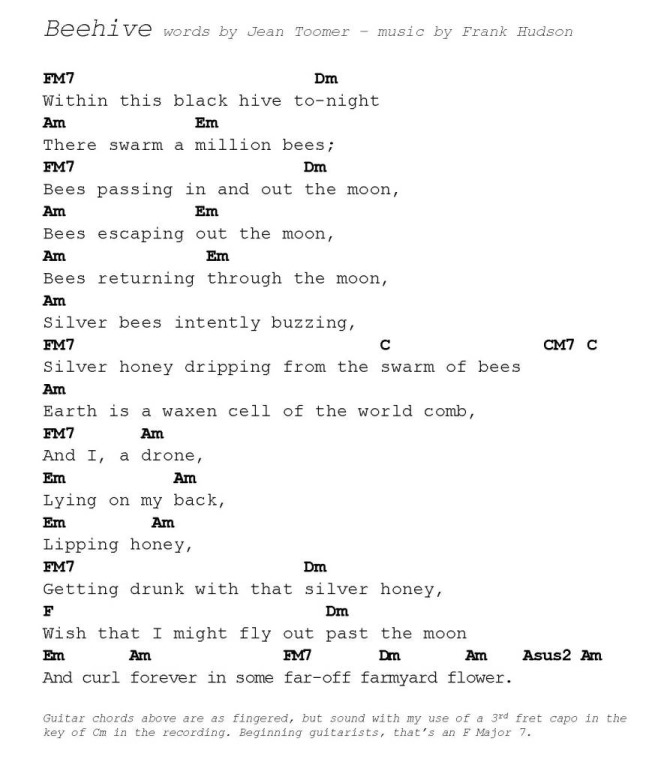
Here’s Toomer’s poem as a chord-sheet for my musical performance.
.
I had fun during this year’s marathon Emily Dickinson reading typing a chat notice every time a bee appeared in a Dickinson poem, and my opportunities there were plenty — but Dickinson’s leitmotif choice can be easily explained: she had a great interest in plants and gardening, and so the busy pollinator could be like Blake or Rilke’s angels to her, an important object in her understanding of how things are signaled and accomplished. That’s how I understand Dickinson’s bee,* but Toomer’s choice to use bees six times (not counting associated words hive, comb, buzzing, drone, and swarm) in this 80-word poem is my task today.
If one wants to think about this poem in addition to enjoying its word-music and flow of images with their surface lushness, the bee here seems a clear image for labor. Toomer published this in his book Cane, which gives his impressions of southern American agricultural labor. Toomer himself was the child of an enslaved man. The laborers in his book from the Last Decade to be Called the Twenties, are part of a feudal arrangement that barely rises to the level of Capitalism, and that scheme is enmeshed with a blunt racial caste system. Because the book is set in the past it may be easier to see the sharp edges and crushing weight of such things for some of us — however much the haze of the present day occludes our present vision. The moon is silver, the color of coinage, this work is part of an economic system, the beehive. The speaker is a drone, a worker. The bees are portrayed as agricultural workers not poets (the pollination is of a “farmyard flower” not artistic flower-show candidates.) They appear alienated to the degree they’re thinking at all, yet our poem’s bee is unable to separate themselves from the hive, the swarm.
Does that reading damage the poem for you? I can imagine it might for some. “It was a pretty poem” might be a response to the above. And of course I could be wrong — poets themselves have told me I misread their poems. I’m not an expert on Toomer, I’m merely here exploring with you.
You can hear my musical performance of Jean Toomer’s “Beehive” with the player many will see below. Those who don’t see the player can use this backup highlighted link.
.
*Dickinson’s bee is most often singular from my casual memory. Toomer’s here in this poem is always plural, though the quiet quitter dreaming of lying on their back drunk with “lipping honey” seems a single drone’s desire.
I have no new musical piece for today’s American celebration of freedom’s restoration, Juneteenth. I made moves toward one, but things didn’t move fast enough. In my wayward search I’ve been spending more time thinking about the Mid-20th century period 1940-65 that I wrote about a few posts back. During that period the Afro-American art form Jazz moved from being a predominant popular music style (though often performed by non-Afro-American musicians) to a multi-valent art music that intelligently reflected young Black artists, their concerns, and their adaptations.
That transformation is a complex thing, and this’ll be a short post. Early this century Ken Burns’ Jazz made the simplified case that this was a tragic arc. Art-music is something a smaller portion of people listen to, live with, care about. I don’t buy that singular tragic summary any more than I buy the companion theory held by others that the audience’s advancing stupidity is to be blamed instead. I suspect these theories are subject to the downhill-to-hell-in-a-handbasket generational syndrome that is ever repeated throughout time. Not that there aren’t things worth observing, worth reviving attention to, worth taking back out of the toolbox for reuse in these sorts of reverence for the past! After all, I’ve spent a good deal of time in this project drawing attention to and finding worth in early 20th century Modernist poetry. So, moldy figs, check.
I’ve spent a good deal of time this month listening to mid-century Black American Jazz, some of it from the end of that mid-century quarter when “free jazz” was the new thing. It’s not everyone’s cup of expresso-in-a-small-club. In Burns’ Jazz, several of the talking critics had it that these were the vandals that sacked Rome. Last night at dinner I tried to explain Albert Ayler to my spouse, who loves me enough to forgive that.* Want a simple blurb from me now on Ayler? Most people will be unable to listen to many of Ayler’s recordings with pleasure without significantly understanding something of its intent and context. There’s an argument to be made that art should never resort to that. My belief: sometimes one needs to be baffled, needs to ask questions on the parade from ear to heart. In the Jazz documentary, Stanley Crouch (the initial G is silent) would say of a player like Ayler “the emperor has no clothes.” I’d say he’s stripped naked.
Mid-Century was also an era when LP liner notes could be saying something. Here’s a bit written by Steve Young on 1965’s Black Arts/Free Jazz live album “The New Wave In Jazz.” I’m unable to find anything about what happened to this Steve Young.
.
So, it was Free Jazz in my ear as I approach this month’s American’s celebration of the restoration of freedom. Soon it’ll be American Independence Day. We Americans abundantly like the word freedom. Conceptually freedom is inherently a broad thing. People tore into the Capital crying freedom from votes they wished to disenfranchise. People were beaten on the Pettus bridge crying freedom to cast votes.
So, Freedom’s a broad thing. Freedom is like the meaning of life, self-evident and elusive. I think it’s to find your joy and to help others.
Here is today’s returning meeting of my original music and someone’s poetry, from one of the too-overlooked Afro-American artists of the last decade that was called The Twenties: Gwendolyn Bennett. She just called it “Song,” as broad a title as freedom for a complex thing that is Black American music. You can play it with the player below if you see that, or with this highlighted link.
.
*I told her I’d just spent the day reading LeRoi Jones/Amiri Baraka and listening to free jazz from 1965. Poetry and 50-plus-years-ago free-jazz combined will interest a few people, less perhaps than even the small crowd for either of those things by themselves — that’s you folks reading this far — and she’d just spent her day helping sick people. Sing heavenly muses: that I clearly have a higher calling.
As we continue into the last week of National Poetry Month I’m going to remind casual readers here that poetry is not only beauty or amazement, even if during this month we often emphasize those qualities. Yesterday’s piece by Chicago’s Carl Sandburg was about a lovely evening, about a generalized bonhomie with love, music, and moonlight. Today’s poem is by Sandburg’s Chicago contemporary Fenton Johnson and it’s about abject dejection and bitterness. It’s called “Tired” and it’s strong stuff, even today more than a hundred years after it was written.*
As you might expect, it was controversial when first published, even among Johnson’s fellow Afro-American writers. Some didn’t care for the poem’s prosey free verse. Some thought it’s despair unseemly or unreflective of the demonstrated willingness of Afro-American’s to struggle and overcome. Here’s how James Weldon Johnson,** a multi-talented Black American who republished “Tired” in his pioneering anthology The Book of American Negro Poetry, judged Fenton Johnson:
He disregarded the accepted poetic forms, subjects, and language, adopted free verse, and in that formless form wrote poetry in which he voiced the disillusionment and bitterness of feeling the Negro race was then experiencing. In some of this poetry he went further than protests against wrong or the moral challenges that the wronged can always fling against the wrongdoer; he sounded the note of fatalistic despair. It was his poetry written in this key that brought him recognition. The central idea of this poetry was startling. Doubtless its effect was in some degree due to the fact that it was an idea so foreign to any philosophy of life the Negro in America had ever preached or practiced. Fenton Johnson is the only Negro poet who has ever sounded this precise note.”
There doesn’t seem to be any good summary available to me about what Fenton Johnson himself thought about his poetic methods, or his political beliefs — but after reading a range of his published verse accessible to me I believe “Tired” to be a “persona poem,” presenting one of a series of characters,*** not the author speaking their own memoir as poetry, not a summary of correct political stances, but one of a variety of examples: some comic, some ironic, and none quite as despairing as the speaker in “Tired.” My theory: much like Sandburg and other early Midwestern Modernists such as Edgar Lee Masters, Fenton Johnson wanted to show a range of outlooks and modes of expression.
Do James Weldon Johnson, or others who’ve wrapped Fenton Johnson with the label of bitter and despairing, know better? You and I should consider that. Still, even when they speak of Fenton Johnson’s work in mixed terms, that testifies to the shear condensed power of “Tired’s” expression and how it struck them as it might still strike you today.
Sandburg’s “Back Yard” celebrated immigrants, and Chicago’s Afro-American population in 1919 included a lot of interstate Black immigrants fleeing a Jim Crow South.
.
As National Poetry Month continues, still three ways to hear this piece. There’s a graphical audio player below for many, and this highlighted link if you don’t see that — and our April bonus, a lyric video with more 100-year-old photographs like those in our contrasting-mood Carl Sandburg “Back Yard” video last time.
.
*As with “Zeppelins” from earlier this month I thought it best to put warnings on the video description so the casual watcher doesn’t come upon the depiction unawares.
**These two Johnsons aren’t related, but it makes references to the pair in this post more longwinded.
***The “Last Chance Saloon that haunts “Tired” appears for example as a place of musical conviviality in another character poem of Johnson’s that I’ve performed here “The Banjo Player”. A third Fenton Johnson poem I’ve performed is his masterful recasting of a spiritual sermon “A Dream.” Feel free to click the hyperlinks for those two to get a wider view of Johnson’s poetry.
Here’s a sharp short poem about an alienated performer written by a little-known Afro-American poet who slots in between Paul Laurence Dunbar and Langston Hughes, Raymond G. Dandridge.* Given that most 20th century Afro-American poets get placed in the “Harlem Renaissance” shelf-section, it’s notable that all three of these Black poets have connections with Ohio. Dandridge lived his life in Cincinnati, Dunbar was from Dayton, and Hughes went to high school and started writing poetry in Cleveland.
Unlike Dunbar and Hughes, Dandridge never left Cincinnati, but “Zalka Peetruza (Who Was Christened Lucy Jane)” made it into some anthologies, and that’s where I came upon it in the early years of the Parlando Project. It’s a momentary portrait of a woman who has taken on a foreign sounding name to further her persona as an exotic dancer. Dandridge says she “danced, near nude,” but the poem doesn’t more fully explain the context. Moderns may wonder if this is a tawdry stripper kind of gig, but my ignorance of what Dandridge would have known and possibly seen as a young man in early 20th century Ohio, doesn’t give me enough of a clue.
The 19th and Early 20th century in America did have scandalous but putatively artistic dancing by scantily clad women, often playing exotic roles from myths, legends, or even the Bible. So, I just don’t know. What Dandridge does make plain is that our Zalka Peetruza is doubly alienated. She’s not presenting herself as Lucy Jane, a domestic Afro-American, and there’s no sign that she has agency or enjoyment in the eroticism of her act.** There are levels upon levels of alienation here: she’s pretending to not be an Afro-American, she’s performing without joy in the performance, without any understanding of her by the audience, and all this is in the situation of America’s racial caste system and overt early 20th century racism.
To illustrate the strange alienation of black dancers before white audiences, I was able to find some pictures of the Afro-American performers at Harlem’s famous Cotton Club whose audience was “whites only.”
.
Dunbar’s poem “We Wear the Mask” has become a famous general statement of Afro-American alienation. Dandridge’s poem is more specific and focused, but it gains its own power from that.
But wait, there’s one more level of alienation to deal with here. Raymond Dandridge was paralyzed from polio as a young man. He wrote this poem about a dancer when he himself was bedridden, able only to write after learning to use his left hand. From this stance, this situation, he wrote a poem about all the ways that dancer was alienated from being an authentic artist in America, and the moment of “shame” in that failure.
A newspaper illustration of how Dandridge wrote. Oddly, the illustrator shows him using his right hand.
.
There are three ways to hear my performance of “Zalka Peetruza (Who Was Christened Lucy Jane)” that I’ve re-released as part of our observance of National Poetry Month this April. Above is a new lyric video, and then below (for some) is a graphic audio player. If you just want to hear the audio of my performance and musical setting for Dandridge’s poem, and don’t see the player, there’s also this highlighted link.
.
*Silly things I wonder about sometimes. There are two other notable Black Dandridges. One that even comes up in web searches for Raymond G. is Ray E. Dandridge who was a slick fielding and hot hitting Negro Leagues 3rd baseman who was just a bit too old to benefit from the post Jackie Robinson integration of baseball. He did spend time in the high minors past his prime playing years with the Minneapolis Millers, who played a few blocks from where I write this. And then there’s Dorothy Dandridge, who was a mid-20th century Afro-American singer, dancer, and actor. I idly wonder if our poet was related to either. Ray E. was from Virginia, but Dorothy was from Cleveland.
**Nor does the poem’s speaker, who is perhaps Dandridge himself, admit to any positives to Zalka’s dance. The implications may be that he does not have, or that he’s not willing to talk about any erotic charge received from it — but I also suspect that there are elements here of the sexual exploitations of enslavement making the dance situation shame-prone. However, Dandridge is not shaming the dancer, only noting that she feels shame. The poem doesn’t tell us what took Zalka/Lucy Jane to this career, or even who the audience or employer is. I can only speculate.
Just suppose that back in the 1920s someone wanted to record a Blues song based on Emily Dickinson’s “A Soul selects her own Society,” and so they waxed a 78 rpm platter at Paramount records “New York Recording Laboratories,” located back then in, well, Wisconsin.*
If they did, it might sound a little like this.
We offer this sort of nonsense as part of our celebration of National Poetry Month. Then again, maybe it’s not nonsense. Dickinson’s poem does fit into “Old Weird America” and its music shockingly well. Why’s that?
As best as can be determined, Dickinson wrote “A Soul selects her own Society” during her highly-productive mid-19th century, but for a variety of reasons, this poem, like almost all the other poems that she wrote, wasn’t published until near the end of that century. Somewhat “regularized,” Dickinson’s poetry was bound then into book-length collections that sold well for poetry by an otherwise unknown author, partly due to the myth of her eccentric later-life used as hype for the verse, and because some of her poetry was disarmingly informal and approachable — at least on the surface.
Literary poetry gradually began to take notice of her. I presented Sandburg’s audacious mention of her in 1914 as an “Imagist” earlier this month, and over the course of the 20th century her work has eventually been judged as important as Whitman’s in presaging 20th century Modernism. Now, I daresay that if one was to survey living poets in 21st century America for what 19th century American poet they read, admire, and use as an influence, Dickinson would beat out Whitman — and those two would leave the rest of the field far arrears.
What else happened around the beginning of the 20th century, but took serious critics and culture a while to notice? Afro-American secular music — Blues and Jazz — which would come to significantly define American music internationally and become the dominant strain of our country’s music ever since. Americans were highly important in English language poetic Modernism.** Afro-Americans had their Modernist revolution to offer too, and a great deal was musical in this era.***
So, in another way, this unlikely pairing of Dickinson and Blues isn’t as odd as it seems.
Three ways to hear this performance of speculative fiction: a graphical player is below for a portion of you, but if your way of reading this blog doesn’t show that, this highlighted link will also do the job.And the new lyric videos we’re doing this month is the third way to hear “Soul Selector Blues.” Oh — it’s not your speakers or computer — it’s supposed to sound like a Paramount 78 RPM record!
.
*Port Washington Wisconsin to be exact. I’m not entirely sure why Paramount Records wanted to make it sound like it was in New York, perhaps for prestige, and despite the name they had no connection with the motion picture company Paramount either. What was a record company doing in Wisconsin anyway? Well, they made furniture (the upper Midwest was a timber source) and that led them to make cabinets for the new entertainment device, the phonograph. And if they made phonographs, why not seek another income stream from the “software,” the disks to be played on them?
If you choose to view today’s lyric video you’ll see a sampling of how they marketed to Black Americans variously (I can hear the meeting: “Who really knows what they like and will buy…”). High culture to gut-bucket, spirituals to sexual rebels (Ma Rainey’s “Prove It On Me” is about exactly what the illustration on its Paramount ad might lead you to think it was about). They had a pitch for your money and ears.
**Curiously, almost exactly 50 years before the “English Invasion” brought British rock’n’roll bands to the U.S., a small but influential group of Americans were over in England evangelizing poetic Modernism. Were The Beatles payback for Ezra Pound and T. S. Eliot?
***Even literary minded Afro-American writers, critics, and poets weren’t necessarily ahead of the curve in seeing Jazz music and Blues lyrics as an authentic Modernist revitalization of tired-out existing tropes at first. Langston Hughes and Carl Sandburg were exceptions a century ago in seeing this.
In 1922, amazing Afro-American polymath James Weldon Johnson* published an audacious anthology titled The Book of American Negro Poetry.Not only did it claim that there was a tradition worth an anthology at that early date; in his preface Johnson made the observation that Afro-American music was disproportionately important in American musical culture, and furthermore that he saw no reason that Afro-American’s literary impact shouldn’t also arise to that level.
A century later Johnson the prophet could be charged with underestimating Black American’s musical impact, but we are entering an era when his predictions about Afro-American poets are no longer considered exceptional cases, and not even a “why not” situation — but instead an “of course” predilection.
One has to give Johnson credit for declaring this back then, with what poets had managed to be published or otherwise eked out a career at a time when the ex-enslaved were still living. A few of the poets he put in his anthology would soon be known as the vanguard of the “Harlem Renaissance” and yet others would remain little-known afterward. Only one, Paul Laurence Dunbar, really had made writing a career at that point, and a large part of that career’s viability was on the back of a 19th century fashion for dialect writing, with rough printed approximation of regional and ethnic speech being put forward as evidence of America’s diversity or oddness. Reading Dunbar’s dialect poems today is rough going, a lot of context and translation cultural and phonetic is required.** But Dunbar also wrote fluent poetry in the rhymed metrical styles of the day, and those are the poems he’s remembered for now.
And what about those “deep cuts” in Johnson’s anthology, those poets and poems that aren’t required in a modern summary anthology of American poetry? One of those is Anne Spencer. It’s an imperfect analogy, but you could roughly think of Spencer as a sepia Emily Dickinson. The two poets even shared a passion for gardening. Except there wasn’t a preserved and handed-down pack of good copies of poems in Spencer’s case. Imagine what we’d know of Emily Dickinson if the tiny number of poems that were published in Dickinson’s lifetime were all we had?
It’s plausible the proximate reason that Spencer’s poem praising Dunbar was included in Johnson’s anthology was that Spencer’s home was a waystation and salon frequented by Black artists and civil rights activists in the Jim Crow era, which would have included Johnson. But let’s just be grateful, it’s a lovely short lyric making in a handful of words, the case that Dunbar, and by extension Afro-American poets yet to come, can stand with and extend the tradition of British poets then considered “canon.” And by linking Dunbar with the struggling working-class poets Chatterton and Keats, and the exiled radical Shelley, Spencer may have been making a subtle point about where poetry could, or should, come from. And like Johnson, she predicted with her poem’s linkage that by our present time we’d remember Dunbar as a supple lyrical poet unlinked from the fashion of dialect poetry.
The lyric video includes a poster for a Dunbar performance and some photos of Spencer. Spencer wrote poetry throughout her life, but didn’t focus on publishing.
.
Three ways to hear my setting and performance of Spencer’s “Dunbar” today. You can use a players that will be shown below in some ways this blog is read, or this highlighted link if you don’t see the player. And, as we’re doing this April, there’s the lyric video above.
.
*Polymath? Well, let’s see: key early civil rights leader, helped found NAACP, poetry, novels, wrote the lyrics to “Lift Every Voice and Sing” (aka “the Negro National Anthem”), diplomat, teacher.
**Dunbar made a go of it touring and reading his poetry, the sort of thing that was the YouTuber or podcaster route for extra-literary revenue and publicity then. His dialect poems were often touted on the billings, and so may have been the crowd draw. I don’t know how integrated his audiences were, or indeed how the dialect stuff was presented. I’m unaware that any recordings of Dunbar exist, and I don’t know that we even have secondary recordings such as exist of folks who knew Twain, imitating him on early records from direct memory of performances.
It’s Black History Month, and I’m planning on presenting a series focusing on Langston Hughes’ first poetry collection: The Weary Blues — butbefore we get to today’s new Hughes’ piece, let me briefly set down a few reasons for why Langston Hughes.
This project presents early Modernist poets most often. From the American predecessors of Modernism (Whitman, Dickinson) we often jump to those of the 1905-1926 era who sought in various ways to “make it new.” While I continue to read and have interest in post-1926 work, less of that can be reused freely for this project. This reduces the Afro-American sources free to use, as the beginnings of the Harlem Renaissance have moved into Public Domain slowly, year by year, since this project began in 2016. My earlier Hughes’ pieces, even if they were eventually included in The Weary Blues, were published earlier and so had already moved into PD. It’s only on January 2022 that the whole book’s contents moved to public domain.
Our February focus: Langston Hughes’ first book.
.
A second reason: look at the title of Hughes’ first book, it includes “Blues.” As we celebrate Afro-American contributions and experience this month there’s an important parallel here. Americans, some of whom set up shop in England and France before WWI, are hugely important in establishing the Modernist break with the shopworn 19th century writing styles. At the same time, Afro-Americans were crucial in doing the same job for music. As I tried to briefly explain last Black History Month, a great deal of the American Black intelligentsia was caught flat-footed by this musical revolution happening around and by them.*
Let’s cut them some slack on that: cultural change is hard to understand while it’s happening, and the quick white adaptation of Afro-American musical ideas in The Jazz Age of the previous Twenties reflected back to the Black community some rough or even derogatory approximations of what was really going on.
Hughes was a young man when he wrote today’s poem. He’d crossed paths with Black intellectuals by then, but he wasn’t fully one of them. His father had cut a bargain for him to go to Columbia to become a professional. Langston skipped out, worked as a cook and at other restaurant jobs; and took to sea working on merchant ships. Hughes came quickly to an understanding of this new music, it’s complexities and its reflections.
Lastly, here’s one of the things I’ve come to understand about the beginning of Modernist poetry in English: there were substantial elements there that sought to strip back poetry, to simplify it to its essence, to make it immediate to an open heart and mind without pre-requisites. This mode was eventually superseded by a more academic and allusive poetry to the degree that some of the best of this early poetic Modernism was set aside or down-rated as simplistic and insufficient.
Over the years you’ve heard me sing the praises of Carl Sandburg, who seems to have been eventually excused away as cornball. But Sandburg was still vital to the young Langston Hughes in the 1920s, and Hughes took Sandburg’s Midwestern American Modernism and applied it to his own heritage and experience. The mainstream of Afro-American poetry retained more of the vitality and working-class connection that Sandburg expressed. Thank you, Afro-Americans.
Let’s move onto the poem I used as today’s text for the performance you’ll be able to hear below. “To Midnight Nan at Leroy’s” is not one of Hughes’ best-known works, though it deserves more attention. Here’s a link to the text. You could skim through it on the page and see the Blues connection, even if it’s not a Blues stanza as printed — though it could be refitted as one — but more importantly, it’s got a Blues sensibility. My reading of the poem says there may be a little playing going on, a little con and double consciousness which the whole of the work will show up. This will let the hip listener say on hearing it “Yeah, you and I know what that’s like.” That’s Blues sensibility.
I think the poem is a dialog. Nan of the title is performing at a club, and she’s expressing some eroticism in her performance. I think the poem’s other voice is hitting on Nan. The opening stanza is that other voice, the un-named man, who’s starts out teasingly acknowledging that he’s getting what she’s putting down.
The second stanza could be either voice. I performed it neutral, even as if it might be a narrator, a third voice. Note the loaded word “jungle” in it, one of the “primitive” adjectives used to describe this new Afro-American art. Primitive isn’t totally a derogatory or diminutive to the Modernists, who remember wanted to remove the cruft of a worn-out culture and get back to an essence; but in the context of a white-supremacist-soaked society it could surely slide over to being that. Black artists with intact self-respect did use labels such as “Jungle” in the 1920s, so it’s not simply an external white appellation, but it sure sounds like they’re partially reflecting with the white culture when they do. Pause at the last line: I hear Hughes’ “And the moon was white” with intent.
The third stanza is the man cheering on the singer/performer Nan, and I think also he’s suggesting that if “lovin’” is her object, he’s ready.
Fourth? Yes, the two get together. I perform this as Nan’s voice. Note Nan’s use of the diminutive “boy” for the man in this part of our dialog. He may have been acting the player in his earlier stanzas, but I think this is an intentional reveal that the male character is less than a fully actualized man. The white moon image returns, and their moments of Black joy contrast against it. One could write a moving essay on this poems white moon image, but I’ve already gone long.** You write it.
The poem concludes by refraining the entire first stanza. I perform in the man’s voice, now sour-grapes-ing the couples’ night. Who put one over on the other in this one-night? Maybe some of both, and maybe external social forces are part of the fate-mix too. Hughes chose to dedicate the poem to Nan, so I suspect his sympathies lie more with her. Another question: is Langston Hughes the unnamed male voice? Hughes’ sexuality is mysterious, and while that’s possible, my estimate is that he’s observing, not writing a poem as memoir here.
I performed “To Midnight Nan at Leroy’s” with my own one-man-band providing the trio accompaniment, and I hope your speakers can handle the bass part. Some of you will see a graphical player gadget below, but other ways of reading this blog won’t show it, so here too is a highlighted hyperlink to play it.
.
*Last years Black History Month book was 1925’s The New Negro , which included an essay worrying about the dilution of Black uplift and culture from the diversion of frivolous Jazz. Read my post on that essay here.
**As with Sandburg’s short poems, with Langston Hughes here it may help to imagine that you are translating this from Tang dynasty Chinese. The plain English words here could mislead us to think this a mere rote moon/June thing and that Hughes had nothing complex to say.
I’ve got reasons for kicking off Black History Month a few days early: my February is going to be appointment-filled, something that’s likely to reduce new work for this project, and I want to participate in this observance of American history.
Why was I so determined to do this? Well, note this project’s subtitle: “Where Music and Words Meet.” I’m an American composer, and American music is disproportionally Afro-American music. Yeah, it’s a big country, and many musicians with heritages from every continent* have contributed, but if you compose or play American music, a lot of the notes are Black. So let’s get to today’s piece through three short, linked, tales.
The First Story:
Who’s this Sonny Rollins, and what bridge is he selling us back in the Fifties of all decades? It’s easy writing about poetry as I do here most often, to get used to a constrained fame; but I suspect more of the general Internet audience will know Emily Dickinson, William Butler Yeats, or T. S. Eliot than know this man’s name and work. Mid 20th Century Americans, most often Black Americans, made a consolidated point of becoming masters of improvisation on the saxophone. Afterwards artistic accountants rank art and artists — and even if you think that’s wrong-headed, I’ll cite those who expend sincere effort in doing that and say that lists of great improvising saxophone players likely include Sonny Rollins.
But, just saying Rollins was good at it, a skilled musician, reduces him. For one thing, he had a dedication to the art of his craft, a need to expand the expression. So much so he famously spent a couple of years or so just dropping out of what was then still a viable commercial niche of jazz gigs and recording when he was considered to be one of the best and brightest on his instrument. To do what? To get better.
Insiders later learned some particulars of what he did. He went to a near deserted deck of a busy urban bridge and just played. And played. For months. For hours a day. In all kinds of weather. No, he wasn’t busking for spare change. Few noticed him. One of his records before this time was called Saxophone Colossus. This wasn’t ironic as a title, or laughable, or a piece of hopeless self-promotion. Once likened to a metal giant who could stride rivers, Rollins on the bridge was small and alone and unnoticed, one man in a wind-gap of a city’s gusts. Practicing there he was no more than a flea on the back of a colossus.
After around two years of this, he figured he found some of his new/better. If you’re writing a screenplay you know how the final scene plays out. Our hero walks off the bridge and into a recording studio. A selection of ominous natterers remind us of the stakes in quick cuts: “Was he kicking drugs, or failing to kick? Is he washed up?” “You know folks like it sweet and tropical, he should try to play bossa nova.” The next voice says, “Funky jazz is the thing.” And another says, “How can you be even more free than ‘free jazz?”
And you know the next beat in your screenplay: he emerges with a record or a concert or both — and all of a sudden everyone realizes that he’s found it, something great, unique, ground-breaking, resplendent and recognized.
Wait, you don’t know who Sonny Rollins is — or maybe you do, but you know the person next to you on the Internet doesn’t. The record that Rollins did make was called The Bridge in honor of the solitary workshopping he did over the East River. It was not a cultural event. Throw out your screenplay, the elevator doesn’t want your pitch. Even the experts then, the artistic accountants and grim critic-coroners were underwhelmed. Paging the Joseph Campbell who isn’tan under-recognized Irish poet, this is The Hero’s Journey that ends with a shrug.**
The Second Story.
Back in my youth you paid for music ala carte. Every bit you could access at will was on a material disk you had to pay for. A person like myself with more time and adventure than money might scrounge. One thing I liked to do was to go into charity and second-hand shops and look for used records that attracted me. I can’t recall the exact cost of a new LP then, but I think it was around $3 to $4 or so. Records in these dingy shops might be a dime or 25 cents. Those within cardboard covers gave you extra material to judge if it was worth your widow’s mite — but at those places and time, the most forlorn records were just bare black disks scuffing against each other in a bin, and sometimes those got an additional price break. Whenever I recall those naked disks, I think of those who cleaned up after someone died or skipped rent and town, who just shoveled it all off to Goodwill or the Salvation Army in whatever, Warholian, cardboard boxes.
That’s where I found Sonny Rollins’ The Bridge. I may have heard a bit about Rollins, how he was a particularly good improvisor because his improvisations had the logic of more considered compositions while retaining the flow of fresh idea after fresh idea.
Three things struck me about the record upon listening to it over and over and under its scratches and surface noise: that it mixed moods more than most jazz records. It wasn’t just a fast blowing session with a change of pace ballad or two, but that it was both angular and spare and hauntingly beautiful in both sorrow and joy.** That the guitar player, Jim Hall, on the record didn’t sound like “jazz guitar” as I had heard it then.*** Instead, Hall added unusual harmonic colors that Rollins would then carve from. Eventually I realized something else unusual about the record as I compared it to more jazz records: there was no piano or other keyboard instrument. I eventually learned that this was something Rollins’ made a practice of. Yes, Hall was giving pieces some harmonic framework, and bass players in non free Jazz contexts are often asked to, and then, play “the changes” indicating the chords; but keyboard players, even if it’s not their session, often dominate the harmonic and rhythmic structure of a track. Here there was none of that.
Poetry in Gray. I know this is a long post, and I value your time, but here’s 30 minutes of the same group that recorded The Bridge playing live with a short interview with the 32 year old Rollins.
.
The Third Story
I read this week an article by John Fordham in the Guardian that reminded me that Sonny Rollins went into the studio to start recording The Bridge on January 30th in 1962 — so, 60 years ago. Fordham remarked on the legend of Rollins’ time on the Williamsburg Bridge along with a new interview he did with Rollins.
Unlike almost every one of his mid-century saxophone contemporaries, Rollins is still alive. He’s 91 years old now, and I last saw him play when he was around 80. Rollins was performing in a trio on that night with just bass and drums, and for about an hour he tore it up covering so much sonic space with his monophonic but powerful instrument. I marveled then, and now that I’m approaching his age at that gig, my amazement increases. Rollins developed lung disease and can no longer play, but he seems to have retained his composer as improvisor ability to see the patterns and connections.
This month I’ve been trying to build up a little strength and chops on guitar again. Nothing like Rollins’ multiple hours each day on a bridge level of woodshedding, but enough so that I can play that instrument that requires some physicality to realize its sounds.
In the midst of this, in the middle of the night, I awoke with some thoughts I had been growing about Rollins and the task of being an American and Afro-American artist. I wrote a complete first draft of today’s text in that middle night awaking. Not quite a Kubla Khan dream, but still complete and formed enough to count today’s text as an improvisation. Wednesday, I came up with the song’s harmonic structure equally quickly. Yesterday I recorded it. Given that I’ve no access to other musicians — and I hardly make count-one-musician unless I beg the composer (who’s me, so I listen) to make things I can play — I had to play a track at a time. Today’s recording is a trio: drums and two guitar parts. I first recorded the chordal guitar part on a big archtop guitar (DeArmond X-155) along with the vocal. I’m no Jim Hall, but like Rollins’ The Bridge I let that instrument set the harmonic framework. I confess (though listeners have already convicted me) I’m not good at Jazz comping, a key guitarist’s skill in that genre. I pardoned myself and proceeded. I then did the drums, trying very hard to get them to play off the guitar’s rhythm feel. And then finally as my studio-space time was coming to a close, I got to “blow” with guitar for the lead part.**** I did four passes, and the third was the best, and there you are. No, it doesn’t sound like The Bridge LP, but then the point of The Bridge wasn’t to sound like what went before either. The player gadget to hear it is below. No gadget? This highlighted hyperlink will also play it.
.
*I must pedantically interrupt in footnote form to note that the continent of Antarctica has done little for American musical culture! It may be because our human species only visits there? One man, one guitarist at that, stands (sinks?) as the submariner of Antarctic-American guitar: Henry Kaiser. Here’s a 90 minute example. Yes, that’s him playing guitar, and doing the under-ice diving too.
**Joy? “Without a Song. ” Sorrow? “God Bless the Child.” Angular? The title cut’s cascade of heterodox melodic ideas. Or the stubborn “John S.” I used to share a workspace with a 20-something guy who liked his progressive metal. He was perfectly tolerant of my King Crimson live tour ‘70s tapes. But the opening riff of “Jon S.” would drive him right around the bend to a burlesqued old-person-like rant about “take off that noise.”
***Jazz guitar at that time was represented to me by John McLaughlin in his Mahavishnu Orchestra years and others exploring that bag. Those guitarists were loud and very in your melted-face with their expression. Even quieter, older generation jazz guitarists often played more notes in one song than Jim Hall played on the entire The Bridge LP. Magazines would have “best of” polls back then for musicians, and I’d always vote for Jim Hall, who’d end up in the fine print of “those also receiving votes.” Then strangely enough as the 20th century started to end, Jim Hall became the model for a number of other guitarists who came up later, for example: Pat Metheny and Bill Frisell.
The Bridge itself has come to be recognized as more vital in retrospect. Oh, not necessarily to the raters who will need to get numbers down for Kind of Blue, A Love Supreme, The Shape of Jazz to Come first, but to those who seek to learn new pleasures listening to music whose time has passed but whose timelessness remains. You may not like all of it if you just taste test it. Looking today, about eight times more Spotify listeners pleasantly listen to “God Bless the Child” than dig “John S.” By the way, the version on Spotify seems to be remastered, and to my memory Jim Hall’s parts are mixed up higher than they were in my vinyl memories.
****Should it have been saxophone? Yes, but I have a hard time wrangling any of my saxophone MIDI virtual instruments to get good expression, and Rollins is a master of saxophone expression. I stuck with my primary instrument for the lead instead. By the way, it’s the same jumbo DeArmond archtop that chopped the chords, but my little combo amp is turned up.




 Frank Hudson