Emily Dickinson: Forever and Crumbling

Today Emily Dickinson is going to show us how not to write a poem—and how to make it work anyway.

This piece combines two different poems she wrote: “Forever—is composed of Nows”  and “Crumbling is not an instant’s Act”  in a way that I hope lets each poem reflect on each other. Both speak about time and the universe’s track along it, and that’s part of Dickinson’s substantial task as the poet here: these things are abstract. The Modernist experiment, which Dickinson in many ways presages, would generally try to represent even the most abstract, contradictory, and elusive things as images, palpable things. When that tactic works, it lets us find a shape, a sensual feeling, a weight and color to things we otherwise cannot behold.

Dickenson can  do that. Forgotten Imagist Carl Sandburg* even called her an Imagist, just as Imagism’s call to Modernism was emerging a few decades after Dickinson’s death and posthumous publication. But here, in these poems, she predominantly avoids that tactic.

I can think of a few reasons she might do what she does in these poems. If you’d like to follow along, here are links to the text of  “Forever..”  and to “Crumbling…”

First, she received a science education. This may seem odd, even though some time back we learned that Percy Bysshe Shelley, the uber-romantic poet knew how to calculate the distance between the Sun and the Earth, but Emily Dickinson was a woman as well as a poet in Shelley’s 19th century. Science? My 21st century child goes to a high school with a substantial STEM program. “It’s all guys, and they act like it too” is the report about the Engineering class here in 2020. But in Emily’s New England, science, the humble mechanics of the universe, was actually considered a safe subject for the hampered female brain. Politics, theology, fine arts would all be fields walled off from women anyway, but they were also considered inappropriate for the lady-brain.

The second is that she grew up in a household steeped in the legal profession. Her father, her grandfather, and her brother were all prominent lawyers. Though I’m not a full-fledged Dickinson scholar by a long-ways, I’m not aware that this substantial fact is much discussed as potentially formative in how Dickinson saw and thought about things. Yet, here by her poetry we can see that she was possessed of a mighty intellectual engine, one whose genetic blueprints and environment would be tailored to express things as lawyers might: in sharply defined abstract legalities.

Lastly, 19th century poetry was comfortable with abstraction of the sort she exhibits here, though few could match her compression of expression. We still use much abstract rhetoric in general discussion, but our poets generally recognize the danger of taking the specific vividness out of verse.

In the first piece of our dual Dickinson presentation today, she makes a statement about the nature of time: that it cannot be experienced relatively other than as an infinite series of nows. She cannot find a physical image for this, and so uses abstract scientific and legal language to describe this mystery: “Composed…Infiniteness…latitude…remove…dates…dissolve…exhale,” and the near-enough Latin of “Anno Dominies.” This, the language of a contract or scientific paper. That said, a phrase like “Years—exhale in Years” is palpable.

The second piece, “Crumbling is not an instant’s Act,”  could be read as a tiny summary lecture on entropy. In the middle stanza of this three-stanza poem (‘Tis first a Cobweb on the Soul…An Elemental Rust,”) Dickinson moves from abstract summary to imagery, but even here, her knowledge of botany, both empirical and academic, is deployed. “Cuticle” is not some chat over a manicure—it’s a distinct feature of plants. “Borers” and “rust” likewise would be familiar to Emily as the dedicated gardener of the Dickinson household.

Cucticle-Herbarium-Clausius

Emily Dickinson, science nerd:. Hosta’s cuticle protects it from dust, Dickinson’s self-made herbarium scientifically categorized a host of plants, and Rudolf Clausius considers entropy and whether to grow a mustache or not


The concept of entropy was only first posited in 1850, and I don’t know if Dickinson had any access to discussions of what would have been a fresh scientific concept. Some read “Crumbling is not an instant’s act”  as a reaction to medical or psychological issues Dickinson was personally facing rather than musings on the formal structure of ruin and the universe’s law of return to equilibrium. That reading works too. This old guy may not study thermodynamics, but I can personally recognize the states in this poem without measuring instruments or a blackboard of equations.

If you or I were to try to write either of these poems, we’d risk failure. Our abstractions might seem enervated, while the compressed energy of Emily Dickinson carries me through her argument, even where one cannot follow its intellectual thrust easily. In the middle of these abstract arguments, in the second stanza of each three-stanza poem, Dickinson lets in enough imagery to pull us in.

It may seem odd, now, in this month, as the nation stands at a crossroads to present these two poems today. Frankly, as I looked for any poem in the public domain that wouldn’t seem beside the point or merely pander to it, I failed.

Dickinson wrote in the midst of the greatest crisis, moral and physical, that our nation ever faced. In 1963, in a critical year of struggle against Afro-American civic oppression, John Coltrane released four records. In 1863, in the midst of the turning point year of the American Civil War, Emily Dickinson wrote 295 poems. Coltrane was a musician, not a poet or singer. I can’t fault him for not giving us words when he gave us “Alabama”  and “A Love Supreme.”  Emily Dickinson’s poet’s words don’t address the Civil War directly, we can even doubt that she understood the situation of Afro-Americans and slavery’s advocates significantly, however sharp and searching her mind was. So, check your privilege Emily? Sure. But her poetry is about—no not just about, is —freedom, a searching, seeing mind. Our caring hearts take us partway there. Our minds must journey too.

In combining these two poems I wanted to put them in a context that rings for me, in our present moment, however abstractly. We are in our forever nows, as we always are. Ruin is not a now, but a formal process, consecutive and slow.

Thank you for reading and listening. The player to hear my performance of two poems by Emily Dickinson should appear below.


*In looking for the next piece here I must have read or re-read over a hundred Carl Sandburg poems this past week. He’s often remembered as the 20th century’s first great inheritor of Walt Whitman, with great spanning catalogs of Americana in rambling free verse. But early Carl Sandburg is full of attempts and successes at concise Imagist poems that work like his contemporary pre-High Modernism Imagists’ poems did.


Reading Du Fu in the Ruins (with hope)

I’m still unable to think of completing new content here, but let me quickly follow up to say that we seem to have passed through the worst nights featuring the burn and bust cadres on Lake Street in Minneapolis. Which leaves only the sorrow and injustice, more than enough to tamp down my muses.

If plagues, oppression, and fires seem Biblical, then we get miracles too. Take the scene of the semi-truck coming down the freeway with thousands sitting on the pavement in focused protest just past a gentle curve. I have surely slighted the murmurations of crowds in a recent post, because they parted in an instant of flight seen in the video that looped over and over in coverage last week. Moses and Aaron never saw the like—not a single significant injury. Knowing America bristles with guns governmental and otherwise is not a comforting thought any night for me, but also the guns barking hardly at all* (so far) seems nearly as miraculous.


Plagues and miracles: additional phone video showed some of the first to the cab stopped retribution being taken on the driver. 


I continue to be amazed and gratified at the racial diversity of the protests here. That shouldn’t be a miracle, but it’s noticeably different than the earliest BLM protests. This may be a result of the clear casual atrocity of the George Floyd killing or some “Great Awokening” kind of evolution. Call them the Prince Rogers Nelson brigade. Afro-Americans seem to be leading the protests and observances now and focusing on the issues and pain. When people jumped on the still crawling forward semi-truck and yanked the driver from his controls in the furious moment when several tons had just missed killing and maiming hundreds, it was Afro-Americans in the crowd who stayed the blows.

There’s been much chatter in the neighborhoods/local social media and in some mainstream media articles about who the smash and burn cadres are, and if they are in some organized sense. From watching hour after hour of coverage and trying to use what rusty “radar” I have from old activist days, I suspect at least some small-group organization aided by modern cell-phone tech and automotive mobility is a factor. When I talked to alternate Parlando voice and keyboard mainstay Dave Moore last week I said “Give me 50 agile young people with some hand tools and fire accelerants and I could create all the significant destruction of the past week.” Five teams of ten, even if they aren’t together, would work just as well. Largely unconfirmed reports have these as anything from leftish anarchists, to younger right-wing militia types who hate the police too, to drug seeking gangs.**

Multi-racial neighborhood people seem to be on edge about this. It’s not just some rehash of the old “outside agitators stirring up our good local Negroes” trope. As the protests become more focused and organized, they also seem more effective at recognizing adventurist acting out and curbing it.

When I spoke recently about the Gloomy Gus progressives, the ones who will sagely tell us how nothing ever gets better, and how this or that supposed progressive advance was an illusion or failure, I perhaps should have made clear I was talking to an element in myself too. My nature and life says the human condition is limited, even though it can store immense amounts of hate and love, creativity and indifference.

What are those limits? What elements will be part of the solution or part of the precipitate? What I think about these things, what I can do about them, is less important that what you and you and you think and do.

So, nothing new today, but here’s Dave Moore and I performing a poem written in a set of wet ruins by the supreme classical Chinese poet Du Fu centuries ago, and translated by myself. Was Du Fu a Gloomy Gus? Maybe, though like Robert Frost when he was lost or downhearted, he knew to press on anyway. Here’s the text if you’d like to read along, and the player gadget for the peformance is below unless you’re reading this with the WordPress IOS app (try using a browser instead to hear the audio piece in that case).

Jade Flower Palace – Du Fu trans. by Frank Hudson

The stream winds, the wind sighs.
Rats are running in the rafters.

The prince who owned this palace–
No one knows his name,
But it stands, abandoned beside these cliffs.

In dark rooms green ghost fires are shinning.
The streams now run over the boulevards.
From the trees I hear flutes? Voices?
Autumn leaves are wet with rain and rattle in the wind.

The young palace ladies,
Once painted on scrolls:
Now yellow dust buried in the earth.
What use now their robes,
their makeup and kohl?
And his gold chariots and the men who drove them?
There is only this carved stone horse.

I sit down on the grass and try to write of this,
But my ink is overcome by rain or tears
There are many paths away from here
How long are any of them?
None of them go on forever.


*One man reported shot and killed in what was sketchily reported as a looter/store-owner confrontation is all I know of. He seems forgotten in the surplus of events.

**One publicized arrest so far is a white guy (from, of all places, Galesburg Illinois, the hometown of Carl Sandburg) who live-streamed himself doing stunt arson and looting for a following that looks smaller than this poetry and music blog. The main argument for gangs is that far away from many of the crowds of protesters that unintentionally provided herd-cover in the early days of this, a large number of drug stores got broken into across the city.

The Stare’s Nest at My Window revisited

For Heidi

It’s been a rough series of days in the Twin Cities. Other than no great new loss of life (only fear of it) there’s not been much accomplished in my home or in my city.

I have a few new pieces in various stages of completion, and ordinarily I’d be working on additional ones for this project. This spring the pandemic quarantine measures have been bothersome, but so far Dave and my family have been coping and doing the best they can. Given the number of people sickened and killed by Covid-19, bothered and coping might as well count as “the best we can do.”

Then comes a public act of callous manslaughter. Worse for not being unprecedented. Worse for being tied to the sickness of racial oppression. We have a vaccine and a natural immunity for that: It’s empathy and love. Yet, many refuse to be vaccinated, or don’t have the vaccine available to them.

The phrase “the best we can do” has fallen into disrepute. Perhaps you’ve come upon this piece after reading or hearing someone else remarking on why this phrase is dispensed with, or should be dispensable.

For the last two nights the quarantine from the virus has been trumped by the fires and murmuring crowds. Crowds with the wisdom of crowds, which is to say, not much. Crowds work like a jangling overstimulated nervous system, tingling with pleasure and pain receptors, with a prejudice for why not.

My family, my friends, my artistic compatriots, my neighborhood are at the epicenter of this. Long time readers may know that alternate voice here Dave Moore was associated with a 20th century literary magazine that called itself “The Lake Street Review.”  Minneapolis’ Lake Street is (insert here the English verb that needs to be invented that stands for the balance of hope/fear/despair in our present moment poised in is/was/will be) a multi-ethnic, multiclass (if mostly working class) strip of enterprises where you can get diapers, groceries, your prescription filled, that part to keep your old car running, foods from fast to global, places where bands used to play before Covid-19, bookstores, libraries, arts labs, paper and toner for your printer, intoxicating beverages, hardware stores, your laundromat-load destination, where you go when your car needs gas and air for the leaky tire. It’s were the Latin Americans and African and Asian immigrants have their shops. Lake Street is an early 20th century construction. Apartments still over the retail ground-floors in older buildings, houses and apartments right next door behind the stores, closer than modern codes allow. Great portions of this are now gutted, looted; still smoldering from last night or cold ashes from the night before that.

I’m sure what we live  is a hugely interesting phenomenon for commentators, political philosophers, or folks just looking for a “news hook” to write or say something. Some will be civic sports-bar-tone arguments for who needs to be shot on sight for the sight of their targets, others will be earnest explainers about how rioting is the only effective language of the dispossessed, and that the wreckage of the places that a large percentage of those from the middle on down to the homeless frequent and depend on isn’t the disaster for them that it looks like to those less-evolved in their political consciousness.

As I’ve said already, I myself fear I’d dishonor this with my broken prose and dim eyes. And what old men think about this is less important than what those younger who may read this think, resolve, and do.

The Stare Nest at my Window text

Yeats poem written while sequestered in Ireland with his wife during a civil war. “Stare” is a old name for the starling, considered a nuisance bird.


Beneath the beach, more paving stones.

Friends of my family since both our children were born spent the hours around midnight wondering if the unchecked flames from a torched gas station would spread to the homes next door. My neighborhood post office (the same one where Lake Street Review  submissions used to come in) went up in big black smoke as it was deliberately broken into and set aflame. I’m not sure if anyone looted stamps.

My wife asked around midnight if we should flee.

“Where would we go?” I asked.

“Away from the flames.” She said.

All this is happening in a mix of memorializing assemblies at the site of the callous killing, protest marches with pointed aims, and then the looting and vandalism. I’ll offer one piece of observation that you may have not seen in the reports and thumb-sucking think-pieces: the memorializing, the protestors, and the vandals are an integrated lot. Skin tone and hair, those markers for ethnicities we use in our great cultural mythology of race, is My Rainbow Race in these events from the pious, to the protest, to the break and burn brigades. Watching cell-cam videos and media long-shots has impressed on me that the palette of the sufferers and perpetuators of these actions are not one shade. Racists are going to need to ignore these visuals as they form their illness’ distortions. The guy smashing the library window, setting fire to the auto parts store, or acting like a drunk frat boy he would never righteously be as he shoves the burning dumpster nearer to the building might well be white in these nights.*  And the “Nothing-ever-changes” cadre of gloomy-Gus activists** are likely too tired and weary to notice that the white, Asian, and Latin American participation has increased markedly in this time’s repetition of events sad, demanding, and chaotic.

I used gendered pronouns in moving to the vandal side of things, as that part does tend to become a sausage-fest. My wife is going off to join others this afternoon to sweep up broken glass. Not to get into gender stereotypes here, but how much do you want to bet that the gender mixture there will be distinctive too?

Tonight, I do not know what will happen. The memorializers will continue to do so, for George Floyd is still dead. The protestors will continue to protest, for it’s still wrong. And the vandals, not even interested in the materialist desire of the looter *** for a case of beer, a flat-screen TV, a book of Yeats collected poems or LeRoi Jones’ liner notes will continue to maintain that the best refutation of a failed “the best we can do” is: “the worst we can do.” The tao is too strange for me to know. Blessed be if they are right.

This is all the squishy thinking and writing I’ll be capable for a while. Tonight, I will probably not sleep, or fall asleep in imponderables. Will my wife be able to sleep the night before our anniversary? Will someone’s laddish fire, set with self-congratulating righteousness, find its equivalent of four Birmingham Sunday-school girls? When will America’s Valkyrie gunfire (I say with dread: remarkably rare so far) begin to sing? Will progressive change crest and recede? How happy is Donald Trump, our king of misrule, as his empire expands while progressives proclaim nothing ever changes as proof of their progressive acuity. Tell me, I want to believe, I need comfort: are you sure too it can’t get worse?

I now return you to our usual cultural activities. The most popular piece I’ve posted this year is by a cultural nationalist poet from another nation: Ireland’s William Butler Yeats. When I posted it at the end of January I wondered if I’d done well by it, but I now think I did, and listeners seem to agree. I’m also now sure my reading of this text is shared-heart-true. If you have time, and are interested in the exact background as Yeats wrote this, read the original post linked here.

This is a week where I have been in my own little run-down tower, seeing out my  window as Yeats showed me. Brothers and sisters, read the last stanza of Yeats poem in tears—even though they don’t put out fires directly.

Rather than a link to the text you’ll see it above in its entirety because I urge you to do that. If you’d like to hear my performance and music for this, the player gadget is below.


*Having tasted but not absorbed the fibrous materials of current cultural appropriation tropes, do any white anarchist allies as they smash the state at the library window, or get all dewy being a revolutionary fire-starter in a multi-ethnic neighborhood wonder if they are being authentically respectful of non-white culture from their skin privilege?

**I have long wondered at the futility of the salesman (as an agitator is, to a large degree) who paints their product as ineffective in use and their allies and audience as always deficient. I’m an old man. I understand being sick and tired. I’ll buy the “I can’t believe we’re still fighting these same old battles” T-shirt. But don’t tell me it itches, it’s guaranteed to fall apart, and isn’t available in my size.

***A few years back someone, who I cannot remember in order to credit, said that rioting with looting combines the two least attractive tendencies in American culture: shopping and violence.

An Old Man on Record Store Day

The Parlando Project is mostly about presenting other people’s words. I like that. It adds variety and it lets me write about what encounters with those words bring forth. We’ve done that over 400 times since this thing kicked off publicly in 2016

So, we’re always ready to celebrate National Poetry Month. Any month is poetry month here! But every once in awhile I slip in one of my own poems. Sometimes it’s just because I have something I want to say to this adventuresome audience, but it’s often because I’ve read something someone else wrote and I think of something I wrote (or should write, and then write) that relates to it.

A blog I read regularly by Paul Deaton has ranged over various subjects in the past couple of years, but lately he’s been writing some about the past, including lives that range back into his parents and grandparents generations. I’m not going to go back that far, I’m only going to go back to when I was a young man. Given my age, this is “Boomer” territory that’s been already over-farmed—but bear with me. This isn’t really a poem about the past, it’s about someone in my generation who has a past, but presently. For those Gen X and Millennials who find this insufferable, I remind you that I’ve been priming my High Schooler who isn’t a Millennial to blame Gen X and Millennials for ruining things for the current and subsequent generation. I urge other geezers, crones and wise-ass elders to do the same. As our aged, but still very stable emperor demonstrates, the best thing to do to deflect blame is be proactive in shoveling it elsewhere. I don’t know why that should work, but it does!

Anyway, I’ve presented quite a few poems this year by younger-than-mid-life poets whose poems speak as if they are aged.

Besides National Poetry Month, April is supposed to bring us Record Store Day. It would have been last Saturday, an annual celebration of those venerable little stores that once again were selling dark flat petroleum circles that sing when you poke them with a needle. Our current crisis has canceled that.

Now back in my day…Oh man, having a past and dragging it around does make one insufferable doesn’t it…this sort of thing was serious business for me. I had little spending money, but I would hope to have it in order to buy one of those foot-square pieces of art with the circles inside. Something cool. Something that represented my generation.

I can remember a particular spring afternoon. Somehow my girlfriend and I had caged a ride in a keyboard player’s new AMC Javelin to travel to Iowa’s capital city where there was a “head shop” (which is where the best new records were sold, along with, well, “smoking accessories.”) On the way we listened to an 8 Track tape of the Moody Blues To our Children’s Children’s Children.  When we got there, I could merely marvel, as I had barely enough for one record album, and couldn’t decide which one to get or if I might need the money for something else. So, the only thing I bought was a pinned badge: a smaller, paler circle, containing a bit of the cover art to the Cream’s Wheels of Fire  record.

Badge
A circle from “The Sixties.”


Recalling this day 50 years ago or so, says paradoxically to me what music and recordings meant to me then. A record was a precious clue to take me through days or weeks. Foolishness? It’s always been partly that.

But of course something else was on my mind, and the mind of some of my generation on that non-official, just another record store day. War. Justice. The cutting edge of the then gap between generations and elders that had been through WWI, WWII and the Korean War, and were often sure we were ducking our war turn. Our best thoughts of ourselves were that there were more important battles, and of course some of us didn’t succeed in avoiding the war they wanted us to fight. And some of us went off looking for Eden, a place you can sort of find, and then lose track of again.

What else does that memory mean? What does it mean presently? That’s what today’s short piece is about. The player gadget is below to hear it.


Missing

Frances Cornford is a 20th century poet that is close to unknown in the United States, despite achieving some degree of success in Britain. She’s sometimes classed there as a “Georgian poet,”* a grouping that like the Imagists produced several contemporary anthologies in that century’s teens and twenties.

It’s not a term used much in America, even in literary circles, as the 20th century Modernist revolution and American hegemony in general brought so many American voices to the first rank of English language writing. The closest to an American “Georgian Poet” might be Robert Frost, whose first book length collection was published while he was living in England and building a close connection with British writer Edward Thomas who was labeled a Georgian poet.

Georgian poets are often set in opposition to the Imagists and the Modernist movement in general, even though they shared the same times, events, and places with each other, and even though occasional friendships and other affinities might cross between the groups. As Modernism “won” the war after WWI and the crises of the Thirties and Forties, Georgian poets were often seen as too tied to old poetic formalism and nostalgia—and even more damningly, to not fully appreciate the absurdities and dangerous forces of the modern world.

Labels are after all just sticky paper, but in reading poets like Frost and Thomas, I don’t see a pure division. Thomas and Frost’s outlook is just as Modernist as any, just as bleak and unsure of any easy consolation.** What they don’t share with many Modernists is a conviction that seemingly random assemblages of images with obscure rational connections are a useful and powerful tactic in expressing a reality.

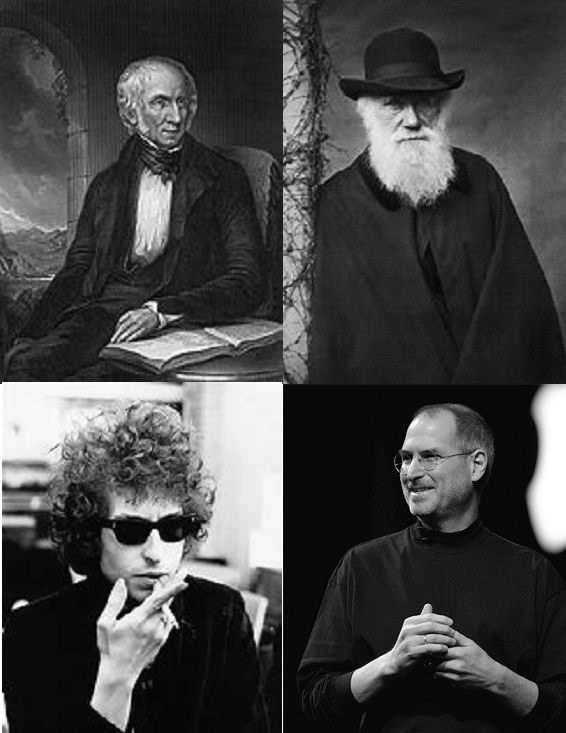
Frances Cornford has a singularly interesting back story, one that (so far) I only know the outlines of. On her father’s side she’s the granddaughter of Charles Darwin, one of the founders of modern science. On her mother’s side, she’s descended from William Wordsworth, a great reformer of verse in English at the turn of the 19th century. She seems to be whip smart, but her poetry may have a deceptive surface. Just to glance at it on the page or rattle it off the tongue, some of it looks and sounds like light verse, the kind of thing that might speak of little foibles and humorous misapprehensions. But then there comes a line that seems out of place, almost a mistake. When I first presented her earlier this month, the “sticks out” line in that poem was “O fat white woman who nobody loves.” Even if we may read that line differently than she intended, I think this smart writer intended for us to be surprised and arrested by it.

Wordsworth-Darwin-Dylan-Jobs

Frock coats to black turtlenecks. Frances Cornford: roughly like being a descendent of Dylan and Steve Jobs today.


Today’s Cornford piece, “Missing,”  is even shorter. Two lines in (but ¼ of the way in this very compressed poem!) we might think we are about to get a piece of humorous verse musing about “just where did I put that.”

Wham! “Dead soldiers or unposted letters…”

If this was a Dada or Surrealist collage we might be forewarned by stylistic expectations, not just that a war casualty is about to drop into our short poem, but that it would be joined with something as mundane and as overlooked as an unsent letter. Like Cornford’s “Fat white woman” line it risks seeming like bad poetry or an example of egregious insensitivity.

But of course, this was a woman who lived through both World Wars. She named one of her sons after Rupert Brooke, the doomed Georgian poet whom she knew, and who would die in WWI. And that son then was killed fighting on the side of the republic in the Spanish Civil War.

Taken inside, as small, strange poems can be, Cornford’s “Missing”  may make you see differently, think differently. Also, these poems have made me think again about the value of risking “bad poetry.”

To hear my performance of “Missing,”  use the player below. I liked the simplicity of the music today, just strumming guitar and voice, as I worked on a more complicated piece that you might soon hear. Maybe you’ll like it too.


*In 1910 the British king Edward died and King George V was crowned. He lived until 1936, so his reign was a handy shorthand for a group of British poets whose careers emerged just before WWI.

**The group of American women poets, sometimes given the label “Songbird Poets” (Teasdale, Millay, Wylie, and to some degree Taggard and Bogan) who are favorites here have some of the same position and problems with “High Modernism”.

A Letter to Those Who are About to Die

Certainly not the most self-love inspiring/invest me with hope/promise to give me beauty title for a poem. Mid-century American poet Kenneth Patchen could supply those sorts of things, but in his first book, Before the Brave  published in 1936, he was looking around him, and the things he saw and felt were ominous.

In that collection and this poem, Patchen seems militant and politically committed in tone, though the poems seem too immediate to the times for me to fully decode his advocacy. “A Letter to Those Who are About to Die”  indicates something’s coming, but it doesn’t simply say what. Violent revolt or revolution? Another World War? State-run oppression? Radical social change? If we study history, we know that it turned out to be some all of that. By the time Patchen was writing “A Letter to Those Who are About to Die,”  the Italian invasion of Ethiopia, the Spanish Civil War and the Japanese invasion of China were at hand or a few months away. Hitler was firmly in power in Germany. America was in economic crisis—and if you were poor, black or another ethnic minority perhaps only a generation away from another country that might be equally troubled, your life was now doubly challenged.

Kenneth Patchen 1939

A photo of the young Kenneth Patchen in the 1930s


I know the later Patchen, the pacifist, the poet of love, the painter of illuminated outsider pages, but this was an angrier voice, more desperate than I expected. He was all of 24 and he’d just found the love of his life—but this wasn’t a newlywed world of hope. Could we look back from our perch informed by 20th century history and say he was wrong, that he was over-reacting? No. The ovens, the bombs, the death marches, the battle beaches, the truncheons, the gulags, the lynchings, the public gunshots.

Someone called Patchen’s mid-century cohorts The Greatest Generation. They fought for and against these things, perhaps in roughly equal numbers, and there are claims in all alignments that some of the above list of horrors were necessary to defeat some others also of the above. Objective history can tell us this all happened, even if it can’t speak with one voice on which horrors were justified. As far as I know, Patchen was against all of those horrors, which made him an outsider in his generation. Idealist? Naïve? An individual who opted out from being blamed for history?

I’ve been taken this spring by a song of Andrew Bird’s “Bloodless.”  Bird’s an artist that I’ve previously admired more than I’ve wanted to listen too, but this song has a laid-back Curtis Mayfield/Marvin Gaye groove and heart that I can’t deny, with lyrics about the poets exploding like bombs “And it feels like 1936 in Catalonia.” That feels, in my present, like today’s Patchen poem.


Andrew Bird’s “Bloodless” official video.


So, even with that title that refuses to be attractive, I’m willing to give Kenneth Patchen a read and a performance, and you may be willing to give it a listen.*

Musically, my band and voice aren’t going to be keeping Andrew Bird awake on those nights when it’s music and not the parallels of the Spanish Civil war that interrupts his sleep. However, Patchen is one of those pioneers in combining spoken/chanted poetry with jazz-influenced American music, including collaborations with John Cage and Charles Mingus and a series of LPs with other musicians issued in the ‘50s. I do not expect or wish to frighten the ghosts of Cage and Mingus, only to honor their, and Patchen’s, independent spirit. The player gadget to hear my performance is below. There is no easy place to read the text of this poem on the Internet, but this link may work for those that want to read along.


*By coincidence, the Poem-a-Day from poets.org today is by Fatimah Asghar titled I Don’t Know What Will Kill Us First: The Race War or What we’ve Done to the Earth,”  which title probably equals Kenneth Patchen’s in click-through rate, even though the poem itself might ask us to read the title after the poem rather than before. I sat in a bakery this week and overheard two older white guys, looked my age or a bit younger, discussing the ridiculousness of fears like unto Bird’s and Fatimah Asghar’s these days in America. I wonder what Kenneth Patchen would say if he were to stop by?

Hitch Your Wagon to a Star

As we continue to celebrate National Poetry Month here, I ask your indulgence—today’s piece isn’t based on a poem. Earlier this week I did use a Ralph Waldo Emerson poem, mentioning then that his poetry often fails. Well, there are compensations—as an essayist, Emerson often expresses himself poetically.

Today’s piece is part of an Emerson essay published in The Atlantic in April 1862 called “American Civilization.”  In it Emerson ranges quite a bit, including some racial and regional stereotyping that may shock some modern readers with its ignorance and prejudice. But rather than concentrate on what Emerson got wrong—after all, I don’t need to go to 150-year-old writing to find that sort of thing, our own age will supply all we’ll ever need—I want to present to you some things that Emerson might have gotten right.

I’ve selected a handful of sections from Emerson’s essay for today, the parts of the essay that strike me as if they were a poem. I call my extracted text “Emerson’s Wagon,”  in that one of the phrases it popularized became a pervasive folk-motto: “Hitch your wagon to a star.”

What do you think that means when you hear it today? Most likely you think it means have high ambitions, aim for success not mediocrity, that if you only make it half-way you’ll still get farther than if you’d set your sites lower.*

If so, you may be surprised to hear how Emerson meant that phrase. Indeed, the whole argument Emerson makes in today’s piece is a subtle and surprisingly contemporary one.

Ralph Waldo Emerson at desk

Emerson wondering if his essay will go viral—wait—can something go viral on the telegraph?


“Emerson’s Wagon”  starts by telling a technology story. While he’s speaking about the telegraph, a recent marvel of his time, the metaphor here could just as easily be applied to the Internet on which you are reading this.**  In this metaphor we meet the essay’s first wagon, and it’s, well, stuck and broken down. He points out technology has found a way to get around that.

OK, nice story. Interesting contemporary parallel.

Then mid-19th century Emerson starts considering renewable energy. A couple years back I was talking to someone about that very subject and he mentioned Massachusetts had fewer resources than some other parts of the U.S. for that, which I found ironic, because Emerson’s 19th century Massachusetts was leading the country in exploiting water and tidal energy for industrial power.

Here is Emerson’s second wagon, the first one he hitches to a star. He’s not talking about personal advancement particularly, he’s talking about harnessing nature’s renewable power, and working with it to improve our civilization.

Now his technological story is getting more interesting. How many times have you heard of nature and technology portrayed as opposites? Enough that you may think that technology inevitably destroys nature, or that technology is replacing nature, and so on?

Emerson’s asking you to think of technology (and also nature, as we’ll soon see) differently. Technology comes from close observation of and analysis of the powers of nature. And in concert, the book of nature can tell us something about how to use and deploy technology, and how we should share the bounty of that.

Finally, Emerson goes somewhere you probably won’t expect. His third wagon*** says that moral principles are natural principles (and vice versa). We moderns may have some doubts about this, but it was part of the Transcendentalist ideals that Emerson and his fellows believed. From that equivalence, he says that for American civilization to succeed, for us to fix those broken and stuck in the mud situations like that first wagon, we must align ourselves (if we wish to make change) with the moral principles of a nature that spreads over all and gives benevolently. To do so makes us more powerful agents of change that cannot be defeated in the long run.

An interesting thought for a time of lies and behavior that isn’t pulled forward by the tides of heroic stars, that instead aims at the lower level of personal enrichment defended with the muddy shield of not-quite-legally-indictable.

To hear me perform Emerson’s story of three wagons, use the player below, and electricity will transfer it to you in its invisible pockets. To read all of Emerson’s essay, you can find it here.


*It was a phrase my mother would use, and in this sense too. She raised her large and different family whose members did different things, so maybe it has some value used in this way as well.

**The “invisible pockets” he has the telegraph carrying data in so easily become the “packets” that have flown through TCP/IP routers to bring this post or the accompanying audio file to you. Did you know that some of the savviest conceptual thinking about how the Internet works can be expressed via carrier pigeons?

***As he once more returns to the line “hitch your wagon to a star” Emerson eventually reels off a list of constellations named after heroes. You might be thrown by the first one on his list “Charles’ Wain.” I’d never heard of it. Turns out it’s another name for the Big Dipper. Wain is a Middle English word for, yes, wagon and together Charles’ Wain sort of morphs into the name of legendary king Charlemagne.

I Thought It Mattered

Today is May Day, a day that combines many things. Neo-Pagans can point to it as Beltane or the morning that follows Walpurgis Night. Since the late 19th Century it’s been “International Worker Day” associated with labor and Socialist movements. It’s about midway between Spring Solstice and Summer Equinox.

It was also once a more or less secular holiday celebrated because by now it’s likely Spring in essence, not just Spring in some calendar’s notion in northern climes. A long time ago, in my childhood, in my little Iowa town settled by Swedes, May baskets were still exchanged—this before Easter had become one of the commercial candy holidays paired with Halloween. In Britain May Day still a bank holiday, celebrated next Monday with sundry celebrations.

In Minneapolis, this Sunday is the date of an annual parade organized by a local urban puppet theater. We will sit on the curbsides as Indigenous dance crews, drum bands, anarchists, political candidates, stilt dancers, decorated bicycles, giant papier-mache puppets, and various cause marchers pass by to music by flat-bed truck rockers and strolling brass bands. The Minneapolis May Day parade combines all those May Days into one thing, a Whitmanesque democratic cultural event, a container of multitudes spilled open on a city street.

I used to take pictures and film it, but now I just go and watch it. It may be just me, but in the past couple of years the level of invention in the costumes/puppets seems to have fallen off, but that may just be me and nostalgia filters. Ah, for the good old days of 2010! I’m holding that this is just random variation—but in the end it’s the gathering of South Minneapolis people, parading and watching who make me most appreciate it.

The 2010 theme incorporated William Blake, and my soundtrack to this slideshow features Blake’s “The Tyger.”


Today’s audio piece, “I Thought It Mattered,”  has words and music by Dave Moore, and is sung by him along with our more spontaneous incarnation, the LYL Band. Dave’s song speaks of lifetimes, marchers and causes. I think it’s one of his best songs, so give it a listen using the player below.