Are we through with Irish poets? No. Is there going to be less politics this time. Well, sort of. This Project’s goals were not to provide political commentary – the Internet has plenty of that in all varieties – but I’m beginning to have some appreciation for what a hero of mine Carl Sandburg said when asked about his radical politics while already at risk because of his is-this-really-poetry free verse, he answered that politics must find its way into his poetry, in that it was part of him, surrounding him and his times.
So, here’s a poem by Irish poet William Butler Yeats about being weary of politics – yet, he couldn’t avoid it, it was part of him and part of his times too. This poem’s weariness elicits a short catalog of international political issues that he thought of while exclaiming he’s not wishing to think of them. It’s also an old man’s poem, written near the end of Yeats’ life, when he was in his seventies. I’m older than Yeats was when he wrote this, but I too can see what old men do with the weapons of political power so discordant from the Spring that still exists and says we are not here to be the last ones living, but to be as the first ones. Here’s a link to the text of Yeats’ poem, “Politics,” and it’s an interesting link for more than just a reference to the text.
Let me delay you just a bit from listening to the song I made from Yeats’ verse to speak a little about its making. My household this year has become a haven for a small group of young people going through living as if they’re the first ones. Mostly, I try to stay out of their way, but their hustle and bustle in this house complicates the process of creating these pieces you read and listen to here. In these days, I remind myself of the musicians and composers’ prayer: “May music find a way.”
Unable to use one of my good acoustic guitars in my studio space, which I would normally record with a sensitive microphone, I decided to realize the song I had made using a guitar I keep in my home office. It’s an Ovation Applause, a battered old thing, designed as an experiment in making a cheap instrument out of materials thought unmusical.* The body is plastic with plywood, and the neck doesn’t seem to be made from wood (other than the fretboard facing).** Before I bought it used decades ago, my Ovation suffered from a fall or other accident as a lower edge has shattered and there’s a spiderweb of fine cracks extending from the site of that blow. For the past few years this guitar has been stuck in a rack out in the open in my home office because there’s little or nothing in it that could be damaged by the dry winter air there.
Many serious acoustic guitar players make something of a fetish around the woods and construction details of their instruments. It’s not just rosewood, it’s Brazilian rosewood. Sapele isn’t really mahogany, and don’t let them tell you otherwise. Spruce, sure, but from what forest region? Did they use old-school hide glue to assemble it and nitro lacquer to finish it?
This guitar is in opposition to all that: certainly the familiar of a heretic.
So, how’s it sound? Let’s give the witchfinder their due – not to put to fine a point on it, it sounds like crap. If you want richness of sound, this is poverty. There might be some value in its current role: a tool to compose on. That mystery neck has stayed stable all these years, it’s still easy to fret. And its sparce sound would keep one from being to enamored of a something that sounds pretty without having anything beyond its timbre to recommend it – but I’m not sure I’d go that far: it was even more inexpensive being used and damaged, I have it, it’s a hardy thing, and its small size makes it easier to play sitting in an office chair.
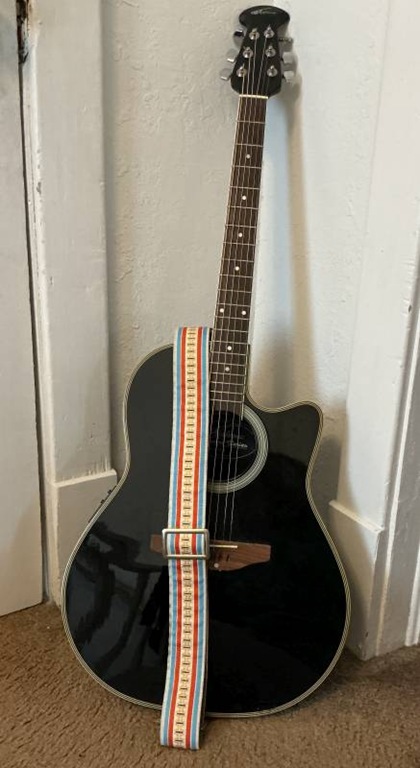
It’s looks legitimate & peaceful sitting there, but what might it summon with its tinny horn?
.
And one night this month, I had an inconvenient time to record a realization of a fine poem by the famous Irish poet Yeats. Yeats got a Nobel literature prize. Yeats became a Senator when his country achieved independence. Yeats is so honored in Ireland, a poem of his is on their passports. Yet, I played my song version of Yeats on an old battered guitar, its cheapness designed in.
And you know, I appreciate a good sounding acoustic guitar. Those folks in thrall to the details aren’t imagining things. But then my singing voice isn’t a finely crafted instrument either, and I’m asserting I can express something of the essence of Yeats’ poem anyway. You can hear it with the audio player below. No player? Has that old wizard Yeats summoned the devil to fly from the shuttered Ovation Connecticut factory with Hartford’s Mark Twain and Wallace Stevens riding with his hoard to take that audio player from you? No, it’s likely just a matter of some ways of reading this blog choosing to not show the player gadget. This highlighted link will open a new tab with its own audio player.
.
*The Ovation brand still exists, a shadow of itself, having been haunted through a series of owners. The plastic bowl-shaped back – though often paired with much better sounding other components than my low-end example – is still controversial. In its glory days, Ovation was well-known for pioneering under-saddle acoustic guitar pickups. They were so preeminent there, that in the last quarter of the 20th century if you were to see a popular guitarist in concert in any sort of larger venue playing acoustic guitar, you’d be more than likely to see them playing an Ovation guitar that looks remarkably like my more lowly example.
Eventually other manufacturers caught up with their own acoustic guitar pickup systems, eclipsing Ovation’s USP. Come the 21st century, the New Hartford Connecticut Ovation headquarters and factory, home to these innovations, was closed.
**At least some early Applause models used aluminum necks. I can’t say for sure what’s under the black paint of mine, but it sure isn’t wood.






 Frank Hudson