The Lent Lily

Here’s a poem by British poet A. E. Housman that’s not an Easter poem — and then again, might be. On its heathered surface it’s a poem about wildflowers. My wife, who likes to hike in natural areas, could probably make good sense of it on first reading — but if you don’t know your wildflowers and aren’t attune to some Britishisms, you might be left with just a pretty set of words.

Lent Lily

Trying to mesh Housman’s poem to the music I was forming, I ended up making changes to the poem as it appears on the page (linked here).

.

Right off in the poem we’re rambling on “brakes.” As a bicyclist, “hilly brakes” might make me think of brakes squealing on my old much-missed mountain bike. While I’d like to think of Housman in a tweed jacket enjoying such a ride, the “brakes” here are a Britishism for a thicket or area of shrubs and other undergrowth. Other words that would have “special” British or archaic English meanings? Young girls are asked to “sally” — which is not the given name of one of the girls, but a word meaning to go forth. In the first stanza besides the “brakes” Housman calls the place of the flowers “hollow ground,” a word-choice that’s a little harder to parse. Hollows are an old word for a small valley, which is likely what Housman means (he calls out valleys in the last stanza). One reading I came upon thought the “hollow” a variant of “hallow,” as in “hallowed ground,” and derives from that the idea that Housman’s wildflowers have sprouted in a graveyard. I can’t find a cite for that variation, but hollow is a somewhat odd choice here, and without regard for hollow meaning hallow, graves do produce hollows in the ground.

Our first wildflower, primroses, are found in that opening stanza. Next stanza, next wildflower, the windflower, which I first thought was a Gerard-Manley-Hopkins-like compound word, but windflower is the common name for another wildflower. The stanza goes on to introduce the flower featured in the poem’s title: The Lenten Lily which the poem tells us “dies on Easter day.”

Third stanza, the primrose and windflower are still present to decorate May Day, but the daffodil we’re told is not. And the poem ends with a final stanza telling us again that the daffodil dies on Easter day.*

Here’s more wildflower ignorance on my part: the Lent or Lenten lily is the daffodil — just another name for the same flower. I’d never heard that Lent lily name, but for a long time I really didn’t know the daffodil either. The daffodil is a common wildflower, but unlike my wife, I don’t know it to call it out by its name and properties on sight. I knew the daffodil not from the book of nature, but from the famous poem by William Wordsworth** “I Wandered Lonely as a Cloud.”

A few years ago while visiting England in the early Spring I came upon an entire lawn at Kew Gardens filled with yellow flowers. “Daffodils” my wife told me. This was a London park, not the hilly brakes of Britain’s Lake District, but I suddenly found myself, from her knowledge imparted to me, inside Wordsworth’s poem and the physical, now knowing, presence of this flower. The dark green grass and the sunny yellows in array before me were ever brighter because back at my home in one of the most northern states, things were still snow covered in early April.

My view soon after entering Kew Gardens.

.

Housman is telling us something else about the daffodil: not only is it one of the earliest blooming Spring wildflowers, giving rise to the Lenten lily alternative name for it, but it’s also one of the quickest flowers to die and disappear. That name, that property, gets us to the question of “Is this an Easter poem?” Housman is not at all a Christian devotional poet — he was a devoted academic classics scholar and agnostic.

Well, maybe that’s his point. Easter is the particularly Christian holiday of resurrection and eternal life. Housman, not a Christian believer, has written a poem that refrains on something natural — this flower — that’s not spiritual like a soul or godhead, but a piece of lovely, wind-caressed carbon that dies by Easter Day. In that natural order, this brief wildflower certainly dies. A Christian apologist could easily counter: that’s the promise of The Resurrection, that it is something else. One can read the poem and see either side. Of course, there is a thumb on the balance: Housman has written a poem, and I’ve gone along with him and made a song of it. Poems are not so much about what they say — because they have sound and a carefully selected order, they are more about what it feels to say or see or sense something.

You can hear what I made of what Housman’s poem portrays with the audio player you should see below. What, has any player disappeared like the daffodil? It’s not that — some ways of reading this blog don’t believe in showing the player. So, you can roll away the stone and use this highlighted link to hear it instead.

.

*I’ve read that English churches are decorated with picked daffodil flowers during Eastertide, which may be what Housman is referring to when he says that other Spring flowers survive April. Or the primrose and windflower et al may just be hardier species.

**As it turns out, William Wordsworth based his daffodil poem partly on journaling done by his sister Dorothy Wordsworth who had accompanied him on his Lake District walks. That’s a wonderful thing about our relationships with others: what we see and sense can be informed by them.
Soldier from the wars returning

I’m going to present a pair of poems which are more related to Armistice Day, the former name for the holiday now called Veteran’s Day in the U. S. Here’s the first one.

Earlier this month I was confessing to Lesley Wheeler that I haven’t read much of English poet A. E. Housman, a poet who I believe retains more readership in the UK than here in the States. Well, no matter how little I know of him, his poetry has qualities that attracts musical composers like myself.

Soldier from the wars

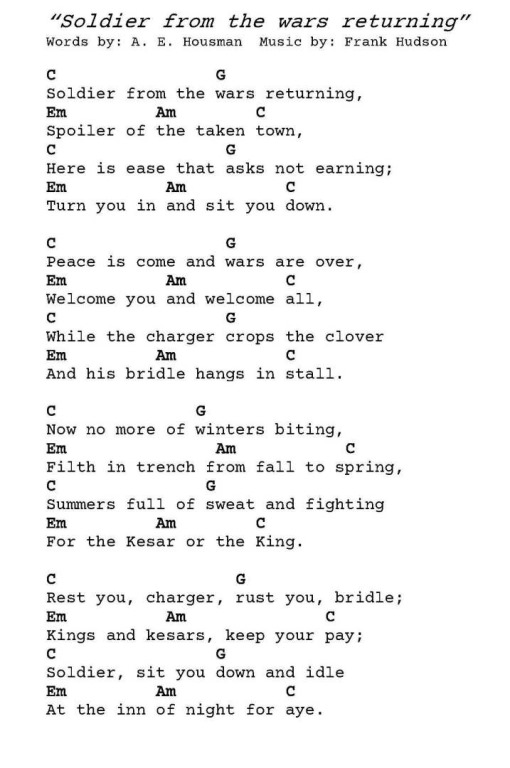
Here’s a chord sheet for today’s song. I recorded this with a capo on the 2nd fret, sounding in the key of D

.

This poem, which may not have had a title as I saw it with just the first line in quotes, is clearly a poem for Armistice Day and its veterans, first published a few years after the end of WWI. I don’t find it a complicated poem, but that doesn’t hurt it when one seeks to be comprehensible in an immediate performance such as I gave it. It’s hope, contemporary with Housman and his listeners when he wrote his words, that “wars are over,” now has sort of cruel quaintness, but it was an earnest statement then. Here’s a link to Housman’s words, and then below this is an audio player gadget to hear my performance of the song I made from them.

No audio player? Clicking on this highlighted link will open a new tab with its own audio player in that case.

.

Fall 2020 Parlando Project Top Ten, numbers 7-5

Continuing on with our count-down of the most listened to and liked pieces here this past autumn. A reminder, each of these selections starts with a bold-faced hyperlink to the post where I first presented the author’s piece. There you may find a bit more about the writer and a link to the full text of the poem I used.

7. Her Strong Enchantments Failing  by A. E. Housman. Our Halloween series of eerie spell-casting stories drew strong listenership, with this one coming in at number 7. It’s likely just coincidence, but I enjoyed thinking of Housman’s selection as if it could be a response to Emily Bronte’s poem “Spellbound.”

Musically this one combines electric guitar and electric piano, two instruments that don’t sound exactly like their acoustic siblings, but they mesh together just as well. There’s a player gadget below to hear Housman’s “Her Strong Enchantments Failing,” or you can use this highlighted hyperlink if you’re reading this in a reader that doesn’t show the player.

.

6. Truth Never Dies  by Anonymous. After encountering this poem extolling the endurance of truth despite human disbelief and ridicule on Kenne Turner’s blog, I just had to try and find out where it came from. In the end I wasn’t able to come up with any likely author despite a day or two of searches, but it now looks likely that “Truth Never Dies” was written in the early part of the 20th century, and the author likely was connected to the Seventh Day Adventists, though a version of the poem appeared in early trade union and temperance publications as well as church bulletins of various denominations.

Now of course most Protestant churches, labor halls, or temperance meetings wouldn’t have a string ensemble at their disposal, but I set “Truth Never Dies”  to one anyway. Once again, here’s a highlighted hyperlink to hear it, or you can use the player gadget below.

.Truth Never Dies4

Times, Times. It’s silly, no? When a rocket ship explodes and everybody still wants to fly…” (Prince was raised an Adventist)

.

5. The Dream  by Lola Ridge.  I may be attracted to lesser-known authors here from time to time, but then in some cases their personal biographies are often as rich in detail and adventures as any better-known poet. Ridge is one example of this. Ridge, like Mina Loy touched scenes on more than one country and continent early in the 20th Century, but like Loy she ended up connected to New York City bohemian circles around the time of WWI. After decades of obscurity, 21st century scholarship is starting to show more interest in Ridge. This poem of hers is as resolutely Modernist as Loy, William Carlos Williams, or Marianne Moore—but in our year 2020 of wildfires, pandemic, political illusions, street demonstrations and disorder, Ridge, and her more than a hundred-year-old poem, seemed to fit our zeitgeist.

Music for this? More strings, though a smaller group of them. Maybe it’s somewhat incongruous to hear my bellowing yap chanting along with bowed instruments, but those are just conventional expectations, and I don’t go to conventions. This is the hyperlink to hear my performance of “The Dream”  or you can use the player below.

Her Strong Enchantments Failing

Here’s another Halloween short poem with a supernatural spell and struggle in it, this time by British poet A. E. Housman. I found it spookily similar to Emily Bronte’s short poem from last time—but while Bronte’s poem wrung its fear from being frozen, this one is more hot-blooded.

Housman retains a degree of non-academic popularity in England but is less well known here in the United States. Academics on both sides of the Atlantic soured on his poetry during the 20th century as it didn’t hew to the Modernist ways of expression, because they viewed much of his verse as sentimental, not complex and allusive, and he often dealt with humble English characters. He’s not alone in that fate, but it’s somewhat ironic in that Housman was himself a formidable scholar, specializing in classical Latin poetry.

I found Housman’s language in “Her Strong Enchantments Failing”  as brisk and unemotional as an epigraph, despite its fantastic element. It would be easy to present as a pulp tale that starts with a statement about a failing spellcaster that by the fourth line has a knife at her neck. It moves as fast as any hardboiled fiction. Here’s a link to the text if you’d like to check it out.

The final two stanzas give us the summary, the box score, of a battle between the spellcaster and the knife-wielder. There’s no rigmarole of dice throws, just the final inning laid out as the poem ends with each character left a mystery.

All we know of the spellcaster, she with the weakened spell, is that she’s viewed as some kind of evil principal portrayed as at ease with killing. We’re told less about the other character, only that he’s young and a man, and that he’s got the upper hand holding the blade.

…this poem and Emily Bronte’s ‘Spellbound’  from last time have strange correspondences…”

Housman seems to be taking the young man’s side in the tale. His opponent is called the “Queen of air and darkness” here. I said this poem and Emily Bronte’s “Spellbound”  from last time have strange correspondences, perhaps only coincidental—but in Bronte’s “Spellbound”  the subject is held, apparently suspended, frozen in the darkening air. If we jam the poems together, our knife holding young man is a spellcaster too, and as today’s episode opens with a “previously on the Parlando Project…” connection, he was able to freeze our Queen, destroy her fearful towers and vials of poison. Bronte’s “Spellbound”  character isn’t described, but perhaps she shares Emily Bronte’s gender, and we sympathize and shiver with her for the length of Bronte’s poem. Bronte says the spell that binds her character is from a tyrant.

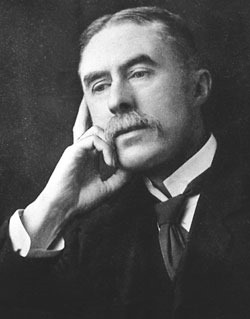
A E Housman

A. E. Housman, humble classics scholar, thinking how he could beat Emily Bronte in a fantasy boss fight

.

There’s nothing that says the young man who is ready to kill an evil spellcasting Queen in Housman’s poem is not themselves a spellcaster and maybe not a humble freedom fighter either. After all, to slightly alter the old saw, who wants to bring a knife to a spellcasting fight? In my performance I couldn’t help but start to sympathize with this doomed formerly formidable Queen, even it she’s evil, or said to be so.

Well, that’s two good weird-tales poems now in our celebration of Halloween. The player to hear A. E. Housman’s “Her Strong Enchantments Failing”  may be below. Don’t see it? Not an enchantment failure, it’s just that some blog readers won’t show that. Here’s a highlighted hyperlink that will also play it.  There may be time to do a third Halloween tale yet this month. Check back to see.

.

.


The Night Is Freezing Fast

One peculiarity in the process of producing these pieces is that I plan sometimes based on odd intuitions. So, as I was looking forward to another session with LYL Band keyboard player Dave Moore late this fall I made a snap decision.

I had earlier noted this turn-of-December poem by A. E. Housman and made a note that it would be a good way to transition from the autumn to winter season here. That’s planning.

Then intuition stopped by.

Is intuition the Manic Pixie Dream Girl or Disreputable Boy Friend of an artist’s mind? I don’t know, but intuition was suggesting that for music I could combine Housman’s words with Motörhead. Somehow it’s hard for me to visualize the graceful classical muses dancing about me with their lyres and lutes suggesting this sort of thing.

Minerva and the Nine Muses by Hendrick van Balen

Yes Dave, I’ve been working with cellos, violins and acoustic guitars a lot this fall. But the muses are suggesting: Lemmy!


I had less than a day to add more “plan” to this intuition. I listened to some Motörhead to refresh myself on them, and quickly settled on their name-sake song “Motorhead”  as a rough template for what I’d try to do with Dave the next day. Taking the Housman poem text, I added some refrains* to bring out more song-like qualities, and to closer match the text of Lemmy’s “Motorhead”  song.

Motörhead performs “Motorhead” for a group of people who seem to be waiting for the 12-step group meeting to start


Dave arrived and we did a quick pass through with the original lyrics to get the sense of the musical donor for this dodgy operation. I dropped a chord or two of this already simple song form, and then we were on to attempting “The Night is Freezing Fast.”

This week I listened to what we put down that day.

Dave acquitted himself admirably, as he often does, with this spontaneity. And the take you’ll hear below also has my original guitar playing from the session. But there was one substantial fault to it: all the tempo I could push myself to that day was still too slow for Motorhead.

Honoring intuition with plan, I none-the-less pressed on completing “The Night is Freezing Fast.”  I added bass guitar to the track, guitar under the guitar solo (it wasn’t manic enough to stand without a second guitar) and recorded a final vocal.

What you can hear with the player below is an imperfect mixture of plan and intuition. Considering it now I think the intuition was even better than I hoped. The overall plot of Housman’s poem is a little gem: the onset of cold winter recalls to the poem’s speaker the otherwise un-explained Dick who hated the cold—and then a mere one additional verse comes which by sideways description tells us that Dick is dead and buried.

I’m not familiar with English idiom of Housman’s time and place, but one line in his text “prompt hand, and headpiece clever” is colorfully awkward to me, but in the context of the poem I read a stalwart and resourceful friend or workman being described.

Lemmy’s lyrics had a strong fatalistic tendency that meshes well here. The lines I added that were meant to echo “Motorhead’s”  structure added an extra element to Housman’s spare poem, bringing out an undercurrent that’s there but easily missed. Housman says the dead friend has become the “turning globe:” he’s now part of the eternal seasons. The sea change (or ice change) that’s occurred implies that he’s become December, the always returning season of fresh death. In the run out after the verses I started interjecting some cries in the manner of John Lee Hooker.**  Melding Lemmy and Housman was intuition’s idea, and a good one.

My planning and execution were, I think, less successful. On the other hand, it’s the best Housman/Lemmy mashup you’ll likely hear today (or most other days). Housman’s original text is here. Lemmy’s lyrics to “Motorhead”  are here, suitable for your next book club or 12-step meeting. The player to hear the LYL Band performance of “The Night Is Freezing Fast”  is below.


*Refrains, choruses, hooks—these sorts of things tend to make page-words more song-like. In this project I’m helped by having a liking for songs and other musical expressions with words that don’t use those structures, but in this case I thought they’d also help intensify some elements in Housman’s poem, and in this setting, intensity is a requirement.

**Specifically, I was recalling Hooker’s “I’m Goin’ Upstairs,”  which ends with a magnificent and mysterious verse and an upper register ululation that chills me every time I hear it. Here are Hooker’s lyrics and the most-well-known recording.