Dolphins (Heroes)

I live in a city where 12-string guitars are over-represented. Since I’ve only lived in Minneapolis for 50 years, I can’t say for sure why that’s so. Folk-revival pioneers Leadbelly and Pete Seeger, likely the ur-source for the instruments post WWII use, have no direct connection, but by The Sixties™ this powerful but awkward branch of the guitar family had a nexus of players here. The guitar playing other two sides of the Pythagorean Koerner, Ray, and Glover trio played 12-string. Leo Kottke made the beast a virtuoso instrument while working the small clubs and coffeehouses of the Twin Cities. John Denver had fallen in love with a Minnesota girl and played a lot of 12-string (and who can say what is the cause and effect there). By the time I arrived in the Seventies, Ann Reed, Peter Lang, and Papa John Kolstad also played 12-string in small venues. The year my ten-year-old Pontiac rolled into town, a local college student, Steve Tibbetts, was self-recording his first LP featuring 12-string landscapes pebbled with percussion over which roamed howling electric guitar wolves.

At that point I owned my J C Penny’s nylon string guitar and a weird amorphously shaped Japanese electric guitar I’d bought at a flea market and for which I couldn’t yet afford an amp.  Accommodating my new hometown, I soon felt I should get a 12-string guitar. A year or so after arriving I managed to afford a Cortez 12-string acoustic which was sold as a sideline item at the local Musicland record store. My memory was it cost $79. Designed to outwardly look like a “professional” instrument at the lowest cost, it could have been the music equivalent of costume jewelry or a stage prop. As these sorts of things go it wasn’t as bad sounding as modern forum-dwelling guitar aficionados would suspect, and mine had pretty good “action,” reasonable string height to allow easier fretting.

Later in the Seventies I added a DeArmond sound-hole pickup and I played this guitar with the LYL Band, and for the rest of the 20th century. With their double sets of strings, 12-strings sometimes warp and self-destruct under the increased string tension – but cheap and cheerful as the Cortez was, it’s held up, though the top has bellied-up over the years.

I eventually got a better 12-string, but I kept the Cortez around. A few years back I set it up to use Steve Tibbetts stringing variation where most of the octave strings are replaced with unison strings.*

Now let’s jump the month just ending, January 2026. As a writer I can’t paper over the immense mood shift this entails: from oddities about the types of guitars, to lives being mangled by intended government action.

I still feel unable to write fully about my reactions to the many injustices and atrocities that are incurring at the hands of thousands of federal agents that are roaming my city and the rest of Minnesota this winter. The first of the murders this month, the shooting of Renee Good in front of her wife happened on the street just across the alley of my home office and “Studio B.” If I hadn’t been wearing headphones and working on music for this Project I would have heard the gunshots – instead, it was my wife who rushed in to tell me. As of the end of the month, we’ve had a non-fatal shooting and one more murder by the federal agents, and a daily grind of sufferings. I won’t be the one to try to catalog all the careless to cruel things that are happening day after day. It sorrows me, and perhaps you, and at least for now, this information is available elsewhere. Nor will I offer enough praise for the ordinary people in this city who are trying to mitigate that suffering and plead for its ending. I will call out one thing many of them are doing: they’re seeking to be “Observers,” the term that has come to be used for folks who feel called to witness and record with their phones what our own government agents are doing to the people living around us. Think about this for a moment as you read this: these Observers are intending to go to where cruel things are being done by armed bullies who will use their weapons – issued along with pledges from their leadership that they will face no consequences – to rough up, to detain with and without charges, to attack with chemical and “less-lethal” munitions, to in two infamous cases, to kill them. Folks were doing this before Renee Good was killed – and after she was shot, more signed up. After the next murder of Alex Pretti pushed to the ground holding his cell phone camera: more again signed up.

I think of the incredible bravery of the American Civil Rights movement of the mid-20th century, and this is like unto that. But here’s something else I think concerning that role, something I don’t recall being written much about yet. There’s a chance that these observers are going to see armed agents of our government kill someone in front of them, and they’ll be tasked with recording that. The infamous murders of the Sixties’ Civil Rights movement happened in darkness and rural separation, though the corporal brutality of clubs, dogs, and firehoses was done in public and was sometimes filmed.

Along with bravery, that’s an additional heavy burden to take on. And some are now carrying that specific burden. We have memorials to Alex Pretti and Renee Good, but I want to stop and think of those that witnessed their killings, and what they must be carrying in their minds. My mind is once removed, however close to me these things happened, and yet it’s filled with conflicting and intense reactions – but they were there, in that instant as this happened. Dozens of people in my city, some intentional observers, some protesters, some just bystanders, are carrying that as I write this.

So, the name that most often arises in my heart this month after the many insults to justice and mercy isn’t one of the detained or murdered, but is instead, Rebecca Good, Renee Good’s spouse, who was apparently observing ICE action on the broad avenue near her house and mine. When the federal agents came up to their car and began to hassle Renee, Rebecca tries to draw their attention away from her partner. In that moment, I read her actions as saying: detain me, let Renee get away, throw me down onto the ice and snow and get a few punches or sprays of mace into the eyes while you strap cuffs on me. Rebecca can’t get in as Renee puts the car in drive, the doors are locked. On one of the videos you can hear her say “Drive babe,” allowing herself to be left behind with the agents. And then the shots.

You hear her voice in another video, moments later, sitting on the side of that broad road just behind my house, saying that they’ve killed her spouse, and moaning that she was the one that suggested they move to Minneapolis. I should transcribe her exact words, but I can’t bear to watch that video again just for journalist precision tonight.

Another jarring transition I can’t engineer now. In between Renee Good’s murder and Alex Pretti’s, and thinking of Rebecca and other survivors, and of the witnesses, observers, I somehow fell to thinking of a song written by another 12-string guitar player of The Sixties,™ Fred Neil, “The Dolphins.”   Neil’s songwriting was a mixture of earnest and off-hand, an unusual combination. “The Dolphins”  is a somber wail about the cruelty of the world compared to the swimming pods of the famously playful aquatic mammals, and it’s just a handful of words.** Neil’s career was one of those “better known to other musicians” ones, and his song was covered by others back then, particularly those who played the 12-string guitar. Now if we move onto the Seventies – that off-brand extension of The Sixties™ – I’ve always thought that when another songwriter who played a lot of 12-string guitar in The Sixties, David Bowie, had to have been thinking of Neil’s song when, in the midst of his Cold-War-Berlin masterpiece “Heroes,”  he has one of the lovers kissing next to the armed guards around that inland city’s border wall think of dolphins again.

Fred Neil had a rich baritone voice, and David Bowie was a talented singer. I, alas, am mostly singing things here myself, yet I wanted to make a realization of those two songs while thinking of Rebecca Good, and others I didn’t (and still don’t) know how to number and name in this time. That would mean no first-rate vocalist, and I also decided to go primitive on the 12-string guitar, using that old Cortez 12-string. As the song progresses I strummed that 50-year-old box loudly, and I didn’t necessarily want a pretty 12-string with a rich sound.

.


*One of the features of the Cortez is a “zero-fret,” a still unusual feature that brings two benefits: it insures optimum string height in the “cowboy chord” first position area for easy playing and allows greater freedom in using different gauge strings at the player’s whim. Conventional 12-strings use a thinner string tuned an octave above the regular string for the low E, A, D, and G strings. Steve Tibbetts (like Leadbelly) instead uses two regular gauge, unison not octave tuned, strings for some of the courses. My Cortez 12-string has unison D and G strings.

**Neil’s choice of the dolphins, however casual it seems in his song, was a serious one. He drifted out of the music business in the Seventies and spent the rest of his life working on a dolphin support/conservation project.

Emily Dickinson’s Snow

I woke up this morning to learn that it’s Emily Dickinson’s birthday—and I didn’t get her anything.  Well, we do know how to do something here at the Parlando Project and that’s create musical presentations quickly, and it’s not like we’ve run out of Dickinson poems to use.

So today’s piece is a Dickinson poem about snowscapes. Having had the opportunity to visit the Dickinson family house in Amherst and hearing there that the area across the highway road was in Dickinson’s time a farm field helps me visualize Emily writing this. I can clearly sense her looking out the window from her bedroom writing table on that road and field that are this poem’s landscape.

This is Dickinson in her playful mode, but that doesn’t stop her mind from creating some exact and fanciful descriptions for the snowscape, starting right out with the snow fall being sifted like flour (do cooks still sift flour?) *

The least playful image in my mind is also the most striking in the poem, it’s a description of that farm field as “summer’s empty room”, not yet filled with snow (the furrows are still visible) and some now deserted plant stalks are jutting through picking up windy veils of snow. This is likely a poem written about an early winter, December, snow fall

In other work Dickinson can be harrowing or she might present us with some concise mysticism or philosophic equation, but that’s as close here to a darker note as we’ll get in this one. She seems content in her vision of a stilled winter and a smoothed and sparkling world—as I was today watching the white outdoors and below-zero temps just the other side of my glass as I wrangled a dense percussion track for this piece. It was afternoon before I moved on to a few keyboards. Then the final musical task was to add the 12-string electric guitar parts.

DeArmond S72-12

My electric 12-string, “recordless, but for them”


Long time readers here will know that the Twin Cities is something of a center for the 12-string guitar, an instrument I’ve used since shortly after I arrived here, but the electric 12-string remains a rare instrument here as it is elsewhere. Acoustic or electric, for each of the guitar’s conventional six strings the 12-string adds a paired string right next to it. Most of those additional paired-strings are conventionally tuned** an octave higher than the regular guitar strings, and the two strings when struck never quite vibrate in unison, adding a slight wobble that’s either charming or sea-sick depending on one’s taste and ear. I added to that with a whole load of echo, delay and reverb today, and all this called for the parts to be played sparsely and slowly. Even with an echo effect glitch*** that ruined the first couple of takes, I was able to lay down the parts quickly enough that you can hear it tonight with the player below. If you’d like to follow along with today’s poem (sometimes cataloged under its first line “It sifts from Leaden Sieves”)  the full text is here.


*Emily would have sifted as the household’s baker. The flour in her time was less refined—and sifting also removes things like bugs or foreign matter that might be mixed in with the flour. And sifted flour is more suited for blending with other ingredients. Sifting seems metaphorical matter for creating art, doesn’t it?

**Conventionally the high B and high E strings are tuned in unison and the bottom 4 in octaves, but some players tune additional strings in unison rather than octaves (Steve Tibbetts and Huddie Ledbetter/Leadbelly for two unlike examples).

***User error on the part of the producer, engineer and musician, which is easier when they are all me. I also make the tea, so there’s no one else to blame.

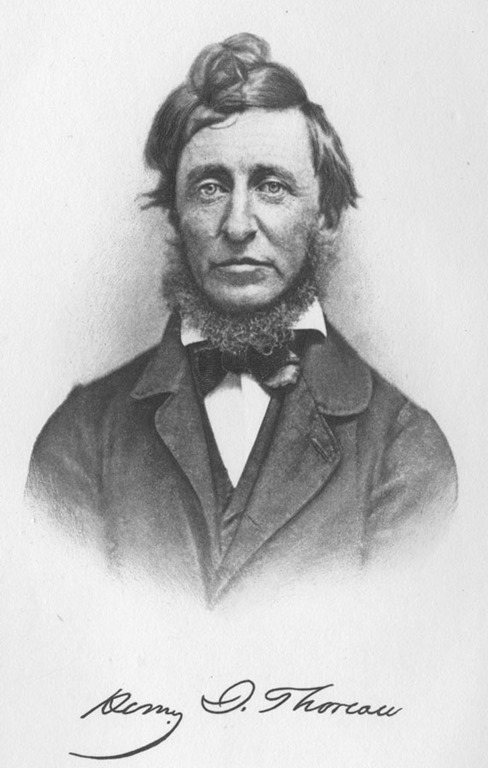
Thoreau’s June

We’ve already heard from Claude McKay and Thomas Wentworth Higginson on the month of June, and now it’s time to turn to one of the foremost spirits of the mid-19th century American Transcendentalist movement, Henry David Thoreau.

Thoreau is well-known for being in the activist, live-the-ideals, wing of Transcendentalism, though readers here have been introduced to Thoreau’s contemporary Thomas Wentworth Higginson—more than a footnote in the Emily Dickinson story—who also spent considerable time living those ideals.

Henry David Thoreau

Collect the series: Unfortunate Hair Stylings of Important Personages


Thoreau and Transcendentalism’s major domo Ralph Waldo Emerson lived in the same town in Massachusetts, and one of the most striking things for me when I first visited that town, Concord, was to think that in a matter of a few blocks there lived Emerson, Thoreau, Hawthorne, Bronson and Louisa May Alcott—all in this place not that much larger than the small farming community I grew up in. What a town that must have been in those years!

Transcendentalism is a little hard to put a finger on exactly as a movement because it was interested in and had change-convictions about so many things. Higginson in his 1899 collection of memoir pieces Cheerful Yesterdays  calls it “The Period of the Newness” and speaks of “The Sisterhood of Reforms.”

My current working-definition of Transcendentalism is it is the belief that there is a primary knowledge to be obtained from the deep study and meditation on the structures and methods of nature, as opposed to the accumulation of received and conventional truths about it. Thoreau the Transcendental activist helped to pioneer this, often writing about his direct experience of nature. His thought process also caused him to develop political ideals, including Civil Disobedience to unjust and violent government actions, famously inspiring Gandhi and Martin Luther King.

Thoreau didn’t just inspire Gandhi and King with his writing. The first story I ever heard of Thoreau recounted the tale of Ralph Waldo Emerson visiting Thoreau who had been jailed for refusing to pay taxes as a protest against the Mexican-American war and its support of slavery.

Henry, what are you doing in there?” Emerson asked across the jail door bars.

“Waldo, the question is, what are you doing out there?” Thoreau replied.

But here’s one lesser known thing about Thoreau, the deep naturalist, writer and political activist: he was also something of an engineer. Between writing and other activities, he was active in his father’s business, a small factory that made pencils. A chief problem at the time was the formulation of the graphite used in the “lead” for these indispensable writing instruments. Thoreau’s father’s pencils, like other American pencils at the time, used a too soft binder that led to a crumbling point and blurry line. Through study of European pencils (and one suspects a little lab time on his part) Henry David Thoreau, Transcendentalist writer, philosopher, and activist figured out a clay formulation to mix with the powdery graphite to produce a much better American pencil. Profits from the sale of these pencils and the underlying technology* were largely what supported Thoreau’s writing career.

Not to make too fine a point of it—and King and Gandhi might have found other inspiration, and Thoreau other funding—but the 20th century Afro-American civil rights movement and the independence of the Indian sub-continent owe something to a thing as prosaic as a better pencil design—monumental things that literally come from a feet of clay.

Today’s piece is a short meditation taken from an entry in Thoreau’s Journals for June 6th 1857. Adding to the above connection, when Thoreau was writing his nature observations in the field, he most likely was doing so using a pencil of his own design. Note too that at one point engineer-Thoreau talks of the revolution of thought connected to the revolution of the natural cycle of seasons as if they are the meshing of a gear train.

Thoreau June 6 1857

Handwriting as bad as mine! The page from Thoreau’s journal containing today’s text.


Written as prose, it has a flow that I could find to recite and accompany it with music. The piece’s chordal part I played on an electric 12-string guitar recorded in the manner Roger McGuinn and the engineers on The Byrds recordings devised in the Sixties. Instead of the John Coltrane-inspired lead 12-string melodic line of something like “Eight Miles High”  I played an acoustic guitar with an E-Bow, a magnetic invention that drives a guitar string to vibrate and produce a flute-like sound. As I read a little about Thoreau this week, I came upon the information that he was also an avid flute player, so it seems appropriate.

The player gadget is below. My apologies for being away from this blog and blog activities so far in June—you know, life and things.


*Here’s more about Thoreau and his pencils. I first heard the story on the radio series “Engines of our Ingenuity”.

Prologue to the Canterbury Tales

One way to get experience is to seek it through the directed travel of a pilgrimage. Many religious traditions include the idea of a such journeys, and one side-effect of a shared destination is the mingling of travelers from diverse setting-off points along the trail.

In the Middle Ages, in England, one pilgrimage had the greatest potential to bring a diverse group together, the pilgrimage to the Cathedral of Canterbury where the sainted Thomas Becket had been assassinated. A series of stories ostensibly told by various tellers together for this trip became the great early work of English literature: Geoffrey Chaucer’s “The Canterbury Tales.”

April is National Poetry Month in the US, and though this celebration’s founders give no exact reason for April being chosen, two widely known poems explicitly start in April, and whether it’s cause or effect, I think of these poems when I think of April and National Poetry Month. The oldest of these, is today’s post “The Prologue to the Canterbury Tales”  which begins:

“Whan that aprill with his shoures soote
The droghte of march hath perced to the roote”

Now I know I’ve let slip too many typos in these notes before today, but that’s not a particularly bad day at the keyboard—instead, it’s Chaucer’s version of English as spoken in the 15th Century. It’s a challenge to read this in the original pronunciation, though I once was delighted when a skilled classical music DJ mic checked at 5:45 AM one morning with a perfect rendition of this Prologue in Middle English. I’m not going to attempt the same; today’s episode uses a modern English version for clarity, and in consideration of my thicker tongue.

Musically I’m not in the Middle Ages or in Canterbury for this piece either. I’m going to use the 12-string guitar once more. There is no shrine here in the Twin Cities of Minnesota, but for some reason three of best players of this troublesome priest of an instrument came to prominence here: “Spider John” Koerner, Leo Kottke, and Steve Tibbetts. For this episode, the 12 String’s musical tale is told in the character of Steve Tibbetts—or rather a modest imitation on my part using Tibbetts’ distinct stringing of the 12 string, which uses octave strings only on the two lowest courses of the 12 string with unison string pairs on the rest.

Cortez 12 string Tibbetts Stringing Closeup

More thick strings, fewer skinny ones, setting up a 12-string Tibbetts-style

.

To hear the 12 string strung that way, and to hear about the English April in Chaucer’s report, use the player that appears below. Don’t see the player? Well, this highlighted hyperlink will also play it.


.

Spring View

I’m often attracted to Chinese poetry, and I’m not sure why. Perhaps it’s the deceptive simplicity to the images, that hardly seem like images at all if one expects the showy metaphors used by many western poets. The concision of many of the most admired Chinese poems can be shocking. And to me there seems to be a radically flat broadness to the way some of the poets consider society and politics. Like a lot of my favorite UK folk songs, the tales of royalty and servants, peasants and generals, saints and drunkards seem to treat them all with the same even diction and consideration.

From what I read, Du Fu is highly regarded as poet in Chinese culture. He wrote in the 8th Century, about the time someone in Europe was compiling Beowulf  between long drinks of mead out of cups made from skulls. Du Fu’s time was a chaotic one, with the Chinese kingdom falling into rebellion and civil war. “Spring View”  is his response after his side had lost the battle and he was in disgrace.

Du Fu

Du Fu:  the red trucker cap or the pink pussy hat?


In translating Du Fu’s “Spring View,”  I thought of our own times, particularly here in the United States, three months now into some kind of change. Alas for Du Fu, I became so enamored of seeing our own current events in his lament that halfway through I started to get more “free” with my translation, until by the time I reached the final line, I chose to conclude on a different thought altogether from the original. Consider it a theme and variation composition.

I do not read Chinese, but here is Du Fu’s “Spring View”  as written:

春望

国破山河在
城春草木深
感时花溅泪
恨别鸟惊心
烽火连三月
家书抵万金
白头搔更短
浑欲不胜簪

Musically this piece uses 12 string acoustic guitar, an instrument I love to struggle with. The overtones and extra harmonics of the 12 strings are the attraction, and the danger too, as they can clash a bit. Some musicians work very hard to try to even out the intonation of those notes to minimize this, leading to one of my favorite music jokes. Question: how long does it take to tune a 12 string guitar? Answer: Nobody knows.

JF30-12

“Every politician should be issued a 12 string, because you never really tune it, you just negotiate with it.”


My approximate ear has come to embrace the somewhat woozy sound of the 12 string for much the same reason that loud electric musicians may choose to welcome feedback or that electronic musicians select the detuned effects of things like ring modulators.

To hear Spring View (after Du Fu)  use the player below.