I wrote down this poem earlier in the year as a good fit for an April National Poetry Month piece. It’s author, Edna St. Vincent Millay, was from Maine, and I write from another northernmost American state, Minnesota. If a southern-born St. Louis boy like T. S. Eliot who went to live his life in temperate England wants to ironically write about April being the cruelest month, dryly riffing on the Middle English of a Chaucer’s pretty “Aprille with his shoures soote” — well, what with all the flowers and pleasant nourishing rain, that kind of puts a climatic brand on the month poetry-wise.
I rise with Millay to contradict: we have birdsong here, but it’s a more desperate, assertive song, not some celebratory strope — because it rained, sleeted, and concludingly snowed a sloppy wet mix all night and afternoon as I worked on completing today’s musical piece, and this morning everything — tree branches, overhead wires, yard fenceposts, garbage cans — had, to the very limits of toppling, piles of sticky snow as high as any booklover’s stack of unread books.
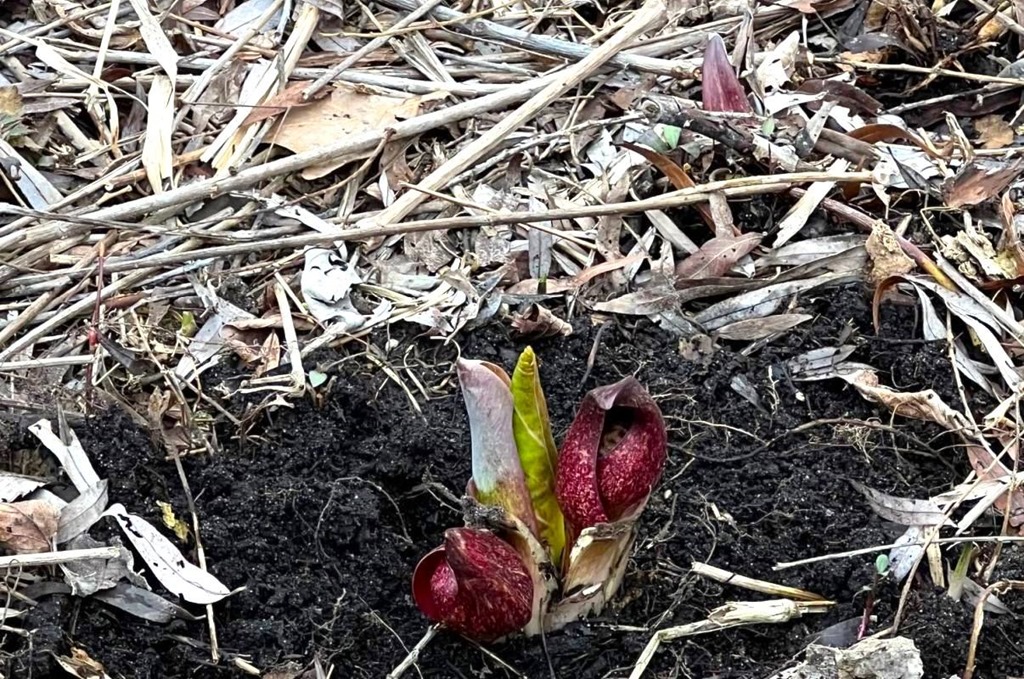
My nature loving wife took a European-born friend on a hike last week and showed the friend skunk-cabbage, a strange red, raw-meat looking early Spring plant that is exothermic — it creates its own heat like some huddled mammal so that it can bake through the snow cover. Nearer to home, indeed right next to the foundation, a small surviving clutch of tulips has sent up green leaves, but no buds yet. Their leaves course with some green antifreeze, as nighttime temps remain consistently below freezing.
“O April, full of blood, full of breath, have pity on us!”
.
My wife and I have varied memories of who planted the tulip bulbs. I remember it was my late father, long ago — while she thinks it was her mother more than a decade ago. There are only a few left. Brazen squirrels dig them up, or perhaps they are only perennial in the same sense that we are, bound to rise in many springs, but not forever.*
So, if the theme of this April’s Poetry Month is The Shared World, I certainly felt I was sharing the world within Millay’s poem “Northern April.” The wind, the resonance of a creek with remaining ice, the just warm enough to be rain/rain. At least for me, in my northern clime, there’s a rich sensuousness in the poem, and enough word-music inherent in it to command me to sing it.
I’ve noticed that I haven’t used my 12-string guitars much this winter. They are a little more stout to play, and I think they show less forgiveness for my less-than-pristine technique, but I tried to plant today’s piece in the furrows dug between my limitations.
My music today makes use of a couple of instruments playing at the edge of their ranges. The bass guitar part is entirely played in the upper octave of the instrument, giving it an unusual sound I found I liked; and for a bit of melodic embellishment, I played an oboe line, again at the upper reaches of the instrument. Why an oboe? I thought of a 20th century band called Oregon who would mix 12-string guitar with reed/woodwind instruments, and I wanted to revisit that set of timbres from the composer/player side instead of from my listener’s memory.
*I took leave from poetry and music to very briefly look at that issue from gardening knowledge. It appears that the bulbs shoot off other child bulbs, a process hidden in the dark underground in the later, non-flowering, part of the year. If so, appropriate for the idea that we think these spring flowers are from our parents.
I wondered what I’d do for this April’s U.S. National Poetry Month. I’ve usually done something to observe it, though what I do may not be similar to other places. The audio pieces here almost always use literary poetry we combine with original music, so appreciation of poetry is business as usual there. What about writing poetry? I’m not a big fan of overt poetry prompts, instead working from a personal expectation that anything in life or art worth creating a poem over will let you know; and while I write sometimes about the process of creativity, I’m not a creative teacher. I’m also not promoting my own poetry — an honest, necessary task, just not one that I’ve chosen to do much of. Similarly, I’m by present resolution non-commercial with the music I create here. The current music business situation is difficult enough that the least troublesome and most assured way to make nothing from music is to start with, and keep to, the goal of doing exactly that!
So, what to do this April? I’d considered a close-focus theme, or the presentation of the work of a particular poet, but I’ve recently tested my appreciated readers a bit with a long series on the mystery of a musician’s scrapbook that came into my possession decades ago. Enough long- form for a while I think.
Online, I asked for requests, and got one: anti-fascist poetry. I’ve been bending somewhat away from my usual “you can get your complete diet of politics many other places” practice due to my nation’s current situation, which frankly disgusts me in the present and frightens me in its extrapolated expectations; but as a practical matter I almost always use older Public-Domain-status words for the poetry texts I combine with music here. Unlike our current Twenties, the last decade to be called The Twenties (where PD status generally ends) had yet to come upon that brand of authoritarian superiority.*
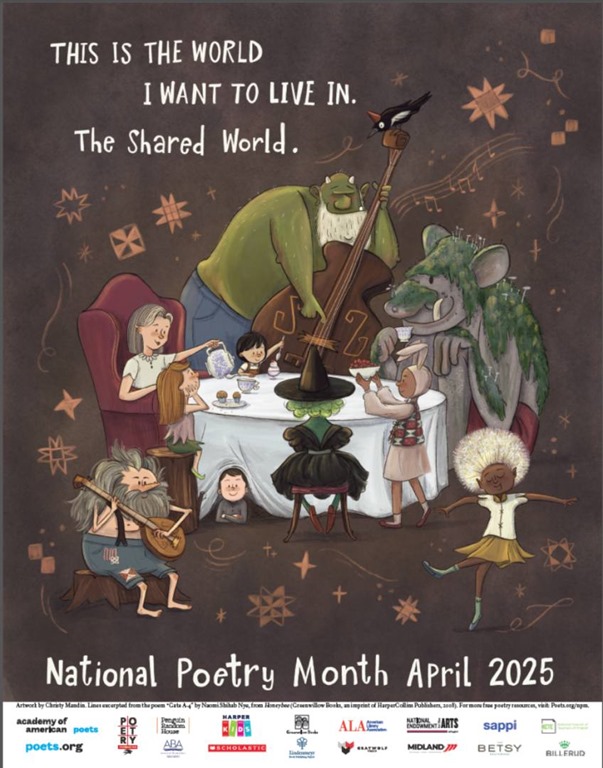
I found my solution by looking at the materials made by the organizers for this 2025 National Poetry Month. I saw that this year’s theme takes off from a line in a Naomi Shihab Nye poem “Gate A-4” which offers me a suitable theme for the Parlando Project this April in this country in this year. That line is: “This is the world I want to live in. The shared world.” So, there will be some civic poetry on civic issues. There will also be poems of varied shared experiences. I haven’t completed any translations from other languages recently, but if I don’t get to that this month (and it’s usually a very busy month) I may feature some of my favorite not-originally-in-English poems from my past decade’s work.
This year’s poster by Christy Mandin.
.
To start off #NPM2025 I’m going to do something that’s not representative of what this Project normally does: from the start we’ve focused here on other poets’ poetry, even though Dave or myself could’ve supplied a great number of song lyrics and poetry to be recast as such. That decade-long primary practice is not followed in today’s audio piece — instead, it’s a sonnet from the Memory Care Series I’ve been writing for several years — some of which have been performed here in draft form. Though I wrote these words, it doesn’t really violate this Project’s maxim: “Other People’s Stories,” because it’s the tale of a daughter with a mother descending deeper into dementia, and of the connections and slow-motion mourning the course of this disease assesses.
Earlier this month I performed Alice Dunbar Nelson’s “I Sit and Sew” a civic poem about a woman who wished to help the war-distressed and injured. Sewing was a bitter consolation in that poem — but in today’s sonnet, sewing is an image of a different, though still bittersweet, connection. You can hear my performance of “She Dreams of Sewing Machines” with the audio player gadget below. If you don’t see any such gadget, it’s likely because you’re viewing this blog through a reader that suppresses showing it, and so I offer this highlighted link as an alternative. It will open a new tab with its own audio player.
Return here throughout April to see what other, varied poetry, music, and performance styles I can complete and add to our shared world, or just use the blog follow feature.
.
*Arrogant ignorance, prejudice, persecution, vain greed for glory and gelt — that all existed before the name fascism, and that may still provide some PD poems. The pieces that I have nearer to completion are more about the human experiences that we all share, and by telling of them we by implication speak against callous disregard.
The song below using the words of William Butler Yeats had a direct, contemporary inspiration: John “Paddy” Hemingway died this St. Patrick’s day. He was Dublin born, and in Dublin he died — and he was in the news because he was the last surviving RAF pilot from the Battle of Britain during WWII.
Reading the notice, I immediately thought of this Yeats poem, about a fatalistic Irish pilot during WWI who flew into battle having no love for the British Empire. John Hemingway’s Wikipedia summary mentions nothing about his weighing of the enormous risks he took in RAF battles, but a recounting of the number of times he was shot down and got back to flying again makes me think he’d accepted his death as a probable result of his service. Fate had sport with him, he lived to be 105.
Not much research required in this case, it’s widely recognized as a poem written as an elegy to a particular doomed Irish Airman, Robert Gregory, the son of a friend and ally of Yeats, Lady Gregory.
I know nothing of how this poem was received by the mother who’d lost a child. Yeats portrays a peculiar heroism with the poem’s subject. Using only the evidence within the poem’s boundaries, it’d be a fair reading to say that the titular airman here was driven to mortal combat because there was no hope otherwise in his country’s situation. Another reading, more specific to the man Yeats had in mind, might be that the airman was drawn to air warfare for the pure sport and sensation of it, but that latter reading still incorporates, if not an outright death wish, a sense that the most intense love of the moment asks for an acceptance of imminent death. So, an odd poem, poised between self-destructive despair and dark romantic thrills.
Well, whatever — it is a poem by Yeats, so of course it’ll sound wonderful, and reading it on the page will cause any number of its silent readers to want to sing it. After I completed my version, I listened to nearly 10 other musical versions, yet I still hope that my version isn’t superfluous.
Here’s the chord sheet for today’s song version of Yeats’ poem. Feel free to improve on my attempt. As I play it the G and A chords in the last line of each stanza are played at the 3rd & 5rh fret positions.
.
I chose to make my song entirely jaunty, a reverse of my minor key remembrance in the E. E. Cummings Spring poem last time. That doesn’t mean I want the listener to take it as a recruiting poster or an endorsement. Poetry is portraiture you can feel in your ears or breath, but you’re still allowed to think. Whatever his internal motivations or conflicts, the singer of Yeats’ words seems proud of his choice. John Hemingway likely thought he was in for the same deal that Robert Gregory signed up for. Fate laughed. Reports say Gregory, the brilliant Irish WWI flying ace, may have died either from friendly fire or pilot error secondary to a case of the flu. Another man, a proudly stupid one, once said that he liked pilots who didn’t get shot down. Hemingway, as it happens, was shot down several times in WWII, and yet had decades to live other pleasures I’d find more delightful than combat. And that otherwise unrelated man, the one who truncates his thought, but not before he asks to be judged by his judgements — how is he weighed?
You can hear my performance of Yeats’ “An Irish Airman foresees his Death” with the audio player below. No player to be seen? You can hear my performance stored somewhere in the clouds above by clicking this link, which will open a new tab with its own audio player.
This E. E. Cummings poem is often read as delightful. And it is. It’s also a poem some encounter in childhood. At least in my youth, it was an anthology favorite that vied with Carl Sandburg’s “Fog” as an introductory example of free verse. And no verse is ever more free than this: the letters smattered like mudprints all over the page, capital letters not yet grown, stuff smushed together. No colonnaded sonnet, no astringent exhale of meditative breath like a haiku. On your poetic menu, this is a mudpie for Spring.
Is it just this?
I set it to music. That’s what this Project does in Spring, and Fall, and Winter too. Every chord in the music I made today is a minor chord. Is this a sad poem, did I want to force it to be one? Not that simple. Just lowering the 3rd note in a scale a half-step to form a chord from it, is that really determinative? These are just sounds playing together.
But this is a considered song about Spring and the distance in half-steps from childhood, not just some neutral exhalation of it. The poem itself grew up, or blew up, over a few years. It was first submitted for a class assignment by a Harvard college student in 1916, and that version, while free verse, lined up this way.
I found this excerpt of the original version of the poem in a section on Cummings written by Michael Webster included in A Companion to Modernist Poetry published in 2014.
.
That college student would soon go overseas into a world war as an ambulance driver, and Cummings and his cohorts there took exception to simplistic war piety. I’d guess the logistics of suffering didn’t firm up the young man’s patriotism. In something I see echoed in this week’s American news, his talk was deemed an imprisonable thing to say, and Cummings was imprisoned in France. It’s one thing to write free verse, it’s another to convert the currency of one’s free thought into loss of freedom. I wonder if at this point the blood-soaked mud of WWI’s trenches were known to the young man. Anything but mud-luscious.
Cummings had enough luck or privilege to be released. In 1920 The Dial publishes a new version of that college poem. In a few years more this magazine would publish an expatriate American’s poem that indicted Spring, starting “April is the cruelest month…” But this is Cummings’ poem, and this is how it looked on The Dial’s pages.
On first publication it’s largely the poem we now know, but it doesn’t have a title. And curiously, the second instance of balloonman is “balloonMan.” Did a proofreader just get exhausted editing Cumming’s manuscript?
.
In 1923 Cummings published a poetry collection, Tulips and Chimneys. He put the still untitled poem in a section “Chansons Innocentes” (Innocent Songs). By innocent did he mean from childhood’s sensibility, or a plea of not guilty? And this is how that version went.
Nope, the balloonman to balloonMan thing must have been Cumming’s intent.
.
We’re near the final version, but at some later date (I’d assume a selected or collected poems publication) it converted its first line (strictly constructed) into a title with some typographical marks to make it look like Cummings was establishing Bon Iver’s song titling methods a few decades before the bard of Eau Claire. In the end, the poem that a lot of folks informally recall as “In Just Spring” is [in Just-]. I can’t help but read that title as a pun.
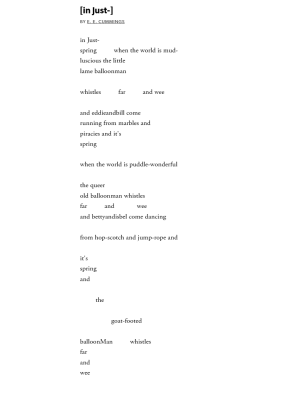
Here’s how the poem in it’s final form appears collected on the PoetryFoundation.org web site. “Just” is the only capitalization and man stays lowercase.
.
And now decades have past — and I, an old man, have gone to perform this poem for this year’s Spring, and I pick minor chords. Much has past us, dancing toward or running from: another world war, and current cruel wars happening somewhere further than the far distance whistle of the balloonman. Cummings’ childhood was close enough to me that I can actually recall playing marbles in the dry dirt finger-writ circle of a schoolhouse playground.* I know how a hopscotch chalk field is laid out. Do children still jump rope with rapping rhymes, and if not, what has poetry and hip-hop lost? If there’s a balloonman, his creatures are mylar and determinedly decorated no doubt. All this 20th century stuff is now as archaic as the arcadian goatfoot-god Pan who whistles like escaping air. I, and once-girls with names like Betty and Isbel, know this. Now, as I experience the poem this year there’s more distance there than there was for a twenty-something poet who wrote it. I put a distance far and wee in the music — for Cummings was of an age that he knew he was to be an adult now, while still young enough in years to know within his body’s memory the lost experience of the playing children delighted at the balloons. Balloons that would either fly away or deflate — escape/ascent vs. air loss or a pop as sharp as a bullet.
It’s the first day of spring. My chords have a third a half-step deflated. Disordered self-important dolts are running things, and I think better to have an old halt body with a bouquet of floating hearts. If the world can still seem puddle-wonderful — to be aghast is not to wonder. So, I must recall how to wonder, far and wee.
You can hear my performance of E. E. Cummings “In [Just] spring” with the graphical audio player below. Did someone let go of the string and a player is blown away? Don’t whistle, just use this highlighted link alternative that will open a new tab with its own audio player.
.
*And playing pirates without extra-faceted dice, is a lost quattro too — but I wonder if Cummings was thinking of Barrie’s Peter Pan in choosing that manner of play. I’ve just finished watching an absorbing 2022 TV documentary series called Wonderland on BBC Select that often asks over its episodes how much childhood trauma, WWI, and social injustice informed English children’s literature a hundred years ago.
I’ve made note that I didn’t do a piece from Dave Moore for St. Patrick’s Day, but I’m about to deal with that. Readers of earlier posts this month know that I was writing about falling in with a group of Irish-American writers almost 50 years ago. The group in its last decade or so was just four of us, and you’ve heard my performance of words from the two of them who died a few years ago. Dave’s not in that group — well, he was in the group, but he isn’t dead — and I don’t know if Dave ever considered himself an Irish-American writer either. At the other pole, we have Ethna McKiernan who spent time living in Ireland, whose father was a figure in the Irish cultural renaissance, who ran an Irish-arts focused store for many years, and some of her poetry was published by an Irish publisher. That’s more Irish than green beer.
What makes one an Irish or Irish-American writer? I’m just an observer here, but I suppose opinions differ. It never crossed my mind to consider Edna St. Vincent Millay an Irish-American writer, but there’s Irish heritage there, and while her most well-known poems don’t explicitly speak of Irish themes or history, I eventually found and performed this poem of hers that’s quite Irish. Shortly after I discovered Joseph Campbell and was in my first burst of enthusiasm for him, I asked Kevin and Ethna if Campbell was counted in the realms of Irish culture. He was as unknown to them as he remains generally, but he was deeply embedded in Irish culture in his writing and life in both Ireland and the United States, and even his downfall was largely due to ending up on the losing side in the Irish Civil War. Campbell’s clearly an Irish writer who lived in the U.S., but he’s just so little-known. Let me add one more: does anyone consider Frank O’Hara an Irish-American writer? I once did a web search looking for anything written along those lines. If I didn’t come up dry, what I found wasn’t enough to dampen the leather above my bootsoles. If I was asked to find such a connection, I’d point to O’Hara’s manifest sense of mischief and his greater interest than most mid-century Americans in poets who weren’t British.
Perhaps it’s somewhat a coincidence if one is an Irish-American writer or one isn’t. You don’t have to write one way or the other, and it may not have to do with where your parents or grandparents were born. And by coincidence too long to interject here, I came to see that this Tuesday, the day after St. Patrick’s Day, is the anniversary of SciFi writer R. A. Lafferty’s death. I saw this and — ta-da — I remembered that I have a recording of Dave Moore singing his song about that writer. Recalling that, I found that recording and worked today on spiffing it up a bit sonically since it was 10-years-old and reflects some older recording tech. And sure enough, right in the lyrics Dave claims Lafferty as an Irish writer. So, an easy job to complete today’s musical piece and post?
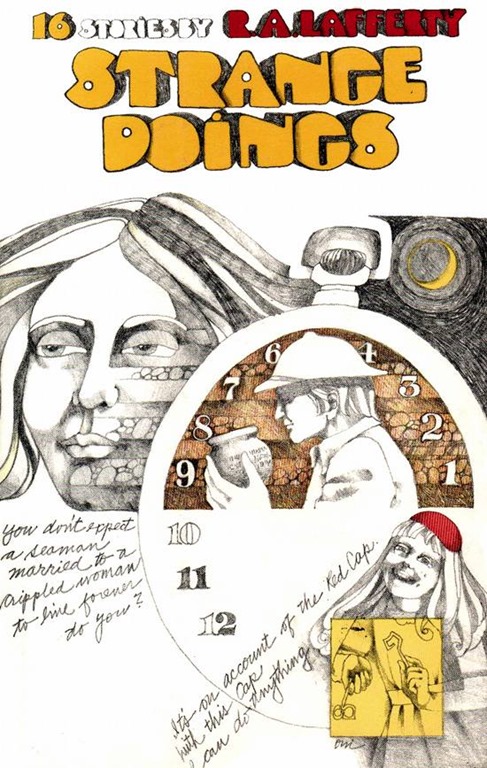
Sort of. I didn’t plan this enough ahead of time to give Dave time to say anything about Lafferty and his writing. I had memories of his telling me, or trying to tell me, about Lafferty’s writing, which had a brief flowering in the 1960s-80s — but what was that he said back then? I thrashed about this afternoon finding a copy of his 1972 short-story collection Strange Doings. I rapidly read a half-a-dozen of his stories just trying to get a flavor, and I got some sense of why Dave had a hard time encapsulating Lafferty’s virtues. At least in this collection, his prose style is somewhat creaky pulp, yet with that instrument he sets out to tell rather strange metafictions in even stranger ways, often ending in a shaggy dog joke. The image I got was I’m at a dive bar, and there’s this man sitting on one stool. He wants to tell me a story. As he goes on, I try to get a read on who he is. Is he some kind of scientist on a weekend bender, or an in-his-cups academic from a nearby Catholic college? Or maybe he’s a man who’s watched too many episodes of Ancient Astronauts, and takes Neil Oliver and Graham Hancock as his vademecum? Are the beverages why the story started to twist, or are you just not ready to understand the essence of the fractal he’s generating? I ask him what he does for a living, and he tells me he’s an electrician.
One thing’s certain: he needs just one more drink to finish his story.
“So why are you so interested in all this you’re telling me?” I ask.
“Oh, I’m also a writer. You said you’re a writer. I thought you might be interested in this.” He looks at me, expecting reply.
“If you write like you talk, you’re more like how I play electric guitar. I run off in some direction until I hit something, then I bounce off in another direction.”
This 1972 collection of Lafferty short-stories credits the cover design to “ONI”
.
There should be a graphical audio player gadget below to hear Dave and I playing Dave’s song “R. A. Lafferty” back in 2015. At the very start of the Parlando Project I set this recording in a folder of possible pieces to use for it, but I never did because I feared the audience for literary poetry might not find much relevance in Lafferty. Well, the imp of the perverse convinced me otherwise. No audio player? You see, Lafferty has documented that the audio player gadget was invented by Higgston Rainbird and — oh never mind, you can use this highlighted link which will open a new tab with its own audio player if you don’t see the gadget.
Here is a piece based on a poem by a second Irish-American poet, Ethna McKiernan, who before her death in 2021 would host a reading every St. Patrick’s Day. I can’t say I knew her very well as a person, though as mentioned last time she was a long-time participant in the Lake Street Writer’s Group with myself, Parlando contributor Dave Moore, and the poet featured last time, Kevin FitzPatrick. I’ll next be going off on a short tangent, as is my nature, but it any of this writing displeases or tires you, just skip to the bottom. I quite like the piece that is the occasion for writing this today, and you are excused to go there and just listen to it.
I don’t think Ethna liked me much as a person, and I can imagine any number of reasons why that might be so. Let me leave most of those guesses behind for today’s purposes. In my old age I’ve come to the realization that I am often a careless and inappropriate person. I suspect that’s for neurological reasons, but who can say, it may be a defect in my soul as would have been said in the old ways.
One peculiarity that I had in writing groups is that I was prone to writing long responses to drafts shared by other members. I’d often get quite detailed with noticing what works, and at least as much so with what I thought didn’t or had alternatives to be considered. The audience of this Project know that I have a broad appreciation for styles and approaches. I don’t hold to a narrow poetic style and down-rank anything that doesn’t follow it, but just as I do with editing audio or trying out compositional ideas in music, I tend to look closely, and over the years of doing this, I’d notice how zoomed in and nit-picky some of my responses were — and I wasn’t at all sure my suggestions for alternative approaches were actually improvements. It’s been a few years since I’ve done that, but I still cringe at some of the things I wrote, particularly in response to Ethna’s poems. After all, here was a poet with several published collections, a grant-winner with a distinct cultural connection to a great poetic culture, and who had taken advanced academic creative writing study. Me? I’m a high-school graduate from nowhere, who has no distinct poetic style to trumpet, who last was published in the 20th century. And need I add one more kicker — I would be in Etna’s case a man writing to a woman poet. Women poets reading this know how that often goes.
So in summary: matters of technique and poetic tactics vs. being emotionally myopic. A lot of the first only emphasizes the second.
My reactions to Ethna’s poems continue to trouble me because, at her best I considered her to be an excellent writer, but one that left me tantalized by another poet within her — a far stranger one, one that only materialized from time to time, and seemed to be constrained by her internal editor and self-anthologist.* Yes, it’s a writer’s prerogative to choose what to present or emphasize, but I wonder if other writer’s group respondents, creative-writing seminars, or outside editorial preferences/fashions kept that element down in McKiernan’s writing. Those things have standing, and it may be me who’s out of step, whose taste is questionable or unlikely. But that’s how I felt when reading the poem “Barn Burning” used to make today’s musical piece. I was compelled to do something that may be regrettable. I strongly thought that a developed image just past the midpoint of the poem was not quite as vivid as possible, and that the poem’s ending was short of how sharply spoken it could be.**
Ethna is some years dead now. Poets have trouble finding audiences when alive, and once they cross the Lethe, our forgetting often matches the dead’s. Improper, inappropriate, imperious, presumptuous — convict me of the lot. I’m taking the risk that I’m damaging the poem, though that’s not my intent. It’s done out of love for the poem and in hopes of bringing forth this element of the poet who might be condemning me from the other side.
If the worst is the case, take the performance below as damaged, counterfeit goods. If the best of the case is so, enjoy this poem’s mystical experience with my best efforts at adding music to it. I’m not Irish, I just hung out with some Irish-American poets, and it seems consistent to make this offense out of admiration.
*I remain puzzled why her poem “Letting Go the Wolves” was not included in her own final new and selected collection Light Rolling Slowly Backwards. While it’s a fine collection, well worth reading, to my tastes that’s a pluperfect anthology piece, one I’d say any poet could be proud of having be the one poem others know of their work. Of the poems included there, poems as strange as “Stones” and “Barn Burning” display moods not widely indulged in, even though her other poems have their virtues too.
**Should be? Let me say again, I don’t know. I’m just one reader, but one who chose to perform it, and who wants to maximize its impact. Here are the last six lines of “Barn Burning” as McKiernan had them in her final collection: “The outline of the lit barn/and its lean bones;/the world changed suddenly/as baptism, my life changed/forever with the knowledge/of fire.” Here is what I performed: “The outline of the barn,/the eager edges of its light/surrounding reluctant bones./The world, now sudden as baptism./My life forever with fire knowledge.” And as evidence of how zoomed in my suggestions sometimes were: I think the poem’s title is stronger with a comma in the middle.
Nearly 50 years ago when I moved to the Twin Cities I fell in with a group of Irish-American writers — only they didn’t call themselves that, they called themselves the Lake Street Writer’s Group, and when my friend Dave Moore wanted to roughly categorize them back in those days he’d say many of them worked as bartenders. And so, at first, their monthly meetings would be at a bar table, I think the first one I attended was at the Artist’s Quarter, a bar and music venue.
Time and writing changes one, and so it changes groups of writers. Over the years some wandered off to other pursuits, or to other cities, and one or two died. In its last decade of existence, the group winnowed down to four people. Dave Moore and myself, and two other poets: Ethna McKiernan and Kevin FitzPatrick.* None of us remainers were bartenders. Dave worked for a co-op grocery after working in bookstores. I worked for a public radio network. Ethna ran an Irish-Arts store until it needed to close, and then worked as a social worker. Kevin had a job with the state labor department, but he spent every non-workday at his life-partner Tina’s farm across the border in rural Wisconsin.
The poet I perform today and his last book.
.
Kevin was a healthy seeming guy, able to handle the manual small-farm work in contrast to his desk job. During that decade our little quartet of poets would hear Kevin recount his latest news from the farm, and then we’d hear what he’d transformed out of that when he showed us drafts of poems about the odd turn his post middle-aged life had taken. In this series of poems an office-worker who grew up in the Cities was encountering country labors, mores, and situations, being befuddled or making sense of them.
Kevin’s poems were narrative, and he had a real knack for that form, particularly in his talent for drawing characters in a few words and letting you get a sense of them in a stanza or two.** One of the charming characters we met as the series of poems spun out was the farm dog: an incongruous poodle named Katie — not a Collie or German Shepard, not any other breed you’d naturally think of protecting the flock and farm. The poet didn’t invent that detail of the farmstead’s dog, but the poet knew a symbol when he came upon one.
Farm dogs are pets with job descriptions, but I don’t think Katie was a herding dog in a professional sense, any more than Kevin was a professional farmer. Still, there were in the poems a sense of Katie being an intermediary between the livestock and the bipeds, and she was portrayed as a useful watchdog and companion when Kevin needed to return to his workweek office job.
In Kevin’s poems we learned that Katie had gotten sick; and though it strained budgets, she had gone through some veterinary treatment. Then, at one month’s meeting, we learned that the poodle farm-dog had succumbed to her illness.
The Kevin FitzPatrick poem I perform today came shortly thereafter. For me, this poem works well, even though intellectually it could seem maudlin or sentimental if summarized. We should be wary of such reduction — poems are much more than AI summaries. Kevin undercut the merely weepy here with his dry sense of humor and understated anger — and then too there’s the poem’s sensual detail: a man at work with the remains and memories of a working dog, the corpse as light as a cardboard cutout, the unthawed March cold.
The poem’s ending has extra poignance for me: it was not that long after the poem was written, and the collection that contained it, Still Living in Town,*** was published, that Kevin unexpectedly took sick and died. I think I remember talking with Kevin — before that knowledge on either of our parts — about liking the final part of the poem, how it implies that when the fear and final of death might come to the poem’s speaker, that the dog’s spirit, preceding over the hill, that hearth and home animal in-between livestock and us humans, would be there faithfully there to assuage the fear of what may be nothing in an empty darkness. I call the piece today “Kevin FitzPatrick’s Farewell” because to me its writer ended up making that statement while writing a poem about a farm dog.
Kevin heard a couple of my performances of his poems, and his feedback was that I overstated them — and my performances were certainly different from his. He had that drier Robert Frost reading tone down whenever I saw him do public readings, mixed with the kind of Irish wit that evidences just a slightest eye twinkle and unvocalized “a-ha!” while it spears some folly with an off-hand brickbat or dagger. So, to honor that contrast between us I had to fire up the electric guitar and make the speaker in his poem a little shoutier than Kevin. You can hear that performance of mine with the audio player below. No audio player to be seen? Listen: Katie is barking that you can use this highlighted link that will open a new tab with its own audio player.
.
*Kevin and Ethna took to hosting a poetry reading every St. Patrick’s Day. The last ones not at some Lake Street dive bar, but at a more tony academic site: The University Club near St. Paul’s Summit Avenue. I’m not Irish, but personally I don’t favor the mandatory cute intoxication elements endemic to that celebration, so I preferred a spotlight on that culture’s poetic side. As the holiday approaches this year, I’m planning to get to Ethna’s poetry too in time for St. Patrick’s Day.
**I admire conciseness. I’ve sometimes compared Kevin’s poems to the narrative poems of Robert Frost. While Frost’s longer blank-verse narrative poems have their power and richness, it’s not the mode that I read for pleasure. Kevin’s rural life poems take more after Frost’s shorter narrations like the “Mending Wall.” And Kevin’s poems make more use of humor than Frost’s do.
Today is International Women’s Day, and I was fortunate to be able to complete this recording of a new musical piece setting a poem by Alice Dunbar-Nelson before the day ended.
“I Sit and Sew” is likely Dunbar-Nelson’s best-known poem — it’s certainly the first one I knew of. I’d encountered it as a poem written amid WWI during the years this Project was noting that conflict’s centenary. “I Sit and Sew” still comes up fairly often in regards to war and destruction, or because it mentions domestic, woman-associated work in the context of the greater world.
I noticed one other element in re-reading it this week: it seemed to me to relate to another line of woman-associated work: medical nursing. Having spent a couple of decades doing nursing work myself, the poem’s focusing-in on the trauma and injuries of warfare really made me think Dunbar-Nelson wasn’t just thinking generally, writing something that could be paraphrased as “War is terrible, and yet here I am peacefully making or mending something with needle and thread, as women have for millennia.” There’s nothing wrong with experiencing the poem that way, as a companion-piece perhaps to Hardy’s “In the Time of the Breaking of Nations” — but I’m a person who often asks questions while reading.
While the poem can stand on its own, I wondered if Dunbar-Nelson herself wanted to serve as a nurse.* Short answer: this issue has additional complications. Currently in the United States we’re suffering from numerous outlandish statements and acts snuffing out complexities of diversity, but historically women’s wartime work, including nursing, is tightly connected with increasing respect and civic equality for women.
Alice Dunbar-Nelson was an Afro-American woman. The U.S. armed forces were segregated during WWI, and the roles available to the non-White military were limited along with that, based proximally on rules about race-mixing no-doubt supported by a pervasive background of racial superiority. A few years back, while learning about another poem, I came upon the case of Col. Charles Young, a Black West Point educated officer with experience in two foreign deployments who couldn’t get himself utilized as America mobilized for WWI. The situation for Black Americans who wanted to work overseas as nurses was also exclusionary. I’ve found out Dunbar-Nelson was working as a national organizer, a member of something called the Women’s Committee of the Council of Defense, and her focus was on Afro-American support of the war effort. She published today’s poem in 1918, and after the war she wrote up a summary of Black women’s WWI efforts.
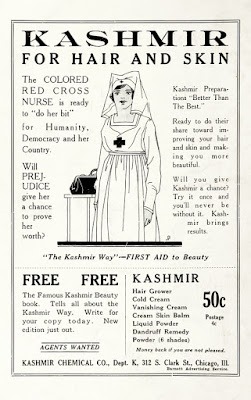
We Wear the Mask Dept. I found this ad here in another post mentioning this poem. In her article linked above, Dunbar-Nelson mentions, in passing, (pun intended) that some lighter-complexion Afro-Americans snuck through the overseas nursing service ban.
.
No long post today, that’s a start for anyone who wants to dig deeper.
The song I made out of her poem came together more efficiently than many, partly because it began before I knew I was making a song. This week I remodeled a nearly 30-year-old Squier Telecaster that I had put a Bigsby vibrato bridge on a decade or so ago. This guitar and that bridge just never worked out. I couldn’t get the neck angle and string height right, the saddles rattled, and the strings slipped sideways when I bent strings. After some looking, I unearthed the guitar’s original non-vibrato bridge and put it back on.** The guitar was transformed. Back when I put on the Bigsby I’d also installed a set of upgraded replacement pickups, and with the string-path mechanics sorted out, the guitar played and sounded great! While I was resetting the action/intonation etc., I quickly made a short musical piece on my recording computer that would let me play strummed chords, arpeggiated chords, and single-note lead lines over three separate sections — just so I could have fun while seeing if I’d eliminated all issues.
Funny how fast you can compose, if you’re not composing. I saved the drum pattern, the bass track, and the keyboard noodling after testing the guitar, thinking “Hey, I like that groove, might be useful.” This morning, I had about an hour when I could open a mic and record. I loaded the saved rhythm tracks, worked them into a longer song-form, recorded the guitar parts using the transformed guitar, and found that I could sing Dunbar-Nelson’s poem to this.
You can hear it with the audio player below. No player? It’s not hiding under a box, it’s just some ways of reading this blog suppress the player gadget. This highlighted link will open a tab with its own audio player.
.
*”Nursing” is a very broad word covering a wide range of caring work and levels of technical knowledge. Dunbar-Nelson’s write-up seems to indicate the women’s war work she was promoting covered a range of things, not just licensed medical nursing as we know it this century.
**One difficulty was that the original — like the Vibramate-brand vibrato bridge I took off — was a non-standard bridge. When I finally found the original bridge, it was sitting underneath a storage box in my studio space. Luckily, like most Telecaster parts, it’s not a fragile thing. By the way, I’m not knocking Vibramate’s hardware. I’ve used Vibramate products to add Bigsby vibrato bridges to other guitars with good results, and their “Spoiler” accessory for Bigsby bridges makes restringing or replacing a broken string a much calmer experience.
A friend of the blog noticed today I used a particular phrase when I wrote about late-night work on the musical piece you can hear below. I’ll try not to take too much of your time, but I thought I’d expand on my explanation to him, and at the bottom you’ll be able to hear a 2-minute song made from a poem by Alfred Kreymborg.
The early years of the Parlando Project benefited from several things that are not in as great a supply now: I had multiple days in each week when I could work on finding and making these musical pieces. I worked regular workday hours on this, beginning after my morning bicycle ride for breakfast. I was eight years younger then, and those days were filled with rewarding creative work as I learned more about musical composition and recording technology. Shortly after the public launch of the Parlando Project, we had a consequential election in America,* but that (if anything) increased the energy I found most weeks.
Those who happen upon early posts here might notice a tone that isn’t as common in recent years. Without announcement, I was writing back then with my child in mind as an audience. They were going to be entering the 6th grade, and I vividly recall from my own youth how a great vista of complex, connective, and evaluative thought opens up around that age. I wasn’t going to make it a point to them to read this — adolescents aren’t looking for that sort of thing from parents — but rather more, I thought others in their peer group might come upon this Project and find some interest in my promotion of discovery and enjoyment. Working from that aim, as my child grew, I gradually changed the age group I was aiming the blog writing here at — though I don’t know if I ever achieved an adolescent audience.
Then a few years ago my family went through a series of crises, and it was only after a period of distress that the wise and resourceful members of my little family met those issues and managed them. I tried to be supportive — I probably was, to my imperfect degree — but that work was largely their doing. I’ll say that in that year or so of the greatest distress, my time spent here was a tonic for me from the stress and worry. How much of that was (in the modern terminology) “self-care,” and how much was temporary flight from responsibility? I can’t say, my perspective is too close-in.
But now in the past year or so, the time I can devote to this Parlando Project is constrained by external and internal factors. By choices outside my control, days go by when I’m restricted from recording, and even the blocks of assured time to compose or research are harder to come by. At the same time my energy endurance is lower as I age. As grateful as I remain to have the opportunity to do this Project, I guilt and grumble as an old codger when an opportunity comes — time when I can play or record — and at that moment my body is saying: take a nap instead. If I could schedule creative time, if I was to ask for concessions to schedule it, I’d probably face complex outcomes and reactions when my old body can’t be assured the energy levels and ready fingers like my 70-something self could.
Let me be complexly-clear about that though: that frustration doesn’t outweigh the gratitude. To have the opportunity and resources to do this Project remains a blessing! I just have to work with this, that’s all.
Here’s one “how” of that: after everyone in the house has gone to sleep early, or is at work on an evening shift outside our home — I can do my work, as long as it’s in silence. Knowing this, I often get a “second-wind” after 8 or 9 PM or so. I might spend this time researching or writing early or final drafts of these posts. There’s even limited music-making that can be done without making noise. I can go over the things I have been able to record, evaluate if they are worth using, perhaps adding additional parts silently using my little plastic keyboard, and mix the results into something suitable for releasing to the public. So: the hours between 9 PM and 1 AM have increasingly become working hours for the Parlando Project.
I’ve come to call that time “burning the midnight lamp.” As I told my online friend this morning, that phrase is taken from two particular sources — ones you might not guess could be combined.
“Burning the Midnight Lamp” is a song, a lesser-known “deep cut,” by Jimi Hendrix. The song had a long gestation, Hendrix struggled to complete it. It was written early in his Jimi Hendrix Experience career, while living in London. Hendrix was a young man who previously had been in the care of a succession of childhood relatives, foster homes, and then a short Army barracks stint followed by couch-surfing until this point. For the first time he had his own place, shared with a woman in what sounds like an equality of love.** That Hendrix London flat has been restored to appear as it did then, and when I visited it some years back I thought of what a special place it must have seemed to him. I imagine his thoughts: my own place, paid for with my own money, living on my own recognition, work done under my own name. In anyone’s life (not just a “rock star”) the time when one has achieved that — that’s something.
Here’s an odd connection: when you visit the site it’s a joint institution. Hendrix’s apartment is upstairs, but the main floor is laid out to reflect another emigrant musician of another era: this address was also George Frideric Handel’s London home.
When Hendrix was searching for the extra sound needed to complete his “Burning the Midnight Lamp,” he found the recording studio he was in had an odd instrument present: a harpsichord. Comparing Hendrix’s guitarist skills to my own would be laughable, but things even out in naivete when at the musical keyboard. Today’s song uses piano, but I had to play separate right and left hand tracks to realize the simple part. Likewise, Hendrix hacked out a little harpsichord part for his song. Was Hendrix tipping his hat to his downstairs ghost with that harpsichord?
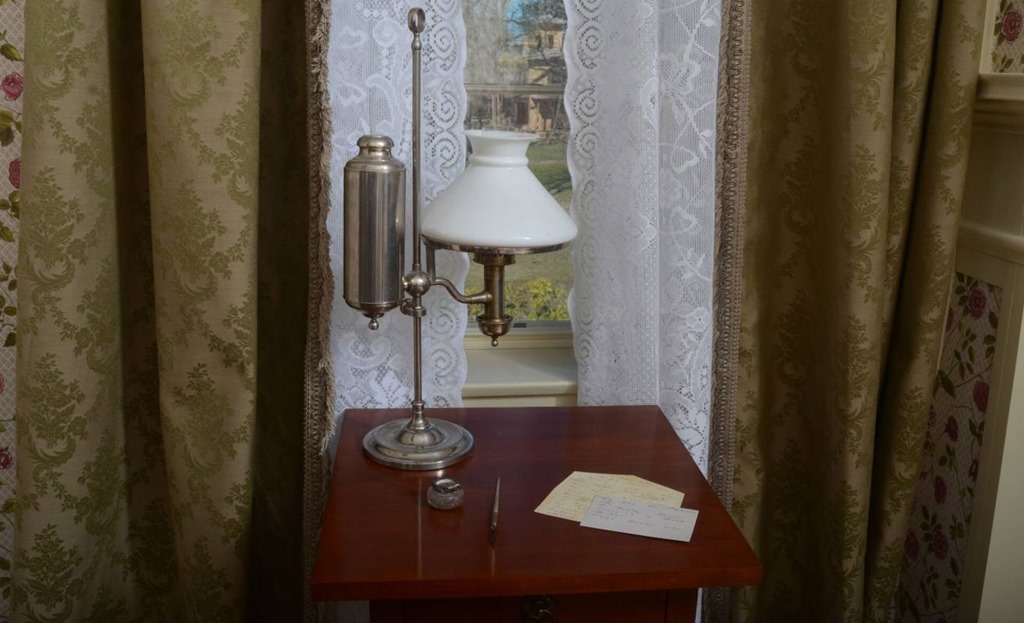
Why did Hendrix write his tune about working late within the endemic uncertainty of creatives using the image of a lamp? No guess. But another lamp, elsewhere, in another visit: something I recall when visiting Emily Dickinson’s bedroom was the little table that was her writing desk. On the small top of the table was a whale oil lamp. Dickinson, living with her family in a household, with household tasks and human needs that would take the daylight hours, had this little mid-19th Century, middle-class luxury of a warm effective light to work by after the busier-with-others’ hours.
“Ready for the same old explosion/Going through my mind…” A small writing table and lamp in Emily Dickinson’s bedroom (photo from the Emily Dickinson museum)
.
Looking at Dickinson’s lamp, I thought of the whole system that represented: the swimming mammals of the dark, cold sea, the diverse Moby Dick industry which captured, killed and deconstructed those massive bodies — and so, extra hours glowing with North Atlantic juice opened for a woman to scribble and sew little booklets. If I’d try to tell these thoughts and feelings when looking at the lamp to the average person, they’d sense a disproportion. Someone might even harrumph to me “It’s just a lamp — an unexceptional, domestic thing.” Readers here? You’re not that sort of person — and on her part, Dickinson too, she had further thoughts.
And so I continue, to burn the midnight lamp. Alone.
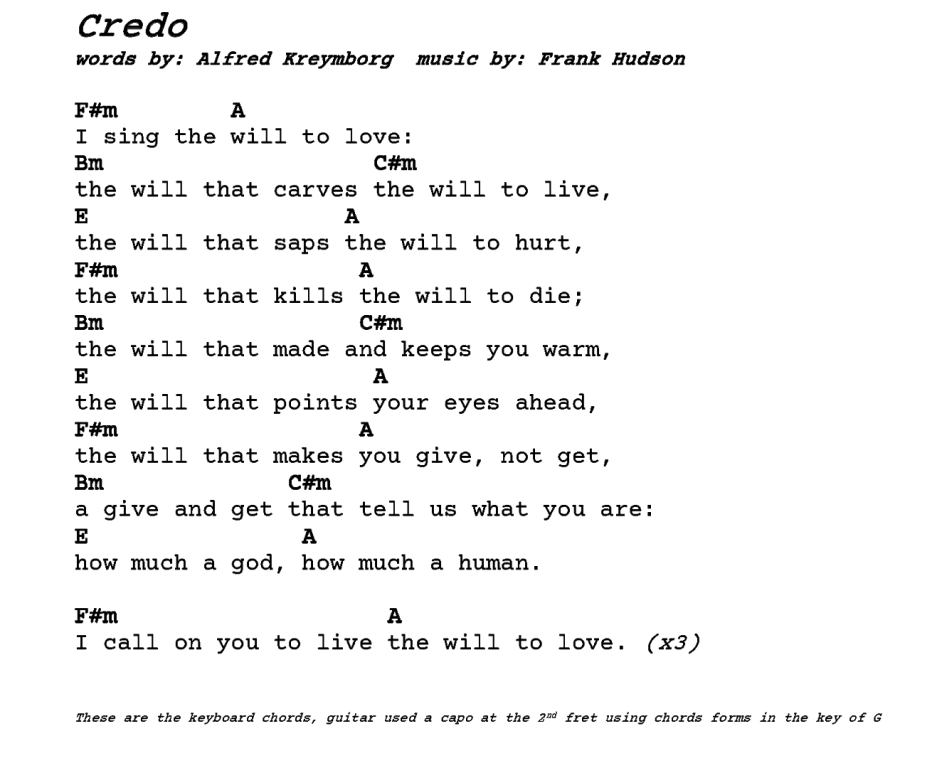
Today’s results came after a week of disappointing myself as I looked for some words to express what I was feeling, words that would ask me to sing them out even with my inexact and unprofessional voice. I was seeking words that would add something hopeful in a time of extraordinarily slipshod callousness carried out with motives of punishment as a virtue. It was this short poem by early American Modernist poet, editor, and publisher Alfred Kreymborg that captured me.
As I often say here under these chord sheets: someone out there can likely sing this song better than I can.
.
Last post here was a series of inspirational maxims carried by a Jazz musician. Maybe Kreymborg’s “Credo” seems a little too hopeful, too earnest for some of you. It’s probably not the sort of poem you’d first think of as an early text of American Modernist poetry from a colleague of William Carlos Williams, Man Ray, and Mina Loy. Little matter, I felt I needed to sing it. That’s enough for now.
You can hear my performance of “Credo” with the graphical audio player gadget below. No gadget? It’s not that you didn’t keep your lamplight trimmed and burning, it’s just that some ways of reading this suppress showing the player gadget. This highlighted link will open a new tab with its own audio player.
.
*Decades before, longtime Parlando contributor Dave Moore and I started the LYL Band just before Ronald Reagan’s election. Then too something that wasn’t very good for the country paradoxically encouraged creativity as contrast.
Early this morning, I was reading a blog of a modern avant garde poet who has lots of philosophic theories about prosody, and there this quote of Walter Benjamin’s is brought up: “To write history is to give dates their physiognomy.” Well, yes, I thought, that’s what I’ve been doing in this Black History Month series. This scrapbook, its photographs, ephemera, ads, and clippings from newspapers — all a picture of the history of an American Black man: Lawrence Kasuth “Hank” Hazlett, a musician and singer who lived from 1911 to 1990. That scrapbook that had come into my hands portrays his nation-touring time in the 1940s and a residence in South Minneapolis in the 1950s. When it comes to civil rights or diversity, we tend to see change, or the preceding things that needed to change, from a later vantage point. The scrapbook documents such a preceding time, and the sort of things that musician Frank Zappa liked to call “mutations” — the tiny breaking of norms. But, isn’t it just a scrapbook?
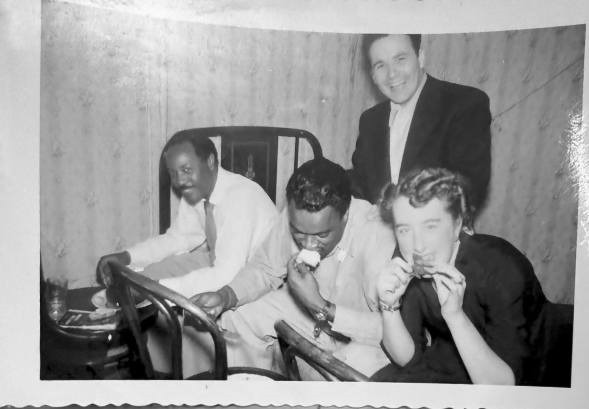
There are pieces in the scrapbook that may give us a glimpse into what its maker noted and selected to save. In the last post, we saw a picture of Hazlett playing on stage with a white bass player with the hippest of truncated neckwear — but overall, the performance photos show black musicians with him, playing (as far as I can see) to black audiences. Yet, here’s a photo from the scrapbook that stood out from that segregated norm:
.
In this photograph two black men (the one on the left appears to be Hazlett) are sitting on a cheap enameled-bedstead bed eating. Sitting on the same bed is a white woman and behind those three, a white man in a dark suit is standing. Black and white, men and the woman are smiling. It looks like an inexpensive hotel room, and maybe they’re all on tour.
On the back of the postcard they wrote: To Edith and Hank. So nice meeting you, it’s a pleasure to be an entertainer along with you. Jeannie Bill and Don
.
The scrapbook also collects this promotional picture postcard for an act called Jennie and her Boyfriends, who issued a single 45 RPM do-wop style record in 1959. Jeannie in the promo picture has a completely different hairstyle and hair-color, but it’s plausible this is her and one of the members of her trio in the bed-sitting photo.
Also in the last post in the series, we showed some clippings in the scrapbook of Black entertainers working to defeat limiting stereotypes, but one thing that struck me was that the scrapbook also contains clippings showing white entertainment figures. Ephemera in the book, like that MGM W2 form from ’44 and Los Angeles addresses for Hazlett make me think that he might have had at least tenuous connections with some of them during the 1940s. Here’s a page from the scrapbook showing a clipping featuring Lana Turner, which may have been included because its caption says Turner likes Duke Ellington records.**
Lana Turner isn’t into vinyl, she’s spinning shellac.
.
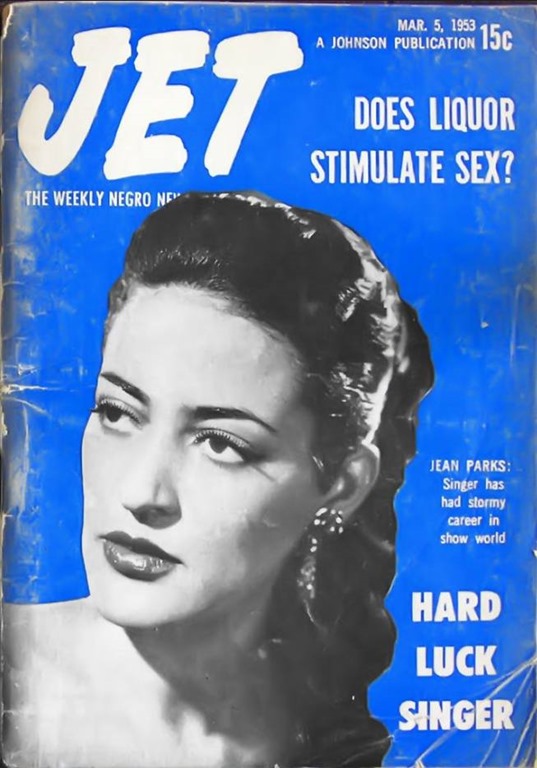
These are old clippings, sometimes from lower-res reproduction, and occasionally I’m misled by the ambiguities of race in the photographs. Take this one of Jean Parks found on this page with both white and Black entertainment figures. I figured she was white.
Find the second Afro-American woman on this page.
.
Those who’ve followed this blog will know that I was immediately saying to myself “Who’s Jean Parks?” The story outlined from asking that is as rich or richer than the story of Bruce Dybvig from earlier in this series. WWII military service put a crimp on the supply of male musicians — so just as with other occupations, there soon arose a number of female bands — Rosie the Riveter, only with saxophones. Popular pre-war bands often enough had female singers, and there were a smattering of woman pianists (and small-group guitarists) — but women playing horns, reeds, drums in big bands— important featured instruments in those ensembles — I can’t think of one. Then came the war and mobilization. All of a sudden there were groups entirely made up of Black or white lady musos sprung full borne from the brow as it were.
One of those was Eddie Durham’s All-Star Girl Orchestra. OK, now we’re studying history, so we have to do dates. It’s Victory over Japan Day, the war is over. In NYC a sailor grabs a nurse in a crowd without her consent, starts kissing her in front of a cameraman, and everything thinks this is splendid because the immense horrors of world war are over — and the, you know, sissy stuff of regular old living is to return. The All-Star Girl Orchestra are in the middle of an engagement on the opposite coast, in Oakland California. The link above says that manager Durham sees that the men are going to return — and just then, dissolves the act. Well, sort of. Some remainder is rebranded around singer Jean Parks. As it turns out, the post-WWII years will be tough for all big bands — and all-around, the all-girl band thing doesn’t survive the peace.
And here’s what happens when Parks meets the world of The Fifties. Just look at the bad-girl triple-double implied and indicted in this paragraph: Black, caught with a 6-foot-tall platinum blond “friend”/roommate, sex-work — and drugs? We got’em all: reefer, opium, cocaine. Other than a Communist Party membership card signed Mr. and Mrs. and documents linking her to a plot to cancel Howdy Doody, this is complete “All-Star” material.***
Seeing that other headline on the Jet cover, and suddenly I’m a teenager in the back row of the classroom muttering to a classmate “I must be drinking the wrong kind of booze.”
.
Two other pictures in the scrapbook seem to tell some kind of story about connections between the races, likely in Minneapolis in the ‘50s. There’s this snapshot, pasted on the same page as the similarly posed picture I speculated last time might be of a child of the Hazletts. I have no idea who Maxine is, or who’s Chuck. But as with the other pictures and accounts in today’s post, I’d reckon that mixed race connections like this had elements of risk beyond just social disapprobation. White school integration riots, Emmett Till, the beating and burning of the Freedom Riders buses, all were contemporary with the scrapbook.
.
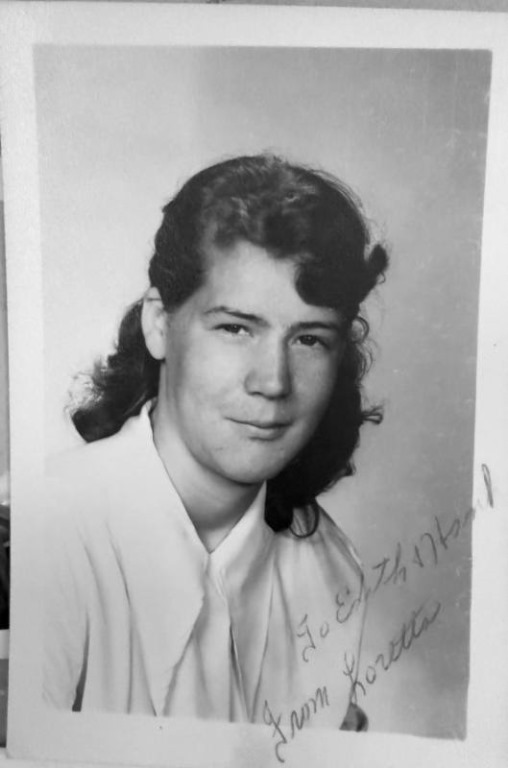
Then there’s this picture, inscribed to Hank’s wife Edith and so presumably from the early 1950s. So many of us have awkward school-picture-day photos, but I found this one more arresting than awkward. This is hard to detail, so I’m going to be more awkward than the picture, where after all Loretta is smiling and seems comfortable with themselves: Loretta looks quite masculine. Unattributed, it could easily be a 20-year-later photo of a mullet-head male guitar player in someone’s high school rock band. Burn-out the long-point blouse collar and retouch the long tresses in the back and it would be a 1950s boy who wants to grow up to play in Elvis’ band.
Loretta.
.
There’s no other context other than the inscription and being in the scrapbook. Looking at Loretta’s photo this month I immediately thought of “Get Back,” the Beatles lyric. Some of you may be singing the applicable verse in your head now that I’ve said that. My second thought: I’d love to know Loretta’s story, but there’s next to no chance I ever will.
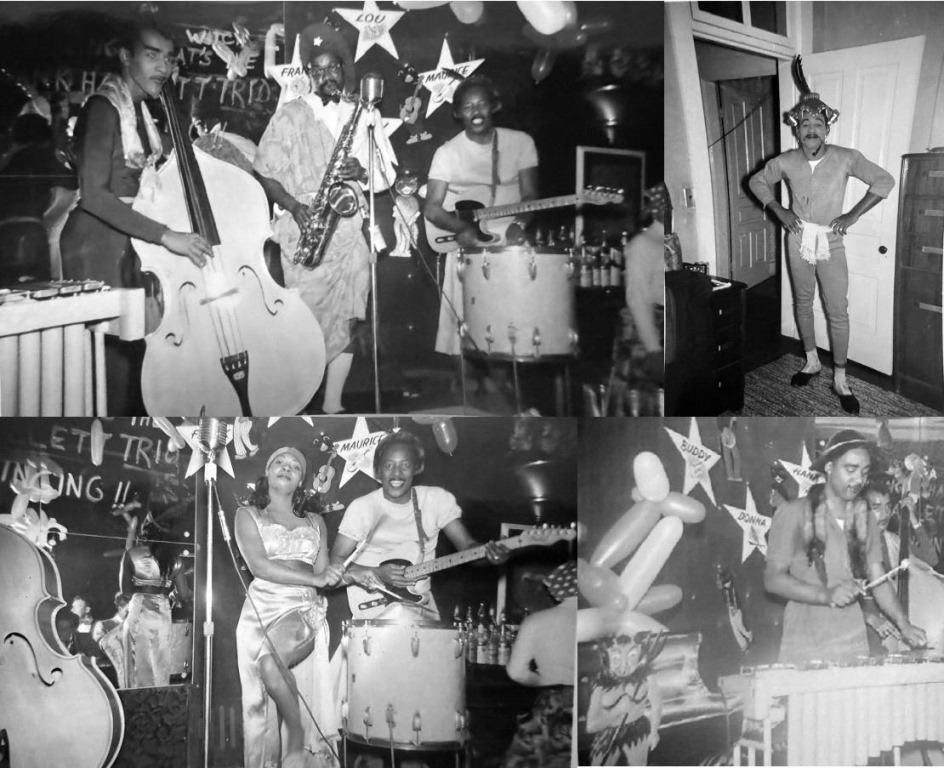
And now a transition that may or may not be apt. There are several pictures of Hank Hazlett, and Hazlett with his Trio, dressed in drag. I can’t place the club stage shown in most of the pictures. The Telecaster he’s playing says this is likely during the Fifties when he’s largely working out of Minneapolis, and it may be a Minneapolis club. Everyone looks like they’re having a good time, and dressing in drag is a multivalent act that can be meant to convey different things.
..
Everyone seems to be having a good time. Of course, right now we know it’s supposed to mean danger to children, and therefore we must let rich folks get richer so they can stop those goings on, because…religion. That’s a very serious opinion, mandate and all — you ought to pay attention to it instead of looking at this approaching 20,000 word series on — what? — a scrapbook about a Black musician who few have even heard of. And the scrapbook is mostly pictures, where’s the meaning in them? Of course, then there are these other Walter Benjamin quotes: “Those who do not learn how to decipher photographs will be the illiterate of the future” and “We collect books in the belief that we are preserving them, when in fact it is the books that preserve their collector.” Benjamin’s life, which we know more about than Hank, or Edith Hazlett’s, or Loretta’s life, could be called in to rebut those quotes. In a corporeal sense, he had little future, books didn’t extend his human, breathing, skin-coated living. But Benjamin did have his quotes, groups of words that might work like poems to let us see something new, and there are even some who will read philosophy at length.
There’s a new musical performance today, taken from a piece of folded and unfolded paper that was pasted into the Hazlett scrapbook. Did Edith carry it? Did Hank? On it, in faded pencil, are written 6 quotes, 6 maxims that someone wanted to carry in order to carry on. They are from a mixed-bag of writers, numbered 1-6 on the page, and in which order I read them in this performance: M. B. Whitman, H.D. Thoreau, Lloyd C. Douglas, Helen Keller, Herbert Kaufman, and Ambrose Bierce.
You can hear that performance with the audio player below. What? No player to be seen? Well, there’s injustice, carelessness, and cruelty we don’t see, and that’s a bigger deal than a couple of minutes of me dressing up in weird Jazz-band drag and reading some inspirational quotes — but you could use this highlighted link which will open a new tab with its own audio player.
.
*Marv Goldberg mentions that the Cats and the Fiddle might have had some involvement with the 1945 MGM Judy Garland film The Clock, which would have been several years and lineups past the original Cat’s quartet burst of Hollywood film appearances in 1938 — those all even before they had made their first appearance on recordings. A 1945-released film would have overlapped the time that Hazlett was in the Cats, could explain the 1944 W2. Mysteriously, I distinctly recall seeing a clipped advertisement for that movie when I first looked into the scrapbook years ago, thinking I should check the film out — but for some reason it isn’t in the scrapbook now.
***Like The Clock ad, I also distinctly remember seeing an article about someone in entertainment arrested for prostitution when I first looked through the scrapbook years ago. It too is missing now. The scrapbook was part of at least one move, and when I look at it now, I have to take care, as it’s falling apart. I now suspect that might have been more on the Parks case. The All-Star Girl Orchestra could have shared bills with the Cats in Hazlett’s time — they played the same theater circuit during WWII.







 Frank Hudson