Social media likes controversy, so it’s no surprise that two things have recently mingled there in provocative assertion: poet Mary Oliver and the dread “middlebrow” epithet.* It’s not a long bridge between the two: Oliver’s poems are put forward as all too middlebrow in this charge, and middlebrow is a sign of significant lack of ambition or achievement. I’m not a fan of the term “middlebrow,” for a hierarchy is implied and I don’t care for hierarchies much — but to speak of this I should define middlebrow poetry. A definition that works for me is: poems that remind us of something we already sorta-kinda know, but maybe couldn’t quite put into words. These poems are usually immediately understandable on first reading by a significantly literate reader.
Why’s this bad or lacking? If this is a singular mode it rules out poems that tell us multivalent things, or mysterious things that require more thought to comprehend, thought perhaps taken in stages. It rules out shocking, utterly surprising poems. And such poetry doesn’t feed our playful desire to puzzle-solve with clues we are proud to have acquired.**
My view? I think various modes of poetry (even differing modes of reading the same poem) have diverse values, and I’m more than OK with that. Poetry’s eye should be the insect’s compound eye, containing a hundred, a thousand, ommatidia. And so, if it was up to me, the best cultures wouldn’t be restricted to, or rewarding of, one poetic mode. This may be a visceral thing with me: I get bored with all one type of thing quickly. Building towers of hierarchies might be fun, and illustrative of what one can stably hold long enough to build such a tower, but in the end, the domain one will look out on will have a lot of scenery that isn’t in your tower. In the right mood, I can get pleasure out of looking at the commonplace apprehension poem and a “difficult” avant-garde one — and in the wrong mood on my part, or insufficient achievement in the poet, not a touch of pleasure in either mode. And beyond all this meaning and metaphor, there’s the oldest part of poetry, the part even young children understand, that poetry also has abstract pleasures like music has — poetry is the instrument on which the meaning plays.
A great many of the poems in our pair of 1920s children’s poetry anthologies are as middlebrow as any Mary Oliver poem brought up on charges in this controversy. This shouldn’t surprise us. A modern children’s anthologist looking to duplicate the task of those in the previous decade called The Twenties would, I think, do likewise. Some of those pressures would be commercial: what will sell to parents, libraries, teachers. Some would be practical: these children aren’t yet bored with the lessons of the world — those lessons are new and useful building-blocks for their youthful towers — and maybe a lesson of my old age (and a lesson of Mary Oliver) is that I shouldn’t have been bored with the lessons of the world either.
I think too of what happened as the first childhood readers of these poems in the 1920s progressed into the economic distress of the Great Depression, the rise of nationalist dictators, the Second World War, and the Damoclean Cold War. All through the middle of their lives how much time would they have for poetry that offered them the highbrow pleasure of gnostic meaning, of shocking new combinations and collisions?
The answer is: some would find the time, some went on and made their own verses in those modes — and many others would not. Some kept food on the table, kept bolts tightened on airplanes, tended the sick, kept fuel in NATO tanks facing east. Some had their yet young lives ended sans poetic envoi. Others desired, birthed, and raised my generation.
Highbrow, middlebrow, it is neither sophistication nor no-nonsense populism to forget either part of that cohort.
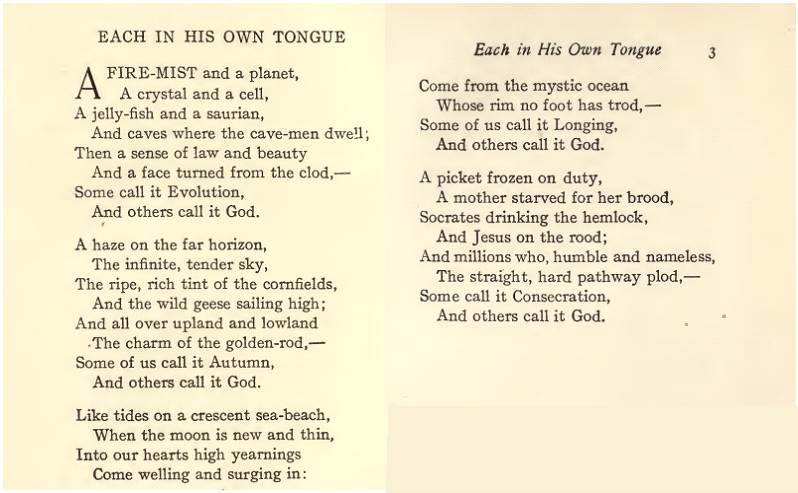
On to today’s poem, an example of a poem that earnestly intends to be a lesson: “Each in His Own Tongue” by William Herbert Carruth. Look! Mary-Oliver-approved wild geese make their appearance in it, decades too early! I also offer this month’s puzzle challenge: the pair of 1920’s anthologies I’m drawing from were gendered: one for boys, one for girls. So as with each post this month, you’re asked to guess in which volume did the poem appear. Answer lower down.
Here’s today’s poem as it appeared as the title poem in a book-length poetry collection by Carruth.. Marginalia picked up in the scan of a copy of that poetry collection. Wonder who Ina Coolbrith is? Here’s a link.
.
The brief Wikipedia stub for Carruth tells me he was “president of the Pacific Coast Conference of the Unitarian Church.” One of my preacher relatives once said of an Unitarian school he’d attended “The only time anyone would speak of ‘God’ is when someone stubbed their toe.” I read this morning a brief poetic knot of a summary of Oliver’s earnest lessons delivered by A. M. Juster who wrote that he’s “Not a big fan or a big detractor of Mary Oliver” but then sums up his impressions of her work by saying “I also think her spirit wanted to write religious poetry, but her mind wouldn’t let her.” Each in their own tongue I’d say, ungendering Carruth. Carruth wrote “His,” and his poem appeared in the Boys Book of Verse. You can hear my musical performance with the audio player gadget below. No gadget to be seen? This highlighted link is a backup which will open a new tab with an audio player.
*This last factor is less-often laid out as I just did, perhaps because it doesn’t seem serious when complex poetry is discussed. But let’s admit it: great portions of humanity loves puzzles and challenges in which they feel rewarded if they can progress farther than some other human.
For National Poetry Month this year we’ve been looking a poems that were selected in 1922 and 1923 for a pair of gendered poetry anthologies: The Girls Book of Verse and The Boys Book of Verse. Today’s poem is another reasonably well-known selection, John Masefield’s “Sea Fever.”
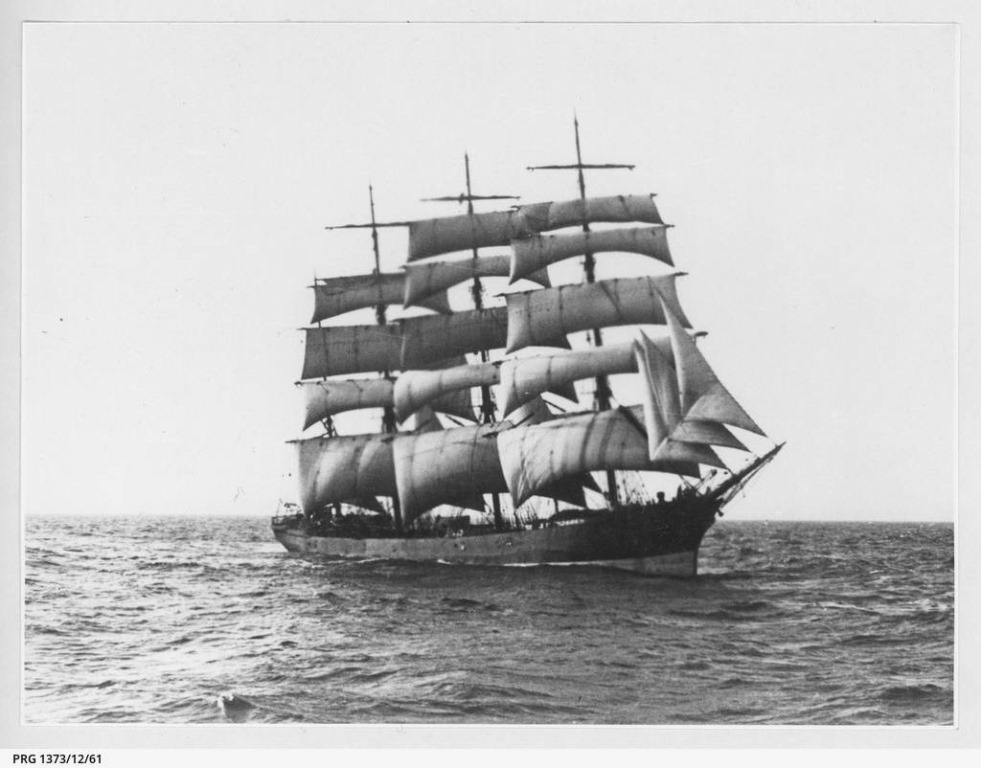
I’ll not have much to write about the poem itself, it speaks so straightforwardly. I will say that I always thought of it as a poem by an older poet, and an archaic one at that in that it speaks of ocean-going sailing ships. Turns out, I read this poem with misapprehensions. Reading briefly about the poem, I found it was published by a poet only in their mid-twenties, and though the long-lived Masefield’s life overlapped mine — he was still England’s Poet Laureate during my schooldays in the United States — he indeed worked on windjammers.
The young Masefield sailed on the cargo ship Gilcruix at the end the 1800s, and yet the ship looks like it could have been from the beginning the 1800s.
.
These two 1920’s poetry anthologies clearly wanted to encourage reading for the children that would grow to become the fabled Greatest Generation of the Great Depression, WWII, and the Cold War. Ironically, Wikipedia says Masefield was unhappy in school and shipped out to a life at sea “to break his addiction to reading, of which his aunt thought little.”
Masefield worked at sea and in America* for the next decade. The seagoing did not cure his reading addiction,** he continued to read on shipboard and eventually began to write himself.
While “Sea Fever” is more in the mode of poetic memoir than our poem last time by Emily Dickinson — it’s a nice bit of parallelism that Dickinson imagined books as a replacement for sailing far away, and Masefield imagined he could sail far away as a replacement for books!
As with our other poems from this pair of gendered anthologies this month, I’m going to ask you to guess if this was in the boys or the girls poetry anthology — answer below.
Here at the Parlando Project we take words, usually literary poetry written by various poets, and set them to original music in different styles. Not for the first time, this is a poem that already has a fairly well-known “art song” setting: one by John Ireland. Ireland made a lovely song, and not an overly elaborate one melodically for that sort of thing — but it’s beyond the limits of my vocal talent. So, the setting I created and performed with just my cruder voice and acoustic guitar is what you can hear below. I don’t know if you will be able to hear the canvas slap or the wind through the rigging in this version, but I was trying for that and a hearty song feeling in this one. There’s a graphical audio player to hear it below, but if that player is not visible, this highlighted link is your backup. It will open a new tab with its own audio player. Was this song of manly company on the high seas in the girls or boys book? It was in the girl’s volume.
.
*In between voyages, Masefield worked in a factory in Yonkers New York, something I did in my early 20s too. I may not have shared his nautical adventures, nor will I ever become the poet laureate of anyplace, but that tiny little happenstance made me feel kinship with Masefield 70 years apart.
**More of what is likely only coincidence: when Lou Reed’s protagonist in his song “Heroin” escapes into his drug addiction he likens it to a wish that he’d “Sailed the darkened seas on a great big clipper ship sailing from this land here to that.” If Reed had started his other song of that era “I must go down to Lexington 125, to the call of the running tide” we’d have an actual connection to go on.
For National Poetry Month I’ve set out on a feature where I’m examining the poems in a pair of poetry anthologies directed at children which were published roughly a century ago: The Girls Book of Verse and The Boys Book of Verse. Each collected around a hundred poems in a variety of styles, sub-categorized in broad subject areas the anthologists thought reflected childhood moods and interests.
That child audience became our ancestors. The early readers of the first edition would have been the oft-praised Greatest Generation which grew up in the Great Depression and served in the titanic national struggles of WWII and the Cold War. It’s likely that childhood has changed since then, but did these books in any way equip the young minds for the panorama of their future?
One of the pair of anthologies used this well-known poem by Emily Dickinson as a lead-off poem placed even before the table of contents. How many libraries had, maybe still have, this poem on the wall of their children’s section? I can’t say, but I recall seeing it in more than one in my post-WWII childhood.
Some of the words, if laid plain on the page, might risk being obscure to a 1920 or 2020’s child. Dickinson and the anthologists seemingly had little fear of that. A frigate is a class of fast war ship. Do children still have youthful romance with sea-ships? Born in a landlocked Midwestern state, I did — reading of and knowing all the classifications of ships, famous naval battles, famous captains, that sort of thing. Modern youthful D&D fantasists of the earth-like realms seem kind of land-bound to me, perhaps because Tolkien seems to have left his sea-faring tales to the long unpublished Silmarillion. Current SciFi readers might still have all the trappings of sea-battles recast in airless space, but that is less the exact particulars of historic ships.
Coursers too is not a word in most modern children’s vocabularies, and I have my doubts for a 1920s child. It’s a term for a fast-pursuing horse, and by extension those that ride them. With frigates just preceding it, I always heard and misremembered the word here as corsairs, a term for pirates or privateers, and it’s possible Dickinson thought she was punning there.
Dickinson’s second stanza makes reference to funds, and by extension class, in its metaphor. Rather than the appeal to straightaway imagination in the more remembered first stanza, here she makes the case that it doesn’t take much money to read. Dickinson’s family seems to have been roughly middle class, despite some challenges in her family’s finances during her childhood. Extensive world travel might have been outside their means or attitudes, but books wouldn’t have been. Oddly though, she says the “poorest” can have this book-led adventure. Does she simply not know of that level of poverty, or is this just “poetic license?”
I’m grateful to my parents and librarians for extending limited means to afford books as a child. My mother, an avid reader, knew how to use library extension services to order nearly any book, and I can still recall my joy when she’d open a substantial cardboard box from a letter-placed order which would include several books picked by some far-off librarian to be about sailing and historic sea battles for me to read. My father would let me ride in the empty well of his bread truck to be let off at the county seat which had a beautiful and bountiful library for me to wander in.
Here’s a standing question for this month’s pieces from the two gendered anthologies: do you think it was the for boys or for girls book that lead off with this Dickinson poem? Answer below.
A note about how today’s musical setting of Dickinson’s poem came about. At around 10 PM, which ought to be bed-thinking time, I was still thinking about more recording opportunity to bank musical pieces for this Project. Like last-time’s Blake piper, today’s poem’s book-with-far-flung-words seems to invoke not only poetry, but this Project itself — so I thought I should do this one sooner rather than later. My wife, who’s sometimes bothered trying to sleep if I strum an unplugged electric guitar in the next room was out house-sitting for a friend. I need a tune! I grabbed an old plastic acoustic guitar with a large crack in its top that I bought in a second-hand shop decades ago and now keep out in the dry, wood-cracking-weather of my home office. The chord progression I settled on was simple. My melody, like many of mine, is doomed to be served by my voice, and so is utilitarian. After finding that music in the nighttime, I decided to record a short demo then and there. It was after midnight. I rigged up some way to record the cracked plastic guitar — a brittle and unappealing pickup as there’s no room for a mic on its body like I would use in my studio space — and set one down.
Simple guitar chord sheet in case you’d like to sing this song yourself.
.
The next morning I listened to the demo and thought it aspired to be presentable. To disguise the crinkly sound of the guitar I did my best to sweeten it with EQ and reverb — but more elaborately, I composed one of my simple string trio parts to further cover the guitar sound up. You can hear that night sound Tolless-Traverse with the audio player below. No player? This highlighted link is a backup way, as it opens a new tab with its own audio player. Was our poem, written by a woman hunting on fast, pursuing ships in her imagination, in the girls or the boys verse anthology? It was the boy’s book.
From my Parlando outlook, this is a fine choice to start off a look at our twin girls and boys 1920’s poetry anthologies for National Poetry Month. Today it’s a poem by William Blake, a poet still known and rated today, and a poem that includes a child and praise for music inside of it. It’ll make a natural beginning I figured.
After I made that decision, I started to notice a couple of things. The poem began to seem stranger than it somewhat straightforward first reading might suggest. The odd thing I noticed first was the amount of insistent repetition in it. Lyric poetry, and even more so poetry meant to be sung. will often refrain lines, repeat entire verses or sections — look at many a modern charting pop song and you’ll see hooks as repetitious as today’s poem — but it still struck me as odd. The child continues to ask for song. The piper plays it. Immediately, the child asks for the song again. Parents experienced with young children may relate here — insert your own bête noire kids-song ear worm and insatiable toddler — those requests can be cute and dulling at the same time. Blake’s child is laughing at the time of the first request, weeping at the second, Why? Best guess: because the song is over, and they must hear it again. But then the child asks for a third song — perhaps the same one, perhaps not — and they are asking for it without the piper playing the pipe. Since most pipes are wind instruments it’s likely the piper in the poem hasn’t been singing the first two times.*
Combining the child’s responses after the first two requests which the piper has immediately fulfilled (laughing, weeping) the child “wept with joy” after the third go-round.
The picture I get here is joy in repetition, and woe at ending. The child makes one more request: the piper should cease the singing and write this music down. The piper MacGyvers up a pen and ink and gets to scoring.
Simple guitar chords on the chord sheet this time.
.
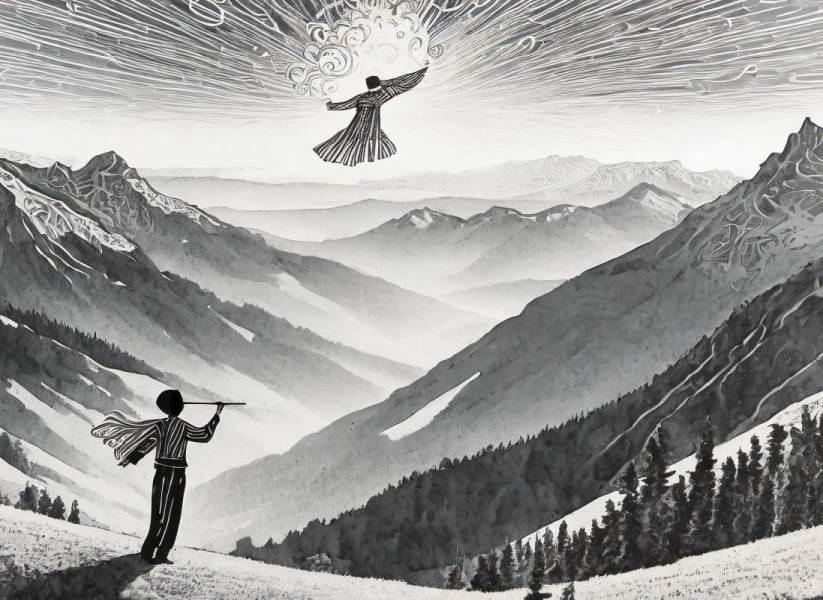
Then we’re told the child vanishes. This shouldn’t surprise us. If we were paying attention, this child appeared to the piper “on a cloud.” This child wasn’t a flesh and blood child — wasn’t one of the potential readers or listeners to the anthology’s contents — it’s a spiritual emanation of childhood.
OK, that’s a little weird, but Blake was a self-confessed visionary, and literary inspiration stories can be peculiar. Just another day at the poetic office for Blake. And as the piper makes his own pen and ink, I thought of one of the things that I found most inspirational in Blake’s life: that despite literary poverty he mastered the means of creating his own poetry, art, and engraved books.
Just after completing my musical version of this, another area of concern came to me. Just how strange did this seem to the children in the 1920s or to their parents who might read this to them if they were younger children?
I was a young child in post-WWII America, and in my time and place, I would have been puzzled. About the only piper I’d have any reference to was The Pied Piper, a page-bound storybook character. Yes, various kinds of musical pipes were extant then, as there would have been in the 1920s, but nothing I would expect in my time to see being played in wild valleys. Blake’s poem was over a century old when the 1920s anthology was made— maybe late 18th century England had itinerant rural pipers?
As they grew up, the child reader, then or now, would likely understand this is fantasy, even if exactly what Blake was getting at with his fable might be missed. Its value would remain as a set of word-music that speaks to the joy found in music and the arts.
Is anyone trying to guess if this was in the girls’ or boys’ anthology? Male author. The cloud/child is male, the piper is not gendered. Is joy in music a gender role thing? Not really.
Wilderness cumulous-carried spirit children are not a reliable compositional prompt.
.
It’s from the introductory section of the “for girls” book. My music is a simple folk music setting: acoustic guitar and bass, and eventually an Irish tin-whistle for piping. The tin-whistle is a played VI.** Two other instruments make a subtle entry in this recording. There’s a quiet electric piano in the piece, played and mixed so low it almost sounds like an overtone of the guitar, and another VI of a small obscure 1940s keyboard instrument, the Solovox that comes in for the next-to-last verse.
The Solovox was an FDR-era monophonic analog keyboard synthesizer, with glowing tubes and a wood-veneer case like a large table radio of the time. I used it for two reasons. If this song floats in fairy-tale time with children appearing and disappearing out of clouds, I thought the piper’s sound could change from the tin whistle to something more mid-20th century as a marker of how the children the anthologies were written for grew and changed. But also, I’ve seen, even briefly played, a particular real Solovox. The mother of alternative voice and keyboard player in this Project Dave Moore had one, and when he was young his mother would play piano and deftly slip one hand over to play melody lines on a Solovox. Dave now has his mother’s example of this old instrument, and has had it fixed so it plays, though with some glitches.
To hear “Piping Down the Valley’s Wild” you can use the graphical audio player you should see below. Player vanished? This highlighted link will open a new tab with an audio player. I plan more poems, adapted musical pieces, and observations from The Girls/The Boys Book of Verse coming up soon.
.
*There are methods to do that, where a singer alternates using their breath to sound the instrument and to sing lines of song. And there are bagpipes and the like where the wind comes from a bellows. But the child has asked the piper to drop their pipe and sing, so it stands to reason this is a request for the piper to sing a song with words after playing instrumentally for two renditions. The song then progresses from melody, to sung words, to finally written words — a plausible metaphor for the writing of a poem.
**I explained VI/Virtual Instrument technology last time, but in short it’s playable software that tries to contain all the sounds an actual instrument makes, often by capturing all conceivable notes and many articulations of those notes with a microphone it makers placed on the real instrument.
Perhaps we should remind ourselves in this pre-AI age that every poem, any poem, is written by another human being. I did the math with the years, and this is a poem published and likely written about a hundred years ago by a 40-something Midwestern American.
I’m decades past that age, as was Donald Hall when Hall gave us his law that states that most poets, even prize-winning ones, will be forgotten 40 years after they die. This may sound callous, but that process is likely necessary. How many poets can we hold as a culture, as a reader? Dozens? Certainly more. Hundreds? Whatever, there’s a limit. The poet who wrote today’s piece? Who would we give up in the pantheon to let him in?
I came upon the poet who wrote today’s poem, Edwin Ford Piper, by reading a striking poem he wrote of the closing American wilderness that I’ve already presented earlier this year. I know little about him as a person.* I almost worry to find out more, since human beings are full of all kinds of faults, deleterious opinions, vanities, and misapprehension. Did he write this poem in this time of the year, in the Spring? Who can say. Writers are full of memories, and imagination that can redress any cold or baren place, but it feels like he did. The poem’s trope of Spring’s reincarnation of driving/seeking life paired with the Christian holiday of Easter is far from unique — but the poem’s not, in feeling, much of a Sunday-dress observance — it’s luxuriously pantheistic. “Whispering Often” was written in a past era we still call Modernism, published in a journal that put forward many of the great English Language Modernist poets, Chicago’s Poetry Magazine, and it was included in Poetry’s founder’s anthology shortly afterward that had Modern American Poetry imprinted on its end-boards — but I can’t call it an example of Modernism.
If you can un-embarrass yourself, you could sing this Spring poem too.
.
It’s not end-rhymed. It does sing on the page, despite having a meter that I can’t easily chart out. There’s a familiar iambic rise to many of the phrases, but I don’t think I can call it blank verse, a form that Piper used elsewhere. Oh, but does this rite of Spring want to sing! The title says whispering, so maybe the poet is abashed at the voice that is called forth. Not a lot of today’s poetry sings like this. Instead, we’re more often interested in a poem showing us a particular apprehension the poet has uncovered, an apprehension we are to recognize and share. We are want to pause and recognize the matter of typical 21st century poems, like a friend speaking with us. A wise friend perhaps, a little better with language than we normally are — but still, we wouldn’t want them to break out into a song over shared teacups or beer glasses. How gauche that’d be!
And so, I think of this poem now, as Spring is rebeginning here in my Midwest, as the Abrahamic religions are celebrating holidays of freedom, rebirth, and revelation — but more so as the northern half of earth is celebrating something that Abraham could have seen in a place outside Ur. In this case, a man in his 40s, a Midwestern American like myself, stopped and wrote this down.
What an odd act! If he paused to think about it, he would know that by all odds this poem will be soon forgotten. Yes, Piper was a professor of literature, but he was an adult, someone who knows the comings and goings, the correct way to behave, the agreed worth of this and that. Yet the poem will appear as something as outrageous as an unbidden public song, one with a crush of erotic desire for life. Religion can shape and seek to make that solemn — and perhaps such a transformation teaches wisdom, brings thoughtful ethics to our roots and melting eddies — but that Spring is older than wisdom.
It’s enough to make a grown man break out into song after all.
So I did. Earlier this month I hurriedly sang a bunch of pieces I had written that I feared wouldn’t have time to shape and improve into full arrangements in an interrupted life. Long-time listeners will know my voice isn’t going to be polite, though maybe it should be. You can hear that quick, short, performance with the graphical audio player below. No player? You don’t have to rush past, you can use this alternative highlighted link that will open a new tab with its own audio player.
.
*It’s not certain, but there’s a fair chance that later this year I will make another trip to pay respects to one of my poetic heroes, Carl Sandburg, and on the way tarry awhile to see if I can learn more about Edwin Ford Piper.
Today is World Poetry Day, and if I want to represent the United States poetically to the world, one of my first thoughts for a representative poet would be Emily Dickinson. Dickinson has many “Greatest Hits,” poems remembered, poems anthologized, poems that literary critics have generated essays from.
Today’s poem isn’t one of those, for whatever reasons. I suspect it seems too playful, even child-like. The Dickinson I was taught in my youth, when she was considered a less important poet than she is today, was at least eccentric, often gothic. But here there’s no death in a carriage, no fly-funerals — there seems no novel slant of light or truth being told. It’s just the wind, an ordinary thing — or that’s the first impression.
The other immediate impression the poem might give is from its sound. This is Dickinson’s prosody at its most exuberant. No stern march of iambs here, and the use of unpredictable rhyme, end and internal, near, imperfect, and perfect. I love the loosening of rhyme personally, though I know there are others for whom imperfect rhyme grates. But this poem is so rich with the rhyme and pararhyme: today, hay, hat, very; bur, door, fir, where, declare, ever, there; odors, clovers, ours, mowers, hours; pebble, stubble, steeple; hay, day, say, stay.
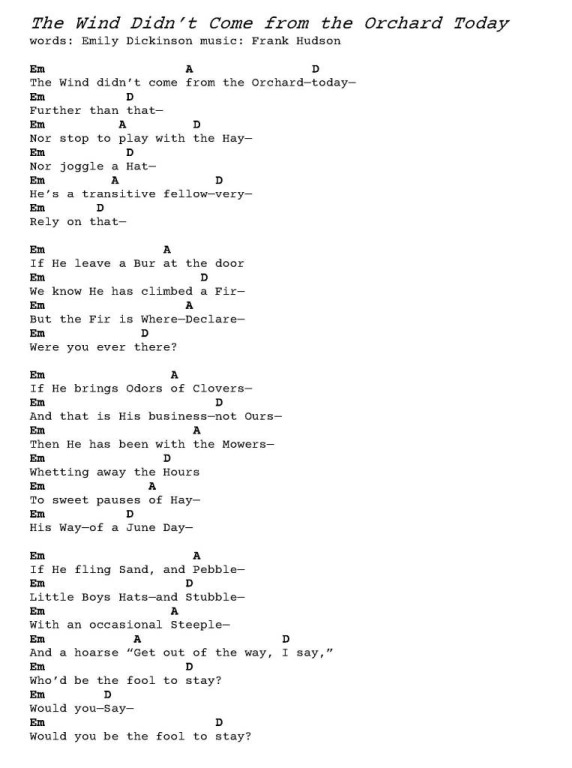
A chord sheet in case you want to celebrate World Poetry Day by singing it yourself. For performance I broke-apart Dickinson’s text, which is all one stanza — indeed, a single onrushing sentence!
.
America is a big country, a big culture. We certainly have our perfect formalists. But we have artists, like Dickinson, for whom form, and perfection in duplicating the form, is but an armature on which to improvise variations. While I’m one small ear compared to American Culture, I’ll take Dickinson’s side and place this poem in evidence.
Another thing to love in this one: the asides, set off with famous Dickinson dashes. “He’s a transitive fellow — very — rely on that” for example.
OK, so is this a musical slight-and-light poem about a playful wind we might meet in Spring?
Maybe.
Note that the poem starts off with a difference. The wind doesn’t come from the fruitful orchard.* It’s from somewhere distant. When I performed the poem, I began with the sense this must be an important fact to lead the poem off with it, but I didn’t know more. A playful breeze is mentioned, but again in the negative, this wind is too much in a hurry, that “transitive fellow — very,” and we can rely only on its capriciousness.
The sound of the “fir/where/declare” is so delightful, but what has happened here? Is the fir tree gone, uprooted, now out of place? Or is it just branches and seed-cones carried away from the location of the tree?
The sound of the mowers section is also delightful — and the work of hand mowing is so poetic one could create a whole suite of poems mentioning that kind of work — but it’s also the decapitation of anything above a height, and that’s always been part of the metaphor.
The final segment of the poem suggests a fiercer wind. An unremarkable wind might raise a little sand, but pebbles are being flung.** A playful March wind might dislodge a hat, but here it’s a steeple that has toppled off its head and the thing is like a run-away carriage.
In my Midwest, tornadoes are a common and feared storm with extraordinarily intense, though localized, winds. Dickinson’s New England has few of these. However, in the fall of 1861 during Dickinson’s most active years as a poet, two hurricanes, storms that can have high winds spread over a larger area, hit New England. Detailed contemporary meteorological measurements for that sort of thing don’t seem to exist, but sustained 60 mph winds are estimated. Ships were damaged, a ship was lost only a mile from the Boston harbor light, there were storm-driven high tides, and so forth. How far inland to Dickinson’s Amherst and at what force level it reached there I can’t say, but Dickinson could have been writing from regional news reports.***
In the many decades since Dickinson wrote her poem, we might not at first be able to hear the runaway roar of storm winds when we brush up against this poem — just the rush and song of Dickinson. So today, I will prod you to sense the mystery of the weather and the wind which we do not control.
For those of you who may have noticed a bit of a break in posts this month, it was not due to anything bad, more at a lot of effort toward new composing and recording. For the first time since last fall, The LYL Band reconvened last week, and you can hear their full folk-rock band performance of my song made from Dickinson’s poem with the audio player below. Has that audio player gadget seemingly blown away? Some ways of viewing this blog suppress showing it, so I provide this highlighted link as a backup.
.
*The Dickinson household was engaged in raising some of its own food, with Emily and her mother being known as experts in that field. The landscaping has changed at the Dickinson Homestead, but I understand that fruit trees were part of their domestic garden in Emily’s time.
**An incident from my own life. After a tornado at a branch radio network studio a few decades ago, I got a box containing the studio’s Macintosh tower audio computer to see what could be done for it. I took the computer out of its carton, and opened it to see what I could see, and the interior was packed with pea-sized landscaping gravel that had surrounded the building that housed our branch.
Even though the Parlando Project is about presenting other people’s words,* I sometimes remind myself that I still write poetry and lyrics. Every so often I’ll think of a song, sometimes one I wrote years ago, maybe one that never got a presentable recorded version, and I’ll wonder if I could record it like a regular Parlando Project piece.
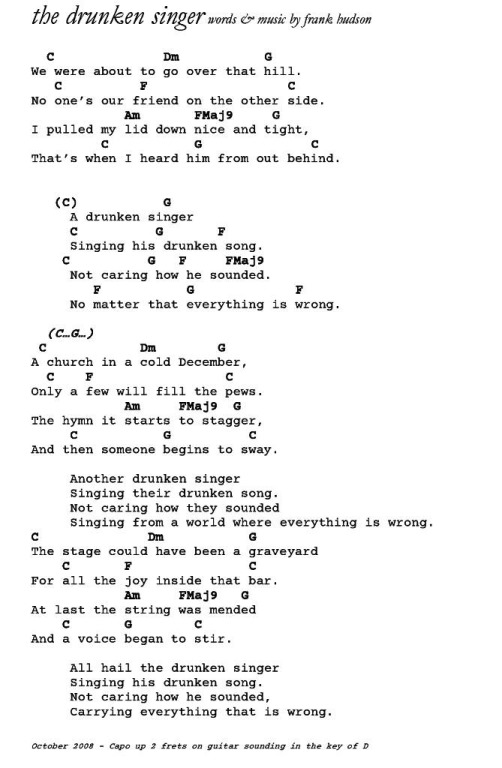
“The Drunken Singer” is one of those songs. It’s well over a decade old, predating the Parlando Project altogether. A couple of coincidental things made it come to mind. At another place online that I participate in, there was a recent thread on another older song, one by the extraordinary singer-songwriter Richard Thompson called “God Loves a Drunk.” I love Richard Thompson’s work, but his fans sometimes feel called to warn potential listeners that he can be very dark. Like the British Isles folk music that influenced him, he can produce songs of death and misadventure — but he’ll also go another step further and produce songs of even greater bleakness. “God Loves a Drunk”is one of those.
Early in this Project I told the story of my misapprehension of a folk song of alcoholic abandon “Rye Whiskey.” I had wondered how my teetotaler great-grandfather could have been fond of it. In the process of working with this Project I discovered it was an oft-performed set-piece for the popular “Cowboy Singer” Tex Ritter, who played the song for laughter by imitating a drunken fool while he sang it. Thompson’s drunk song has no plausible laughter, though it does point out something ironic: that inside their degradation, the alcoholic touches on elemental things about the limits of the human condition.
Thompson’s song, and his performance of it, are skilled and intricate as are the many details he uses in it. None-the-less, it reminded me of this song of mine. “The Drunken Singer” uses only three sketchily presented incidents, a less-is-more approach that I often favor when writing lyrics or other poetry.**
A part of the inspiration for writing this song: despite my being in the cold-water army, my voice often produces sounds that too are not proper or correct.
.
The second reason “The Drunken Singer” came to mind was that I found myself working this month on a handful of possible songs I could set from poems that referenced singers, and you just heard one of them last post: “The Late Singer” by William Carlos Williams.
So, these are my reasons for inserting this, my own song, into the Project today. You can hear my new recording of “The Drunken Singer” with the player gadget you should see below. If there’s no gadget (some ways of viewing this blog suppress it) you can use this highlighted link that will open its own tab with an audio player.
.
*New here? The Parlando Project takes those words, usually literary poetry intended for the page, and combines them with music we compose and perform. Because I almost always use poetry in the public domain, I often use poems from the most recent period that has clearly moved into that status: the early 20th century, the era when Modernism emerged. But I don’t keep to the early Modernists only, as an examination of the more than 700 audio pieces available here since we started eight years ago will demonstrate.
**As to the “Are song lyrics poetry?” question, my summary answer is “They are a kind of poetry.” Do lyricists and literary poets focus on, or stress different things, or work with different expectations? Yes — but the range of what is canonically literary poetry shows those things vary widely within literary poetry too.
This Project knows there’s a tension there between page poetry and songs. I just think it’s fun to work within that tension, to push: to pull, to refer and to connect.
A short post and a short off-the-cuff audio piece today. I keep trying to fit this Project into my life, and this William Carlos Williams’ Spring poem reminds us that it’s never too late to sing.
I had to cancel a more pristine time in my recording space this week. I lost sleep the night before as I prepared fresh material to record, and then woke up early the following morning, anxious to see what I could do performing this new material. Then just as dawn and others woke up, I heard that a mild illness would cancel my plans. Disappointing, but, oh well. If life wasn’t bigger than this Project, what would there be to sing about?
Later that same afternoon I decided that I should do something, anything, with what had been put off. It occurred to me that by the time I’d have an occasion to reschedule I might forget the musical material I had only in my mind, since at this point the songs only existed on simple paper chord sheets, like this one.
Here’s one catch of my recording space: while ramshackle, and having a remarkable sound capturable in the room, is not acoustically isolated. Since outside sound leaks in, recording quieter acoustic instruments requires planning and scheduling. I decided, no matter if it wasn’t quiet there, I should record short, demo versions of the seven songs I was planning to work up. I figured I could do that in an hour or so, and I could afford that time.
I sat down in the space, background noise accepted, and used my Telecaster electric guitar* instead of an acoustic guitar, and ran through the seven songs one after the other. A couple of takes each, a third only if I had a major stumble. Time was so compressed that the first take was largely my own test of my “so far, only in my head” plans for the song.
During that hour I produced this quick & dirty version of William Carlos Williams’ “The Late Singer” that you can hear below with the audio player you should see. No player? This highlighted link then. It occurs to me that Spring itself has its way of being quick and dirty, and we find charm in that.
.
*Electric guitar masks much of the leaked noise compared to the sensitive microphones used for acoustic guitar. Some of the leakage into the vocal mic I found I could minimize with software that does a good job of “ducking” that noise. Solo electric guitar with a single singer is not a common musical format. Jazz has some examples, ones using more chops than I have. Some early Blues makes it powerful, but that format was soon superseded by full bands. Jeff Buckley’s outrageously good “Live at Sin-é” makes me want to put my voice inside a box in a closet and hide it. Billy Bragg, a man more of my utilitarian approach, busked and recorded with just his own electric guitar backing.
Nothing excites me more while doing this project than coming across a little-known poet that I had never heard of. Some of these poets have perhaps a single poem worthy of interest; others, whole bodies of work which have slipped off the page, fallen to the floor, and have then been lost in the cracks.
Just how interesting is Edwin Ford Piper? I don’t know yet — and that’s fascinating! I’ve picked up a few things about him. He grew up during the closing act of the American frontier in the vicinity of the small town of Auburn Nebraska near where Nebraska’s southeastern border meets up with Missouri and Iowa. Despite a typical rural childhood of his era, with schooltime being “Sometimes two months a year, sometimes none,” he largely educated himself as a child by reading, graduated from the University of Nebraska, and he then became a long-time college professor of English Literature at the University of Iowa until he died in 1939.*
But here’s what’s intriguing me so far: unlike a great many of his contemporaries, it appears he takes as his subject the local culture of the Midwest in his time, including the ordinary working-class and underclass. At least at first glance he’s a Modernist of a sort. Some of the first poems I’ve read look like a melding of Sandburg** and a Midwestern, not New England, Frost — but with his own vision and sound.
I’ve been long-winded lately trying to share as much as I’ve been able to find out about another lesser-known Midwestern poet of this time, Fenton Johnson. So, let me rest your eyes from the historical matters of Piper so far, and share a performance of the first poem of his I came across: “The Last Antelope.”
In its deep cross-species empathy the poem reminds me of Kenneth Rexroth, who’s a generation later. Piper tells its story using some Modernist tactics, including abrupt time-shifts and changes in point of view, always chasing the most vivid perspective. It’s in an unfussy iambic pentameter, but like Frost, the language and word-music seem so natural you don’t hear the pentameter, just feel the rhythm without noting it. If you’d like to read the poem along with my performance of it available below, you can find the text of it here.
Like Fenton Johnson, there’s not a lot of pictures of Piper to be found online. How little-known is Piper? Not even a stub Wikipedia page!
.
A few pieces of detail about the pronghorn antelope that might serve as background for this poem: it’s the fastest land animal in North America (55 mph top speed!), and unlike some other speedsters world-wide, it can keep up significant speed over a long time and distance. The method of hunting implied in Piper’s poem is similar to what Indigenous tribes used, but with guns improving on bow and arrow: large groups of hunters driving the antelope into a natural or constructed dead-end pen where it can’t use its speed to escape.
Why did it become extinct in the Iowa/Nebraska area in Piper’s childhood era? He concisely notes the reasons in the midst of the chase the poem takes us on: they are skittish prairie creatures who want the lookouts of high ground and long free spaces to run. Early attempts to conserve them in fenced ranges failed, they refused to thrive where they couldn’t run. Barb-wire, a famous marker of the closing of the American frontier, was particularly dangerous: the pronghorn generally don’t leap over fences, they prefer to kneel and crawl under them. The barb-wire then tore at them, their crown of thorns.
Simple music for this closing of the frontier story — just acoustic guitar — but I hope I can tell well the story Edwin Ford Piper wrote. You can hear it with the audio player below this. No player? This highlighted link is an alternative way to get an audio player for it.
.
*Coincidences: for a few years late in the 20th century the University of Iowa’s Iowa Poetry Prize was named the Edwin Ford Piper Poetry Award, but for whatever reason, this name was abandoned. While it had this name, Missouri-to-Minnesota poet Phil Dacey, who I treasure for his early kind words and influence to me, won that prize.
**Like Sandburg (actually “with,” as he submitted collected songs to Sandburg’s landmark American Songbag that helped kick off the American Folksong Revival) Piper was known to break into song when reciting poetry. He got called “The Singing Professor” for this, and that makes him a natural Parlando Project interest.
We’ve come to the end of our Black History Month series on early 20th Century Black Chicago poet Fenton Johnson. Let me try to wrap things up with a few summary points — which as I’ll warn again, are preliminary and include speculation on my part. Long post, so the headings may help you if parts of this are of more or less interest.
Was Fenton Johnson able to achieve his goals during his lifetime?
No. He seems to have had very high goals however. He wanted a general readership for his poetry across racial lines, he wanted to be part of the solution to “the racial problem” in America. For an Afro-American poet of his time being able to publish several book length collections, or to receive any notice for his poetry should mark him as achieving something. But those books were all self-published and likely had a small audience. It’s unlikely that he had anything like Paul Laurence Dunbar’s audience in the Black community, and his white cross-over audience was small. These are estimates: but it’s clear he didn’t “break-through” with either audience — and his political platform seems unremarkable and no more successful than early 20th Century America was in general when addressing racial discrimination and oft-times violent white supremacy.
Why did he fail in that?
Remember one of this Project’s mottos: “All Artists Fail?” Even the most successful will be misunderstood and will be downrated for cause by some, will have a limit to their reach even if popular or well-ranked. But even if we don’t rate him against a perfect score, he didn’t succeed to the level of Dunbar, and he was superseded by his successors in the Harlem Renaissance such as Langston Hughes in Black or white readership. My guess: he overrated the audience value of his verse and likely highly overrated the value of his prose/journalism. It’s easy to suppose that he was a bright young man seeing himself in the eyes of youth protected at least at first by the loving support his family was able to give him, but not necessarily with the eyes of a skilled careerist or marketer. His early poems have more value than his contemporaries judged, but some of that value was too deeply coded for some to appreciate in the pre-WWI era. Judging from the small portion of his journalist-writing I’ve read, his efforts there may have displaced his stronger talents. His later poems? James Weldon Johnson’s evaluation of Fenton Johnson in the 1931 version of The Book of American Negro Poetry points out that FJ was uniquely despairing for an Afro-American poet, and contrasts him with Claude McKay’s famous poem “If We Must Die” from the same era as “Tired,” discerning that McKay at least says we can, we should, fight back. One thing that is odd about Fenton Johnson, he’s unsparing about deprivations of rights and dignity for Black Americans in his poetry while maintaining this public face in his presentation of “we just need to listen to each other and work together.” Even onward into the era of Jim Crow and the Great Depression he might have been both too down-beat and too optimistic.
Further supposing on my part: Johnson seems to have been discouraged around 1920 by the evident failure of his audacious goals, and there’s a report that the self-funding from family sources had dried up. I don’t know how dire his life was after 1920, but his pre-WWI Black middle-class status might have changed in ways that refocused his life and added new obstacles. A lot of modern poets reach their heights in writing quality and audience in middle age, which was about the time Johnson’s poetry stops being published.
The Harlem Renaissance has been informally extended to include writers who weren’t NYC located in retrospect, but Frank Marshall Davis and Margaret Walker from between-the-wars Chicago indicated that patronage support and publishing contracts were not at New York levels in Chicago then. Yes, there was a Chicago Renaissance in Black writing, but that came after Johnson stopped publishing.
If Johnson’s early attitudes continued, he may have had a disconnect with some Black literary cultural outlooks that followed WWI. I’ve yet to find anything linking him directly to Temperance/Prohibition, but he writes often enough about alcohol as the marker of a fallen state. He seems to have retained a religious component until he stopped writing — and even the religious have been known to disdain those whose religion differs only slightly from their own, as much or more than non-believers. And lastly, Johnson is explicitly adamant that he’s against “the Bolsheviks,” and commented to friends that this was hurting him in literary circles.
If he’s just some poet who didn’t rise to an undeniable level of success, why read him?
I think there’s unqualified value in the best of Johnson’s poetry. Historically, reading even his lesser-known poems can tell us something about what a smart Black man in this “bridge era” was thinking and writing.
Johnson is precedent-setting in the use of Afro-American musical forms in poetry. This particularly endears him to me. This element alone is highly important culturally and should cause him to be more widely considered. He was active in an era when our resources for Afro-American speaking and musical expression are scarce, so there’s some musicological interest on top of literary value.
You were so down on his political essays. Would you rather he was some kind of radical who might have been tied to between wars dictators? Or hassled by the Red Squads?
No. They were just disappointing in their slack writing and surface allegiance to common political stances without any vivid insights. The man I see in his poems is much sharper than the essayist I’ve read so far. It’s possible that that writing was insincere, that he’s trying to market himself, probably to white audiences who might help fund him. Was he conscious of this split in himself? I can’t say. One may think of one of Dunbar’s best-known poems “We Wear the Mask.”
After he stopped publishing poetry, his friendships in Chicago included those who would be aligned with more leftist politics. As with his non-extant post-1920 poetry, his political analysis might have continued to evolve.
Even some relatively unsuccessful writers influence those who come later. Is Johnson one of those?
Incomplete, but there may be something there. Although his post-WWI poems are few, they were anthologized, and anthologies are still a place younger writers find ideas of the possibilities of their own poetic voice. This Project is an anthology of a kind, and I’ve tried to add that his “spirituals” are worthy of re-evaluation.
This month, I was able to read two accounts of the next generation of Black midwestern poets (Margaret Walker and Frank Marshall Davis) who lived in pre-WWII Chicago, knew Johnson, and mention Johnson’s connection with other writers in this period when Johnson was no longer publishing. Davis (who is himself a bridge between the pre-WWII Black poets and the post WWII Black Arts Movement) admired Johnson and found his work validating his own. Little that I know beyond that, but at least by association there’s a possibility that a later-in-life Fenton Johnson may have influenced these other writers first or second-hand, even after he ceased publishing himself.
AFAIK, this is the only known photo of Fenton Johnson, from when he was in his 20s. We have more photos of Emily Dickinson or Robert Johnson.
.
Summing Up, and A Musical Piece for Today
In closing, there’s still more for me to find out about Fenton Johnson, even if it’s likely that I (or any “we’s” reading this and sharing my curiosity) will never find out other details that would illuminate him. We have those final poems before he “went dark” as far as literature is concerned, and I’ll maintain that his earlier work has qualities worth re-assessing. Yes, he’s a case of someone who dreamed big, maybe spread himself too thin, maybe his self-regard was blind, maybe he underestimated the resources and skills needed — all that “reach exceeds his grasp” stuff. And he certainly had to deal with generalized and persisting cultural undervaluing of Afro-Americans — so this isn’t a simple case of hubris. His most famous poem, that despairing “Tired” remains on various printed pages silently waiting to be found — but there’s an unwritten poem that sums Fenton Johnson up for me: “Tried.”
His most famous poem, that despairing “Tired” remains on various printed pages silently waiting to be found — but there’s an unwritten poem that sums Fenton Johnson up for me: “Tried.”
For today’s musical piece I’ll give you something sung by Dave Moore. It’s called “When the Dream Outruns the Real.” Dave didn’t write it about Fenton Johnson, but it is about anyone who tries, dreams, and doesn’t make it. Here’s what I think is cool about what Dave wrote and sang: it’s not a rote put-down. Easy to laugh at the over-reachers, easy to mark it all down to vanity. The Qoheleth in Ecclesiastes preaches that “All is vanity.” Could that mean we laughers are vain too? You can hear The LYL Band perform this with the audio player below, or with this backup highlighted link.
.
Here’s my sketchy and incomplete timeline of what I know of Fenton Johnson’s career.
1888
Born in Chicago on May 7. An only child and his parents are middle-class. There seems to have been at least some modest wealth in other branches of his family. According to his later friend Arna Bontemps, he starts writing at age 9.
Circa 1905
At least one play was produced in Chicago while he’s a high school student. There are scattered other mentions of Johnson writing plays, but I’ve found nothing about what they were about or if there was much notice of them.
1906
His early model, Afro-American writer Paul Laurence Dunbar dies. Around the same time he graduates from Wendell Phillips High School in Chicago. Attends Northwestern University and the University of Chicago, does post-graduate work at Columbia University in NYC circa 1914.
1910
Briefly teaches at a HBCU, Simmons College in Kentucky, founded by the Baptist church.
1909
He submits a manuscript (handwritten on lined paper from the scanned copy I’ve seen) to Doubleday as a non-fiction diary, though it’s fiction. It survived, though unpublished. Titled a “A Wild Plaint,” the main character in the story commits suicide due to the stresses of his Afro-American life. I have not read this yet.
1913
Self-publishes his first book, a poetry collection A Little Dreaming which has a wide variety of poems in subject matter and styles reflecting mainstream 19th century poetry modes as well as dialect poetry. Dedicated to a relative who may have helped finance its printing.
1915
Returns to Chicago, presumably ending his education. Self-publishes his second book Visions of the Dusk. Dedicates it to Albert Shaw, a well-known white reviewer who had given a favorable review to his first book.
1916
Founds The Champion magazine in Chicago and is listed as its editor. It’s uncertain how many issues are published. One issue does exist as a scanned complete copy. I just found it online, though I haven’t read it yet. Also in 1916 comes a third volume of self-published poetry, Songs of the Soil, which concentrates on his dialect verse.
1918
Founds The Favorite Magazine. Again, it’s unsure how many issues there were, but it may have been as few as two. Published Three Negro Spirituals: “How Long, O Lord,” “Who is That A-Walking in the Corn,” and “The Lost Love” in the June issue of Chicago’s influential Poetry magazine.
1919
Publishes his best-known poem,“Tired,” in the January issue of The Others. The Others circulation is small, but it’s an influential landmark little magazine focusing on the new American avant-garde poetry
Publishes five poems in the February issue of The Others: “Aunt Hannah Jackson” “Aunt Jane Allen,” “The Gambler,” “The Barber,” “The Drunkard”
Publishes “The Artist” and “Dreams” in The Others April-May issue.
1920
Self-publishes two short books: For the Highest Good and Tales of Darkest America. The former is a reprint-collection of pieces from The Favorite Magazine and they are largely anodyne Republican party material. The latter is a short stories collection which sustains some interest while not demonstrating that Johnson is a great undiscovered short-fiction writer.
Around this year Johnson seems to have another ready manuscript of new poems, but is apparently unable to find a commercial publisher and family funds to self-publish another book are denied.
1921
Published Two Negro Spirituals: “A Dream” and “The Wonderful Morning” in the December issue of Poetry magazine.
1922
James Weldon Johnson publishes the first anthology of Afro-American poetry at the dawn of the Harlem Renaissance. He includes five of Fenton Johnson’s poems including “Tired,” marking down Fenton Johnson as someone to be remembered in future surveys of Black verse. JWJ says little about FJ in his preface, saying he “gives promise of greater work than he has yet done.” Fate laughs: FJ is no longer publishing poetry. Nearly a decade later JWL publishes a new edition of A Book of American Negro Poetry and has more to say about FJ then, notes his work is uniquely despairing.
1925
The Cabaret Girl, a play he wrote was staged at Chicago’s Shadow Theatre. I know nothing about the work, nor of any other public work by Fenton Johnson after this.
Works for the Federal Writers’ Project part of the WPA. Others recall he was also in the “South Side Writer’s Group” of Afro-American writers including Richard Wright, Arna Bontemps, Margaret Walker, Theodore Ward, and others. The young Gwendolyn Brooks may have been connected to this group’s later incarnations.
Margaret Walker says she worked with WPA/FWP in Chicago while a senior at Northwestern. She reports Nelson Algren, Jacob Scher, James Phelan, Sam Ross, Katherine Dunham, Willard Motley, Frank Yerby, Richard Wright, Arna Bontemps, Sterling A Brown, and Fenton Johnson were also in the Chicago WPA.
Personal note: my relative Susan Glaspell was also associated with the Chicago FWP during the Great Depression. I don’t know how officially or unofficially the FWP was racially segregated, so there’s no guarantee my relative and Johnson even knew of each other. I know of no work of interest ascribed to Fenton Johnson from the FWP, at least as yet.
1958
Fenton Johnson dies in Chicago on September 17. Some of his papers etc. reported destroyed in a basement flooding event. Arna Bontemps was his literary executor.






 Frank Hudson