Parlando Project Winter 2017–the Most Popular Piece of the Last Season

The last few days I’ve been looking back over the past three months at the audio pieces that received the most listens and likes from visitors here, and we’ve now counted up to the post revealing the most popular piece.

But before I get to that, let me let newer visitors here know what the Parlando Project is. For the past few years I’ve been experimenting with the ways that words can be used along with music. Most of the words are going to be poetry, if only because I like shorter pieces for this, and poetry accommodates that desire most easily. The music? My goal is: as varied as we can make it. The “we” here are largely myself and Dave Moore, who I’ve played with as the LYL Band since the late 1970s. Dave also is the alternative voice of the Parlando Project, one that’s read or sung several popular pieces during the history of this project.

Dave and I have also been writers (Dave’s also a cartoonist) since our youth, but this project is not, in it’s greater part, about presenting our written work. Rather it’s about looking at a variety of other people’s experiences and expressions, reacting to them, and seeking to embody them in a way we hope you’ll find interesting.

Do we turn the poems into songs? Sometimes. Sometimes they were, or were meant to be, songs anyway (Tagore and Campion for example). But often we aim for something that is cast between spoken word and chant. As best as I can figure out, this is akin to what William Butler Yeats once aimed to do with poetry and poetic drama, and he thought William Blake, Sappho and the Celtic bards did the same. And for myself, in addition to those Yeats pointed to, it’s my spin on what Jack Kerouac, John Lee Hooker, Allen Ginsberg, and Patti Smith (along with others) did.

Rap/Hip Hop does this too, but as varied as those artists’ approaches are, most of their tactics I can’t make work for me. No disrespect, it’s just my limitations.

Well, here’s the Parlando Project’s most popular piece from the last three months: Tristan Tzara’s “The Death of Apollinaire.”  It was number 3 last September, so it’s been getting the listens since last summer, yet it’s not one I selected because it was well-known or sure to be popular.
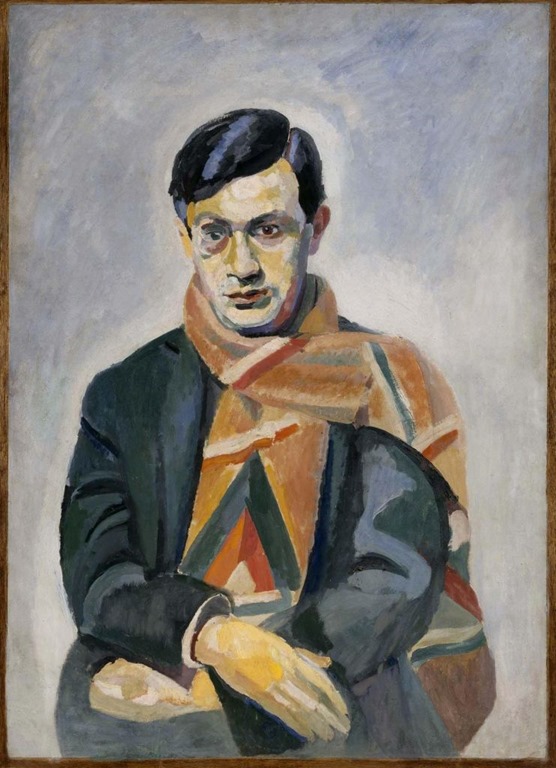
Tristan Tzara by Robert Delaunay

Accessorizing with knitted wear was the most important artistic dictum of Dada

Tristan Tzara, one of the founders of Dada, is not that widely available in English, and even the subject of this elegy, the influential Polish-French writer and critic Guillaume Apollinaire, has a fame that doesn’t transfer with full brightness off the European continent. I did my own translation from Tzara’s French for this piece. And though I’ve attempted to do this, off and on, since my youth, translating Surrealist, much less Dada, poetry into English has it’s extra complications: to what degree is an image meant to be impenetrable and random, meaningless as a stance; and to what degree is it instead a shockingly fresh juxtaposition?

I have a prejudice for the later. When I am translating poetry I take it for a given that I will not be able to convey the auditory music of the original, though I try to retain the musical development of its statements, and above all, I try to find English words and idiom that will grab the English-speaking reader’s interest with vividness.  This approach has it’s dangers, as I’m not enough of a scholar of the lives of writers or of the their languages to make the most informed decisions, but in the case of “The Death of Apollinaire”  I feel this leads to a very effective and affecting statement about the death of an artist still suffering from his battle wounds just after the end of the WWI.

My limitations aside, I hope I was faithful to Tzara’s voice, and I hope you’ll find it moving too. You can listen to it with the player below.

New pieces will be coming soon, so come back and check, or hit that “Follow this Blog” button up near the top-right to get notices of new pieces.

The Parlando Project Winter 2017 Top 10 Part 3

Here we go, continuing our Top Ten countdown for the most popular audio pieces from the past Fall as counted by your likes and streaming listens. In the past two posts we’ve done numbers 10 through 5, so let’s move on to number 4.

One thing I enjoy about this project is that I can’t predict which pieces will get the most response, and in 4th place this past Fall we have my rendition of a excerpt from Gertrude Stein’s arch-Modernist “Tender Buttons.”  Not only was it popular last Fall, but it actually improved on its 8th place position from last Summer’s Top 10.

Stein’s experiments have to be seen as the forerunner of what came to be known decades later as “Language Poets”—poetry that reveled in the indeterminacy of our language, that exploited all the cracks and odd turns in our real everyday spoken syntax. This poetry can seem intimidating if one is pressed to extract a meaning immediately, but one value of the Parlando Project is that we’re free to perform the poetry with music and allow any straightforward meaning to take a back seat to the sound and flow of the words. And the poetry of “Language Poets” often gains some singular meanings when read aloud, because our everyday spoken syntax is nowhere near as clear as good written prose would be. We commonly understand meanings when words are  spoken from inflection and our groupings of words that no diagramed sentence can measure.

Musically, I doubled down on the Modernist tilt of Stein’s words by speaking them to my interpretation of the style of Don VanVliet who performed as “Captain Beefheart.” VanVliet took the vernacular freedom of Delta Blues music and expanded on it even further. His own lyrics, like his own music, like Gertrude Stein’s words, don’t seem to make sense at first, until you open up and let them in for awhile, until the off-center is normalized, and you begin to see the facets of the brilliant corners. That journey starts—maybe only starts—when you listen to this piece the first time.


At Number 3, we have another returning piece from last Summer, “On the Troop Ship to Gallipoli,”  based on my recasting of WWI poet Rupert Brooke’s late fragment, written down shortly before his death on the way to the front in Turkey. If the soldier’s death of Modernist instigator T. E. Hulme (whose “Trenches St. Eloi”  was earlier in our Top 10) cost him the opportunity to solidify his position as a founder of British Modernism, Brooke’s death gave him no chance to outgrow or adapt his 19th Century poetics to the new realities of warfare that WWI revealed to many others.  So, while maintaining my respect for Brooke’s experience as he wrote it down, I tightened and modernized his language and presentation to create the kind of poem Hulme, F. S. Flint, Ezra Pound, or Siegfried Sassoon would have written.

I tried to work the time-worn musical tactic of the slow build in my setting for this one. The final fuzzy musical strain in this is a conventional electric guitar played with an E-bow, a device that magnetically drives a string without plucking it, somewhat in imitation of what a real bow does on a bowed string instrument.


Robert Johnsons

One of these two guys cut a crossroads deal at midnight that let him use Shakespeare’s lyrics


At number 2 in our Top 10, we’re back to a piece that hasn’t made a Top 10 before. It just so happens that it’s another adaptation or free translation, this time by Elizabethan physician, poet, musician Thomas Campion. With “Let Us Live and Love”  Campion’s first stanza is a faithful enough translation of a poem by the Roman poet Catullus, but he then decided to develop his own path out of that beginning.

And so, by the second stanza Campion comes close to coining the Sixties’ slogan “Make Love not War” and he closes with a mighty invocation of love as the great illuminator of our darkness.

The Elizabethan age saw a flowering of lute player/composers. Many of them adapted the words of Elizabethan poets as well as writing and using their own poetry. One of Campion’s contemporaries was the great John Dowland, and another was a man named Robert Johnson. A perfectly common name, but a name that many people today associate with another singer/composer/stringed instrument player, the famous Delta bluesman.

So rather than using Campion’s own tune, I chose to set Campion’s words to my own Blues tune with slide guitar and harmonica.


That leaves only Number 1 to go. What piece was the most liked and listened to here last Fall? Check back tomorrow to find out.

The Parlando Project Winter 2017 Top 10 Part 2

Picking up from where we left off yesterday, here are the next three most popular audio pieces based on readers here hitting the like button along with the number of streams and downloads counted during this past fall.

Number 7 is Edna St. Vincent Millay’s “”Sonnet 43”.  I seem to be coming to a greater appreciation for Millay as I do this project. Like my long time favorite Carl Sandburg, Millay “suffered” from too much popularity in her heyday, and like Sandburg I believe that her popularity in non-academic circles at the least caused critics to feel that they need not bother to examine her work more closely.

I’ll admit, I was one of those that thought she sounded like someone trying to be a 19th Century poet when the 20th Century was well and truly underway. Now in the 21st Century, I find this less of a crime, and when I let go of that, I find I like this sonnet’s complex appreciation of love’s limits.

Musically I love that I was able to play a convincing arco bass using a MIDI-controlled virtual instrument for this one. Bowed string bass is like the snoring of the bear mother in a winter den to me, immense, and yet sweet and comforting.


Speaking of Carl Sandburg, his “Autumn Movement”  made it all the way to number 6, and that’s remarkable because it was only released on October 20th and thus had less than half of the Fall interval to pickup likes and listeners. I love the central autumn image in this one from Sandburg’s “Cornhuskers”  collection, and it reminds us that Sandburg, known also for his acutely observed Chicago poems and journalism, was from the very start of his career interested in conveying rural life as well.

Musically, this piece demonstrates how recently I had seen Bill Frisell in concert—and seeing him, and the musicians he plays with, is something I try to keep always recent in my experience. Of course, Bill Frisell has an immense amount of musical vocabulary under his fingers, and I don’t; but I tried to make the best of mine, which is all any musician can do.


Bill Frissell with books

Besides his music, I admire Bill Frisell’s interior decorating sense and, alas, his sartorial style.


Our number 5 piece in popularity this fall was T. E. Hulme’s report from “Trenches St. Eloi.”   Many of the Modernist soldier/poets who served in WWI grew not only to  hate war, but to distrust their country’s cause and justifications for their particular war. Hulme is something of a exception. As far as I can tell, he remained supportive of the British war effort in which he eventually lost his life. That doesn’t make “Trenches St. Eloi”  propaganda, for it’s far from blind to the horrors and difficulties of extended conflict. Hulme’s death shortened his career and helped mask his seminal contribution to modernizing British poetry.

Since starting this blog, I’ve been following the centenary of World War I off and on in the background, which meshes well with much of the material I can present here without running into rights issues, since modern public domain status cuts off at 1924. The material from the poets who served in the war or were otherwise touched by it, is, not unexpectedly, downbeat. Just as the Modernist revolution changed poetry, WWI changed how war was written about, breaking millenniums-long Homeric traditions of war heroes, that however flawed, were able to shape battles by their character, into stories of endurance like this one.

This is another one where the bass guitar gets to carry a lot of weight.


Thanks again for reading and listening. It’s been a huge amount of work this past year to bring you the Parlando Project pieces, hundreds of hours of reading, studying, translating, composing, playing, and recording these unique combinations of various words (mostly poetry) with various original music (as varied as Dave and I can make it). That wasn’t drudgery—far from it—it’s brought joy and amazement to me to see what’s out there that I haven’t heard or imagined before, and I hope some of that wonder and discovery comes through to the readers and listeners here, because it’s our goal to surprise and delight you, to show you new facets of poems or poets you thought you knew and to introduce you to some writers that didn’t get included in your textbooks.

Here’s what I ask you to do if we’ve succeeded in that, even if only for a piece or two out of the more than 160 pieces we’ve presented so far: let others know about it. Tap them on the shoulder, show them the URL, link us on your blog or on social media, stick an earbud in their ear. Every like, listen, link and comment helps me keep doing this. I know I should be a better promoter of this work, but frankly, I’m too engaged in the work itself to do as much as is needed.

And standby, the next three most popular pieces from the past fall will be posted soon.

The Parlando Project Winter 2017 Top 10 Part 1

I’m going to do the top 10 list a little differently for the past fall,  doing it in parts, so as to not overwhelm visitors here in one post with more audio pieces than you might have time to listen to. I’m also a bit pressed for time right now, and this fits with my schedule as well.

In traditional fashion, we’ll start with the 10th most popular audio piece from the past three months, and work our way up the list in popularity judged by your streams of the audio and likes on the blog.

Number 10, we have my looser translation of Rainier Maria Rilke’s “The Dark Interval,”  which is one of five pieces that are returning from our last Top 10 from September.  I translated this a few years back, making choices at the time (as translators must) as to what the author was getting at in the original German, and what English could most effectively reflect that. Knowing just a little bit more about Rilke, I think I’d make some different, better informed choices now, but the choices I made then do make for a particularly apt Winter poem with it’s opening skiing metaphor that was my most audacious choice. Rilke’s lines “I can speak in many voices/but this voice shuts up quick.” remain personally meaningful.

Musically, this is one of the short and pretty ones, so go ahead and listen.


Number 9 finds the piece that remains a perennial on the Top 10 lists, a little angsty ditty written by a love-lorn teenager infatuated with a neighbor girl. Although he didn’t actually complete the piece, with it’s acrostic scheme that was to spell out the young woman’s entire name left abandoned partway through the last name, and even though he apparently didn’t get the girl, you have to admit it’s an ambitious move by a young poet or suitor.

I titled it with the love object’s first name “Frances.”  The guy went on to military and political success, capping it off eventually with popular success as a wordsmith here. You may have heard of him: George Washington


Rose3

“When the last rose of summer pricks my finger…” photo by Renee Robbins


Well, is it all going to be repeats from last time? No. At number 8 we have a newer piece, making it’s first appearance on a Top 10 here, William Carlos Williams’ “It Is a Small Plant.”

My late wife often found pleasure in looking at things closely. How intent and intense could her focus become, and what would that reveal? If she found out, she could never tell me exactly, only that she was drawn to do that. Many years ago, after her death, I took to digitizing the photographic slide prints that she took, some of which were as close to buds and flowers as her lens could focus, and the feeling of being behind her eyes, looking with her intent, fell over me.

Williams does something like that in his poem, which also cannot tell you straightforwardly what it apprehends, while the power of the seeing is overwhelming. I like the music I played for this one quite a bit, particularly the fretless bass part, an instrument that I took up this year, and have felt greatly rewarded by.


That’s all for today, but three more of the Top 10 will be posted here soon. And remember, we now have over 160 pieces posted, so if you’d like to see what else we’ve performed and interpreted, the Archives (to the right on the web page) will let you listen to other pieces.

In Praise of Not Great Poetry

I’m about to make a point that seems to me to be nearly self-evident, yet I feel the need to make it because I sense a conflicting opinion is the premise behind some commonly made judgements about poetry.

Poetry of course is only one of many arts. In our time, it is one of the arts that feels it needs to justify itself more often. Poetry feels like it’s neglected, marginalized, underappreciated, and there are reasons for it to think so.

Does music do this? One can find defenses for the value of music, yes, but these cries are not the same. Similarly, the other arts that use words: prose of various kinds, cinema, live drama—people will defend their value, but not with the elephant of marginalized dread that advocates of poetry feel they must deal with.

Why is that? I’m going to use a loaded word to describe the cause, one that is likely not quite right, but one that I can’t find a short pithy substitute for: snobbery. There may be a better word. I mean, really, it’s more at a misapplied kind of elitism, but elitism is an even more misunderstood and misused word.

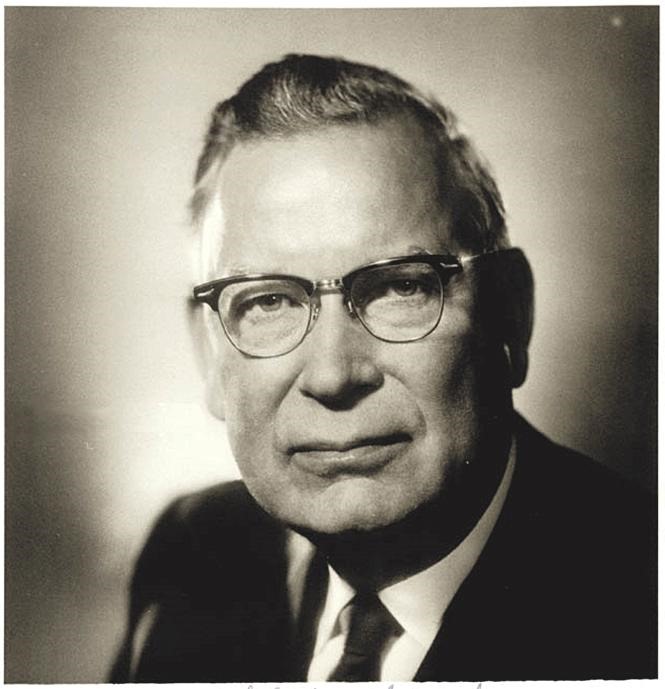
Roman Hruska

Roman Hruska. Is this is a picture of a great modern poet, or a leading voice of
“The New Criticism” who established the 20th Century ideals of great poetry?


Roman L. Hruska was a doctrinaire Midwestern conservative who served in Congress in the middle of the 20th Century. His place in history is constrained to one quote. Hruska’s infamous rhetorical thrust, meant to defend a Supreme Court appointment before the Senate for confirmation, was so mockable that it helped defeat that candidate.

I rise today knowing that what I’m about to say risks the same fate.

Here’s what Hruska said about Harold Carswell, who as candidate for the High Court, had been attacked as a mediocre jurist. “Even if he were mediocre, there are a lot of mediocre judges and people and lawyers. They are entitled to a little representation, aren’t they, and a little chance?”

That too is a misunderstanding of elitism. It is elitism to want the best leaders, the best judges. It is also elitism to desire all kinds of difficult and challenging arts. Given that elitism is sometimes thrown around as an insult in our century, let me be clear, I support that idea. It’s good to desire the best, to even take risks for the best, particularly in the arts, which have fewer direct consequences, and therefore can serve as a “research and development” department for outlooks and thoughts that we may want to experiment with a bit before we apply them to surgery or criminal law.

What does this have to do with poetry’s pervasive feeling of marginalization?

In the last century, poetry continued on an artistic and critical path that diverged from the other musical and literary arts. When any serious critical and institutional focus on the poetic arts were called for, poetry divested itself of all of it’s non-elite branches and expressions. Song lyrics? Not poetry. Popular poems, the kind once memorized by schoolchildren? Not real  poetry. Humorous poems? Humor, not poetry. Verse that is predominantly interesting because it’s musical speech? No. You don’t understand, poetry is about complex language examining difficult to express matrixes of experience. Thoughts and experiences from marginalized or particular speakers? Well, nice that they can speak up these days, but, please, it’s not poetry. Hip Hop/rap? Oh, come on! Get serious.

I can agree with what some literary critics and gatekeepers observe about these forms of expression, but not their judgement.

I too can be bored and uninterested in things that may fall into those “It’s not  poetry” bins. I can also be bored and uninterested in some page poetry which is credentialed and endorsed as serious mainstream literary poetry—you know, the stuff that’s poetry.  I can even change my mind about what I find interesting and worth my attention. I see new things in the work. I live new experiences. And sometimes when I’m listening to some musical speech, I’m seeking a pleasure or relief that’s hard to detail as criteria for greatness.

What if we considered all narrative prose that wasn’t a contender for the greatest novel ever written as, well, not prose. I enjoy a detective novel once in a while. Short stories can be sublime. Should I remind myself as I enjoy them that they are inferior in some criteria for a great novel? I find interest in some of the most austere or minimal modern serious music, but if every time I hear a good three-minute tune that makes a conventional set of chords seem inevitable all over again, should I feel ashamed that I think that’s music?

Can what is “not great” inform something greater? Many of the early Modernists seemed to think so—but it need not be applied like a newspaper clipping to a cubist collage or a folk tune to a symphony, it can be part of a vital continuum of human expression without needing elevation or even a judgment of hierarchy over all else.

I believe it’s a mistake for poetry, so concerned with it’s potential vital contribution to human culture, to feel that it can best survive by severing its cerebral head, leaving its ass and its elbow to wander around as “not poetry.”

Stopping by a Woods with Bad Cellphone Service

For some time, I’ve disliked the way the idea of “generations” has been treated by the culture at large. Not the nugget of thought that’s in it, that cohorts of people in a particular time and place will share certain experiences, some of which will shape their outlook—but the nutty, pseudo-scientific way it’s been used. The balderdash that’s been added to “generations” includes the nonsense that there are some sharp and agreed on borders to them and that everyone inside of these sharp lines in time not only shares the same experience, but reacts to these things in the same way.

The crap labels we use like “Generation X” (Billy Idol and Richard Hell may have a lot to answer for, but let’s not hang this on them) or “Millennials,” (who could just as well be perennial grinders of grain for all the meaning I assign to that word) have become like unto the Sixties’ penchant for astrological signs. “Oh, you’re so Millennial” or “Members of Gen X think this way” have become the Moonchildren and Fire Signs of our age.

And of course, the borders of these deterministic generation containers are natural and inviolate—no, don’t look at them, as they will seem arbitrary and varied if you look too close. Are generations 12, 20, 30 years long? Don’t ask, as we don’t agree. And is someone born in 1946 exposed to the same set of experiences as someone born in 1963? Don’t look too close.

I bring this up, because this week I wrote a parody. And as humorists have been known to do, I went and used some generational stereotypes. I was pressed for time, those sorts of things are ready-mades, one or two people found it funny, if I use it humorously I’m making fun of it—Oh, I’m giving up. I’m ashamed.

Look, one of the good things about considering the experiences conveyed by writers whose words I use here, is that most have been dead for generations, no matter how long we define that term. Seems like they are each their own people, not clichés like “Victorians” or “the Lost Generation.”

New start. I had a serious thought as I started this. Earlier this month I revisited the well-known yet too-little-reconsidered Robert Frost poem “Stopping by a Woods on a Snowy Evening.”  As I thought about the experience Robert Frost was describing (if an actual country winter buggy ride, some think it occurred in 1909), I considered how different the night and the rural roadscape would have been then, compared to how we have informally remembered Frost’s poem. I thought the opening stanza of that poem, starting with Frost’s line that’s fallen into too-famous-to-think-about status: “Whose woods these are, I think I know,” could be describing a person who was lost in a darkening, rural pre-electric light, night—instead of a poet some of us remember as irresponsibly stopping to look at a well-lit Christmas-card pretty sight of a woods in snowfall.

I was thinking then: “Now I’d have not just the possibility of bright headlights, but a cellphone in my pocket that should tell me just where I am, no matter what poetic truth I’d be trying to express.”

And then I thought again about that phone. There are still areas, even in North America, without cellphone service. GPS signals don’t penetrate everywhere. Those maps in our apps are not without errors.

Cell Coverage vs Drake in Coat

Drake’s from Canada, but Minnesota and New England need cell coverage and warm coats too.


So, today’s piece, which I call “Stopping by a Woods with Bad Cellphone Service”  is actually a serious piece of winter travel safety advice, not a scurrilous piece of generational stereotyping, which I would never stoop to doing here.

Stopping by a Woods with Bad Cellphone Service lyrics

Here are today’s words, but you want to listen to the music don’t you?


But when you think of scurrilous, I hope you think of the LYL Band. It’s been awhile since I’ve had a piece that wasn’t created by that scrupulous and well-behaved group of musicians that is myself—recording it instrument by instrument, a track at a time. The LYL Band is an organization in the same way that a hockey fight or litter of kittens is organized, which is to say, barely, though we attack things with abandon playfully or otherwise. To hear us, use the player below.


A Dust of Snow

Here’s another winter poem by Robert Frost to put to our uses. Writing about my last piece here, Frost’s “Stopping by Woods on a Snowy Evening,”  I wondered about the actualities of the scene the poet was describing: a New England winter road in a dark snowy evening before the coming of rural electrification. Frost would know, of course, that it would be quite dark in those conditions. But did he use that knowledge when he wrote the poem? Did he, the author—like I did as a reader once (despite knowing too the darkness of rural night)—visualize a well-lit snowfall on trees, an alluring and beautiful sight that might tempt him to stay and watch for a while?

I can’t say for sure.

Frost’s “A Dust of Snow” is even shorter, and the accepted meaning of its images has been a settled thing for some time. Last time I wondered if “Stopping by Woods”  was more a poem about a man who was lost in the dark in both levels of meaning rather than a man who was tempted by bright beauty. I could have been wrong, but I think it’s worth considering. With “A Dust of Snow”  certain images have been determined by most academic readers to be, well, symbolic. What if we consider them as real, natural objects and not as handy metaphors?

Robert Frost with axe

Let’s cut down on our use of overdetermined symbols with Robert Frost

We start right off with a crow. “A symbol of death” it is said. Perhaps it doesn’t hurt the poem to think that. I think it’s a crow. A dark bird, darker yet against the snow, and no crow would let the poet that near without a racket of loud caws. The poet doesn’t let us hear the caws though. Instead, like the uncanny sound of sifting snow in “Stopping by Woods,”  Frost wants us to feel just a dusting of snow falling from the branch as the bird flaps off. He wants the main action in the poem to be almost microscopic. He could have written that the bird’s takeoff “dumped a pound of cold slush down my collar”—but that wouldn’t be the poem he wrote. Is the dust a symbol of death too? Or is it an image of a tiny action of little weight? I hold to the later.

Oh, and symbol alert! The tree the bird left is a hemlock tree. Or as the movieReal Genius  reminds us in “the immortal words of Socrates, who said: ‘I drank what?”

How aware was Frost that the American Hemlock is a pine tree and the European poison is a completely different, smaller plant? If this were written by the avid amateur botanist Emily Dickinson, we’d know the poet would know this. Even William Carlos Williams M. D. might have need to know about the derivations of poison. Like the crow being “death” or a bird, “hemlock” could be a reference to death or suicide—but the evergreen is also a symbol of life in winter too, if it must be a symbol. Frankly I think either taken in a one-to-one direct simile way may overdetermine the poem. In the book of nature, having a black bird against white snow causing the small, light amount of snow to fall from an evergreen tree is sufficient.

And this snow falls on the narrator of the poem, and the small sprinkling of snow lifts the rueful mood. I think that’s the essence of the poem: the smallest action of nature, a flighting crystalline snow sprinkle that may not have weighed an ounce, can lift a human out of their dense internal fixations. I think that’s a more graceful poem than the leaden march of death-crows, grave-dust snow and poison trees. I could be wrong, but I like that poem better.

Musically, a much simpler arrangement than last time, just a bass and 12-string guitar. I’m trying to carve out time to prepare for some more recording with the LYL Band tomorrow. Even if we are successful, you won’t hear those pieces for some time, so use the player below to hear “A Dust of Snow.”

Thanks again for the likes, comments, and the sharing of these pieces on your blogs or on social media.

Stopping by the Woods on a Snowy Evening

Today I’m presenting a piece that is extraordinarily well-known, by an American poet whose work is still read and remembered outside of academic settings, Robert Frost.

In such cases it’s easy to think we know the poem, perhaps we’ve even memorized it in whole or in part, and we then say we know it in that special way. If we studied it in school, perhaps we learned or apprehended some deeper meanings for it. If this is so with you, I’ve had those experiences with “Stopping by the Woods on a Snowy Evening”  too.

Yet, sometimes, when we look at something with intended freshness, things step out from our remembered poem and introduce us to things we didn’t realize were always there. Let’s start with just how I (and perhaps you) have visualized the setting for this poem.

Currier and Ives Sledding in Central Park

In the rural winter of Frost’s time, things would be considerably more dark

.

Is Frost in a woods, a bright high-contrast Currier and Ives scene of crisp white snow and colored accents? Not as he wrote it. The title and a line in the second stanza tells us he’s on (presumably) a road, and that he is between the woods and a frozen lake. Is there a full moon and clear sky? No clear sky, it’s snowing, so overcast. He says “the darkest evening of the year,” so the moon isn’t adding significant light. In the rural New England of Frost’s time, it’s probably dark and getting darker, in a way that few of us know darkness today. There are no street lights, no farm yard lights, likely no headlights. One might see villages spotted with oil-lamp-lit windows from the crest of a hill, but he’s told us no village is in sight.

When he says he only thinks he knows “Whose woods these are,” he probably means, “I could tell you if it were noon, but not in this dark.” In the rural area of my youth, even forty years after this poem was written, directions were still given by knowing who owned (or once owned) a piece of land. Is he lost? Possibly. At the least, he wants us to know that he’s not exactly sure where he is.

At the end of the first stanza he says he stopping to watch the woods fill up with snow. If he accomplishes this, he doesn’t tell us. There are hundreds of good lines to describe snow falling on trees visually, and Frost has written many of them, but he doesn’t do it here. Is he leaving us to visualize it ourselves, from our own rich storehouse of memories? That’s possible. And if you and I remember the poem as having images of falling snow drifting through tree boughs in moonlight, that worked. My current guess is that Frost’s narrator could “see” this too, but like us, only in their mind.

It’s a testament to how thoroughly we prioritize visual imagery in poetry that we think those images are there, even if we’ve memorized the poem. Frost was especially proud of the poem’s third stanza, and justly so. It’s all sound images. The dark and solitary nature of being in the middle of un-occupied rural space at night allows sounds to take the place of what our eyes would lord over otherwise. It starts with the horse sounding his harness bells, bells not merely a decorative pretext to sing “Jingle Bells,”  but a useful method of letting other narrow-road users know someone’s coming around a curve or hill-crest, particularly in the dark. And the snow image that’s really there? It’s so quiet and he’s so focused in the darkness, that he can hear the sweep of the top layer of snow blowing across the surface of the rest.

The infinite depth and darkness of the woods in the final stanza is not just a metaphor. It’s dark out, and it will not get lighter until morning. Its loveliness, invisible in the dark, is conceptual art at this point for Frost.

In this view, the decision about staying or continuing the journey is not a temptation of a seductive external snowfall-on-the-woods scene, nor is it a thought of embracing death or a contemplation of suicide, though those elements may be there as subtext. The situation is “I’m not even sure where I am on this road in the falling dark. The momentary beauty I sought here is elusive and mostly in my head. Keep following the road, though I don’t have sure landmarks and don’t know for how many miles. Better the finite, even if not quantifiable, promises of the rotating wheel of my buggy than the depth of a forest I cannot see.”

And the sleep he ends the poem with? Frost always maintained it wasn’t death in metaphorical disguise, despite what professors in electrically lit rooms might think. The story is that he wrote “Stopping by the Woods”  at end of a long night of work on another, longer poem. Any writer would recognize that it’s actual sleep he now desires, rest that we only allow after exhausting our attempts to see what is lovely, dark and deep despite the night.

Musically, I sought to combine the familiar with a few twists for this one. There’s a reassuring folkie acoustic guitar part and even a cod banjo motif I played to my rusty ability. But then a cello and viola part carries throughout. Instead of bass guitar, I decided to play tambura, a traditional drone instrument of South Asian music, on my guitar using a MIDI interface.

I liked how it came out, maybe you will too. The player gadget below will let you hear it. Don’t see the player? This highlighted link will also play it.

Rosemary

It’s been awhile since a new post, what with holidays and family occasions, but here’s another piece, “Rosemary,”  using the words by Edna St. Vincent Millay.

Millay was one of the most popular, most often read, poets of the first part of the 20th Century, but the later part of the century gave her less consideration. A contemporary of the Imagists and other poetic Modernists that we’ve featured a lot this year here, and while connected to their world, she didn’t sustain favor with the rise of the “New Criticism” that became the dominant academy in the English-speaking world after WWII.

Reasons? Well, there’s gender. One must assume that played a role. And popularity of the general-readership sort would not have been an asset either, as perhaps only Robert Frost and Emily Dickinson survived being read by a general readership in the mid-century without losing their high-art cred. Why couldn’t Millay have joined Frost and Dickinson in these critics’ esteem?

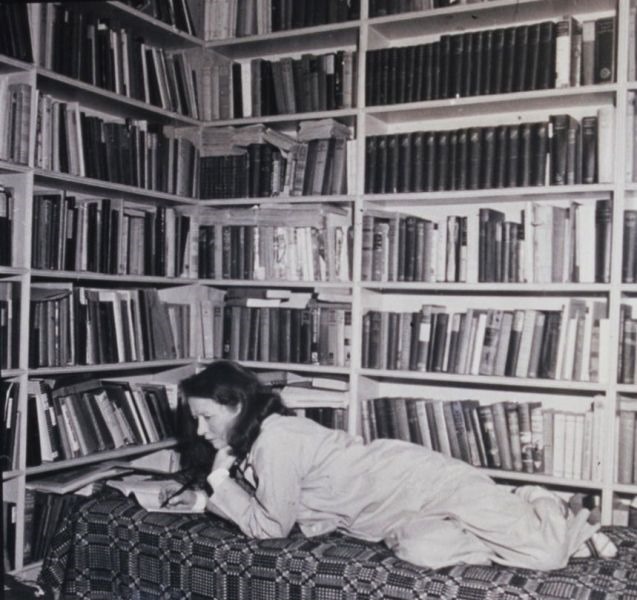
Millay with books

Millay at work. Other than the lack of guitars, just about the perfect décor.

I think it’s largely a case of her poetry not seeming to have the subject of their criticism: fresh, complex, allusive and illusive, imagery. Frost and Dickinson may have used homey sounding language, but in the end those funerals in the brain and snow, roads and woods added up to something to talk about in critical prose.

The New Critics were an inflection point. Before them, poetry was largely considered musical speech, a container that could hold a variety of subjects, after the New Critics, poetry was about the imagery, how you portrayed things with it. And unless one aimed for satire, such complex rhetorical structures must be in service to serious matters.

And so, there’s subject matter too. Millay’s great subject was love and affection, it’s presence, absence and all the shades in-between. In doing so, she addresses much of life and its condition, but did she receive enough credit for that? Is a heartbroken man a tragic philosopher of fate, and a woman merely a spurned lover? Narrow-mindedness can’t be ruled out.

“Rosemary”  allows us to examine these issues. This looks to be a poem about the death of a passionate love or the death of a dear one. I’m not sure which of those two possibilities is standing for the other, but for an audience, it does not matter as both events are common to our hearts.

I think there is an intent here to conjure a complex world of timeless folk magic. Though written in the 20th Century, it could have been written anywhere up to five centuries earlier. In the title we have rosemary, an herb associated with remembrance even in Shakespeare’s time (Ophelia’s mad speech in Hamlet for example), and in the first stanza we have rushes being scattered on a room’s floor, a custom from medieval times to hide the stink and mess of a less hygienic age, a strewing of reeds that may have included rosemary because it was thought to be something of an insecticide. Bergamot is another fragrant plant. Stink, rot and pestilence are all inferred subtly in this verse that on the face of it seems only a short catalog of flowers.

The second verse adds a rain barrel to catch rain, or is it tears? And what’s with that iron pot. Is it a cauldron? The poems last two lines are in quotes on the page. I was suspicious that the “An it please you, gentle sirs,” line was a quote, and finding out what it was from might be important, but I can’t place that line—if any reader knows, please clue me in.

And at the end of this timeless lament: “well-a-day,” which might sound to you or me like “have a nice day,” but is instead a word that harkens back to Old English, meaning woe-is-me.

What I think we have here is a poem, that read quickly, seems to be a trivial verse about some flowers with a bit of a kitchen scene, but it’s stated with deliberately archaic specifics so that the attentive modern reader might notice that time cannot heal this loss. And each thing in it is an image, though they don’t loudly announce themselves as such.

I’m reminded of my distant relative Susan Glaspell’s famous play “Trifles,”  where the domestic clues hide all the information the dense men seeking important information miss.

The Pentangle

The Pentangle. It’s not fair to compare. There’s 5 of them, and only 1 of me. Oh, and talent.

Musically, I went with bass, drums, two acoustic guitars and my voice for this. I was aiming for an impression of the sort of thing The Pentangle did many years ago. They were better at it, but it was good to try. Use the player below to hear my performance of Millay’s “Rosemary” or failing that, this highlighted link.

Love Song for a Woman I Do Not Love

One joy of this project’s exploration has been coming upon poets I know nothing about and acquiring their words in my bloodless version of that conqueror on the “peak in Darien.” Writing about Frost, Pound, HD and Eliot in England early in the 20th Century lead me to T. E. Hulme, an Englishman of pugnacious artistic pronouncements and surprisingly modest and moving poetry. And T. E. Hulme led me to F. S. Flint, another British writer and literary theorist in this circle in the years just before WWI.

Last month I introduced readers here to Flint’s amazing rise from Victorian poverty. In the interim I’ve been reading more of his work, including his 1920 collection of poems (he called them “cadences”) titled “Otherworld.”  Since Flint is not commonly studied or anthologized, each poem as I encountered in the collection was a fresh experience, no different than reading a new poet’s chapbook published this year. I could start a poem of his in “Otherworld”  about a confused midnight awakening, and come to find it’s a first-hand account of a deadly London air-raid by a German Zeppelin.

Today’s piece, in the same collection, held another surprise. It tells you it’s a Love Song, but contradicts that before the end of the title. What it is instead is an unstinting examination of the corrosion class and gender inflict on the grail of love. The singer of this song lays bare a combination of disgust at how he’s judged as a poor man, with an undisguised desire to own the things he does not have, including this other human being, the woman of the title.

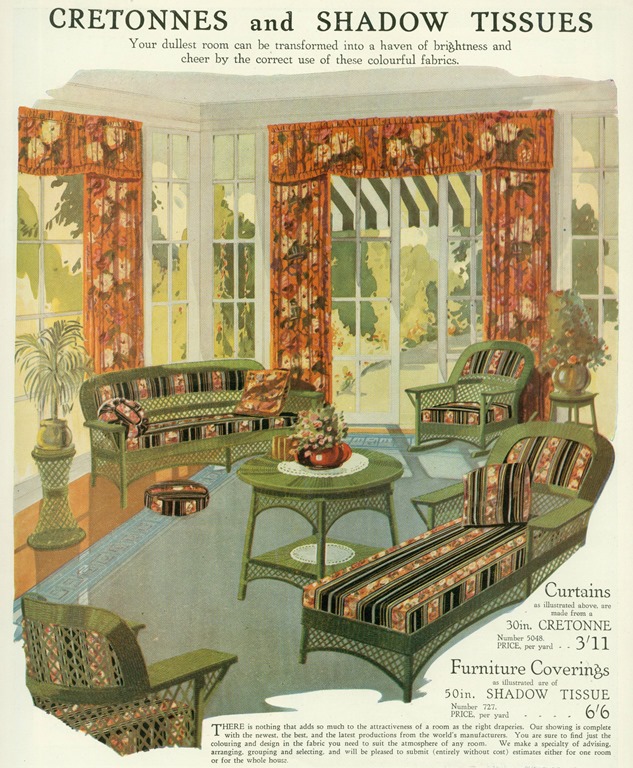
Bright Coloured Cretonnes!

“Bright-coloured cretonnes…” What is the erotic despair of draperies and upholstery?

I can think of dozens of popular songs that deal in some variation of this, but it’s harder to come up with 100-year-old poems, much less ones as good as this one, that talk of this. Ignore a handful of references to the interior decorating trends of Flint’s time, and this poem could have been written yesterday, except few writers of any time would be as acute as Flint is in observing this.

What new poets of the Modernist movement do I get to discover and share with you in the upcoming year? I can’t be sure, but I noted that Flint’s “Otherworld”  is dedicated to Herbert Read, and from what few poems of his I can find online, Read seems just as fresh and fascinating.

But let’s not get ahead of ourselves. Musically I’ve been telling myself I want to utilize some of the methods of hip-hop records, and yet each time I set out to do this, I get side-tracked by my own idiosyncratic musical muse. The melodic top line is my appreciation of early 1960s hard-bop organ playing. The bass part is a combination of a left-hand organ part with electric bass. Two bass lines shouldn’t work, but I think it does here. That’s not the only duality in this: the drum machine beat is augmented by some percussion which keeps the drum machine from ruling the groove “correctly.” The hip-hop rhythm flow eludes me again, though maybe I recall some predecessors like Dr. John the Night Tripper?

To hear my performance of F. S. Flint’s “Love Song to a Woman I Do Not Love,”  use the player below.