Isn’t it odd how you know, and yet don’t know things, even in this world of instant communications and webs world-wide. Yesterday I started work on a new Parlando Project piece, and this morning I returned from a brisk ride to breakfast on a cool sunny April day to write about this piece whose words were written by Sara Teasdale.
I would have said that I was introduced to Teasdale from an LP record by one of my musical influences, Tom Rapp. I figured I’d link to something about him…
…and there I learned, that he had died more than two months ago.
So, I’ll link to this, his performance, Parlando Project-like, of Shakespeare’s song “Full Fathom Five” from The Tempest combined with Teasdale’s “I Shall Not Care.”
Even though that’s an example of the Parlando Project principle: “Other Peoples’ Stories,” that is to say, it is words Rapp didn’t write, it conveys something of the impact Tom Rapp can have if one is open and receptive to his presentation. He didn’t need to use Teasdale’s words or Shakespeare’s, because Rapp is one of the best singer-songwriters you likely don’t know about.
Let me not inflict too much biography on you. Rapp is another child of the Midwest, born on the Dakota plains, raised some in Minnesota. While still a grade-schooler, he bested a teenager from Hibbing— kid named Bobby Zimmerman —in a talent contest in Minnesota. That Zimmerman kid moved to New York and changed his name to Dylan. Rapp ended up in Florida in the middle 1960s and formed a band with other kids in his high school. He named the band from a phrase from the Sermon on the Mount: Pearls Before Swine. Their first LP from 1967, with a cover taken from Hieronymus Bosch painting was the only one with any appreciable sales, and Rapp issued a handful of albums afterward to ever declining audiences. Why?
As you’ve heard me proclaim here “All artists fail.” Even the most successful, have multitudes remaining who couldn’t care less what they have done; and unique ones do not get any advantage. Rapp wrote fewer songs about romantic love, and his best songs did not offer any easy comforting. And he’s as far from get-down, party until you forget as any musician who ever lived. Rapp is a writer of look, and then look deeper, and remember.
Unique can mean mostly that the audience is not shouting for more like him or her. Yet, I’m sure there are in this troubled world a great many who could find solace, as I did, in Tom Rapp.
You can be the 82nd person to listen to this since 2014.
When I found that link to the LP cut of the song he made from Shakespeare and Teasdale on YouTube, I saw that it had exactly 80 views since it was uploaded four years ago. Let that sink in for a minute. 80 views. The clumsiest unboxing video for some appliance will easily garner more. There have been a few successful “songwriters you should have heard” stories this century, where decades-old work becomes better known—Nick Drake or Rodriquez come to mind—but to succeed in finding an audience, such things require luck, and we’ll only allow a few to win when we re-spin Fortuna’s wheel. Pearls before swine indeed.
While performing and posting about T. S. Eliot’s “The Waste Land” bit by bit this month, have I mentioned enough how artistically revolutionary it was? For today’s section let me talk first about form and then about subject, and I’ll share a little-known episode in Eliot’s life that may have contributed.
I call today’s part of “The Waste Land” “Goodnight Ladies.” Formally, even today, nearly a century later, a section of a major poem written like this would be provocative. First off, it’s not “poetic” in its language. While there’s a minimal irregular structure from the interjected closing-time refrain of the bartender’s call, there’s no striking images, meter, rhyme, melodic flow, and certainly no “poetic diction” in it. It’s part in the musical structure of this very musical poem is to present a section with no music in its words. While politically and culturally apart from the Dadaists working at the same time outside of England, Eliot’s structure for “The Waste Land” is to throw in jarring and unannounced cuts in voice and setting. Even sophisticated, educated readers cannot agree how many voices and scenes are present in the “A Game of Chess,” which this passage concludes. I made it three pieces, three scenes, others think differently. Eliot has already used plenty of high culture references in the “A Game of Chess” section of “The Waste Land” before today’s scene: Shakespeare, Ovid, and obscure Jacobean playwright Middleton—but he’s also thrown-in a pop song parody. Now he concludes “A Game of Chess” with a bit of working-class pub dialog absent of any literary allusions (until the very end).
The speaker, an unreliable narrator, as well as her subject are working-class women. There is no sentimentality. This isn’t a “salt of the earth” bit of condescending or ennobling praise. The speaker is unkind and perhaps duplicitous (the implication is that she will, or has, put a move on the subject’s husband), and her subject, Lil, is a woman described uncharitably as looking “antique” at age 31, after multiple difficult pregnancies and an induced abortion.
The monolog, if not poetry, feels authentic. The depiction of class and sexual politics, is sharp and unstinting. A poet like Carl Sandburg, the radical and newspaperman, could have heard such dialog—but where the hell did T. S. Eliot, upper middle class raised, prep-schooled, Sorbonne and Harvard (legacy) educated, international banking officer, and furthermore, a man with a reputation as stand-offish and diffident toward women—even those of his class and cultural background—get informed enough to write this passage?
I couldn’t let that question go without some research, and I think I found an answer. It’s one of those “this would make a great movie” moments in literary biography. I knew Eliot had taken a crack at teaching school at a boys-only school in Highgate. That’s the start of the story, he taught French, Latin, math, history, drawing, beside duties coaching baseball (!) and swimming. One of his students: a 9-year-old John Betjeman.
Schoolteachers will know what kind of workload that entails. The bank officer job that followed was a relief to Eliot.
Here’s where it gets interesting. Through some connections, he was introduced to the Workers Educational Association. They were organizing college-level night school classes in Southall. Eliot applied to teach Modern English Literature there, and he continued to do this from 1916 through 1919. Since WWI was on, with many men overseas, the classes were ¾ women.
The weekly classes were a lecture followed by an hour of discussion. Regular papers and reading were required of the students.
What was the experience like for Eliot and his working-class students? Surprisingly rewarding for Eliot, and (as far as we know) for the students. In letters home to America, Eliot praised the minds of his best students, singling out several women. In an account he provided for the Association’s 50th Anniversary in 1959, he could still recall one in particular:
“There was one poor young woman who was one of my best students, but was an elementary schoolmistress with a very large class of little children in the daytime and (she)…died, I am sorry to say, of overwork.”
Was Eliot being polite in both his contemporary letters and his remembrance letter to the Association? Perhaps he did gloss over, or was unaware of, the difficulties one could imagine between himself and his students—but he did this for three years, as a second job that was presumably not his main source of income, and each year, he asked to do one more. Each year, he developed a new syllabus covering additional authors for his literature night-students, some of whom stayed with him for his entire run.
Inscription on a gift copy of The Oxford Book of English Verse signed by his students on the day of Eliot’s last lecture. The longer article about this is a must read for those interested in this little-known period of Eliot’s life.
Was that worn-out school-teacher, or some other night-school student, a model for Lil in today’s portion of “The Waste Land?” It seems possible. After reading this, my thoughts went to those students, hungry to learn and experience more about literature in the London night speculating of Zeppelin raids. How I wish we had accounts from the students as well! In “The Waste Land,” Eliot wasn’t going to give us anything he learned about their joys, or any compensations they found for the travails of their lives, anymore than he gives anyone that. We’re left, in today’s piece, with this mean girl’s account of Lil, unsparing in scorn, revealing Lil’s burdens as more of the weight of the timeless waste land on post-WWI Europe. Eliot doesn’t even give her story, told so meagerly, any ennobling literary references, nor any poetry, does he? Just a story in a bar.
Wait. Her name’s Lil. Lillith? Possible, but I think not. How did this poem begin? “April…breeding lilacs out of the dead land.” And the last line, the one I use for the title of this performance? It’s no longer the recounter of Lil’s life speaking (she who says it “goonight” not “good night”). The voice has shifted again, without warning in this unpredictable poem. It’s the voice of Ophelia exiting to her death by water in Hamlet.
Ophelia by John Millais. Almost nothing to do with Eliot and “The Waste Land,” but it’s been too long since I’ve been able to put a Pre-Raphaelite painting in a post.
The reader in this performance is Heidi Randen, who does a great job with the words and keeps me from having to inflict my voice in too many pieces here. To hear it use the player below.
I do make something of an effort to look for other folks doing something interesting with poetry and music online, and to check out the blogs of folks who’ve commented or otherwise contributed here. I really should be more consistent in doing this, but particularly this month as I’ve attempted to ramp up production of Parlando Project pieces as part of the National Poetry Month celebration, I’ve fallen behind. Come May I’ll have a lot of blog reading to catch up on!
But this one caught my ear just after posting my own attempt at presenting a Wordsworth nature poem. A group of Keswick School students working with Durham University in England have posted a couple of audio pieces connected with William Wordsworth and his sister and collaborator Dorothy Wordsworth’s Lake District observation of nature and the resulting landmark poems. This one has the students speaking about the book of nature and some of Dorothy’s journal entries on the siblings walks. There some nice, spare music added to this one as well.
As we read over the poems composed by the students, it was fascinating to see how many of them – the majority of the group, in fact – had fixated on the idea of more modern distractions from nature, and in particular, the role of smartphones in quite literally ‘filtering’ nature for us. While William’s poem admonishes its addressee to abandon books and ‘hear the woodland linnet’, the year ten pupils from Keswick School used their poems as a chance to reflect on the need to abandon their phones and enjoy nature in its own right.
I keep asking my middle-school aged son what his generation has decided the rapidly aging Millennials don’t understand and that his generation will have to fix. He looked at me funny when I asked him again this week
. “Is that some kind of Dad joke?”
Perhaps he just doesn’t want to divulge yet his generations secret plans to fix the worst mistakes of those who came before, or maybe he’s still formulating the answer. But one of the time-tested ways to look for answers or better questions is to skip back a few generations and see what someone observed and thought before those now running things made their decisions.
It may be U. S. National Poetry Month, but one can’t deny the impact that English poets have had on poetry, particularly before the Modernists launched with significant American participation.
Modernism, as practiced by those early 20th Century Imagists sought to cleanse poetry of the rust and rot of “poetic language” and rote abstract metaphors. Strong, exact words, no more complex or numerous than necessary were to describe things that were actual things, not merely decorative analogies to describe something else. By the 1920s, that American import, T. S. Eliot, became the standard of one large stream of Modernism. Although inspired by this fresh use of language, the Eliot wing of Modernism sought to rid poetry of “romanticism,” defined as a relentlessly subjective expression of personal experience unshaped by a greater historical and cultural understanding. Poetic language might be refreshed, but the cult of the great poem returned, and said that poetry is best to be in service of great themes and elaborate—rather than elegant—structures of thought.
Early Imagist/Modernist poems were about moments. The High Modernism of Eliot allowed it to be about eras. Imagists prized images of things formerly ignored or costumed only in the rhetorical finery in 19th Century poetry. High Modernism still allowed the mundane to stand for sublime thoughts, but it often sought to display a level of knowledge and literary scholarship along with the everyday in its choice of images.
This is why it’s important to look at the early part of artistic movements. Often their best ideas become mutated as the movements develop. Their revolutions become the new orthodoxy.
Today’s piece, “I Wandered Lonely as a Cloud (Daffodils)” is by English poet William Wordsworth, one of the founders of Romanticism. It’s a poem that can be attached to an exact (April, Poetry Month) date: April 15th, 1802, and to a walk that Wordsworth and his sister took in rural England. But that’s not how the poem was written. Wordsworth wrote it a couple of years later. He referred to his sister’s detailed journal entry about the April walk to refresh his particulars. His wife supplied two critical lines for the final stanza. This was not a spontaneous outburst of subjective personal feeling at all.
I couldn’t make it to the Lake District, but even a month ago, daffodils were blooming during an English Spring in Kew Gardens
In a few weeks my lawn will look like this in Minnesota—only dandelions, not daffodils.
When I performed the version you’ll hear below, I made one significant change and one minor one. The minor change? I dropped the adjective golden from his line “A host, of golden daffodils.” I suspect I did this by accident as I performed it. Not to dis Wordsworth (and by the way, Billy, what’s with that obvious pen name “Words-worth” for your poetry gig?) but I think I improved the line when I sung it as “A host, a host of daffodils.” First off, daffodils are a common flower, and they are in the wild always yellow. Strict Imagists would say the golden adjective is therefore unnecessary—and it is, well, a gilding of the lily. I can’t recall my reason for the major change, dropping the next to last stanza—I may have desired to shorten the piece for performance—but it is the weakest stanza in the poem.
I do retain something else Wordsworth does here, something I don’t recall the Imagists doing much. “Daffodils” is presented in a framing device, while the Imagists were all about the presentation of immediacy. Wordsworth doesn’t say merely that looking at all these wildflowers, the temporary exultation of spring, was transfixing—and he says that less with that next-to-last stanza removed. This is not a poem only about letting us see them in their wild, external multitude through his eye on an April walk in nature.
No, the poem starts, deliberately, in past tense. “I wandered lonely as a cloud.” And the poem closes even more removed. The speaker of the poem is not the energetic nature-walker strolling in Spring. In the actual, unknown, later time of the poem, he’s lying on a daybed, vacant or pensive. These daffodils are now only obtainable by the “inward eye” of recollection.
Setting something in the past can be seen as a tactic of sentimentality, something the Modernists distained, but what we have here is worth that risk. How so?
I thought it a delightful little nature poem when I read it as a teenager. Then I read it decades later, as my Eagle Scout father, the angler long accustomed to waiting perpendicular on the flat surface of lakes, the man who had bicycled across his rural state many times—while then, as I re-read, he was further and further confined to lying flat in rooms with the erasing of days. In that later time, noting the wild daffodils bliss is told to us in memory, I reversed Wordsworth’s famous dictum on the origin of poetry. In my reading, in that time, it became a poem, a song, of tranquility recollected in emotion.
Here’s my performance of “Daffodils” as I sang and accompanied it on acoustic guitar.
Continuing in our April Poetry Month serialization of “The Waste Land” by T. S. Eliot, it’s come time to perform the next section of the poem, which I call “Rats Alley.”
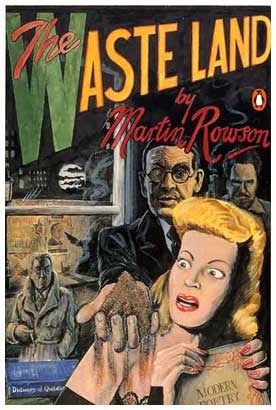
It just happens that this week I got a copy of Martin Rowson’s “The Wasteland,” a 1990 comic-book riff on Eliot’s poem as if written by hardboiled-detective fiction writer Raymond Chandler and filmed like “The Big Sleep” or “The Maltese Falcon.” Rowson notes that in “The Long Goodbye” Chandler had referenced Eliot’s “Prufrock” with a character quoting “In the rooms the women come and go, talking of Michelangelo” and having the character ask his detective Marlowe “Does that suggest anything to you sir?”
Marlowe replies, “Yeah—it suggests that the guy didn’t know very much about women.”
Though that’s clever repartee, charges that Eliot was naïve about women or even misogynistic can be difficult to disentangle from his general misanthropy. A female Chandler character may be given more apparent agency than the women in Eliot’s “The Waste Land,” but both the male and female voices of “The Waste Land” are frankly damaged and the minor male characters, wraiths and zombies.
Sometimes with a dame you gotta show’em some quotations in Greek or Latin.
In any case, Rowson’s comic-book/graphic novel is a lot of fun for fans of Film Noir and Chandler, or Eliot and Modernist lit. His drawings have more in-jokes than a season of “The Simpsons” watched with a finger on the pause button. And from his notes Rowson supplies in my edition on dealing with Faber and Faber and the Eliot estate, it could have been even funnier if any of them had allowed the comedic-take to use any of the lines from the poem. I laughed often reading the Rowson, but never so much as when he recounts being refused the rights to use the ancient Greek and Latin quotes Eliot dropped into his poem, because Eliot’s rights now include them as part of a unique compilation. That may well be legally sound, but it’s also howlingly funny. Eliot as he wrote his “Waste Land” was clearly borrowing widely from other authors’ work, because he thought it would show us something new when he put them in another context—the same thing that Rowson’s book sought to do.
Which is also what we try to do here as part of the Parlando Project, show you familiar and unfamiliar words in the context of different music and performance styles.
“We are in Rats Alley, where the dead men lost their bones”
“Rats Alley” is a dialog, and the two speakers are clearly broken vessels. The woman dissatisfied, depressed, afraid, maybe even unstable. The man, numbed, haunted, unable to express even the short expressions of discontent the woman speaks. When he (once in the poem, three-times in my performance) breaks into the cryptic “We are in Rats Alley, where the dead men lost their bones” I decided to alter the voice, to make it a third voice. She’s asking him to speak, to tell her what’s going on, but she doesn’t seem to have heard him say anything, other than a litany, literally, of “nothing.” And so, I’m portraying the Rats Alley line as his inner torment, his monster, that is heard loudly, but only in his head.
“In the rooms the women come and go, digging riffs from Ahmad Jamal”
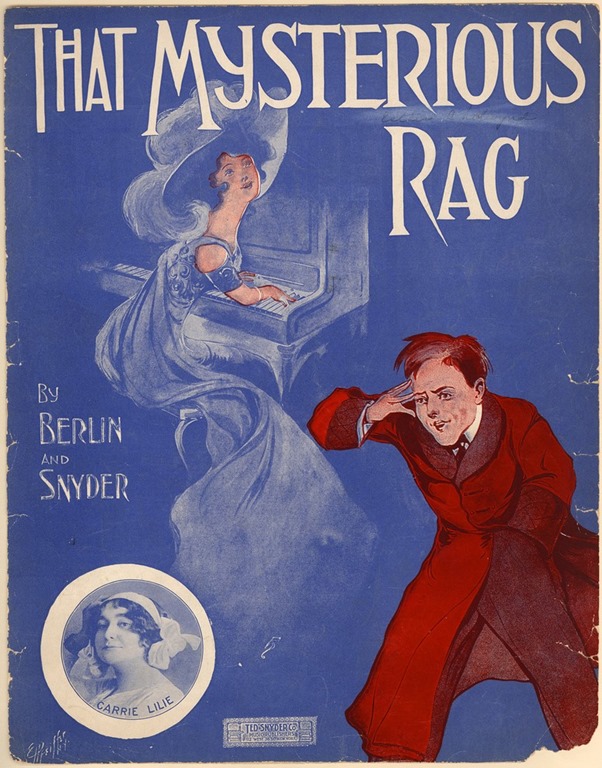
Rats Alley sounds like yet another reference to some dark Jacobean revenge play, samples from which Eliot has already peppered his poem with. If it is, no one has found that work. Some speculate it sounds like the darkly humored street-signs WWI trench-soldiers hung on their subsurface battle lines. If so, then the last voice, the fourth voice of the piece, an imaginary, comic ear-worm song Eliot has made up, “That Shakespearean Rag,” could also be an internal voice. It’s sometimes been considered to reference Irving Berlin and Ted Snyder’s “That Mysterious Rag,” a giant pre-WWI hit with lyrics that say “Did you hear it? Were you near it? If you weren’t then you’ve yet to fear it.” In the hit parade context, the lyrics turn out to be just bragging that this rag is a killer hook “because you never will forget it.” Eliot substitutes Shakespeare in his parody, but is this male voice a soldier, haunted by the trenches and dead comrades to whom old tunes now take on a new context, a sinister edge? It’s a bit of a stretch, but could Eliot have planned to use “That Mysterious Rag’s” mock-dangerous lyrics as a counterpoint to his scene—wouldn’t that have been a powerful sample!—but was enjoined by copyright issues?
To hear my performance of “Rats Alley,” today’s segment of Eliot’s “The Waste Land,” use the player below. You can hear the first section, “The Burial of the Dead” or the first part of the “A Game of Chess” section which I performed as “Visions of Cleopatra” by looking in our previous posts this April as we celebrate #NPM2018.
We had a real Minnesota whip-saw this week, the aftermath of a 15-inch snowstorm as the week began and a day in the 50s as it ends.
Much digging out of cars, and wheels doing the whistle-spin on the ice beneath for three days. It’s been a long winter, but “Sometimes It Snows in April” as Prince once sang.
Today, when it reached the lower 50s, people were out in shorts and T-shirts, with snow still covering yards, with the low rubble of white ruined walls still on the streets where cars had once been imprisoned. This is how Minnesotan’s celebrate unbelievable spring.
Now this Saturday brings the anniversary of Prince’s death, which was as unbelievable as Spring. I was looking for another poem to combine with music, and I reminded myself I hadn’t done an Emily Dickinson poem yet this April, and there can be no full celebration of U. S. National Poetry Month without Dickinson. As I looked, I came upon this poem, and it seemed right.
“Dear March” has one of Dickinson’s bold apostrophes, but instead of death or some other imponderable, it’s Spring that gets to be portrayed as the caller, one who gets welcomed at the door with old-school manners. There’s delightful wit in this: the March winds portrayed as being out of breath, it must have walked the long way to get here! “I got your letter, and the birds.” But being Dickinson, she will add her slant. Just past halfway she bemoans the colorless landscape of winter that she’s been left with, as if it would be her job to color it in: “There was no purple suitable/you took it all with you.”
“There was no purple suitable, you took it all with you.”
I think again of Prince, and I think this is the poem to do.
The poem continues, and we can now understand that the wit has an undercurrent. Someone else is knocking. It’s April, more visitors—or are they both suitors? “I will not be pursued!” Dickinson is now ambivalent to more Spring, to more young man’s fancies. She’s not answering the door “He stayed away a year”—well so did March. The poem ends in ambivalence. She should doubt the constancy of these Spring suitors even with the flirting, the flattery and the gifts they bring, but then there’s joy in blaming them for their absence now that they have returned.
Prince: performer, songwriter, impresario, but I’ll think of him as the patron saint of studio rats
,
I don’t want to stretch things too far here, but there are a couple of similarities in Dickinson and Prince. Both known for wearing one color (white and purple). Both enigmatic to the public (“The Myth” and “The Glyph”) and increasingly reclusive. And both were capable of being prolific and artistically self-sufficient, though this is not as rare for poets as it is for musicians and songwriters who could (as Prince did) write and record all the parts. In the end, they are both American originals, not copies of anyone before or since.
To hear my performance of Emily Dickinson’s “Dear March” use the player below. And let folks know about what we’re doing here, combining various words (mostly poetry) with original music in different ways. It’s #NPM2018, and you can dance to it.
“Jewels and binoculars hang from the head of the mule.” This famous line from T. S. Eliot’s modernist epic “The Waste Land” —oops! I’ve become confused here. As part of our celebration of National Poetry Month this April, I’ve been performing “The Waste Land” and dropping the mixtape here as I complete a section. We’ve completed the first part “The Burial of the Dead,” and this week I moved on to the start of the second section.
That section, sub-titled “A Game of Chess” opens with an elaborate descriptive passage with lines quoted from older literature, with paraphrases and references of stories dating back to Classical Greek. It’s opening lines are cribbed from Shakespeare’s description of Cleopatra. The section’s sub-title itself is taken from an allegorical play first performed at Shakespeare’s Globe Theater.
Throughout “The Waste Land” Eliot does this. He’s sampling. He thinks these bits will add flavor, perhaps even to those that aren’t as well-read and as he was in 16th and 17th Century literature. But this is also part of one of his tactics in his poem, to portray the specific malaise and suffering throughout Europe after the First World War and his own personal depression and chaotic marriage as something adrift in time, an infinity echoing inside the museum of Western Culture.
In this opening section he’s describing a woman in an over-decorated room full of upper-class bling and old-fashioned mannerist art that makes only sentimental reference to searing tales. As he describes this his syntax is convoluted, his sentences run-on, his poetic line breaks disassociating. And all this is in service of a segment when nothing, absolutely and intendedly nothing, happens.
As I re-encountered this section I had that flash of metaphor that I love. Metaphor is the powerful fusion that occurs when two things unite into one expression. Eliot’s room may be decorated differently, but the room seemed familiar, the language usage brought forth déjà vu, the air in the radiator pipes rumbled, the heat pipes just coughed.
How much did T. S. Eliot, “The Waste Land”, or this section of “The Waste Land” enter into Bob Dylan’s toolbox? The two poets share some common influences from French poetry. Both love to mix highbrow and lowbrow references. Both quote and paraphrase other writers, though in Eliot this is usually considered scholarly, and with Dylan it’s too often taken as evidence of plagiarism. Sometimes Dylan is just Eliot without footnotes.
All I have to go on is a passing reference to reading and finding some value in Eliot in Dylan’s memoir “Chronicles,” and the line in Dylan’s own waste land epic “Desolation Row” where “The Waste Land’s” editor and dedicatee Ezra Pound and Eliot are fighting in the (ivory?) captain’s tower. That’s plainly thin evidence. The flash of metaphor don’t care, these two moments of decorated stasis feel similar enough to inform this performance.
I got part way into this recording of the first part of the second part of “The Waste Land” as illuminated by Bob Dylan’s “Visions of Johanna” before I decided I’d go with more than memory and listen to the canonical recording from the “Blonde on Blonde” record. I’ll have to say that my memory-track of “Visions of Johanna” is mostly a mashup of the various live versions performed solo with acoustic guitar and harmonica in 1966, where Dylan’s “you’ll like it, or you won’t” singing makes every word tell. Dylan had a hard time getting an electric band version recorded that same year, perhaps because a Rock’n’Roll song about stasis is a hard thing to make. On reencountering the “Blonde on Blonde” version, I took some inspiration from it: the organ player who gets lost partway in, the importance given to the bass part, and the drums that follow the ebb and flow of the singing. I’m not trying to duplicate the record, just tipping my hat to its effects.
This is the sort of thing we do here, even on months that aren’t National Poetry Month, bringing music to poetry and illuminating poetry with music, reencountering familiar poems to see something new in them, finding lesser known poems and presenting them. We do that a little different each time, as a visit to our archives on the right side of the page will demonstrate, but to hear this part of Eliot’s “The Waste Land” performed, use the player below.
Yesterday’s post ran so long that I needed to improve it by removing some things that weren’t relevant to the story of Robert Hayden choosing a school of literary criticism to place not just his work, but his life, in context. But I love the minutiae I find when I’m researching these pieces. So here are some outtakes from yesterday’s post about Hayden’s sonnet praising Frederick Douglass.
Frederick Douglass was not the name he went by as a slave. As with most enslaved persons, to the degree he needed a last name, the name used was from one of the families that had owned his. After his escape from slavery, it was suggested that a name change might help shield him from slave catchers that would kidnap and re-enslave Afro-Americans. He took the name “Douglass” from an immensely popular Scottish historical romance by Walter Scott, “The Lady of the Lake,” where one of the main characters had that family name.
Sir Walter Scott was a huge cultural force in the 19th Century. His stories set in an idealized past of clans and medieval knights kicked off a revival of all kinds of Highlands Scottish culture. Alas, in another case of artists that cannot be held responsible for their fans, one far-flung example of Scott’s influence was his popularity in the American slave-holding south.
There you go, a renowned abolitionist and an infamous symbol of violent racism, both took their names from Sir Walter Scott.
I mentioned Hayden’s disagreements with those associated with the Black Arts Movement and some kinds of Black Nationalist politics in his later life during the 60s and 70s, still too large a subject, and one on which I lack authority. But since I was alive in that time, such things cause me to remember things.
To an under-recognized degree, mainly white radical movements in the mid-20th Century, admired, totemized and sought to copy those contemporary Afro-American movements. When I entered college myself in the 60s, my Irish-American Chicago-born roommate, a college football playing offensive-lineman with his knees already scarred from injuries playing for Lane Tech, kept a photo of John Carlos and Tommie Smith with their black fists raised on the Olympic podium. Within a year or two, that gesture would become a diversely popular gesture of radical protest.
Fred Hampton, the Chicago-based Black Panther killed in a highly questionable police raid was part of our conversations, a newspaper photogravure of his bedroom door scarred with dozens of bullet holes (all inward facing, the caption pointed out) was studied like a record album cover.
For some young serious musicians, Afro-American originated jazz and free-jazz were still examples of the highest forms of contemporary music-making. Some white musicians and artists sought to emulate the independence and syndicalist self-organization that Black Arts associated musicians had developed.
How did Afro-Futurist Jazz appear with hard-rockin’ punks the MC5?
Poster by Gary Grimshaw for a concert promoted by John Sinclair
For a moment, for a young white man in any area outside of a few urban enclaves to grow long hair was to a degree both real, and “that’s crazy, it’s not the same!” to become a voluntary Black person. Younger readers, let that sit in for a moment. Isn’t that a ludicrous thought?
I was there. Yes, surely there was much ignorance there, staggering naiveté. The term cultural appropriation hadn’t been invented yet, but surely this would be a cause to invent it. Yes, that comparison, that metaphor, was partly false, partly true.
Fifty years ago, in the Detroit area—where Robert Hayden was born and would spend much of his life—a white poet, arts-cooperative guru, and jazz-critic John Sinclair lead a small group to declare themselves the “White Panther Party,” issuing a manifesto that echoed the Black Panther party. Other than provocation, their chief asset was they had a rock band, which was better than the mimeograph most other movements could boast.
And so it was, that when I read of Robert Hayden, the poor Black kid, who struggled to attend Wayne State University during the Great Depression of the 1930s, a Black man who couldn’t volunteer, who’d have his own battles between the universal and the particular—when I read the name of that school where he went to learn poetry, a short, near-blind, unathletic kid, I thought of this performance by that rock band, the MC5, at Wayne State’s athletic field in 1970.
“Kick Out the Jams” is about irresistible musicians, but note, the crowd is 80% male.
Today’s piece uses words by Robert Hayden, who was a 20th Century American poet who often wrote about that essential American subject, Afro-American history. He was born just before WWI, and was writing poetry both before and after WWII, during the rise of the New Criticism, which held that the poem exists as a thing created as a conscious work by an author but is best judged irrespective of who that author is.
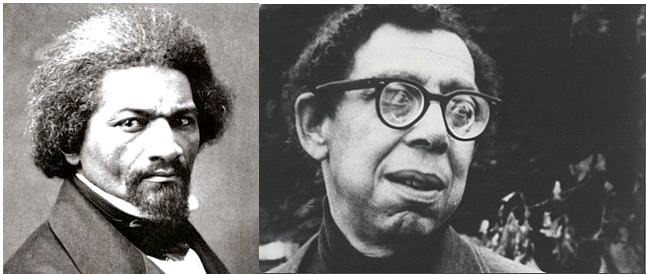
Frederick Douglass used the power of the charismatic portrait as well as his powerful words
Robert Hayden had to rely more on the words alone, but what words they are!
To the degree that this theory was actually practiced, it solves a number of problems. One of them are the issues of discrimination, old-boy networks, and literary log-rolling where who you know or where you are in the social and academic order pre-emptively decree the worth of writing. It helps deal with thorny problems, like having poetic Modernism’s great progenitor Ezra Pound becoming a Fascist propagandist during wartime. If it was still in vogue, it might assist in considering issues around artists in our time who’ve committed heinous acts or supported political opinions we judge to be beyond the pale.
There’s a saying: in theory, there is no difference between theory and practice; but in practice, there is. Historically, the New Criticism as a critical movement didn’t consistently break down cultural barriers, though things like the post WWII GI Bill certainly did. Extra-academic movements like the Beats and their successors, and the Black Arts Movement did so as well. Great cultural shifts such as the civil rights movement have literary impact. In the end, the New Criticism seemed to restrict itself to giving students and academics a framework to discuss literature without the need to refer to the problems in their authors lives.
Perhaps too, it’s just easier to judge works based on friendship, affinity groups, or cultural and political stances. Even for an artist, how much can we live in an artistic world separated from the daily, inescapable effects of the political and economic world?
But let’s not be too unfair to the New Critics. They cared about the work as it exists, treating art not as inessential decoration for something else. They offered open structures, criteria that were open to any to master. When Robert Hayden, born in the crowded Detroit ghetto swelling with southern migrants looking for industrial work, mastered those structures, he (eventually) earned a place in the culture of his time. How did this play out as my generation, born after WWII, came of age? Let’s look at the tape.
15 minutes from a Robert Hayden interview in 1975.
This is a time capsule from over 40 years ago, yet it could be longer for all the patina of time. The monochrome of the film makes the impassive white interviewer, the smoke from his constant cigarette, and the later-life Hayden all look gray. You see the coke-bottle glasses on Hayden’s face, but not the tint of his skin that would have born him instant misjudgments throughout his life, misjudgments that he would have to have dealt with along with his art. You will hear him make the claim I made to describe him at the beginning of this: that he’s an American poet who will write about Afro-American subjects, and hear him begin to make the case as to why this distinction is important. I can clearly hear how important he believes this is.
Around 10 minutes in, he’s asked to engage with the separatist strain in Afro-American culture, and he offers his full-throated disagreement with what he thinks are their goals. That’s too big a subject to deal with here, but apparently at the point at which he was finally achieving some recognition for his poetry, some aligned with the Black Arts Movement saw him as an assimilationist. Some might view this part as a “damn kids, get off my lawn” generational moment.
Also, in the film Hayden reads two poems. One is probably his most well-known work “Those Winter Sundays,” and the other is today’s piece, “Frederick Douglass.” In the later, using only the eloquent words in his sonnet, Hayden makes that argument that he could write a political statement timeless and yet incisive, and in the former, he writes a poem of gratitude to his foster father, an unpoetic man who made it possible for him to be a poet.
“Those Winter Sundays” will be featured this month on Poetry In America on PBS. It’s a fine poem, and I’ll be interested in seeing what they do with that poem’s details, things that one needs to linger a bit to see. I, on the other hand, had already chosen to present “Frederick Douglass” for my first Robert Hayden poem here. If you take the poems together, you’ll see two arguments for paying attention to Hayden. One the universalist for liberation (a political theory Hayden shared with Frederick Douglass) and the other the argument for gratitude to those, however imperfect, that helped us.
When I first read Hayden’s “Frederick Douglass” this year I was immediately struck by the poem’s uncanny details, laid in-between the eloquent flow. It was written over 50 years ago, but it’s more current than that B&W film from 1975. Perhaps you’ll hear them too if you attend to them: freedom that can be beautiful and terrible, hunted aliens, metal statues more valued than lives made possible.
Here’s my performance of Hayden’s words about Douglass. Use the player to hear it.
Well, the rooks were wrong about Winter passing, at least for now. As much of Minnesota is covered with a foot or more of forgetful snow, with more remembering to fall over the top of us all day, it’s a good time to return to T. S. Eliot’s landmark of Modernist poetry “The Waste Land,” the poem that, by beginning with the famous line “April is the cruelest month” is largely responsible for National Poetry Month being set in April.
Other than the “Dead” thing and the sinister Roman numeral, seems normal enough;
but “The Waste Land” will soon get stranger and darker than anyone expected in 1922.
We’ve been performing it on the installment plan this month, following up on our performance of the first segment of it last April. But, it occurs to me that because so many of our listeners hear us via the podcast section of Spotify, which perversely doesn’t allow podcasts to be placed in playlists, that it might be good to combine what we have completed into one longer piece.
So, here’s the more-or-less complete first section of “The Waste Land” titled “The Burial of the Dead.” Eliot intended his poem to be musical, so even though it’s sprawling and includes many voices, it’s been fun to make audible the musical implications in it. As I do this, I’m reminded again of my first encounter with “The Waste Land.” I didn’t understand any of it—well, that’s not completely true, I could extract meaning from a few lines—but the whole thing could just have well have been a symphony with notes in place of words. Even now, for me, “The Waste Land” remains a hard poem to love, and unlike many poems and poets of our current scene, it’s not asking us to love it.
So, if it’s hard to understand, and hard to love, why listen to it?
Because it is a great poem? I doubt that would work. Because it was so influential historically? Well, that influence is now largely historical. It did move things powerfully one way, and then, after decades, things moved another way, in part in reaction to it. Because there are still fresh experiences to encounter in it? Now we’re getting closer. Art isn’t immortal only because it’s great in some ideal way, an art work’s immortality happens from our mortal human actions, our human reactions to it, and some of those become richer when the work has become strange to us from a change in fashion.
But in the end, I ask you to listen to it consistent with our overall tactics here in the Parlando Project: listen to it as music first, do not worry at the overall meaning immediately. I hope I can illuminate some meaning with my performance and music, but simply to comprehend “The Waste Land” as this suite of voices and moods is to comprehend much.
Here’s the player gadget to hear “The Burial of the Dead.” Since it combines what had been four pieces issued separately here, it’s longer, at 13 minutes, than our usual stuff. If you’re looking for something brief, why not take a random walk through our archives for one of the more than 200 shorter pieces we’ve available.





 Frank Hudson