The route today’s musical composition took to existence was almost comically round-about. I added a new virtual instrument (VI)* drum set this week, one with a drier, more retro sound. I decided I should try it out. I grabbed an acoustic guitar track I’d recorded weeks ago, but not used for anything, and went to creating a simple drum track using the new kit’s sounds to see how they meshed.
It sounded pretty good, but that track-of-convenience guitar part had bleed from other stuff into the acoustic guitar mic, and so I used a tool I have that extracts a chord progression from an audio file, and then had that extracted progression played with a VI piano.
That cleaned things up enough that I figured I should make a little instrumental piece with this. Why not complete a trio and play some bass? Just over my shoulder in my little bedroom-now-home-office sits a Squier fretless Jazz bass.** I love its sound, but my old fingers need to be in good shape to get a clean sound out of it. Yesterday, my fingers were feeling strong, so that’s what I grabbed. I found a bass motif and played it in my best attempt to fit into the “pocket” of the drum groove.
A great musician or a more meticulous recordist might have perfected this, but something in me accepts a certain looseness and imperfection. Even if I’m recording one track at a time in one-man-band mode I’m often looking to get that spontaneous live-take feel, and my resulting trio had that I thought.
At this point my little house was filled with a half-dozen late-stage teenagers, all looking to have an autonomous time playing video games and watching YouTube. I holed up in my little office to let them be young. Might as well look to add another VI to my trio — if nothing else, to pass the time. The computer I work with virtual instruments on doesn’t have speakers, only headphones. Returning to the world between the cups of the headphones, I wouldn’t be bothering them.
What could be that another instrument? I decided to try cello. What articulation should I choose? My cello VI has a dozen or so articulations to choose from: different bowing techniques, styles for flowing legato or choppy stabs. I auditioned a few, and found two finalists I liked with the existing trio. Two roads diverged within a wood. Which one to take? I decided I’d use both of the finalists.
I set the cello part to echo the keyboard part, a simple choice. I often enjoy simplicity in music, and my use of orchestra instruments often reflects that. I’ve taken to calling some of my pieces “Punk Orchestral” for this reason. Hey, ho, let’s go!
It was 11 PM by the time I finished the instrumental. The teenagers decided to decamp for a Perkins restaurant*** in a late-night post-modern way. Listening to the rough mix of the trio with the cello section I now thought this is good enough for a Parlando Project piece — I just need to find a poem for the words. I didn’t have much collected for possible imminent use. I had some Emily Dickinsons, but I fear I’m doing too much of Dickinson lately, as much as I like the results. I tried a Robinson Jeffers, but the mood of the poem didn’t match the jauntiness of the music’s groove. Then I tried a short poem I’d drafted in June, inspired by watching waterfowl in my city’s urban parks, lakes, and ponds. That fit!
The poem that became today’s lyric
.
I revised the music slightly to use with these words. Guided by the instrumental’s chords and using my imperfect voice, I devised an expeditious melody. I tried a couple of takes singing the words, and found that my poem sung better with some mild editing of its text. It was around midnight when I tracked the final vocal take you can hear today before going to bed. It was just after that final tracking that a comic turn happened. The drum track, the new VI sound I started with, that, which had inspired the course of this composition, stopped playing, muted itself. A bug perhaps? But in the early AM hours I decided it sounds better without the drums, as the other instruments now have absorbed the groove conception I started with within themselves.
Today I mixed the resulting piece “All These Wild Geese Poems.” Mixing involves placing the instruments within the soundfield in stereo width and volume depth, and using other audio processing on their dynamic envelopes and frequency ranges. I then created the final mix using some computer tools to adhere to current streaming services loudness levels, and uploaded it to the service that shares my audio to play here and on the podcast platforms of Google, Apple, etc.
You, poet, you’re not much of a goose, or much of a Yeats either, so get out of my way!
.
“All These Wild Geese Poems” takes off from the many romantic poems about geese, cranes, swans and such large waterfowl. The urban geese I meet in my city nature are instead cantankerous beasts, and I thought our contemporary poems often take a similar stance, no pristine “Wild Swans at Coole” musings for these birds — more at the famous Dustin Hoffman Midnight Cowboy “I’m walkin’ here!” self-involved swagger with a limp. You can hear the performance with an audio player below if you see that, or with this alternative link that will open a new tab with an audio player.
.
*Virtual Instruments are precisely recorded sounds of the various notes and timbres of a physical instrument. Either by using compositional scoring, or the computer equivalents of that; or by playing the notes with a MIDI controller equipped keyboard or guitar, one can make reasonably convincing performances of instruments that one cannot play or afford in real life.
**I play interesting but relatively inexpensive guitars. Squier is an entry-level brand devised by Fender to sell low-cost versions of their famous instruments. Back in the 20th century any aspiring player found with a Squier was considered non-serious. “Real musicians” used “pro instruments” — but in the past decade or so the quality of the better Squier instruments has increased substantially.
***Perkins restaurants are like a Denny’s. Big menus with lots of senior-citizen specials and tastes —but open early and late for the time-expanding young person.
Like many days recently with this Project, I have been thrashing about looking for time to find an inspiration for a new audio piece, and some inspiration to spend that time. This weekend I found one sliver of inspiration in musical memory, and then yesterday, I found an Independence Day piece so monumental that I had to figure out how to grasp it inside music.
The sliver? I recalled a song, or rather just a line, a refrain from a song, from my younger years. That refrain was also the song’s title, and the title of today’s piece, but by itself it was insufficient. “Almost Independence Day” is a song that closes an early 1970s album by Van Morrison. It’s a peculiar song,* a lengthy (10-minute) two-chord jam with largely mundane lyrics that earns it’s interest — if it does — by the singer’s investment in presenting the ordinary, and by the unusual combination of instruments it uses to accompany itself. Morrison’s “Almost Independence Day” has drums, bass, two guitars, and keyboards. But the bass is an upright Jazz-sounding bass, allowed a high place in the mix at times, and one of the guitars is a 12-string guitar prominent in the song’s texture. And the keyboards? The keyboardist on the cut is Mark Naftalin, the son of a former mayor of my city. Naftalin was the keyboard player in the classic Butterfield Blues Band lineup, a tough sounding, gritty integrated band that played post WWII Chicago Blues — but on this song, the most prominent keyboard part is a low electronic synthesizer, reportedly played on one of those made by American synth pioneer Robert Moog. Wikipedia thinks it’s one of the earliest uses of that instrument on a “rock” record.
I had only remembered that song’s refrain — but even on re-listening to it, I found little besides the refrain and the song’s odd musical texture that I thought I could use.
Then early yesterday morning I thought of another, more substantial, set of words for Independence Day: a speech given in 1852 by Frederick Douglass, “What to the Slave Is the Fourth of July?” I’ve read it silently before, and I read it silently again. It’s a 19th century oration, the kind of lengthy and precisely enunciated rhetoric that would seem archaic to modern ears and attention spans.** Yet, it’s worth reading because it’s a unstinting analysis of American Ideals (worthy), acknowledging of American scientific and civic achievements (evidence of the possibility of unimaginable change), and yet clear and precise on great failures in extending its best to all Americans. As the title given to the speech makes clear, Douglass spoke at a time when chattel slavery was a large part of our country, when he himself had been enslaved, when a reticent and resistant national government had (through the Fugitive Slave Act) made clear that the whole nation was to support and maintain this evil.
I assume we are all in agreement on that evil, on that horrendous disconnect.*** But continue: Douglass’ speech still speaks to us today if we can translate a bit from its old-style oratory. Doing so, it’s a forceful reminder on this holiday that American ideals, such as the things stated in our historic Declaration on the first Independence Day, aren’t an award citation — they are a to-do list. The work of our founding, the work of emancipation, the work of fulfillment of our ideals, is on-going. So, if we are clear in retrospect about the acceptance and legal enforcement of slavery, that’s only a beginning lesson. We need to be as unstinting in asking where we are today out of step from our best principles and practices.
American ideals, such as the things stated in our historic Declaration on the first Independence Day, aren’t an award citation — they are a to-do list.
In devising a way to use Douglass’ speech in our short musical format, I decided to take a short part of it, a litany of assertions made in 1852, and make them an enduring set of questions to ask ourselves (or for any nation to ask itself) about that disconnect now and in the future. Douglass’ recast litany starts at about 1:20 in the audio piece, and the other words are mine, though I’m seeking in them to convey Douglass’ insights.
So yesterday, in an hour or two that I had available after finding my inspiration, I worked to perform Douglass’ litany of questions, and still was able to finish with a couple of lines from an Irishman’s song. Why was Van Morrison singing about almost Independence Day? Perhaps, it was only July 3rd, and he was noticing, as an immigrant, the expectations of this American holiday. But maybe too, this white man who sang “they can’t stop us on the road to freedom” was thinking that we are always, should be always, like those men in granite who declared our Independence two days before July 4th, looking forward to Independence Day, not remembering it.
You can hear my musical performance of this recast portion of Frederick Douglass’ speech with the audio player below. No player? This highlighted link will open a new tab with an audio player.
.
*Peculiar and a Van Morrison record is a tautology.
**Consider this: for all its elaborate speech, it’s shorter than the usual modern podcast length, and spends less of its time with repetitive familiarities and co-host back-slapping. Have our attention spans really gotten shorter, or is it the density of 19th century speeches like Douglass’ that wears out our attention?
***Well, there are still some neo-Confederates out there who will tell us it was a benign sort of thing, unremarkable really, and so long ago that we need not think about it — and coincidently, we should not think or teach about this example, and so setting out laws or best practices against that.
It’d be possible to do something like this Project using only the poetry of the great American poet Emily Dickinson. While we’re approaching publishing our 700th piece of original music combined with various words (mostly literary poetry) — there are nearly 1800 poems that Dickinson wrote. That’s a lot of material.
The Parlando Project has featured poets all the way from classical antiquity through the first quarter or so of the 20th century,* and I like to vary moods and poetic approaches in the pieces I set to music here — but Dickinson has enough different modes that just her work alone might suffice for variety. Would I miss some of the freshness I find in early poetic Modernism? A woman of the middle of the 19th century, Dickinson was present in an America that is both like and unlike our present country, but like all poetic geniuses she has the power to make time and place fade in importance. As it happens, I was looking for and reading early 20th century poetry when this poem came across my screen, and I found it as immediately fresh and vivid as one of those newer poems. Dickinson’s poem here uses the title of convenience taken from the poem’s first line: “Those cattle smaller than the Bee,” and you can read the text at this link. Rather than a grand poem about important life points, specific social conditions, intense feelings, existential issues, or majestic nature, this is a poem about a prosaic insect, the fly. Dickinson starts out very much like a Surrealist here, imagining as if the fly was a useful domestic animal, like a cow or the honey-producing bee, but the poem then goes on describing what could be a bothersome number of flies inside the Dickinson Homestead house.
“Well Lavina, I’m thinking I’ll go for prize houseflies at the next town fair.” Surrealism manufactured by the AI art program that claims it’s trained on art work that the artists have been paid for.
.
I may be paying too much attention to detail in this playful poem, but I wondered what kinds of flies she’s observing. The season of winter is mentioned, and houseflies generally lay their eggs inside in colder parts of America to hatch during winter. Since Emily cooked for the family, I can imagine that hatching would not make for a pleasant kitchen. Noting Dickinson’s choice of an unusual word “odiouser” in the poem, that may be what that strong language is about.
The final stanza admits that the chapter of the Transcendentalist book of nature describing the worth and meaning of flies is one that Emily hasn’t yet read. Also note: she chose “remand,” a courtroom term, in that final verse — more evidence that Emily picked up some lawyerly ideas from her male family members’ line of business. The Bee mentioned in the first line is something of an Emily Dickinson touchstone, the word and animal appearing often in her poems. In contrast, the fly is quite rare in Dickinson compared to the bee or the butterfly. There is another Dickinson poem that begins “If you were coming in the fall” that mentions a housewife brushing away a fly — but by far the most famous fly in Dickinson is inside “I heard a fly buzz when I died,” one of her strangest and most gothic poems.
I tried to keep the music today reasonably light to go with the mode of today’s poem. You can hear my performance of Dickinson’s “Those cattle smaller than a Bee” with the audio player below. No player to be seen? This highlighted link will open a new tab with a player then.
.
*I rather like the early Modernist era of poetry, but another reason that I generally cut things off at 1927 is that such works clearly in the public domain are free to modify and use however I wish.
1913. 110 years ago. Two people met in England and called each other poets. One of them you might know: Robert Frost. He was almost 40 and hadn’t been making a calling as a poet in America. The other was a British man four years younger who wrote prose furiously as a freelancer for pay, “Burning my candle on three ends” as he described it. That freelancer was Edward Thomas. Some of the freelancer’s work was literary reviews, and unlike American editors and gatekeepers, Thomas admired Frost’s work. Within a year, Frosts first poetry collection, North of Boston, would be published in England and Thomas’ appreciation of Frost’s talent helped make it a success.
A little log-rolling for the work of a nascent poet who just happened to be a friend? Well, Frost’s slim volume included “Mending Wall,” “The Death of the Hired Man,” “The Wood Pile,” “Home Burial,” and “After Apple-Picking.” The evidence says that many readers know these poems over a century later without knowing the man. Friendship aside, Thomas recognized a poet worth consideration.
In looking at some of Thomas’ prose work-for-hire, Frost told Thomas that his close attention, particularly of the book of nature, was the stuff of poetry. Frost also thought Thomas already showed a grasp of musical cadence in his prose writing that was like Frost’s theory of poetic word-music. Neither man was one for high-flown language or trite metaphors — things that were present in much poetry being published then in English. Both men knew the complexity of human acts and emotions. And both men shared something else: they suffered from depression, suffered this in periods of greater or lesser depth.*
Thomas’ hard work as a freelancer was to support his wife and a young family who he loved — but that relationship, that feeling was not simple. He tried to keep some of his demons from his wife to spare her, and while I’m not knowledgeable of all the details, he had at least “emotional affairs” with others which his broadminded wife understood as helpful in keeping Edward Thomas’ spirits up.**
Edward and Helen Thomas. The iconography of a couple with one looking off to the side is inescapable.
.
Within a year of meeting Frost, taking Frost at his word, Thomas began writing poetry. He wrote it just as furiously as his reviews, criticism, or hack work. In his first six months as a new poet Thomas wrote 75 poems. Beyond that quantity, when reading his collected poems I’m struck by how fresh even his early work seems when I read it against most of his British contemporaries. Many of Thomas’ peers of this era knew how to score points technically, and which images and plots would elevate their verse to seem professionally poetic. Thomas (and Frost) don’t seem to care as much for scoring well on the required figures and rules. Even the beginning Thomas’ word-music in English is attractive, his expression rarely seems hampered by a too-tight fitting prosody.
Today’s early piece, which he called simply “Song,” is an example. Here’s a link to the text if you’d like to read along. A short lyric that sings off the page should not seem difficult to do for its reader or listener — but in deed, it is hard to do. This paradox is a big part of pulling the trick off. Though printed in quatrains, “Song” is approximately Alexandrines. Rhyme connoisseurs make note that “June/tune” and “sigh/die” have triteness demerits, but the opening pair “beautiful/invincible” delights me. And I believe a somewhat too-common rhyme is forgivable if the matter of the poem is fresh enough.
Without being an expert on Thomas’ life, I’m going to assume this is a poem to his wife. Invincible happiness would build a wall in many relationships with a depressive, yet that difference is acknowledged in the poem, yet accepted. The “She laughs” “I sigh” refrained pairing reinforces this difference. The spoiler cuckoo is a bird known in folklore and folksong as a bird of inconstant love and cuckoldry. Yet the poem says that the couple love each other unto death, as they summarily did in life. In matter, this is one of those rarer love poems that speaks of long-term committed lovers fitting themselves together despite seeming incompatibilities.
The poem’s refraining nature makes it attractive for casting into song, and so that is what I did. I even increased that factor by repeating the 3rd stanza also between the 1st and 2nd verses. I also set my composer-self a limitation in writing the music: to try to effectively use only some of the simplest and most common chord colors in my chord sequence. All major chords, no minors. No suspended chords dropping the third. You can hear how it came out as I perform it as a piano trio with the audio player gadget below. No gadget? This link is an alternative that will open a new tab with an audio player.
.
*Again, I’m no expert on Thomas nor psychology, but the periods of high output and the periods of suicidal depression suggest bipolar.
**Not being overly knowledgeable on the marriage, I can see how some feminist analysis could have different insights and conclusions on this. All my scattered reading says this cluster of friendships was complicated, and that’s enough to give background into why this love poem isn’t one to file in the more common desire thwarted/satiated, muse, heartbreak, or betrayal folders. And yes, Frost’s marriage too had elements of a long-suffering spouse and family tragedy.
If you’ve noticed I’ve been gone for a while, I have as well. The last few weeks have had a lot of other things to attend to. Mostly happy things: travel, and work around the teenager’s graduation from high school. Still, I found myself picking up a book from my teetering “plan to read” pile that I thought would be mildly diverting: Donald Hall’s Old Poets. This book is a hybrid, like one of my favorite books from last year, Lesley Wheeler’s Poetry’s Possible Worlds.* Like Wheeler’s book, Hall’s book contains some memoir elements mixed with consideration of poets the writer knows, and from there the qualities and connections of poetry and poems with the poets. Hall’s memoir material covers the bildungsroman years, that life era of a few posts about my life I’ve done this spring, while Wheeler’s examines her relationship to her parents and poets well into midlife. The time settings of the two books are different: Wheeler more in this century, Hall centered around the last midcentury.
Here’s something I found striking in Hall’s accounts from his time and place. As an undergraduate he had access to not just his Harvard contemporaries** but to Robert Frost and T. S. Eliot. Since a good portion of Hall and my lives overlap, Hall being only about 20 years older, I found it strange to read that as a 20-year-old he had a series of informal interactions with these two while they were giants in a way that no poet today is. The effect was scarcely less shocking than some SF novel where the author dines and discusses poetic topics with Shakespeare, Milton, Keats, and Whitman. I suspect much of Hall’s access is due to Ivy League effects, whereas I think today’s poetry scene is more decentralized even while being more academic/MFA connected. If I was 20 in 1949, I would have been as likely to repeatedly meet the two great poets as I am to contact them by Ouija board today.
Hall’s book has 6 sections devoted to 7 poets, including ones on Frost and Eliot. Hall’s portrait of the older Frost is particularly vivid and special, while his stories of drinking with Dylan Thomas are less unique.*** Yet, within his Thomas chapter, Hall dives into why Dylan Thomas’s poetic stock fell off by the end of the century. Hall reveals that Thomas himself told him that he had only written about three good poems.**** The one Thomas poem we all think of, the villanelle whose refrain has become memeable, was not one of those three. Thomas and Hall agreed over potent-potables that “Do Not Go Gentle Into That Good Night” was only a skilled attempt to put on Yeats’ coat.
Now to get on to today’s new audio piece. Hall compares one of the poems Thomas thought was one of his best early works unfavorably to a poem by Thomas Hardy, and Hall’s Thomas chapter gives us that Hardy poem, “Transformations” in full.
If reading Hall’s book was to be a portable replacement for work on this Project, that Hardy poem was stunning enough to cause me to try to get something composed and performed in the spaces between other things this week. Hardy’s “Transformations” is an account of the experience of a non-spiritual approach to immortality — not to life after death, but life as a thing that only changes form, of which we as people are only incarnations. Here’s a link to the text of this poem.
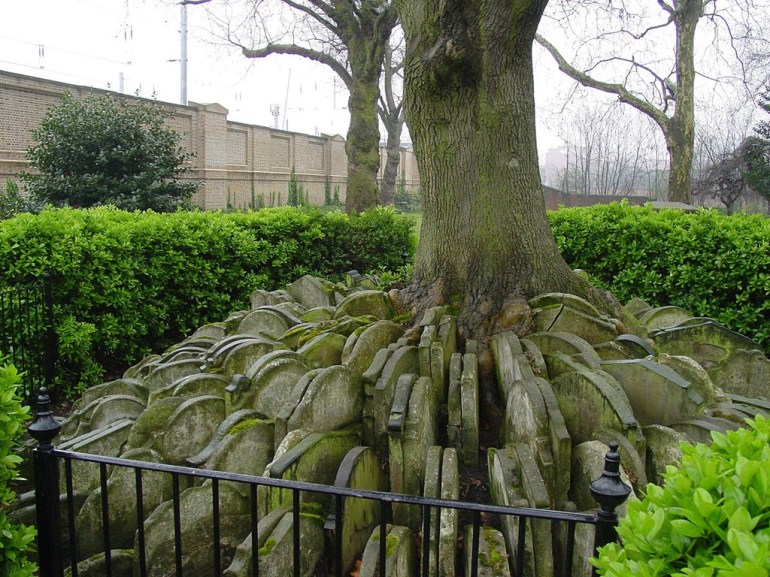
Hardy himself worked out this method of consolidating a graveyard’s worth of tombstones, and it makes a striking illustration for his poem.
.
Hardy, an Englishman born of the middle of the 19th century drops in but one or two anachronistic words in this poem — but while “grandsire” doesn’t sound natural on a 21st century American’s lips, the gist of this metrical and rhymed poem is easily singable in 2023 I thought. Down went Hall’s book and up went the efficient composer! I whipped up the music quickly. Long time listeners here will know that my music is usually not harmonically complex, but my simple cadences often try to confound the usual chords and progression resolutions. I hope I’ve done that with this one. The time to record the piece was scant, so I went with my go-to “I may have to hop a freight train shortly” folk music standby, the acoustic guitar and overdubbed a quick bass guitar part. You can hear it with an audio player below — or if you can’t see that graphical device, with this backup link that will open a new tab with its own audio player.
.
*Few click hyperlinks, so let me put this in a footnote. Wheeler’s book has these additional reasons to read it beside just being good: its story and poetry is contemporary, and as a writer and a woman Wheeler focuses on elements of our lifetime journeys that other poetic memoirs gloss over. Here’s those hyperlinks: Wheeler’s book. Hall’s book.
**Hall’s Harvard classmates circa 1951 included Frank O’Hara, Robert Bly, Adrienne Rich, Kenneth Koch, John Ashbery, and others. Eliot — and to a trivial extent, Frost — were Harvard alums. My personality, alas, is not socially skilled, but even at my most sociable, my circle of working-class Lake Street poets and state college teachers in my 20s is not as name-dropingly famous.
***It’s possible that everyone even vaguely literary in sundry metropolitan areas around this time had drinking with Dylan Thomas stories, even if Hall’s analysis of Thomas’ poetry is individually savvy.
****In his Eliot chapter Hall says that Eliot said more than once to him that no poet knows if their work is any good. When Eliot said this in an interview Hall did with him that was destined for print in a literary magazine, that statement was cut because it seemed too down-beat.
It’s been said of poets that they go out into a perfectly good morning only to think of glum existential thoughts. When I read something like that and look at the pieces this Project does, reflection is called forth. That certainly calls out a lot of subject matter I deal with here.
There’s a rebuttal, songwriter Townes Van Zandt said “There’s only two kinds of music: the blues and zippety doo-dah.” Poetry of course is music’s sister muse, but despite Steve Earle’s cowboy boots,* Van Zandt isn’t likely to be recognized as the world’s best songwriter. A dialectic of “blues and zippety doo-dah” risks falsely reducing Blues to a synonym for “sad songs.” One reason that Van Zandt, who was an excellent songwriter, won’t get the World’s Best award is that his songs vary between sad, sadder, and saddest. Doesn’t make them less perfect for what they are, just makes them suitable for certain moods while other songwriters might portray a range of outlooks and characters. I like Townes Van Zandt, I think “Flyin’ Shoes” is as near a perfect song as ever written, but a playlist of 20 to 30 Van Zandt songs would not carry my attention as well as a similar-length selection of Bob Dylan, B. B. King, Joni Mitchell, or Mose Allison.
An Emily Dickinson playlist would be equally as varied as anyone in that latter quartet. There’s the goth-girl Dickinson, the satirist of religion Dickinson, the legalistic philosopher, the altered-states psychedelic Dickinson, the secret bisexual passion Dickinson, and then there’s the Dickinson I’ll perform today: the botany nerd Dickinson. Part of what makes Dickinson such a fascinating writer is that all those personas talk to each other, seem to know each other.
I’ll not go into thousand-words territory on today’s Dickinson piece — I’ve been too long-winded lately for that. I’m going to treat her poem as a simple delight in the oddities of fungi. I have every reason to estimate that that was Dickinson’s intent, and we can enjoy that intent’s achievement. Here’s a link to the full text of the poem if you’d like to read it. To briefly brag about my restraint, there’s a possible deeper, subconscious, reading of the sporocarp fruiting body — but let’s be done with that. All the other Dickinsons may have been there when this poem was written, but we can simply enjoy one of them today.
Apostate mushroom, pleased grass, surreptitious summer. Emily Dickinson not pictured.
*A famous quote by fellow Texas songwriter Steve Earle was plastered on a Van Zandt album cover: “Townes Van Zandt is the best songwriter in the whole world, and I’ll stand on Bob Dylan’s coffee table in my cowboy boots and say that.” Wikipedia reports Van Zandt had a comeback when asked about that blurb too.
While visiting western North Carolina this month I toured two houses built in the 19th century, each high on hilltops overlooking the mountains surrounding them. My mind likes to link things, I couldn’t help but look at them as a pair.
The first house was named Connemara by an owner that lived there in between the man who had it built and the man whose shade I’d come to visit. The man who had it built was Christopher Memminger who had enslaved workers to build it. Memminger eventually became the Confederacy’s Secretary of the Treasury, so he must have known something about money and the slavery that helped accumulate it.* The later owner was a poet and writer who somehow found his own words remunerative enough to afford it, Carl Sandburg. Sandburg was said to have found the place a bit baronial for a socialist poet, at least on first sight — but his beloved wife wanted temperate pastureland for her dairy goat herd, and this place had that. She’d helped and stood by Carl through his unlikely rise from hoboing between short-lived work, to being an aide to a mayor of Milwaukee, to daily journalism in Chicago, to becoming a prize-winning poet and multi-volume biographer of Lincoln.
The second house is Biltmore, built for George Vanderbilt II. If you know your Gilded Age, the Vanderbilts were likely the first great fortune family of enormous wealth in 19th century America. Brief accounts I’ve read of him don’t make him sound like someone all that interested in business or growing wealth. He was bookish, a bit shy — but also very rich and looking to use that wealth to put his mark on things, to enclose his life in the best as he saw it. If one wonders at the two socialist second-generation immigrants living in the large farmhouse of Connemara, Vanderbilt’s house makes that place look like an outbuilding. Biltmore’s not just bigger, it’s thought to be the biggest residence ever built in the United States, with around 4 acres of floor space beneath huge high-vaulted common rooms. The estate surrounding it was over 100,000 acres, and Vanderbilt had it landscaped by Frederick Law Olmsted, the man who had worked on a much smaller canvas with the 800 acres of New York City’s Central Park.
The mix of manicured and wild seeming landscape is beautiful in the Olmsted manner. We biked along a trail through 8 miles of it, past lagoons and along the banks of the French Broad river —and as we rolled over a wood-rimed rise down past a pasture I was delighted to see three hawks at tree-top level swooping over us, so low that the shadows of one passed over me rolling beneath them.
The two houses have similarities, if not in scale. Both Carl and George were packrats, though at the wealth level of a Vanderbilt, it’s called being an art collector. The Sandburg house was donated to the US government just after Carl’s death. His wife and two live-in adult children packed up as if going on vacation and left the house for residence in Asheville. The Park Service has maintained it ever since in Marie Celeste ghost-ship-shape. One of Carl’s cigar butts sits in an ashtray on the set-for-a-meal dinner table. Piles of books and magazines cover many surfaces as if they were just set down this week. Sandburg has thousands of books in bookcases everywhere around the house, and there are busts of Carl and his long-term subject Lincoln, art photographs by his wife’s brother Edward Steichen, and scattered knickknacks. Vanderbilt had even more thousands of books, all stored in a large floor-to-two-story-high ceiling library room, all arranged with leather and gilt bindings a-plenty. Life-size John Singer Sargent portraits abound and above giant elaborately surrounded fireplaces. Hallways are hung their entire length with framed etchings. Large Flemish tapestries showing Biblical virtues completely cover walls of a big room. Servants kept it all clean and ordered then, and that’s how it’s displayed now.
Vanderbilt Biltmore Library and a Sandburg bookshelf. Some Sandburg clutter.
.
The mood of the two places, as I sensed it, was very different however. Biltmore seemed dark, and though some of that was likely due to preservation of valued pieces from bright lights, both my wife and I had simultaneous Citizen Kane thoughts by the large tables and giant fireplaces. She nudged me and asked if I’d like to put together a jigsaw puzzle. In contrast, the Sandburg house seemed domestic in a familiar way to me. The metal handles on the hand-touch-patinaed Sandburg kitchen cabinets — chrome ones fluted like a Pontiac’s hood — were the same that were in my childhood’s kitchen. The clutter there, like my clutter.
The Sandburg house kitchen
.
In the lengthy tour of the Vanderbilt house, the highlight was when we detoured outside onto a long stone veranda with splendid views of the Blue Ridge Mountains. We sat on deck chairs, as we might sit on our own home’s rickety screen-porch, and gazed not at a multicultural Midwestern neighborhood, but on the far hazy peaks as swallows darted to and fro just over the railing as they likely did when the Cherokee could not dream of steamboat millionaires or multi-volume biographies.
There’s a wicker chair out on a large flat granite rock, yards from the Sandburg house. It too offers a view of the tree-covered mountains, but with no roof over one’s head or seats for others. Carl Sandburg would go to that chair and sit to write first drafts. That unkempt shock of white hair of his would blow like leaves in the breeze, and the sun would remind him how blank the new page was.
Sandburg lived at his hilltop house bought with the proceeds from his own literary labors for two decades. Though George Vanderbilt was rich the day he was born, he had only about the same number of years to enjoy the extraordinary elaborate one he had built to his desires. Some of us still read Sandburg’s work in our homes — only tourists will now see Vanderbilt’s commissioned magnum opus.
I told you I like to connect things — and these two houses around Asheville are a natural pair — but I also look for the more tenuous connections. Last time I said that Sandburg’s most lasting influence, obscured by time and the others influenced by him, was being an original “roots” or “Americana” popularizer, the man with poems, a guitar, and songs from all corners and sub-cultures of America. What is perhaps the greatest lasting fruit of the extended Vanderbilt family tree? Not steamboats. Not gilded age mansions. Not art collections. Maybe not even philanthropic donations to long-lasting institutions. In 1910, Emily Vanderbilt Sloane, descended matrilineally from the Vanderbilts, gave birth to John H. Hammond. There’s no room to tell you all John Hammond gave us, so here his Wikipedia entry is linked. Why would you want to click that link? Here are names you’ll see linked to John Hammond there: Bob Dylan, Bruce Springsteen, Benny Goodman, Robert Johnson, Harry James, Charlie Christian, Billie Holiday, Count Basie, Teddy Wilson, Big Joe Turner, Pete Seeger, Babatunde Olatunji, Aretha Franklin, George Benson, Freddie Green, Leonard Cohen, Arthur Russell, Jim Copp, Asha Puthli, Stevie Ray Vaughan, Mike Bloomfield, and John H. Hammond’s own son John P. Hammond.
Today’s post is dedicated to my life partner of two decades today, Heidi. For a musical piece here’s one of Sandburg’s chief influences whose birthday also happens to fall today, Walt Whitman’s “I Hear America Singing.” In his song Whitman reminds us of our labors, and as the son of a house carpenter, he knew directly who built the houses. Graphical audio player below for some,backup link here if you don’t see it.
..
*Carl Sandburg, Lincoln biographer, was not a Confederate, and was a proud “Civil Rights” supporter. When the tour guide noted the incongruence of this, I put on my village explainer hat and told the tour group that poet Longfellow, he of patriot poems like “The Ride of Paul Revere,”lived in a house built by a Tory who fled the American Revolution.
I’m in Asheville North Carolina this weekend, and I visited the Carl Sandburg home national site not far from here. Longtime readers will know that Sandburg is a touchstone for me and this project, and so I thought it’d be worthwhile to put down a few observations and questions that have arisen from my visit in consideration of Sandburg.
I think Sandburg has suffered from succeeding in doing something we no longer expect poets to do. He achieved a certain level of fame during his lifetime — and that alone is problematic. If poetry has lost sufficient cultural interest, as some critics and some poets believe, then a poet too famous has presented a case that they aren’t really writing true poetry. It doesn’t help that Sandburg wasn’t known as a critic himself, and didn’t present an explicit theory of how poetry works. This led to an assumption that there’s no depth, originality, or vision in his work. From this perceived lack, his fame — and one might assume his influence — died off quickly with the celebrity poet character he became in his long lifetime.
Yet there’s one line of influence that I say is underappreciated, one that flows from his writings and public persona, a path of influence that mixed with others who had complementary urges. That line of influence runs through Sandburg’s work with American folk music. He seems to have been working roughly contemporaneously with John Lomax and Charles Seeger* in popularizing folk music at a time early enough that one couldn’t yet term their actions a revival. And he was mixing these folk tunes collected from various subcultures in America’s regions and mixing them within a project that included outreach of high culture poetry and a lefty political slant from the presenter, as if it was all one thing. There was no natural reason these things were required to be combined, and so a successful poet and author combining them, as Sandburg did, helped set the format for the progress of the folk music revival from the WWI era through to the eventual “folk scare” of the Fifties which launched Bob Dylan and many others who would be called song poets.
Sandburg singing with his grandkids. Note the classical guitar position, a way of holding acoustic guitars I adopted too. Guitar and piano currently in the Sandburg home. I couldn’t get an angle to read the headstock. Anyone got knowledge or a guess what make and model is is?
.
Critical intermediaries in this half-century progression were Pete Seeger and Woody Guthrie, and I’m often struck by how similar their presentations were to Sandburg’s. If you mix Sandburg and Will Rogers** into a cloning machine you wouldn’t get an exact Woody Guthrie, but you’d likely get something like him. Guthrie familiarly called Sandburg’s pioneering 1927 folk song collection The American Songbag “Carl Songbird’s American Sandbag.” And like this project, Guthrie played and composed music to accompany Sandburg poems for public performance. Pete Seeger’s Chautauqua-ish concerts presented to and aligned with a Sandburgian “The People, Yes” outlook. Seeger’s breakout group The Weavers made much of this blurb given them by Sandburg “When I hear America Singing, I hear the Weavers.” Before that, when he was beginning, Pete claimed he got ahold of American Songbag when it came out. Again, like Woody, Pete was Pete. They added themselves.
I admire Langston Hughes, and while not single-handedly, he’s seminal in the development of Afro-American poetry. In reading his early work, some of which remains in the forefront of his legacy, I hear strong echoes of Sandburg’s word-music. Are they both hearing Walt Whitman in their ears? Likely, but the concision of many of Sandburg’s early poems is not Whitmanesque, and Hughes’ poetry likewise could be concise. Langston Hughes was too, himself, but a poet like Sandburg at least ran interference for his work.
Hughes was an early proponent of Jazz Poetry, yet Sandburg’s “Jazz Fantasia” was there to serve as an example when Hughes’ first poems were published. Later on, I was often hearing elements of Langston Hughes in Gil Scott Heron, and if we continue that line, perhaps there are reflected elements of Sandburg is some down-tempo, socially conscious rap.
One of the things a tour of Sandburg’s home offers is the ability to peak at his many bookshelves and scattered magazines. They show a man with wide interests in politics and human rights alongside poetry. Here’s one little something I didn’t expect to find, wedged in between The Roots of American Communism on its left and McCarthy: The Man, The Senator, The Ism on the right: a copy of a science fiction magazine. Did Sandburg read or at least casually follow mid-century SF? Has anyone even asked this question? Is there any way to answer it? Was this one issue or are there many in the house?
The magazine is right next to the McCarthy study. Hard to read the spine, but it may be this issue.
.
Here’s an oddity that I thought of while sitting in Asheville thinking also of the Black Mountain College that existed nearby. From 1945 when Sandburg moved to North Carolina until the college closed in 1957, it existed in the same part of the Blue Ridge mountains with Sandburg. In the 1950s it became the locus of a group of poets*** who eventually were called The Black Mountain Poets after the school. You might wonder (well, I did) did any of them seek out Sandburg, or did Sandburg make any note of them? So far, I can find not a trace of an answer to that question. Was Sandburg either too busy or too retired to mix with them? Was he considered too mainstream and successful to be of interest to insurgent “post modernists?” Many Black Mountain Poets admired and communicated with William Carlos Williams, Sandburg’s contemporary — but Sandburg too had championed a more American and less European-culture-centric style of free verse continued by the Black Mountain Poets. There’s a dog not barking there.
In the end, I suspect Sandburg might be comfortable with his diminished reputation in the 21st century — even if I’m not. Sandburg often spoke of the work of the people as being continuous, of that factor being part of the peoples’ power. In that way he might be satisfied. Things he helped build, put in motion, continue to move forward, change, and develop.
For an audio piece today, here’s a short poem by one of the foundational Black Mountain Poets Charles Olson titled “These Days.” I performed it acapella this morning, recording this very short piece on my phone in a less than quiet room I’m staying at. It speaks of something Olson and Sandburg might have agreed on. You can hear it with the audio player below, or if you don’t see that, with this backup link.
.
.
*Father of Pete, Mike, and Peggy Seeger. Husband of Ruth Crawford Seeger.
**Will Rogers arose in a very similar time-frame to Sandburg. The amateur guitar player/author/speaker Mark Twain had died just a few years previous. The clever yet folksy artist observing the entire range human behavior from a loving/skeptical non-East-coast/high-culture place was a needed character in American life, and while Sandburg isn’t a Twain clone, the role he played was somewhat successive.
***The list of other famous students and teachers of Black Mountain College included Buckminster Fuller, John Cage, Charles Olson, Walter Gropius, Joseph Albers, Robert Motherwell, Robert Rauschenberg, Merce Cunningham, John Cage, Paul Goodman, Franz Kline, Willem de Kooning, Robert Creeley and Robert Duncan.
A great many countries have holidays honoring their nation’s soldiers, often with an emphasis on memorializing the dead of past wars. The United States has two such holidays, a Veteran’s Day on the date of the WWI Armistice and the one that arrives this weekend, Memorial Day.
Long time readers here will know I’ve presented a lot of soldier’s poems in this Project, and poems otherwise about wars. This is fitting, war as a poetic subject matter goes back to Homer and further.
Many soldiers’ poems are at least ambiguous about the worth of war, some are outright harrowing. But that’s poets. Outside of poetry, many in the US have developed a particular carefulness in speaking of our wars, a hesitancy to speak honestly about those ambiguities mixed with a deadened obligatory reverence for veterans — a reverence with no other required obligation or attention. Yet we have these two holidays.
Well, do we have such an obligation to remember the horrors of war and the hard-won realities the warriors helped enforce? Asked this way the answer is suggested: yes, we do. For this year’s Memorial Day, I’m going to present two poems that suggest something else in addition.
The first one is by poet Kevin FitzPatrick, who I’ve been memorializing since his death in late 2021. Kevin was not a vet, but he helped with the arrangements that led to his father Bernard FitzPatrick’s memoir, A Hike Into the Sun, about his WWII experience as a prisoner of war in the Bataan Death March. Let me briefly summarize that, for those for whom this is ancient or foreign history: In the early days after Japan declared war on the US, the Philippines came under attack. The fighting was fierce, with Americans and Filipinos resisting without anything like sufficient logistical support to hold out very long.
After they surrendered the near 70 mile march began, with brutal mistreatment and wanton execution of captives adding to the suffering of the weakened and injured soldiers. Forced labor for the duration of the war followed for those who survived the early days. Death counts vary, ranging from 5600 to over 10,000, continental American soldiers and their Filipino comrades. WWII had many accounts of human depravity. This was one of them.
Kevin’s father survived the march, survived the years as a POW doing forced labor, and then wrote his book about it in the 1990s. That’s only background, this isn’t what today’s poem is about. “Survivor” is about his son Kevin visiting his dad in the 21st century while the infirm father in his late 80s was in a care home. How much can someone like myself know about Bernard FitzPatrick’s experience?
It just happens that one of the Parlando Project’s mottos is “Other Peoples’ Stories.” That motto also admits, understands that I (and you) can only partially understand others’ experiences, even if poems and performances might inform us somewhat.
I’m not going to spoil the ending of the poem, you’ll need to listen to my performance in order to hear it. Without spoilers I can say that when I first heard Kevin’s poem, when he read it in draft form, his tale of a chair transfer reminded me of my time working in nursing homes and like Ray was performing those kinds of tasks, but the ending took it another place I didn’t expect the poem to go. You can hear my performance with the audio player below. If you don’t see that player (some ways of reading this blog hide it), this highlighted link will open a new tab to play it.
.
Knowing how Filipinos and US troops suffered in the hands of the Japanese, what does the ending say? There’s no secret right answer, this isn’t a pop quiz. Instead of defining a clear answer, let me supply another poem in a performance I shared here many years ago before some of you followed this Project. I think of it as a great Memorial Day poem because for it to achieve its greatness you need to think about it, think about what it implies in the compressed story it tells. The poem is Carl Sandburg’s “Grass.” Coincidentally, Sandburg was a veteran of the Spanish-American war, the conflict that made the Philippines an American Commonwealth up until independence just after the ending of WWII around 50 years later. Sandburg as a soldier wore Civil War era heavy woolen uniforms while stationed in tropical Puerto Rico, and his commander was a Civil War officer. That’s how close his time was to the bloody American Civil war whose battles are mentioned. “Grass” was written when the bloody battles of WWI, also mentioned, were contemporary events.
Kevin FitzPatrick and Carl Sandburg. A couple of poets imply some things you’re not likely to hear elsewhere this Memorial Day
.
Sandburg’s poem in its short duration reminds of the costs of war — but what does his ending mean? Does it mean it will be best all-tolled when we have the option to forget their sacrifice? Does it simply observe that time passes, and we will forget, eventually? Is he saying that more wars, more bloody battles, obscure the dead of past wars? Chances are you won’t hear any of those statements in any Memorial Day commentary or post — but you will hear about Memorial Day discount savings, and rote uncomplicated praise for service.
Here’s the audio player for The LYL Band performing Carl Sandburg’s poem “Grass” live several years back. And here’s the backup link for it.
I’m going to share a musical performance of an Emily Dickinson poem, but before I get to that, I’m going to continue my memoir-of-influences series on things that formed the idea of the Parlando Project earlier in my life. I’m going to try to keep it short, which will force some amputations, but I feel embarrassed spending much time on the small events of my single life. Those in a hurry, or only interested in the new audio piece and what I have to say about that, can skip down to the second section of this post.
At the end of the last post I had moved to Newburgh, a town on the Hudson river about 60 miles north of New York City. I don’t know if the town knew what to do with The Seventies, it seemed between eras; and in some larger sense I might not have known what to do either, but like the town I had a daily job to do, and kept doing it. Can we say that had some value?
I liked many of the people I worked and lived with during my five years there. I still think of some of them from time to time, and they were often kind to me. The folks who worked with me at St. Luke’s Hospital, particularly those in the Emergency Department, worked hard under significant limitations trying to do things that we could only address partway. I could say much of that under-addressed were systematic issues — and I’d be right — and the levers of those systems were outside our direct grasp. Another part of those limitations were closer to us, internal. I said I’d try to be brief. I said there would be amputations. Newburgh had a racism problem. The town, the region, was populated by stratums of immigrants, with the original European WASP colonials to Irish, Italian, and Puerto Rican waves following on. Mixed in there were Afro-Americans who were there, as they were everywhere in the United States. I don’t know the exact demographic details, and I said I’d try to keep this concise, but I’d guess the Black Americans were first in the region from servant and slavery times, and then there was some low-paid and otherwise undesirable work that still may have seemed better than some parts of America for Black folks. Few poor people ever emigrate for marginal gains from acceptable situations.
That work had shriveled over the years, and what jobs there were, those other immigrant waves got some of the employment from the white folks who did the hiring. Again, I’m no expert, I may have some of this wrong, but when I think of the Irish and Italian Americans who can recount the derogatory tropes employed against their ancestors,* I still suspect that even within the cruel othering they received, they sometimes got, in practice, hiring preferences over Afro-Americans.
This led to the town, in the time I was there, with an underclass of underemployed Black folks viewed by too many of the white population as shiftless, ungrateful and unenterprising wards of the state. Think I’m amputating too much to say this was a prominent white attitude? Ten years before I arrived there was a controversy that was called “The Battle of Newburgh.” I didn’t know much of this specific history in 1971, but the attitudes were still easy to hear and feel while I lived there. Here’s a link to a 30 minute podcast on the 1971 controversy. Wonder what happened later? Here’s an article that updates things to 2015.
Back in my Emergency Room, The Seventies, we were the place anyone came when things broke down. Folks needing medical care that couldn’t pay. Victims of violence. Stressed out or addicted people. Worn-out old workers and beneath the working-class people. I worked the 3-11 shift, the busiest one in the ER. We’d typically get 50-70 such situations every shift. What could we do for them, right now, in our imminent place? Patch’em up. Give them a preliminary diagnosis and maybe a shot or some pills. Hand off a referral card to a medical system already fragmenting and requiring insurance levels of payment from various payers. Witness their deaths.
So those folks I worked with, who did this, were they racists? I’m not saying that. I can’t see into the hearts of them — not then, and not with any level of magnification now. I know we were frustrated with the people in and around the treatment beds at times, thinking that what’s close and in front of us was the most significant thing in what was going on. No, no, we’d no doubt say, that thought wasn’t from the color of their skin, that was what they did, or were doing, or weren’t doing. From what some of my coworkers said talking among our tired selves, I could hear racism, hear pat rationalizations. I’d be hearing this from folks on a modest paycheck given the responsibility of a past that isn’t even the past as Faulkner put it. Our actions were mostly care — yes I saw kindness too, even when our philosophies and capacities could not fully appreciate the lives of our patients and their families. Perhaps it was good that we were too busy to think about that incongruity. Would our care have been better if we — speaking now of the whole group of us, including myself — were less ignorant and more broadly empathetic? That’s certain. But such wiser folks weren’t there then, we were. Imperfection trying to heal what could be treated directly.
A couple of years before this, a songwriter was 40 miles to the north of me, goofing off with his Canadian R&B band buddies in a big pink house. Sing heavenly muse, he sang these lines:
Remember when you’re out there
Tryin’ to heal the sick
That you must always
First forgive them.”
To this day, when someone, almost always a white person, concludes some confession to me with a variety of the phrase “You might think I’m a racist because I said that.” I reply “You said it, and you might well be to some degree. So, what are you going to do about that, and about the situation that is before us?” Ignorance and prejudice may not guide us well in trying to solve things, to remedy faulty systems — so what efforts can reduce that so we can see more clearly? But beyond that, even though our thoughts and prejudices can make us work blindly or in the wrong direction, the injured and endangered may be more in need of helpful actions than faultless inner wisdom.
Is writing and performing poetry a helpful action? Well, it’s not clearly so as is binding wounds or performing CPR. Poetry is in the calling-attention business, including part I normally celebrate here as “Other People’s Stories.” With that focus, I feel conflicted in writing so much within this series which touches on individual and sometimes trivial things in my life. What good will calling those things to attention do? Perhaps it helps make you aware of the “unimportant” things in your life, or the dependencies we have in others who have broadened or deadened what we’ve seen and felt. It can be someone else’s story that helps you see the contours of your own story.
And then too, poetry is full of little, trivial things that poets write down to stand for the ineffable larger things. Can our lives stand for the larger things? They do I believe, or they can, in ways we never fully know.
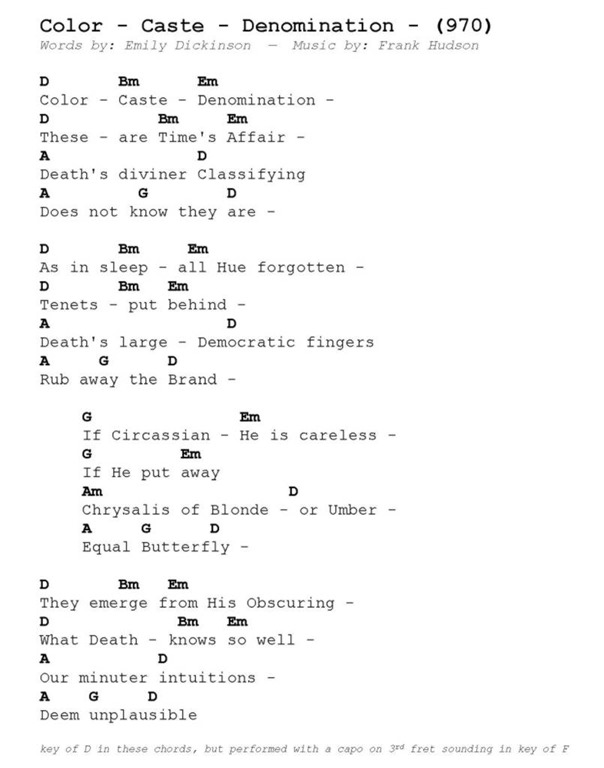
Once more a chord sheet if you’d like to sing this too.
.
The Emily Dickinson Poem
Emily Dickinson has many poems where the small things stand for larger, and then she has others using more philosophical language — yet I was still struck by the first line of today’s Emily Dickinson poem. Poems sometime seek to grab your attention right at the beginning, and this one does that with a trinity: “Color — Caste — Denomination.” These things rule so much of our lives. We may think we don’t let them rule us, but then we see the next person is using them to guide them — or perhaps guide them in how they view us. How can that not affect us. How many next persons can there be without us sometimes being one of those next persons, or yielding to the next person in our lives?
A couple of short notes on things to mention in the poem since we’re running too long. Who’s a “Circassian?” It’s a Middle-Eastern Muslim-believing ethnic group largely exiled from their homeland by the old Russian Empire. “Caste” is a word given by Portuguese colonialists to a hereditary hierarchy they found in South Asia, but it has taken on new usage in modern America to describe the intertwined prejudices and discriminations based on skin color, ethnic background, religion, and economic class. Both terms show a breath in Dickinson’s reading and education. Even though Dickinson’s America was approaching or undergoing a war around race-based chattel slavery when this poem was written, Dickinson seems to give religious prejudice equal or greater weight in the “minuter intuitions” her poem holds that we use to obscure our common humanity. Some scholars have pointed to this poem as a comment on Irish-Catholic immigration in Dickinson’s region at this time which led to a substantial reaction from the existing Protestant settlers.**
My musical setting for it is simple, just guitar and voice, as I’m somewhat rushed for time — and then wanting to use what gifted time I find available when I can record acoustic guitar with open microphones that would otherwise pickup other noise. Though that may have been a practical reason, I think the simplicity works for this hymn from Dickinson’s alternative hymnal. You can hear my performance with the audio player below, or with this alternative, a highlighted link that will open a new tab with an audio player.
.
*Not doubting those stories — see the next note as we see that connect to Emily Dickinson. And I haven’t mentioned anti-Semitism in its Jewish and Muslim varieties. Or the ugly anti-Chinese laws and hate. Oh, and First Nations? I could go on. And that’s just America. I know I have an international readership. Other countries have their own varieties of this, as we’ll see too in Dickinson’s poem. We had all kinds of supposed levels of intelligence and moral fitness that bedeviled us then and now.
**As I mentioned in one of my favorite posts on the roots of Emily Dickinson, her mid-19th century Amherst Massachusetts region had Afro-Americans, mostly in her time in servant class jobs. As she grew into adulthood, the Irish immigrant wave started to displace them, and anti-Irish sentiment ran high. Emily’s brother Austin, who she was close to, at least dabbled with the notorious anti-immigrant Know-Nothings. When young Austin was assigned to teach Irish immigrant kids in Boston, he found the job stressful. There’s a letter from his sister Emily where she jokes that it sounds so bad for him that he ought just as well to go and kill some of them, referencing in the same letter a notorious Boston murder case with anti-Catholic connections. Generously, I sense Emily the satirist there, but this kind of edge-lord humor, then as now, can just be “just joking” license as well. I think: Dickinson, for all her independence of mind, was part of systems, just as you and I are. Even Transcendentalism, the time’s new thought movement that sought to open up cultural enquiry, was not without racism and prejudice. Emerson’s “American Civilization”which I presented part of earlier here, and which is contemporary with this poem, contained portions with racist ethnography.
The most remarkable thing I can think of regarding Emily Dickinson and Irish-Catholic prejudice is that she ended up working elbow to elbow with Irish maids on her rural homestead that retained elements of its former farmhouse work-load carried with other poor first generation Irish immigrants as the hired help. The longest serving maid, Margaret “Maggie” Maher — did she recall Irish poetic bards and song? When Emily’s precious packets of her remarkable poems, overran a portion of a bureau drawer, Maggie offered up her immigrant’s trunk, in which she’d carried her all to America. When the Dickinsons decided they didn’t like the likeness in the oft-seen daguerreotype of Emily we rely on now, they tossed it out, and Maggie rescued it and kept it. Maggie worked beside Emily as she cared for her invalid mother during her prolonged illness, and she then cared for Emily as she lay dying. She was a loyal worker, but it’s said Emily told her to burn the poems. Then, she didn’t obey. When Mabel Loomis Todd was given the task of arranging the poems for posthumous publication, I read that Maggie did housework for Todd to free up her time for the editorial efforts.
And here’s the final thing, as final as death’s equivalence that today’s poem recounts. When Emily Dickinson died, she, this descendant of one of the town old-guard WASP leaders, asked that her coffin be carried by the Irish workers of her homestead. Aren’t you glad you read footnotes, patient reader? You can read a summary account I relied on for much of this in this academic paper available via JSTOR. It’s author Aife Murray expanded her research into this book, which I read a few years back.




 Frank Hudson