I Felt a Funeral in My Brain

Before leaving our Transcendental Trio of Emerson, Whitman and Dickinson, we should feature another set of words from Emily Dickinson, particularly since today is her birthday.

Besides the poems themselves, Emily Dickinson is a series of cracking good stories. One story is similar to guitar poets Robert Johnson, Nick Drake, or Rodriguez, all artists who never made it during their prime, but who get discovered later and find greater distribution and acclaim. In Dickinson’s case, she wrote most of her work in the middle of the 19th Century. After her death in 1886 over 1700 poems were discovered in her papers, and a selection of her work was published in the 1890s. As fortuitous as this discovery was, the process was fraught with complex family dynamics and a decision by the editors to edit the work to make it more conventional for print. All this was not sorted out until the last 60 years or so when readers could finally read the poems Dickinson wrote as she wrote them. So, there’s one good story—one every little-published author can envy.

Then there’s the legend of Dickinson’s life itself, which was in the forefront as I was introduced to Dickinson as young man: Poor Emily, naïve and unlucky in love with a mystery man in her youth, she secludes herself in an attic and spends the rest of her life cloistered like a nun, the patron saint of introverts everywhere. This turns out, like most myths, to be a misleading account.

I’m not a Dickinson scholar, no more than I’m an expert on Blake, Sandburg, Frost, Whitman, or Emerson. I’m a poet who’s worked at that for 50 years, a musician who’s done what he can for 40 years, and for about 20 years I worked in hospitals, mostly in emergency departments. I’ve got my theories, like those that have spent more time on Dickenson. She’s clearly whip smart and no more naïve than Frank O’Hara or Margaret Atwood. When she presents herself as naïve, she’s role-playing. She’s as stubborn about her own theology and philosophy as William Blake, and she’s just as stubborn and original about her musical tactics as Joni Mitchell. She can be as mordantly funny about the human condition as Leonard Cohen.

On one Dickinson question, I wonder about neurological matters. As an introvert myself, I suspect introversion, perhaps even something “on the spectrum” as they say these days. One thing non-introverts don’t understand is that it takes a whole lot of energy for introverts to do what others think of as little things.  Add to that the burden of being an intelligent, free thinking woman with a talent for writing in the 19th Century—well then, choosing to restrict one’s social obligations makes a lot of sense.

A few years back, a Dickinson biography was published that suggested that Dickinson may have been an epileptic. Another theory is that she suffered from migraines. There may be something there, and either could explain her choice in reducing her social interaction. In poems like I Felt a Funeral in My Brain, one can easily see metaphors that could be framed as reports of the pre-event auras that suffers experience, as well as post-ictal, after the event states—but let’s show some respect here. I remember reading as a youth that Monet may have painted his impressionist water lilies because he became near-sighted as he aged, and those ponds just looked blurry to him. Well, I’m nearsighted, and I can’t paint like Monet; and if Monet’s art includes elements of a medical condition, “explaining” it that way is reductionist. Monet would still have to choose to paint those water lilies blending and floating, and if Emily Dickinson had migraine auras and dreadful headache episodes, she’s still have to choose to write so originally and vitally as she does in I Felt a Funeral in My Brain.

Biographical mysteries echo the mystery of the poems, but there are plenty of poets with plain lives and mysterious poems. Dickinson is a master of first lines, as this one has. That first line/title might lead one to expect a Roger Corman directed Edgar Allen Poe pulp movie—and you can enjoy the poem as that. Others see it as a statement of desperation, as a statement of sincere anguish at potential unrealized, “a mind is a terrible thing to waste.”  If one wants to take the migraine approach—or for non-suffers, those who’ve had a really bad hangover—you can read it sardonically, “Hey, stop with that clomping around in your boots. You know what kind of night I had!”  You can read it as a meditation on a death foretold.

To the degree I had to choose as a reader I somewhat favored that last one, but with a bit dark humor underlying it, “Get the damn obligatory service over will you, I’m ready to contemplate oblivion.”  That last stanza may be a change in mood. I was reminded of Roger McGuinn’s fine song 5D as I was reading Dickinson’s poem this time, “And never hit bottom and keep falling through just relaxed and paying attention.”

Musically, I started by aiming for something like John Cale’s arrangements for Nico.  I played all the instruments, and the syth part came out something like that. The piano part was an adventure in that I’m not a piano player, and keeping with the John Cale idea, I tried to channel Cale’s part on Nick Drake’s Northern Sky, though the result is something else. Now if I could just dream of translating a bit of Danny Thompson on bass! Well never mind, no one can listen to intentions, but you can hear the results by clicking the gadget that will appear below.

To A Locomotive In Winter

A few years back there was a little Internet brouhaha about a woman who looked like she was talking on a cell phone as she was filmed walking down a street in 1928. “Proof of time travel?” asked the rhetorical askers “In 1928 there’d be no cell phones for 50 years, so she has to be from the future.”

time-traveler-cell-phone
About time we get cracking on Bluetooth don’t you think?

We’ve been talking here recently about Ralph Waldo Emerson, Emily Dickinson, and Walt Whitman, three 19th century Americans. As far as we know, none of them used cell phones, and their considerable accomplishments may have been easier insomuch as they didn’t have to worry about PokéStop locations. But maybe they were time-travelers none-the-less?

One of the remarkable things about Emily Dickinson was that she seemed to be writing 20th Century poetry in the middle of the 19th Century. Oh sure, skeptics will say, she was a genius, and through her genius became influential to later writers. Typical debunkers!

Walt Whitman too, often seems a prophet and precursor of a new age, but maybe he wasn’t a prophet? Maybe he was just reporting from the future, and he knew all his bets were sure things. How else can you explain Whitman’s podcast on gender equality streamed here?

Today’s piece, Whitman’s To a Locomotive In Winter, was written sometime between 1874 and 1876, but it reads like a “Futurist” poem written 40 years later. The early 20th Century Futurists embraced technology and sought to bring it into the arts. Poems, paintings, sculpture and musical works celebrating bicycles, airplanes, motor cars and trains were their stock in trade. Was Whitman a time traveler from 1914 who had read the Futurist Manifesto?

futurism_meccanica_pannaggi_speeding_train

Thee for my recitative!

Another American who paid attention to the Futurists (besides time-traveler Walt Whitman) was George Antheil, a composer, who by the 1920’s was trying to engineer machines to make music. He had this idea that he could realize a musical composition by syncing more than one player piano together so that an even greater mechanized noise could be exactly made. By the 1940s, perhaps after hearing Whitman’s podcast on women’s strength, he was in Hollywood and hooked up with actress Hedy Lamarr—no, that kind of hook up. You see Hedy had this idea for a radio-guided torpedo. One problem: if you used radio to guide it, you could use radio to jam it. What if the control signals could use random radio frequencies Lamarr wondered? How would the controller and torpedo stay in sync? Antheil had the solution, the same thing you used to control player pianos: a roll of punched tape. The tape would tell the radios to switch frequencies in perfect time with each other. You couldn’t jam that jam because the radio frequency could hop at some sick number of beats per minute.

George Antheil with machines

Maybe I should have just developed MIDI instead?


Antheil and Lamarr tried to interest the US War Department on this. Those square faces listened to this idea of randomization and said “No dice!”

hedy lamarr

Not interested in my remote-controlled, frequency hoping torpedo? Can I tell you I invented Fizzies too?


Antheil and Lamarr patented their idea, but after rejection no one cared. Then decades later folks are trying to setup CDMA, the core technology for cell phone transmission. The engineers dig up that patent in a pre-existing-art search—or were Lamarr and Antheil time travelers who had been reading the cell phone engineers’ PowerPoint decks? Maybe that woman in the 1928 street scene is the elderly Hedy talking on a cell phone with Walt Whitman?

So back to Whitman then, and To A Locomotive in Winter, and to time travel. In this piece, Whitman time travels forward to 1956, to Chess studios in Chicago. Earl Phillips kicks off the loping beat. Hubert Sumlin, Willie Dixon and Hosea Lee Kennard fall in. The band is playing a drone their bandleader had heard Charlie Patton play back around World War I, but the bandleader is letting this strange traveler, this gray bearded old white man who says he’s from the over-soul, from the Emersonian universal mind. The bandleader has had to deal with racism for almost half the 20th Century, has had to figure that out as a practical matter, he’s seen enough to not ever be surprised. Walt Whitman steps to the mic…

Walt-Whitman-001

No sweetness debonair of tearful harp or glib piano thine


You’ll need to click on the gadget below to hear the LYL Band portray that that event.


Eros

Time and the universe are designed to make us disappear. What makes us cry at that? What makes us laugh at that? What is the agreement we can reach with that?

The words in this piece are from Ralph Waldo Emerson. Emerson is another of those 19th century New England worthies that we’ve touched on before. Many other writers were encouraged, promoted, and inspired by Emerson in their day.

Ralph Waldo Emerson

Ralph Waldo Emerson (Lake and Palmer not available)

If Walt Whitman and Emily Dickinson are the father and mother of modern American poetry, Emerson is their common grandfather.

For Dickinson, Emerson’s heterodox religious views seem to have buffered her from her family’s more conventional Christianity. Emerson’s ideas of individuality, of attention to inner voices and discernment, and on the book of nature illuminate Dickinson’s world-view. Some of what is obscure and puzzling in Dickinson (a poet whose music can grab us long before her meaning and vision can become clear) opens up when read in the light of Emerson and his circle.

Walt Whitman, that iconoclast who otherwise defies all authority, promoted his career on the back of an enthusiastic letter of praise from Emerson. He published that letter for PR effect, and then blurbed it prominently in subsequent editions of Leaves of Grass. Never shy, Whitman’s work often trumpets Emersonian ideas and concepts, sometimes taking them farther than Emerson would. Emerson may have written this poem and titled it  “Eros,” but Whitman’s poetic accounts of physical love caused Emerson to personally consul discretion to Whitman.

Dickinson’s personal library contained the Emerson poetry collection where this poem, Eros, appeared. When writing to Emerson’s colleague, Thomas Higginson, Dickinson said this of Higginson’s mention of Whitman:

You speak of Mr Whitman-I never read his Book-but was told that he was disgraceful

However, Emily Dickinson was quite capable of portraying herself to Higginson in misleading ways, so one never knows. Ralph Waldo Emerson visited Dickinson’s hometown. He even stayed next door during the visit. Biographers say she attended Emerson’s lecture but didn’t meet him.

Thomas higginson-cyclist

Thomas Higginson, Transcendentalist and long-tail cargo bike pioneer

So Emerson, Whitman, Dickinson. Each of the poets had seen Emerson, each read him, but the other side of the triangle probably never closed. Dickinson was not widely published in Whitman’s lifetime, preventing Whitman from reading her work, and Dickinson may not have read Whitman. So let’s leave it at Ralph Waldo Emerson, and put it shortly:

Emerson is the theory, and Dickinson and Whitman are the practice.

Emerson also wrote poetry, though his considerable 19th century fame came from other things. As a popular lecturer and essayist, he was able to introduce his ideas widely into American culture. As a scene-maker, he declared American independence in cultural matters roughly 60 years after the political fact of independence, and his school of thought, Transcendentalism, was in America the 1960’s counter-culture of the 1840’s.

For such an influential person, particularly as an influence to poets, his poetry is not always rewarding.

To put it frankly, Eros is strangely worded. It’s rhymed and loosely metrical—but despite the casualness with structure, some lines read like someone trying to contort English syntax to fit a strict metrical form. The next-to-last line “And, how oft soe’er they’ve turned it,” is an abomination. It sort of echoes the meter of the first part of the couplet, but it just doesn’t sound good or make it’s point well. I’m also not clear on the image in that line. Are “men and gods,” or some other “they”, turning love on a lathe and not improving its natural form?

So, regarding that line, good Transcendentalists may well just respond: “OK, Ralph, whatever.”  The strong point in Eros, to put “To love and to be beloved” in the center of existence’s meaning is strong enough to overlook infelicities.

In creating this piece, I did some things to try to convey the poem’s strengths. I turned the separated rhyming lines “To love and be beloved” and “’Tis not to be improved” into repeating refrains to bring out that central thought. Musically I use a favorite tactic of mine: repeated motifs that seem at first to be repeating, but are actually changing. Sonically the guitar part has a modulated echo that adds a bit of microtonal warble, and I treated the vocal with a light “throat singing” effect. My sonic goal there was to tip my hat to Emerson and Transcendentalism’s introduction of Asian religious concepts to America.

To here my music and reading of Ralph Waldo Emerson’s Eros, click on the gadget below.

Slim Harpo Marx

Let’s a take a break from Whitman’s attempt to embody everything in his poetry and turn to a Dave Moore written piece where two Americans become one.  Dave might comment here later and bring more insight into his composition, but for now I’ll speak as myself.

I encountered Slim Harpo and Harpo Marx at roughly the same time, somewhere in the early 1960s. Slim Harpo then was a part-time bluesman (full time job: ran a trucking company) who was able to occasionally get records saturated with a humid southern feel onto pop charts where I could hear them.

I was young, and I knew little about where music came from. I also knew little about how it could be separated out into bins with labels stuck on the front of them, like “blues.” So, I didn’t know Slim Harpo was “blues” until sometime later. I’d never heard Muddy Waters, Howlin’ Wolf, Robert Johnson, BB King, Memphis Minnie, Bo Carter, or even any of the jazz-tinged blues divas like Bessie Smith—but I had heard Slim Harpo. He was right there on the Midwestern teenage radio in the early Sixties, just like Bobby Vee or the Shirelles. After dark, when the lone local teenage station would fade out by law to allow “clear channel” stations to bounce off the stars and the wire I’d run out my window to an apple tree, I’d hear KOMA in Oklahoma and WLS in Chicago spin records as late I could stay up.

Harpo Marx and the Marx Brothers came in via another late-night broadcasting practice: the late movie. TV stations then would run old movies at the end of their broadcast day, after the local news. The Marx Brothers movies were only around 30 years old at the time, but they seemed set in another century. In the Marx Brothers movie-world fresh off the boat European immigrants mixed it up with society matriarchs dressed like empresses, and leather helmeted varsity football players and professors in Victorian beards were collaged together.

Which was farther away: the Marx Brothers 1930s or Slim Harpo’s Jim Crow Louisiana happening in my time?

Somehow it didn’t matter that Slim Harpo was a near 40-year-old Louisiana African-American, or that the Marx Brothers were steeped in a disappeared immigrant vaudeville culture, or that either of them were ambassadors from the country of adult sexuality that I had yet to visit.

Did a poem ever speak to you before you could understand it? At night, Harpo Marx and Slim Harpo spoke to me, and neither exactly needed words to say what I heard.

Dave Moore’s piece “Slim Harpo Marx” fuses those two characters. Let me be clear, I realize this is a dangerous melding. In the course of “Slim Harpo Marx” an Ashkenazi German-American imitating a mute Irishman becomes one with an African-American born into a region retaining French colonial overtones. Is that harp Celtic, or a Germanic Hohner harmonica, a “Mississippi Saxophone?” Dave thinks that’s funny. If cultural appropriation is evil, well…

As Americans, we largely came here from pogroms, poverty, thwarted revolutions, and refused authority. Those here first from Europe got to rob the native peoples—and worse. Those here first got to declare the foundational republic of the modern world—and establish an economy buttressed with human slavery. Those here later got to both benefit from the appropriations of these tragedies—and suffer the disapprovals of those who were here sooner. That lesser Marx brother, Karl Marx, said “History repeats itself, first as tragedy, second as farce.”

Karl, Karl, you say that like it’s a bad thing.

Harpism Cover

The words and music this time are by Dave Moore. He usually performs the words too, but for reasons to embarrassing to recount, this version has my reading. To hear “Sim Harpo Marx” click on the gadget that will appear below.

Leaves of Grass

Alas, it’s been a busy week or so with family reasons, and I’ve had to leave Walt Whitman from the last post with his hymn to revolutionary violence hanging out there in one channel.

If you’ve heard the last post’s audio piece, The Blood Of Strangers, recall in that other channel was the tender and exact testimony of someone caught up in gunfire that believes it’s all for a cause. Whitman didn’t write that account, but he could and would speak like that as well. This is Whitman’s great value: he really wanted to write the all of the world. That means foolishness, evil, selfishness, loss as well as tenderness, steadfastness, love—and to write too of all those middle things that are neither: lust, mystery, liberty.
 
Whitman’s use of language is also all over the place. Every reader will find some of Whitman unbearable (as I find his France section I used in The Blood of Strangers) and some sublime.

Rather than write an essay about those qualities of Whitman I’ll offer instead a link to Randall Jarrell’s great discussion of Whitman, of whom he says:

“only a man with the most extraordinary feel for language, or none” (could write as Whitman does.)

The stance that Whitman takes of someone observing the world in its totality, not coldly, but with frank, almost corny at times, emotion, is one that continues to bear poetic fruits. I don’t know that Lou Reed ever pointed to Whitman, but there are times he echoes that outlook powerfully.
 
Earlier this month, as I recorded some new material, I found myself performing Mark Kozelek’s “The Greatest Conversation in the History of the Universe” in its rambling entirety. I like doing things like this. “The Greatest Conversation” is a very particular individual experience, and that work’s catalog of events and opinions I only halfway share—and that’s what I like. Mark Kozelek can embody Mark Kozelek, and it’s not exactly effortless, for being ourselves is not effortless; but none-the-less, Mark probably feels a familiarity as he finds those thoughts in himself. I, on the other hand, must figure those particulars out, find some common ground with them, translate them into performance. Kozelek’s work in “The Greatest Conversation,”  consciously or not, is also Whitmanesque. Essentially his tale of New York City is as close to Whitman’s experience of New York City in the 19th Century as it is to my experience of New York City in the 20th century. Which is to say: different and the same. As I recorded and spoke as Kozelek, I felt Whitmanesque.

young-whitmanLou ReedMark Kozelek (8)

Three blades. Of grass?

 
Because I do not know yet how to go about getting clearance for sharing work still in copyright to use with the Parlando project, you will not hear the LYL Band’s version of “The Greatest Conversation” today. However, you can hear the original Sun Kil Moon and Jesu version here. NSFW warning: “The Greatest Conversation” contains F bombs and a short account of a sexual encounter.

Walt Whitman could have easily embodied Kozelek, he could have embodied Lou Reed or Laurie Anderson too. He would have tried to embody Muhammad Ali as well. This piece uses one of the best-known sections of Leaves of Grass. In it, Whitman stakes his claim to a universality, a universality so broad it transcends death. The music is from the LYL Band again. To hear, click on the gadget you will see just below.

The Blood of Strangers

As we go forward, following Leonard Cohen’s suggestion “Let Us Compare Mythologies,” I’m going to take you to another very dark place. If Siegfried Sassoon was hesitant to publish the last piece Christ and the Soldier, I too am somewhat hesitant to publish this piece, The Blood of Strangers. For The Blood of Strangers to work it must achieve its aim to be provocative. Let’s take that word seriously: it means to provoke you, it means to make you uncomfortable.

That’s one of the things art can choose to do, but it does not give me any lasting pleasure to do so. As an attempted artist I do not believe I must have any greater insight to things than you do, but the nature of art is to try convey things vividly, and in this case I’m going to convey two viewpoints on revolutionary violence.

A year ago, only hours after the terrorist attack on the rock concert at the Bataclan in Paris France, I was scheduled to record as part of the work of making this Parlando project combining spoken word and music. As a musician, I felt compelled to address this event simply and parochially because the attack intentionally targeted music. I chose to use two texts to examine that event: excerpts from a first-person account by Isobel Bowdery, a member of the audience attacked that night, and a section of Walt Whitman’s Leaves of Grass.

Bowdery’s account is to my mind extraordinary, even more so for having been composed so shortly after the attack. Whitman, in contrast, had much more time with his text, as he famously worked and reworked Leaves of Grass over his lifetime. The Whitman piece I used “France”  first appeared in Whitman’s 1860 third edition of Leaves of Grass and was retained in the final edition of 1891. Moreover, Whitman is particularly writing about the French Revolution, events already over 60 years old.

I believe I need say no more about Bowdery’s eloquent words. They are close enough to our time as to speak for themselves. Whitman’s are more problematic.

Modern American poetry has a father and a mother. Its mother is Emily Dickinson; its father is Walt Whitman. As a child, I can’t help but sometimes take after both parents. The Parlando project has already presented work of Dickinson, but this is the first piece we’ve published using Whitman—and this may be an unfortunate introduction, for Whitman’s France is a somewhat mythologized but unwavering appreciation of violence and revenge in the furtherance of a cause. Near the start I told you that I would not tell you what to think of this, but in the just-hours-past the Bataclan attack I was appalled at Whitman.

I suggest at this point, assuming you are prepared to visit a dark place, that you listen to The Blood of Strangers now and have your own experience of it. Musically this is another piece that takes after The Velvet Underground, a band I’ve talked about before this. My intent in speaking the two texts at the same time was not only a homage to a tactic the Velvets used, it was aimed at breaking up the flow of either text so that you will not experience them in isolation from each other, or as a logical “Point Counterpoint” debate, but rather a simultaneous experience in two different frames. The last half of the piece is an “instrumental” where The LYL Band gets to synthesize their feelings in the aftermath of that attack speaking only with music. Link alternative for those whose way of reading this supress the audio player gadget.

OK, if you’re still reading, what can I say in defense of Whitman?

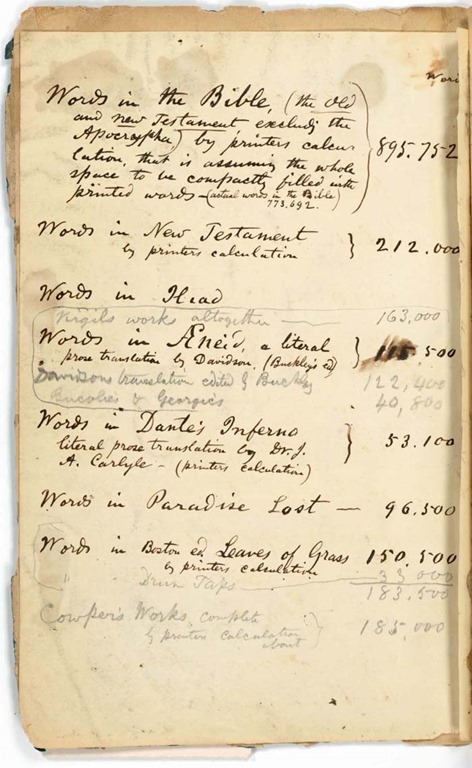
Whitman Leaves of Grass Table

Whitman wanted Leaves of Grass to be all-inclusive. That was one of his core ideas. And this piece, France, was only one small part of this great, lifelong work. In his own copy of the 1860 edition that introduced this piece, he wrote down a table of the word counts of that edition of Leaves of Grass compared to other epic poetic works, proudly noting that he had already exceeded the word counts of the Bible, the Aeneid, Dante’s Inferno, and Paradise Lost. His radical inclusiveness wanted to take in all manner of despised and un-praised things in his great work. Although writing 60 years after the end of the French Revolution, he is writing on the eve of America’s great blood bath, the Civil War. So, as he continued to work on Leaves of Grass, where he kept and expanded the piece called France, he was intimately acquainted with the results of gunfire and bombs. I often thought of that Whitman, the wound-dresser, when I myself was applying bandages or tending to the ill and injured. Whitman famously declared:

Do I contradict myself? Very well, then I contradict myself, I am large, I contain multitudes.

Christ and the Soldier

Tomorrow is called Veterans Day in the United States, but originally it was Armistice Day, celebrated on the day that World War I ended. WWI was a dark dividing line between all that came before and after. Books have been written about only one or two aspects of what changed, but a whole shelf of books could not tell all.

And this year is the hundredth anniversary of one year in that dark dividing line, 1916, when those that thought war was simple, or had to be simple, brought the 20th Century efficiency of the assembly line to killing in the battle of the Somme, where over one million men were killed or wounded.

One of the soldiers in that battle was a poet, Siegfried Sassoon. Last time we took a look at a funny and pious story from World War II, The Deck Of Cards, and had a little irreverent fun with the form of that story in my parody. In this piece, Sassoon’s Christ and the Soldier, the humor is very dark. I’ve heard that it was dark enough that Sassoon did not, or could not, publish it until the war was over.

As usual, I’m largely going to let he piece speak for itself. One thing I like about it is its use of dialog. For some reason, most poems eschew dialog entirely, and I think poetry misses out on a useful device by avoiding it. Musically it’s a mode that the LYL Band visits often, combining organ or piano with electric guitar. I play the guitar part on my Jaguar, a guitar that was once associated with “surf music” but has since had a revival in indie-rock circles. I play it often because its short scale and spring-softened action are friendly to my arthritic fingers.

To hear Christ and the Soldier, click on the gadget that should appear below, but some ways of viewing this blog won’t show it. In those cases, this highlighted hyperlink is another way to play the performance.

The Deck of Cards, or The Old Weird America Part 2

Returning to the other side of that post WWII Tex Ritter record I discussed yesterday, let’s look at The Deck of Cards. I think I probably first heard this as the Wink Martindale version from 1959 which was the third or fourth time a version of The Deck of Cards had charted on some hit parade somewhere, and as the Wikipedia link shows, it would return again and again, which should not surprise us, since the story dates back to the 18th century.

I rather liked the piece when I heard it as a child. First off it was spoken not sung, so it stood out from all the singers on the radio, and the piece’s narrative twist, that the threatened poor and irreverent man would show himself to be learned and pious, is the kind of twist that can keep a piece of folk material current for centuries. As I said in the last post, no one in the mid-20th century folk revival would have ever considered The Deck of Cards an authentic folk song—but like our supposed irreverent soldier—it is, and not what folks presumed it to be.

Did this record specifically influence the Parlando project to mix music and spoken/chanted words? Not at any conscious level. The popular spoken word record with music just was around in my childhood. Yet, as one starts to do concentrated work in some area you may begin to notice all kinds of things that must have taught you some possibilities.

The plot of The Deck of Cards follows the rhythm of a joke: tension, danger, expectation; then unexpected twist, release of tension, pleasure. So, it’s not surprising then that some of the renditions of this old tale passing through the folk process twist it again to parody, and so here’s mine. It’s based loosely on that rough Robyn Hitchcock version, even uses a couple of his lines, but is mostly mine. If you don’t know the 1948 Tex Ritter version, you can hear it first by clicking here. You should listen to Tex, you can’t have irreverence without reverence. Or you can hear T Texas Tyler’s version which predates Tex Ritter’s by a few months here.

Oddly enough, I performed a straight rendition of the 1948 text the same day that the LYL Band recorded this parody, but you won’t hear that here when you click on the gadget that should appear below.

Frank Eli Hudson and Rye Whiskey

It’s election day in the United States, a day of great hope and fear. Yesterday I was on the shore of a great lake and the sunrise was a perfect unbroken horizon of a bright line with pink above that, and then graduations to blue rising up over our heads as high as we wished to look. At our feet, the lake waves came from wherever they come from and broke on the stone ballots cast on the beach.

We are riding a great wave of change sweeping from wherever it comes from to wherever it goes. I feel our country has become both more perceptive and more blind,  in what is too close to equal amounts. I do not know what part of that proportion of blindness is mine or yours. Perhaps until we see, if we ever see, we will not know.
 
We’ve talked about myths here before, our big stories that explain ourselves. When Homer sang his myths he was said to be blind, and myths are often blind. When John Keats read Homer in Chapman’s translation, he wrote about it in a fine sonnet almost exactly 200 years ago, but oops! he put the wrong explorer on that Pacific-viewing peak. So clearly a mistake that a friend pointed it out to Keats immediately, but in the end, it harms the poem in only that simple and clear “wrong guy, Johnny!” way. People who know about these things might note that Chapman’s translation of Homer, published 400 years ago this year, is a bit loose as well. Homer’s music is always very hard to translate, but they say that Chapman added some additional material dear to his own philosophy.

Let’s just leave it at this for now: little or big deviations from the truth make up many, perhaps all, myths, those explanations of ourselves. We grow blind and perceptive at the same time.This piece, Frank Eli Hudson and Rye Whiskey, is as much true as my proportion of blindness and perception can make it now.

My appreciation of what was called “folk music” in the US in the mid 20th Century was founded on an appreciation for “authenticity.” “Authenticity” is a particularly hard to define myth. If I can distill it briefly, “Authenticity” believes that certain emotions and feelings are more perceptive, closer to the truth of things. So, to portray those emotions and to share them through art allows one’s audience to see and share the truth of things. The 20th Century American folk music circles search for authenticity is not much different from hard-core punk later in the century (the two musical movements have many parallels).

I saw the folk song Rye Whiskey though that shared myth of authenticity, just as the piece recounts. On the page, and as performed by many folk-revival singers, Rye Whiskey seems to call on harrowing emotions. However, for a time this year it occurred to me to see what I could find out about my great-grandfather for whom I was named, A decade-old report from an uncle that he liked the song Rye Whiskey was one thing I knew.
 
Around this time a co-worker thought my son, who likes math, would be interested in some sets of numbers relating to a deck of playing cards. I told the co-worker that some of that material was used in a hit song of my youth, The Deck of Cards. Turns out The Deck of Cards was a hit not once, but several times, and that Tex Ritter had been one of the earliest to have a successful cover recording of it.

On the other side of Tex’s A Deck of Cards was Rye Whiskey, a  that song that was part of Tex’s repertoire for a long time, going back at least into the 1930s. I can’t say for sure where Frank Eli Hudson heard Rye Whiskey, but Tex Ritter would be an odds-on favorite.

The Deck of Cards was not “authentic” folk music. Robyn Hitchcock once did a parody of it that is hilarious. And Tex’s version of Rye Whiskey?  Well, listen to the piece as played by the LYL Band to hear what I found about how my great-grandfather, authentically living in that “Old Wierd America” that Greil Marcus writes about, might have experienced this song. The gadget to play Frank Eli Hudson and Rye Whiskey should appear below.


After you’ve heard my tale, here are some versions of Tex Ritter singing this authentic American folk song.

If Not For Ed

Here is a little Halloween sidetrack. Last year, before the Parlando project, when people asked me what I was doing, I’d tell them I was writing a rock opera.

Daft looks on their faces, particularly if they’d heard me sing. It was pretty much a conversation stopper.

“It’s about Vampira.” I’d follow up with.

Blank looks now.

But it wasn’t my idea. The idea was Dave Moore’s. Well, not the rock opera part—that was mine—but the idea of a series of pieces on Vampira was Dave’s. As I read those pieces they had voices, various emotional states, and a loose tread of events. It just seemed they needed music and I got working on that along with Dave. In the end, we had around 10 complete songs worked up as demos. This is one of them.

Vampira was the creation of Maila Nurmi, who in that character originated the concept of the drolly comic host presenting old horror movies on television in 1954 in Los Angeles; but by the time of this song in the sequence, she has left show business and is recounting one of her last roles, an appearance in 1958’s “Plan 9 From Outer Space,” often judged the worst film of all time. Oddly enough, that conspicuous badness gave the film a robust second life. Plan 9’s auteur, Ed Wood, the Ed sung about in this song, even got his own biopic.

Nurmi’s successful earlier TV work was never archived (save for this small fragment). Since her attempts to find other outlets for her character came to naught, for many people she was only known from her short appearance in this bad movie.

So here is the story of a true original who, alas, is largely remembered for being part of the worst project in her career. To hear the song selection from the Vampira project, click on the gadget below.